
Table of Contents
- What Is a Dobsonian Telescope and Why Beginners Love It
- Aperture Choices: 6, 8, and 10 Inch Dobsonians Compared
- Optics 101: Focal Ratio, Collimation, and Mirror Quality
- Mount Design, Motions, and Ergonomics for Smooth Tracking
- Portability, Storage, and Setup Time in the Real World
- What You Can See: Planets, Deep-Sky Objects, and Double Stars
- Essential Accessories: Eyepieces, Finders, and Filters
- Urban, Suburban, and Dark-Sky Observing Strategies
- Budget, Brands, and Value: What to Expect at Each Price
- Future-Proofing: Upgrades, Mods, and Maintenance
- Alternatives to Consider: Tabletop, Truss, and GoTo Dobsonians
- Frequently Asked Questions
- Final Thoughts on Choosing the Right Dobsonian Telescope
What Is a Dobsonian Telescope and Why Beginners Love It
A Dobsonian telescope is a Newtonian reflector optical tube mounted on a simple, ground-standing alt-azimuth base made of wood or composite boards. The design was popularized by John Dobson in the 1960s–70s for sidewalk astronomy: maximum light-gathering at minimum cost, easy to use, and quick to set up. For beginners, a Dobsonian offers the most “aperture per dollar” of any visual telescope type. In practical terms, that means brighter nebulae, more star clusters resolved into pinpoints, and finer planetary detail compared to smaller, more complicated, or more expensive alternatives.

Artist: James Stewart 669
Unlike long, spindly tripods, the Dobsonian base sits low and stable on the ground. You nudge the tube by hand to follow the sky’s motion. There are no polar alignments to fuss with and no delicate gears to jam. Because the mirrors are large, the views are bright. Because the mount is simple, costs stay down. That combination is why many observers start—and stay—with Dobsonians for years.
This guide focuses on 6–10 inch (150–254 mm) solid-tube Dobsonians. That range hits the sweet spot for first-time buyers: large enough to make deep-sky objects pop, yet small enough to store, lift, and transport without special equipment. We will compare apertures in the aperture comparison, explain optics in Optics 101, and cover the practicalities of portability and setup, must-have accessories, and budget expectations.
Key idea: If your budget favors optics over electronics, a Dobsonian is your most efficient path to brighter, more detailed visual astronomy.
Aperture Choices: 6, 8, and 10 Inch Dobsonians Compared
An astronomical telescope’s primary job is to gather light. Light-gathering scales with the area of the primary mirror (aperture). Doubling the diameter collects four times the light. In the 6–10 inch range:
- 6 inch (150 mm) mirrors are often around f/8 (about 1200 mm focal length).
- 8 inch (200 mm) mirrors are commonly f/6 (about 1200 mm focal length).
- 10 inch (254 mm) mirrors are typically f/5 (around 1250 mm focal length).
These focal ratios are typical of solid-tube Dobsonians offered by many manufacturers. Exact numbers can vary by model, but these benchmarks are widely representative and help explain the trade-offs you will encounter.
Light-Gathering and Resolution
- Relative to a 6 inch, an 8 inch mirror collects about 1.8× more light and has proportionally greater theoretical resolution.
- Relative to a 6 inch, a 10 inch mirror collects about 2.8× more light and has even better theoretical resolution.
In practice, the jump from 6 to 8 inches is very noticeable on galaxies and globular clusters. The jump from 8 to 10 inches strengthens that effect further, especially under dark skies, where extra photons translate into more structure: spiral arms, dust lanes, and fainter halos become more apparent.
Ease of Use and Optics
- 6 inch (f/8): forgiving collimation, lower edge-of-field aberrations (coma), easier to use with simple eyepieces, long tube but light weight, gentle on focusers and mounts.
- 8 inch (f/6): a balanced sweet spot—serious light-gathering with manageable size; collimation matters more than at f/8 but remains approachable for beginners.
- 10 inch (f/5): big leap in deep-sky performance; faster optics show more coma at the field edge with simple eyepieces; collimation precision becomes more important.
Physical Size and Weight
Approximate real-world numbers for common solid-tube models (can vary by manufacturer):
- 6 inch: Tube length ~120 cm (47 in); total assembled weight roughly 14–20 kg (30–45 lb). Easy for one person to move in two pieces.
- 8 inch: Tube length ~115–120 cm (45–47 in); total assembled weight roughly 18–25 kg (40–55 lb). Still a comfortable, two-piece carry for most adults.
- 10 inch: Tube length ~120–127 cm (47–50 in); total assembled weight roughly 25–32 kg (55–70 lb). Manageable, but bulkier; stairs and small cars require planning.
Consider how far you must carry the scope, whether you have stairs, and how you’ll fit it in your vehicle. A 10 inch might be perfect for a garage-to-driveway roll-out but too big for a fourth-floor walk-up. Revisit Portability, Storage, and Setup Time to match aperture to your living situation.
Cost Expectations
- 6 inch: Typically the most affordable; often bundled with starter eyepieces and a red-dot or optical finder. A popular first upgrade is a better low-power eyepiece.
- 8 inch: A bit more expensive, but many observers find the performance jump worth it. Often considered the “best first serious telescope.”
- 10 inch: Costs more and may nudge you toward better eyepieces or a coma corrector to make the most of fast optics. Big payoff under dark skies.
Balance your budget not only for the scope, but also for the essentials in Essential Accessories. A great telescope with terrible eyepieces underperforms; a good telescope with a sensible eyepiece set can shine.
Optics 101: Focal Ratio, Collimation, and Mirror Quality
Understanding a few key optical concepts will help you choose and use a Dobsonian effectively. Newtonian reflectors use a parabolic primary mirror and a flat secondary mirror to deliver the image to the side of the tube. Everything you see at the eyepiece depends on mirror figure quality, alignment (collimation), and the eyepiece design.
Focal Length and Focal Ratio

Artist: Tmoore
The focal length of the telescope is the distance over which light is brought to focus. The focal ratio (f/number) is focal length divided by aperture. In our range:
- 6 inch f/8 ≈ 1200 mm focal length
- 8 inch f/6 ≈ 1200 mm focal length
- 10 inch f/5 ≈ 1250 mm focal length
Lower f/numbers are called “faster” optics and offer wider true fields of view for a given eyepiece, but demand more from eyepiece designs to control off-axis aberrations such as coma and astigmatism. Higher f/numbers are “slower,” offering narrower fields but being more forgiving of simple eyepieces and collimation errors.
Magnification, Exit Pupil, and True Field
Three simple formulas govern visual performance:
  Magnification = Telescope focal length / Eyepiece focal length
  Exit pupil (mm) = Eyepiece focal length / Telescope f-ratio
  Approx. true field (degrees) = Eyepiece apparent FOV / Magnification
In practice:
- Low power (large exit pupil ~4–6 mm) is best for framing big nebulae and galaxies.
- Medium power (exit pupil ~2–3 mm) is a deep-sky workhorse for open clusters and galaxy detail.
- High power (exit pupil ~0.5–1.5 mm) brings out lunar and planetary detail and splits tight double stars when the atmosphere allows.
Collimation: Keeping Mirrors Aligned
Collimation is the alignment of the primary and secondary mirrors. It ensures the optical axis lines up with the focuser and eyepiece, delivering sharp images. Beginners sometimes fear collimation, but modern tools and tutorials make it straightforward. At f/8, tolerances are generous; at f/5, you need to be more precise. Either way, a basic collimation cap or Cheshire tool works; a laser collimator can speed things up once you understand the geometry.
As a rule of thumb, check collimation after transport, or whenever views seem soft compared to expectation. You’ll usually adjust the primary mirror with three spring-loaded knobs and occasionally tweak the secondary mirror’s tilt. Frequent small adjustments are normal and take only a couple of minutes once learned. See practical tips in Future-Proofing: Upgrades, Mods, and Maintenance.
Mirror Quality and Cooling
Most mass-market Dobsonians use aluminized borosilicate mirrors. Quality has improved markedly over the years; typical mirrors today deliver good on-axis performance when well collimated and cooled. Thermal equilibrium matters: a large mirror brought from a warm house into a cool night will create heat plumes that soften detail. A small, quiet rear cooling fan accelerates cooldown and stabilizes the image. Expect ~20–60 minutes to reach equilibrium depending on temperature difference and mirror thickness.
Coma at Fast Focal Ratios
Coma is an off-axis aberration inherent to parabolic mirrors; stars near the field edge look like little comets at low f/numbers. It is mild at f/6 and above, and more noticeable at f/5 and below, especially with wide-field, long focal length eyepieces. Solutions include accepting some edge softness, choosing better-corrected eyepieces, stopping down the aperture slightly for critical viewing, or adding a coma corrector. Planetary observing at medium–high magnification typically uses only the central field, so coma is not an obstacle there.
Mount Design, Motions, and Ergonomics for Smooth Tracking
A Dobsonian mount is a low-friction alt-az design optimized for smooth motions in altitude (up-down) and azimuth (left-right). Getting the motions right makes the difference between frustration and flow.
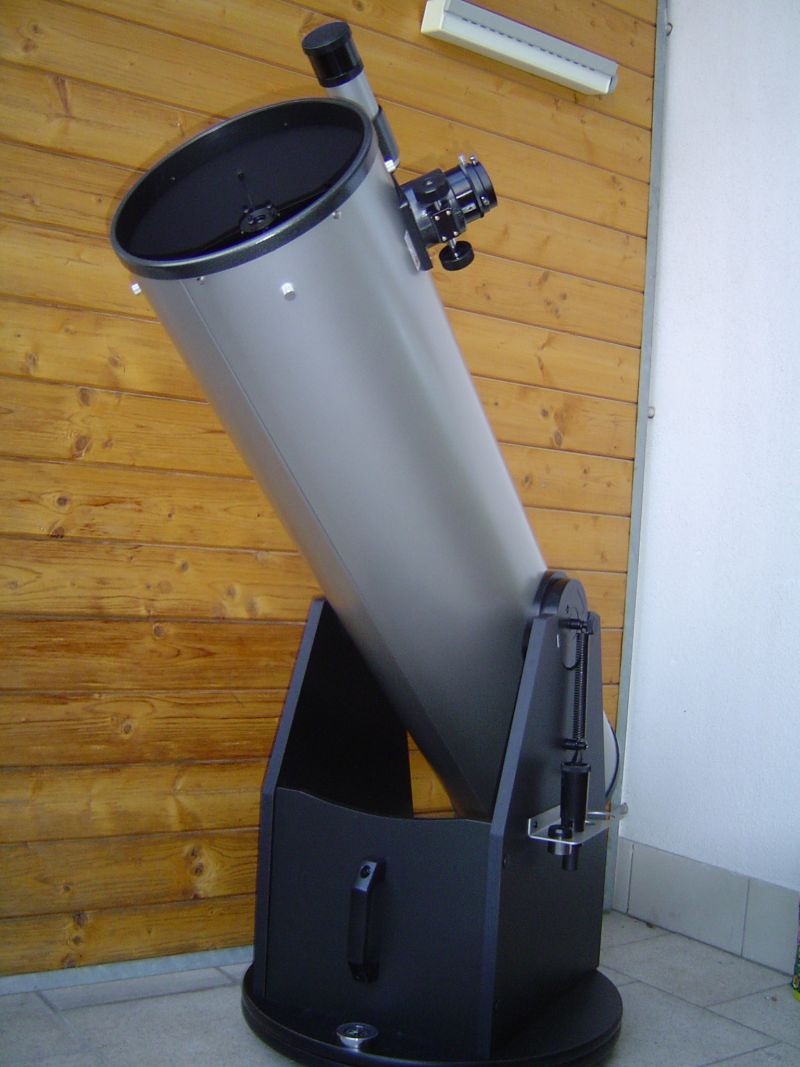
Credit: first uploaded on the English-speaking Wikipedia under the same filename
Bearings and Friction Surfaces
- Altitude bearings: Large semi-circular or round bearings spread weight and maintain smooth movement over a wide balance range. Smaller bearings can be sensitive to eyepiece weight changes.
- Azimuth bearing: A ground board and rotating base ride on Teflon, nylon, or roller assemblies. A well-tuned azimuth motion allows easy nudging without overshoot.
Look for adjustable tension or spring systems that help keep balance with heavy eyepieces or a finder scope. Some models include brake knobs or clutches; these can be helpful if you frequently switch between light and heavy accessories.
Finder Placement and Focuser
Ergonomics matter. A right-angle correct-image (RACI) finder reduces neck strain and makes star-hopping intuitive. A dual-speed Crayford focuser enables fine focusing at high magnification. If a model includes only a single-speed focuser or a straight-through finder, plan to upgrade later (see Essential Accessories and Future-Proofing).
Tracking Celestial Objects
Because Earth rotates, objects drift in the eyepiece. With a Dobsonian you manually “nudge” the tube to keep targets centered. At low power, you can enjoy long, hands-off views. At high power on planets or double stars, you’ll nudge every few seconds. Smooth bearings and good balance make this habit easy to acquire within a single observing session.
If you prefer automated tracking, some Dobsonian models add “push-to” encoders with digital setting circles or full GoTo and tracking via motors. These add cost and weight, but they can be game-changers in light-polluted skies where star-hopping is harder. We compare these in Alternatives to Consider.
Portability, Storage, and Setup Time in the Real World
The best telescope is the one you will use often. Consider where you’ll store the telescope, how you’ll carry it outside, and whether your observing site has stairs, narrow doors, or uneven ground.
Storage and Carrying
- Two-piece transport: Most solid-tube Dobsonians separate into the optical tube assembly (OTA) and base. Carry one in each hand or use a hand truck or shoulder sling.
- Vehicle fit: Most 6–10 inch OTAs fit across the back seat of a sedan and easily into hatchbacks. The base is bulkier; measure your trunk opening and back seat width.
- Weight and grip: Look for side handles on the base and a grab handle or strap on the tube. Some users add aftermarket straps for secure lifting.
Setup and Cooldown
- Setup time: From car to first target can be under 10 minutes with practice: set base, drop tube into bearings, attach finder, check collimation, and start observing.
- Cooldown: Attach a rear fan if included; if not, consider adding one to speed thermal equilibrium. Start with low-power targets while the mirror cools.
Observing Comfort
Observing while seated steadies your body and improves what you can see. A simple adjustable chair (like a drummer’s throne or observing chair) pays dividends. For 6–10 inch solid-tube Dobsonians, most eyepiece heights are comfortable from a normal chair for altitudes up to ~60°. Near zenith you may need to stand; conversely, on low targets an adjustable chair prevents neck craning.
What You Can See: Planets, Deep-Sky Objects, and Double Stars
All three apertures can deliver inspiring views. The difference is how bright and detailed those views will be, and how well they hold up under light pollution versus dark skies.
Planets and the Moon
- 6 inch: Sharp lunar detail, craters and rilles pop in good seeing; Jupiter’s cloud belts, Great Red Spot in steady conditions, Io’s and Europa’s transits; Saturn’s rings, Cassini Division, and several moons; Mars shows polar caps and dark features at favorable oppositions.
- 8 inch: Finer planetary structure: festoons in Jupiter’s equatorial belts, subtle Saturn ring shading and planet bands, improved Mars albedo features. More stable high-power performance in average seeing than a 10 inch that’s not fully cooled.
- 10 inch: When fully cooled and collimated in steady air, it can reveal exquisite low-contrast detail: Jupiter’s small white ovals, Saturn’s Encke minima region (a very challenging feature), and smaller craters on the Moon. The larger aperture pushes useful magnification higher when seeing allows.
Deep-Sky Objects (DSOs)
- Nebulae: Orion (M42) shows more structure with each aperture step; planetary nebulae like the Ring (M57) and Dumbbell (M27) grow brighter and support higher magnification to reveal shape and internal texture. Narrowband filters (see Filters) greatly help under light pollution.
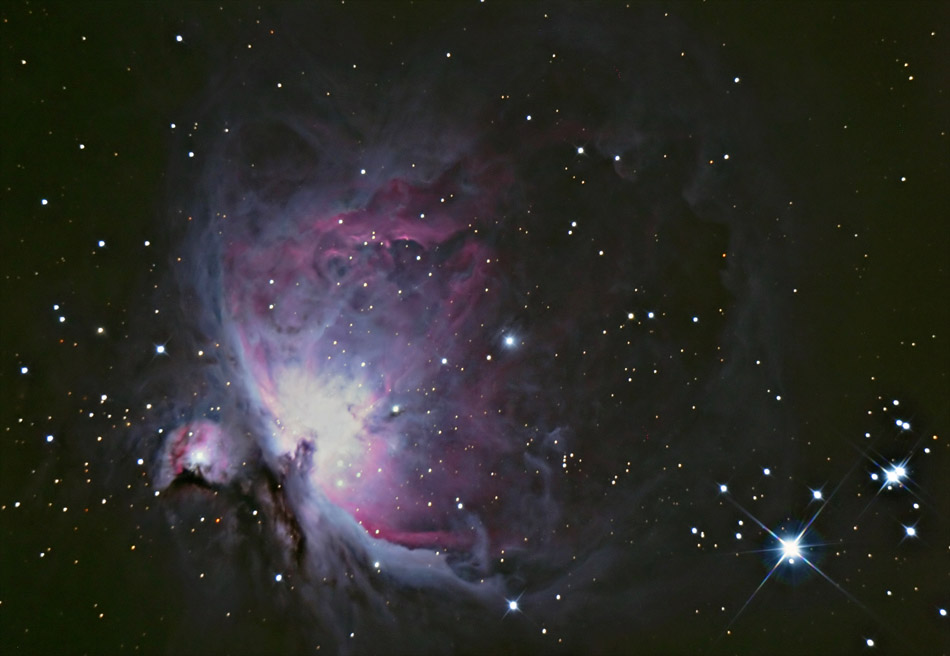
Photo of the Orion Nebula (also known as Messier 42, or NGC 1976). Photo taken in Gaisberg, Salzburg (Austria).
Artist: Rochus Hess - Galaxies: In dark skies, an 8 inch begins to pull in spiral hints in M51 and M33; a 10 inch makes arms more persistent and enhances dust lanes in M31. Under city skies, galaxies are toughest; aperture helps, but filters do little for galaxies, so dark sites matter most.
- Star Clusters: Open clusters glitter in a 6 inch; an 8 inch and 10 inch add depth and faint members. Globular clusters like M13 begin to resolve into individual stars in a 6 inch, more fully in an 8 inch, and strikingly in a 10 inch under good skies.
Double Stars
Dobsonians excel at double-star observing. Larger apertures split closer pairs in theory, but seeing dominates. Even a 6 inch can cleanly separate iconic pairs like Albireo and Epsilon Lyrae under steady conditions. A 10 inch enables tighter splits when the atmosphere cooperates.
Tip: Pick targets that suit your sky. In bright urban conditions, focus on double stars, the Moon, bright clusters, and emission nebulae with a UHC or OIII filter. Save galaxies for darker nights or trips to a dark-sky site.
Essential Accessories: Eyepieces, Finders, and Filters
Most Dobsonians ship ready to observe, but a few thoughtfully chosen accessories can transform your experience. Prioritize optical quality, ergonomics, and tools that remove friction from your observing flow.
Eyepieces: Building a Useful Set
Start with three focal lengths that cover low, medium, and high power. Examples for 1200–1250 mm focal length telescopes:
- Low power (24–32 mm, wide field): Maximizes true field and exit pupil for sweeping the Milky Way and framing large DSOs. In an f/5–f/6 scope, a 24–28 mm wide-field eyepiece is a good balance; longer focal lengths may exceed your eye’s pupil or highlight edge aberrations.
- Medium power (12–14 mm): Deep-sky workhorse for nebula structure, globular clusters, and galaxy detail.
- High power (5–7 mm): Planets, lunar features, and tight doubles. On nights of average seeing, 150–200× is often optimal; exceptional nights support more.
If you wear glasses for astigmatism, prefer eyepieces with long eye relief (typically 17–20 mm) and consider a Dioptrx-style astigmatism corrector. Zoom eyepieces can be convenient for dialing in the best magnification for seeing conditions.
Finders: Red-Dot, RACI, or Both
- Red-dot finder (RDF): Projects a red dot on the sky; great for rough pointing and alignment.
- RACI finder (Right-Angle Correct-Image): A small optical finder with an upright, non-mirrored view matching star charts; minimizes neck strain and enables precise star-hops.
Many observers combine an RDF for initial pointing with a RACI for fine placement. Alignment is critical: center a bright star in the eyepiece, then adjust both finders to the same point so they agree with the main scope.
Filters: When and Why
- UHC and OIII: Narrowband and line filters selectively pass emission lines from nebulae, improving contrast under light pollution. They do not help galaxies or star clusters but make nebulae stand out.
- Moon filter: Optional; you can achieve similar brightness control by increasing magnification. Neutral density filters can be comfortable for outreach.
- Light pollution filters (broadband LPR): Their benefits are subtle on modern LED-lit skies but can still slightly improve contrast on certain targets. Manage expectations.
Other Useful Tools
- Collimation tools: A collimation cap is often included; a Cheshire/sight tube combo or a well-aligned laser streamlines the process.
- Observing chair: Stability equals better visual acuity—an underrated upgrade.
- Dew control: Dew shields or small heaters for finders and eyepieces in humid climates.
- Star charts and apps: Printed atlases or reputable mobile apps help you plan and navigate. Red-light mode preserves night vision.
Urban, Suburban, and Dark-Sky Observing Strategies
Where you observe shapes what you see as much as aperture does. Match your strategy to your sky quality, and you’ll consistently have satisfying sessions.
Urban Observing
- Emphasize bright targets: Moon, planets, double stars, open clusters, and emission nebulae with a UHC/OIII filter.
- Use building shadows to block direct lights and set up on thermally stable surfaces (grass is better than concrete).
- Wait for objects to rise high above the horizon to cut through less atmosphere and reduce haze.
Suburban Observing
- Galaxies begin to reward patient observation, especially near the zenith on moonless nights. Aperture helps here; an 8 or 10 inch shows more detail.
- Globular clusters crackle with resolved stars at medium–high power.
- Use shielding: portable screens or strategic positioning behind trees and fences to block stray lights.
Dark-Sky Trips
- Plan a target list ahead of time; wide-field eyepieces will shine on sprawling nebulae and galaxy groups.
- Let optics cool thoroughly; the darker the sky, the more your eye and scope reveal, so give them time.
- Practice averted vision and gentle nudging—moving the scope slightly can make faint structures pop due to the eye’s sensitivity to motion.
Budget, Brands, and Value: What to Expect at Each Price
Dobsonians offer strong value by simplifying the mount. Prices vary with aperture, build quality, included accessories, and optional features like dual-speed focusers, finder types, and push-to or GoTo electronics.
Typical Price Ranges (Solid-Tube, Non-GoTo)
- 6 inch: Often in the most affordable tier. Many packages include two basic eyepieces and a red-dot finder.
- 8 inch: Mid-tier pricing. Commonly ships with a better focuser, 2-inch eyepiece capability, and sometimes a RACI finder.
- 10 inch: Upper mid-tier. Expect upgraded bearings or tensioners, 2-inch focusers, and more robust bases.
Exact numbers fluctuate with supply chains and regional markets, but the relative differences remain stable: every step up in aperture adds cost and demands a slightly larger accessory budget to reach the telescope’s potential.
Well-Known Manufacturers
Several reputable brands offer 6–10 inch Dobsonians globally. Models frequently seen include those from Sky-Watcher, Orion, GSO-made brands (such as Apertura and Zhumell in some markets), and others. Many share core optical components but differ in included accessories, focusers, and base designs. Read current owner reports before purchase, and focus less on brand loyalty than on the specific package features you value.
Where Value Hides
- Focuser quality: A dual-speed 2-inch Crayford is a long-term asset. Smooth focus at high magnification lifts planetary performance.
- Finder quality: A RACI finder adds real-world usability that exceeds its price difference over a basic red-dot alone.
- Mirror cell and cooling fan: Robust support and active cooling accelerate sharp views.
- Base design: Sturdy, well-finished bearings and adjustable tension save you later DIY tweaks.
Future-Proofing: Upgrades, Mods, and Maintenance
One virtue of Dobsonians is how easy they are to personalize. You can start simple and refine over time, spreading costs and tailoring the scope to your preferences.
Smart Upgrades
- Dual-speed focuser: If your scope ships with single-speed, upgrading yields finer snap focus for lunar/planetary work.
- Better eyepieces: A well-corrected wide-field eyepiece transforms low-power sweeping. A high-quality mid-power eyepiece often becomes your most-used glass.
- Coma corrector (for f/5): Tidies edge stars at low power; not essential, but many 10 inch owners appreciate it for rich-field views.
- Finder swap: Add or replace with a RACI; combine with a zero-power sight for excellent navigation.
- Cooling fan: A small, quiet fan behind the primary mirror speeds thermal equilibrium and steadies the image.
DIY Tweaks
- Flocking: Lining the tube opposite the focuser with matte black material reduces stray light, improving contrast in bright environments.
- Altitude balance: Magnetic counterweights or spring tension kits help with heavy eyepieces.
- Azimuth feel: Some users adjust pad placement or materials on the base to fine-tune motion. Small changes can yield big improvements in tracking comfort.
Maintenance Basics
- Collimation checks: Quick verification before sessions, adjustment as needed. See Optics 101 for tolerances.
- Mirror cleaning: Only when necessary—dust alone rarely hurts views. Use gentle methods like a distilled water rinse after blowing off grit; avoid frequent handling.
- Storage: Cap both ends, store in a dry place, and avoid extreme temperatures. Ventilate after dewy nights.
Alternatives to Consider: Tabletop, Truss, and GoTo Dobsonians
While a standard solid-tube Dobsonian is the default recommendation, alternatives may suit specific needs.
Tabletop Dobsonians

Artist: Morn
Small reflectors on mini-Dobson bases are ultra-portable and budget-friendly. They’re ideal for travel or as a family scope. Limitations include shorter focal lengths (faster optics, more coma), simpler focusers, and the need for a sturdy table or platform. Light grasp is less than full-size 6–10 inch models; however, they are fun, convenient, and excellent for casual sessions and outreach.
Truss or Collapsible Dobsonians
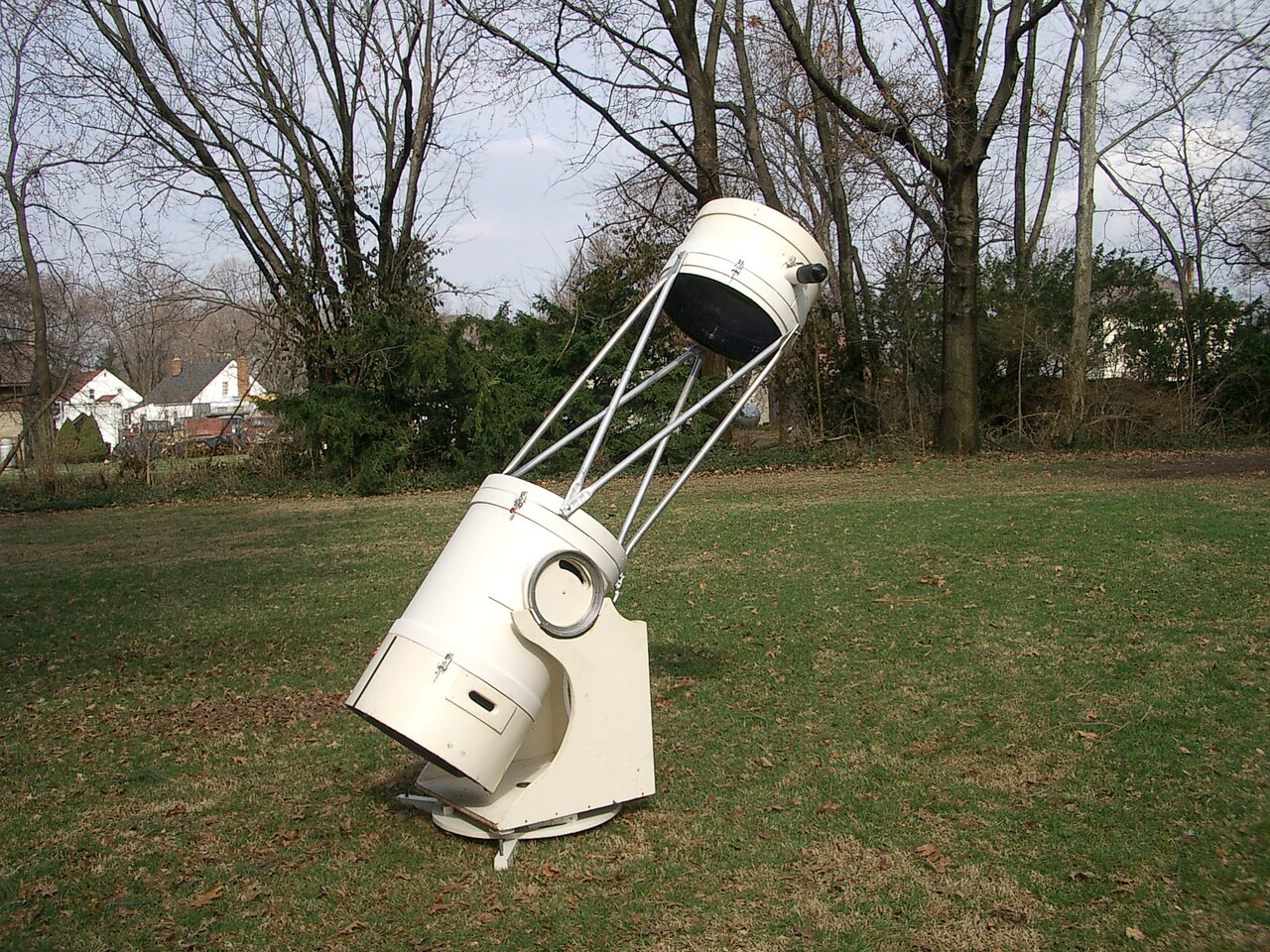
Artist: JamesStewart669
Larger apertures often adopt truss or collapsible designs to improve portability. In the 10 inch class, collapsible tubes exist that shrink storage length at the cost of a bit more setup and potential need for a shroud. Truss structures demand more assembly and careful collimation but reward with bigger mirrors in smaller cars.
Push-To and GoTo Dobsonians
- Push-To (digital setting circles): Encoders and a handheld controller or app guide you by showing arrows toward targets you push the scope to. You retain manual control and simplicity, but locating faint targets becomes much faster.
- GoTo with tracking: Motors slew to targets and keep them centered, invaluable for group viewing and high-power planetary work. Added cost and weight are the trade-offs, along with power requirements.
If your skies are bright and time is precious, Push-To can be the best compromise, preserving Dobsonian feel with efficient navigation.
Frequently Asked Questions
Can a beginner collimate a Newtonian? How hard is it, really?
Yes. Collimation is a learnable skill that becomes second nature. Begin with a simple collimation cap or Cheshire tool in daylight. Center the secondary under the focuser, align the secondary’s tilt so the primary mirror appears centered, then adjust the primary’s three knobs to center the reflected marker in the sight. At f/8, tolerances are forgiving; at f/5, precision matters more, but the process is the same. A few practice runs and a good tutorial will get you there. If views seem soft at high power, recheck collimation and verify that your mirror has cooled.
Do I need GoTo or tracking for a Dobsonian to enjoy the night sky?
No. A manual Dobsonian and a simple star chart can show you thousands of objects. That said, Push-To or GoTo systems can be very helpful under light pollution and for outreach or high-power planetary views. If you value simplicity and low cost, start manual. If you need help finding faint targets quickly, consider Push-To. For hands-free viewing and group sessions, GoTo with tracking is convenient. You can also add digital encoders later to some manual mounts.
Final Thoughts on Choosing the Right Dobsonian Telescope
Choosing between 6, 8, and 10 inch Dobsonians comes down to a few practical questions: how much you want to lift, how much you want to spend, where you plan to observe, and how much you value incremental performance gains. A 6 inch offers light weight, high optical forgiveness, and budget-friendly entry. An 8 inch lands at the classic sweet spot with a visible step up on deep-sky objects while remaining manageable. A 10 inch, properly cooled and collimated, is a powerhouse that shines brightest under dark skies and rewards careful eyepiece selection.
Focus first on core usability: smooth mount motions, comfortable ergonomics, a decent 2-inch focuser, and a finder system that makes navigation easy. Build a simple but effective eyepiece set covering low, medium, and high power, and add a UHC or OIII filter for nebulae. Practice collimation and cooldown routines; these two habits will do more for your views than any single accessory. As your experience grows, consider targeted upgrades—better eyepieces, a dual-speed focuser, or a coma corrector on faster scopes—to deepen the quality of your sessions.
Above all, observe often. The sky rewards patience, and your eyes develop with practice. Keep notes, revisit favorite targets through the seasons, and seek darker skies when you can. If you found this guide helpful, explore our related articles, and subscribe to our newsletter for upcoming deep dives into eyepiece selection, star-hopping techniques, and seasonal observing lists tailored to Dobsonian owners.