
Table of Contents
- What Is a Dobsonian Telescope and Why Choose One?
- Aperture, Focal Length, and Focal Ratio: The Core of Performance
- Alt-Az Dobsonian Mount: Advantages, Limitations, and Workarounds
- Optical Quality, Mirrors, and Collimation Essentials
- Size, Weight, and Portability: From 6-inch to 16-inch
- Finding and Tracking Objects: Manual, Push-To, and GoTo
- Eyepieces, Barlows, Filters, and Essential Accessories
- Observing Targets and Real-World Performance
- Light Pollution, Observing Sites, and Visual Strategies
- Budgets, New vs Used, and What to Expect
- Astrophotography with a Dobsonian: What’s Realistic?
- Care, Maintenance, and Smart Upgrades
- Step-by-Step Buying Checklist for Your First Dobsonian
- Frequently Asked Questions
- Final Thoughts on Choosing the Right Dobsonian
What Is a Dobsonian Telescope and Why Choose One?
A Dobsonian telescope is a Newtonian reflector optical tube mounted on a simple alt-azimuth (up-down, left-right) base. Popularized by John Dobson in the 1960s and 1970s, the design prioritizes large aperture at low cost, stable and intuitive manual operation, and quick setup. The hallmark of a Dobsonian is its value: you get more light-gathering power per dollar than almost any other visual telescope format.

Dobsonian Telescope by James Stewart. Depicts a truss tube design.
For beginners and seasoned observers alike, Dobsonians are compelling because:
- They deliver outstanding deep-sky views thanks to large mirrors at affordable prices.
- Setup is fast—no polar alignment or complex electronics required for basic models.
- The viewing position is generally comfortable, especially with mid-sized apertures.
- Maintenance is straightforward: mirrors can be collimated and cleaned as needed.
Dobsonians come in many sizes and formats—from compact 6-inch tabletop units to 18-inch truss-tube light buckets. Before you choose, it helps to understand the core optical parameters. We’ll start with the fundamentals in aperture, focal length, and focal ratio, then discuss the mount, optics, and practical considerations like portability and accessories.
Aperture, Focal Length, and Focal Ratio: The Core of Performance
Three specifications define a Dobsonian’s visual performance more than any other: aperture, focal length, and focal ratio (f/number). Understanding how they interact will help you set realistic expectations and choose wisely.
Aperture: The Light Bucket
Aperture is the diameter of the primary mirror, typically expressed in inches or millimeters (e.g., 8-inch, 200 mm). Bigger apertures collect more light and resolve finer detail, improving views of faint galaxies and nebulae and adding subtle structure to planetary features. As a rule of thumb:
- 6-inch (150 mm): Great for beginners, portable, solid on the Moon, planets, and brighter deep-sky objects.
- 8-inch (200 mm): A sweet spot—still portable, excellent planetary detail, and noticeably better deep-sky performance.
- 10-inch (250 mm): Significant deep-sky boost; heavier but manageable by many observers.
- 12-inch (300 mm) and up: Deep-sky punch; larger footprint, often truss-tube designs for transport.
For light-polluted urban observers, more aperture still helps, but you’ll also want strategies from the section on light pollution and observing sites to get the most from your scope.
Focal Length and Magnification
Focal length (e.g., 1200 mm) mixed with eyepiece focal length determines magnification. The basic formula is:
magnification = telescope_focal_length / eyepiece_focal_length
For example, with a 1200 mm Dobsonian and a 10 mm eyepiece, magnification is 120x. Practical magnification ranges depend on optics and atmospheric seeing. An 8-inch Dob typically delivers crisp views from ~40x to ~200x on most nights, occasionally higher under steady skies.
Focal Ratio: Speed, Coma, and Eyepiece Behavior
Focal ratio is focal length divided by aperture (e.g., 1200 mm / 200 mm = f/6). Shorter focal ratios (f/4.5–f/5, often called ‘fast’) provide wider fields and shorter tubes but present more coma (edge aberration) and demand better eyepieces. Longer focal ratios (f/6–f/8) are more forgiving of eyepieces and collimation, typically offering sharper edges but narrower maximum field for the same eyepiece.
- f/5–f/6: Common sweet spot for modern 8–12 inch Dobsonians—wide fields, manageable coma.
- f/7–f/8: Often found on smaller apertures; easier collimation tolerance and simpler eyepiece needs.
- f/4–f/4.5: Ultra-fast, wide-field truss Dobs—require precise collimation and may benefit from coma correction.
Exit pupil, a key visual comfort metric, connects eyepiece focal length with focal ratio:
exit_pupil = eyepiece_focal_length / telescope_f_ratio
For an f/6 scope with a 30 mm eyepiece, exit pupil is 5 mm—a bright view great for deep-sky sweeping. Planetary work often favors exit pupils around 0.5–1 mm, achieved with shorter eyepiece focal lengths or a Barlow lens (see eyepieces and accessories).
Alt-Az Dobsonian Mount: Advantages, Limitations, and Workarounds
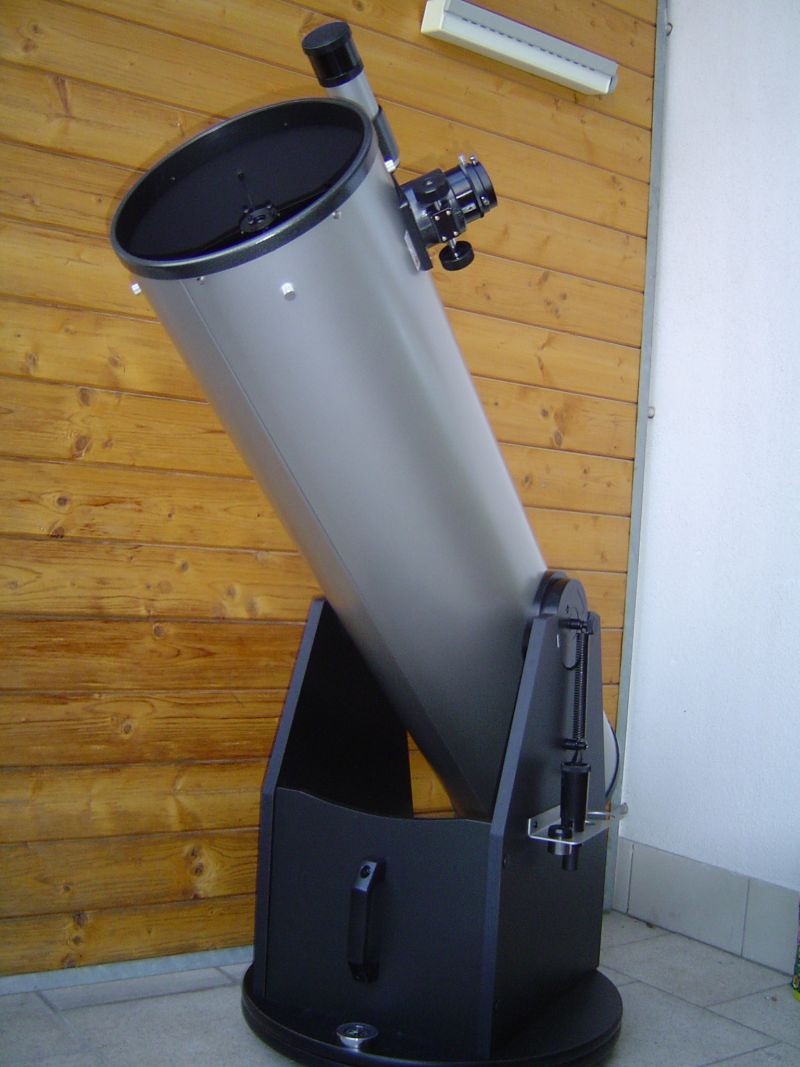
10″ Newton telescope on dobson mount.
The Dobsonian’s alt-az base is the essence of simplicity: you push the scope up/down and left/right on Teflon or roller bearings. Quality of the bearings and balance define how smoothly you can track objects at high power.
Advantages
- Simplicity: No polar alignment, minimal setup time, and intuitive motions.
- Stability: Low center of gravity and wide footprint reduce vibration.
- Cost-efficiency: Savings go into the optics rather than mount complexity.
Limitations
- Manual tracking: At high magnification you nudge the scope frequently to keep objects centered.
- Field rotation: Without an equatorial platform, long-exposure astrophotography is not practical due to rotating fields.
- Zenith hole: Some designs become less smooth when pointing near straight up; modern bearings help mitigate this.
Workarounds
- Altitude/azimuth tensioning: Adjustable bearings or clutches can fine-tune motion.
- Equatorial platforms: Add tracking for visual and short-exposure imaging; see astrophotography with a Dobsonian.
- Push-to encoders: Digital setting circles provide guided navigation; discussed in finding and tracking.
Optical Quality, Mirrors, and Collimation Essentials
Dobsonians are Newtonian reflectors with a parabolic primary mirror and a small flat secondary mirror. Quality varies, but modern mass-market mirrors are generally quite good. The difference between a ‘good’ and ‘great’ mirror often emerges at high magnification on planets or tight double stars—assuming excellent collimation and thermal equilibrium.

Simple Diagram of a Newtonian Telescope created by TMoore using MSPaint.
Primary Mirrors: Parabolic, Substrate, and Cooling
- Figure: Parabolic mirrors correct spherical aberration at fast focal ratios. Most 6–12 inch Dobs use parabolas.
- Substrate: Common materials include standard plate glass and borosilicate (e.g., Pyrex-like). Lower expansion helps temperature stability, but design and thickness matter too.
- Cooling: A small rear fan helps bring the mirror to ambient temperature, reducing tube currents and improving image stability.
Secondary Mirrors and Obstruction
The secondary mirror introduces a central obstruction, slightly reducing contrast. In typical Dobsonians, this is a modest trade-off for the large aperture’s benefits. Secondary size is a design balance: it should fully illuminate the field without becoming unnecessarily large.
Collimation: The Make-or-Break Skill
Collimation is the alignment of the primary and secondary mirrors. It’s crucial—especially for fast scopes (f/5 and below). With practice, collimation takes just a few minutes. Tools include sight tubes, Cheshire eyepieces, and lasers. High-quality lasers and simple tools both work if used correctly.
- Center the secondary under the focuser (usually a one-time adjustment).
- Align the secondary tilt so the focuser aims at the primary’s center mark.
- Adjust the primary tilt to return the beam (or Cheshire reflection) precisely to center.

A handcrafted Cheshire collimation tool. The Cheshire eyepiece is combined here with a sight tube featuring crosshairs. Such a tool is used by amateur astronomers to align the optics of their telescopes.
Check collimation at the start of each session, and after temperature changes or transport. For more on how focal ratio affects collimation tolerance, revisit focal ratio considerations.
Size, Weight, and Portability: From 6-inch to 16-inch
Choosing aperture is partly an exercise in honesty about your observing habits. A scope that’s too heavy or bulky won’t be used often. Here’s what to expect.
6–8 Inch Solid-Tube
- Footprint: Fits in most sedans. One-person carry in two pieces (tube and base).
- Use case: Beginners and urban observers. Quick to cool, easy to store.
- Performance: Excellent planetary and lunar views; brighter nebulae and many galaxies under dark skies.
10–12 Inch Solid-Tube or Truss
- Footprint: Base becomes wider; the tube is longer and heavier. Many 12-inch scopes adopt truss designs.
- Use case: Enthusiasts chasing deep-sky detail while still retaining a manageable setup.
- Performance: Noticeably deeper reach and more detail in nebulae, globular clusters, and galaxies.
14–16 Inch Truss
- Footprint: Breaks down for transport; takes longer to assemble and collimate.
- Use case: Dedicated observers with access to dark sites and storage space.
- Performance: Reveals structure in many galaxies and resolves globular clusters brilliantly under good skies.
Before buying, imagine the full flow: storage, carrying to vehicle, transport, setup, cooldown, and teardown. If any step sounds daunting, consider a size down. Remember that accessories, a chair, and an observing table add to the load. For visual targets by size class, see observing performance.
Finding and Tracking Objects: Manual, Push-To, and GoTo
Navigating the sky with a Dobsonian can be delightfully tactile. You can star-hop manually or add technology to guide you.
Manual Star-Hopping
- Finders: A red-dot finder (RDF) gets you on bright stars; a 6× or 8×50 finderscope shows star fields for hopping.
- Charts and apps: Use a planisphere, printed charts, or mobile apps with night mode.
- Technique: Hop from a bright anchor star to progressively fainter waypoints until you arrive at the target.
Push-To (Digital Setting Circles)
Push-to systems use encoders and a handheld or app-based computer to guide you: the display shows arrows to push the scope to the target. You still move the scope by hand, but alignment and navigation are speedier—ideal if your time is limited or you observe under light pollution. For information on how the mount’s mechanics affect push-to smoothness, revisit mount advantages and limitations.
GoTo Dobsonians
GoTo adds motorized slewing and tracking. Benefits include convenient tracking at high magnification and easy access to faint objects. Trade-offs are higher cost, extra weight, reliance on power, and slightly longer setup due to alignment. If you plan to experiment with short-exposure imaging, GoTo plus an equatorial platform can be helpful.
Eyepieces, Barlows, Filters, and Essential Accessories
A great Dobsonian becomes superb with the right eyepieces and accessories. You don’t need to buy everything at once, but a strategic kit enhances versatility and comfort.
Eyepiece Basics
Three eyepieces often cover most needs:

Meade LightBridge Mini 114, a 4.5″ f/4 (focal length 450 mm) Dobsonian reflector telescope, shown with Bob’s Knobs adjustment screws for the secondary mirror and the included 26 mm 1.25″ eyepiece. Two eyepieces, 26 mm and 9 mm, are included with the telescope which result in about 17x and 50x magnification, respectively.
- Low power, wide field: 25–32 mm for f/6–f/8 scopes; 24–30 mm for f/4.5–f/5. Target exit pupil ~4–6 mm for bright views of extended objects.
- Medium power: 12–15 mm for general deep-sky and lunar detail.
- High power: 5–8 mm for planetary and double stars, when seeing allows.
Apparent field of view (AFOV) options range from ~50° to 100°+. In a Dobsonian, wide AFOV eyepieces make manual tracking more relaxed, keeping objects in the view longer.
Barlow Lenses
A 2× Barlow doubles the magnification of each eyepiece, effectively expanding your set. It also preserves eye relief in shorter focal lengths. Many observers pair a 2× Barlow with a medium eyepiece to cover high-power needs.
Filters for Visual Observing
- Moon filter or variable polarizer: Reduces glare for comfortable lunar viewing.
- UHC (Ultra High Contrast) or narrowband: Boosts emission nebula contrast under light pollution or even dark skies.
- O-III filter: Excellent for planetary nebulae and certain supernova remnants.
Finders and Alignment Tools
- Red-dot finder: Quick acquisition of bright stars for alignment.
- Right-angle correct-image (RACI) finder: Comfortable, correct orientation for star-hopping.
- Cheshire or laser collimator: For the collimation steps described in optics and collimation.
Comfort and Practicalities
- Observing chair: Keeps your eyes steady at the eyepiece, improving detail detection.
- Dew control: For finders and secondary mirrors in humid climates.
- Cooling fan and battery pack: Speeds mirror temperature equilibrium.
Field of View Calculations
Two common ways to estimate true field of view (TFOV):
- Approximate:
TFOV ≈ AFOV / magnification - More precise (if field stop is known):
TFOV ≈ (field_stop / telescope_focal_length) × (180/π)
Knowing TFOV helps plan star-hops in manual or push-to observing and ensures your low-power eyepiece frames large objects well.
Observing Targets and Real-World Performance
What will you see in a Dobsonian? Results depend on aperture, sky conditions, and experience. Here’s a realistic guide.
Moon and Planets
- Moon: Razor-sharp craters and rilles; dazzling at all apertures. Use a neutral-density or variable polarizing filter for comfort.
- Jupiter: Equatorial belts, polar hoods, festoons, and the Great Red Spot in mid-sized apertures on steady nights.
- Saturn: Cassini Division, ring shadow, and subtle banding; Titan and several moons visible.
- Mars: Polar caps and dark albedo features near opposition; seeing conditions are critical.
Deep-Sky Objects (DSOs)
- Open clusters: Rich star fields; the Double Cluster and M35–M38 region are stunning in 8–10 inch scopes at low power.
- Globular clusters: Larger apertures begin to resolve edges and cores into grainy stars—M13 and M5 shine in 10–12 inch Dobs.
- Nebulae: With a UHC or O-III filter, the Orion Nebula (M42), the Veil Nebula, and Lagoon (M8) show structural detail.
- Galaxies: Under dark skies, spiral structure and dust lanes become visible in brighter targets like M51 and M31. Aperture and darkness dominate here.
Double Stars and Asterisms
Dobsonians excel at splitting doubles thanks to aperture and resolution. Even a 6-inch can make quick work of many famous pairs, with color contrasts adding aesthetic appeal.
If your primary interest is wide-field sweeping of Milky Way star clouds, match your eyepiece strategy to your scope’s focal ratio to achieve generous exit pupils and large TFOV.
Light Pollution, Observing Sites, and Visual Strategies
Sky quality makes or breaks deep-sky observing. Large aperture helps, but a dark sky transforms the experience.
Choosing an Observing Site
- Local parks and clubs: Astronomy clubs often host star parties at decent sites.
- Travel to darker zones: Even a short drive can cut skyglow dramatically.
- Safety and access: Choose sites with safe parking and minimal direct lighting.
Techniques Under Light Pollution
- Averted vision: Look slightly off the object to activate more sensitive rod cells.
- Shield stray light: Use a hood or shield around the focuser; keep the observing area dark.
- Filters: Narrowband filters help with emission nebulae; they don’t brighten galaxies but can increase contrast in certain targets.
For urban observers, pairing a portable 8-inch Dob with strategic trips to a darker site offers an excellent balance—see portability trade-offs in size and weight.
Budgets, New vs Used, and What to Expect
Dobsonians range widely in price. A new 6-inch tabletop model can be quite affordable, while premium truss-tube systems with high-end mirrors cost much more. Here’s how to think about budgeting.
Where the Money Goes
- Aperture: Larger mirrors cost more, and the base must scale accordingly.
- Mechanics: Smooth bearings, solid altitude trunnions, and sturdy rocker boxes improve the experience.
- Optics: Mirror quality and coatings matter, especially for high magnification work.
- Electronics: Push-to encoders and GoTo systems add capability and cost.
New vs Used
- Used advantages: Excellent value; many Dobsonians are durable and age well if cared for.
- Used caveats: Check mirror coatings for haze or pinholes; inspect bearings; verify that collimation hardware works smoothly.
- New advantages: Warranty, support, and latest design tweaks.
Accessories in the Budget
Reserve funds for eyepieces, a Barlow, a finder solution that works for you, and a comfortable observing chair. A good chair can make as much difference as an extra inch of aperture because steady, relaxed viewing reveals more detail.
Astrophotography with a Dobsonian: What’s Realistic?
Dobsonians are designed for visual observing. Field rotation and manual tracking limit traditional long-exposure deep-sky imaging. That said, you can still do several rewarding forms of astrophotography with a Dob.
Planetary and Lunar Imaging
- High-frame-rate video: Use a planetary camera to record thousands of frames; stack the best for sharp results.
- Barlow lens: Increase image scale; ensure precise collimation and thermal equilibrium.
- Manual or GoTo tracking: Manual is possible but GoTo or an equatorial platform makes it easier.
Short-Exposure Deep-Sky Experiments
- Live stacking: Some software can stack short exposures to mitigate rotation; still limited by alt-az tracking.
- Equatorial platform: Adds equatorial motion to the base, reducing field rotation over short periods.
If deep-sky astrophotography is your primary goal, consider a different setup. But if your priority is visual observing with occasional Moon/planet imaging, a Dobsonian is a strong choice. For guidance on tracking solutions, revisit finding and tracking and mount workarounds.
Care, Maintenance, and Smart Upgrades
Dobsonians are mechanically simple and easy to maintain. A few habits and upgrades can extend performance and durability.
Routine Care
- Collimation checks: Verify alignment each session; see collimation essentials.
- Dust management: Keep caps on; occasional gentle cleaning is fine, but avoid frequent cleanings that risk micro-scratches.
- Mirror cooldown: Run the rear fan for 15–45 minutes depending on temperature difference and mirror thickness.
- Storage: Dry, dust-free space; avoid rapid temperature swings.
Easy Upgrades
- Altitude bearings: Larger or adjustable bearings improve balance with heavy eyepieces.
- Focuser: A dual-speed Crayford focuser makes high-power focusing easier.
- Coma corrector: At f/5 and faster, a coma corrector can sharpen field edges with wide-field eyepieces.
- Shroud (truss scopes): Blocks stray light and dew.
When to Recoat or Replace Mirrors
Mirror coatings gradually degrade. If you see significant haze, pinholes, or performance decline even after cleaning, recoating may be warranted. Premium recoats can extend life for many years. For most owners, this occurs on the scale of a decade or more depending on environment and use.
Step-by-Step Buying Checklist for Your First Dobsonian
Use this checklist to evaluate options and avoid surprises.
- Define your observing goals: Planets, Moon, double stars, bright DSOs, or faint galaxies?
- Assess your site and transport: How dark is your observing location? What vehicle do you have? Where will you store the scope?
- Pick aperture you’ll use often: 8-inch is a common sweet spot; go larger only if you’re comfortable with size and weight (portability guide).
- Choose focal ratio: f/5–f/6 balances wide fields and manageable coma for most users (focal ratio).
- Decide on navigation: Manual, push-to, or GoTo (finding and tracking).
- Inspect mechanics: Smooth altitude/azimuth motion, stable base, and quality focuser.
- Optical considerations: Primary cooling fan, secondary size, and collimation hardware quality (optics and collimation).
- Budget for eyepieces and filters: A balanced kit magnifies your scope’s capability (accessories).
- Plan for comfort: Observing chair, dew mitigation, and a red flashlight.
- Consider future upgrades: Coma corrector for fast scopes, RACI finder, or a dual-speed focuser (upgrades).
Frequently Asked Questions
How big should my first Dobsonian be?
For many observers, an 8-inch f/6 strikes the best balance of performance, portability, and price. It’s small enough to transport and store, yet powerful enough to show fine planetary detail and a wealth of deep-sky objects. If storage or carrying are concerns, a 6-inch is lighter and still very capable. If you have dark skies and room for transport, a 10-inch provides a noticeable deep-sky upgrade. For portability trade-offs, see size and weight.
Do I need GoTo on a Dobsonian?
No. Many observers prefer the simplicity and engagement of manual star-hopping. Push-to systems are a great middle ground, offering guided navigation without motors. GoTo adds tracking and convenience at higher cost and complexity. Your choice depends on how you like to observe and whether you value tracking for high magnification or planetary imaging. Learn more in finding and tracking.
Final Thoughts on Choosing the Right Dobsonian
A Dobsonian telescope offers a rare combination of affordability, aperture, and ease of use. Focus on the fundamentals: choose an aperture you’ll set up often, a focal ratio that matches your eyepieces and expectations, and a mount configuration that feels smooth and intuitive. Build a small but effective accessory kit—wide-field, medium, and high-power eyepieces; a Barlow; and a nebula filter—and practice collimation until it’s second nature.
Whether you select a minimalist manual 8-inch or a larger push-to or GoTo model, the Dobsonian design rewards time at the eyepiece. Under a dark sky, even modest apertures reveal breathtaking detail in nebulae, clusters, and galaxies. Under city lights, the Moon and planets remain spectacular targets with frequent opportunities for crisp, high-contrast views.
If you found this guide helpful, explore our related articles on visual observing techniques and equipment optimization, and consider subscribing to our newsletter to receive future deep-dives, equipment guides, and observing plans directly in your inbox.
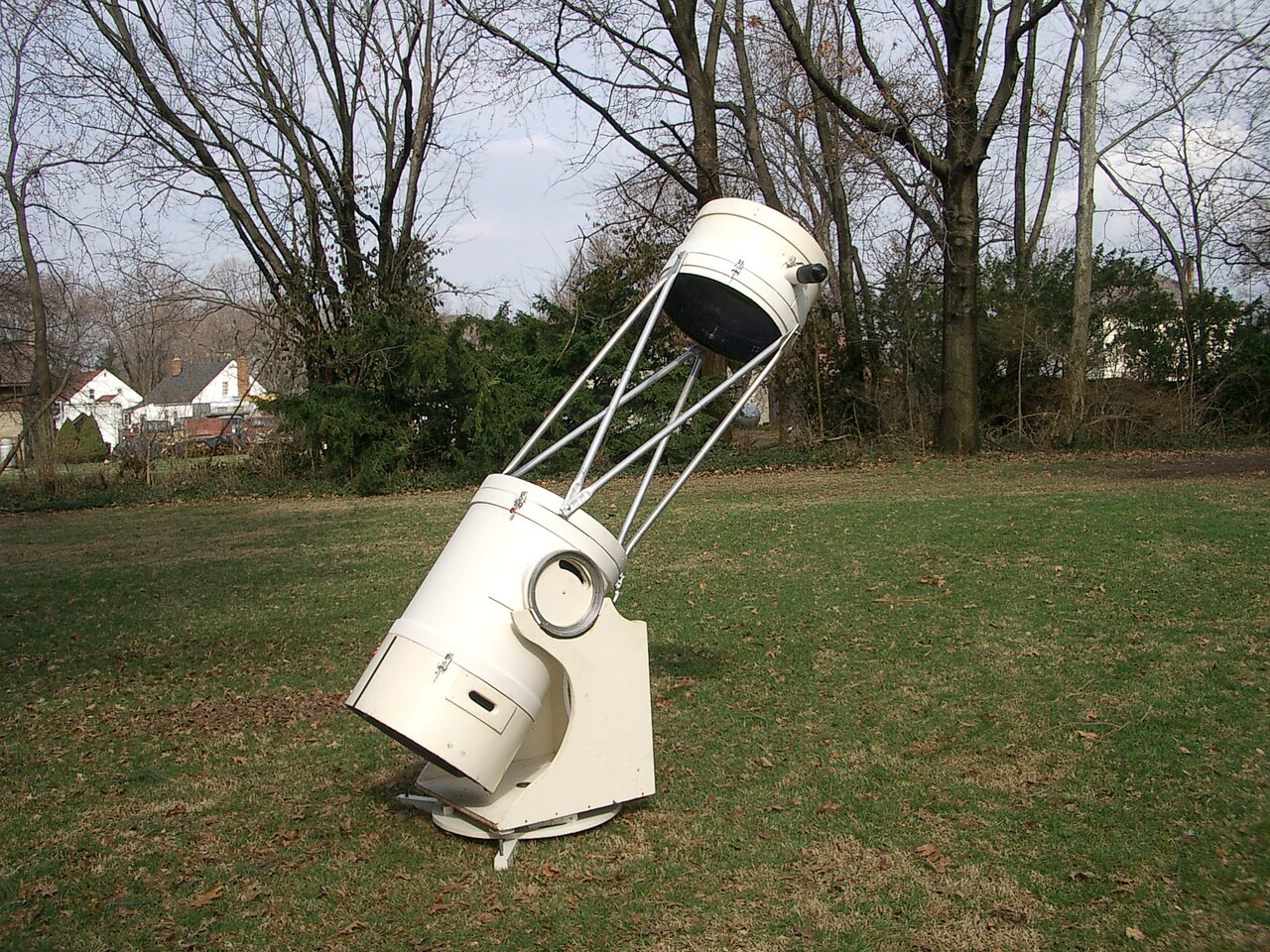
dobsonian telescope built using a truss tube design