
Table of Contents
- What Is a Dobsonian Telescope and Why It’s Popular?
- Aperture, Focal Length, and f/ratio: How They Shape Your Views
- Dobsonian Mount Mechanics: Stability, Motion, and Upgrades
- Optics and Thermal Management: Mirrors, Coatings, and Cooldown
- Collimation Made Practical: Step-by-Step Alignment That Works
- What You Can See: Planets, the Moon, and Deep-Sky with a Dobsonian
- Portability, Storage, and Light Pollution: Making the Most of Your Scope
- Accessories and Upgrades: Finders, Eyepieces, Filters, and More
- Buying Guide: Sizes, Features, New vs. Used, and Common Pitfalls
- Frequently Asked Questions
- Final Thoughts on Choosing the Right Dobsonian Telescope
What Is a Dobsonian Telescope and Why It’s Popular?
A Dobsonian telescope is a Newtonian reflector optical tube mounted on a simple altazimuth base. It was popularized for backyard astronomy because it offers large aperture per dollar, intuitive point-and-view operation, and minimal setup time. Instead of a complex equatorial mount, a Dobsonian uses a low-friction, ground-hugging base that pivots up/down (altitude) and left/right (azimuth). The result is a rugged, user-friendly instrument that excels at visual observing.
For beginners, the combination of light-gathering power and simplicity is transformative. An 8-inch Dobsonian is often recommended as the best beginner’s telescope for visual deep-sky observing because it balances portability, cost, and performance. Seasoned observers also love large-aperture Dobs—12, 14, even 20 inches—because bigger mirrors reveal more galaxies, nebulae, and globular clusters under dark skies.

Artist: JamesStewart669
Key characteristics of Dobsonian telescopes include:
- Newtonian optics with a parabolic primary mirror and flat secondary mirror.
- Altazimuth base built from plywood or particle board, using Teflon or similar bearing surfaces for smooth movement.
- Manual “push-to” tracking (though modern variants may add digital setting circles or full GoTo tracking drives).
- Fast f/ratios (often f/5–f/6 for 6–10 inch models) that provide wide fields of view and bright images.
Dobsonians are optimized for visual observing. While technically you can do some lunar and planetary imaging with a smartphone or simple camera, the traditional Dobsonian mount is not ideal for long-exposure deep-sky astrophotography because it does not track the sky in equatorial coordinates. If you primarily want to photograph faint nebulae and galaxies, consider a German equatorial mount or a dedicated astrophotography setup. But if your goal is to see more with your eyes, few instruments beat the Dobsonian for value and sheer capability.
If terms like aperture and f/ratio or collimation sound unfamiliar, don’t worry; this guide explains them step by step.
Aperture, Focal Length, and f/ratio: How They Shape Your Views
Three specs dominate telescope performance: aperture, focal length, and f/ratio. Understanding how they interact will help you choose the right Dobsonian for your sky conditions and observing interests.
Aperture: The Light Bucket
Aperture is the diameter of the primary mirror, measured in inches or millimeters. More aperture collects more light, revealing fainter objects and finer details. All else equal, a 10-inch mirror gathers more light than an 8-inch, which gathers more than a 6-inch. This translates into brighter views of galaxies and nebulae and improved resolution of planetary features under steady seeing.
- 6-inch (150 mm): Lightweight, easy to carry, shows many Messier objects.
- 8-inch (200 mm): Widely recommended sweet spot for beginners—excellent value and performance.
- 10-inch (250 mm): Noticeably brighter and more detailed than 8-inch, but bulkier.
- 12-inch (300 mm) and up: Deep-sky powerhouses; demands more space, lifting ability, and often a vehicle for transport.
One caveat: aperture is limited by your seeing conditions, cooldown, and collimation. A larger mirror out of thermal equilibrium or poorly aligned will not outperform a smaller, well-tuned scope. That’s why sections on thermal management and collimation are essential reading.
Focal Length and Magnification
Focal length determines the image scale and how different eyepieces behave. Magnification is calculated as:
magnification = telescope focal length / eyepiece focal length
So, if your telescope has a 1200 mm focal length, a 25 mm eyepiece yields 48x, while a 10 mm eyepiece yields 120x. Shorter eyepieces and Barlow lenses boost magnification, but see the caution below on seeing limits.
- Low power (e.g., 30–60x): Wide fields, easy target acquisition, best for large nebulae and open clusters.
- Medium power (e.g., 80–150x): Balances brightness and detail; great for globular clusters, small galaxies, and lunar views.
- High power (e.g., 180–300x+): Planetary detail, close double stars—limited by seeing and collimation.
f/ratio: Speed, Field of View, and Eyepiece Demands
The f/ratio is focal length divided by aperture (e.g., 1200 mm / 200 mm = f/6). “Faster” telescopes have lower f/ratios (f/4–f/5) and deliver wider fields and brighter images at a given eyepiece focal length, but they are more demanding on eyepieces and collimation. “Slower” scopes (f/6–f/8) are generally more forgiving.

Artist: Morn
- f/5–f/6 (common in 8–10 inch Dobs): Versatile; good wide-field capability and manageable collimation tolerance.
- f/4–f/4.5 (common in large, truss Dobs): Very wide fields; may benefit from a coma corrector and high-quality eyepieces.
- f/6–f/8 (more typical in smaller reflectors): Easier on budget eyepieces; narrower maximum field for a given focuser size.
At fast f/ratios, coma—an off-axis aberration—produces star shapes that elongate toward the field edge. Many observers mitigate this with a coma corrector, especially below f/5. If you prioritize simplicity and budget eyepieces, an f/6 8-inch Dobsonian is a remarkably comfortable starting point.
Bottom line: choose aperture for light-gathering, f/ratio for handling and field of view, and remember that collimation and thermal control ultimately determine how sharp your views can be.
Dobsonian Mount Mechanics: Stability, Motion, and Upgrades
The Dobsonian base is the unsung hero of the design. It must be stable enough to support the optical tube yet smooth enough to allow precise nudging at high magnification. A good base should start and stop without stick-slip and maintain balance as you swap eyepieces and accessories.
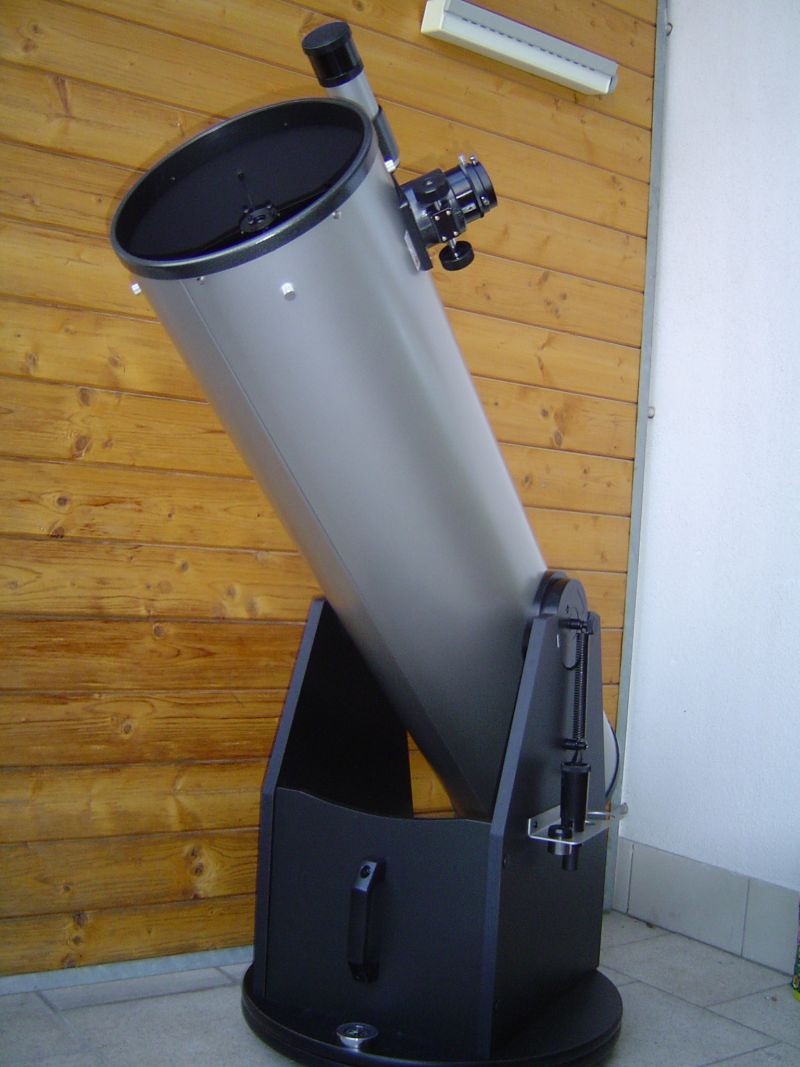
Credit: first uploaded on the English-speaking Wikipedia under the same filename
Altitude and Azimuth Bearings
Dobsonians ride on two bearing systems:
- Azimuth: The base rotates on a center pivot and bearing pads. High-density plastic (often PTFE/Teflon-like) riding on a laminate surface is a classic, smooth, durable solution.
- Altitude: Large side bearings on the tube cradle allow up-down motion. Larger diameter bearings spread friction and help keep motion smooth and controllable.
If your scope exhibits stickiness, kits exist to upgrade bearing materials or add low-friction surfaces. Paying attention to bearing cleanliness and even a modest application of a recommended dry lubricant (if the manufacturer allows it) can improve motion.
Balancing and Tension
Balance is crucial. Heavy eyepieces, finder scopes, and coma correctors add weight high on the tube, potentially causing nose-diving in altitude. Solutions include:
- Adjustable altitude tension knobs or clutches that increase resistance.
- Magnetic counterweights on the mirror end.
- Larger altitude bearings that widen the balancing sweet spot.
Proper balance makes high-power tracking smoother and reduces the need for constant fiddling.
Push-to, Digital Setting Circles, and GoTo
Traditional Dobsonians are manual: you point and nudge as the Earth rotates. However, many modern models offer:
- Digital Setting Circles (DSC): Encoders and a hand controller or app provide real-time push-to guidance to targets. You still move the scope manually, but the system shows where to go.
- GoTo Dobsonians: Motors slews to and tracks targets once aligned. These add complexity and weight but enhance convenience, particularly at high magnification or during public outreach.
Manual, push-to, or GoTo? If you love star-hopping or value simplicity, manual is great. If your skies are light-polluted and targets are faint, DSC push-to is a pragmatic compromise. For planetary observing or shared sessions where tracking is helpful, GoTo may be worth the extra cost and setup steps.
Note that GoTo systems can increase power usage, so plan for an external battery if observing away from outlets. For purely visual observers who prioritize stability, a well-tuned manual base remains hard to beat.
Optics and Thermal Management: Mirrors, Coatings, and Cooldown

Artist: Fernly at English Wikibooks
The optical heart of a Dobsonian is a parabolic primary mirror. Secondary mirrors steer light to the side-mounted focuser. Quality mirrors are figured to a high standard and coated for reflectivity and protection.
Mirror Types and Coatings
Most Dobsonians use glass primary mirrors with aluminum coatings that reflect visible light well. A thin protective overcoat helps guard against oxidation and minor abrasion. Some premium options offer enhanced coatings for slightly higher reflectivity. For visual work, standard modern coatings perform very well; enhanced coatings are a nice-to-have rather than a must-have.
Secondary mirrors are similarly coated and mounted on a spider vane assembly. The thickness of these vanes influences diffraction spikes on bright stars. Many commercial Dobs use metal vanes that balance rigidity and minimal obstruction.
Cooldown and Thermal Equilibrium
Mirrors and the air in the tube need to reach thermal equilibrium with the night air to deliver sharp images. Thermal plumes rising from a warm mirror can soften planetary detail and bloat stellar images. Practical tips:
- Set the telescope outside early—allow time for cooldown before high-power viewing.
- Use the built-in primary mirror fan (if available) to speed equilibrium.
- Consider a light shroud for truss-tube designs to stabilize air and block stray light.
In climates with significant temperature drops overnight, a gentle rear fan that runs continuously on low can maintain stable images. Collimation may shift as the scope cools, so a quick check before critical observing is smart.
Tube Currents, Dew, and Stray Light
Solid-tube Dobsonians are less prone to crosswinds but can trap warm air. Truss designs breathe better but require a shroud to suppress stray light. In humid environments, secondary mirrors and eyepieces may dew up; a small dew heater or dew shield helps.
Finally, baffles and flocking material inside the tube can reduce internal reflections, improving contrast—especially under light-polluted skies.
Collimation Made Practical: Step-by-Step Alignment That Works
Collimation aligns the primary and secondary mirrors. It’s critical for sharp, high-contrast views—especially at fast f/ratios like f/5. Fortunately, collimation tools and a little practice make it straightforward.
Tools You Can Use
- Collimation cap: A simple peep-hole cap; basic but effective for rough alignment.
- Cheshire/sight tube: Combines alignment views with a reflective face for centering the primary’s reflection.
- Laser collimator: Projects a beam to the primary; a barlowed laser accessory can improve primary alignment accuracy.
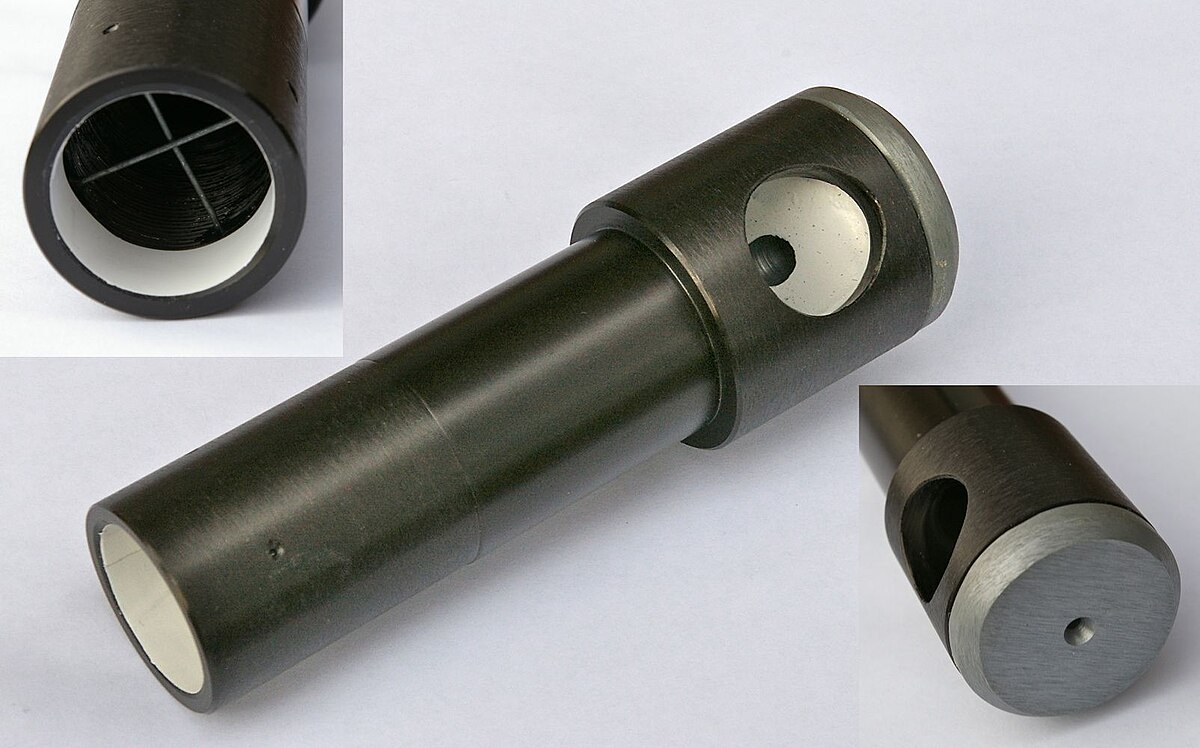
Artist: M. Tewes
Fast, Repeatable Procedure
Here’s a practical, repeatable approach. Always start with the scope roughly horizontal for safety and convenience.
- Center the secondary under the focuser using a sight tube if available. Ensure the secondary appears round and centered when looking down the focuser. This step is about positioning, not tilt.
- Adjust the secondary tilt so the focuser sight line intersects the primary center mark. With a laser, return the beam to the center mark. With a Cheshire, align the crosshairs or reference.
- Adjust the primary mirror tilt using the collimation screws until the primary center mark is centered in the Cheshire’s reflection (or the barlowed laser target).
- Star test at high power on a bright star: defocus slightly inside and outside focus. Concentric diffraction rings indicate good alignment. Touch up the primary if necessary.
Keep notes on which screws control which direction of motion. After a few sessions, this process becomes quick—often under five minutes for a well-behaved scope.
Collimation Checklist
Print or save the following checklist to streamline your setup:
Dobsonian Collimation Checklist
- Allow scope to reach thermal equilibrium first
- Verify secondary is centered under focuser (position, then tilt)
- Use Cheshire or laser to aim focuser axis at primary center mark
- Adjust primary mirror tilt to center the donut in the Cheshire/barlowed laser
- Perform a quick star test at high power and fine-tune if required
- Recheck after transporting or large temperature changes
If you feel uncertain at first, revisit the basics in What Is a Dobsonian and practice on a distant daytime target to build familiarity. For optical performance, nothing rivals the payoff from consistent, careful collimation.
What You Can See: Planets, the Moon, and Deep-Sky with a Dobsonian
Dobsonians shine at visual astronomy. Their large mirrors gather ample light, making fainter deep-sky objects more accessible, while also providing detailed planetary views when seeing cooperates. Here’s what to expect across common targets, plus techniques that help you see more.
The Moon
The Moon is the perfect target for beginners—bright, detailed, and ever-changing. Use low to medium power to frame entire lunar maria and high power to explore crater rims and rilles when the terminator casts long shadows. A neutral density or variable polarizing filter can reduce glare, making extended viewing more comfortable.
Planets
Jupiter, Saturn, Mars, and Venus are regular showpieces. An 8–10 inch Dob under steady air can reveal:
- Jupiter: Cloud bands, festoons, and the Great Red Spot; transits and shadows of the Galilean moons.
- Saturn: Rings, the Cassini Division in good seeing, and several moons.
- Mars: Polar cap and dark albedo features near opposition; seeing-limited and sensitive to collimation.
- Venus: Phases; details are subtle because of its bright cloud cover.
Planetary viewing rewards patience. Wait for moments of steady air; keep magnification moderate and inch upward. For best results, ensure thermal equilibrium and spot-on collimation.
Deep-Sky Objects: Nebulae, Galaxies, Clusters
Deep-sky targets come alive through aperture. Under dark skies, an 8–10 inch Dobsonian shows:
- Nebulae: Emission nebulae like the Orion Nebula, planetary nebulae, and supernova remnants; filters can enhance contrast.
- Galaxies: From bright favorites to dimmer smudges; structure appears with experience and averted vision.
- Star clusters: Open clusters burst with pinpoint stars; globular clusters begin to resolve into granulated cores at moderate power.
Even in suburban light pollution, many open clusters and brighter planetary nebulae remain rewarding, especially with a narrowband filter and careful dark adaptation. A larger Dobsonian simply shows more—more members of galaxy groups, more planetary nebulae, and more subtle details.
Seeing More with Technique
- Averted vision: Look slightly off the object to engage more sensitive parts of your retina.
- “Stack” moments of clarity: Your brain integrates fleeting detail during steady seeing.
- Use appropriate magnification: Too little power washes out contrast; too much dims the view. Adjust for object type and conditions.
- Shield stray light: Use a hood or shield to block neighbor lights; a shroud on truss scopes helps.
For more on optimizing visibility under less-than-ideal skies, jump to Portability, Storage, and Light Pollution.
Portability, Storage, and Light Pollution: Making the Most of Your Scope
Owning a telescope is about using it. Consider how you’ll store, transport, and deploy your Dobsonian—and how you’ll work around skyglow if you’re near a city.
Portability and Size Trade-offs
Traditional solid-tube Dobsonians are simple and robust, but the tube length equals the focal length: a 1200 mm (f/6 8-inch) tube is roughly four feet long. Larger solid tubes can be unwieldy for cars and stairways. Truss-tube designs break down into components, easing transport at the cost of setup time and the need for a shroud.
- 6–8 inch solid-tube: One-person friendly, fits in most cars.
- 10 inch solid-tube: Heavier and bulkier; manageable with planning.
- 12 inch+: Consider truss designs for portability; mirror box and rocker box may still be heavy.
Weigh the convenience of quick setup against your appetite for more aperture. The best telescope is the one you’ll use often. If lifting is a concern, a hand truck or dolly can make yard moves easy, and wheeled platforms are common for roll-out storage in a garage.
Storage and Maintenance
Store your scope in a dry, temperature-stable area. Cap the tube to prevent dust and insects from entering. Mirrors generally need infrequent cleaning; dust largely reduces reflectivity only slightly. When cleaning is necessary, use gentle, well-documented methods and avoid touching the mirror coatings.
Light Pollution Strategies
Urban and suburban observers can still enjoy a Dobsonian by choosing targets wisely and using contrast-enhancing techniques:
- Target types: Open clusters and brighter planetary nebulae fare better than faint galaxies under heavy skyglow.
- Filters: Narrowband and OIII filters can improve nebular contrast; see Accessories for details.
- Shielding: Use a dew/light shield and observer’s hood to block direct light.
- Timing: Observe after local lights diminish and when targets are highest (culmination) for less atmospheric extinction.
- Dark-site trips: Even occasional travel to darker skies will dramatically expand what your scope can reveal.
Tip: A well-collimated, thermally equilibrated 8-inch Dobsonian at a dark site routinely outperforms a larger, poorly tuned scope in the city. Master the fundamentals, then seek darker skies whenever possible.
Accessories and Upgrades: Finders, Eyepieces, Filters, and More
Accessories refine the observing experience. Start with essentials and add selectively as your interests become clear.
Finders: Red-Dot, Reflex, and Optical
- Red-dot/reflex finders: Project a dot or reticle to align with your target; intuitive for initial pointing.
- Optical finder scopes: 6×30 or 8×50 finder scopes show real star fields for star-hopping; choose an erect-image or right-angle variant for comfort.
- Combination: Many observers mount both a reflex finder for alignment and an optical finder for pattern matching.
Eyepieces: Building a Versatile Set
A small, well-chosen eyepiece kit beats a large, mismatched collection. Consider:
- Low-power wide-field (e.g., 24–32 mm for 1.25" focusers or 30–42 mm for 2" focusers): Sweeping star fields and framing large objects.
- Medium power (e.g., 10–15 mm): Workhorse for clusters, galaxies, and general observing.
- High power (e.g., 5–8 mm): Planets, double stars, and lunar detail; seeing-dependent.
- Barlow lens: Doubles or triples magnification while preserving eye relief; great value.
At fast f/ratios, choose eyepieces known to handle steep light cones well, or accept that edge aberrations (coma and astigmatism) can appear. A coma corrector can substantially clean up edges in f/5 and faster scopes.
Filters: Enhancing Contrast
- UHC/narrowband: Boosts contrast on emission nebulae by passing key wavelengths while rejecting background skyglow.
- OIII: Emphasizes oxygen-III emission; excellent for planetary nebulae and some supernova remnants.
- Neutral density or polarizing: Comfort on the Moon; subtle balancing for bright planets.
Filters don’t make galaxies pop in bright skies, but they can be transformative for nebulae. Start with a good narrowband (UHC-type) filter, then add OIII if you love hunting planetary nebulae and filamentary supernova remnants.
Comfort and Control
- Adjustable observing chair: Comfort steadies your gaze and improves visual acuity.
- Dew control: Heater straps or shields for secondary and eyepieces in humid climates.
- Fans and power: A quiet primary mirror fan and a small power bank keep thermal behavior in check.
Optional tech like DSC encoders or a GoTo kit can modernize a manual Dobsonian. For purely visual use, ensure the base remains smooth and stable after any upgrades.
Buying Guide: Sizes, Features, New vs. Used, and Common Pitfalls
Selecting the right Dobsonian means balancing performance, budget, and logistics. Here’s a structured way to decide.

Artist: Wutthichai Charoenburi
Choose Your Aperture Class
- 6–8 inch class: Ideal first scope; modest cost, quick cooldown, forgiving of average seeing.
- 10 inch class: Noticeable step up in deep-sky reach; plan for larger, heavier components.
- 12 inch and beyond: Deep-sky specialist territory; consider truss designs and vehicle space, plus a shroud and active cooling.
Focuser and Mechanical Quality
Look for a 2-inch dual-speed focuser for fine control at high magnification and compatibility with wide-field eyepieces. Check altitude bearings and azimuth movement in person if possible; smooth motion is a hallmark of a satisfying Dobsonian.
Manual, Push-to, or GoTo
If you’re new to star-hopping or observe under light pollution, a push-to system can dramatically shorten the learning curve. If outreach and high-power planetary work are primary goals, a GoTo Dobsonian may be helpful. For simplicity, reliability, and budget, a manual base is still superb.
New vs. Used
Dobsonians are mechanically simple, making the used market attractive. When buying used:
- Inspect mirror coatings for obvious damage; some haze or dust is normal.
- Check focuser smoothness, bearing condition, and structural integrity of the base.
- Verify collimation hardware works and that the mirror cell supports the primary properly.
- Factor in missing accessories you’ll need to add (finder, eyepieces, shroud, etc.).
Replacement coatings are possible but add cost. If a mirror needs recoating soon, adjust the price accordingly or consider another specimen.
Common Pitfalls to Avoid
- Too much scope, too soon: A very large Dobsonian that seldom leaves the corner is less useful than a smaller one used often.
- Neglecting collimation: Poor alignment can make even the best optics underperform; revisit Collimation.
- Ignoring thermal behavior: Cooldown and ventilation can make or break planetary detail; see Optics and Thermal Management.
- Underestimating accessories: A comfortable chair, a decent finder, and a couple of good eyepieces dramatically improve the experience.
Budget Planning
Budget not just for the telescope, but for a minimal accessory set. A sensible starter bundle for an 8-inch Dobsonian might include:
- Red-dot or reflex finder plus an 8×50 optical finder
- Three eyepieces: low, medium, and high power, or two plus a Barlow
- UHC/narrowband filter for nebulae
- Adjustable observing chair
- Collimation tool (Cheshire or laser)
With this kit and the best practices in What You Can See and Light Pollution, you’ll be set for gratifying nights under the stars.
Frequently Asked Questions
Is an 8-inch Dobsonian really the best telescope for beginners?
“Best” depends on your constraints, but an 8-inch Dobsonian is widely recommended because it balances aperture, cost, weight, and ease of use. It’s large enough to reveal impressive deep-sky objects and planetary detail, yet portable enough for many observers to set up alone. If you need something lighter or more compact, a 6-inch may be better; if you can handle more bulk and want deeper views, consider a 10-inch.
Can I do astrophotography with a Dobsonian?
Dobsonians are optimized for visual observing. You can capture the Moon and bright planets using afocal or short-exposure techniques, especially with tracking assistance on GoTo models. However, for long-exposure deep-sky imaging, an equatorial mount that tracks the sky’s rotation is typically preferred. If your primary goal is imaging nebulae and galaxies, explore dedicated astrophotography setups. If your main goal is seeing these objects with your eyes, a Dobsonian is an excellent choice.
Final Thoughts on Choosing the Right Dobsonian Telescope
A Dobsonian telescope is arguably the most effective path into serious visual astronomy. By prioritizing aperture, keeping the mount simple and stable, and mastering collimation and thermal management, you unlock views that surprise newcomers and delight veterans alike. For many observers, an 8-inch f/6 Dobsonian remains the most versatile entry point, while larger truss-tube designs beckon for those chasing faint galaxies and intricate nebulae from dark skies.
As you evaluate options, think realistically about portability and storage, set aside budget for a few key accessories, and consider whether manual, push-to, or GoTo functionality best fits your observing style. Remember: time under the stars matters more than specifications on paper. A well-used, well-tuned Dobsonian will outshine a neglected one every time.
If this guide helped clarify your choices, explore related topics and observing guides, and consider subscribing to our newsletter for future articles on telescopes, observing techniques, and seasonal sky tours. Clear skies and happy hunting.