
Table of Contents
- What Is a Telescope Mount and Why It Matters?
- Alt-Azimuth Mounts: Simplicity, GoTo, and Field Rotation
- Equatorial Mounts: Right Ascension, Declination, and Polar Alignment
- Polar Alignment Methods: From Sight Tube to Plate Solving
- Tracking, Guiding, and Periodic Error: How Mounts Stay on Target
- Payload Capacity, Tripods, and Balance: Building a Stable Rig
- GoTo Systems, Encoders, and Mount Control Software
- Use Cases and Decision Framework: Visual, EAA, and Imaging
- Setup Workflows: Fast Visual Night vs. Imaging Session
- Maintenance, Power, and Troubleshooting Common Issues
- Frequently Asked Questions
- Final Thoughts on Choosing the Right Telescope Mount
What Is a Telescope Mount and Why It Matters?
A telescope mount is the foundation that supports your optical tube, points it at celestial targets, and—if motorized—keeps those targets centered as Earth rotates. While beginners often focus on the telescope itself, experienced observers and imagers know that the mount has an equal or greater impact on what you can see and capture. Stability, tracking accuracy, ease of setup, and control interfaces all come from the mount. A good mount makes observing effortless and astrophotography possible; a poor mount turns bright aspirations into blurry stars and frustration.

Photo: Gn842
There are two dominant classes of amateur mounts: alt-azimuth (alt-az) and equatorial (EQ). Alt-az mounts move in altitude (up/down) and azimuth (left/right), much like a camera tripod head. Equatorial mounts rotate around axes aligned with the sky’s coordinate system—right ascension (RA) and declination (DEC)—so that tracking Earth’s rotation requires motion around a single axis. Understanding the tradeoffs between these types is the key to choosing the right tool for your observing goals. We’ll explore both designs, describe polar alignment methods, and go deep on tracking, guiding, and periodic error. We’ll also cover practical setup, balancing, and power considerations in payload and stability and maintenance and troubleshooting.
Rule of thumb: For visual astronomy, a smooth, stable alt-az mount is often the fastest road to great views. For long-exposure astrophotography, an equatorial mount with good tracking is usually essential.
Alt-Azimuth Mounts: Simplicity, GoTo, and Field Rotation
Alt-azimuth mounts are popular because they are intuitive and quick to deploy. You place the tripod on the ground, level it, attach the mount, and you’re essentially ready to observe. There is no need to align the mount with Earth’s axis. For visual use, this simplicity is compelling.
Manual Alt-Az Mounts
Manual alt-az mounts range from basic yoke heads and fluid video heads to sophisticated friction-bearing designs for large Dobsonian telescopes. The latter can support large apertures (e.g., 8–20 inches and beyond) while remaining stable and straightforward to use. Many observers appreciate the “push-to” experience, often augmented by digital setting circles (DSCs) that show altitude and azimuth readouts to help you locate targets.
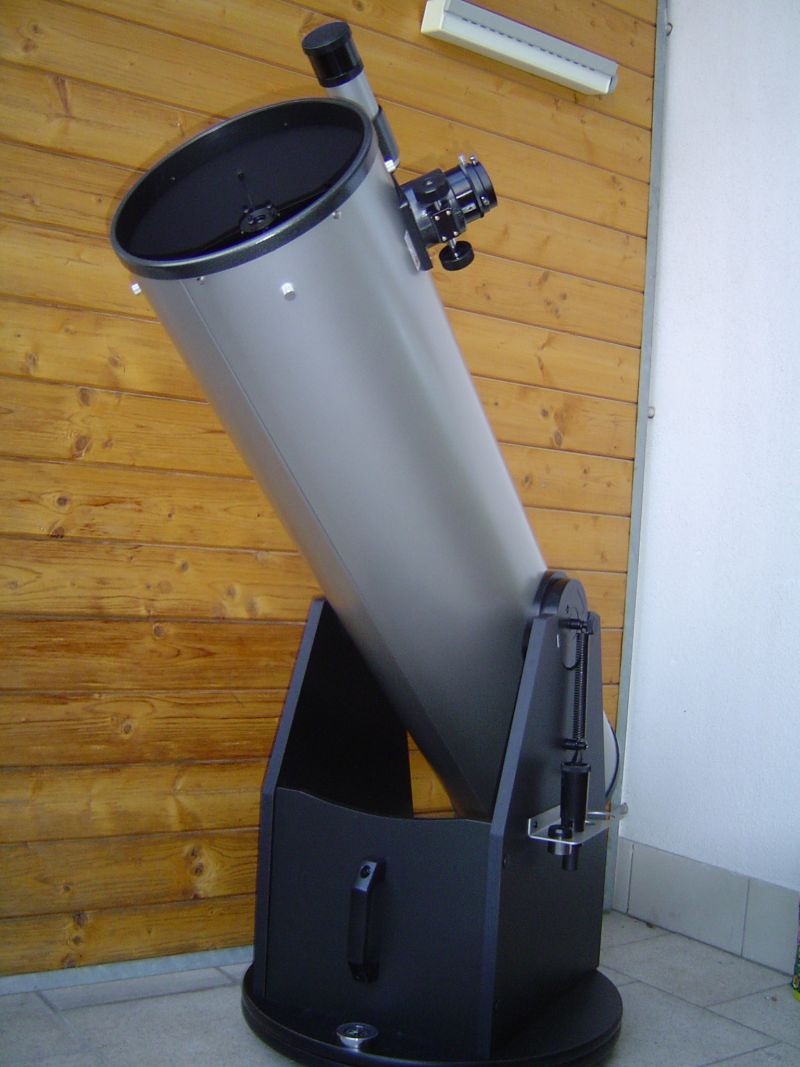
Credit: first uploaded on the English-speaking Wikipedia under the same filename
- Pros: Fastest setup; quiet; minimal power needs; inherently stable with good tripods; great for public outreach and scanning the Milky Way.
- Cons: No automated tracking unless motorized; at high magnifications, manual nudging can become frequent; not ideal for long-exposure imaging.
Motorized Alt-Az and GoTo
Motorized alt-az mounts add tracking and GoTo functionality. You perform a quick star alignment and the mount slews to objects and tracks them by moving both axes in small increments. For visual astronomy, this is a major upgrade—stars stay centered, and you can hop between objects efficiently, especially under light-polluted skies where star-hopping is challenging. Many popular fork-mounted Schmidt-Cassegrain telescopes (SCTs) are delivered in alt-az form with robust GoTo electronics.
- Pros: Quick deployment; tracking for visual, outreach, and lunar/planetary video; compact systems are airline-friendly.
- Cons: For long-exposure deep-sky imaging, field rotation blurs stars unless you add a field derotator or switch to an equatorial configuration (e.g., by using a wedge or GEM).
Field Rotation Explained
As an alt-az mount tracks, the camera’s field of view slowly rotates with respect to the sky. Visually this is irrelevant—you won’t notice. For imaging, however, star trails accumulate within a single exposure unless you keep sub-exposures short. Live-stacking software can compensate by aligning successive short frames and rotating them digitally, which is why electronically assisted astronomy (EAA) with alt-az mounts is feasible.
- Lunar and planetary imaging: Use very short exposures or video capture (milliseconds per frame); field rotation is negligible.
- EAA on deep-sky objects: Typically limited to short subs (e.g., 5–20 seconds) depending on target altitude and focal length.
- Long-exposure deep-sky astrophotography: Requires an equatorial solution or a field derotator with precise control.
If you plan to transition from visual to astrophotography, you can still start with an alt-az mount and add capabilities over time. Some fork-mounted SCTs accept an equatorial wedge, transforming them into a polar-aligned system; others can be moved onto a German equatorial mount for flexible imaging. We’ll compare those options in equatorial mounts and outline practical workflows in setup workflows.
Equatorial Mounts: Right Ascension, Declination, and Polar Alignment
Equatorial mounts align with the sky’s coordinate system. If the RA axis is pointed at the celestial pole, the mount can track stars with a single, smooth motion that cancels Earth’s rotation. This is the foundation of long-exposure astrophotography.
Common Equatorial Designs
- German Equatorial Mount (GEM): The most common design in amateur astronomy. It features a right ascension axis with a counterweight shaft, and a declination axis holding the telescope. GEMs are versatile, support a wide range of payloads, and are well-served by accessories and software.

This is the 90mm apochromatic refractor actively imaging. The moon and venus is visible as well. 🙂
Photo: Gustaaf Prins
- Fork Mount on a Wedge: SCTs with fork arms can be set on an adjustable wedge so the entire assembly tilts to the local latitude. This effectively turns the fork into an equatorial mounting while keeping the compact optical tube attached.
- Harmonic Drive (Strain Wave) EQ Mounts: A newer category that uses strain wave gearing for high torque in a compact package. Many models can operate with minimal or no counterweights at modest payloads, improving portability. They typically have periodic error like worm-driven mounts but low backlash.
Why Polar Alignment Matters
Polar alignment is the process of pointing the RA axis at the true north or south celestial pole. When done well, the mount tracks objects without drifting in declination, allowing long unguided exposures (depending on the mount’s periodic error and focal length) or more reliable autoguiding. Poor polar alignment produces field drift, which guiding must correct by pushing DEC. Excessive DEC corrections can lead to oblong stars and increase the risk of guiding oscillations. Details and methods are covered in polar alignment methods.
Meridian Flip and Clearances
German equatorials perform a meridian flip when a tracked object crosses the local meridian to avoid collisions. Your imaging software will usually orchestrate this automatically by pausing exposure, slewing to a mirrored orientation, and resuming. Fork equatorials and some equatorial platforms do not require a flip but may have clearance limits at certain declinations. Planning for cable management and camera clearance is crucial, especially with filter wheels or off-axis guiders.
Polar Alignment Methods: From Sight Tube to Plate Solving
Polar alignment techniques range from simple sighting to precise, software-assisted routines. Your required precision depends on your focal length, exposure time, and whether you guide.
Rough Alignment
- Compass and Level: Set the tripod roughly north-south using a compass (corrected for magnetic declination) and level the mount. This is adequate for daytime solar work with a filter or quick visual sessions.
- Point at Polaris: In the northern hemisphere, centering Polaris in the finder gets you near the pole. Polaris sits less than a degree from true north; don’t confuse it for the exact pole.
Polar Scope Alignment
Many GEMs include a polar scope with a reticle showing the position of Polaris relative to the true pole (and an Octans pattern for the southern hemisphere on some reticles). Using a smartphone app or the mount hand controller, you place Polaris at the indicated clock angle in the reticle by adjusting altitude and azimuth bolts. This method is quick and can be accurate enough for moderate focal lengths and several-minute exposures, particularly if guiding.
Drift Alignment
Drift alignment measures how a star drifts from the crosshair over time to diagnose polar misalignment. You observe a star near the meridian and the celestial equator to correct azimuth, and a star near the eastern or western horizon to correct altitude. Software-assisted drift routines simplify the process by showing direction and magnitude of drift. Though slower than a polar scope, drift alignment can be very accurate and is a robust backup in case your view of the pole is obstructed.
Software-Assisted Polar Alignment
Modern tools use your imaging or guide camera to plate-solve short exposures and compute the mount’s polar offset. Popular workflows in imaging suites enable sub-arcminute alignment when the sky and horizon conditions cooperate. These routines typically prompt you to rotate the RA axis by a specified angle, capture images, and then guide you to adjust altitude and azimuth until the error falls below a threshold. This approach is fast, precise, and avoids peering through a polar scope—especially convenient for portable setups.
Regardless of method, do the mechanical parts first: firmly tighten the tripod, eliminate slack in altitude/azimuth adjusters, and check that the RA axis rotates smoothly. That groundwork makes the fine steps of guiding and tracking more effective.
Tracking, Guiding, and Periodic Error: How Mounts Stay on Target
Even with excellent polar alignment, no mount is perfect. Mechanical imperfections cause stars to wander on the sensor. The two main contributors are tracking rate inconsistencies and periodic error (PE) in the drive train.
Tracking and Sidereal Rate
Mounts track at sidereal rate to counter Earth’s rotation. For lunar or solar work, most mounts can adjust to lunar or solar tracking rates, which are slightly different. In practice, tracking accuracy depends on gear quality, motor control, and load balance. Small deviations over seconds to minutes create star movement that your exposure or guiding must tolerate or correct.
Periodic Error (PE)
Worm-driven mounts have a worm gear that completes a cycle in several minutes. Tiny eccentricities cause the RA axis to speed up and slow down periodically, producing a characteristic back-and-forth star motion. The total swing over a cycle is the peak-to-peak periodic error. Typical consumer equatorials may have tens of arcseconds of PE; premium mounts can be in the single-digit arcseconds. Guiding can correct most of this, especially at shorter focal lengths, while some mounts support Periodic Error Correction (PEC) recordings that replay compensations each cycle.

Photo: HiyoriX
Autoguiding Basics
Autoguiding uses a separate guide camera—either on a small guide scope or through an off-axis guider (OAG)—to watch a reference star and issue small corrections to the mount. Corrections can be sent via ST-4 cable or pulse guiding over the mount’s control link. Software like PHD2 chooses a star, measures its centroid, and nudges RA and DEC to keep it fixed. Guiding can compensate for PE, small wind gusts, and residual polar misalignment.
- Guide scope vs OAG: A guide scope is simpler and works well at short to moderate focal lengths. At long focal lengths, differential flexure—where the guide scope and main scope move slightly differently—can blur images; an OAG eliminates this by guiding through the imaging telescope itself.
- Guide exposure length: Shorter exposures chase seeing; longer exposures may average out turbulence but react slower. Typical guide exposures range from about 1 to 3 seconds, adjusted for seeing and mount behavior.
- Dithering: Randomly shifting the telescope a few pixels between exposures helps defeat fixed pattern noise and walking noise in stacked images.
Interpreting Guiding Graphs
Guiding software displays RA and DEC error in arcseconds. Healthy graphs show errors meandering within a tolerable band, with corrections neither saturating nor oscillating. Large, sharp spikes may indicate cable snags, wind, or mechanical stiction. Steady DEC drift suggests polar misalignment. If DEC corrections alternate rapidly, you may be seeing backlash or too-aggressive settings.
Unguided Imaging and Encoders
Some mounts offer high-resolution encoders for improved tracking or even real-time error correction. Absolute encoders can dramatically reduce tracking error, enabling longer unguided exposures at moderate focal lengths. However, conditions like seeing and flexure still argue for guiding in many scenarios, especially at longer focal lengths. Encoders also improve pointing repeatability and eliminate the need for homing sensors in some designs.
Payload Capacity, Tripods, and Balance: Building a Stable Rig
Manufacturers publish a payload rating for mounts, but context matters. A mount may claim to carry a certain weight for visual use, but imaging imposes stricter demands due to long exposures and the need for precise tracking.
Understanding Payload Ratings
- Visual vs Imaging: A common guideline is to keep your imaging payload to around half to two-thirds of the stated maximum, especially for long focal lengths. This is not a hard law but a practical heuristic that yields better results.
- Distribution and Moment Arm: A compact 8 kg refractor may be easier to handle than a 6 kg Newtonian with a long tube and heavy camera at the end. Moment arm and inertia matter as much as mass.
- Accessories Count: Cameras, filter wheels, guiders, focusers, dew shields, and cables all add up. Weigh everything, including dovetail plates and rings.
Tripods, Piers, and Vibration
The tripod or pier is as critical as the head. A stiff tripod with wide leg spread reduces vibration. Adding a pier extension can prevent the telescope from colliding with tripod legs near the meridian, but it raises the center of gravity—balance stability against clearance needs.
- Spreader Tension: Tighten the spreader to lock legs firmly. If your tripod has a tray, it often doubles as a structural spreader.
- Ground Coupling: On hard surfaces, anti-vibration pads can shorten damping times. On soil, sink the feet slightly for better grip.
- Portable Piers: For semi-permanent setups, a portable pier provides excellent rigidity and consistent alignment from night to night.
Balancing the Mount
Balance both axes with your full imaging train attached as it will be used (dew heaters, cables, focusers extended to focus position). On GEMs, slide counterweights to achieve slight balance toward the east on the RA axis—this keeps the worm engaged against the gear. Some modern harmonic drive mounts with friction clutches do not require “east-heavy” balancing; follow the manufacturer’s recommendation.
- RA Balance: With the clutch released, the RA axis should settle gently without oscillation. A small bias eastward helps prevent gear float.
- DEC Balance: Move the telescope in its saddle and/or shift accessory positions to balance DEC. With OAGs and filter wheels, you may need to slide the OTA in its rings.
- Cable Management: Route cables so they do not tug during slews or bind near the meridian. Leave enough slack, bundle runs, and fix them to the mount—not the moving telescope—where possible.
GoTo Systems, Encoders, and Mount Control Software
GoTo functionality slews your mount to selected objects using onboard catalogs or external control software. Combined with plate solving, GoTo delivers precise, repeatable pointing—an especially big win for imaging where framing matters.
Star Alignment and Plate Solving
Traditional GoTo requires a one- to three-star alignment so the controller learns the mount’s orientation and cone error. Plate solving narrows this gap by taking a quick exposure, matching star patterns against a catalog, and computing an exact sky position. Modern workflows often skip star alignment entirely: slew approximately, plate solve, and sync. This is quick, accurate, and reduces operator error.
Control Ecosystem
- PC Control: Many mounts integrate with platform drivers that allow planetarium and imaging software to steer the mount, run GoTo, and manage parking positions.
- Mobile Control: Handsets and smartphone apps provide wireless control, slewing, and object databases. Wi‑Fi modules are common, and some mounts embed web interfaces.
- Encoders and Homing: High-resolution encoders can track position precisely even after a power cycle. Homing sensors enable the mount to return to a known index without manual alignment.
Safety, Limits, and Parking
Configure slew limits and meridian behavior to avoid collisions. Define safe parking positions that clear tripods and piers. Before each session, confirm that the time, date, and location are accurate—errors here will undermine GoTo and tracking.
Use Cases and Decision Framework: Visual, EAA, and Imaging
Choosing a mount depends on how you plan to observe and where you’ll use it. Consider portability, setup time, payload, and automation needs. Below is a practical framework.
Visual Observing
- Backyard or Balcony: A compact, manual alt-az with slow-motion controls or a video head paired with a short refractor can deliver quick, high-quality sessions. For heavier SCTs or Maksutovs, a sturdy motorized alt-az helps tracking at high power.

Meade LightBridge Mini 114, a 4.5\” f/4 (focal length 450 mm) Dobsonian reflector telescope, shown with Bob’s Knobs adjustment screws for the secondary mirror and the included 26 mm 1.25\” eyepiece. Two eyepieces, 26 mm and 9 mm, are included with the telescope which result in about 17x and 50x magnification, respectively.
Photo: Morn
- Dark-Sky Trips: If you prioritize aperture, a Dobsonian provides the most light per dollar and setup minute. Add push-to encoders for easy object finding.
- Public Outreach: Quiet, reliable tracking is a gift during outreach nights. Motorized alt-az or fork SCTs keep the target centered while guests take turns.
Electronically Assisted Astronomy (EAA)
- Alt-Az Advantage: With live stacking of short sub-exposures (e.g., 5–15 seconds), an alt-az mount can deliver colorful, deep views with minimal setup. Field rotation becomes manageable when sub lengths are short and software performs alignment.
- Equatorial Edge: An equatorial eliminates field rotation, allowing longer subs and cleaner stacks. If you plan to capture fainter galaxies or narrowband nebulosity with longer exposures, EQ is the smoother path.
Deep-Sky Astrophotography
- Short Focal Lengths (e.g., 135–400 mm): Many modest EQ mounts perform well with wide-field lenses or small refractors, especially with guiding. The demands on tracking and PE are lighter.
- Moderate to Long Focal Lengths (e.g., 500–2000+ mm): A robust EQ with good stiffness and low PE is important. Off-axis guiding is commonly recommended to avoid differential flexure.
- Portability vs Performance: Harmonic-drive EQ mounts offer compelling portability and quick setup, sometimes with no counterweight at modest payloads, but careful balance and cable routing still matter. Traditional worm-gear GEMs remain excellent workhorses and can provide very smooth guiding when well-tuned.
Planetary and Lunar Imaging
- Mount Requirements: High magnification and high frame rates put fewer demands on long-duration tracking, since you capture many short frames and stack them. Both alt-az and EQ mounts work well here; motorized tracking is strongly recommended.
- Field Rotation: Essentially irrelevant during sub-second video capture; your stacking software aligns the planet’s disk and features.
Still unsure? Revisit the feature summaries in alt-az mounts vs equatorial mounts and note which tradeoffs fit your sky access, interest in imaging, and tolerance for setup complexity. Then review setup workflows to visualize your typical night.
Setup Workflows: Fast Visual Night vs. Imaging Session
Real-world performance is shaped by your workflow. Consider two contrasted routines.
Fast Visual Session with a Motorized Alt-Az
- Tripod and Level: Extend the tripod legs, set it down, and level by eye. Attach the mount head and the telescope.
- Power and Alignment: Connect a small battery. Perform a quick two-star alignment (or use a built-in alignment routine if your mount supports it).
- GoTo and Observe: Select objects in your app or handset. The mount slews and tracks. For higher power, engage slow-motion or fine slews.
- Wrap-Up: Shutdown and stow in minutes. No meridian flips, no polar scope, minimal cables.
Imaging Session with an Equatorial Mount
- Site and Level: Plant the tripod or pier, level carefully, and orient the mount roughly north/south.
- Attach Gear: Mount the telescope, camera, guide scope or OAG, filter wheel, dew heaters, and route cables cleanly. Balance both axes as described in payload and stability.
- Polar Align: Use a polar scope or software-assisted routine from polar alignment methods.
- Connect Control: Start your control software, confirm time/location, and home/park status. Slew to a bright star, focus, and plate solve to sync.
- Guide Calibration: Launch guiding, calibrate near the target’s declination, and verify smooth corrections in guiding graphs.
- Acquisition Plan: Define exposure length, dithering, filter sequence, meridian flip behavior, and end-of-sequence park. Start the run and monitor conditions.
- Shutdown: Warm the camera, stop guiding, park the mount, and coil cables for next time.
Each pass through the routine gets faster. With a semi-permanent setup or a portable pier, steps 1–3 compress significantly, making an EQ routine feel almost as quick as alt-az for experienced users.
Maintenance, Power, and Troubleshooting Common Issues
Mounts are mechanical systems that benefit from periodic checks. Good habits reduce errors and prolong life.
Care and Maintenance
- Fasteners: Periodically check tripod bolts, dovetail clamps, and counterweight locks for snugness. Use manufacturer torque guidance where available.
- Lubrication: Many modern mounts come properly greased from the factory. Unless you notice stiffness or binding, internal regreasing is not routine—and opening the mount may void warranties. When needed, follow official procedures.
- Weather and Storage: Avoid dew pooling on electronics. After a dewy night, let the mount air out indoors. Store desiccant packs in cases and keep connectors capped.
- Firmware: Update only when necessary and after reading release notes. New features can help, but stability during clear nights matters most.
Power Planning
Most mounts run on 12 V DC power and draw a few amps during slews, less while tracking. Add camera coolers, dew heaters, and mini PCs and you can exceed modest battery packs. Plan capacity using watt-hours (Wh).
  Mount: 1 A average at 12 V  -> 12 W

  Camera cooler: 2 A at 12 V  -> 24 W (varies with ambient)

  Guide + mini PC: 2 A at 12 V -> 24 W

  Dew heaters: 1–3 A at 12 V   -> 12–36 W (duty cycle)

  Total typical: ~60–90 W during imaging
  For a 5-hour session at 75 W average -> 375 Wh required

  Add 30% reserve -> ~490 Wh battery
Use regulated outputs and sufficiently thick cables to avoid voltage drop, especially in cold weather. Mounts can behave erratically if supply voltage sags during slews.
Common Pitfalls and Fixes
- Poor Pointing: Verify date/time/location. Rebuild your pointing model or use plate solving to sync. Check for mount time zone/daylight saving settings.
- Guiding Oscillation: Reduce aggressiveness or min-move in your guiding software. Rebalance and inspect for cable drag. Confirm that backlash compensation is not overcorrecting.
- Backlash: In DEC, too-loose gear mesh or balance near neutral causes correction delays. A slight imbalance to keep gears engaged, plus careful mechanical adjustment, helps.
- Star Trails Despite Guiding: Look for flexure between guide scope and main scope; consider an OAG. Also examine wind exposure and tripod stability.
- Sudden Guide Spikes: Check cable snags near the meridian or at certain orientations. Tie down cables, and test full-range slews before imaging.
- Periodic Error Too High: Record PEC if your mount supports it. Guide with slightly longer exposures to average seeing if the PE waveform is smooth.
Frequently Asked Questions
Do I need an equatorial mount to start astrophotography?
Not necessarily. You can begin with short, wide-field exposures on a camera tracker (a compact equatorial drive for cameras) or practice EAA on an alt-az with live stacking. If your goal is multi-minute sub-exposures of faint nebulae and galaxies at moderate to long focal lengths, an equatorial mount with good tracking and guiding support is the more reliable long-term investment. Many imagers start with a small refractor on an entry-level GEM, then scale up as skills and ambitions grow.
Photo: HiyoriX
How accurate does polar alignment need to be?
It depends on focal length and exposure length. For wide-field imaging with short lenses, a rough polar alignment can be tolerable, especially with guiding. As focal length and exposure times increase, strive for sub-arcminute alignment to reduce DEC drift and guiding workload. Software-assisted routines make this achievable in minutes. For visual observing on an EQ, the tolerance is much looser; you only need enough accuracy that objects don’t drift quickly out of view.
Final Thoughts on Choosing the Right Telescope Mount
Choosing a mount is selecting the character of your nights. Alt-az mounts deliver instant gratification—point, observe, smile. They are perfect for visual astronomy, outreach, and planetary imaging, and with live stacking they open the door to electronically assisted deep-sky views. Equatorial mounts demand a bit more setup—but they repay you with the precise tracking needed for long-exposure astrophotography, repeatable framing, and an upgrade path to ambitious projects.
If you’re new and primarily visual, start simple with a solid alt-az or Dobsonian and spend your time at the eyepiece. If the imaging bug has already bitten, look to a capable equatorial mount, keep your payload modest, and build a clean workflow around accurate polar alignment, stable guiding, and rock-solid balance. Whichever path you choose, remember that the mount is your instrument’s foundation. With a thoughtful purchase and a few evenings of practice, it becomes invisible—letting the sky take center stage.
For more in-depth guides on mounts, optics, and imaging workflows, explore our related topics and subscribe to our newsletter. We publish practical, tested advice every week to help you go farther under the stars.