
Table of Contents
- What Is Europa, Jupiter’s Ocean Moon?
- Ridges, Bands, and Chaos: Europa’s Surface Geology
- Evidence for a Global Subsurface Ocean
- Habitability: Chemistry, Energy Sources, and Ocean Dynamics
- Radiation, Surface Chemistry, and Oxidants
- Possible Water Plumes: What the Data Really Say
- Missions to Europa: Galileo, Hubble, JUICE, and Europa Clipper
- How Scientists Model Europa’s Ice Shell and Ocean
- How We Might Detect Biosignatures on Europa
- Europa in Context: Comparing Ocean Worlds
- How to Observe Europa from Earth Without Fancy Gear
- Frequently Asked Questions
- Final Thoughts on Exploring Europa’s Ocean
What Is Europa, Jupiter’s Ocean Moon?
Europa is one of Jupiter’s four large Galilean moons, discovered by Galileo Galilei in 1610. Slightly smaller than Earth’s Moon, Europa’s radius is about 1,560 kilometers. Beneath its bright, striated shell of water ice, multiple lines of evidence point to a global liquid ocean—an entire world of water locked under tens of kilometers of ice. That single fact makes Europa one of the most compelling places in the Solar System to search for signs of life.

Attribution: NASA / Jet Propulsion Lab-Caltech / SETI Institute
Orbiting Jupiter at roughly 671,000 kilometers, Europa completes one lap around the giant planet every 3.55 Earth days and keeps the same face toward Jupiter due to synchronous rotation. Its eccentric orbit, maintained by a three-body resonance with Io and Ganymede, flexes Europa’s interior, generating tidal heat. This heat is a prime suspect for keeping a deep ocean from freezing solid. The moon’s surface is strikingly youthful, with few large craters; geologists infer ongoing resurfacing that likely taps into the ice–ocean system below.
Key physical attributes of Europa include:
- Diameter: ~3,121 km (about 90% the size of Earth’s Moon)
- Bulk density: ~3,013 kg/m³ (consistent with a rocky interior and icy exterior)
- Surface temperature: roughly −160 °C to −220 °C (varies with latitude and time of day)
- Gravity: about 13% of Earth’s
Because Europa sits deep within Jupiter’s magnetosphere, it experiences a harsh radiation environment. That radiation drives potent surface chemistry, creates oxidants, and likely alters the color and composition of the topmost ice. Despite the inhospitable surface, the internal ocean may be shielded and chemically enriched—conditions relevant to life as we know it. In the sections that follow, we explore the geology, the ocean evidence, and how upcoming spacecraft aim to answer the biggest questions about this ocean world. For a deeper dive into Europa’s ice mechanics, see How Scientists Model Europa’s Ice Shell and Ocean.
Ridges, Bands, and Chaos: Europa’s Surface Geology
Europa’s surface is a tapestry of crisscrossing ridges, long dark bands, and blocky “chaos” terrain that looks like broken ice rafts frozen in place. Unlike heavily cratered moons, Europa’s relatively smooth face tells a story of renewal. Much of what we know comes from NASA’s Galileo mission (1995–2003), which returned high-resolution images of key regions such as Conamara Chaos and Tara Regio.
Double ridges and lineae
One of the most distinctive features are double ridges—paired walls of ice separated by a trough. These ridges can extend hundreds of kilometers across the surface. Their formation likely involves repeated fracturing and freezing of water or slushy ice that gets pumped upward from below. Buried pressurized water lenses or tidally flexed faults may feed the process, producing cyclical uplift and cracking.
Dark lineae—long, relatively narrow stripes—may mark older fractures that were filled by darker material, potentially salty brines or contaminants from the ocean or the near-surface ice. Many lineae follow great-circle paths, consistent with stress fields driven by tidal flexing and nonsynchronous rotation of the ice shell over geologic time.
Chaos terrains
Chaos terrain appears as jumbled, rotated blocks surrounded by finer-grained background material. A plausible mechanism involves partial melting or intense fracturing of a region, perhaps above a buoyant, warm diapir or a shallow water lens. Blocks detach, drift, and refreeze. The scale ranges from small patches to massive regions spanning hundreds of kilometers. The relatively low number of superimposed craters suggests these terrains are geologically young—likely tens of millions of years old.

Attribution: NASA/JPL
Compositional clues on the surface
Spectral data reveal that Europa’s surface is dominated by water ice. But non-ice contaminants—salts and radiation products—give the surface some of its color and composition. Early work favored magnesium sulfate salts for the dark material; more recent observations point to sodium chloride (table salt) as a significant constituent in certain regions, especially after irradiation, which can impart a yellowish hue. Such compositional diversity provides windows into the chemistry of the ice shell and potentially the ocean below.
Geology connects to habitability in several ways. Fractures and chaos terrains provide conduits for exchange between the surface and the interior. If oxidants and other reactants can move downward through these features, they could fuel potential ecosystems in the ocean—a point discussed further under Habitability: Chemistry, Energy Sources, and Ocean Dynamics.
Evidence for a Global Subsurface Ocean

Attribution: NASA/JPL-Caltech/SwRI/MSSS/Kevin M. Gill
The case for a global ocean beneath Europa’s ice shell rests on multiple independent lines of evidence. Much of it was assembled from data taken by the Galileo orbiter’s magnetometer and imaging instruments, along with Earth- and space-based observations.
Induced magnetic field and salty water
Galileo detected variations in the magnetic field near Europa that point to an induced field—a magnetic response created by a conductor when Jupiter’s field sweeps past. Salty water conducts electricity well. The best explanation for Europa’s induced field is a global ocean of salty liquid beneath the ice, thick enough and conductive enough to produce the observed response. This conclusion does not rely on a single measurement; it is supported by passes with different geometries and by comparative studies with other moons.
Tidal heating
Europa’s orbital eccentricity and Laplace resonance with Io and Ganymede force the moon to flex rhythmically. This constant kneading dissipates energy as heat, especially in the ice shell and possibly in the silicate mantle. The heat budget from tidal dissipation can plausibly keep an ocean liquid over geologic timescales. If parts of the rocky interior are heated enough, water–rock interactions (e.g., serpentinization) could produce hydrogen and other reactants useful to life—a topic we revisit in Habitability.
Surface geology consistent with ice–ocean coupling
Features such as double ridges, banded terrains, cycloidal cracks, and chaos regions are consistent with processes occurring in a thick ice shell overlying a liquid reservoir. Models show that tidal flexing produces stress patterns aligning with observed fracture orientations. Numerically simulated diapirs—warm, buoyant upwellings—can produce the disruption patterns seen in chaos terrains. While these lines of evidence are indirect, their coherence across multiple datasets is persuasive.
Thermal and compositional hints
Thermal anomalies and surface composition variations indicate localized activity. Some regions may be warmer or enriched in salts, suggesting recent exchange between deeper layers and the surface. Together with the induced magnetic field measurements, these hints reinforce the ocean hypothesis rather than providing singular proof.
In short, Europa’s ocean is not just a speculative idea; it is the leading, well-supported interpretation of a converging set of measurements. The depth and details remain uncertain, but a global water layer tens to hundreds of kilometers deep is the scenario that best fits the evidence so far.
Habitability: Chemistry, Energy Sources, and Ocean Dynamics
Europa’s habitability depends on three broad questions: Does the ocean have water? (yes), does it have the right chemistry? (likely complex), and does it have energy sources to sustain metabolism and cycles over time? While definitive answers await new data, existing measurements inform each piece of the puzzle.
Water–rock interactions and hydrothermal potential
If Europa’s ocean is in contact with a silicate seafloor—as many models suggest—water–rock reactions could occur. Processes like serpentinization, in which ultramafic rocks react with water to produce hydrogen and other reduced compounds, may provide chemical energy. On Earth, hydrothermal vents host ecosystems powered by chemical gradients without sunlight. Europa’s internal heat, though lower than Earth’s, might create similar gradients on the seafloor.
Salts and carbon: lessons from spectra
Europa’s surface contains non-ice materials including chlorides and sulfates. Their presence hints at an ocean with dissolved salts, which influence freezing temperature, density, and circulation. In 2023, observations with the James Webb Space Telescope detected carbon dioxide concentrated in a region known as Tara Regio. The spatial distribution and spectral characteristics are consistent with CO₂ originating from the interior rather than delivered externally, though scientists consider multiple pathways. If carbon-bearing compounds are being cycled from the ocean to the surface, it strengthens the case for a chemically active interior.
Oxidants from the surface
Europa’s surface is bombarded by radiation that splits water ice and other molecules, creating oxidants such as oxygen and peroxide. If small-scale tectonics, ridge cycling, or brine percolation move these oxidants downward, they could help balance the ocean’s redox state. An ocean supplied with both oxidants (from the surface) and reductants (from the seafloor or interior) would be more habitable than one lacking either.
Ocean structure and circulation
Models suggest Europa’s ocean could be tens of kilometers deep, perhaps on the order of 60–150 km. The ice shell above may be 10–30 km thick on average, potentially thinner or thicker depending on regional heat flow. Salinity, temperature gradients, and tidal forcing could drive ocean currents, which in turn transport heat and chemicals. If true, Europa’s ocean is not a static reservoir but a dynamic, circulating system.
Constraints and unknowns
Key unknowns remain: the exact salinity and pH of the ocean, the presence and vigor of hydrothermal systems, and the rate at which surface oxidants reach the ocean. The thickness of the ice shell affects how rapidly materials exchange between surface and interior. Upcoming missions—discussed in Missions to Europa—are designed to address these variables using magnetometry, radar, mass spectrometry, and imaging.
Europa’s habitability is not a single yes/no question. It is a balance of water, chemistry, and energy that can evolve over time as the moon’s interior cools and its orbital tides shift. The best evidence so far indicates a world with multiple, interacting sources of chemical energy.
Radiation, Surface Chemistry, and Oxidants
Any discussion of Europa’s chemistry must factor in Jupiter’s formidable radiation belts. High-energy electrons and ions slam into Europa’s icy surface, splitting water molecules and driving reactions that create oxidants and other species. The rate depends on latitude, local shielding, and the surrounding magnetospheric environment, but the net effect is substantial.
Radiolysis and surface products
Radiolysis—radiation-induced cleavage of chemical bonds—produces hydrogen and oxidized molecules, including O₂ and H₂O₂. These oxidants can accumulate at the surface. Over time, micrometeorite gardening and thermal processes can churn the regolith, potentially aiding in the downward transport of chemicals.
Delivery to the ocean
For oxidants to matter for habitability, they must reach the ocean. Several transport pathways are discussed in the literature:
- Fracture networks that penetrate deep into the ice
- Subsumption or subduction-like processes in which the surface ice is forced downward
- Percolation of brines along grain boundaries in warm ice
- Periodic melt-throughs above thermal anomalies or diapirs
Which mechanisms dominate is still uncertain. Nevertheless, any transfer from surface to ocean helps close the redox loop and enhances the potential for metabolisms that rely on electron donors and acceptors.
Balancing radiation hazards and scientific opportunity
Radiation is a hazard for spacecraft and would be lethal to unprotected life at the surface, but it is also a powerful natural laboratory. Studying radiation-induced products can provide indirect insights into the ocean’s composition—if the contaminated surface materials are sourced from within. Mission planners have to balance exposure (for instrument survival) against the need to sample the most interesting regions. The tradeoffs are central to the design of Europa Clipper flybys.
Possible Water Plumes: What the Data Really Say
Reports of water vapor plumes erupting from Europa have generated excitement and caution in equal measure. Plumes would be a game-changer: sampling ejected material with a spacecraft would offer a window into the ocean without drilling through ice.
Observational hints
Over the past decade, studies using the Hubble Space Telescope have reported transient signals consistent with water vapor above Europa in ultraviolet observations. In some cases, reanalyses of magnetometer and plasma wave data from Galileo suggest the spacecraft may have flown through a plume-like disturbance during a close pass. However, other observations have yielded non-detections, indicating that if plumes exist, they are intermittent, faint, localized, or all three.
What counts as confirmation?
Definitive confirmation requires multiple, consistent datasets—imaging of a plume silhouette, simultaneous detection of water and associated particles, and reproducible signals at the same location or under predictable conditions. As of the latest widely discussed results, the scientific community treats Europa plumes as possible but not conclusively confirmed. This conservative stance influences how missions plan their observations and how they interpret transient signals.
Implications for exploration
If plumes are present even sporadically, they offer sampling opportunities for spectrometers and dust analyzers during flybys. Instruments can sniff gases and analyze ice grains for salts, organics, and isotopes. That is why missions like Europa Clipper include high-sensitivity mass spectrometers and dust analyzers. Nonetheless, mission success does not hinge on plumes; many critical measurements of the ocean, ice shell, and surface chemistry do not require active eruptions.
Missions to Europa: Galileo, Hubble, JUICE, and Europa Clipper
Europa’s scientific renaissance began with Galileo’s close observations in the late 1990s and early 2000s. Since then, new telescopes and missions have refined the picture, and a new generation of spacecraft is poised to transform our understanding in the coming decade.
Galileo’s legacy
Galileo was the first spacecraft to perform multiple flybys of Europa. Its magnetometer detected the induced field consistent with a salty ocean, while its camera and near-infrared spectrometer mapped surface geology and composition. The mission established the principal questions that drive today’s exploration: the ice thickness, the ocean’s properties, and the mechanisms of surface–interior exchange.
Hubble and other observatories
Though not designed for Europa-specific studies, Hubble’s ultraviolet capabilities enabled searches for tenuous atmospheres and transient water vapor. Ground-based telescopes and, more recently, the James Webb Space Telescope have contributed compositional insights, including the 2023 detection of concentrated carbon dioxide at Tara Regio.
ESA’s JUICE mission
The European Space Agency’s JUICE (JUpiter ICy moons Explorer) mission launched in 2023 to conduct an in-depth investigation of Jupiter’s environment and its icy moons, with a primary focus on Ganymede. JUICE is planned to perform flybys of Europa and Callisto as part of its tour. Its instrument suite—featuring cameras, spectrometers, a magnetometer, particle analyzers, a radar for icy moon exploration, and a laser altimeter—will contribute context on Europa’s surface properties, environment, and interior interactions during those flybys.
NASA’s Europa Clipper
NASA’s Europa Clipper mission is designed to conduct dozens of close flybys of Europa while in orbit around Jupiter. As planned, the mission will map the ice shell, probe for subsurface structures, analyze surface composition, and assess the moon’s habitability. Its payload includes imaging systems, an ice-penetrating radar, a magnetometer and plasma instruments for magnetic sounding, infrared and ultraviolet spectrometers, a thermal camera, a mass spectrometer, and a dust analyzer. Together, these instruments aim to determine properties such as ice thickness, ocean salinity, regional activity, and the presence of organic or prebiotic molecules on and above the surface.
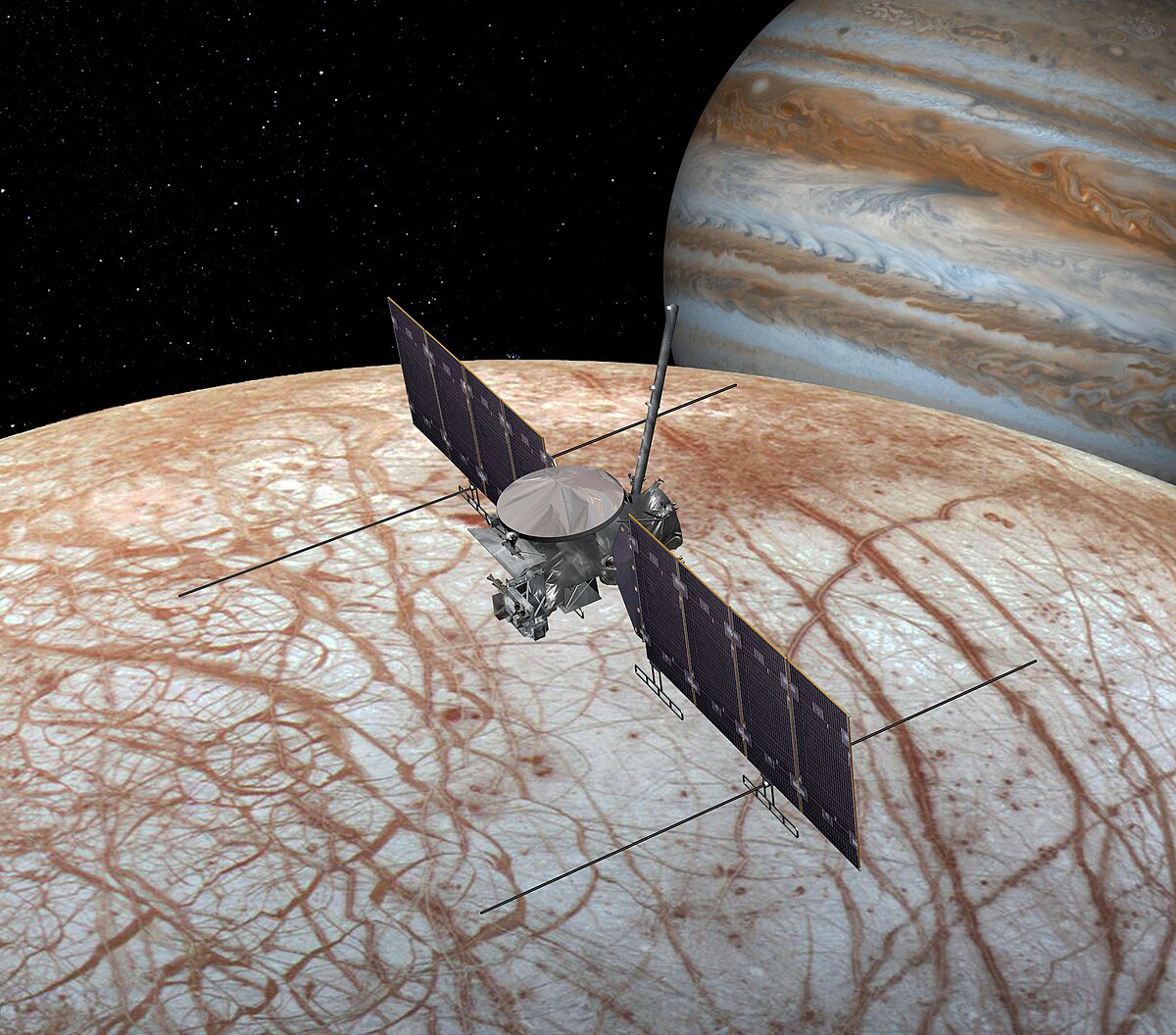
Attribution: NASA/JPL-Caltech
Europa Clipper and JUICE are complementary. While JUICE emphasizes Ganymede, it places Europa in a comparative context; Europa Clipper provides targeted, repeated sampling of Europa’s environment. The synergy will be crucial for resolving ambiguities—for example, separating ocean signals from magnetospheric noise or distinguishing surface salts sourced from the interior from exogenic contaminants.
How Scientists Model Europa’s Ice Shell and Ocean
Because we cannot yet drill into Europa’s ocean, much of our insight comes from models constrained by data. Scientists combine magnetometry, gravity, geology, and thermal physics to estimate layer thicknesses and dynamics.
Ice thickness and ocean depth
Model estimates commonly place Europa’s ice shell thickness in the range of roughly 10–30 km, with regional variability. The ocean beneath could be on the order of 60–150 km deep, depending on salinity and heat flow. The total water layer might therefore be comparable in volume to Earth’s oceans combined—or greater—even though Europa is smaller than Earth’s Moon.
Heat sources and sinks
Europa’s internal heat budget includes tidal heating in the ice and possibly in the rocky mantle, radiogenic heat from radioactive decay within rocks, and latent heat effects from melting and freezing. Cooling occurs via conduction through the ice and radiation to space. The net balance determines whether the ocean persists and how vigorously the ice and ocean circulate.
Fracture mechanics and diapirs
Fractures form when stresses exceed the ice’s tensile strength. Tidal stresses vary over Europa’s orbit, producing predictable patterns of fracture orientations. Thermal anomalies can create density inversions in the ice—warmer ice is less dense—leading to diapirs that rise, deforming and melting surrounding layers. These mechanisms together can build double ridges and chaos terrains described in Ridges, Bands, and Chaos.
Magnetic sounding and ocean salinity
To infer ocean salinity and depth, scientists analyze how Europa’s ocean interacts with Jupiter’s changing magnetic field. The amplitude and phase of the induced field depend on the conductivity of the ocean, which in turn reflects salinity and temperature. Europa Clipper’s magnetometer and plasma instruments will work in tandem to isolate the induced signal from surrounding plasma effects—a technique called magnetic sounding.
Radar for internal structure
Ice-penetrating radar can reveal layering, brine pockets, and potential water lenses within the ice shell. Signal attenuation depends on temperature, impurities, and salt content. By combining radar profiles with thermal models, researchers aim to map the architecture of the ice shell and identify regions where surface–interior exchange is most active.
A simple energy budget sketch
Below is a simplified pseudo-code sketch of how one might explore the balance between tidal heating and conductive cooling in the ice. It’s a toy model—not a substitute for full geophysical simulations—but it shows the logic of energy accounting.
# Pseudo-code: Europa ice energy balance
# Inputs: shell_thickness, tidal_heating_rate, ice_conductivity, surface_temp, base_temp

Q_tide = tidal_heating_rate  # W/m^2, effective average within ice
# Conductive heat flux through ice (Fourier's law):
Q_cond = ice_conductivity * (base_temp - surface_temp) / shell_thickness

if Q_tide > Q_cond:
    # net heating; potential for melting or thinning from below
    state = "warm/thinning"
else:
    # net cooling; potential for thickening or refreezing
    state = "cool/thickening"

print(state)
Real models incorporate spatial variations, time-dependent forcing, viscoelastic rheology, and feedbacks between salinity, melting, and refreezing. Nevertheless, the principle holds: if interior heat exceeds conductive losses, liquid water can persist.
How We Might Detect Biosignatures on Europa
Detecting life beyond Earth is a tall order. On Europa, scientists contemplate a tiered strategy: first establish habitability, then search for signs of life with instruments capable of detecting biochemically interesting compounds, and finally look for patterns that are hard to explain abiotically.
Assess habitability
- Measure ice thickness and ocean salinity via radar and magnetic sounding
- Map thermal anomalies and active regions with thermal imaging
- Characterize surface composition, focusing on salts, organics, and oxidants
Search for organics and isotopes
Mass spectrometers and UV/IR spectrometers can look for organic molecules in tenuous atmospheres, putative plumes, and surface frost. Isotopic ratios (for example, carbon and hydrogen isotopes) can constrain formation pathways. Dust analyzers can sample microscopic ice grains lofted from the surface by impacts or, if present, by plumes.
Look for contextual patterns
Biological activity often creates spatial or chemical patterns: concentration of reduced and oxidized species in specific ratios, or associations between organics and certain salts. If multiple instruments observe consistent, co-located anomalies—say, a thermal hotspot, fresh fractures, and organics enriched in a specific region—the case for interesting chemistry strengthens. Still, extraordinary claims require robust, redundant evidence.
Limits of remote detection
Even a well-instrumented flyby mission cannot deliver a definitive, universally accepted biosignature by itself. But it can prioritize hypotheses and pinpoint the most promising locations for future, more focused missions, such as landers or sample return concepts. In that sense, today’s missions set the stage for tomorrow’s decisive tests.
Europa in Context: Comparing Ocean Worlds
Europa is not alone among icy worlds that may harbor subsurface oceans. Context from other moons helps refine what to look for and what to expect.
Enceladus (Saturn)
Saturn’s moon Enceladus has confirmed plumes venting water vapor and icy grains from fractures in its south polar terrain. The Cassini spacecraft flew through these plumes, finding salts, organics, and molecular hydrogen—evidence for hydrothermal reactions at the seafloor. Enceladus’ ocean is shallower and more localized beneath the south pole, but the direct sampling makes it a compelling habitability case. Europa’s advantage is scale and potential oxidant delivery from the surface; its challenge is a thicker ice shell and uncertain plume activity.
Ganymede (Jupiter)
Ganymede likely hosts a deep ocean sandwiched between layers of high-pressure ices. Unlike Europa, Ganymede has a magnetic field of its own. The ocean’s interface with rock may be complex due to pressure effects, and the delivery of oxidants from the surface may be limited by thick ice. JUICE will provide key constraints that allow meaningful comparisons with Europa, especially regarding interior layering and magnetospheric interactions.
Titan (Saturn)
Titan’s surface is dominated by organic-rich sands and liquid methane–ethane lakes, with a subsurface water ocean inferred from gravity and rotational data. The combination of organic chemistry and liquid water at depth is intriguing. However, the energy sources and exchange pathways differ markedly from Europa’s, making Titan a different flavor of astrobiological target.
Callisto (Jupiter)
Callisto may have a deep subsurface ocean as well, but its surface shows little tectonic activity, and it sits farther from Jupiter’s strongest radiation. The apparent lack of vigorous resurfacing suggests limited surface–ocean exchange compared with Europa, though the diversity among these moons helps test our general models.
Comparative planetology clarifies what is unique about Europa: a global ocean in contact with a rocky interior, significant tidal energy, and a radiation-driven supply of oxidants at the surface. Together, those factors set a high bar for potential habitability.
How to Observe Europa from Earth Without Fancy Gear
Even without a specialized setup, you can see Europa as a starlike point near Jupiter. The experience is different from professional imaging, but it connects you directly to the system we have been discussing.
- Find Jupiter: It is one of the brightest objects in the night sky when visible. A simple sky chart app helps you locate it.
- Use binoculars: With steady 7–10× binoculars, you can often pick out 2–4 tiny points near Jupiter—the Galilean moons. Their configuration changes night to night.
- Small telescope: A modest backyard telescope (60–100 mm aperture) will show the four moons distinctly and sometimes reveal when a moon disappears behind Jupiter or in front of it.
- Track motion: Sketch the positions on consecutive nights. Software and almanacs list which moon is which. With practice, you can identify Europa and note its 3.55-day orbital period.

Attribution: Lunar and Planetary Institute from Houston, TX, USA
Observing Europa’s dance around Jupiter provides a visceral sense of orbital dynamics and resonance. It also reminds us that today’s sophisticated questions—about oceans and habitability—grow from simple, repeatable observations anyone can make. For context on how Europa’s geology reflects tides, see Ridges, Bands, and Chaos and Evidence for a Global Subsurface Ocean.
Frequently Asked Questions
Is Europa more likely to host life than Enceladus?
There is no consensus ranking. Enceladus offers confirmed plumes that spacecraft have sampled, revealing hydrogen and organics tied to hydrothermal processes—tantalizing signs for habitability. Europa likely has a larger, global ocean and a mechanism for delivering oxidants from its surface. If Europa’s ocean interfaces with a rocky seafloor and receives a steady input of oxidants, that could support a rich chemical environment. Differences in ice thickness, energy budgets, and exchange processes complicate any one-to-one comparison. Future measurements from Europa Clipper and additional missions to Enceladus will clarify the picture.
How thick is Europa’s ice and how deep is the ocean?
Current estimates place the average ice shell thickness in the ballpark of 10–30 km, with regional variations. The underlying ocean could be tens to over a hundred kilometers deep. These ranges come from magnetic induction, gravity and shape data, surface geology, and thermal modeling. Precise values will depend on salinity, temperature gradients, and heat flow. Instruments on Europa Clipper—radar, magnetometer, plasma, and thermal systems—are designed to refine these estimates.
Final Thoughts on Exploring Europa’s Ocean
Europa stands out as a world where the ingredients for habitability plausibly come together: liquid water in abundance, energy from tidal flexing, potential water–rock reactions at the seafloor, and an external source of oxidants created by radiation at the surface. The resulting chemical gradients and dynamic exchange processes create a compelling environment for prebiotic chemistry, and perhaps, for life.
Key takeaways from this overview:
- The induced magnetic field detected at Europa is best explained by a global, salty subsurface ocean.
- Surface geology—ridges, bands, and chaos terrain—fits models of an active ice shell coupled to internal water.
- Radiation both complicates exploration and powers surface chemistry that may feed the ocean with oxidants.
- Plumes at Europa remain possible but not yet confirmed; missions are designed to capitalize if they exist.
- Upcoming spacecraft—JUICE and Europa Clipper—will provide decisive tests of ocean properties, ice thickness, and habitability indicators.

Attribution: NASA/JPL-Caltech/SwRI/MSSS/Kevin M. Gill
As those missions advance, the scientific community will pursue a balanced strategy: first assess habitability with geophysics and chemistry, then search for potential biosignatures using multiple, cross-checking instruments. Whether Europa ultimately proves lifeless or alive, the journey will reshape our understanding of ocean worlds and the conditions that foster life in the cosmos.
If you enjoyed this deep dive into Europa, consider exploring our related articles on ocean worlds and planetary habitability, and subscribe to our newsletter for updates on mission milestones and new discoveries.