
Table of Contents
- What Is an 8-Inch Dobsonian Telescope?
- How a Dobsonian Works: Optics, Base, and Motion
- Aperture, Focal Ratio, and Real-World Performance
- Dobsonian Mount Stability, Bearings, and Smooth Tracking
- Collimation, Cooling, and Mirror Care
- Eyepieces, Finders, and Smart Accessories
- 6-Inch vs 8-Inch vs 10-Inch: Which Size Fits You?
- What You Can See: Planets, Deep-Sky, and Seasonal Tours
- Portability, Storage, and Night-Readiness
- Buying Guide: Features, Options, and Budget
- Troubleshooting Common Issues in the Field
- Frequently Asked Questions
- Final Thoughts on Choosing the Right 8-Inch Dobsonian
What Is an 8-Inch Dobsonian Telescope?
An 8-inch Dobsonian telescope is a Newtonian reflector with a primary mirror roughly 203 mm (8 inches) in diameter, mounted on a simple, stable, alt-azimuth base popularly known as a “Dobsonian” mount. The design pairs a relatively large, parabolic primary mirror with a straightforward, ground-level rocker box. The result is a high-aperture telescope that’s remarkably affordable, easy to use, and capable of delivering excellent views of the Moon, planets, and a vast array of deep-sky objects.
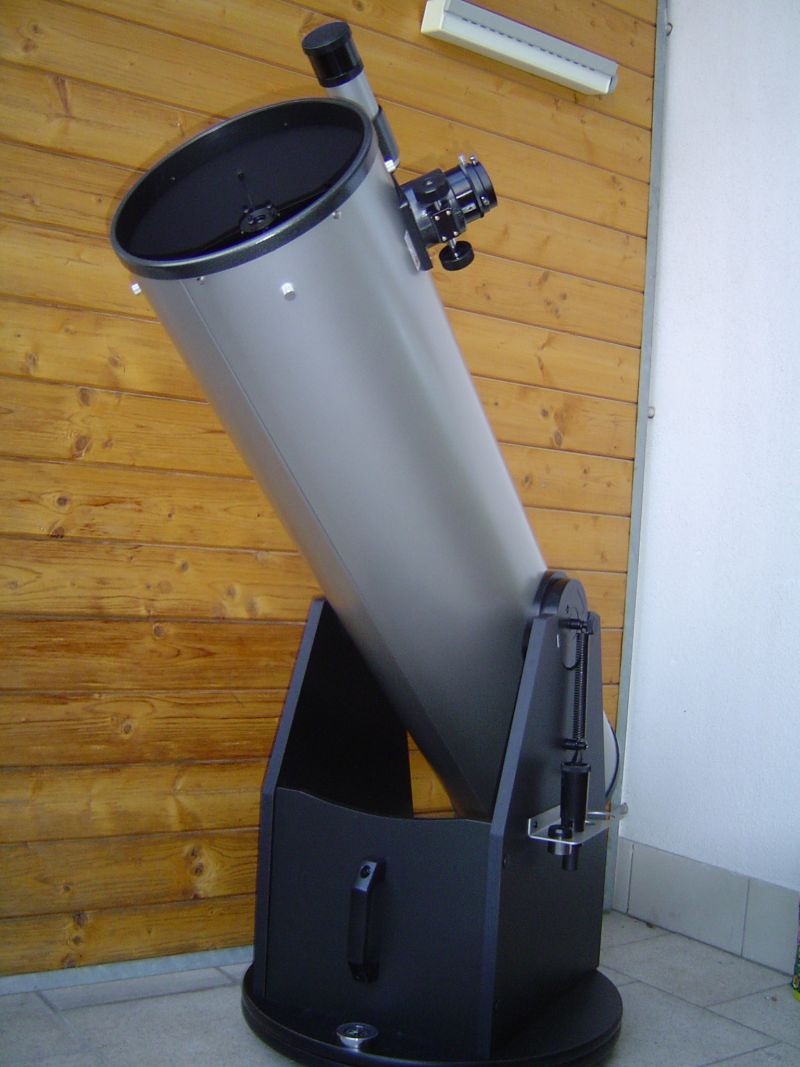
Credit: first uploaded on the English-speaking Wikipedia under the same filename
In practical terms, an 8-inch Dobsonian hits a “sweet spot” for backyard astronomy. It gathers enough light to start resolving globular clusters, show structure in bright galaxies under dark skies, and tease out delicate filaments in planetary nebulae with the right filters. At the same time, it remains portable enough for one person to carry in two pieces: the optical tube assembly (OTA) and the base. For beginners and experienced observers alike, it’s often recommended as a first serious telescope or as a reliable grab-and-go for deeper exploration.
This guide explains how the optical system works, what to expect from different focal ratios, and how to choose accessories. You’ll also find advice on collimation and cooling, a comparison to 6-inch and 10-inch models in the size comparison section, and a field-oriented checklist covering portability and storage in the portability section. If you’re on the fence about which version to buy, jump to the buying guide for feature-by-feature considerations.
How a Dobsonian Works: Optics, Base, and Motion

Artist: Fernly at English Wikibooks
The Dobsonian concept marries a Newtonian optical tube with a simple alt-azimuth mount. Here’s how the pieces fit together:
- Primary mirror (parabolic): A 203 mm mirror gathers and focuses light. Parabolic figures minimize on-axis spherical aberration, ensuring sharp central images.
- Secondary mirror (flat): This small, flat mirror diverts the focused light 90 degrees to the side of the tube, where the focuser and eyepiece reside.
- Focuser: Commonly a 2-inch Crayford or rack-and-pinion focuser, accepting both 2-inch and 1.25-inch eyepieces (via an adapter). Smooth, backlash-free focusing is essential at high magnifications.
- Dobsonian base: A rocker box that pivots in altitude (up-down) and azimuth (left-right). The classic setup uses low-friction materials like Teflon on laminate for smooth, hand-pushed tracking.
Because the mount is alt-azimuth, you move the telescope manually to follow objects as they drift due to Earth’s rotation. With practice, “nudging” becomes second nature. The simplicity reduces cost and setup complexity yet maintains impressive stability for visual observing. For astrophotography, a Dobsonian isn’t an ideal match for long-exposure, deep-sky imaging due to field rotation and lack of precise motorized tracking; short-exposure lunar and planetary “lucky imaging” is possible, a point we address in the FAQs.
Many 8-inch Dobsonians are f/6 (about 1200 mm focal length), though some are f/5 (around 1000 mm). The focal ratio affects field of view, coma at the field edges, and exit pupil for a given eyepiece, which we unpack in the next section.
Aperture, Focal Ratio, and Real-World Performance
Aperture and focal ratio drive much of what you’ll see through an 8-inch Dobsonian. Understanding these parameters will help you make informed choices about eyepieces and expectations.
Why 8 Inches Matters
- Light gathering: Compared to a 6-inch, an 8-inch mirror collects about (8/6)^2 ≈ 1.78 times more light—roughly a 78% increase. Versus a 10-inch, the 8-inch gathers about (8/10)^2 = 0.64, or 64% of the 10-inch’s light.
- Resolution: Angular resolution scales with aperture. Using common rules of thumb:
- Rayleigh criterion ≈ 138 / D(mm) arcseconds → about 138 / 203 ≈ 0.68″
- Dawes’ limit ≈ 116 / D(mm) arcseconds → about 116 / 203 ≈ 0.57″
Atmospheric seeing often prevents you from reaching these limits, but an 8-inch has the optical potential to split many tight double stars and reveal planetary detail when the air steadies.
Focal Ratio and Field Behavior
Most 8-inch Dobsonians are f/6 or f/5. The focal ratio influences:
- Coma: Off-axis aberration more noticeable at faster focal ratios (f/5). Wide-angle eyepieces can reveal triangular star shapes near the field edge in f/5 systems. An f/6 scope typically shows milder coma. A coma corrector is optional; many observers live with the edge performance, especially for visual use.
- True field of view (TFOV): Faster scopes provide a wider TFOV for a given eyepiece. This helps with star-hopping and framing large objects.
- Eyepiece sensitivity: Fast telescopes are more demanding on eyepieces. Premium widefields control off-axis aberrations better at f/5. At f/6, even modest eyepieces often perform well.
Magnification, Exit Pupil, and Practical Limits
Observing comfort and image brightness rely on three linked quantities: magnification, exit pupil, and seeing conditions.
- Magnification (M) is set by telescope focal length (F) and eyepiece focal length (f):
M = F_telescope / f_eyepiece Example: 1200 mm telescope, 10 mm eyepiece → 120x - Exit pupil (the diameter of the beam leaving the eyepiece) is:
Exit pupil = f_eyepiece / f_ratio Example: 30 mm eyepiece in f/6 → 5 mm exit pupil - True field of view (approximate) is:
TFOV ≈ Apparent FOV / Magnification
Example: 68° eyepiece at 60x → ~1.1° TFOV
A typical 8-inch f/6 runs comfortably from about 40x to 200x on most nights, with 250–300x reserved for steady conditions. A commonly cited upper bound is ~50x per inch of aperture under excellent seeing, but in practice local atmosphere limits you long before the optics do. Low power (large exit pupils of ~4–6 mm) is ideal for sweeping star fields and locating objects; medium power (~2–3 mm exit pupils) is perfect for galaxies and nebulae; high power (~1 mm exit pupil and below) pulls detail from planets and tight doubles when the air steadies.
Dobsonian Mount Stability, Bearings, and Smooth Tracking
One hallmark of the Dobsonian is its stable, intuitive mount. Smooth, consistent friction is crucial for comfortable hand-tracking at high magnification.
Base Materials and Bearings
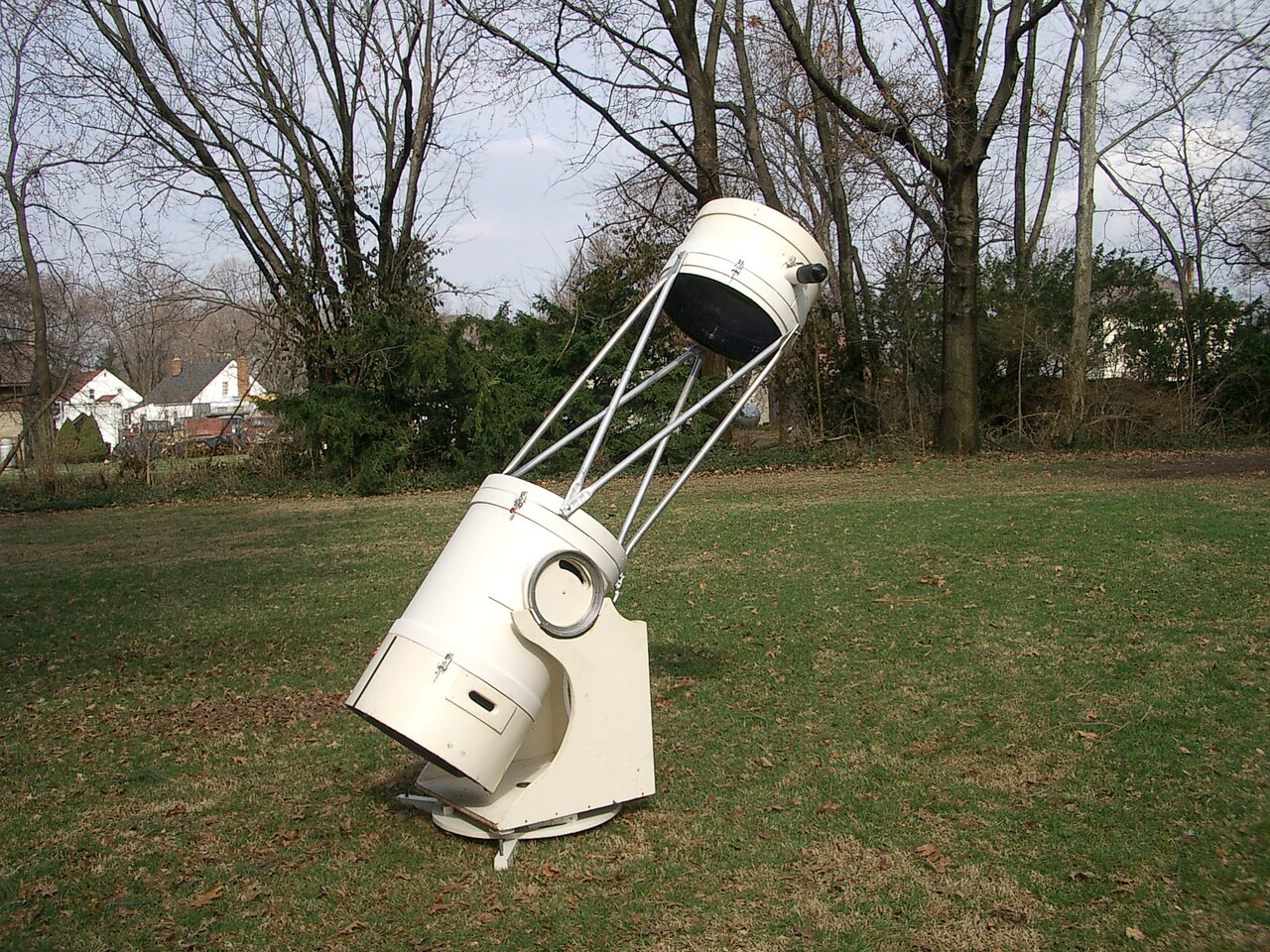
Artist: JamesStewart669
- Rocker box materials: Many commercial bases use engineered wood (particleboard or MDF) with a laminate surface; some premium or DIY builds favor lighter plywood. A good laminate-Teflon interface creates a buttery-smooth glide.
- Azimuth movement: Classic designs use Teflon-on-laminate pads. Some models add a “lazy Susan” bearing. While very low friction feels nice at low power, it can make precise high-power nudging tricky. Many observers prefer a tuned friction that resists wind but moves predictably.
- Altitude bearings: Large radius bearings distribute weight for smoother movement and better balance. Some designs use spring tensioners or adjustable clutches to keep heavy eyepieces from causing the tube to dip.
Balancing and Payload
Wide-angle eyepieces, coma correctors, and heavy finder scopes alter balance. To maintain smooth motion:
- Add counterweights (magnetic weights, ankle weights, or sliding weights) opposite heavy accessories.
- Use altitude tension adjustments or springs if provided.
- Avoid overtightening bearings; stiction (stick-slip) ruins fine tracking.
When set correctly, a well-tuned 8-inch Dob tracks planets smoothly at 150–250x, with gentle taps in altitude and azimuth. If your scope feels jumpy or too loose, see Troubleshooting for field fixes.
Collimation, Cooling, and Mirror Care
Newtonian reflectors are straightforward to collimate once you know the steps. Good collimation and thermal equilibrium can be the difference between fuzzy and razor-sharp views.
Tools and Methods

Artist: Morn
- Collimation cap: A simple, effective tool that centers the primary and secondary reflections.
- Cheshire/sight tube: Adds precision, aligns secondary placement and primary tilt.
- Laser collimator: Fast for aligning the primary and secondary; verify laser alignment and finish with a star test.
A basic, reliable workflow:
1) Center the secondary under the focuser (sight tube/Cheshire).
2) Adjust the secondary tilt so the focuser axis hits the primary’s center mark.
3) Adjust the primary mirror tilt so the return beam (or Cheshire reflection) is centered.
4) Perform a star test at high power on a bright star: defocus slightly inside/outside focus.
   - Concentric rings indicate good collimation.
   - Asymmetry suggests further fine-tuning.
Cooling and Thermal Equilibrium
Mirrors perform best when they reach ambient temperature. Without adequate cooling, you may see shimmering “heat plumes” and soft detail, especially at high power. Many 8-inch Dobsonians include or can accept a small rear fan that pulls air across the primary mirror. Consider:
- Set the scope outside early: Allow 30–60 minutes for an 8-inch mirror to settle, depending on the temperature drop and enclosure.
- Use a fan: A gentle, quiet fan behind the primary helps speed equilibrium and reduce boundary layer effects.
- Avoid heat sources: Concrete and roofs radiate heat; observe from grass when possible.
Cleaning and Handling Mirrors
Coated mirrors are durable but should be cleaned sparingly. Light dust rarely affects views and is better left alone than risk scratches. When a cleaning is truly needed:
- Remove the primary carefully, noting screw/clip positions and orientation.
- Rinse with distilled or clean tap water to float off dust; use a gentle soap solution if necessary.
- Rinse thoroughly with distilled water; let it drip-dry or wick remaining droplets with optical tissue by touching (not wiping) edges.
- Ensure mirror clips don’t pinch the primary upon reassembly; clips should just prevent rattling, not apply pressure.
Secondary mirrors rarely need cleaning; if they do, follow similar gentle methods. After any disassembly, repeat collimation.
Eyepieces, Finders, and Smart Accessories
Great views come from pairing the telescope with a sensible set of eyepieces and accessories. Start with the strengths of an 8-inch: it can deliver bright, wide fields at low power and crisp, detailed views at higher power under good seeing.
Eyepiece Strategy
One effective three-tier set for an 8-inch f/6:
- Low power (finder/ widefield): 30–32 mm eyepiece (2-inch) for ~37–40x and a large true field. Perfect for framing open clusters and star-hopping.
- Medium power (workhorse): 14–18 mm (≈ 67–85x). Ideal for galaxies, bright nebulae, and globular clusters—especially paired with a UHC or O-III filter.
- High power (planetary/doubles): 6–10 mm (≈ 120–200x). Excellent for Jupiter, Saturn, Mars (in season), the Moon, and double-star splits.
A 2x Barlow effectively doubles your eyepiece collection and helps you reach high magnifications without resorting to very short focal length eyepieces. In fast scopes (f/5), wide-angle eyepieces with better edge correction can improve off-axis performance. If you’re running f/5 and are sensitive to coma, consider a coma corrector, acknowledging the added weight and backfocus considerations that can affect balance (see mount stability).
Filters: Bringing Out Faint Details
- UHC (Ultra High Contrast): Useful for emission nebulae like the Lagoon (M8) and Orion; increases contrast under light-polluted skies by rejecting common light pollution bands.
- O-III: Strongly enhances planetary nebulae (e.g., the Dumbbell, the Helix) and supernova remnants (e.g., the Veil under dark skies).
- Neutral density or variable polarizer: Tames the Moon’s brightness for comfort and subtle detail.
Finders and Aiming Aids
- Red-dot finder (RDF): Intuitive for initial pointing; shows where the tube is aimed against the naked-eye sky.
- RACI finder (Right-Angle Correct-Image, e.g., 8×50 or 9×50): Comfortable star-hopping view that matches star charts; pairs well with an RDF or reflex sight.
- Reflex sights: Large projected reticles (e.g., bullseye patterns) are excellent for navigating to bright asterisms before switching to RACI.
Comfort and Utility Add-Ons
- Adjustable observing chair: Arguably the single best upgrade; steady posture reveals more detail at the eyepiece.
- Dew control: Dew shields for the finder, gentle heat for the secondary (if needed), and lens caps for idle eyepieces help prevent fogging.
- Red headlamp: Preserves night vision while leaving hands free.
- Planisphere or astronomy app: Complements the scope with sky context; star-hopping is faster with a good chart and a well-chosen eyepiece set.
- Collimation tools: Keep a collimation cap/Cheshire in your kit; a well-collimated scope consistently outperforms an uncollimated one of larger size.
6-Inch vs 8-Inch vs 10-Inch: Which Size Fits You?
All three apertures have devoted fans. The 8-inch often strikes the most balanced compromise between light grasp, portability, and cost, but personal circumstances can tilt the decision.
6-Inch Dobsonian
- Pros: Lighter, smaller, cools quickly, and typically less expensive. Easier to store and carry up stairs.
- Cons: About 44% less light-gathering than an 8-inch (1 − (6/8)^2). Fainter galaxies and globulars are more challenging, especially under light pollution.
- Best for: Observers with strict portability constraints or tight budgets who still want satisfying lunar, planetary, and brighter Messier object views.
8-Inch Dobsonian
- Pros: Major leap in light grasp over a 6-inch; still very manageable to transport; excellent all-rounder for both planets and deep-sky.
- Cons: Heavier than a 6-inch; base and tube may be bulkier for compact cars; cooldown a bit longer.
- Best for: First serious telescope or do-it-all visual instrument, balancing power and convenience.
10-Inch Dobsonian
- Pros: Roughly 56% more light than an 8-inch; reveals more structure in galaxies and added granularity in globulars under good skies.
- Cons: Bulk and weight increase; setup and cooldown take longer; demands more careful mounting, balance, and possibly larger vehicle space.
- Best for: Observers prioritizing deep-sky performance and who have room to store and transport a larger instrument.
In short, if you can comfortably manage the size and transport of an 8-inch, it’s a robust choice that opens the door to a lifetime of targets. If dark-sky travel is rare and storage is tight, a 6-inch might be smarter. If you plan frequent trips to dark sites and can manage the extra weight, a 10-inch pulls ahead on galaxies and nebulae.
What You Can See: Planets, Deep-Sky, and Seasonal Tours
Under steady skies with good collimation and thermal equilibrium, an 8-inch Dobsonian produces views that keep people in the hobby for decades. Expectations should be grounded in real-world conditions such as light pollution (Bortle scale), seeing (atmospheric steadiness), and target elevation. Here’s a practical tour.
The Moon
- Low to medium power: Sweep the lunar terminator where long shadows highlight craters, rilles, and mountains. A neutral-density or variable polarizing filter can add comfort and reduce glare.
- High power: Craterlets in Clavius, rilles near the Alpine Valley, and delicate wrinkle ridges become accessible when the air steadies.
Planets
- Jupiter: Cloud bands, festoons, barges, and the Great Red Spot are visible; watch moon transits and shadows. High contrast improves with patience and moments of steady seeing.
- Saturn: The Cassini Division is commonly seen; ring tilt affects visibility year to year. Subtle banding on the globe and a handful of moons are within reach.
- Mars: Near opposition, albedo features, polar caps, and limb hazes appear at 150–250x. Outside opposition, Mars is smaller and less detailed.
- Venus and Mercury: Phases are easy; surface detail is absent in visible light for Venus, but cloud-top contrast filters exist. Mercury benefits from twilight steadiness and high elevation.
Double Stars
With good seeing, an 8-inch resolves many challenging pairs. Notable examples include pairs near the Dawes limit when the air cooperates. Star colors stand out beautifully at moderate magnifications.
Deep-Sky Objects
- Open clusters: Sparkling fields such as the Double Cluster, the Beehive (M44), and M35 are spectacular in a 30–32 mm eyepiece.
- Globular clusters: M13, M5, and M3 begin to resolve into granulated stars at medium to high power. Dark skies make a dramatic difference.
- Galaxies: Bright spirals like M81/M82, M51 (with hints of structure under dark skies), and M31 show dust lanes and core brightness variations. Urban light pollution dims low-surface-brightness detail; use higher magnification to darken the background sky when appropriate.
- Nebulae: Emission nebulae (e.g., Orion) bloom with a UHC; planetary nebulae (e.g., the Blue Snowball) pop at medium to high power with an O-III.
- Supernova remnants: The Veil Nebula reveals filamentary arcs under dark skies with an O-III filter and a widefield eyepiece.
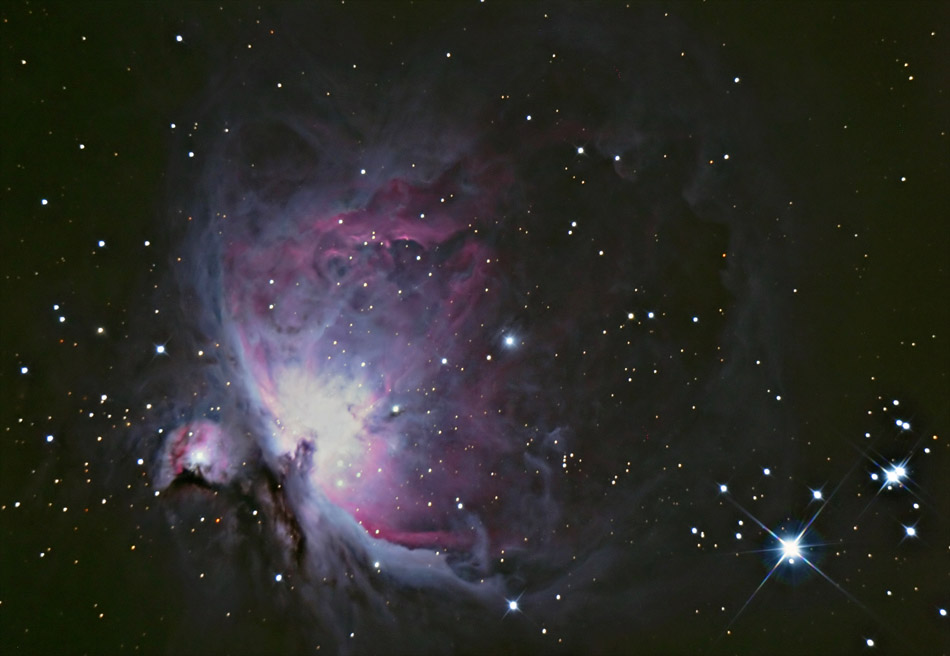
Artist: Rochus Hess
Seasonal First-Light Tour (Sample)
Use a 30–32 mm eyepiece to locate targets, then increase power to tease out detail:
- Spring: Galaxy season—M81/M82 in Ursa Major; Markarian’s Chain in Virgo/Coma for wide sweeps; M104 (Sombrero) for a sharp dust lane.
- Summer: The Lagoon (M8) and Trifid (M20) in Sagittarius with a UHC; the Swan (M17); globular M22; the Wild Duck (M11) as a dense open cluster; the Veil in Cygnus with O-III for filaments.
- Autumn: Andromeda Galaxy (M31) and companions; the Double Cluster; NGC 752 for a wide, delicate cluster; planetary nebulae in Aquarius and Pegasus.
- Winter: The Orion Nebula (M42) with the Trapezium; M1 (Crab) under darker skies; open clusters like M37/36/38 in Auriga; the Beehive late in the night or early spring.
Tip: Many observers spend more time at the eyepiece when they prepare a short list of targets for each session. Mix easy showpieces with one or two challenges to sharpen your star-hopping skills. Keep filters and eyepieces handy to adjust contrast and scale quickly.
Portability, Storage, and Night-Readiness
An 8-inch Dobsonian is typically split into two pieces: the OTA and the base. Approximate weights vary by brand and construction, but each component is often in the range of roughly 8–12 kg (about 18–26 lb). Many observers carry each piece separately and assemble at the observing site in under a minute.
Transport and Handling
- Vehicle fit: Solid-tube 8-inch scopes usually fit across a back seat or in a trunk. Use blankets or foam for protection and to avoid sliding.
- Carrying methods: Use base cutouts/handles; consider a soft strap or sling for the OTA. Move slowly to prevent bumps; keep the tube capped.
- Stairs and tight spaces: If you have multiple flights of stairs, measure and plan routes. Some users store the base near ground level and bring the tube up and down as needed.
Storage and Environmental Concerns
- Dry, stable environment: Store indoors away from humidity swings. Avoid unventilated sheds that trap heat and moisture.
- Dust and pests: Keep caps on; consider a breathable cover. Avoid plastic bags that can trap moisture.
- Cooldown strategy: If nights cool rapidly, set the scope outside early. In colder seasons, insulate yourself and bring warm packs; your comfort directly affects observing quality.
Quick-Start Night Checklist
• Collimation cap and quick check before sunset.
• Eyepieces: low/medium/high power, plus Barlow.
• Filters: UHC, O-III, lunar.
• Finder powered and aligned (RDF battery checked).
• Red headlamp; printed chart or app.
• Observing chair, dew prevention, microfiber cloths.
• Fan battery (if used) and tools for minor tweaks.
Buying Guide: Features, Options, and Budget
Most 8-inch Dobsonians share core traits, but details vary in ways that affect usability and long-term satisfaction. This section walks through key checkpoints. If you’re deciding between models after reading this, revisit mount stability and accessory strategy to visualize how each option fits your observing style.
Focal Ratio and Optical Tube
- f/6 (≈1200 mm): Balanced performance; milder coma; forgiving on eyepieces; great all-rounder.
- f/5 (≈1000 mm): Wider fields; more compact tube; more sensitive to eyepiece edge performance and coma. Consider a coma corrector if edge sharpness is a priority.
- Focuser: A 2-inch dual-speed Crayford is desirable for fine focusing at high power and compatibility with wide 2-inch eyepieces.
Base and Bearing Design
- Altitude bearings: Larger radius or adjustable tension mechanisms maintain balance with heavy accessories.
- Azimuth bearing surface: Teflon-on-laminate offers controlled friction; turntable bearings feel light but may require tuning to avoid overshoot at high power.
- Build quality: Sturdy joinery, smooth edges, and accessible handles improve transport and longevity.
Included Accessories
- Finder scope: Many packages include a red-dot and/or RACI finder. A RACI around 8×50 or 9×50 is a valuable asset for star-hopping.
- Eyepieces: Kits vary from single Plössls to multiple eyepieces plus a Barlow. You can upgrade later; don’t overpay for included pieces you’ll replace quickly.
- Cooling fan: A rear-mounted fan expedites thermal equilibrium; inexpensive and helpful.
- Collimation tools: A simple cap is useful out of the box; plan to add a Cheshire or a well-aligned laser for precision.
Pricing for 8-inch Dobsonians commonly falls in the mid-hundreds of USD to around a thousand, depending on focal ratio, focuser type, bearing design, and accessory package. Exact costs fluctuate over time and by region. When comparing, focus on optical quality, mount smoothness, and the features you’ll use often. If a package includes a robust finder, a dual-speed focuser, and a cooling fan, those conveniences tend to pay dividends at the eyepiece.
Troubleshooting Common Issues in the Field
Most problems have simple fixes. Here’s how to diagnose and tune your scope’s performance.
Views Look Soft or Unsteady
- Check collimation: A quick star test at high power reveals misalignment. Realign and test again.
- Allow for cooldown: Heat plumes can mimic poor optics. Run the fan, wait 30–60 minutes, and recheck.
- Match magnification to seeing: Nights of poor seeing limit planetary detail; back off the power to ~120–150x.
- Avoid heat radiators: Observe over grass when possible; nearby roofs and asphalt produce turbulence.
Mount Feels Sticky or Overshoots
- Check bearing surfaces: Dust or grit increases stiction; gently clean Teflon pads and laminate.
- Adjust tension: If your scope has altitude springs or clutches, fine-tune until motion is smooth but secure.
- Balance payload: Heavy eyepieces and accessories up front need counterweights in back.
Star Shapes Look Triangular or Comatic at the Edge
- Coma: Normal in fast Newtonians; move targets toward the center or consider a coma corrector for wide-field work.
- Pinched optics: If star images look triangular across the field, loosen primary mirror clips slightly so they don’t pinch the glass.
- Astigmatism: Could be the eyepiece at large exit pupils or your own eye; test with a different eyepiece and rotate the eyepiece to diagnose.
Finder Alignment Is Off
- Daylight alignment: Center a distant terrestrial object in a low-power eyepiece, then adjust the finder to match. Recheck at night on a bright star.
- Secure mounting: Loose brackets drift; snug set screws and re-verify alignment after bumps.
Dew and Moisture
- Secondary and finder dewing: Gentle heat or a dew shield helps. Keep spare caps ready for eyepieces not in use.
- Post-session drying: Store the scope in a dry area; avoid sealing in moisture with plastic bags. Ventilate the cap if you must cover immediately after a dewy session.
Frequently Asked Questions
Is an 8-inch Dobsonian good for beginners?
Yes. The mount is intuitive, setup is quick, and the optical performance is rewarding. The main skills to learn are basic collimation, gentle hand-tracking, and sensible eyepiece selection (see eyepieces and accessories). The size is manageable for most adults, and two-piece carry makes transport practical. If storage or stairs are significant constraints, consider a 6-inch; if you can handle more bulk for deeper views, a 10-inch may appeal.
Can I do astrophotography with an 8-inch Dobsonian?
For long-exposure deep-sky imaging, a Dobsonian is not the best tool due to field rotation on an alt-az mount and lack of precise motorized tracking. However, for lunar and planetary imaging, you can capture short video clips with a planetary camera or a smartphone adapter and then stack frames to enhance detail (a technique called “lucky imaging”). Visual observing remains the Dobsonian’s core strength; if you anticipate a heavy imaging focus, consider an equatorial mount or a different setup purpose-built for that task.
Final Thoughts on Choosing the Right 8-Inch Dobsonian
An 8-inch Dobsonian telescope is a powerful, practical gateway to the night sky. It delivers substantial light grasp and resolution in a package that’s easy to set up, intuitive to use, and friendly to upgrade over time. With sound collimation, adequate cooling, and smart eyepiece choices, this class of telescope excels on the Moon and planets and opens up deep-sky vistas that keep observers engaged year-round.
When comparing models, prioritize smooth mount motion, a solid focuser, and a finder system you’ll enjoy using. Decide whether you prefer the broader fields of an f/5 or the gentler edge behavior of an f/6. Build a small, versatile kit around low-, medium-, and high-power eyepieces, and add a UHC or O-III filter to amplify nebular contrast. Above all, give yourself time at the eyepiece—experienced observers see more not because of different optics but because they practice observing patiently.
If this guide helped you clarify your choices and plan your first nights out, consider exploring our related deep-sky tours and equipment primers. For ongoing tips on observing, gear, and seasonal targets, subscribe to our newsletter and join us for next week’s article.

Artist: James Stewart 669