Table of Contents
- What Is Numerical Aperture in Light Microscopy?
- Resolution, Diffraction Limits, and How NA Governs Detail
- Condenser NA, Illumination Coherence, and Capturing Fine Structure
- Trade-offs: Working Distance, Depth of Field, and NA
- Air, Water, Glycerol, and Oil Immersion: Refractive Index and NA
- Cover Glass Thickness, Spherical Aberration, and Correction Collars
- Camera Pixel Size, Nyquist Sampling, and Effective Magnification
- Choosing Objectives by NA: When More Is—and Isn’t—Better
- Frequently Asked Questions
- Final Thoughts on Mastering Numerical Aperture and Resolution
What Is Numerical Aperture in Light Microscopy?
Numerical aperture (NA) is one of the most important specifications on a microscope objective, often printed right alongside its magnification. If magnification tells you how large an image appears, NA tells you how much detail the objective can theoretically transmit. In optics terms, NA quantifies the light-gathering and resolution capability of the objective’s front lens by describing the cone of light that can enter or exit the system in the sample medium.
Formally, numerical aperture is defined as NA = n \\sin(\\theta), where n is the refractive index of the medium between the specimen and the objective’s front lens (air, water, glycerol, or immersion oil), and θ is the half-angle of the light acceptance cone in the object space. A larger \\theta (wider cone) or a higher n both increase NA. That simple relationship explains many practical choices microscopists make: switching from air to immersion, using a high-NA condenser, or selecting objectives based on front lens design and working distance.

Key implications of NA include:
- Resolution potential: Higher NA can support finer spatial detail because it collects higher spatial frequencies from the specimen. See Resolution, Diffraction Limits, and How NA Governs Detail.
- Light throughput: Higher NA gathers more light, generally improving image brightness at the sensor for the same illumination and exposure conditions.
- Depth of field trade-offs: Increasing NA reduces depth of field and depth of focus, which places higher demands on focusing accuracy and mechanical stability (discussed in Trade-offs: Working Distance, Depth of Field, and NA).
- Compatibility with immersion media: By increasing the refractive index between specimen and objective, immersion objectives can reach NA significantly higher than air objectives (see Air, Water, Glycerol, and Oil Immersion).
Because NA bundles together several foundational aspects of imaging performance, it is the natural starting point for understanding what a microscope objective can, and cannot, reveal.
Resolution, Diffraction Limits, and How NA Governs Detail
In optical microscopy, even a perfect, aberration-free lens cannot resolve arbitrarily small features. The fundamental limitation arises from diffraction: a point source is imaged not as an infinitesimal point but as a finite diffraction pattern known as the point spread function (PSF). Two closely spaced points blur into overlapping patterns, and their separation must exceed a certain distance to be recognized as distinct structures.
Two closely related metrics are commonly cited to quantify this limit:
- Rayleigh criterion (widefield, incoherent imaging): The lateral distance for just-resolvable points is approximately
\\delta_R \\approx 0.61\\,\\lambda / NA, where\\lambdais the imaging wavelength. - Abbe limit (periodic structures): The smallest resolvable feature period is approximately
d_{Abbe} \\approx \\lambda / (2\\,NA). This is often discussed in the context of resolving fine gratings or repeating patterns.
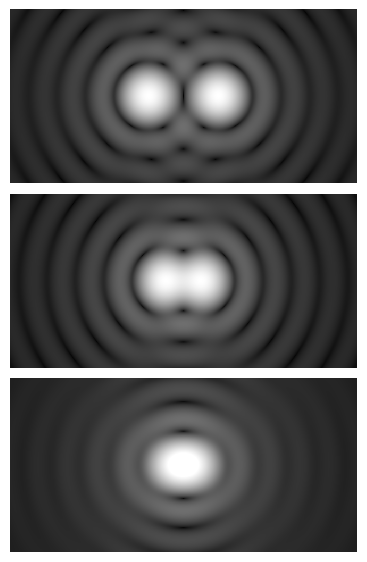
For typical brightfield microscopy with incoherent illumination, both expressions convey the same fundamental message: lateral resolution improves as NA increases and as wavelength decreases. Practical microscopy usually treats these limits as guides rather than hard lines, since contrast criteria and image processing can influence how “resolved” a structure appears, but the physics-based trend is unambiguous.
Axial (z) resolution has a different dependence on NA. A widely used scaling shows axial resolution varying inversely with the square of NA and directly with refractive index and wavelength. In other words, the axial dimension is much more sensitive to NA than the lateral dimension. As a result, high-NA objectives are invaluable when discerning structures not only across the plane of focus but also along the optical axis.
It is useful to connect these limits to the spatial frequency picture. In incoherent imaging, the optical transfer function (OTF) has a cutoff spatial frequency roughly proportional to 2\\,NA/\\lambda for the lateral dimensions. A larger NA shifts this cutoff higher, allowing higher-frequency information (finer details) to pass through the imaging system. Reducing the wavelength has the same effect. In coherent imaging, by contrast, the cutoff is about NA/\\lambda. Real-world microscopy often lies between fully coherent and fully incoherent conditions depending on the illumination configuration, which is a key reason the condenser NA and illumination setup matter.
Practical takeaway: All else equal, doubling NA roughly halves the diffraction-limited feature size in the lateral dimension, while moving to a shorter wavelength proportionally improves resolution. The benefit of higher NA saturates if other factors—such as illumination coherence, specimen-induced aberrations, or sampling at the camera—are not aligned to exploit it.
Finally, remember that magnification alone does not change resolution; it only changes the apparent size of the image. “Empty magnification” occurs when magnification increases without a corresponding improvement in NA or optical quality. For example, pairing a low-NA objective with extreme eyepiece or digital magnification yields a larger but not more detailed image. The remedy is to focus on NA and the elements that support it, not just nominal magnification. The consequences for camera-based imaging and sampling are covered in Camera Pixel Size, Nyquist Sampling, and Effective Magnification.
Condenser NA, Illumination Coherence, and Capturing Fine Structure
Objectives do not work in isolation. Particularly in transmitted-light brightfield, the condenser and its aperture diaphragm are essential partners that determine how thoroughly the objective’s resolution potential is realized. The condenser forms the illumination cone at the specimen; its numerical aperture sets how many illumination angles contribute. This, in turn, influences the degree of spatial coherence and the system’s ability to transfer fine detail.
Two practical principles are broadly applicable:
- Match, or slightly underfill, condenser NA to objective NA for maximum detail: If the condenser NA is significantly lower than the objective NA, the system can fail to deliver the objective’s full lateral resolution because the high-angle illumination needed for the highest spatial frequencies is missing. When possible, set the condenser aperture so the illumination cone approximately matches the objective’s acceptance. Many microscopists use a slight underfilling to trade a bit of resolution for improved contrast and stray light control.
- Adjusting the condenser aperture controls contrast and resolution: Closing the aperture increases contrast and depth of field but reduces resolution (and brightness). Opening it increases resolution and brightness but lowers inherent contrast and depth of field. The correct setting depends on sample transparency, desired contrast, and the goals for fine detail.
The coherence of illumination also matters. Incoherent or partially coherent illumination generally supports higher lateral spatial frequency transfer than fully coherent illumination. Köhler illumination—an alignment approach that provides even, defocused illumination at the sample plane and conjugate aperture control—helps ensure that the condenser NA and aperture are used effectively. While the mechanical steps of alignment are outside the scope here, the conceptual link is direct: good illumination practice allows the objective’s NA to govern resolution rather than illumination artifacts.
For reflected-light (epi) microscopy, there is no separate condenser, but the illumination path shares the objective. Even so, the effective source distribution and pupil fill still influence coherence and contrast. The same rule of thumb applies: insufficient pupil fill can limit transfer of high spatial frequencies, reducing the realized benefit of a high-NA objective.
These considerations explain why two microscopes with the same objective can deliver noticeably different images. The “hidden variables” are often the condenser NA, aperture setting, lamp or LED characteristics, and alignment quality. If maximizing fine detail is your priority, verify that the illumination pathway supports the objective’s NA rather than constraining it.
Trade-offs: Working Distance, Depth of Field, and NA
High NA magnifies not only specimen details but also certain practical difficulties. Two of the most important are working distance and depth of field (DOF), alongside its counterpart at the image plane, depth of focus.
Working distance vs. NA
The working distance is the physical clearance from the objective’s front lens to the focused specimen surface. To capture a wider cone of light (larger \\theta in NA = n\\sin\\theta), the front lens must sit closer to the specimen or be made larger relative to focal length. Consequently, higher NA typically implies a shorter working distance. This is especially evident in high-magnification, high-NA objectives, where clearances can be very small.
Shorter working distance constrains sample types (e.g., thicker samples or those with protruding features may be difficult to image) and elevates the risk of contact between the lens and specimen. It also necessitates careful handling and sometimes the use of immersion media. Long-working-distance (LWD) objectives mitigate this constraint, but for a given magnification they generally offer lower NA than their short-working-distance counterparts.
Depth of field and depth of focus
Depth of field is the axial range in object space over which the specimen appears acceptably sharp. Diffraction theory shows that DOF shrinks rapidly as NA increases, with a typical scaling on the order of n\\,\\lambda/NA^2 for the diffraction-limited component. While different definitions of “acceptably sharp” lead to slightly different constants in front of that expression, the core dependence is consistent: higher NA means thinner DOF.

Depth of focus is the tolerance at the image plane (camera sensor or eyepiece intermediate image) within which focus remains acceptably sharp. It also decreases as NA increases. With high-NA objectives, even small mechanical disturbances can move the image outside the permissible focus range, which is one reason vibration isolation and stable mounting improve the practicality of high-NA imaging.
These relationships explain why focusing feels “touchier” at higher NA and why stopping down the condenser aperture (thereby reducing the effective NA of illumination) appears to increase DOF—though at some cost to resolution and brightness. They also clarify why techniques such as focus stacking become common in high-magnification imaging of thick or three-dimensional specimens: a thin DOF requires synthesizing an extended focus view if the goal is to display more of the specimen in focus simultaneously.
F-number perspective for camera systems
Microscope objectives can be related to the photographic concept of f-number. For high magnification (where magnification M at the sensor is much greater than 1), the effective f-number in image space is approximately f/# \\approx M / (2\\,NA). This approximation helps bridge concepts between microscopy and photography. A lower f-number corresponds to a “faster” optical system at the camera sensor plane, consistent with higher NA yielding more light and shallower depth of focus. This connection is useful when considering exposure and noise with digital cameras.
To sum up, high NA gives you finer detail and more photons at the cost of tighter tolerances on focus and working distance. Choosing the right NA is therefore inseparable from thinking about your specimen thickness, mounting, mechanical stability, and the imaging goals you care about most. For a structured decision process, see Choosing Objectives by NA: When More Is—and Isn’t—Better.
Air, Water, Glycerol, and Oil Immersion: Refractive Index and NA
The refractive index of the medium between the specimen and the objective determines, together with the acceptance angle, the numerical aperture. Air-immersion objectives (n ≈ 1) are common and convenient, but water-, glycerol-, and oil-immersion objectives enable higher NA by virtue of higher refractive index. They also influence aberrations related to refractive index mismatch.
How immersion increases NA

Recall NA = n\\sin\\theta. Increasing n allows NA greater than what air alone permits, even with the same acceptance angle \\theta. Immersion objectives are designed to operate with a specified medium in contact with the front lens. This eliminates the air gap and reduces refraction at the interface, letting more of the high-angle rays from the specimen enter the objective.
- Air immersion: Most accessible; maximum NA is limited by
n \\approx 1and practical lens geometry. - Water immersion: Matches the refractive index of many biological samples and aqueous mounting media, reducing spherical aberration when focusing into water-based specimens. Supports higher NA than air for the same geometry.
- Glycerol immersion: Offers an intermediate refractive index, often used when imaging into media with similar refractive indices to reduce mismatch-induced aberrations.
- Oil immersion: Designed to match the refractive index of standard cover glass, allowing very high NA in thin, coverslipped preparations. Particularly effective for maximizing lateral resolution at or near the cover glass plane.
Aberrations and refractive index matching
Refractive index mismatches between the immersion medium, cover glass, mounting medium, and specimen can introduce spherical aberration, which broadens the point spread function and degrades contrast and resolution. Oil-immersion objectives are typically optimized for a glass–oil–glass path near the coverslip, while water-immersion objectives are optimized for aqueous environments. Using the wrong immersion medium, or imaging far from the plane for which the objective is corrected, can erode the benefits of a high NA.
Water-immersion objectives often excel when focusing into aqueous specimens because they maintain better axial resolution and contrast over depth, whereas oil-immersion objectives are optimal for thin, coverslipped samples near the glass interface. Glycerol can be a compromise for samples or clearing media whose refractive index sits between water and oil. The guiding idea is consistency of refractive index along the optical path to minimize aberrations—as elaborated in Cover Glass Thickness, Spherical Aberration, and Correction Collars.
Practical handling notes
- Use the immersion medium the objective is designed for; mixing or substituting media compromises performance.
- Maintain a clean front lens and proper contact with the medium to avoid stray reflections and degraded contrast.
Immersion is a tool to extend NA and maintain image quality across refractive index transitions, but it works best when the overall optical path—specimen, mounting medium, cover glass, immersion medium—forms a consistent, well-corrected stack.
Cover Glass Thickness, Spherical Aberration, and Correction Collars
High-NA imaging is sensitive to small optical imperfections, and one of the most common sources is the cover glass. Many objectives are designed with a specific cover glass thickness in mind, often noted on the barrel (for example, a value commonly used in microscopy). Deviations from the intended thickness, or imaging without a cover glass when one is expected, can introduce spherical aberration that degrades resolution and contrast.

Why cover glass thickness matters
Light rays entering the objective at high angles travel through more material near the periphery of the lens. If the cover glass thickness or refractive index differs from the design assumptions, those rays focus at slightly different axial positions than paraxial rays. The result is a broadened point spread function and reduced peak intensity—exactly the opposite of what you want when pushing to high NA.
In practice, small departures from the design thickness may be tolerable for moderate NA, but the tolerance narrows as NA increases. The situation becomes especially stringent for oil-immersion objectives, which are capable of very high NA and therefore are more sensitive to path mismatches near the coverslip.
Correction collars and how they help
Some high-NA objectives include a correction collar. This feature allows the user to compensate for small differences in cover glass thickness or temperature-related index variations by mechanically adjusting the lens group spacing. When properly set, it reduces spherical aberration and restores contrast, particularly off-axis.
Conceptually, a correction collar tunes the objective’s internal aberration balancing to match the optical path formed by your specific cover glass and mounting medium. While the exact calibration technique depends on the microscope and objective design, the general goal is to optimize image sharpness at the actual working conditions. Collared objectives are especially useful in live-sample imaging where the refractive index of the medium may change or where precise matching to the design cover glass is not guaranteed.
Flatness and field curvature
Another common label on objectives is the field correction, such as “plan,” indicating a design that flattens the field across a larger image circle. While not a direct function of NA, field curvature can interact with focusing tolerance at high NA. A plan-corrected objective helps ensure that the periphery of the field focuses similarly to the center—a subtle but important factor when working near the limits of depth of field. For large-format cameras or wide field numbers, this can be the difference between usable edge detail and noticeable blur.
In short, to preserve the resolution promised by high NA, match cover glass assumptions, use correction collars when available, and pay attention to field corrections that support your sensor size and field of view. The larger the sensor and the higher the NA, the more these refinements matter.
Camera Pixel Size, Nyquist Sampling, and Effective Magnification
Even if your optics deliver exquisite detail, your camera sampling must be sufficient to record it. Digital imaging imposes a sampling grid given by pixel size. If the pixel pitch at the specimen plane is too large relative to the optical resolution, fine details will be under-sampled and can appear softened or misrepresented (aliasing). The Nyquist–Shannon sampling theorem provides the guideline: to represent a highest spatial frequency, you need to sample at least twice per period.
Relating pixel size to specimen-plane sampling
The relevant number is the effective pixel size at the specimen, obtained by dividing the camera pixel size by the total system magnification between the specimen and the sensor. For an infinity-corrected system with a tube lens, the total magnification is the product of the objective’s magnification and any intermediate optics that change the image size at the camera. For example, if a camera has 4.8 µm pixels and the overall magnification to the camera is 40×, the specimen-plane pixel size is 4.8 µm / 40 = 0.12 µm.
To satisfy Nyquist sampling relative to a diffraction-limited lateral resolution \\delta, the specimen-plane pixel size should be no larger than about half of \\delta. Practically, this means:
- If your optics resolve features around 0.5 µm, aim for pixels on the order of 0.25 µm or smaller at the specimen plane.
- If your optics resolve features near 0.2 µm, aim for roughly 0.1 µm sampling or finer at the specimen plane.
If sampling is coarser than Nyquist, fine spatial frequencies cannot be uniquely represented and may manifest as moiré, loss of apparent sharpness, or misleading texture. On the other hand, sampling much finer than necessary does not improve optical resolution; it only yields larger files and possibly more read noise per unit area of the specimen. The goal is balanced sampling that preserves detail without waste.
Empty magnification vs. effective magnification
It is common to speak of “empty magnification” when the display magnification (or nominal optical magnification) surpasses what the optics and sampling can support. In digital systems, a clearer term is effective magnification—the magnification that brings the diffraction-limited features to at least the Nyquist sampling rate at the camera. Increasing magnification beyond this does not add optical information; it just spreads the same information across more pixels and screen real estate.
For a given objective NA and wavelength, you can estimate the lateral diffraction limit and then set a target specimen-plane sampling. From there, choose combinations of camera pixel size and tube lens magnification (if adjustable) that meet or slightly exceed Nyquist. The result is an image that captures the resolving power that your objective’s NA can provide, making your investment in high-NA optics worthwhile.
SNR, exposure, and the role of NA
Higher NA generally increases light collection and can improve the signal-to-noise ratio (SNR) for the same exposure conditions. Better SNR allows shorter exposures, reduced illumination intensity, or both, which can help with vibration sensitivity and sample stability. However, higher NA also reduces depth of focus at the sensor, demanding more precise focusing and possibly more stringent vibration control. Balancing NA, sampling, and exposure parameters is thus a coordinated exercise that depends on the specimen and imaging goals.
In summary, without appropriate sampling at the camera, the benefits of high NA will not be fully realized. Pay attention to pixel size at the specimen plane, use magnification strategically, and ensure your exposure and illumination choices complement the increased light-gathering power of higher NA objectives.
Choosing Objectives by NA: When More Is—and Isn’t—Better
With the physics under our belt, the practical question becomes: how do you pick the right NA for your needs? The answer depends on specimen properties, desired field of view, working distance constraints, and camera sampling.
Situations that reward higher NA
- Demand for fine lateral detail: If the scientific question hinges on resolving features near the diffraction limit of visible light, higher NA is the direct route to finer spatial resolution, especially with appropriate illumination and sampling (see Condenser NA, Illumination Coherence, and Capturing Fine Structure and Camera Pixel Size, Nyquist Sampling, and Effective Magnification).
- Low-light imaging: A higher NA gathers more light, improving SNR and enabling either lower illumination intensity or shorter exposures for the same image brightness.
- Thin, coverslipped specimens: Oil-immersion objectives can excel here, as the optical path is well matched to their design and high NA can be exploited effectively.
Situations where moderate NA may be optimal
- Thick or uneven specimens: A bit more depth of field can be valuable, and working distance constraints often favor moderate NA objectives or long-working-distance designs.
- Large field of view and overview imaging: Lower magnification and moderate NA provide broader context while still delivering crisp images. Extremely high NA at low magnification is rare and typically brings a tiny working distance and strict cover glass constraints.
- Refraction-mismatch environments: If you must image deeply into media with refractive index far from the objective’s design, a specialized immersion medium (e.g., water or glycerol) with a moderate NA objective may outperform a higher-NA, mismatched alternative by maintaining better contrast over depth.
Evaluating objectives: beyond the label

NA is powerful, but it is one specification among several. Consider also:
- Field correction: “Plan” objectives provide a flatter field, important for large sensors or when edge-to-edge uniformity matters.
- Chromatic correction: Achromats, fluorites, and apochromats represent increasing levels of chromatic and spherical correction across wavelengths, which affects contrast and focus consistency when using polychromatic illumination.
- Cover glass designation: If the objective expects a cover glass, use one with the thickness noted on the barrel. When available, a correction collar adds flexibility.
- Immersion requirement: Follow the objective’s intended immersion medium. Water-immersion objectives can be advantageous for live, aqueous samples; oil immersion is optimal near the glass interface for very high NA.
- Mechanical constraints: Working distance, parfocal length, and compatibility with your nosepiece and stage setup all factor into day-to-day usability.
Ultimately, the “right” NA is the one that meets your resolution and brightness needs without imposing impractical constraints on sample handling, focus stability, or acquisition workflow. An objective that is technically superior on paper may not be optimal if other parts of the imaging chain cannot support its capabilities.
Frequently Asked Questions
Is 1000× useful if the objective NA is low?
High display magnification does not add optical information by itself. If an objective has low NA, the diffraction-limited resolution is relatively coarse. Increasing magnification with eyepieces or digital zoom enlarges the image but does not reveal new detail—this is “empty magnification.” For genuinely finer detail, prioritize higher NA (and proper illumination and sampling) rather than nominal magnification. See Resolution, Diffraction Limits, and How NA Governs Detail and Camera Pixel Size, Nyquist Sampling, and Effective Magnification.
Does using blue light always improve resolution?
Shorter wavelengths reduce the diffraction-limited spot size, so, in theory, moving from red to blue improves resolution. However, there are trade-offs: chromatic aberration control may be more challenging at the spectrum’s extremes, specimen absorption and scattering can vary with wavelength, and sensors have wavelength-dependent sensitivity. In practice, choose a wavelength that balances resolution, contrast, optical correction, and detector efficiency. The improvement from shorter wavelengths also depends on maintaining appropriate NA and adequate sampling at the camera.
Final Thoughts on Mastering Numerical Aperture and Resolution
Numerical aperture is the central lever for optical performance in microscopy. It determines how finely you can resolve structure, how much light you can gather, and how shallow your depth of field will be. Yet NA cannot work alone: the condenser’s NA and illumination coherence must allow high-angle information to reach the specimen; the cover glass, immersion medium, and correction collar must maintain a well-corrected optical path; and the camera must sample finely enough to record the details that your optics deliver.
If you remember just a few core ideas, let them be these:
- Resolution scales with NA and inversely with wavelength; higher NA and shorter wavelengths enable finer detail.
- Depth of field shrinks quickly with increasing NA, making precision focusing and stable mechanics more critical.
- Condenser NA, illumination coherence, and alignment materially affect how much of the objective’s resolution potential is realized.
- Cover glass thickness and refractive index matching matter more as NA rises; use correction collars when available.
- Digital sampling must meet Nyquist at the specimen plane; otherwise, optical detail is not fully captured at the camera.
Armed with these principles, you can choose objectives and configure your microscope to match your specimens and goals. Whether you are a student exploring the limits of brightfield or a hobbyist refining a digital imaging setup, focus on NA—and the chain of factors that support it—to get the most from your optics. If you enjoyed this deep dive, consider subscribing to our newsletter for future articles on microscope fundamentals, accessories, and practical imaging strategies.