
Table of Contents
- What Do “Dobsonian” and “Refractor” Actually Mean?
- Optical Performance: Aperture, Resolution, and Contrast
- Real-World Observing: Planets, Moon, and Deep-Sky
- Portability, Setup Time, and Maintenance
- Mounts, Ergonomics, and Tracking Options
- Budget, Used Market, and What to Buy First
- Eyepieces, Finders, and Essential Accessories
- Sample Setups for Different Observers
- Frequently Asked Questions
- Final Thoughts on Choosing the Right Beginner Telescope
What Do “Dobsonian” and “Refractor” Actually Mean?
When newcomers ask for help choosing a telescope, two names appear almost immediately: Dobsonian and refractor. These aren’t just brands; they describe two different optical designs and, just as importantly, two different approaches to observing the night sky.
A refractor uses one or more lenses at the front of the tube to bend (refract) light to a focus at the back. The classic long white tube pointed at the sky—that’s a refractor.

Refractors are known for their crisp, high-contrast views and relatively low maintenance. Modern “ED” or apochromatic (APO) refractors use special glass to minimize chromatic aberration (false color) around bright objects.
A Dobsonian is a type of Newtonian reflector mounted on a simple, stable, alt-azimuth base made famous by John Dobson. The optical tube uses a big primary mirror at the back and a small secondary mirror to direct light to an eyepiece on the side. The base moves up-down and left-right (altitude and azimuth). The genius of the Dobsonian is its emphasis on aperture per dollar—you get a lot of light-gathering and resolution for a modest budget—and on effortless, intuitive push-to pointing.
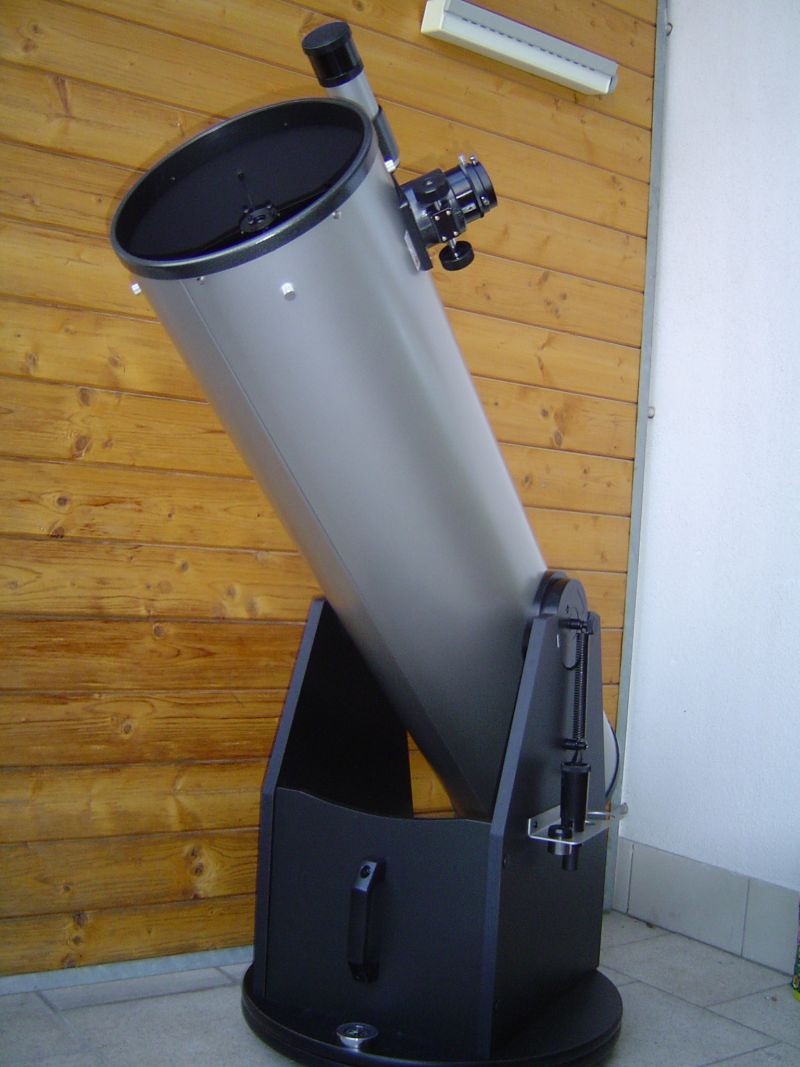
Because these designs differ in how they gather and focus light, they emphasize different strengths:
- Refractors excel at contrast, tight star images, fast cooldown, and compact size, especially at smaller apertures.
- Dobsonians deliver significantly more aperture for the same money, which translates to deeper views of faint galaxies and nebulae and higher resolving power on fine planetary detail when the atmosphere cooperates.
This guide compares the two in practical, evidence-based terms: optical performance, ergonomics, mounts, maintenance, budgets, and the observing experience. If you’re unsure where to begin, start with Optical Performance and then jump to Real-World Observing.
Optical Performance: Aperture, Resolution, and Contrast
Optical performance determines what you can actually see at the eyepiece. Three core ideas matter most: aperture, resolution, and contrast. How each telescope architecture handles these will guide you toward the right choice.
Aperture: The Engine of a Telescope
Aperture (the diameter of the primary lens or mirror) sets two key parameters: how much light the instrument collects and, in theory, its ultimate resolving power. A 200 mm mirror gathers roughly 6.25 times as much light as an 80 mm lens because light collection scales with the area of the aperture.
- Small refractors (60–102 mm) are excellent for bright targets: Moon, planets, bright double stars, and large star fields.
- Mid-size refractors (100–120 mm ED/APO) begin to reach into fainter clusters and show more planetary detail.
- Dobsonians (150–300+ mm) reveal structure in nebulae and galaxies that smaller apertures simply cannot, especially under dark skies.
Resolution: Theoretical Limits vs. Real Atmospheres
The resolving power of a telescope is often approximated with two criteria:
- Dawes’ limit:
θ ≈ 116 / D_mmarcseconds, whereD_mmis aperture in millimeters. - Rayleigh criterion (for green light, ~550 nm):
θ ≈ 138 / D_mmarcseconds.
A larger aperture yields a smaller number (finer resolution). On paper, a 200 mm Dobsonian can resolve details down to roughly 0.6–0.7 arcseconds, while a 100 mm refractor is closer to 1.2–1.4 arcseconds. However, the atmosphere (“seeing”) often blurs images to about 1–3 arcseconds for many observers. That means a well-cooled, well-collimated 200 mm Dobsonian can potentially show more planetary detail, but only if the seeing and thermal conditions allow. Under mediocre seeing, a smaller refractor may deliver steadier, more pleasing views even if its theoretical resolution is lower.
Contrast: Central Obstruction vs. Unobstructed Optics
Refractors are unobstructed; no mirror or support blocks the incoming light, which preserves contrast at mid-to-high spatial frequencies (fine detail). Reflectors (including Dobsonians) have a secondary mirror held by a spider, creating a central obstruction by diameter often around 20–25% in many Newtonians (varies by design). A moderate central obstruction slightly reduces contrast and adds diffraction spikes around bright stars. High-quality Newtonians can still deliver superb planetary views, particularly at larger apertures, but in similar apertures a premium refractor is hard to beat for contrast and image “snap.”
Focal Ratio, Exit Pupil, and Magnification
Three practical formulas help you match eyepieces to either design:
- Magnification:
Mag = F_telescope / F_eyepiece. - Exit pupil (mm):
ExitPupil = F_eyepiece / f_ratio. - True field of view (approx.):
TFOV ≈ AFOV / Mag(AFOV = apparent field of view of the eyepiece).
Useful exit pupils for visual observing typically range from about 0.5 mm (high power) to 5–6 mm (low power). Most observers aim for a maximum magnification near 2× per mm of aperture (about 50× per inch) in steady conditions. Faster focal ratios (e.g., f/5) are common in Dobsonians to keep tubes short and fields wide; refractors come in a variety of f-ratios, with many modern ED refractors around f/6–f/7 balancing portability and color correction.
Remember: resolution is only the starting point. Thermal behavior, collimation, seeing, and optical quality determine whether you reach theoretical performance. We look at those real-world factors in Real-World Observing and Portability, Setup, and Maintenance.
Real-World Observing: Planets, Moon, and Deep-Sky
Numbers are helpful, but the view at the eyepiece is what matters. Here’s how refractors and Dobsonians differ when you actually observe.
Planets and the Moon
- Small-to-mid ED/APO refractors (80–120 mm): Razor-sharp lunar detail; clean diffraction patterns; subdued or absent false color; high contrast on Jupiter’s belts, Saturn’s ring divisions, and subtle Mars albedo markings. Views are typically steady, with quick cooldown and no need for frequent collimation.
- Medium-to-large Dobsonians (200–300 mm+): When fully cooled and precisely collimated under steady seeing, they can show extraordinary fine detail—festoon structures in Jupiter’s belts, intricate features within Saturn’s rings, and tiny craters on the Moon. However, you’ll feel the atmosphere more: focus “boils” and softening during poor seeing. A cooling fan and patience often pay off.
Bottom line for planets: if you value consistently composed, high-contrast views with minimal fuss, a quality refractor is superb. If you’re willing to manage cooldown and collimation to chase the absolute finest detail, aperture wins—and that often means a Dobsonian.
Deep-Sky Objects (DSO): Nebulae, Clusters, and Galaxies
- Open clusters and wide fields: Short, fast refractors (e.g., 80 mm f/6) excel at sweeping the Milky Way and framing giant clusters and nebulae in a single field. Stars appear as tiny pinpoints across a wide, immersive view, especially with 2-inch eyepieces.
- Globular clusters and faint galaxies: Aperture matters. A 200–300 mm Dobsonian resolves more stars in globulars and pulls in faint, low-surface-brightness galaxies that remain elusive in small refractors. Under dark skies, large Dobs make the Virgo Cluster a choose-your-own-adventure of island universes.
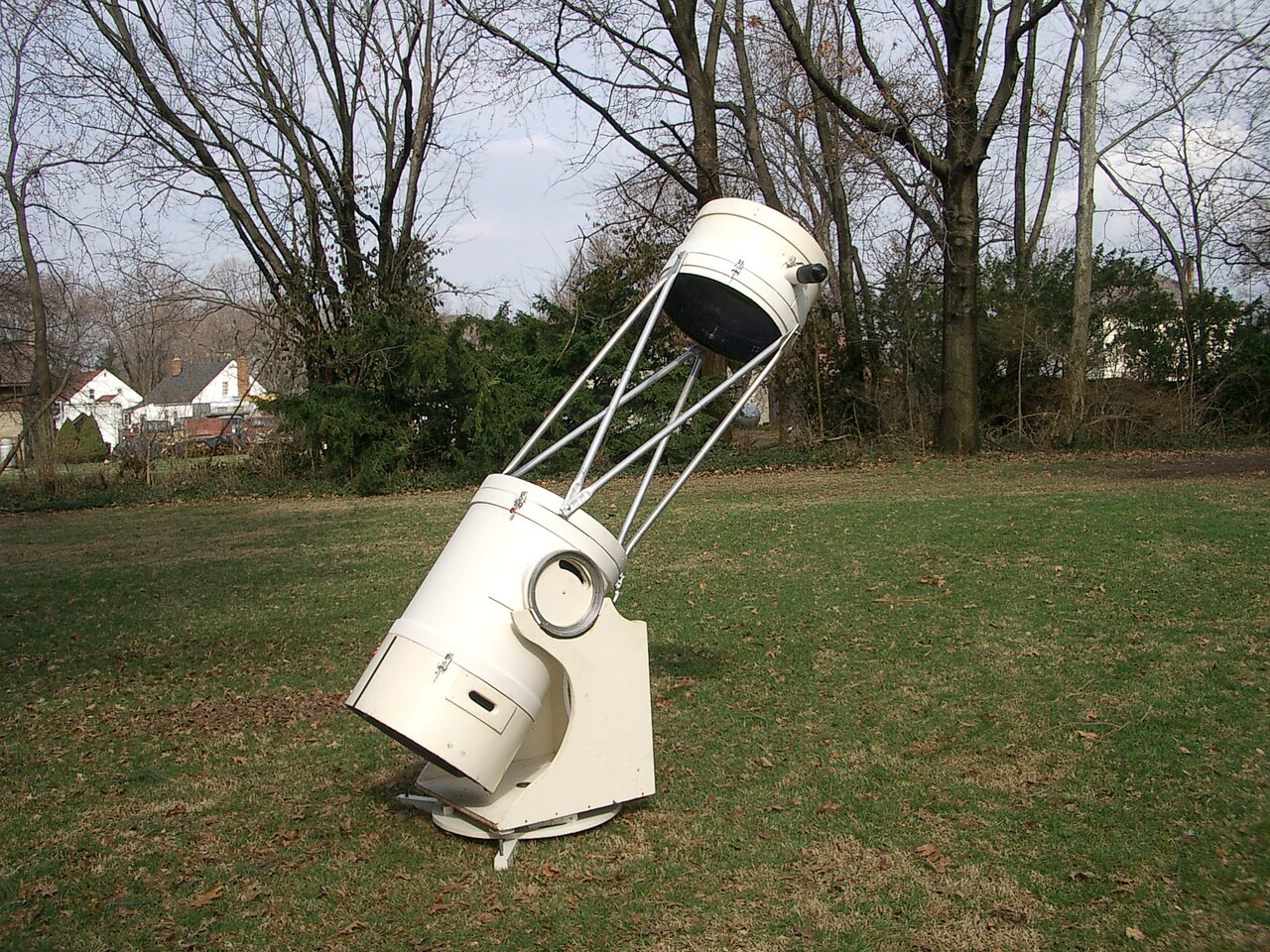
dobsonian telescope built using a truss tube design — Artist: JamesStewart669 - Emission nebulae: Both designs benefit from a narrowband UHC or OIII filter. The refractor offers wide, context-rich panoramas; the Dobsonian lifts delicate filaments and faint contrast out of the background with brute light-gathering power.
In bright suburban skies, contrast is king. Filters help with emission nebulae, but galaxies and reflection nebulae suffer under light pollution. Aperture still helps, but expect the greatest deep-sky rewards when you can reach darker locations. If you’ll mostly observe from the city, a refractor’s wide-field strengths and a Dobsonian’s aperture each bring different advantages; consider your targets and travel habits carefully and revisit Budget and What to Buy First.
Double Stars
Refractors’ unobstructed optics make them excellent for cleanly splitting doubles with high contrast and round, tidy diffraction patterns. Larger Dobs can split tighter pairs when seeing allows, thanks to their resolving potential, but the airy disks and diffraction rings tend to be more pronounced in reflectors with central obstructions. If double-star observing is a favorite pastime, either can serve you well—just factor in seeing and thermal equilibrium.
Solar (with Proper Filtration)
Both designs can be used for white-light solar observing with proper, certified solar filters placed over the objective. Refractors are often popular for quick-look solar sessions because of their setup speed and steadiness. For narrowband solar (e.g., H-alpha), specialized filters and dedicated scopes are a separate topic beyond the scope of this guide.
Portability, Setup, and Maintenance
Telescopes that are used more show more. Portability and ease of use often determine whether a scope lives in the closet or under the stars.
Size and Weight
- Small refractors (60–102 mm): Extremely portable; pair with a compact alt-az mount and tripod for a one-hand grab-and-go setup. Great for balconies and travel.
- Mid refractors (100–120 mm): Still manageable; require a sturdier mount and tripod but remain apartment-friendly. Tube length is modest; total kit often 8–12 kg depending on mount.
- Dobsonians: 150–200 mm solid-tube Dobs are very manageable by one person; bases are wide but light enough to carry separately. 250–300 mm begin to challenge small cars or elevators. Truss-tube designs improve transport but require assembly and often more frequent collimation.

Setup and Cooldown
- Refractors: Typically ready in 10–30 minutes from a warm house to cool night air. No collimation, little fuss. Dew management is the main concern.
- Dobsonians: Assembly is quick, but thermal equilibrium can take 30–90 minutes depending on mirror thickness and temperature drop. A small rear fan speeds stabilization. Collimation may be needed; with practice it takes minutes.
Maintenance
- Refractors: Virtually maintenance-free. Keep the objective clean with occasional careful dusting and use a dew shield. User collimation is rare and generally not needed.
- Dobsonians: Mirrors may need gentle cleaning infrequently (months to years, depending on environment). Collimation is routine but straightforward with the right tools. Secondary mirror and spider introduce diffraction spikes; that’s normal behavior, not a defect.
If you want the simplest path from front door to first light, a small refractor is hard to beat. If you want the most capability for the dollar and don’t mind a little more setup discipline, a Dobsonian offers incredible reach. See Sample Setups for ideas that balance these tradeoffs.
Mounts, Ergonomics, and Tracking Options
How a telescope sits and moves is just as important as its optics. Smooth, stable motions keep objects centered, make star-hopping a pleasure, and reduce fatigue.
Alt-Azimuth vs. Equatorial Mounts
- Alt-azimuth (AZ): Moves up/down and left/right. Intuitive for visual use. Dobsonian bases are AZ. Many refractors ride on AZ mounts with slow-motion controls.
- Equatorial (EQ): One axis aligns with Earth’s rotation, allowing tracking with a single slow-motion control or motor. EQ mounts can be heavier and have a learning curve for balancing and polar alignment. For purely visual use, many observers prefer AZ; for extended high-power viewing and potential future imaging, an EQ can be attractive.

Astro-Physics German Equatorial Mount carrying a Takahashi Fluorite doublet 128mm f/8.1 refractor, aftermarket moonlite focuser; all supported by an ATS portable pier
Ergonomics: Where Your Eye Goes
- Refractors: Eyepiece at the back end; comfortable seated viewing for many targets. Diagonals let you choose viewing angles.
- Dobsonians: Eyepiece on the side near the front. With mid-aperture Dobs, you’ll often stand, sometimes using a small observing chair. Balance and smooth altitude motion are important to avoid “nose dive” with heavy eyepieces.
Manual, Push-To, and Go-To
- Manual: Cheapest, simplest, reliable. Pairs well with star-hopping and sky maps. Smooth bearings are essential for Dobsonians.
- Push-to (digital setting circles): Encoders and a handset/app guide you where to push. You remain the motor, but finding objects is faster and easier, especially under light pollution.
- Go-to (motorized, tracks and slews): Press a button; the scope finds and tracks objects. Great for outreach and high-power planetary viewing. Heavier, more complex, and pricier.
For beginners, a well-tuned manual Dobsonian or a refractor on a smooth AZ mount hits a sweet spot between capability and simplicity. If you anticipate long planetary sessions, tracking (via an EQ mount for a refractor or a go-to Dob) can reduce nudging and eye strain. See Budget & Buying for how these options affect cost.
Budget, Used Market, and What to Buy First
With a budget in mind, you can match your goals to a practical, enjoyable kit. Prices vary by region and year, but the following guidance holds across most markets.
Entry-Level: Maximize Observing Time
- Small refractor on AZ mount: 70–102 mm achromat or 80–100 mm ED on a sturdy AZ mount. Compact, low maintenance, and perfect for the Moon, planets, and bright clusters. Spend on mount stability and a couple of decent eyepieces.
- 6–8 inch Dobsonian: The classic value recommendation. Tremendous aperture for the price, intuitive pointing, and a forgiving f/ratio around f/6 (for 6–8 inch), which is kind to simple eyepiece designs.

Meade LightBridge Mini 114, a 4.5″ f/4 (focal length 450 mm) Dobsonian reflector telescope, shown with Bob’s Knobs adjustment screws for the secondary mirror and the included 26 mm 1.25″ eyepiece. Two eyepieces, 26 mm and 9 mm, are included with the telescope which result in about 17x and 50x magnification, respectively. — Artist: Morn
Mid-Budget: Step-Up Optics and Features
- ED/APO refractor (100–120 mm) on robust AZ or EQ mount: Excellent color correction, crisp planetary performance, and wide-field sweeps. Heavier mount needed for steady high power.
- 10–12 inch Dobsonian (solid or truss): Noticeably deeper reach on galaxies and globulars. Consider a cooling fan and a collimation tool. Push-to encoders are a very practical upgrade.
Higher Budgets: Specialization
- Premium refractors (triplets, fluorite elements): Superb color correction and build quality. Excellent for visual and a foundation for future imaging if you choose that path later.
- Large Dobsonians (12–16 inch+): Transform deep-sky observing under dark skies. Truss designs and premium mirrors offer performance limited mostly by seeing and sky conditions.
Buying Used
The used market can stretch your budget significantly. Reputable forums and local astronomy clubs are good places to look. Inspect optics for obvious chips or coating damage, check focusing smoothness, and ensure mounts move without stiction or wobble. Collimation tools help you evaluate a Dobsonian on-site. Refractors should show clean, fungus-free objectives and tight, play-free focusers.
What to Prioritize
- Optical quality and mount stability: A solid, steady view beats a shaky one every time.
- Ease of use: The best telescope is the one you use most. If a simple refractor means more nights out, that’s a win.
- Aperture for your targets: If faint galaxies call to you, aperture matters. If you love lunar and planetary detail in a grab-and-go package, a refractor might suit you better.
Once you’ve set priorities, match them with the personas in Sample Setups to see concrete kit ideas.
Eyepieces, Finders, and Essential Accessories
Even a great optical tube needs the right support gear. A few well-chosen accessories unlock the performance headroom in both refractors and Dobsonians.
Eyepiece Strategy
Start with a small, coherent set that covers low, medium, and high power with comfortable eye relief and good optical correction. Examples:
- Low power, wide field: 30–40 mm 2-inch eyepiece for sweeping; or 24–25 mm 1.25-inch with a wide AFOV. Excellent with refractors and Dobs for framing large objects and star fields.
- Medium power: 12–18 mm for general deep-sky, lunar, and brighter nebulae with filters.
- High power: 4–8 mm (or a quality Barlow with 8–12 mm eyepieces) for planets and double stars.
In fast Dobsonians (e.g., f/5), edge-of-field correction becomes more critical; well-corrected eyepiece designs maintain sharp stars to the edge of the view. Slower refractors are gentler on simpler eyepieces, though well-corrected designs still enhance the experience.
Barlow Lenses and Zoom Eyepieces
A 2× or 2.5× Barlow can double your eyepiece set economically and preserve comfortable eye relief at high magnification. Zoom eyepieces (e.g., 8–24 mm class) trade some field of view for convenience and are excellent for dialing in magnification as seeing changes, especially on planets.
Finders: Red-Dot, RACI, and Telrad
- Red-dot finders: Lightweight and intuitive; great for aligning on bright stars and planets.
- RACI (Right-Angle Correct-Image) finderscopes: Provide a correct, magnified view for star-hopping without neck strain.
- Telrad or reflex “bullseye” finders: Beloved by Dob users for zero-power, concentric-ring aiming that matches many star charts.
Filters That Make a Difference
- UHC narrowband filter: Increases contrast of emission nebulae under both dark and light-polluted skies.
- OIII filter: Excellent for planetary nebulae and some supernova remnants; often dramatic in medium and large apertures.
- Neutral density (ND) or variable polarizer: Helpful for lunar glare control.
Dew, Collimation, and Cooling Tools
- Dew shields and heaters (refractors): A simple extension often suffices; heaters help in humid climates.
- Collimation cap, Cheshire, or laser (Dobsonians): Keep mirrors aligned for peak performance. Learn with a Cheshire before trusting a laser; alignment of the tool itself matters.
- Fans for primary mirrors: Even a small fan reduces cooldown time and boundary-layer turbulence on the mirror surface.
Comfort and Observing Workflow
An adjustable observing chair is one of the most impactful accessories you can buy. A steady, comfortable body yields steadier views at the eyepiece. A red-light headlamp, printed charts or an app with a night mode, and a simple observing log round out a kit that encourages regular use. For questions on accessory priorities, jump to Frequently Asked Questions.
Sample Setups for Different Observers
There’s no single “best” telescope—only the best match for your sky, lifestyle, and interests. These sample configurations illustrate smart tradeoffs. Use them as starting points, then tailor to your budget and ergonomics.
1) Urban or Balcony Observer: Fast Sessions, Bright Targets
- Optical tube: 80–100 mm ED refractor (f/6–f/7). Quick cooldown and compact.
- Mount: Lightweight AZ mount with slow-motion controls for precise tracking at higher power.
- Eyepieces: 24–25 mm wide-field, 12–14 mm medium, 6–8 mm high power; consider an 8–24 mm zoom for convenience.
- Accessories: Red-dot finder, 1.25-inch diagonal, neutral density lunar filter, dew shield.
- Why it works: Low fuss, minimal space, and superb results on the Moon, planets, and bright clusters even from light-polluted skies.
2) Suburban Family Stargazer: Outreach and Variety
- Optical tube: 150–200 mm Dobsonian (f/6 if possible).
- Mount: Classic Dob base with smooth bearings; optional push-to encoders for easy object finding.
- Eyepieces: 30–32 mm low power (2-inch), 14–18 mm, and 8–10 mm; add a 2× Barlow.
- Accessories: Telrad or RACI finder, UHC filter, adjustable observing chair.
- Why it works: Big, bright views wow kids and neighbors; easy pointing and forgiving optics keep the focus on the sky, not on the equipment.
3) Planetary Enthusiast: Chasing Fine Detail
- Option A (contrast-first): 100–120 mm ED/APO refractor on a stable AZ or EQ mount with very smooth focusing.
- Option B (aperture-first): 200–250 mm Dobsonian with a cooling fan and precise collimation tools.
- Eyepieces: High-quality 6–8 mm for routine nights and 4–5 mm for rare, excellent seeing; or a premium zoom and a Barlow.
- Accessories: Tracking (EQ for refractor or go-to Dob) helps hold the planet steady for extended study. Keep a neutral density or polarizing filter for the Moon.
- Why it works: Option A gives dependable, high-contrast steadiness. Option B, under steady air, can reveal astonishing micro-structure that smaller optics cannot.
4) Dark-Sky Traveler: Deep-Sky Immersion
- Optical tube: 200–300 mm Dobsonian; consider a truss design for car packing.
- Mount: Smooth Dob base; push-to encoders can save time in unfamiliar skies.
- Eyepieces: 30–40 mm wide-field 2-inch, 12–14 mm, and 7–9 mm. Add OIII and UHC filters.
- Accessories: Collimation kit, small fan, red headlamp, printed finder charts.
- Why it works: Aperture unlocks low-surface-brightness galaxies and resolves globulars into glittering swarms. Under dark skies, the payoff is immense.
5) One-Scope-to-Do-Most: Balanced Everyday Rig
- Option A: 120 mm ED refractor on a robust AZ mount—balanced for planets and wide fields, with minimal maintenance.
- Option B: 8–10 inch Dobsonian—superb all-rounder with deep reach and reasonable portability.
- Why it works: Either rig covers a wide target list. Choose A if you prize simplicity and contrast, B if you crave faint fuzzies and resolving power.
Frequently Asked Questions
Is a Dobsonian or a refractor better for a complete beginner?
It depends on your observing environment and temperament. If you want the least maintenance and fastest setup, a small ED refractor is incredibly welcoming and excels on bright targets you’ll observe most often early on (Moon, planets, bright clusters). If you’re enthusiastic about finding faint objects and want the most capability for your budget, a 6–8 inch Dobsonian is an outstanding first telescope. If you can, try both at a local club night before buying.
What about astrophotography—should I factor that in now?
If your primary interest today is visual observing, choose based on the strengths described here. Refractors, especially small ED/APO models, are commonly used for imaging later because they place light at the back of the tube and are relatively forgiving on mounts. Dobsonians can be used for visual observing and for casual snapshots of the Moon and planets via a smartphone or a planetary camera, but deep-sky astrophotography generally requires an equatorial mount and gear that is beyond the scope of simple Dobsonian setups. If you plan to grow into imaging, a quality ED refractor on a sturdy mount is a future-friendly choice, but don’t let potential imaging needs overshadow what will keep you observing now. For visual priorities, revisit Mounts and Tracking and Eyepieces & Accessories.
Final Thoughts on Choosing the Right Beginner Telescope
Both Dobsonians and refractors have earned their reputations for good reasons. Refractors deliver clean, high-contrast views with minimal maintenance and rapid deployment—ideal for bright planets, lunar landscapes, and sweeping star fields. Dobsonians grant access to the vast, faint universe, offering unmatched aperture per dollar and the thrill of resolving deep-sky structure that smaller instruments cannot reach.
Focus on the strengths that align with your observing life:
- If you crave simplicity, quick looks, and crisp planetary views from a balcony or backyard, a small to mid-sized ED refractor is an excellent fit.
- If you dream of teasing out galaxies, resolving globulars, and maximizing capability under dark skies, a mid to large Dobsonian is your ticket.
Whichever route you choose, invest in a stable mount, a modest set of quality eyepieces, and comfort accessories like an observing chair. Then spend your clear nights at the eyepiece—skill and familiarity with the sky are the ultimate upgrades.
If you found this guide helpful, explore our related articles on mounts, eyepiece selection, and observing techniques. For weekly deep dives and practical tips, subscribe to our newsletter so you never miss the next installment.