Table of Contents
- What Is Numerical Aperture in Light Microscopy?
- Resolution vs. Magnification: Why NA Matters More
- Wavelength, Color, and Their Impact on Resolution
- Immersion Media, Refractive Index, and NA Limits
- Condenser Aperture, Illumination, and Contrast
- Brightfield, Darkfield, Phase, and DIC: NA and Contrast
- Depth of Field and Axial Resolution Trade-offs
- Selecting Objective and Condenser NA for Real Samples
- Common Misconceptions About NA and Resolution
- Frequently Asked Questions
- Final Thoughts on Optimizing NA for Sharper Images
What Is Numerical Aperture in Light Microscopy?
Numerical aperture (NA) is one of the most critical parameters in light microscopy. It encapsulates how much light a lens can gather and, just as importantly, the range of angles of the light rays it can accept or deliver. The formal definition is straightforward: NA = n · sin(θ), where n is the refractive index of the medium between the sample and the lens front element (e.g., air, water, or immersion oil) and θ is half the angular width of the lens’s acceptance cone. A larger NA means a lens can collect higher-angle diffracted light from the specimen, which carries the fine spatial detail that determines resolving power.
Two lenses in a transmitted-light microscope each have their own NA and roles:
- Objective NA: Governs image formation and resolution at the detector or eyepiece. Objective NA directly sets the limit on the smallest features that can be resolved laterally. See Resolution vs. Magnification for how this plays out.
- Condenser NA: Governs the angular distribution of illumination. In brightfield, a condenser with suitably high NA provides high-angle illumination that enables the objective to capture more diffracted orders. Properly matching the condenser NA to the objective NA is a key part of illumination and contrast control.
Because NA includes the refractive index term n, immersion media can raise NA beyond what is possible in air (where n ≈ 1.00). That is why oil-immersion objectives can achieve NA values well above 1.0, improving resolution and photon collection. We develop these implications in Immersion Media, Refractive Index, and NA Limits.
Key idea: Numerical aperture describes the angular reach of your lens in a given medium. Higher NA captures higher spatial frequencies from your specimen, improving resolution and often brightness—up to the limits imposed by diffraction and aberrations.
Resolution vs. Magnification: Why NA Matters More
Magnification enlarges an image, but it does not inherently reveal more detail. Resolution—the ability to distinguish two closely spaced features as separate—is determined by diffraction and the optical system’s NA, not by magnification alone. This is a cornerstone concept of microscopy: raising magnification without improving NA merely makes the blur bigger.
Diffraction sets a fundamental lateral limit to resolution. Two commonly referenced criteria describe this limit under typical widefield conditions:
- Rayleigh criterion (point objects, incoherent imaging): minimum resolvable center-to-center distance
d ≈ 0.61 · λ / NA - Abbe limit (periodic structures, line pairs): smallest resolvable period
d ≈ λ / (2 · NA)
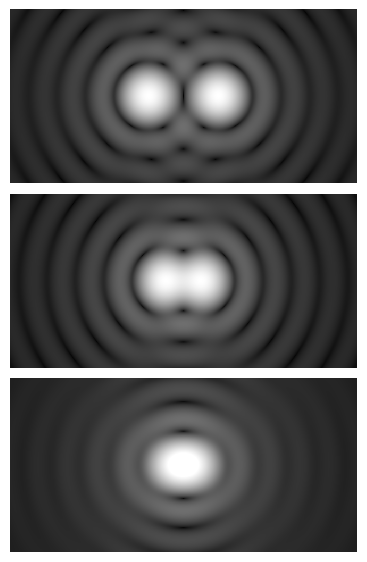
This image uses a nonlinear color scale (specifically, the fourth root) in order to better show the minima and maxima.
Attribution: Spencer Bliven
Both expressions agree on the main message: resolution improves (smaller d) with shorter wavelength λ and higher NA. In practice, modern brightfield systems operate with partially coherent illumination, and the effective constant in front of the λ/NA term can vary slightly; the forms above provide reliable, standard points of reference.
Two additional, practical consequences follow from these limits:
- Empty magnification: Once the optical resolution is set by NA and wavelength, additional magnification cannot create new detail. A widely used rule of thumb is that useful magnification is on the order of ~500–1000 × NA. Beyond that, the image is simply enlarged without revealing finer structure.
- Sampling on a camera sensor: To capture the finest resolvable detail digitally, the effective pixel size at the specimen plane should meet the Nyquist criterion. Using the Abbe period, a practical guideline is to target a specimen-plane pixel size of roughly
p_specimen ≤ λ / (4 · NA)
so that the camera samples at least two pixels across the smallest resolvable period. More than two (e.g., 2–3 pixels) improves robustness to noise and interpolation.
The takeaway: If your current images look soft, inspect NA and illumination first. Increasing magnification alone will not fix an NA-limited resolution. The sections on condenser aperture and wavelength choice map clear paths to tangible improvements.
Wavelength, Color, and Their Impact on Resolution
Because the diffraction limit scales with wavelength, choice of illumination color affects resolution. Shorter wavelengths produce smaller diffraction patterns and finer detail. For example, moving from red light (longer wavelength) to blue light (shorter wavelength) can improve lateral resolution if the optics transmit and focus those wavelengths effectively.

Attribution: SiriusB
- Shorter wavelength → better resolution: All else equal, blue or near-violet light yields smaller d in
d ≈ 0.61 · λ / NAord ≈ λ/(2·NA). - Transmission and aberration considerations: Objectives and condensers are optimized for certain spectral ranges. Achromat and apochromat corrections, anti-reflection coatings, and glass types all influence performance across the visible spectrum. If the objective is not corrected for specific wavelengths, using extreme ends of the spectrum may introduce chromatic or spherical aberrations that offset theoretical gains.
- Filters and contrast methods: In brightfield, a narrowband blue filter can modestly improve effective resolution and depth of focus uniformity across color channels by restricting wavelengths. In phase contrast and DIC, wavelength affects the phase shift or interference behavior; objective and condenser components are designed accordingly.
In fluorescence microscopy (epi-illumination), the emission wavelength predominately sets resolution through the same relationships. Higher NA objectives benefit both excitation (through larger solid angle in epi) and emission collection efficiency, enhancing sensitivity as well as detail. Though this article centers on transmitted-light fundamentals, the same resolution–wavelength–NA triad still governs image sharpness.
The practical message: If your optics support it, working at a slightly shorter wavelength is an elegant route to higher resolving power. Always confirm that the objective’s chromatic correction and coatings are suitable for the chosen spectral band; otherwise the benefit can be blunted by aberrations.
Immersion Media, Refractive Index, and NA Limits
The refractive index of the medium between specimen and objective front lens directly multiplies NA. With air (n ≈ 1.00), a dry objective’s NA cannot exceed 1.0; in practice, advanced dry objectives approach ~0.90–0.95. Immersion objectives replace the air gap with a medium of higher refractive index to allow capture of larger-angle rays:

Attribution: Thebiologyprimer
- Water immersion (n ≈ 1.33): Typical high-NA values are up to ~1.2. Water immersion often reduces refractive index mismatch when imaging aqueous samples or live cells, mitigating spherical aberration through thicker media.
- Oil immersion (n ≈ 1.515 for standard microscope immersion oils): Objectives commonly achieve NA ~1.3–1.4. The increased angular acceptance improves resolution and light-gathering, valuable for fine structural detail and low-light conditions.
Another key element is the cover glass between specimen and objective. Many high-NA objectives are corrected for a specific cover glass thickness, often approximately 0.17 mm (commonly labeled No. 1.5). Deviations introduce spherical aberration that reduces contrast and effectively lowers resolution. Objectives with correction collars allow limited adjustment for varying cover glass thickness and mounting media, restoring optimal performance when the sample environment changes.
When selecting immersion media, consider not only the target NA but also the sample’s refractive index and thickness. Refractive index mismatch between immersion medium, cover glass, and sample leads to aberrations—particularly as focusing depth increases. Higher NA narrows the tolerance for mismatch, so careful matching is pivotal for thick or three-dimensional specimens. These practical choices are revisited in Selecting Objective and Condenser NA.
Rule of thumb: Use immersion media that best match the sample’s optical environment and the objective’s design. Maintain the specified cover glass thickness, or use a correction collar objective where needed, to preserve the high-NA advantage.
Condenser Aperture, Illumination, and Contrast
The condenser is the mirror image of the objective on the illumination side. Its numerical aperture sets the highest angles of light that illuminate the specimen. In transmitted brightfield, adequate condenser NA is essential to realize the objective’s resolution potential. If the condenser aperture is stopped down too much, the illumination becomes too narrow in angle, starving the objective of higher spatial frequencies and reducing resolution—even if the objective NA is high.
Three linked factors control image quality under the condenser’s influence:
- Condenser NA relative to objective NA: For brightfield, a common working practice is to set the condenser aperture to a fraction of the objective NA that balances contrast and resolution—often around 70–100% of the objective NA, depending on sample opacity and desired contrast. Opening the condenser increases resolution and brightness but reduces inherent specimen contrast; stopping it down does the opposite.
- Illumination uniformity and conjugate planes: Köhler illumination is the established framework for producing even field illumination and controlling the angular distribution of light independently of field brightness. While we do not provide step-by-step procedures here, the key idea is that the field and aperture diaphragms are imaged into separate conjugate planes, enabling tuning of contrast without introducing structure from the light source. Good Köhler alignment ensures that changes to the condenser aperture primarily affect angles rather than field uniformity.

Ask your ZEISS account manager for a lab poster! You'll find more knowledge brochures and materials on our website www.zeiss.com/microscopy
Images donated as part of a GLAM collaboration with Carl Zeiss Microscopy – please contact Andy Mabbett for details.
Attribution: ZEISS Microscopy from Germany - Partial coherence: Real brightfield illumination is neither perfectly coherent nor perfectly incoherent; it is partially coherent. The condenser aperture alters this coherence, subtly influencing contrast transfer. Generally, a larger aperture (higher condenser NA) emphasizes fine detail by allowing higher angles, whereas a smaller aperture emphasizes low spatial frequencies and suppresses noise at the cost of fine detail.
As a practical diagnostic: if an image appears high-contrast but lacking in fine texture, the condenser is likely stopped down too far relative to the objective NA. Conversely, if the image appears detailed but flat and low-contrast, slightly stopping down the condenser can improve visibility of features. We discuss strategy by sample type in Selecting Objective and Condenser NA.
Brightfield, Darkfield, Phase, and DIC: NA and Contrast
Contrast mechanisms modify how specimen features become visible against the background. Each method uses the condenser, objective optics, or both to transform phase or scattering into intensity changes. NA remains central across methods, but how it is deployed differs.
Brightfield (Transmitted)
In brightfield, contrast arises from absorption, scattering, and refractive index differences that redirect or attenuate transmitted light. High NA in both condenser and objective improves resolution but can reduce inherent contrast in weakly absorbing, transparent specimens. For such samples, additional contrast methods (e.g., phase contrast) are often beneficial. The interplay of angle and contrast described in Condenser Aperture, Illumination, and Contrast is especially important here.
Darkfield (Transmitted)
Darkfield converts scattered light into the signal while excluding directly transmitted light from the objective’s acceptance cone. In transmitted darkfield, the condenser produces a hollow cone of illumination with angles designed to exceed the objective’s acceptance for direct rays. Only light scattered by the specimen enters the objective. Practical implications for NA include:
- The condenser NA must be sufficiently high compared to the objective NA to ensure that the unscattered illumination cone misses the objective entirely.
- Higher objective NA can collect more scattered light (improving sensitivity to fine structures), but the geometry must still exclude direct illumination.
Darkfield emphasizes edges and small particles that scatter light efficiently. Resolution is still bounded by the objective’s NA and wavelength, but the visibility of sub-resolution scatterers (as bright points) can be enhanced by the contrast mechanism.
Phase Contrast
Phase contrast converts phase shifts (due to refractive index gradients) into intensity differences using a phase annulus in the condenser and a corresponding phase plate in the objective. The method requires an annular illumination shape and matched optical elements; the objective NA still governs resolution, while the specific phase rings influence contrast and halo artifacts. Condenser centering and appropriate ring matching are critical for clean phase images. Relative to brightfield, phase often delivers higher contrast on transparent specimens without staining, at the expense of certain halos and a specific imaging ‘look’.
Differential Interference Contrast (DIC)
DIC uses polarization optics and shearing interferometry to translate optical path gradients into intensity. High-NA objectives in DIC can reveal exquisite fine detail and gradients in transparent samples. As with phase contrast, the objective NA sets the fundamental resolution, while DIC’s anisotropic contrast can accentuate edges along the shear direction. Proper matching of condenser and objective prisms, and attention to the sample’s birefringent behavior, are essential for optimal images.

Attribution: PaulT (Gunther Tschuch)
Across all these methods, the unifying principle stands: the objective’s NA sets the smallest structurally resolvable details; the contrast method governs how those details are rendered visible. Choosing the right technique depends on the specimen and imaging goal, themes expanded in Selecting Objective and Condenser NA for Real Samples.
Depth of Field and Axial Resolution Trade-offs
NA influences not only lateral (x–y) resolution but also sectioning in the axial (z) direction and the depth over which objects appear acceptably sharp. As NA increases, the axial response of the optical system becomes narrower: the system “slices” more finely along z, which reduces depth of field (DOF) but improves axial resolution.
Two helpful scaling relations for widefield imaging are:
- Axial resolution: The axial distance over which two closely spaced planes can be distinguished scales approximately as
Δz ∝ λ · n / NA²
where n is the refractive index of the imaging medium. Higher NA and shorter wavelength both improve axial resolution. - Depth of field: The range of z over which features appear acceptably sharp decreases as NA increases, with a similar approximate scaling of
DOF ∝ λ · n / NA²
in the diffraction-limited regime. Additional terms related to camera pixel size and magnification can also contribute to the effective DOF in digital imaging.
These relations emphasize an important trade-off: a very high-NA lens offers outstanding resolving power but a very shallow focus range. Focus stacking or optical sectioning techniques may be needed for thick specimens in widefield. For thin, flat specimens (e.g., prepared histology sections or etched materials), the shallow DOF can be an asset, cleanly isolating a single plane of interest.
In confocal and related optical sectioning modalities, the effective axial resolution improves further relative to widefield due to spatial filtering. Even then, the scaling with NA and wavelength remains consistent: higher NA and shorter λ sharpen both lateral and axial responses. For the purposes of brightfield fundamentals in this article, keep in mind that wavelength choice and immersion media affect both lateral and axial detail through their influence on NA and diffraction.
Selecting Objective and Condenser NA for Real Samples
Choosing the “right” NA is about matching optical capability to the specimen’s properties and the imaging objective (detail, contrast, speed, field size). Below are typical scenarios and reasoned choices grounded in the relationships discussed above. Where relevant, we link back to the governing concepts so you can adapt these examples to your own setup.
Thin, High-Contrast Specimens (e.g., stained sections, printed microfeatures)
- Objective NA: Higher NA improves resolving power for fine microstructure, especially when detail at the limit is the goal. Oil immersion (NA ~1.3–1.4) excels for submicron features if the specimen and coverslip are compatible.
- Condenser NA: Open to match a large fraction of the objective NA (e.g., 70–100%). This leverages higher-angle illumination and supports maximum resolution in brightfield.
- Wavelength: If optics permit, using a shorter wavelength filter (e.g., blue) can further reduce the diffraction-limited spot size; ensure chromatic correction is adequate as noted in Wavelength, Color, and Resolution.

Attribution: QuodScripsiScripsi
Transparent, Low-Contrast Specimens (e.g., live cells, protozoa)
- Objective NA: Moderate to high NA (water immersion can be helpful) enhances resolution and collection efficiency, but might shrink DOF more than desired depending on thickness.
- Condenser NA: Slightly stop down from the objective NA to enhance intrinsic contrast while maintaining sufficient resolution. Alternatively, switch to phase contrast or DIC to boost visibility without sacrificing fine detail.
- Immersion medium and cover glass: Matching refractive indices is particularly important to reduce spherical aberration through depth. As discussed in Immersion Media and Index Matching, water immersion may better match aqueous samples.
Particulate and Edge-Emphasized Imaging (e.g., colloids, fibers) with Darkfield
- Objective NA: Choose NA sufficient to capture scattered light efficiently while respecting darkfield geometry (direct illumination excluded). Higher NA typically increases sensitivity to fine scatterers.
- Condenser NA: Use a darkfield condenser configuration that provides a hollow cone exceeding the objective’s acceptance for direct rays, as outlined under Darkfield.
- Trade-offs: Darkfield enhances small scatterers and edges; it does not override the diffraction limit on resolving adjacent features. For true resolution-limited detail, brightfield with high NA or DIC/phase may be preferable.
Thick or Layered Samples (e.g., tissue sections thicker than the coverslip standard, microfluidic devices)
- Objective NA: Very high NA can be sensitive to refractive index mismatch and depth-induced aberrations. If the sample is thick or index-mismatched, a slightly lower NA objective that tolerates depth better may outperform a nominally higher NA lens in real-world image clarity.
- Immersion strategy: Use the immersion medium for which the objective is designed, and consider water immersion when imaging aqueous volumes to reduce spherical aberration as discussed in Immersion Media.
- Condenser NA and aperture: A modestly stopped-down condenser can improve contrast and depth tolerance at the expense of peak resolution, a worthwhile trade in thick samples. See Depth of Field Trade-offs.
Digital Imaging and Pixel Sampling Considerations
- Specimen-plane pixel size: Following the Nyquist guideline cited in Resolution vs. Magnification, choose magnification and camera pixel size so that p_specimen is roughly ≤
λ/(4·NA)for the wavelength band used. - Field of view vs. detail: Higher magnification reduces field size on a fixed sensor. When mapping large areas, consider tile scanning or choose an NA and magnification that balance detail and coverage.
- Signal-to-noise: High NA can increase photon collection efficiency for a given exposure, improving SNR. However, specimen contrast may drop if the condenser is fully opened; adjust the aperture to taste, as described in Condenser and Illumination.
In summary, let the sample and task define the NA choice. When in doubt, start with a moderate NA and tune condenser aperture and wavelength. For absolute resolution, step up NA and optimize cover glass and immersion matching. For visually pleasing contrast, embrace a slightly smaller condenser aperture or dedicated contrast methods.
Common Misconceptions About NA and Resolution
A few misconceptions repeatedly surface among learners and even experienced users when diagnosing image quality. Clearing these helps you make the most of your optics.
- “More magnification means more detail.” Not necessarily. Once detail is limited by diffraction, extra magnification only enlarges the blur. See Resolution vs. Magnification for the useful magnification rule of thumb.
- “The objective alone determines resolution.” The objective NA is central, but illumination geometry matters. With an underfilled or stopped-down condenser, the system cannot exploit the objective’s full NA in brightfield. Revisit Condenser Aperture, Illumination, and Contrast.
- “Any coverslip will do.” High-NA objectives are sensitive to cover glass thickness and index. Using the specified thickness (often around 0.17 mm) or a correction collar is important. See Immersion Media, Refractive Index, and NA Limits.
- “Blue light always improves the image.” Shorter wavelengths can improve theoretical resolution, but only if the objective is corrected and coated for that band. Otherwise, chromatic aberration and reduced transmission can negate the benefit. Refer to Wavelength and Color.
- “Stopping down the condenser always helps contrast without cost.” It does increase contrast but reduces resolution and can cause diffraction effects from the aperture itself if closed too far. Aim for a balance that suits the specimen, as discussed in Selecting NA.
Frequently Asked Questions
How do I know if my condenser NA is matched to my objective?
In brightfield, a practical sign of good matching is that fine detail in a high-NA objective appears as sharp as expected from its specification, while overall contrast remains adequate for the specimen. If edges look crisp and high-frequency texture is visible, the condenser aperture is likely opened enough. If the image shows high contrast but seems “coarse” with muted fine texture, the condenser may be stopped down too far relative to the objective NA. Remember, for many specimens a condenser aperture set to roughly 70–100% of the objective NA achieves a good compromise. For more context, see Condenser Aperture, Illumination, and Contrast and Selecting NA.
What limits how high NA can go, and why don’t all lenses have NA > 1?
Two factors set the ceiling: geometry and refractive index. Because NA = n · sin(θ), the angle θ cannot exceed 90°, making sin(θ) ≤ 1. In air (n ≈ 1), the maximum theoretical NA is 1.0; in practice, high-quality dry objectives reach about 0.90–0.95 due to design constraints and aberration control. To exceed NA = 1, the space between specimen and lens must be filled with a medium of refractive index greater than 1 (water or immersion oil) and the objective must be designed to operate with that medium. Optical materials, coatings, front lens curvature, and correction for aberrations become progressively more challenging as NA increases, which is why ultra-high NA lenses are specialized and used when their benefits (resolution and light collection) are essential.
Final Thoughts on Optimizing NA for Sharper Images
Numerical aperture sits at the heart of optical performance in light microscopy. It condenses geometry and medium into a single quantity that predicts how finely your system can resolve structure and how efficiently it can collect light. The essential relationships are compact but powerful: lateral resolution scales as roughly λ/NA, axial sectioning as roughly λ · n / NA², and brightness and contrast are shaped by the interplay of objective and condenser apertures under partially coherent illumination.
To turn these fundamentals into consistently sharp images:
- Pick an objective NA that matches your specimen’s scale and optical environment. Lean on immersion objectives where appropriate to push beyond the limits of air.
- Match the condenser NA to the objective’s capability for brightfield, opening it enough to access high-angle information while tuning contrast to taste.
- Choose wavelengths your optics support; shorter wavelengths reward you with finer detail when chromatic corrections are adequate.
- Respect cover glass specifications or use correction collars to prevent aberrations that erode high-NA advantages.
- Pair NA with proper camera sampling so that your pixels faithfully capture the resolution you’ve earned optically.
When you align these elements—objective NA, condenser aperture, wavelength, immersion medium, and sampling—you unlock your microscope’s true resolving power. If you found this deep dive helpful, explore our other articles on illumination geometry and contrast methods, and consider subscribing to our newsletter to receive future fundamentals and practical guides straight to your inbox.