Table of Contents
- What Do Numerical Aperture and Magnification Mean in Microscopy?
- Optical Resolution Limits: Diffraction, Wavelength, and NA
- Illumination, Contrast, and How NA Affects Brightness
- Common Magnification Traps and Empty Magnification
- Resolution Versus Contrast: Why Sharper Is Not Always Clearer
- How to Choose Objective NA, Working Distance, and Field
- Condenser Aperture and Matching NA in Transmitted Light
- Wavelength, Color, and Chromatic Considerations
- Camera Sampling, Pixel Size, and Nyquist in Microscopy
- Worked Examples: Estimating Resolution, DOF, and Sampling
- Frequently Asked Questions
- Final Thoughts on Choosing the Right Numerical Aperture and Magnification
What Do Numerical Aperture and Magnification Mean in Microscopy?
Two terms dominate discussions about microscope image quality: numerical aperture (NA) and magnification. Although they are related, they affect the image in different ways. Understanding their roles—and their limits—helps you interpret images correctly and choose optics wisely.
Numerical aperture (NA) quantifies an objective lens’s ability to gather light and resolve fine details. It depends on the refractive index of the medium between the specimen and the objective and on the angular spread of rays the lens can accept. Formally:
NA = n · sin(θ), wherenis the refractive index of the immersion medium (e.g., air, water, oil) andθis the half-angle of the maximum cone of light accepted by the objective.
Higher NA means a wider cone of accepted rays and thus better resolving power and improved light collection. In practical terms, moving from an air objective to a water- or oil-immersion objective increases n, which can raise the NA and improve the smallest detail you can distinguish. We expand on this in Optical Resolution Limits: Diffraction, Wavelength, and NA.
Magnification is the ratio of the apparent image size to the actual object size. In a standard compound microscope, objective magnification is multiplied by eyepiece magnification to give a viewing magnification (e.g., 40× objective × 10× eyepiece = 400×). When a camera is used, the total system magnification felt at the sensor depends on tube/relay optics and the objective. Magnification increases the size of features in the image but does not by itself create new detail; only increased NA (with appropriate wavelength and imaging conditions) improves the minimum resolvable feature size. See Common Magnification Traps and Empty Magnification for why more magnification can be misleading.
In summary:
- NA determines the resolvable detail and light-gathering ability.
- Magnification determines the apparent size of features and must be matched to NA and camera sampling to be useful.
Attribution: Ice Boy Tell
Optical Resolution Limits: Diffraction, Wavelength, and NA
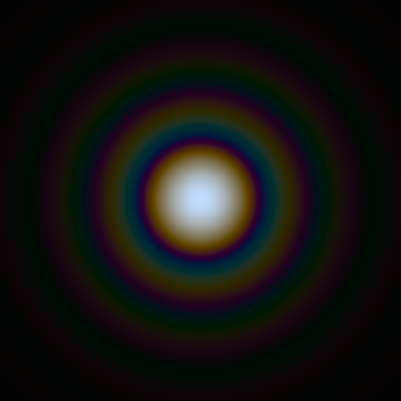
Even a perfect lens cannot resolve arbitrarily small details because light diffracts. A point in the object produces an Airy pattern in the image: a central bright disk surrounded by rings. Two points are considered just resolvable when their Airy disks overlap to a degree defined by a criterion such as the Rayleigh criterion. For incoherent imaging (typical brightfield, fluorescence), a commonly used approximation for the lateral resolution (minimum resolvable distance in the specimen plane) is:
This image uses a nonlinear color scale (specifically, the fourth root) in order to better show the minima and maxima.
Attribution: Spencer Bliven
d ≈ 0.61 · λ / NA
Here λ is the wavelength of light at which you image. Three immediate consequences follow:
- Shorter wavelengths (e.g., blue light) improve resolution.
- Higher NA improves resolution, because the objective captures a wider range of angles.
- Magnification does not appear in this formula; it cannot improve resolution on its own.
The axial resolution (the resolving distance along the optical axis) is generally worse than the lateral resolution for widefield microscopes. A commonly used scaling for widefield axial resolution is on the order of:
Δz ∝ n · λ / NA²
The constant of proportionality depends on details of the imaging configuration and the criterion used, but the inverse-square dependence on NA and linear dependence on wavelength are reliable guides: higher NA significantly improves sectioning in the axial direction, and shorter wavelengths help. Confocal and other sectioning methods can further reduce effective axial blur, but they do so by rejecting out-of-focus light rather than changing the fundamental diffraction behavior.
Because NA appears in the denominator, improvements in NA are potent. Doubling NA, all else equal, halves the approximate lateral resolution limit and reduces axial blur by roughly a factor of four. This is why high-NA objectives are essential for resolving submicron features.
To interpret resolution correctly, keep in mind:
- Resolution is about distinguishability, not visibility. Two line pairs may be visible as a blur yet not resolved as distinct.
- Contrast is required to realize resolution. Without adequate contrast and signal-to-noise ratio (SNR), theoretical resolution cannot be achieved in practice. See Resolution Versus Contrast: Why Sharper Is Not Always Clearer.
- Sampling constraints apply. Your detector or eye must sample the image finely enough to capture the available detail. This is covered in Camera Sampling, Pixel Size, and Nyquist in Microscopy.
Illumination, Contrast, and How NA Affects Brightness
Because NA relates to the angular acceptance of the objective, it affects how much light you collect from the specimen. Under many conditions, the fraction of light captured from a point source in the specimen increases approximately with the square of NA (through its relationship with collection solid angle). In practical terms:
- Higher NA typically increases the collected signal, which can improve SNR for faint features.
- Illumination geometry matters. In transmitted-light modes (e.g., brightfield), condenser NA is critical because it sets the angular diversity of illumination. In epi-illumination (e.g., reflected light, epifluorescence), the objective acts as both illuminator and collector.
- Image brightness at the detector depends on NA, magnification, sensor pixel size, and the illumination intensity. Higher NA can deliver more signal, but higher magnification spreads light over a larger image, affecting brightness per pixel. See Common Magnification Traps and Empty Magnification and Camera Sampling, Pixel Size, and Nyquist in Microscopy.
Contrast mechanisms interact with NA:
- Amplitude contrast (e.g., absorption in stained samples) benefits from adequate illumination NA to fill the objective’s pupil without overwhelming subtle differences.
- Phase and interference methods (phase contrast, DIC) rely on specific illumination apertures and phase relationships. The condenser annulus (phase) or shear (DIC) imposes constraints on usable NA ranges.
- Fluorescence typically benefits from higher NA because of both improved resolution and increased photon collection. However, excitation intensity, photobleaching, and sample viability can impose practical limits.
In transmitted brightfield, stopping down the condenser aperture diaphragm reduces the illumination NA, which usually increases contrast and depth of field at the cost of resolution. Opening it increases resolution but can reduce contrast in weakly absorbing samples. Finding the right aperture match is discussed in Condenser Aperture and Matching NA in Transmitted Light.
Common Magnification Traps and Empty Magnification
Magnification is instantly noticeable, but it can be deceptive. A larger image does not guarantee more information. Empty magnification is the condition where you enlarge an image beyond the resolution supported by the optics (NA and wavelength), creating a bigger, blurrier version without revealing new detail.
How does empty magnification happen?
- Eyepiece swaps: Moving from a 10× to a 20× eyepiece doubles the apparent size, but if the objective’s NA and resolution are unchanged, you are just spreading the same information over more visual angle. The perceived image softens.
- Digital zoom: Enlarging camera images by interpolation makes pixels bigger without adding information. Only true optical magnification (with adequate NA) can place more resolvable cycles on the sensor.
- Objective magnification vs NA: A 100× objective with relatively low NA can resolve less than a 60× objective with higher NA. Always compare NA when evaluating objectives for detail, as covered in What Do Numerical Aperture and Magnification Mean in Microscopy?
For imaging to a camera, sampling criteria (Nyquist) set a useful range of magnifications for a given pixel size. If magnification is too low, the sensor undersamples the optical image and loses detail. If magnification is too high, the sensor oversamples—the data get larger without capturing new detail, increasing file size and potentially reducing per-pixel SNR. The sweet spot depends on optical resolution and pixel size, explained in Camera Sampling, Pixel Size, and Nyquist in Microscopy.
Practical rules of thumb for avoiding empty magnification:
- Match camera sampling to the optical resolution; aim for roughly 2–3 pixels across the minimum resolvable feature (Nyquist or slightly finer).
- Don’t equate “higher ×” with “more detail.” Check NA and wavelength to predict true resolution, using the relation
d ≈ 0.61·λ/NAdiscussed in Optical Resolution Limits. - Use higher magnification only when it improves sampling or visibility of already resolvable features without degrading SNR excessively.
Resolution Versus Contrast: Why Sharper Is Not Always Clearer
Resolution indicates the smallest separable features; contrast is the difference in intensity or color that makes those features stand out. These are related but distinct. A system can have high theoretical resolution yet produce poor images if contrast and SNR are low.
Important distinctions:
- SNR-limited imaging: If the sample is dim or the detector is noisy, the noise can mask high-frequency details. More NA may collect more light, improving SNR, but exposure and detector characteristics also matter.
- Contrast-modifying modes: Phase contrast and differential interference contrast (DIC) improve the visibility of transparent specimens by converting phase shifts into intensity differences. These methods can reveal structures that are otherwise low contrast in brightfield. They do not fundamentally change the diffraction-limited resolution determined by NA and λ, but they can make more of that resolution practically usable.
- Stains and labels: Increasing absorption or fluorescence contrast enhances feature visibility, allowing the optical resolution limit to be approached in practice.
The most informative images usually result from a balanced approach: sufficient NA to support the needed resolution, illumination and detection conditions that provide good SNR, and contrast mechanisms matched to the specimen. For transmitted-light work, that balance often involves careful control of the condenser aperture, as discussed in Condenser Aperture and Matching NA.
How to Choose Objective NA, Working Distance, and Field
Objective selection is where theoretical limits meet practical constraints. Objectives are specified by magnification, numerical aperture, immersion medium, and other properties such as working distance, field flatness, and chromatic correction. Choosing wisely means understanding the trade-offs among these parameters.
www.micro-shop.zeiss.com/
Attribution: ZEISS Microscopy
Numerical aperture and immersion media
Because NA = n · sin(θ), the immersion medium’s refractive index directly affects the achievable NA:
- Air objectives are convenient and versatile. Their NA is limited by
n ≈ 1.0and by practical acceptance angles. Many air objectives have NA values in the range typically up to about 0.95 for the highest-performance designs. - Water-immersion objectives use
n ≈ 1.33, enabling higher NA than air and reducing refractive index mismatch for aqueous specimens. They are useful for live or hydrated samples. - Oil-immersion objectives use immersion oil with
nclose to standard cover glass (n ≈ 1.515). They can reach the highest NA values commonly available in light microscopy.
Higher NA improves resolution and photon collection, but immersion objectives require correct use of the medium and, often, a cover slip of the specified thickness (frequently noted as 0.17 mm). Significant deviations can degrade resolution and contrast.
Working distance and specimen access
Working distance is the space between the objective front lens and the specimen at focus. As NA increases, working distance generally decreases because the lens must accept a wider cone of rays. Short working distance can limit access for micromanipulation and may complicate focusing near uneven surfaces or thick mounts. Long-working-distance objectives exist but typically achieve their extra clearance by reducing NA relative to short-working-distance counterparts of the same magnification.
Field flatness and chromatic correction
Objectives are also classified by their correction level and field flatness, which influence image uniformity:
- Achromat: Corrects chromatic aberration at two wavelengths and spherical aberration at one wavelength; may not provide a flat field across the full view.
- Plan (flat-field) achromat: Adds field-flattening correction so that focus remains more uniform across the image.
- Apochromat: Corrects chromatic aberration at more wavelengths and spherical aberration at multiple wavelengths; often paired with higher NA and better color fidelity.
Choosing among these depends on your specimen’s spectral characteristics and whether you need sharp edges across a wide field or only at the center. See Wavelength, Color, and Chromatic Considerations for more on chromatic behavior.
Field of view and sampling
In eyepiece viewing, the field of view (FOV) depends on the microscope’s optical design and eyepiece field number; on cameras, it depends on sensor size and the projection optics. Higher magnification reduces FOV, so you see a smaller area of the specimen. If you need to survey wide regions, consider lower magnification or a camera with a larger sensor—provided you maintain adequate sampling for the resolution your NA permits. The sampling aspect is discussed in detail under Camera Sampling, Pixel Size, and Nyquist.
Condenser Aperture and Matching NA in Transmitted Light
In transmitted-light modes like brightfield, darkfield, and phase contrast, the condenser is as integral to image quality as the objective. Its two principal roles are to deliver evenly distributed illumination over the field and to set the illumination NA—effectively, the angular spread of light reaching the specimen.
Key principles:
- Resolution depends on both objective NA and illumination NA. If the condenser aperture NA is too small compared to the objective NA, the system behaves as if the NA were lower, reducing the highest spatial frequencies recorded.
- Contrast varies with condenser aperture. Stopping down the condenser increases contrast and depth of field at the expense of resolution; opening it increases resolution and brightness but can make low-contrast features harder to see.
- Matching rule of thumb: For brightfield, setting the condenser aperture to roughly 60–80% of the objective NA often achieves a useful compromise between resolution and contrast. The optimal setting depends on the specimen and desired balance.
Specialized modes impose specific conditions:
- Phase contrast requires ring-shaped illumination (annulus) in the condenser matched to a phase ring in the objective. The effective NA is constrained by the ring geometry.
- Darkfield uses a hollow cone of light so that only scattered light from the specimen enters the objective. The condenser NA must be set higher than the objective NA so that unscattered rays miss the objective aperture.
Although the details of condenser alignment are beyond this article’s scope, keep in mind that the condenser’s role is central to realizing the optical resolution predicted by the objective NA. For more on how NA and illumination interplay with image detail and brightness, revisit Illumination, Contrast, and How NA Affects Brightness.

Attribution: Mikael Häggström
Wavelength, Color, and Chromatic Considerations
The choice of wavelength affects resolution, contrast, and color fidelity in microscopy. Because the diffraction-limited lateral resolution scales as d ≈ 0.61·λ/NA, shorter wavelengths yield finer resolution. However, shorter wavelengths may reduce color contrast for certain stains or fluorophores and can increase scattering in some samples.
Attribution: SiriusB
Considerations when selecting wavelength or filters:
- Monochromatic imaging: Using a narrowband filter (e.g., a green filter in brightfield) can reduce chromatic blur and improve perceived sharpness by minimizing chromatic aberration. This can be useful when measuring fine structures where color is not essential.
- Spectral response of detectors: Camera sensitivity varies with wavelength. Efficiency is often high in the green region; at the extremes (deep blue/UV or near-IR), sensitivity and optics transmission may drop.
- Chromatic aberration: Objectives with higher correction (e.g., apochromats) maintain better focus across multiple wavelengths. If you image in color across a wide spectrum, higher correction objectives reduce color fringing and maintain resolution across channels.
Because λ appears explicitly in resolution formulas, small changes in the chosen imaging wavelength can produce measurable differences in fine detail. For example, imaging at 500 nm instead of 550 nm improves the theoretical lateral resolution limit by about 9%. Whether this translates to a visible improvement depends on NA, SNR, and sampling limits discussed in Camera Sampling, Pixel Size, and Nyquist.
Camera Sampling, Pixel Size, and Nyquist in Microscopy
Digital sensors sample the continuous optical image into discrete pixels. To capture the detail that your optics deliver, your sampling frequency must be high enough. The Nyquist sampling criterion provides a widely used guideline: sample at least twice the highest spatial frequency you wish to record.
Translated into microscopy terms for widefield imaging:
- Let
dbe the lateral resolution limit (approximately0.61·λ/NA). - To satisfy Nyquist in the specimen plane, choose an effective pixel size at the specimen of about
d/2or smaller.
For a camera with pixel size p (measured at the sensor), the effective pixel size at the specimen is approximately p / M, where M is the total magnification between the specimen and the sensor (objective × tube lens ratio × any relay optics). Thus a practical targeting equation is:
p / M ≤ d / 2→ chooseM ≥ 2p / d
This equation connects optical resolution and magnification to your camera’s pixel size. Some additional considerations:
- Oversampling (much smaller effective pixel size than
d/2) increases file size and can reduce per-pixel SNR without adding detail. It is not harmful per se, but it is inefficient. - Undersampling (effective pixel size larger than
d/2) causes aliasing: fine details are inadequately captured and can appear falsely or be lost. - Color cameras with Bayer filters have per-channel sampling and demosaicing considerations; achieving Nyquist for each color channel may require slightly finer sampling than for monochrome sensors with the same pixel size.
- Point-scanning methods (e.g., confocal) also follow sampling principles; step size in the scan should be chosen to meet or slightly exceed Nyquist relative to the optical resolution of the system.
Matching optical performance to the sensor is one of the most effective ways to improve image quality without changing the specimen. It prevents both empty magnification (too much M for the NA) and undersampling (too little M for the pixel size). For how NA, illumination, and contrast interrelate with brightness at the sensor, see Illumination, Contrast, and How NA Affects Brightness.
Worked Examples: Estimating Resolution, DOF, and Sampling
The following examples illustrate how to tie together NA, wavelength, magnification, and camera pixel size using standard approximations. These are for educational purposes to build intuition; actual performance depends on the full optical system and specimen properties.
Example 1: Lateral resolution with air and oil objectives
Suppose you image at a wavelength λ = 550 nm (green light). Compare an air objective with NA = 0.65 to an oil-immersion objective with NA = 1.40.
- Air objective:
d ≈ 0.61·λ/NA ≈ 0.61 · 550 nm / 0.65 ≈ 516 nm - Oil objective:
d ≈ 0.61 · 550 nm / 1.40 ≈ 240 nm
The oil objective halves the theoretical minimum resolvable distance relative to the air objective at the same wavelength. If the sample and imaging conditions support it, you can see roughly twice the spatial frequency content.
Example 2: Axial blur scaling with NA
Using a simplified widefield axial scaling of Δz ∝ n · λ / NA², consider object-side axial blur for typical media.
- Air,
n = 1.0,NA = 0.65,λ = 550 nm:Δzscales like1.0 · 550 / 0.65² ≈ 550 / 0.4225 ≈ 1302 nmtimes a configuration-dependent factor. If that factor is about 2 for a widefield criterion, that yields roughly~2.6 µmaxial blur as an order-of-magnitude estimate. - Oil,
n ≈ 1.515,NA = 1.40,λ = 550 nm: scaling like1.515 · 550 / 1.40² ≈ 833 / 1.96 ≈ 425 nm. With a similar factor of ~2, an order-of-magnitude estimate is~0.85 µm.
While the constants depend on the precise imaging mode and definitions used, the NA-squared dependence is the main takeaway: increasing NA strongly improves axial sectioning in widefield imaging.
Example 3: Choosing magnification for a given camera
Assume a monochrome camera with p = 6.5 µm pixels, imaging at λ = 550 nm with an objective of NA = 1.40. From Example 1, d ≈ 240 nm. Nyquist suggests effective pixel size ≤ d/2 ≈ 120 nm.
- Required magnification at the sensor:
M ≥ p / (d/2) = 6.5 µm / 0.12 µm ≈ 54×.
Common objective magnifications like 60× paired with typical tube/relay optics easily meet this criterion. Using substantially higher magnification than necessary (e.g., 100×) oversamples the image: not harmful, but with lower per-pixel SNR and smaller field of view. Using lower magnification (e.g., 40×) would undersample, losing fine detail available from the 1.40 NA objective.
Example 4: Condenser matching for brightfield
Suppose your brightfield objective has NA = 0.95. A good starting point for the condenser aperture NA is roughly 60–80% of the objective NA, e.g., around 0.6–0.75. Opening closer to 0.95 maximizes resolution but may reduce contrast in weakly absorbing specimens. Stopping down to around 0.6–0.7 often increases contrast and depth of field for samples with low inherent contrast, with some loss in the finest resolvable detail.
Example 5: Wavelength choice and resolution
If you switch from imaging at λ = 550 nm to λ = 500 nm with the same objective NA, lateral resolution improves proportionally:
- Improvement factor
≈ 550/500 = 1.10, i.e., about a 10% improvement in the smallest resolvable spacing. Whether this is visible depends on SNR and whether sampling meets the criterion in Camera Sampling, Pixel Size, and Nyquist.
These examples are approximations but illustrate how NA, wavelength, and sampling combine to define what you can and cannot see. For planning and documentation, it is good practice to record the objective NA, immersion medium, wavelength or filter set, and camera pixel size to interpret results correctly.
Frequently Asked Questions
Is numerical aperture more important than magnification?
For resolving fine detail, numerical aperture is the primary determinant because the diffraction-limited resolution scales as ~ λ/NA. Magnification enlarges the image but cannot reveal details beyond what NA and wavelength permit. That said, magnification must be sufficient to sample the image properly at the camera (or to present the detail at a comfortable scale for the eye). Practically, choose NA to meet your resolution needs, then choose magnification to meet sampling needs without drifting into empty magnification. See Common Magnification Traps and Empty Magnification and Camera Sampling, Pixel Size, and Nyquist.
Can I improve resolution by using a higher megapixel camera?
More megapixels increase field of view at a given sampling rate or enable finer sampling at the same field, but they do not change the optical resolution set by NA and wavelength. If pixel size and magnification already satisfy or exceed Nyquist relative to your optical resolution, increasing pixel count only produces larger images. If your system is undersampling, a camera with smaller pixels (or higher magnification onto the current sensor) can help capture the detail your optics already deliver. For the underlying criteria, see Camera Sampling, Pixel Size, and Nyquist in Microscopy.
Final Thoughts on Choosing the Right Numerical Aperture and Magnification
The real limits of optical microscopy are set by a small set of tightly linked variables: numerical aperture, wavelength, illumination geometry, contrast, and sampling. Of these, NA is the lever that most directly influences diffraction-limited resolution and photon collection. However, NA alone does not guarantee better images—you must also consider working distance, immersion media, cover glass specifications, condenser settings, and whether your detector samples the image adequately.
When selecting optics and imaging parameters:
- Quantify your needs using the relationships
d ≈ 0.61·λ/NA(lateral resolution) and the approximateΔz ∝ n·λ/NA²scaling (axial blur). - Choose the highest practical NA consistent with your specimen and access requirements. Immersion objectives unlock higher NA but require proper media and compatible covers.
- Match condenser NA to the objective for transmitted-light work, balancing contrast and resolution.
- Set magnification to meet sampling criteria for your camera’s pixel size to avoid empty magnification or undersampling.
- Use contrast methods and wavelength selection that enhance visibility without compromising the resolution you have paid for with NA.
Adopting this framework makes microscope images more predictable and comparable. It also clarifies upgrade paths: for finer detail, increase NA (with suitable immersion and corrections); for broader fields, use larger sensors or reduce magnification while staying within sampling limits; for clearer visibility, optimize contrast and illumination NA. If you found this guide useful, consider subscribing to our newsletter to explore future articles on optics, contrast methods, and practical imaging strategies that build on these fundamentals.

Attribution: Kiran Foster