
Table of Contents
- What Is the Orion Constellation and Why It Matters?
- How to Find Orion: Seasons, Hemispheres, and Sky Maps
- Bright Stars of Orion: Betelgeuse, Rigel, and the Belt
- Deep-Sky Wonders in Orion: M42, Horsehead, and More
- Inside the Orion Molecular Cloud Complex: Stellar Birth in Action
- Observing Gear and Techniques for Touring Orion
- Star‑Hopping Routes Across Orion for Beginners
- Mythology and Cultural Histories of Orion Around the World
- Astrophotography Tips for Capturing Orion’s Nebulae and Stars
- Frequently Asked Questions
- Final Thoughts on Exploring the Orion Constellation
What Is the Orion Constellation and Why It Matters?
Few night-sky sights rival the Orion constellation for pure visual impact and scientific richness. Recognizable by the straight, evenly spaced trio of stars known as Orion’s Belt, this constellation bridges stargazing and stellar astrophysics in a uniquely accessible way. Whether you are scanning the winter sky with naked eyes, exploring with binoculars, or diving deep with a small telescope, Orion serves as a gateway to learning the sky and understanding how stars are born, evolve, and die.
Orion stands out because it offers every level of observing challenge: bright first-magnitude landmarks such as Betelgeuse and Rigel; asterisms you can trace from urban backyards; and world-famous deep-sky targets like the Orion Nebula (M42). Those same features make Orion a prime venue for discussing the life cycle of stars. The region hosts massive young stars, glowing emission nebulae, dark clouds, and stellar nurseries—collectively called the Orion Molecular Cloud Complex—providing a living laboratory for star formation.
On clear nights in late autumn through early spring in the Northern Hemisphere, Orion commands the southern sky, while in the Southern Hemisphere it rides high to the north in the summer months. The constellation’s stars and nebulae are relatively bright and spread out, which makes Orion an ideal proving ground for honing skills like star‑hopping, filter selection, and sketching or imaging faint nebulosity. This guide explains how to find Orion, highlights its brightest stars, tours marquee deep-sky objects, and shares practical techniques—so you can make the most out of the season’s most iconic celestial hunter.
How to Find Orion: Seasons, Hemispheres, and Sky Maps
Learning to find Orion becomes second nature once you connect its brightest stars and key anchor points. The shape suggests a hunter with an hourglass torso: two bright shoulders (Betelgeuse and Bellatrix), two bright knees (Rigel and Saiph), and the famous Belt of three blue-white stars (Mintaka, Alnilam, Alnitak) crossing the middle. From the Belt hangs a short line of fainter stars that marks Orion’s Sword, where the Orion Nebula resides.

Attribution: Rogelio Bernal Andreo
Seasonally, visibility depends on latitude:
- Northern Hemisphere: Orion first appears in the eastern evening sky in late autumn (October–November), is highest around midnight in December and January, and dominates the evening sky in January–February. By April, it sets earlier and is mostly gone after twilight.
- Southern Hemisphere: Orion is a signature summer constellation (December–March), high in the northern sky. In latitudes like Australia, South Africa, and much of South America, Orion attains impressive altitude and clarity on warm summer nights.
- Tropics: Orion passes nearly overhead when well placed, offering superb views of nebulosity under dark skies.
A few practical ways to reliably locate Orion:
- Follow the Belt: The three Belt stars are almost evenly spaced and aligned. In the early evening of winter (Northern Hemisphere), look southeast for a trio of bright points in a short line; that’s Orion’s Belt.
- Use bright guide stars: Above the Belt (toward the eastern sky early in the season) lies Betelgeuse (reddish). Below the Belt (toward the western horizon) is Rigel (blue-white). These contrasting colors are visible to the naked eye on steady nights.
- Star patterns around Orion: Extending a line from Orion’s Belt upward and to the right points toward Aldebaran and the Hyades in Taurus; downward and to the left guides you to Sirius in Canis Major. These alignments help confirm you’re in the right place.
When checking charts, favor sky maps set for your latitude and the current month. Mobile planetarium apps can simulate your sky in real time; just keep your screen brightness low and use a red-light mode to preserve night vision. For a deeper tour, jump ahead to Star‑Hopping Routes Across Orion and refer back to this section as a landmark reference.
Bright Stars of Orion: Betelgeuse, Rigel, and the Belt
Orion contains several of the most eye-catching stars in the night sky. Learning their names, colors, and locations provides both a cultural connection and a practical foundation for navigation and object finding.
Betelgeuse (Alpha Orionis)
Betelgeuse is the reddish star marking Orion’s right shoulder (on the sky, the upper left corner of the hourglass). It is a red supergiant—an evolved, swollen star nearing the end of its life. Betelgeuse varies in brightness somewhat irregularly over months and years. It famously dimmed in 2019–2020 due to a combination of surface changes and dust ejection, a reminder that massive stars can be dynamic on human timescales.
At roughly a few hundred light-years away (about 550 light-years is a widely cited figure), Betelgeuse is astronomically close for a supergiant. Its vast radius would engulf the inner solar system if placed at the Sun’s location. While it will eventually explode as a supernova, current evidence does not indicate an imminent event. For more context, see Frequently Asked Questions.
Rigel (Beta Orionis)
Rigel is the bright blue-white star marking Orion’s left knee (on the sky, the lower right of the hourglass). A hot, luminous supergiant, Rigel shines with intrinsic luminosity far exceeding the Sun. Its spectral type and color make a pleasing contrast to Betelgeuse’s orange-red cast. Rigel’s light takes on the order of several hundred years to reach Earth, and in small telescopes you can sometimes split faint companions nearby under steady seeing.
Bellatrix and Saiph
Bellatrix marks the hunter’s left shoulder (upper right of the hourglass), noticeable but dimmer than Betelgeuse. It is a blue-white star at a moderate distance, and it completes the top of Orion’s torso. Saiph (lower left of the hourglass) pairs with Rigel to define Orion’s knees. Saiph is also blue-white and somewhat underappreciated compared with its brighter counterparts, but it forms a useful guide point when tracing the constellation’s shape.
Orion’s Belt: Mintaka, Alnilam, Alnitak
The Belt is arguably Orion’s most recognized feature: three bright, nearly collinear stars. From west to east (right to left in typical northern winter views): Mintaka, Alnilam, Alnitak. All are hot, massive, blue-white stars located hundreds to thousands of light-years away. Alnilam, the center star, is notably distant compared to the other two and intrinsically extremely luminous. The Belt’s alignment points the way to other targets: extend the line southeast to find Sirius, the brightest star in the night sky, and northwest to find Aldebaran and the Hyades.
Just below the Belt lies Orion’s Sword, where you’ll find the spectacular Orion Nebula. The Sword region is rich in young stars and glowing gas, serving as the heart of Orion’s role as a stellar nursery. For the broader context that binds these stars and nebulae, see Inside the Orion Molecular Cloud Complex.
Deep-Sky Wonders in Orion: M42, Horsehead, and More
Beyond its bright stars, Orion houses some of the most beloved deep-sky objects accessible to amateur observers. Many lie within or adjacent to Orion’s Sword and Belt. Even modest binoculars can reveal highlights, while telescopes from 80 mm up through medium apertures (150–250 mm) bring out dramatic structure in glowing nebulae and open clusters.
Orion Nebula (Messier 42) and the Trapezium
The Orion Nebula, or M42, is the crown jewel of the constellation and one of the most observed deep-sky objects of all time. It’s a vast, bright emission nebula—a luminous cloud of ionized hydrogen and oxygen—powered by the radiation of young, hot stars. At roughly about 1,350 light-years from Earth, M42 is the nearest massive star-forming region, making it a benchmark for understanding how stars and planetary systems form.

Attribution: NASA, ESA, M. Robberto (Space Telescope Science Institute/ESA) and the Hubble Space Telescope Orion Treasury Project Team
Binoculars show a soft, luminous patch with a bright core. Through a small telescope under dark skies, its brighter portions look like a spread of wings or a luminous fan, with knots, lanes, and curving arcs. Near the bright core is the compact multiple-star system Trapezium, typically visible as a quartet of young stars. With steady air and moderate magnification, larger apertures split more components in this busy, newborn cluster.
Filters can help. An UHC or O III filter enhances contrast in the nebula’s emission lines, accentuating the arc-like structures and fainter extensions. The nebula rewards long, careful looking: allow your eye to adapt and try different magnifications to tease out detail. For an overview of filter use and magnification tips, see Observing Gear and Techniques.
De Mairan’s Nebula (Messier 43)
Just north of the bright core of M42 lies M43, a segment of the same complex, separated by a dark lane. It is smaller and fainter, but with a UHC filter and moderate magnification, you can isolate its distinctive glow and shape. Observers often overlook M43 because M42 steals the spotlight, but isolating it can be a satisfying challenge.
Running Man Nebula (NGC 1977)
Further north of M42/M43 is the Running Man Nebula, a reflection nebula complex illuminated by nearby hot stars. Its blue-white luminosity differs from the rosy hue typical of emission nebulae and is subtler in small apertures. Look for delicate, wispy glow interlaced with dark structures. A dark sky is crucial, and lowering magnification can help your eye integrate light over a wider area.
NGC 1981 and the Sword Region
Just above M42 lies the open cluster NGC 1981, which frames the Sword’s northern end. Through binoculars, this is a small patch of diamonds; in a telescope at low power it becomes an airy scattering of bright stars. Slide down through the Sword to encounter a field rich with contrasts: dark lanes, bright arcs, and embedded stars, all culminating in M42’s glowing vista.
Horsehead Nebula (Barnard 33) and IC 434
The Horsehead Nebula is one of the night sky’s most iconic silhouettes—a small, dark nebula set against the pale red emission glow of IC 434, just south of the easternmost Belt star, Alnitak. The Horsehead is notoriously subtle visually because you are trying to detect a dark shape against a faint background. From truly dark sites and with at least a small-to-medium telescope, a dedicated H‑beta filter (wavelength around 486 nm) can significantly improve your chances by boosting the contrast of the background emission. Even then, patience and averted vision are essential. For beginners, framing the wider region—IC 434 and the Flame Nebula—often makes the observing session more rewarding.
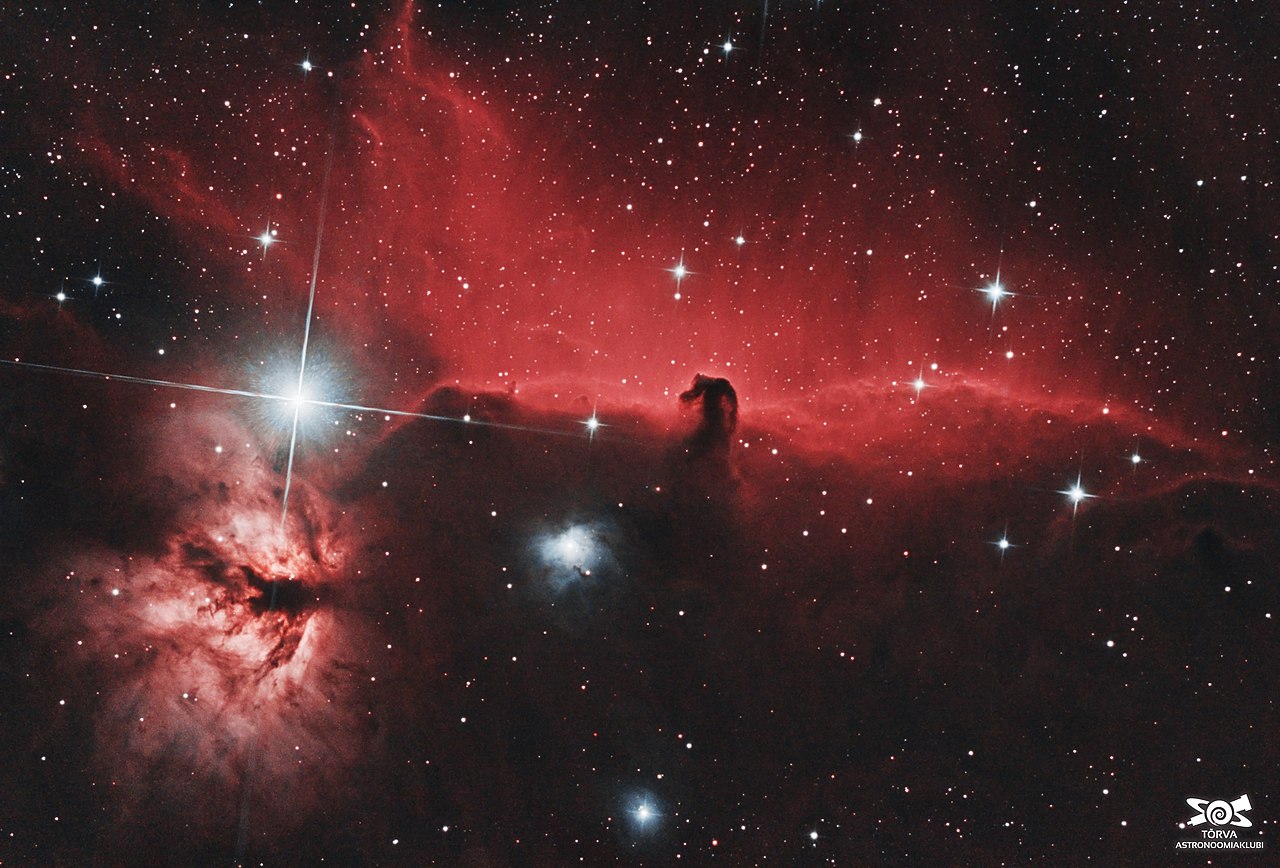
Attribution: Taavi Niittee
Flame Nebula (NGC 2024)
Very close to Alnitak lies the Flame Nebula, a bright emission and reflection nebula complex cut by dark lanes that create a branching, flame-like appearance. The star Alnitak can be bright in the field; reduce magnification and nudge the star just outside the field to reveal more nebulosity. A UHC or O III filter can help, though the Flame often shows up decently even unfiltered under good skies.
Barnard’s Loop and the Orion-Eridanus Superbubble
Barnard’s Loop is a massive, faint arc of emission nebula encompassing much of Orion, visible in wide-field, long-exposure photographs and occasionally with the unaided eye or binoculars under extremely dark, transparent conditions using a narrowband filter. It traces an immense shell of ionized gas linked to past episodes of star formation and stellar winds. The region is part of a larger superbubble extending toward Eridanus, carved by massive stars and ancient supernovae in the Orion complex. While Barnard’s Loop is not an easy visual target, it anchors the astrophysical context of the constellation’s active environment—see Inside the Orion Molecular Cloud Complex for more.

Attribution: SimgDe
Sigma Orionis and Nearby Dark Nebulae
The multiple star system Sigma Orionis, near Alnitak, offers telescopic interest with its components and a neighborhood sprinkled with faint dust and gas. Surrounding dark nebulae create the star-on-velvet look that is especially striking under low magnification and dark skies. While not as famous as M42, this corner of Orion rewards leisurely sweeping with a rich-field telescope or mounted binoculars.
Because Orion’s deep-sky landscape is both varied and interconnected, you can plan a session that mixes easy highlights (M42, NGC 1981) with rewarding challenges (NGC 1977, Flame, and the Horsehead). If you are new to faint nebulae, begin with the brighter fare and consult Observing Gear and Techniques for filter and magnification strategies before tackling the trickier targets.
Inside the Orion Molecular Cloud Complex: Stellar Birth in Action
The Orion Molecular Cloud Complex spans hundreds of light-years and includes some of the most studied star-forming regions in the Milky Way. Comprising dense molecular clouds, ionized hydrogen regions (H II regions), reflection nebulae, and dark dust lanes, it hosts multiple generations of star formation. Its proximity and activity allow astronomers to probe the entire timeline of stellar birth, from cold gas collapse to newborn stars dispersing their birth cocoons.

Attribution: (c) NASA, ESA, CSA / Science leads and image processing: M. McCaughrean, S. Pearson, CC BY-SA 3.0 IGO
Key components include:
- Orion A and Orion B: Two massive molecular clouds that contain rich sites of active star formation. M42 and M43 reside along Orion A, while the Horsehead region and NGC 2024 (Flame Nebula) inhabit Orion B.
- Young stellar objects (YSOs): Embedded protostars, T Tauri stars, and massive O- and B-type stars in various evolutionary stages populate the clouds. Observations across infrared and radio wavelengths reveal dusty disks and jets, hinting at planetary system assembly.
- Feedback processes: Ultraviolet radiation and stellar winds from massive stars carve cavities, ionize gas, and compress surrounding clouds, sometimes triggering new rounds of star formation.
- Large-scale structures: Superbubbles and shells, linked to prior supernovae and energetic winds, shape the region’s overall geometry. Barnard’s Loop may trace one such shell, likely energized by clusters of massive stars over millions of years.
For observers, understanding this context enriches the view. The glowing arcs and dark lanes in M42 and its neighbors are not just pretty—they are the visible skins of vast, dynamic processes. Even at the eyepiece, you are seeing the interplay of radiative energy and matter sculpting space on scales measured in dozens of light-years. When you admire the Belt stars, remember that they, too, are products of this region’s star-making machinery.
Observing Gear and Techniques for Touring Orion
Because Orion offers bright guide stars and a mix of easy and challenging deep-sky objects, you can have a full, satisfying observing session with nearly any equipment. The key is to use the right tool for each target and to match your expectations to sky conditions.
Naked-Eye and Handheld Binoculars
- Naked-eye: Trace Orion’s hourglass, pick out color contrasts between Betelgeuse (reddish) and Rigel (blue-white), and note the Sword region’s faint glow under dark skies.
- Binoculars (7×50, 8×42, 10×50): The sweet spot for wide-field views. Binoculars easily reveal M42’s luminous patch, the open cluster NGC 1981, and star fields around the Belt. A monopod or parallelogram mount steadies the view and reduces fatigue.
Small to Medium Telescopes
- Short focal-length refractors (60–100 mm): Excellent for wide fields. M42 shows rich structure at low to moderate power. Sweeping the Belt and Sword is a treat. Aim for exit pupils around 2–5 mm for bright nebulosity.
- Dobsonian reflectors (150–250 mm and up): More aperture brings fainter structure into reach: subtle filaments in M42, the Running Man, and hints of the Flame. With dark skies and an
H‑betafilter, larger apertures can attempt the Horsehead. - Catadioptrics (Maksutov, Schmidt‑Cassegrain): Their longer focal lengths suit higher magnifications for splitting stars (like the Trapezium components) and examining bright nebular knots. Use focal reducers or very low-power eyepieces for the widest fields.
Filters, Eyepieces, and Magnification
- Nebula filters: A
UHCfilter is a general-purpose enhancer for emission nebulae in Orion; anO IIIfilter can help with contrast in certain regions of M42; and anH‑betafilter is often recommended for the Horsehead Nebula and can improve the IC 434 backdrop. Filters are not magic wands, but under dark skies they can make the difference between a whisper and a clear detection. - Eyepiece choices: Wide-field eyepieces (e.g., 24–32 mm in 1.25-inch format, 30–40 mm in 2-inch format) provide panoramic views of nebulae and clusters; mid-power (10–15 mm) frames the Trapezium and bright arcs in M42; high-power (5–8 mm) helps split tight stars and examine texture in bright cores when seeing allows.
- Magnification strategy: Start low and move up. Nebulae often reward low magnification for contrast and framing, while stellar details benefit from higher power. Don’t be surprised if the “best” view of M42 toggles between low and mid magnification depending on the night’s transparency and seeing.
Observing Conditions and Night Vision
- Dark adaptation: Give your eyes 20–30 minutes to fully adapt. Use a red flashlight and dim your device screens.
- Light pollution: Orion is forgiving—M42 is bright enough for urban observers—but each step darker on the Bortle scale brings exponential payoffs in faint structure. The Running Man, Flame, and Horsehead benefit greatly from dark skies.
- Transparency and seeing: Transparency governs nebula contrast; seeing governs star-splitting and fine detail in bright cores. If the air is steady but hazy, focus on stellar work (e.g., Trapezium); if it’s crystal clear but turbulent, stick to wide-field sweeps and lower power.
For guidance on transforming these tools into a route across the constellation, skip to Star‑Hopping Routes Across Orion and weave in techniques from this section as you go.
Star‑Hopping Routes Across Orion for Beginners
Star‑hopping is the art of moving from well-known guide stars to fainter targets using mental or charted waypoints. Orion’s bright framework makes it a superb classroom for honing this skill. Below are three reliable routes that build from easy to advanced. Use a low-power, wide-field eyepiece for hopping, then switch to higher power to inspect details once you arrive.
Route 1: Belt to Sword (M42/M43/NGC 1981)
- Center the middle Belt star Alnilam in your finder.
- Sweep slightly south to the Sword; you should see a misty patch even in a finder scope.
- At low power, frame the Orion Nebula (M42) and the open cluster NGC 1981 in adjacent fields by nudging north and south.
- Once centered on M42, switch to mid magnification to examine the Trapezium and bright arcs. Try a
UHCorO IIIfilter to boost contrast.
Route 2: Alnitak to the Flame and Horsehead
- Center Alnitak (the easternmost Belt star). A faintly glowing region lies just to its east: NGC 2024 (Flame).
- Reduce magnification and keep Alnitak near the field edge to mute glare. Look for branching dark lanes cutting through a bright haze.
- To attempt the Horsehead (B33), slide south to the faint streak of IC 434. With an
H‑betafilter under dark skies, use averted vision to pick out the horse-head silhouette intruding into the pale background glow.
Route 3: Betelgeuse to the Running Man
- Start at Betelgeuse and sweep downward to the Sword using a low-power eyepiece.
- Go slightly north of M42/M43 to center NGC 1977 (Running Man). A dark nebula creates the “running” profile in silhouette against a soft reflection glow.
- Experiment with no filter or a
UHCfilter; the reflection component is delicate, and less magnification can help reveal its dusty lanes.
When you are comfortable with these, trace the wide arc of Barnard’s Loop in binoculars or ultra‑wide telescope fields under dark skies. Even if you can’t see the whole shell visually, understanding its placement enhances appreciation of the complex’s scale. Revisit Inside the Orion Molecular Cloud Complex to connect the dots between these waypoints and the region’s star‑forming story.
Mythology and Cultural Histories of Orion Around the World
Orion’s pattern is so striking that it appears in the sky lore of many cultures. In Greek tradition, Orion is a mighty hunter, often depicted pursuing the Pleiades or battling Taurus. The Belt stars have been called the Three Kings or Three Sisters in various cultures, and their near-straight alignment makes them ideal as celestial guideposts.
Here are a few cultural threads related to Orion:
- Greek and Roman: Orion the Hunter appears in myths entwined with Artemis and Apollo. Classical authors mention his prowess and tragic death, after which he was set among the stars.
- Egyptian: Some interpretations associate Orion with Sah or the god Osiris. The Belt asterism has been discussed in relation to ancient architectural alignments, though such claims should be evaluated carefully and contextually.
- Middle Eastern and African traditions: The Belt stars have been used as timekeepers and seasonal markers. In some Saharan cultures, local names tie the Belt to pastoral cycles.
- Indigenous American traditions: Stories vary widely by nation, but Orion’s bright stars often play roles as hunters or warriors in sky narratives that encode knowledge about seasons and subsistence.
Across cultures, Orion is a compass in myth and a calendar in practice—an enduring presence that signals seasonal change and inspires stories of strength, pursuit, and renewal.
Understanding this tapestry of lore adds depth to the act of observing. As you trace the bright stars of Orion and dive into its deep-sky wonders, you are participating in a global human tradition of reading meaning from the heavens.
Astrophotography Tips for Capturing Orion’s Nebulae and Stars
Orion is a superb canvas for photographers at all levels. From tripod-mounted nightscapes featuring the Belt and Sword to tracked, high-resolution portraits of M42 and the Horsehead, the constellation invites creative approaches. Below are practical tips that balance accessibility with technical accuracy.
Wide-Field Nightscapes
- Equipment: A DSLR or mirrorless camera, a fast wide lens (e.g., 24 mm f/1.8–f/2.8), and a sturdy tripod. A remote shutter release or intervalometer reduces shake.
- Settings baseline: ISO 1600–3200, aperture wide open or stopped to f/2–f/2.8 for sharpness, exposure 10–20 seconds (adjust to avoid star trailing, depending on focal length and latitude).
- Composition: Frame Orion rising over a landscape or set the Belt diagonally to anchor the scene. Include bright neighbors like Aldebaran or Sirius for resonance.
- Stacking: Even for wide fields, stacking multiple short exposures with software can dramatically clean up noise. Calibrate with dark frames if possible.
Tracked Telephoto and Short Refractor Shots
- Equipment: A star tracker or equatorial mount, 85–200 mm lens or a small refractor (e.g., 250–400 mm focal length). Guiding is helpful but not mandatory at shorter focal lengths.
- Targets: Frame M42 with the Running Man, or include the Belt with the Flame and Horsehead. At 135–200 mm, you can capture a swath of the Orion Molecular Cloud Complex, including Barnard’s Loop under dark skies.
- Exposure strategy: Take many sub-exposures (e.g., 30–120 seconds each) totaling 30–120 minutes or more. Mix short subs (e.g., 10–30 seconds) to preserve the bright Trapezium region and longer subs (e.g., 60–180 seconds) to bring out faint outer nebulosity.
- Filters: A mild light‑pollution filter can help urban shooters. Narrowband filters (dual‑band, tri‑band) on color cameras selectively boost emission lines; monochrome/narrowband setups offer even tighter control over gradients.
High-Resolution Nebula Mosaics
- Field coverage: M42’s dynamic range is extreme; plan for high-dynamic-range composites. Use a range of sub lengths and consider bracketing gain or ISO.
- Color balance: Expect pale teal from
O IIIand pinks/reds fromH‑alpha/H‑betaemissions. Maintain natural star colors by blending a broadband or short unfiltered star layer. - Processing: Calibrate (darks, flats, bias), register, and stack; then stretch with care to avoid clipping the core. Use star masks to protect bright star profiles around Alnitak when processing the Horsehead/Flame region.

Attribution: Astrofalls
Data Quality and Sky Conditions
- Transparency rules: Nebula work lives and dies by transparency. Schedule sessions when humidity is low and the jet stream is not overhead to reduce scintillation.
- Dark sites: Bortle 3 or darker dramatically improves faint details like Barnard’s Loop and the outer wings of M42.
- Drift alignment and guiding: For longer focal lengths, refine polar alignment and tune guiding parameters to keep stars round. Dither between subs to aid noise reduction during stacking.
Astrophotography can be as simple or intricate as you want. Even a few 10-second exposures on a fixed tripod can show the Sword’s glow, while a dedicated session on a tracker can render professional-looking results. Pair these practices with the compositional ideas in How to Find Orion and the subject suggestions in Deep-Sky Wonders in Orion to build a project list that grows with your skills.
Frequently Asked Questions
When is Orion visible and at what times of night?
In the Northern Hemisphere, Orion begins to rise in the east during the evening in late autumn. By December and January, it is well placed in the southeast in the early evening, culminating (highest in the sky) around local midnight, and then setting toward the west in the pre‑dawn hours. By late winter into early spring, Orion is already high during twilight and sets earlier in the evening.
In the Southern Hemisphere, Orion is a summer hallmark. It sits high in the northern sky from December through March during evening hours. Near tropical latitudes, Orion can pass nearly overhead when optimally placed. Always check a current sky chart for your latitude and date to refine viewing times.
Will Betelgeuse explode soon, and can we see it?
Betelgeuse is a red supergiant expected to end its life as a supernova on astronomically short timescales—sometime in the next hundred thousand years or so. While its 2019–2020 dimming drew public attention, research points to surface activity and dust as causes, not an imminent explosion. When Betelgeuse does explode, it will become extremely bright (visible even in daytime) for weeks, then fade over months, but there is no evidence that such an event is imminent. The star is far enough away that a future supernova would pose no threat to life on Earth. For more on Betelgeuse’s role in Orion’s stellar ecosystem, see Bright Stars of Orion and the star formation context in Inside the Orion Molecular Cloud Complex.
Final Thoughts on Exploring the Orion Constellation
The Orion constellation is both an invitation and a promise—an invitation to start exploring the night sky with one of its most obvious guides, and a promise that the deeper you look, the more it will reveal. From naked-eye color contrasts between Betelgeuse and Rigel to the luminous wings of the Orion Nebula (M42), from the subtle Running Man to the elusive Horsehead, Orion contains a lifetime’s worth of observing goals at every skill level.
Use the skills and strategies in How to Find Orion and Star‑Hopping Routes, and tailor your approach with the gear guidance in Observing Gear and Techniques. The astrophysical backdrop in Inside the Orion Molecular Cloud Complex adds meaning to the beauty, connecting what you see at the eyepiece with how stars and planets come into being.
As the season turns and Orion shifts across the sky, keep returning. Sketch what you see, log changes in nebula structure under different conditions, and try new filters or magnifications. For those keen on imaging, plan a progression—from wide-field nightscapes to tracked mosaics—to build a portfolio that tells Orion’s story from multiple scales. And if you found this guide helpful, consider subscribing to our newsletter to explore more deep-sky tours, seasonal targets, and practical observing tips in future articles.