
Table of Contents
- What Are Variable Stars and Why They Matter?
- Key Types of Variable Stars Explained for Observers
- How to Read and Interpret a Light Curve
- Planning Your First Variable Star Observing Session
- Visual, DSLR, and CCD/CMOS Methods Compared
- Filters, Calibration, and Photometric Standards
- Eclipsing Binaries: From Algol to Exoplanet Discoveries
- Pulsating Variables: Cepheids, RR Lyrae, and the Distance Scale
- Long-Period and Eruptive Variables: Miras, Dwarf Novae, Flares
- Submitting Data to AAVSO and Building Scientific Value
- Frequently Asked Questions
- Final Thoughts on Choosing the Right Variable Star Targets
What Are Variable Stars and Why They Matter?
Variable stars are stars whose brightness changes measurably over time. Those changes can be periodic, quasi-periodic, or irregular and occur over timescales ranging from minutes to years. For observers, variable stars open a rewarding gateway to time-domain astronomy: by measuring light variations, you can probe stellar interiors, track orbital dynamics in binary systems, and contribute to professional research through consistent, standardized observations.

There are two broad causes of variability:
- Intrinsic variability: the star itself changes luminosity due to pulsation, eruptive events, or surface features such as starspots and flares.
- Extrinsic variability: the observed brightness changes because of external factors, commonly eclipses in a binary system or rotation that brings starspots into and out of view.
Amateur astronomers play an outsized role in variable-star science. Because variability is about what happens with time, dense and continuous monitoring is crucial. Professional observatories often cannot dedicate long spans to single targets. That’s where an organized community of observers—coordinated through groups such as the American Association of Variable Star Observers (AAVSO)—delivers sustained coverage and scientifically valuable light curves. If you want to understand data fundamentals before observing, review How to Read and Interpret a Light Curve and Filters, Calibration, and Photometric Standards.
Why variable stars are scientifically important
- Distance measurements: Pulsating variables such as Cepheids and RR Lyrae anchor the cosmic distance scale via robust period–luminosity relations.
- Stellar structure and evolution: Oscillations reveal the physics of ionization zones, convection, and energy transport within stars.
- Binary star astrophysics: Eclipsing binaries enable precise measurements of stellar masses and radii—fundamental inputs for stellar models.
- Time-domain alerts: Outbursts from cataclysmic variables or young stars help trace accretion physics, disk instabilities, and magnetic activity.
The skills you develop observing variables translate to broader astrophotography and research: careful calibration, consistent technique, and honest error bars. For a comparison of entry methods, see Visual, DSLR, and CCD/CMOS Methods Compared.
Key Types of Variable Stars Explained for Observers
The variable-star landscape is diverse. As an observer, you’ll encounter a practical taxonomy that maps to distinct light-curve behaviors and observing strategies. Below is a compact, field-oriented tour.
Pulsating variables (intrinsic)
- Cepheids (Classical and Type II): Radially pulsating giants/supergiants with periods of days to weeks. Their tight period–luminosity relation makes them prime distance indicators.
- RR Lyrae: Old, low-mass horizontal-branch stars with periods of ~0.2–1 day. They trace ancient stellar populations, especially in globular clusters and galactic halos.
- Delta Scuti and related short-period pulsators: Periods of hours; require high-cadence photometry for clean phase coverage.
- Mira variables and Semiregular (SR): Cool, evolved giants with large amplitudes; periods commonly hundreds of days. Excellent for visual estimates and long-term monitoring.
Binary and rotational variables (extrinsic)
- Eclipsing binaries: Light curves show periodic dips when one star passes in front of the other. Subclasses include Algol-type (EA, with flat maxima and discrete minima), Beta Lyrae-type (EB, more continuously varying), and W UMa-type (EW, contact binaries with short periods).
- Rotational variables: Brightness modulated by starspots or ellipsoidal distortion as the star rotates. Classes include BY Draconis and RS Canum Venaticorum systems.
Eruptive and cataclysmic variables (intrinsic/interaction-driven)
- Dwarf novae: Accretion-disk instabilities around white dwarfs cause outbursts from quiescence to brighter states over days to weeks.
- Classical novae: Thermonuclear runaways on white dwarfs in interacting binaries, producing dramatic brightening.
- Flare stars: Magnetic reconnection events on active M dwarfs cause sudden brightness increases on minute timescales.
Each class rewards a different cadence and technique. For insight on planning, see Planning Your First Variable Star Observing Session.
How to Read and Interpret a Light Curve
A light curve displays brightness versus time. On the x-axis is time (often in Julian Date), while the y-axis shows magnitude—note that astronomical magnitudes are logarithmic and inverted: lower numbers are brighter. Understanding the structure of a light curve helps you decide exposure times, cadence, and the statistical approach to your measurements.

Key features to recognize
- Amplitude: The range of observed magnitudes. Miras can vary by several magnitudes; RR Lyrae change by around a magnitude or less; eclipsing binaries have characteristic depth differences between primary and secondary minima.
- Period: The time between repeating features. Derived via direct timing for well-defined minima/maxima or through period analysis (e.g., Lomb–Scargle methods) for unevenly sampled data.
- Phase: Collapsing multiple cycles into a 0–1 range reveals the mean cycle shape. Phase plots are invaluable for periodic variables observed over many nights.
- Color information: Multi-filter observations (e.g., B and V) allow color indices (B–V) to track temperature changes through a cycle.
Aliasing, sampling, and window functions
If your cadence doesn’t match the variability timescale, you risk aliasing: spurious periods that arise from sampling. Observing over different hour angles and on multiple nights, and coordinating with observers in other longitudes, helps mitigate alias peaks. These practical choices tie directly to observing plans and instrumental methods.
O–C (Observed minus Calculated) analysis
For predictable periodic phenomena like eclipsing binaries or pulsators with stable periods, you can measure the time of minimum or maximum and compare it to an ephemeris prediction. The difference (O–C) plotted over time can reveal period changes, apsidal motion, or mass transfer. To report accurate timings, maintain consistent calibration and record uncertainties.
Planning Your First Variable Star Observing Session
Good planning maximizes scientific value and minimizes frustration. Here’s a practical checklist and workflow that you can adapt to your site and equipment.
Choose a suitable target list
- Match brightness to your setup: For visual observing, pick stars that range within your naked-eye or binocular reach. For small telescopes or camera lenses, choose targets that won’t saturate your detector at reasonable exposure times.
- Match timescales to your schedule: If you can observe casually several times a month, consider Miras or semiregulars. If you can dedicate a few hours in a night, eclipsing binaries or RR Lyrae are excellent.
- Use curated catalogs: The AAVSO International Variable Star Index (VSX) provides classifications, periods, and recommended comparison sequences for many stars.
Check sky position and seasonality
- Airmass: Aim for targets above ~30° altitude to reduce extinction and seeing issues.
- Moon phase: Dwarf novae and faint targets are easier under darker skies; bright pulsators or eclipsing binaries remain feasible in brighter conditions.
- Field crowding: Rich Milky Way fields near the Galactic plane present blending challenges. For entry-level photometry, prefer sparse fields.
Download charts and sequences
Get AAVSO charts for each target, including comparison and check stars with well-determined magnitudes. For visual estimates, learn the comparison sequence. For photometry, ensure the comps have stable, well-characterized magnitudes in your chosen filters; this is critical for calibration and transformation.
Decide on cadence and exposure
- Pulsators: Shorter exposures and higher cadence during rise and fall phases; longer exposures can be interleaved for fainter phases.
- Eclipsers: Increase cadence near predicted minima; plan to cover ingress and egress if possible.
- Long-period variables: Weekly or biweekly measurements suffice, but consistency over months is key.
Prepare a log template
Write down target, date/time (preferably in Julian Date), instrument, filter, exposure, sky conditions, and observing notes. Archive raw data and calibration frames. A consistent logbook streamlines later analysis and submissions; see Submitting Data to AAVSO.
Visual, DSLR, and CCD/CMOS Methods Compared
Different tools suit different targets and observers. Here is a pragmatic comparison to help you select a method and set expectations.
Visual estimation
- Equipment: Eyes, binoculars, or a small telescope; printed or digital charts with comparison stars.
- Technique: Estimate the variable’s brightness relative to bracketing comparison stars using fractional steps (e.g., “one-third toward the brighter comp”). Many observers use the fractional step method to achieve repeatable estimates.
- Accuracy: Typical individual uncertainty is about 0.2–0.3 mag with practice; averaging multiple nights can reveal trends robustly.
- Best for: Bright, large-amplitude variables (Miras, semiregulars) and eclipse timings (time of minimum) where the event timing matters more than absolute magnitude.
DSLR/mirrorless photometry
- Equipment: A fixed tripod or tracking mount, a DSLR or mirrorless camera with a prime lens or small refractor, and a remote shutter.
- Technique: Shoot in RAW, avoid saturation, and use consistent ISO and exposure. The green channel often approximates Johnson V response; you can refine with transformation.
- Accuracy: With careful calibration and stable sky, you can achieve ~0.03–0.1 mag on suitable targets.
- Best for: Bright variables, short-period pulsators or eclipsers that fit within a lens field; multi-night monitoring projects.
CCD/CMOS photometry
- Equipment: Astronomical CMOS or CCD camera on a tracking telescope, photometric filters, and focusing/automation software.
- Technique: Calibrate frames (bias, dark, flat), use consistent apertures for differential photometry, and choose exposure times that deliver sufficient signal-to-noise without saturating comparison stars.
- Accuracy: With good SNR and transformation, 0.01–0.03 mag precision is often attainable on well-exposed targets.
- Best for: Detailed light curves, multi-filter color tracking, and timing studies. Ideal for eclipsing binaries and pulsating stars.
Practical tips for any method
- Keep stars unsaturated: Aim for a linear detector response (check your camera’s linearity range).
- Use a check star: In addition to a comparison star, a second “check” confirms stability and helps catch sky or instrument drifts.
- Control systematics: Maintain consistent focus, frame orientation, and aperture settings to reduce instrumental scatter.
Filters, Calibration, and Photometric Standards
Reliable photometry rests on careful calibration and standardized bandpasses. Without these, comparisons across nights, observers, and instruments become difficult.
Photometric systems and filters
- Johnson–Cousins: Widely used UBVRI system. V and R are common entry filters; B adds temperature sensitivity at the cost of longer exposures.
- Sloan Digital Sky Survey (SDSS): ugriz filters are popular in professional surveys; many amateur cameras and filter wheels support g′, r′, i′.
- DSLR green channel: The G channel can serve as a V-like band if you calibrate against V standard stars and determine transformation coefficients.
Calibration frames
- Bias: Zero-exposure frames to capture readout noise and electronic offset.
- Dark: Same exposure and temperature as lights to remove dark current and hot pixels.
- Flat: Uniformly illuminated frames to correct vignetting and pixel-to-pixel sensitivity variations.
Apply calibration consistently to all science frames. Quality flats, in particular, can dramatically improve photometric precision and mitigate gradients and dust motes.
Transformation and extinction
- Color transformation: Measure transformation coefficients using standard fields or stars of known color. Apply them to translate your instrumental magnitudes to a standard system.
- Atmospheric extinction: Correct for airmass effects, especially at low altitudes. Differential photometry using nearby comparison stars minimizes extinction, but color differences between target and comps can still introduce small trends.
Uncertainty and reporting
Include statistical uncertainties for each measurement (e.g., standard error from the photometry software). Remember: honest error bars are scientifically better than over-optimistic numbers. For reporting formats, see Submitting Data to AAVSO.
Eclipsing Binaries: From Algol to Exoplanet Discoveries
Eclipsing binaries are two stars orbiting a common center of mass whose orbital plane is near our line of sight. When one star passes in front of the other, the total observed light dips—an eclipse. The distinct shape of the light curve, with primary and often secondary minima, encodes geometry, inclination, and stellar radii ratios.
Algol-type and beyond
- Algol (EA) systems: Exhibit relatively flat maxima and sudden minima. Primary eclipses are well-defined, making them excellent for timing O–C studies.
- Beta Lyrae (EB) systems: Show continuous variations due to tidal distortions and mass transfer, leading to rounded minima and maxima.
- W UMa (EW) systems: Contact binaries with very short periods (often less than a day), producing nearly sinusoidal, continuous variations.
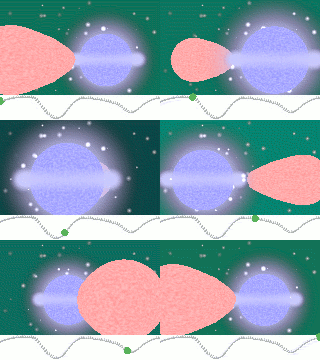
Measuring the time of minimum light is a classic project. By accumulating minima over months or years, you can detect orbital period changes that hint at mass transfer, third bodies, or apsidal motion. For timing precision, increase cadence around predicted minima and maintain consistent filters and calibration.
Exoplanet transit analogy
Although not variable stars in the traditional sense, transiting exoplanets create shallow, periodic dips similar in form to small eclipses. The observing and reduction techniques—precise differential photometry, careful detrending, and robust timing—mirror those used for eclipsing binary variables. If you can measure clean minima in eclipsing binaries, you have the core skills for exoplanet transit work.
Practical observing tips
- Plan around ephemerides: Use published ephemerides to predict eclipse times and set your observing window. Start early to establish baseline out-of-eclipse flux.
- Track systematics: Keep the target, comp, and check stars consistently in the same part of the detector to minimize flat-field residuals.
- Use multiple filters judiciously: If timing is the priority, stick to a single filter for maximum cadence and uniformity. For color effects (e.g., temperature differences), add a second filter on non-critical nights.
Pulsating Variables: Cepheids, RR Lyrae, and the Distance Scale
Pulsating stars rhythmically expand and contract, converting internal energy into coherent surface oscillations. The most famous, classical Cepheids, power one of astronomy’s cornerstone relations connecting period and intrinsic luminosity.
Physics in brief: the kappa mechanism
Many pulsators are driven by the kappa mechanism, where partial ionization zones (often helium) modulate opacity. As layers compress, opacity rises, trapping heat and boosting pressure; the star expands, opacity drops, and the layer cools—creating a self-sustaining oscillation. The period reflects the star’s radius and internal structure.
Cepheids and the period–luminosity relation
In a given passband, a Cepheid’s absolute magnitude correlates tightly with the logarithm of its pulsation period. Calibrated with nearby Cepheids that have geometric distances (e.g., from parallaxes), this relation lets astronomers measure distances to galaxies hosting Cepheids. Your role as an observer: produce well-phased, low-scatter light curves and, when possible, multi-band data to refine mean magnitudes and colors.

RR Lyrae as standard candles
RR Lyrae stars, older and less luminous than Cepheids, populate globular clusters and the Milky Way’s halo. Their shorter periods demand higher-cadence observing sessions but offer clean, repeatable cycles. Monitoring RR Lyrae helps map ancient structures and can reveal subtle period changes. For equipment, see method comparisons; for cadence, review planning tips.

Short-period pulsators
Delta Scuti and related stars vary on timescales of hours with low amplitudes. Achieving sufficient precision and cadence to resolve their multi-mode oscillations is a rewarding challenge for well-calibrated CMOS/CCD setups. Use rigorous calibration and stable comparison stars to keep scatter low.
Long-Period and Eruptive Variables: Miras, Dwarf Novae, Flares
Some of the sky’s most dramatic changes come from eruptive and long-period variables. They reward patience and broad community coverage.
Mira and semiregular variables
Miras are cool, evolved giants with large-amplitude, long-period variability. Their light curves are often asymmetric, with a faster rise and slower decline. Because they are bright at maximum and vary by several magnitudes, they are ideal for visual observing and DSLR photometry. Consistent, long-term monitoring builds high-value datasets that capture cycle-to-cycle changes and long-term trends in amplitude or period.
Cataclysmic variables and dwarf novae
Cataclysmic variables are interacting binaries with mass transfer onto a white dwarf. In dwarf novae, instabilities in the accretion disk trigger outbursts that can last days to weeks. Monitoring these systems helps characterize outburst frequencies and durations. Many observers coordinate alerts to catch the early rise of an outburst, where rapid cadence can reveal disk physics signatures.
Flare stars
Active M dwarfs can brighten dramatically within minutes due to magnetic reconnection events. Capturing flares requires short exposures and rapid cadence, ideally with a stable comparison star nearby and an automated capture plan to maintain coverage over hours. Multi-band observations reveal flare color evolution and temperature changes.
Submitting Data to AAVSO and Building Scientific Value
The AAVSO maintains a global repository of variable-star observations used by researchers worldwide. Contributing data connects your backyard observations to professional science and long-term archives.
Core steps to contribute
- Register and learn standards: Familiarize yourself with AAVSO observing manuals and recommended practices.
- Use the right charts: Download AAVSO comparison star charts for each target and filter; avoid ad hoc comps. For guidance, review planning and calibration sections.
- Document details: Record filter, exposure, instrument, site, and uncertainties. Consistency is key.
- Submit through WebObs: Provide times preferably in Julian Date (UTC-based) and standardized magnitudes with error estimates.
Example: a simple differential photometry log line
The following is a conceptual example illustrating elements commonly included in submissions or logs (consult AAVSO documentation for exact formatting):
Target=RR_Lyr, JD=2459765.5231, Filter=V, Mag=7.68, Err=0.02, Comp=7.89, Check=8.12, Exp=15s, Camera=CMOS, Notes=Clear sky, airmass~1.2

Basic period analysis workflow
If your data are unevenly sampled, periodograms help estimate the dominant period. Here is a simplified Python-like pseudocode sketch showing the concept (use established scientific libraries in practice):
# Pseudocode for Lomb–Scargle period search

import numpy as np

from astropy.timeseries import LombScargle  # typical library choice
time = np.array([...]) # Julian Dates
mag = np.array([...]) # observed magnitudes
err = np.array([...]) # magnitude uncertainties
frequency, power = LombScargle(time, mag, err).autopower()
period = 1.0 / frequency[np.argmax(power)]
print("Best period (days):", period)
After deriving a period, you can phase-fold your light curve and inspect residuals. If aliasing is suspected, extend the time baseline and coordinate with observers at different longitudes to fill gaps; see light curves for aliasing discussion.
Frequently Asked Questions
Can I do variable-star science from a light-polluted city?
Yes. Many bright variables (e.g., Miras, Algol-type eclipsers, and some RR Lyrae near maximum) are accessible with binoculars, small telescopes, or even DSLR lenses from urban sites. While light pollution raises the sky background, careful differential photometry with nearby comparison stars and consistent calibration can yield scientifically useful results. For fainter targets, longer exposures and better sky conditions help, but you can achieve robust work on brighter stars and timing projects even under city lights.
Do I need a photometric filter to start?
No filter is required to begin. Visual estimates and unfiltered DSLR or CMOS observations can contribute valuable time-series data, especially for bright variables and timing studies. However, if you plan to compare magnitudes across observers and epochs on an absolute scale, standardized filters (e.g., V or g′) and transformation practices significantly improve comparability and scientific value.
Final Thoughts on Choosing the Right Variable Star Targets
Variable-star observing blends patience with discovery. The right target list follows your schedule, equipment, and sky. If you prefer casual sessions and dramatic changes, long-period variables like Miras are ideal; if you like fast-paced, data-rich nights, eclipsing binaries and RR Lyrae deliver. Whatever you choose, invest in the fundamentals: solid calibration and filters, thoughtful planning and cadence, and honest reporting of uncertainties.
Your measurements—whether visual estimates or millimagnitude photometry—join a global archive that outlives any single observing run. Start small, iterate your technique, and build a personal program that keeps you engaged over months and years. If you found this guide helpful, explore related topics in our archive, and subscribe to our newsletter to get future deep dives on stars, stellar systems, and practical observing methods delivered straight to your inbox.