
Table of Contents
- What Is the Summer Triangle Asterism?
- Vega, Deneb, and Altair: Spectral Types, Distances, and Brightness
- How to Locate and Observe the Summer Triangle
- Seasonal Path and Latitude Tips: Northern and Southern Observers
- Touring the Milky Way Through Cygnus and Aquila
- What the Triangle Teaches Us About Stellar Evolution
- Cultural History and Etymology of the Summer Triangle
- Best Binocular and Small-Telescope Targets Inside the Triangle
- Urban Astronomy Strategies for the Summer Triangle
- Wide-Field Imaging Notes for the Summer Triangle
- Frequently Asked Questions
- Final Thoughts on Exploring the Summer Triangle
What Is the Summer Triangle Asterism?
The Summer Triangle is one of the sky’s most famous asterisms: three first-magnitude stars—Vega in Lyra, Deneb in Cygnus, and Altair in Aquila—form a large, easily recognized triangle that dominates northern summer and early autumn nights. Unlike constellations (officially recognized groups defined by the International Astronomical Union), an asterism is a convenient pattern within or across constellations. The Summer Triangle spans parts of three constellations and serves as a brilliant guidepost to the Milky Way and numerous deep-sky objects.
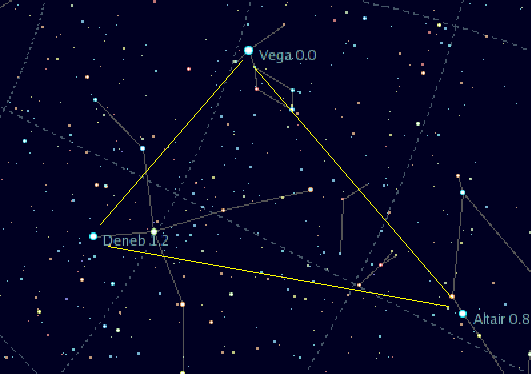
For newcomers, the Summer Triangle is both a starting point and a “cosmic map.” Once you identify these three bright anchors, you can star-hop to a wealth of targets: the Ring Nebula in Lyra, the North America Nebula near Deneb in Cygnus, and the Dumbbell Nebula in nearby Vulpecula. If you’re observing from light-polluted areas, the triangle offers reliable signposts when many fainter stars are washed out. If you are new to star-hopping, jump ahead to the practical guide in How to Locate and Observe the Summer Triangle.
The Milky Way runs through the triangle, most notably cutting across Cygnus and Aquila. This region includes striking dark lanes sometimes called the Great Rift, large clouds of interstellar dust that obscure background starlight. The dramatic contrast of bright star fields and winding dark nebulae makes the Summer Triangle one of the richest areas for binocular exploration. If you are curious about the Milky Way’s structure here, see our detailed tour in Touring the Milky Way Through Cygnus and Aquila.
Vega, Deneb, and Altair: Spectral Types, Distances, and Brightness
Though they form a simple triangle, Vega, Deneb, and Altair are very different stars in terms of physical properties and evolutionary paths. Understanding what they are adds depth to your time under the night sky and connects backyard observing to stellar astrophysics. For more on life cycles and future fates of these stars, see What the Triangle Teaches Us About Stellar Evolution.
Vega (Alpha Lyrae)
Constellation: Lyra | Spectral type: A0 V | Apparent magnitude: about 0.0 | Distance: roughly 25 light-years
Vega is one of the best-studied stars in the sky. It served historically as a photometric standard—an anchor for the zero point of the magnitude system in some passbands—and remains a key calibrator for instruments and surveys. Vega is a fast rotator and appears somewhat flattened at the poles due to its rapid spin, a property measured via interferometry. It’s also nearly pole-on from our perspective, which affects our view of its brightness distribution across the stellar surface.
Vega emits strongly in visible light, which makes it an excellent naked-eye benchmark for judging sky transparency and light pollution. It also hosts a prominent debris disk first inferred from infrared observations in the 1980s, evidence for substantial dust likely produced by collisions among small bodies. In the eyepiece, Vega is dazzlingly white-blue. It sits in a compact constellation filled with notable targets, including the Ring Nebula and the Double-Double star Epsilon Lyrae. We outline specific star-hops from Vega in Best Binocular and Small-Telescope Targets.
Deneb (Alpha Cygni)
Constellation: Cygnus | Spectral type: A2 Ia (supergiant) | Apparent magnitude: around 1.25 (slightly variable) | Distance: on the order of a couple of thousand light-years (with uncertainties)
Deneb is one of the most luminous stars visible to the naked eye. Its exact distance has been historically challenging to pin down with precision, but it is far more distant than Vega or Altair and intrinsically very bright. Deneb is a supergiant nearing advanced evolutionary stages, exhibiting small-amplitude variability characteristic of the “Alpha Cygni” class. This star anchors the tail of Cygnus the Swan, at the top of the Northern Cross asterism.
Deneb’s neighborhood is one of the Milky Way’s great showcase fields. The North America Nebula (NGC 7000) and the Pelican Nebula (IC 5070) are huge emission regions nearby on the sky; they respond dramatically to narrowband filters from dark locations. Dense star clouds coupled with dust lanes form the Cygnus “rift” region, which makes for compelling binocular sweeps. For a structured exploration path, skip ahead to Touring the Milky Way Through Cygnus and Aquila.

Altair (Alpha Aquilae)
Constellation: Aquila | Spectral type: A7 V | Apparent magnitude: about 0.8 | Distance: roughly 17 light-years
Altair is among the nearest bright stars. Like Vega, it rotates rapidly and is measurably oblate. In Aquila, Altair is flanked by two stars that form a short line—Tarazed (Gamma Aquilae) and Alshain (Beta Aquilae). Aquila sits along the Milky Way’s “river of stars,” and south of it lies the Scutum Star Cloud, one of the brightest concentrations of Milky Way starlight. The entire corridor from Vega to Altair, passing through the fields of Sagitta and Vulpecula, is packed with star clusters and nebulae visible in binoculars and small telescopes.
Together, Vega, Deneb, and Altair encompass a wide range of spectral types, ages, and luminosities, making the Summer Triangle a natural gateway for both visual observing and understanding stellar physics. Their separation on the sky creates an enormous “window” into the Milky Way, which we dive into in Touring the Milky Way Through Cygnus and Aquila.
How to Locate and Observe the Summer Triangle
Finding the Summer Triangle is straightforward once you know the seasonal context and a few visual cues. The triangle’s points are widely spaced and brighter than their surroundings, so even in cities you can often pick them out. If you want to understand why the triangle is positioned where it is across seasons, see Seasonal Path and Latitude Tips, which explains the geometry and timing.
Step-by-step star-hop
- Scan the eastern to southeastern sky in late spring or early summer after twilight. Look for the brightest star high up—that’s usually Vega.
- From Vega, look east (or slightly southeast) for a bright white star marking the top of a cross—this is Deneb, at the head of the Northern Cross in Cygnus.
- Return to Vega and draw a mental line down toward the southern sky. The bright star you encounter is Altair. With binoculars, you’ll notice two nearby stars making a line—Altair sits between Beta (Alshain) and Gamma (Tarazed) Aquilae.

Once you identify the triangle, you can begin exploring signature objects. The Ring Nebula (M57) lies between Beta and Gamma Lyrae near Vega. Albireo (Beta Cygni), a beautiful color-contrast double, lies near the “beak” of Cygnus. From Altair, short star-hops lead to the constellation Sagitta and the Dumbbell Nebula (M27) in nearby Vulpecula. Our curated list appears in Best Binocular and Small-Telescope Targets.
Visual cues and patterns
- Lyra’s parallelogram: Just south of Vega, a small quadrilateral marks the body of Lyra—a useful signpost for M57 and epsilon Lyrae.
- Northern Cross: Deneb sits at the top; Albireo at the foot. The cross often stands upright on late-summer evenings.
- Aquila’s line: Altair and its two bright neighbors form a nearly straight line; follow the Milky Way southward to identify Scutum and the rich star fields ahead.
Gear checklist for easy success
- Binoculars in the 7x–10x range. Even modest 8x42s reveal star clouds and open clusters.
- A paper star atlas or a reputable starmap app for real-time orientation.
- A red-light flashlight to preserve night vision.
- Optional narrowband filters (UHC or O III) if you plan on tackling emission nebulae near Deneb. See Urban Astronomy Strategies for filter tips.
Observing conditions that matter most
- Transparency is key for Milky Way vistas. Haze and humidity mute contrast in Cygnus and Aquila.
- Dark adaptation (20–30 minutes without bright light) dramatically increases your sensitivity to nebulosity.
- Seeing matters for splitting close doubles like epsilon Lyrae more than for diffuse nebulae. For a deep dive into splitting doubles, visit Best Binocular and Small-Telescope Targets.
Seasonal Path and Latitude Tips: Northern and Southern Observers
The Summer Triangle is a seasonal asterism mainly because of when it’s highest during evening hours. In the Northern Hemisphere, it’s a hallmark of late spring through autumn evenings. Southern observers can also enjoy it, though Deneb sits lower and may be challenging at far-southern latitudes.
When to look
- Late spring (Northern Hemisphere): Vega rises in the northeast after sunset; Deneb and Altair follow later in the evening.
- Mid-summer: The triangle dominates the overhead sky from dusk through midnight. The Milky Way arches across it, especially obvious from dark sites.
- Autumn: The triangle shifts westward. By late autumn evenings, Altair and Deneb sink earlier, with Vega lingering.
Latitude considerations
- Northern latitudes (30°–55° N): Ideal placement; Deneb and Vega pass high overhead, making Cygnus fields particularly rich.
- Equatorial regions: All three stars are well placed; the Milky Way is bold and near the zenith in appropriate months.
- Southern mid-latitudes (~20°–45° S): Altair is easy; Vega moderately high; Deneb can be low in the north and may require a clear horizon.
- Far south (south of ~45° S): Deneb is very low or below the horizon, so the “triangle” may not be complete.
For planning your session, use a planetarium app to see the triangle’s altitude during your observing window. If Deneb is low from your location, concentrate on the Altair–Vega side and targets in Lyra, Sagitta, and Vulpecula as outlined in Best Binocular and Small-Telescope Targets.
Touring the Milky Way Through Cygnus and Aquila
The region framed by Vega, Deneb, and Altair is one of the Milky Way’s showpieces. Cygnus in particular lies along a rich spiral-arm sightline filled with star formation, emission nebulae, and absorbing dust clouds. Aquila bridges to the bright Scutum Star Cloud farther south, while Vulpecula and Sagitta—small constellations nestled between—harbor accessible gems for binoculars and modest scopes.
The Great Rift and dark nebulae
Running through Cygnus and into Aquila is a sequence of dark lanes known colloquially as the Great Rift. These are not empty voids but rather dense concentrations of interstellar dust that block background starlight. Under dark skies, especially in late summer, the Rift appears as a sinuous gap dividing the Milky Way’s bright band. With binoculars, sweep slowly across the Rift; look for outlines reminiscent of riverbanks where star clouds are abruptly truncated.
Emission nebulae and hydrogen-rich complexes
- North America Nebula (NGC 7000) and Pelican Nebula (IC 5070): Near Deneb. These are extensive emission regions best appreciated with wide-field optics. A UHC or O III filter boosts contrast significantly. From suburban sites, they are challenging but not impossible with filters and a patient eye.
- Gamma Cygni region (Sadr): The heart of the Northern Cross. A wide-field view reveals complex nebulosity and dark lanes interwoven with rich star fields.
- Sh2-86 and surrounding complexes in Vulpecula and Sagitta: Though fainter, these areas reward deep imaging and careful visual scanning from dark locations.

Planetary nebulae and stellar endgames
- Ring Nebula (M57) in Lyra: Compact and high surface brightness. Even small telescopes reveal a smoke-ring appearance. Higher magnification on steady nights shows an oval ring with a dim center.
- Dumbbell Nebula (M27) in Vulpecula: Large and bright, a classic target for 7x–10x binoculars as a faint glow and for small scopes as a distinct hourglass/dumbbell shape. Filters enhance its delicate structure.
- M56 between Lyra and Cygnus: A compact globular cluster that takes magnification well. It sits in a star-rich field, making it a pleasing surprise when sweeping from Lyra toward Cygnus.
Star clusters and asterisms
- M29 in Cygnus: A small, tight open cluster in a dense Milky Way field—great for binocular sweepers to spot as a tiny knot.
- M39 in Cygnus: Large and coarse; best in binoculars or low-power wide-field eyepieces.
- Collinder 399 (Brocchi’s Cluster), the “Coathanger,” in Vulpecula: A delightful binocular asterism forming a hanger shape.
- Sagitta’s arrow: The entire constellation fits within a low-power field and points almost toward M27—useful for star-hopping.
As you roam, note the interplay between emission nebulae (ionized gas glowing in specific wavelengths), reflection nebulae (dust scattering starlight), and dark nebulae (dust absorbing light). The Summer Triangle is a microcosm of the Milky Way’s ecology of gas, dust, and stars at various life stages. For a deeper scientific perspective, see What the Triangle Teaches Us About Stellar Evolution.
What the Triangle Teaches Us About Stellar Evolution
Beyond their visual appeal, Vega, Deneb, and Altair illustrate key concepts in stellar astrophysics: mass, age, rotation, and environment. Together they span a continuum—from main-sequence stars (Vega and Altair) to a luminous supergiant (Deneb)—offering a living classroom in the night sky.
Mass and luminosity: why Deneb is exceptional
Deneb is orders of magnitude more luminous than the Sun. Its spectral type (A2 Ia) flags it as a massive supergiant, nearing advanced fusion stages. The exact luminosity depends on distance, which has uncertainties, but all credible estimates place Deneb among the brighter supergiants visible to the naked eye from Earth. High mass leads to rapid evolution: massive stars burn through their fuel in millions rather than billions of years. Deneb’s strong stellar wind and variability are consistent with a star in a relatively brief, unstable phase.
In contrast, Vega (A0 V) and Altair (A7 V) are hydrogen-burning main-sequence stars, more massive and luminous than the Sun but far less extreme than Deneb. They will spend a substantial fraction of their lives in this steady state before expanding into red giants and eventually shedding envelopes to produce planetary nebulae, leaving white dwarfs behind. That evolutionary path is illustrated by nearby planetary nebulae like M57 and M27.
Rotation and stellar shape
Vega and Altair both rotate rapidly. High rotational speeds cause oblateness—equators bulge, poles flatten—and produce temperature differences across the surface (a phenomenon known as gravity darkening). Interferometric observations have directly measured this shape distortion in Altair and evidence for a similar effect in Vega. The result is that a star’s spectrum and observed color can vary slightly with viewing angle and latitude across its surface.
Debris disks and planetary system context
Infrared observations revealed that Vega hosts an excess of infrared emission, indicating a cool circumstellar dust disk. While dust alone does not prove the presence of planets, debris disks are frequently associated with the byproducts of planetesimal collisions. Such disks provide laboratories for studying planet formation processes and dust dynamics around main-sequence stars.
Cygnus as a star-forming laboratory
Cygnus contains numerous star-forming regions and OB associations—groups of massive, hot stars that illuminate surrounding gas. The complex around Deneb is a classic example of how massive stars sculpt their environments: UV radiation ionizes gas, creating emission nebulae, while stellar winds carve cavities in the interstellar medium. Observers experience these processes directly in the rich nebulosity around Sadr and NGC 7000.
Photometric standards and the magnitude scale
Historically, Vega was used as a reference star to define zero magnitude in certain bands of the photometric system. Although modern systems use carefully calibrated networks of standards, Vega remains an important calibrator. This is more than a historical footnote: it means the brightness of many celestial objects has been assessed relative to a star you can point to with your finger on a clear summer night.
Cultural History and Etymology of the Summer Triangle
Though the Summer Triangle is not an official constellation, it has become a staple of modern star guides and public outreach. The term “Summer Triangle” rose to prominence in the mid-20th century through popular astronomy writers and broadcasters, while earlier European sources referred to it as a “Great Triangle.” Its simplicity made it ideal for introducing newcomers to the sky.
The stars themselves carry a deeper cultural heritage. Vega has been noted in astronomical records for millennia, including in Arabic and East Asian traditions. In Japan and parts of East Asia, Vega (as Orihime) and Altair (as Hikoboshi) are central to the Tanabata festival, celebrated in summer, where the Milky Way is imagined as a river separating two lovers who meet only once a year. Cygnus’s Deneb sometimes plays the role of a “bridge” star in related stories.
Stories woven around the Milky Way—from the Swan of Cygnus to lovers divided by a celestial river—add a human dimension to what we observe. The Summer Triangle, by concentrating both bright stars and the Milky Way’s glow, lies at the heart of many of these narratives.
Using narrative frameworks can also be practical: after you find the Northern Cross in Cygnus and the parallelogram of Lyra near Vega, the swan’s flight guides you along the Milky Way highway toward Aquila. To turn stories into observations, couple these cues with the techniques in How to Locate and Observe the Summer Triangle.
Best Binocular and Small-Telescope Targets Inside the Triangle
A good way to make the Summer Triangle “stick” in your memory is to build a tour of rewarding targets. Below are reliable objects grouped by convenience for 7x–10x binoculars and small telescopes (70–150 mm aperture). When hopping, use the anchor stars as your starting points.
Near Vega (Lyra)
- Epsilon Lyrae (the Double-Double): Just northeast of Vega. In steady air, small telescopes split the two bright components into pairs. Binoculars show it as a tight double.
- M57 (Ring Nebula): Between Beta and Gamma Lyrae in the parallelogram. At low power it appears as a fuzzy star; at moderate power a clear ring emerges. Filters can help, but its surface brightness is high enough for unfiltered viewing.

Attribution: N.A.Sharp, REU program/NOIRLab/NSF/AURA. Deep CCD image of the Ring Nebula highlighting outer structure and inner detail; colors trace physical state of material expanding from the central star. - Sheliak and Sulafat: The bright stars marking the parallelogram’s southern edge; good stepping stones for finding M57.
Along the Northern Cross (Cygnus)
- Albireo (Beta Cygni): A classic color-contrast double at the foot of the Cross. Small scopes often reveal a golden primary and a bluish secondary.
- M29 and NGC 6910: Compact open clusters near the “body” of the Cross. They reward slow, patient sweeping.
- NGC 7000 (North America Nebula) and IC 5070 (Pelican): Near Deneb; large, low-surface-brightness targets. Use a wide-field instrument plus a UHC or O III filter for best results.
- M39: A loose, bright open cluster northeast of Deneb; best in binoculars.
Between Altair and Deneb: Sagitta and Vulpecula
- M27 (Dumbbell Nebula): A top-tier planetary nebula in Vulpecula. Easily visible in small telescopes; even binoculars hint at a puff of light under dark skies.
- Collinder 399 (The Coathanger): A large pattern in Vulpecula that looks like its namesake. Best at 7x–10x; too large for most telescope fields.
- M71: A loosely concentrated globular cluster in Sagitta, appearing as a granular glow in small scopes under steady skies.
Southward toward Scutum
- Scutum Star Cloud: A bright patch of the Milky Way south of Aquila. While technically outside the triangle, it’s a natural extension of an Altair-based sweep.
If you’re observing from brighter suburbs, prioritize compact, high surface-brightness targets (e.g., M57, M27, double stars like Albireo and epsilon Lyrae). For larger low-contrast nebulae near Deneb, consider the techniques in Urban Astronomy Strategies.
Urban Astronomy Strategies for the Summer Triangle
City skies can still yield substantial rewards around the Summer Triangle. While the faint glow of the Milky Way may be invisible, many star clusters, doubles, and compact nebulae remain accessible with the right approach.
General tactics
- Prioritize transparency: Wait for clear, low-humidity nights. Even small improvements in transparency can reveal Milky Way star fields otherwise lost to skyglow.
- Use averted vision: Look slightly away from an object to engage more light-sensitive retinal regions.
- Shield stray light: Observe from a shadowed spot, under a porch or behind a wall, to block direct streetlamp glare.
- Dark adaptation: Give your eyes 20–30 minutes without white light. A red headlamp on the dimmest setting helps preserve sensitivity.
Filters and optics
- UHC or O III filters: These can make nebulae like NGC 7000’s brighter sections pop from darker suburban sites, though very bright urban cores remain challenging.
- Narrow exit pupils: In telescopes, using moderate magnification increases contrast against skyglow (e.g., M57 benefits from this).
- Binocular choice: 8×42 or 10×50 binoculars balance light gathering with hand-held steadiness. On a monopod or tripod, they reveal significantly more.
Target selection
- High surface-brightness objects: M57, M27, M56, Albireo, epsilon Lyrae.
- Skip: Very large, diffuse nebulae (unless you have access to darker skies and filters).
- Double stars: Color contrasts stand out even under light pollution—great for public sessions.
For a set of ready-made observing lists suited to brighter skies, start with the items listed in Best Binocular and Small-Telescope Targets and attempt them in roughly that order of difficulty.
Wide-Field Imaging Notes for the Summer Triangle
This article focuses on visual skywatching, but many observers eventually try wide-field imaging. The Summer Triangle is a forgiving region for first steps into night-sky photography because its subjects are bright, distinct, and large on the sky.
Why the Triangle excels for wide-field images
- Bright anchors: Vega, Deneb, and Altair are prominent in single exposures, easing composition and framing at focal lengths from 14–85 mm.
- Star clouds and dark lanes: Even short exposures from darker sites record the Milky Way’s texture, including the Great Rift cutting through Cygnus into Aquila.
- Rich targets for longer integrations: With tracking, the North America and Pelican Nebulae and the Gamma Cygni complex respond well to narrowband filters.

Starter setups
- Fixed tripod, fast lens: Short exposures at high ISO can capture bright stars and hint at Milky Way structure from dark sites.
- Star tracker: A small equatorial tracker enables multi-minute exposures at 35–85 mm, opening up emission nebulae and dark dust structures.
- Narrowband filters (for cameras sensitive to H-alpha): Useful for bringing out emission regions around Deneb, especially in light-polluted areas.
As you plan a session, consult the seasonal and positional advice in Seasonal Path and Latitude Tips, then cross-reference potential targets in Touring the Milky Way.
Frequently Asked Questions
Is the Summer Triangle visible from the Southern Hemisphere?
Yes, in many locations. From roughly 20°–45° S, Vega and Altair are accessible, while Deneb rides low in the north and may require a very clear horizon. Farther south than about 45° S, Deneb becomes difficult or impossible to see, which means the complete triangle is not visible. For details based on your latitude, see Seasonal Path and Latitude Tips.
Are Albireo’s two stars a true pair?
Albireo is famous for its color contrast, but observations indicate its bright components are likely not a gravitationally bound, close binary pair. Gaia astrometric data support the interpretation that the two visible stars are an optical double—appearing close from our vantage point but moving through space independently. Regardless, Albireo remains an outstanding color-contrast target in small telescopes. For more doubles and compact targets, see Best Binocular and Small-Telescope Targets.
Final Thoughts on Exploring the Summer Triangle
The Summer Triangle is more than three bright stars—it’s a gateway into the Milky Way’s architecture and a living lesson in stellar physics. Vega and Altair showcase fast-rotating main-sequence stars, while Deneb reveals the grandeur and impermanence of a luminous supergiant. Within their shared sky, you’ll find planetary nebulae, open clusters, sprawling emission complexes, and the dramatic silhouette of the Great Rift.
To make the most of the Triangle, follow a layered approach: first master the pattern and seasonal timing in How to Locate and Observe, then explore curated targets in Best Binocular and Small-Telescope Targets, and finally return for deeper appreciation with the science explained in What the Triangle Teaches Us About Stellar Evolution. Under pristine skies, the region is breathtaking; under city lights, compact showpieces like M57, M27, Albireo, and epsilon Lyrae still deliver a satisfying night.
If you enjoyed this deep dive, explore our other guides on constellations and seasonal sky highlights. To stay updated with future observing lists, science explainers, and equipment tips, subscribe to our newsletter and never miss a clear-sky opportunity.