
Table of Contents
- What Is Dark Matter in Modern Astrophysics?
- Astrophysical Evidence Across Scales: From Galaxies to the CMB
- Leading Dark Matter Candidates and Theoretical Frameworks
- How Scientists Search for Dark Matter: Experiments and Observations
- Mapping the Invisible: Lensing, Surveys, and Simulations
- Dark Matter’s Role in Galaxy Formation and Evolution
- Common Misconceptions About Dark Matter
- Frequently Asked Questions
- How to Learn More and Contribute to Dark Matter Science
- Final Thoughts on Understanding Dark Matter Research
What Is Dark Matter in Modern Astrophysics?
Dark matter is a form of matter that does not emit, absorb, or reflect light, yet exerts gravity. It is inferred from a wide array of independent observations that consistently point to more mass existing in the Universe than can be accounted for by visible stars, gas, dust, and planets. In the standard cosmological model (often called nullbnull9-CDM, for cosmological constant plus cold dark matter), dark matter makes up about 85% of the matter content of the Universe and roughly a quarter to a third of the total cosmic energy budget. While the precise fraction depends on the latest parameter fits, the key point is robust: most matter is dark.
Calling it cdark d simply means it is non-luminous and non-interacting with light to a very good approximation. It is not merely dim or hidden; it is a fundamentally different component that appears to interact primarily via gravity and possibly via forces beyond those in the Standard Model of particle physics. This is why the leading research programs fall into two intertwined tracks: (1) astronomical measurements that trace dark matter as gravitational imprint on structure, and (2) laboratory and collider experiments that look for non-gravitational interactions.
Invisible matter reveals itself through gravity. The shapes of galaxies, the bending of light, the ripples left in the early Universe as radiation 6hey all point to a dominant, unseen mass component.

Understanding dark matter is not only about solving a cosmic accounting problem. It is also about explaining how galaxies form, how large-scale structure grows, and why the cosmic microwave background (CMB) looks the way it does. The remarkable convergence of evidence, summarized in Astrophysical Evidence Across Scales, motivates a rich landscape of candidate particles and theories, which we survey in Leading Dark Matter Candidates and Theoretical Frameworks.
Astrophysical Evidence Across Scales: From Galaxies to the CMB
The case for dark matter does not rest on a single observation or technique. Instead, multiple, independent lines of evidence across vastly different scales all point to the same conclusion: there is more mass than meets the eye. Here are the pillars of that case.
Galaxy Rotation Curves and Stellar Motions
In a galaxy dominated by its visible matter (stars and gas), orbital velocities should decline with radius outside the bright stellar disk (roughly following a Keplerian fall-off, v null9 r 2). Observations often show the opposite: rotation curves stay flat, or even slightly rise, far beyond the luminous regions. This implies that mass continues to increase with radius, consistent with an extended, roughly spherical dark matter halo enveloping the galaxy.

- Flat rotation curves are seen in many spiral galaxies spanning a range of masses and morphologies.
- Similar mass discrepancies appear in elliptical galaxies via stellar velocity dispersions, and in low surface brightness and dwarf galaxies where the dark matter fraction is especially high.
These galaxy-scale signatures dovetail with independent evidence on larger scales.
Galaxy Clusters, the Virial Theorem, and X-ray Gas
In the 1930s, galaxy clusters like the Coma cluster revealed a cmissing mass d problem: galaxies move too quickly to be gravitationally bound by the visible matter alone. The virial theorem links the velocity dispersion of cluster members to the total mass of the cluster. When applied to observations, it indicates far more mass than can be seen in stars and hot gas.
Modern multi-wavelength studies strengthen this result:
- X-ray observations show clusters filled with millions-degree gas emitting in X-rays. The gas mass is substantial but still insufficient to explain the total gravitational potential implied by galaxy dynamics and lensing.
- Sunyaev 6eldovich measurements of the hot gas pressure confirm the presence of deep potential wells requiring dark matter to explain their depth and extent.
Gravitational Lensing: Strong, Weak, and Microlensing
Einstein as general relativity predicts that mass bends light. Dark matter as gravitational pull can be mapped directly via how it lenses background galaxies and quasars. There are several regimes:
- Strong lensing produces multiple images, arcs, and Einstein rings, allowing precise mass measurements in galaxy and cluster halos. Reconstructions often show mass distributions that extend beyond stellar light.
- Weak lensing measures subtle statistical distortions (shear) in the shapes of distant galaxies across wide fields. By stacking millions of galaxies, surveys infer the large-scale distribution of matter, dominated by the dark component.
- Microlensing occurs when compact objects (like stars, remnants, or black holes) pass in front of a background source, temporarily magnifying it. While microlensing helps constrain compact dark matter candidates (see Candidates), large-scale lensing maps primarily track the diffuse dark halos.
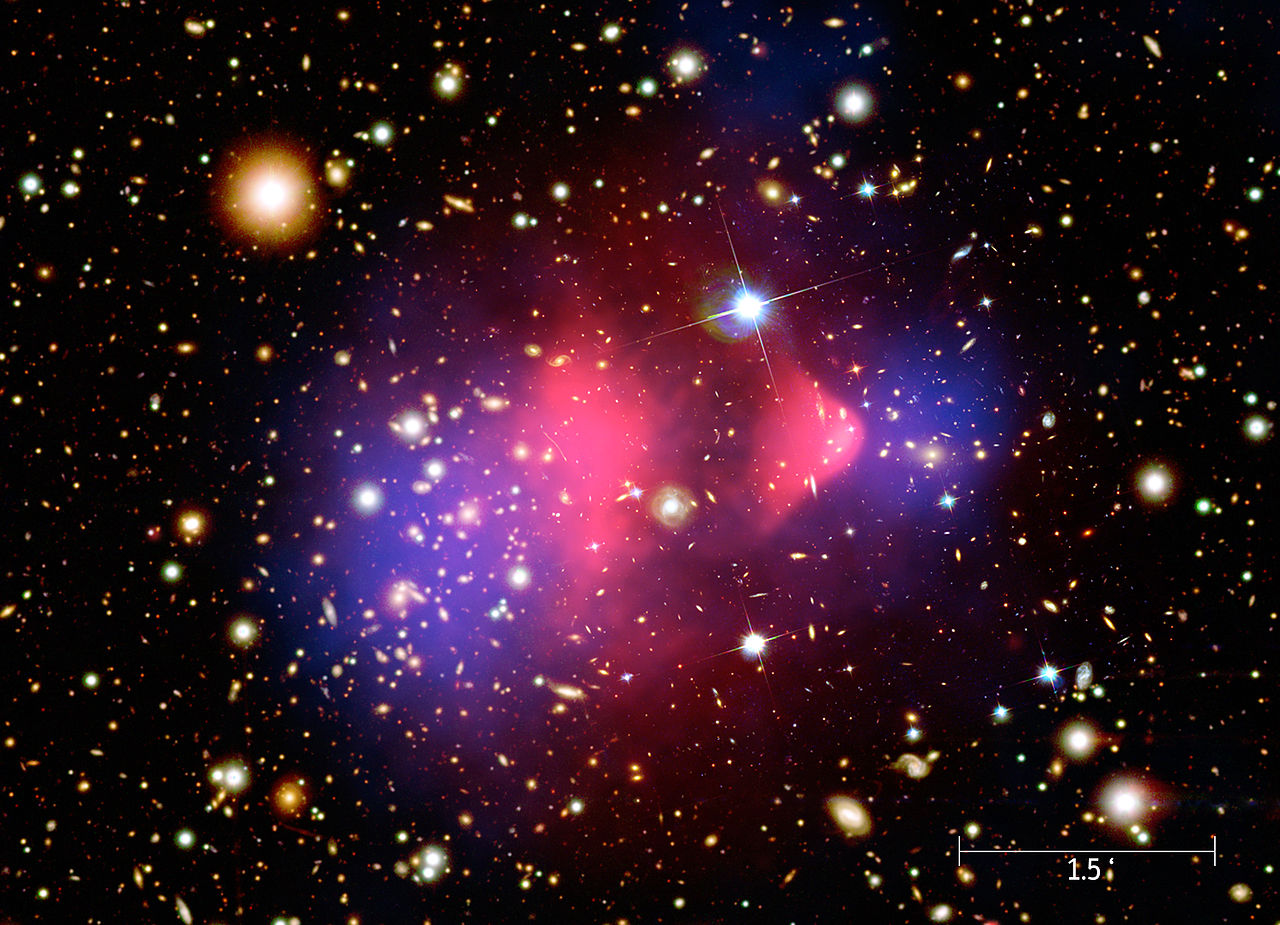
One especially striking case combines X-ray and lensing: in a merging cluster sometimes nicknamed the cBullet Cluster, d the hot gas (seen in X-rays) lags behind as the collision strips it, whereas the main mass peaks inferred from lensing pass through more cleanly. This separation between the baryonic gas and the total mass is naturally explained if most of the mass is collisionless dark matter.
Cosmic Microwave Background (CMB) Anisotropies

The CMB is the oldest light we can observe, carrying a record of density fluctuations in the early Universe. Its temperature and polarization power spectra show acoustic peaks whose relative heights and positions encode the amounts of baryonic matter, dark matter, and radiation.
- Relative peak heights require a non-baryonic matter component. Baryons alone cannot reproduce the observed pattern.
- CMB lensing directly reconstructs the intervening matter distribution by measuring how small-scale anisotropies are distorted, giving an integrated map dominated by dark matter.
The CMB, together with large-scale structure data, strongly supports a Universe where cold dark matter seeds the growth of structure that later becomes galaxies and clusters.
Baryon Acoustic Oscillations and Large-Scale Structure
Acoustic waves in the hot plasma of the early Universe left a cstandard ruler d in the distribution of galaxies known as baryon acoustic oscillations (BAO). Observed as a small preference for galaxy pairs to be separated by a characteristic scale, the BAO signal is sensitive to the cosmic expansion history and the matter content.
Galaxy redshift surveys and weak-lensing measurements trace the growth of cosmic structure over time. Simulations of structure formation that include cold dark matter accurately reproduce the observed ccosmic web d of filaments and clusters, while models with only baryons or with hot, fast-moving dark matter (like light neutrinos) cannot match the small-scale clumpiness we see today.
These independent probes 6alaxy dynamics, cluster physics, lensing maps, the CMB, and the cosmic web all point to the same inference. This mutually reinforcing network of evidence is a central reason the scientific community studies specialized particle and astrophysical candidates, discussed next in Leading Dark Matter Candidates and Theoretical Frameworks.
Leading Dark Matter Candidates and Theoretical Frameworks
Because dark matter has eluded detection via light, theoretical models mostly focus on neutral, long-lived particles or compact objects. Below is a concise tour of the most prominent possibilities, including a few alternatives that try to modify gravity rather than introduce new matter.
WIMPs: Weakly Interacting Massive Particles
WIMPs are hypothetical particles with masses typically from a few GeV to the TeV scale, interacting via forces comparable in strength to the weak nuclear force. A key motivation is the thermal relic idea: in the early hot Universe, such particles could have been in thermal equilibrium and then cfroze out d as the Universe expanded and cooled, leaving behind a relic abundance that happens to be in the right ballpark to account for dark matter. The required annihilation cross-section is characteristically around 3 nulld 10 7 cmnullb3/s, a coincidence sometimes dubbed the cWIMP miracle. d
Specific WIMP candidates appear in extensions of the Standard Model, such as supersymmetric neutralinos or Kaluza cKlein particles in extra-dimensional theories. Decades of experimental searches have not yet found WIMPs, and upper limits on their interaction cross-sections have become impressively stringent. However, significant regions of parameter space remain untested, particularly at low masses and in more complex interaction scenarios.
Axions and Axion-Like Particles
Axions were originally proposed to solve the strong CP problem in quantum chromodynamics (QCD), explaining why the strong force does not appear to violate a certain symmetry as naively expected. Remarkably, axions with appropriate properties could also serve as cold dark matter. QCD axions are expected to be extremely light (micro-eV to milli-eV masses) but can be copiously produced in the early Universe through non-thermal mechanisms, leading to a cold, coherent field today.
Axions couple weakly to photons and other particles, enabling experimental searches using strong magnetic fields and resonant cavities (see How Scientists Search for Dark Matter). More general axion-like particles (ALPs) arise in many theories and broaden the viable mass and coupling ranges.
Sterile Neutrinos and Warm Dark Matter
Sterile neutrinos are hypothetical neutrino species that do not participate in Standard Model weak interactions, interacting only via gravity and possible mixing with active neutrinos. If they have keV-scale masses, they can behave as warm dark matter, with a free-streaming length that suppresses very small-scale structure while still allowing galaxies to form. X-ray observations place constraints on sterile neutrino properties, since such particles could decay into a lighter neutrino and an X-ray photon. Claims of a faint emission line around 3.5 keV in some systems have been debated, and its origin remains unsettled.
Compact Objects: MACHOs and Primordial Black Holes
Massive Compact Halo Objects (MACHOs) include dim stars, brown dwarfs, stellar remnants, and black holes. Microlensing surveys have searched for these by monitoring millions of background stars for temporary brightening events caused by intervening compact objects. Results show that typical MACHO populations cannot account for the majority of dark matter in the Galactic halo.
Primordial black holes (PBHs), formed in the early Universe, are another possibility. Observations across many wavebands and techniques place strong constraints on PBHs over a wide range of masses. While there is continued interest, especially following gravitational-wave detections of black hole mergers, current limits exclude PBHs from constituting all of the dark matter for many mass intervals. Some windows remain subject to further testing.
Self-Interacting Dark Matter (SIDM)
SIDM refers to dark matter with sizable scattering among its own particles. Cross-sections on the order of 0.1 6 cmnullb2/g have been considered to alleviate small-scale tensions (like overly dense halo centers) by transferring heat within halos, potentially creating cores. Observations of cluster collisions (where the dark matter mass peaks appear to pass through) place constraints on how strong such self-interactions can be. Models often feature velocity-dependent cross-sections that affect dwarfs more than clusters.
Modified Gravity: MOND and Relatives
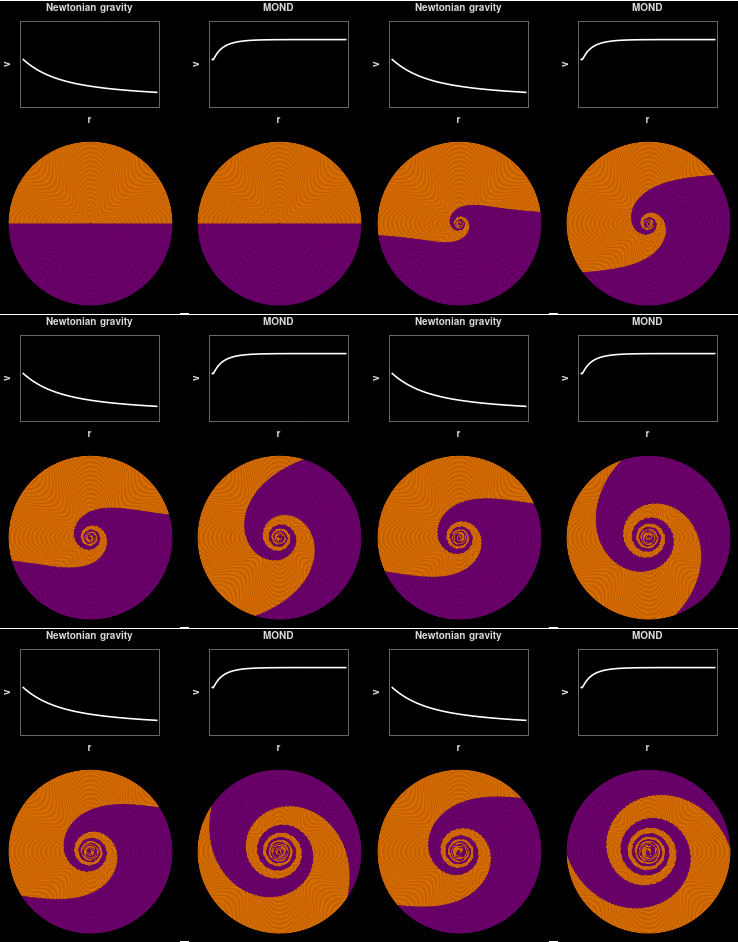
An alternative to adding dark matter is to modify the laws of gravity on galactic scales. Modified Newtonian Dynamics (MOND) posits a change in the relation between acceleration and force at very low accelerations, and it can fit many galaxy rotation curves with a single acceleration scale. However, when tested against cluster dynamics and lensing, the full suite of CMB acoustic peaks, and large-scale structure, MOND and relativistic extensions face significant challenges. Many phenomena are more naturally explained by a dominant, non-luminous matter component with standard gravity.
The leading consensus therefore remains that a new form of matter is present, pushing research toward laboratory searches and precise astrophysical mapping to determine its properties.
How Scientists Search for Dark Matter: Experiments and Observations
Dark matter reveals itself by gravity, but physicists are also pursuing signs of rarer, non-gravitational interactions. The experimental program is broad and complementary, targeting different candidate masses and couplings.
Direct Detection: Nuclear and Electron Recoils Underground
Direct detection experiments look for the tiny energy deposited when a dark matter particle scatters off an atomic nucleus or electron in a detector. To minimize backgrounds, these experiments operate deep underground and use ultra-clean materials and powerful shielding.
- Noble-liquid time projection chambers (TPCs) such as xenon- and argon-based detectors set some of the most stringent limits on WIMP-nucleon interactions. They measure scintillation and ionization signals from potential recoils.
- Cryogenic solid-state detectors (e.g., using silicon or germanium crystals) detect phonons and ionization with exquisite sensitivity, enabling strong constraints, especially at lower masses.
- Low-threshold and electron-recoil experiments push sensitivity to sub-GeV masses by looking for ionization signals and single-electron events in ultra-quiet devices.
- Directional detection concepts aim to measure the direction of recoils, which would carry the imprint of the Solar System as motion through the Galactic halo, offering a distinctive signature.
One long-discussed claim from a scintillator-based experiment reported an annual modulation in event rate consistent with Earth as orbit through a dark matter wind. However, independent experiments with similar target materials and improved control of backgrounds have not confirmed this signal, undercutting that particular interpretation.
As sensitivities improve, experiments approach the so-called neutrino floor, a background from coherent scattering of solar, atmospheric, and supernova neutrinos that will eventually limit sensitivity for some channels. New strategies, including directional measurements and target complementarity, are being developed to further extend reach.
Indirect Detection: Looking for Annihilation or Decay Products
If dark matter can annihilate or decay into Standard Model particles, its products might be observable as cosmic rays, gamma rays, or neutrinos. Key targets include:
- Dwarf spheroidal galaxies, which are dark matter-dominated and relatively free of astrophysical backgrounds, making them prime targets for gamma-ray searches.
- The Galactic center, which has a high expected dark matter density but complex astrophysical foregrounds that must be modeled carefully.
- Galaxy clusters and extragalactic backgrounds, which can collectively constrain annihilation or decay rates.
- The Sun and Earth, where dark matter capture followed by annihilation could produce neutrinos detectable in large ice or water Cherenkov detectors.
Gamma-ray telescopes, cosmic-ray spectrometers, and neutrino observatories have provided powerful constraints, especially in the GeV-to-TeV mass range for WIMPs. A positron excess in cosmic rays prompted interest in dark matter interpretations, but pulsars and other astrophysical sources provide plausible explanations, and stringent constraints from other channels challenge a dark matter origin.
Colliders: Producing Dark Matter at High Energies
Particle colliders, particularly the Large Hadron Collider, can potentially produce dark matter if it couples to Standard Model particles strongly enough. Because dark matter would escape detectors unseen, the signature is missing transverse energy balanced by a visible particle such as a jet or photon ( cmono-X d events). Collider searches explore complementary regions of parameter space articularly scenarios with light mediators or non-standard interactions and have set meaningful limits on simplified models and Higgs-portal couplings.
Axion Searches: Haloscopes, Helioscopes, and More
Axion experiments leverage the particle as predicted coupling to photons. The basic strategy is to convert axions into detectable photons in a strong magnetic field or to do the reverse in controlled laboratory setups.
- Haloscopes use high-Q microwave cavities or resonators inside strong magnets to detect axion dark matter in the local halo. The signal is a very narrow line at the axion rest mass frequency, so experiments scan in steps across possible masses.
- Helioscopes aim at the Sun, looking for axions produced in the solar core converting to X-rays in a magnetic field on Earth. Next-generation designs plan to improve sensitivity significantly.
- Dielectric haloscopes and broadband resonators (e.g., stacks of dielectric layers or lumped-element circuits) target different mass ranges with improved scanning speeds.
This program is steadily covering larger swaths of axion parameter space, with new technologies extending to both lower and higher masses.
Gravitational and Astrometric Probes of Substructure
Even if dark matter never interacts non-gravitationally, its clumpiness should betray its nature. Cold dark matter predicts abundant subhalos within larger halos. Observational handles include:
- Stellar streams in the Milky Way, seen as thin ribbons of stars from tidally disrupted clusters or dwarfs. Encounters with dark subhalos can leave gaps and wiggles in streams, offering a way to count invisible perturbers using precise stellar positions and motions.
- Strong lens flux anomalies and time delays in lensed quasars, which can reveal small dark clumps along the line of the sight or in lens galaxies, even when those clumps contain few stars.
These methods directly inform the small-scale power spectrum of matter and test whether dark matter is truly cold, warmer, or self-interacting. They complement the direct and indirect detection approaches, as outlined across this experiments section.
Mapping the Invisible: Lensing, Surveys, and Simulations
To understand dark matter as role in cosmic structure, astronomers combine wide-field surveys, precise lensing measurements, and high-resolution simulations. Together they produce 3D maps of mass and its evolution with time.

This image was taken with the 570-megapixel U.S. Department of Energy-fabricated Dark Energy Camera (DECam), mounted on the U.S. National Science Foundation Víctor M. Blanco 4-meter Telescope at Cerro Tololo Inter-American Observatory (CTIO), a Program of NSF NOIRLab.
View the Zoomable image to explore this stunning galaxyscape in more detail. Artist: CTIO/NOIRLab/DOE/NSF/AURA Image Processing: T.A. Rector (University of Alaska Anchorage/NSF NOIRLab) & M. Zamani (NSF NOIRLab)
Weak-Lensing Surveys and Mass Maps
Weak gravitational lensing is a cornerstone technique for mapping the projected mass distribution without assuming how light traces mass. By measuring small, coherent distortions in galaxy shapes across the sky, surveys build ccovergence d maps tracing the underlying matter amostly dark.
- Current surveys have delivered high-quality cosmic shear measurements, constraining the matter density and clustering amplitude and creating 2D and tomographic mass maps.
- Upcoming and ongoing facilities are designed to dramatically expand sky coverage and depth, enabling tighter constraints on dark matter clustering and evolution. Their synergy with spectroscopic surveys will further sharpen 3D maps.
Weak lensing also probes intrinsic alignments and requires careful control of systematic errors such as point spread function modeling and shear calibration. Significant progress in methodology has enabled robust inferences that can be cross-checked with CMB lensing and galaxy clustering.
CMB Lensing and Cross-Correlations
Gravitational lensing of the CMB provides a complementary mass map at higher redshifts than typical galaxy lensing, integrating the matter distribution back to the surface of last scattering. Cross-correlating CMB lensing maps with galaxy surveys, quasars, and weak-lensing shear catalogs improves signal-to-noise, breaks parameter degeneracies, and tests for systematics.
CMB lensing also helps calibrate the relation between galaxy light and mass, clarifying how baryons populate dark matter halos. This calibration is central for using galaxies as biased tracers of the underlying matter field in cosmological analyses.
N-body and Hydrodynamic Simulations
N-body simulations that evolve billions of dark matter particles forward in time from early-Universe initial conditions predict the halo mass function, halo concentrations, and the substructure spectrum. The results match many features of observed structure, especially on large scales.
To connect matter distributions with observable galaxies, researchers add baryonic physics to form stars, heat and cool gas, and drive outflows. These hydrodynamic simulations suggest that stellar winds and feedback from black holes can modify inner halo densities, mimicking some effects initially attributed to exotic dark matter interactions. Thus, carefully modeling baryonic effects is vital when using galaxy profiles to infer dark matter properties.
Simulations also generate predictions for lensing substructure signals and stellar stream perturbations, guiding the analyses highlighted in Gravitational and Astrometric Probes.
Dark Matter as Role in Galaxy Formation and Evolution
Dark matter halos serve as the gravitational scaffolding on which galaxies assemble. Gas falls into halos, cools, and forms stars, while feedback processes and environment shape the resulting galaxy. Several key aspects of galaxy formation hinge on dark matter as properties.
Halo Profiles and the Cusp 6ore Discussion
Simulations of collisionless cold dark matter yield a characteristic radial density profile with a steep inner slope (a ccusp d). However, some late-type and dwarf galaxies exhibit rotation curves consistent with shallower inner densities (a ccore d). Two broad explanations have been proposed:
- Baryonic feedback from supernovae and stellar winds can heat and rearrange the central dark matter, flattening cusps into cores over time.
- Self-interacting dark matter can redistribute kinetic energy through dark scatterings, naturally producing cores in low-velocity systems while remaining consistent with cluster-scale constraints if the cross-section depends on velocity.
Distinguishing between these mechanisms requires detailed, system-by-system study, accounting for star formation histories and gas dynamics. It exemplifies how astrophysics and particle physics intersect in the dark matter problem.
Substructure: Missing Satellites and Too-Big-to-Fail
In cold dark matter simulations, Milky Way-sized halos contain many subhalos. Early comparisons with observed satellite galaxies indicated fewer satellites than expected, dubbed the cmissing satellites d problem. More sensitive surveys have since discovered numerous faint dwarfs, narrowing the gap. In addition, models incorporating reionization and stellar feedback naturally suppress star formation in many low-mass halos, explaining why numerous halos might remain dark.
The too-big-to-fail issue concerns simulated subhalos that are dense enough to form stars but appear absent among observed satellites. Proposed resolutions include baryonic effects that alter the central densities of subhalos, selection biases in observations, and, in some models, modest dark matter self-interactions. Improved kinematics and deeper searches continue to refine the comparison.
Dwarf Galaxies and Ultra-Diffuse Systems
Dwarf spheroidal galaxies around the Milky Way exhibit extremely high mass-to-light ratios, making them valuable laboratories for dark matter density profiles and, in indirect detection, for annihilation constraints. Ultra-diffuse galaxies (UDGs), which are large in size but faint in surface brightness, display a range of dark matter content. Some UDGs appear strongly dark matter-dominated, while a few have been discussed as unusually light in dark matter based on distance and kinematics estimates. As techniques improve, measurements of these fragile systems continue to be refined, and claims are re-evaluated with updated data and modeling.
Angular Momentum, Bars, and Disks
Dark halos help set the angular momentum budget of forming disks. The exchange of angular momentum between stars, gas, and halo material influences the growth and slowdown of stellar bars, the stability of disks, and the structure of spiral arms. Careful dynamical modeling of barred galaxies, including resonances and gas inflows, indirectly informs halo density and shape.
Common Misconceptions About Dark Matter
Despite decades of research, confusion persists about what dark matter is and is not. Here are clarifications to frequent misconceptions, with pointers to sections where the evidence is discussed in depth.
- cDark matter is just black holes or faint stars. d Compact objects have been extensively tested via microlensing and other probes. While such objects exist, constraints show they cannot make up the bulk of the dark matter across most mass ranges. See Compact Objects.
- cDark matter is the same as dark energy. d No. Dark energy drives the accelerated expansion of the Universe; dark matter is matter that clusters and pulls via gravity. They are distinct components with different observational signatures.
- cWe only see dark matter in galaxies; it’s a local effect. d Evidence spans from galaxy rotation curves to clusters, gravitational lensing, the CMB acoustic peaks, and the large-scale distribution of galaxies, all consistent with a dominant non-luminous component.
- cMaybe gravity is wrong; then we don’t need dark matter. d Modified gravity can fit some galaxy-scale phenomena but struggles to explain clusters, CMB peak structure, and lensing maps simultaneously. See Modified Gravity and Astrophysical Evidence.
- cDark matter blocks light like dust. d Dust absorbs and scatters light, but dark matter does not interact with photons in that way; its presence is inferred chiefly through gravitational effects.
Frequently Asked Questions
Could dark matter really be a change in the laws of gravity?
It is a serious idea and has inspired frameworks that modify Newtonian dynamics or general relativity to reproduce galaxy rotation curves. However, dark matter is favored because a single, collisionless component explains multiple phenomena simultaneously: cluster mass profiles, gravitational lensing on many scales, the full pattern of CMB acoustic peaks, and the growth of large-scale structure. Modified gravity models often require additional unseen matter at cluster scales or struggle to fit all datasets together. Ongoing tests with lensing, galaxy surveys, and the CMB continue to probe these alternatives.
When might we actually discover the dark matter particle?
There is no guaranteed timeline. The search is proceeding on many fronts: next-generation direct detection experiments are pushing to lower cross-sections and masses; indirect searches continue to refine gamma-ray, cosmic-ray, and neutrino constraints; colliders are exploring new signatures; and lensing surveys are mapping dark matter with increasing precision. A discovery could emerge from any of these avenues c or from a synergy between them. Even null results are highly informative, ruling out possibilities and sharpening our theoretical picture.
How to Learn More and Contribute to Dark Matter Science
While dark matter may sound esoteric, there are accessible ways to deepen your understanding and even contribute to related research efforts.
Follow Key Observational Programs
Wide-field imaging and spectroscopic surveys are producing high-quality lensing maps and galaxy catalogs that constrain dark matter clustering. Keeping up with survey data releases and summaries helps track the field as progress. Many teams provide clear overviews aimed at non-specialists alongside technical publications.
Citizen Science and Visual Discovery
Large imaging datasets benefit from human pattern recognition. Citizen science platforms have hosted projects to identify gravitational lenses, classify galaxies, and spot transient events. Participation enhances machine-learning training sets and can help uncover unusual systems that probe dark matter substructure, tying into the strong lensing anomalies techniques mentioned earlier.
Learn the Fundamentals
Background in cosmology, particle physics, and astrophysics clarifies how the CMB, lensing, and structure growth constrain dark matter. Foundational texts on cosmology and particle astrophysics provide step-by-step reasoning behind the standard model of cosmology, the thermal relic calculation, and the interpretation of galaxy dynamics. Review articles and public seminar series often give approachable summaries of cutting-edge constraints.
Explore Open Data and Tools
Some surveys release subsets of data and code, enabling motivated learners to recreate basic lensing mass maps, fit rotation curves to galaxy data, or model simple N-body dynamics. Even small-scale projects cfrom reproducing a rotation curve fit to experimenting with mock lensing distortions cbuild intuition for how the mapping and detection efforts work in practice.
Final Thoughts on Understanding Dark Matter Research
Dark matter research is a rare scientific enterprise where cosmic cartography, detector innovation, and fundamental theory advance together. The astrophysical case is compelling and multifaceted: galaxy dynamics, cluster mass profiles, gravitational lensing, the CMB acoustic pattern, and the growth of large-scale structure all point to a dominant, unseen matter component. On the particle front, leading candidates like WIMPs and axions remain well-motivated, and the absence of a signal so far has driven creative new experiments and models rather than diminished the core evidence.
In the years ahead, we can expect deeper lensing surveys, more sensitive direct and indirect searches, and improved simulations that better integrate baryonic physics with dark matter dynamics. Each step tightens the net around the properties dark matter must have. Whether discovery arrives as a resonant tone in a magnetized cavity, a low-energy recoil in an ultra-pure crystal, a pattern in the gamma-ray sky, or a subtle signature in stellar streams and lensing maps, the payoff will reshape our understanding of matter and the cosmos.
If this guide helped clarify the landscape, consider exploring related topics in our archive, from cosmic structure formation to gravitational lensing techniques. For future deep dives into astrophysics and observational breakthroughs, subscribe to our newsletter and stay engaged with the unfolding story of the dark Universe.