
Table of Contents
- What Is the Summer Triangle Asterism?
- How to Find Vega, Deneb, and Altair From Any Sky
- Deep-Sky Sights Within and Around the Triangle
- Astrophysics of Vega, Deneb, and Altair
- Cultural History, Etymology, and Myth Across the Milky Way
- Observing Tips by Season, Latitude, and Light Pollution
- Binocular and Small Telescope Projects in the Triangle
- Citizen Science: Variables, Doubles, and Photometry
- Frequently Asked Questions
- Final Thoughts on Exploring the Summer Triangle
What Is the Summer Triangle Asterism?
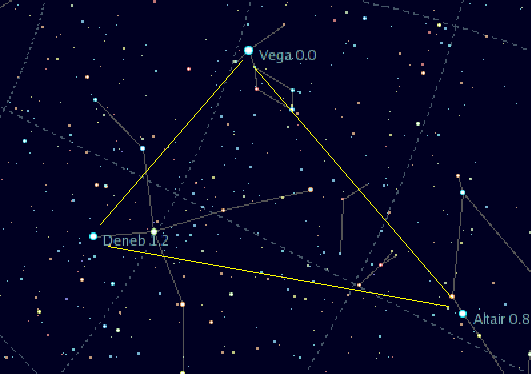
The Summer Triangle is one of the night sky’s most recognizable asterisms: a large, almost isosceles triangle formed by three bright, blue-white stars—Vega in Lyra, Deneb in Cygnus, and Altair in Aquila. Unlike a formal constellation, an asterism is a popular star pattern that spans parts of several constellations. The Summer Triangle stretches across the rich star fields of the Milky Way’s northern band, making it an excellent starting point for stargazers, binocular observers, and astrophotographers who want a reliable seasonal guidepost in late spring through autumn evenings.
Credit: Jim Thomas
Each vertex of the triangle has its own scientific intrigue. Vega (Alpha Lyrae) is a nearby A-type main-sequence star about 25 light-years from Earth and among the brightest in the entire sky. Altair (Alpha Aquilae), about 17 light-years away, spins so fast that it is measurably flattened at the poles. Deneb (Alpha Cygni), enormously farther—on the order of thousands of light-years—shines as a luminous blue-white supergiant, one of the intrinsic heavyweights visible to the naked eye. Together, these stars outline a patch of sky packed with double stars, planetary nebulae, open clusters, and famous nebulae like the North America Nebula.
For newcomers wondering, “What exactly is the Summer Triangle?”—think of it as the northern hemisphere’s summer-time Orion: an anchor pattern that rises to prominence around June evenings, culminates in July and August, and lingers into early autumn. When you can spot the Summer Triangle, you can orient yourself to three constellations and navigate to a host of deep-sky showpieces. This article explains how to find it from virtually anywhere on Earth, the science of its stars, the culture and mythology surrounding them, and practical observing projects for clear nights. If you’re looking specifically for targets to observe, jump to Deep-Sky Sights Within and Around the Triangle.
How to Find Vega, Deneb, and Altair From Any Sky
Finding the Summer Triangle becomes second nature once you’ve located one of its three corner stars. Here’s a step-by-step approach that works in cities and dark-sky sites alike, with alternative routes in case part of your horizon is blocked.
Step 1: Start with Vega, the beacon of Lyra
Vega is the brightest of the three and one of the brightest stars in the entire night sky. It shines with a crisp, white-blue hue, often glittering fiercely when low on the horizon. In mid-northern latitudes, look high in the east during late spring evenings (May–June), nearly overhead on summer nights (July–August), and toward the west in early autumn. Vega sits near a small parallelogram of stars that form the rest of Lyra. When you see a bright solitary star near a compact diamond of fainter ones, you’ve found Vega and Lyra.
- From the Big Dipper (spring evenings): follow the arc of the Dipper’s handle to Arcturus, then continue in a gentle curve toward Vega. The mnemonic “arc to Arcturus, speed to Spica” is common; add your own: “veer to Vega.”
- From Aquila’s line: if you can identify a short line of bright stars in a reef-like pattern low in the east on summer evenings—that’s Aquila. The top of that line leads you to Altair; draw an imaginary line up and right from Altair to reach Vega.
Step 2: Use Vega to find Deneb in Cygnus
Deneb anchors one end of the Northern Cross, a striking pattern within Cygnus. Once you’ve found Vega, sweep your gaze eastward (roughly left, if you’re facing south in the northern hemisphere) along the river of the Milky Way to the next very bright star. That’s Deneb. The Northern Cross looks like a tall kite or cruciform shape, with Deneb as the top. Under dark skies, this whole region is powdered with Milky Way stars and faint hazy patches—prime territory for binocular exploration and the classic nebulae described in Deep-Sky Sights.
- Deneb’s brightness is moderate but steady. Though fainter than Vega, it stands out clearly in rural skies.
- If the Milky Way is visible, trace its brightest band—Deneb often appears embedded right in the shimmering lane.
Step 3: Swing down to Altair in Aquila
From Vega, drop your gaze downward and a bit south; from Deneb, move downward and a bit west. You’ll see a bright star bracketed by two fainter ones in a nearly straight line. The centerpiece is Altair, the head of the Eagle. That short line is a helpful signature: many observers memorize the “three-in-a-row” asterism to confirm they’ve found Altair even in suburban light pollution.
- Altair is bright and relatively close to Earth; under steady skies it burns with a clean white tone but twinkles when low.
- Aquila’s wings spread out from Altair, forming a wide V-shape. If you can see the wings, your sky is fairly transparent.
Seasonal and hemispheric pointers
In mid-northern latitudes (30–50° N), the Summer Triangle becomes prominent in the eastern sky by late spring evenings, dominates the south overhead during mid-summer nights, and slides to the west by October. In tropical latitudes, the Triangle can pass nearly overhead, giving spectacular Milky Way views. In the southern hemisphere (say 20–40° S), the Triangle rides lower in the northern sky during the austral winter and spring; Altair climbs highest, while Deneb remains low but can still be spotted with a clear northern horizon. For practical strategies in bright urban skies, see Observing Tips by Season, Latitude, and Light Pollution.
Quick orientation check: Find the brightest star high overhead in July around 10 p.m.—that’s usually Vega. Sweep east to the next bright star at the top of a cross—Deneb. Then glance down-right to another bright star flanked by two fainter ones—Altair. You’ve just traced the Summer Triangle.

Credit: Tomruen at en.wikipedia
Deep-Sky Sights Within and Around the Triangle
The Summer Triangle is not just a signpost—it encloses and abuts some of the richest deep-sky terrain accessible to binoculars and small telescopes. Below are highlights sorted by constellation, with easy star-hops from Vega, Deneb, and Altair. If you’re new to sky navigation, start with obvious doubles and bright clusters, then progress to planetary nebulae and diffuse nebulae under darker skies.
Lyra: Little constellation, big rewards
- M57, the Ring Nebula: Perhaps the most famous planetary nebula, M57 sits roughly between Beta (Sheliak) and Gamma (Sulafat) Lyrae. In small telescopes it appears as a tiny smoke ring. Medium apertures begin to show a darker center and an oval shape. Averted vision helps even at low power. A classic target once you’ve identified Vega and traced the Lyra parallelogram.

This new image shows the dramatic shape and colour of the Ring Nebula, otherwise known as Messier 57.
From Earth’s perspective, the nebula looks like a simple elliptical shape with a shaggy boundary. However, new observations combining existing ground-based data with new NASA/ESA Hubble Space Telescope data show that the nebula is shaped like a distorted doughnut. This doughnut has a rugby-ball-shaped region of lower-density material slotted into in its central “gap”, stretching towards and away from us.
Credit: NASA, ESA, and C. Robert O’Dell (Vanderbilt University) - Epsilon Lyrae, the Double-Double: Just a fraction of a degree northeast of Vega, Epsilon Lyrae appears as a single star to the unaided eye. Binoculars split it into a widely separated pair; small telescopes, under good seeing, can then split each of those into two—a famous test of optics and atmosphere. Subtle differences in position angle and separation make it ideal for repeated observation as your skills grow.
- Beta Lyrae (Sheliak): A prototype of the “Beta Lyrae” class of eclipsing binaries, it’s a good candidate for brightness estimates over time. More on this in Citizen Science.
Cygnus: The Northern Cross and the Milky Way’s glow
- Albireo (Beta Cygni): At the base of the Northern Cross asterism, Albireo is a striking color-contrast double. Even small telescopes reveal a gold primary and a blue secondary. The pair’s true gravitational relationship is a topic of ongoing study, but visually it remains one of the sky’s crowd-pleasers.
- NGC 7000, the North America Nebula: Just east of Deneb lies this broad emission nebula. Under dark skies it can be glimpsed as a faint, continent-shaped glow in binoculars; telescopes with wide-field eyepieces and nebula filters can trace its “Gulf of Mexico.” Its neighbor, the Pelican Nebula (IC 5070), sits next door; together they form a grand emission complex.

The North America Nebula (NGC 7000), named for its resemblance to the North American Continent here on Earth, is located in the constellation of Cygnus. Most of the nebulosity shown here is in the foreground (superimposed) of the band of the Milky Way. The stars are very dense towards this spiral arm and where the dust and gas thins, their numbers are plain to see.This four frame mosaic subtends more than 4 degrees of the sky. You could easily fit over 30 Moons in this picture! The very bright star on the right of the frame is Deneb, and surprisingly it is not associated with the nebula as it is well over 1,500 light years away. Indeed, if Deneb were 50 times closer (30 light years, I am insinuating absolute magnitude) it would be brighter than Venus in the sky and rival the moon! (-7.2 in magnitude).But the wonderfully glowing clouds shown here are closer, and until recently the star (or stars) responsible for making them glow was a mystery. In the fall of 2004 two astronomers, Fernando Comeron and Anna Pasquali, published a paper that seems to identify this secretive star. The star is hidden behind thick clouds of dust that attenuate its light. By observing in the infrared and looking for stars that are intrinsically hot and bright (OB)- only one seemed to fit the shoe! Click HERE to the same high-resolution image you get when you click on the image below… but with an arrow indicating this stealthy star. Look just off the coast of \”Florida\” in the Atlantic Ocean.This image was taken as part of Advanced Observing Program (AOP) program at Kitt Peak Visitor Center during 2014.
Credit: KPNO/NOIRLab/NSF/AURA/Adam Block - Open clusters: Cygnus is strewn with clusters—look for NGC 6910 near Gamma Cygni (Sadr) and the many sparkling stellar swarms along the Milky Way. Binocular sweeping is especially rewarding here.
Vulpecula and Sagitta: Small constellations, big surprises
- M27, the Dumbbell Nebula (Vulpecula): A bright planetary nebula easily found in small telescopes, it shows a clear dumbbell or apple core shape at moderate magnifications. From Altair, star-hop up through Sagitta and into Vulpecula to locate it.
- Brocchi’s Cluster (Cr 399), the Coathanger: A delightful binocular asterism in Vulpecula that looks like its name. Though historically cataloged as a cluster, it’s a line-of-sight grouping. Wide-field binoculars show the classic shape beautifully.
- M71 (Sagitta): A compact globular/open cluster hybrid in tiny Sagitta. It’s a rewarding telescopic object, showing graininess under good conditions.
Within Aquila and environs
- Open clusters and dark nebulae: Aquila’s star fields are laced with dark lanes and subtle clusters. While fewer showpieces stand out to small apertures compared to Lyra and Cygnus, experienced observers enjoy tracing the Eagle’s wings and picking out star chains and fields.
If you’re observing from urban or suburban skies, start with M57, Epsilon Lyrae, and Albireo, which punch through light pollution relatively well. For emission nebulae like NGC 7000, wait for a dark-sky trip and consult the strategies in Observing Tips.
Astrophysics of Vega, Deneb, and Altair
Though the Summer Triangle’s three luminaries appear similar to the eye, they represent very different stellar stories—spanning nearby A-type dwarfs to a far-flung supergiant. Understanding their properties enriches every view.
Vega: Nearby A-type standard with a debris disk
Vega (Alpha Lyrae) is an A0 V main-sequence star, long used as a photometric standard because of its brightness and relatively stable spectrum. Its visual magnitude is about 0.0 (slightly variable around +0.03), making it one of the sky’s top luminaries. Distance measurements place it roughly 25 light-years from Earth. Infrared observations revealed excess emission indicative of a debris disk—a ring of dust likely produced by collisions among icy and rocky bodies, conceptually similar to a scaled-up Kuiper Belt. Such disks can be nurseries for planetary system evolution or relics of formation.
Vega also plays a role in Earth’s axial precession story. Due to the slow wobble of our planet’s axis (~26,000-year cycle), the positions of the celestial poles shift against the stellar backdrop. In the distant past, Vega lay near the north celestial pole, and in the far future (around 13,700 CE), it will again approach pole star status. Observing Vega with this in mind connects your summer-evening stargaze to deep cycles in Earth’s motion.
Altair: A fast rotator with a squashed shape
Altair (Alpha Aquilae), spectral type A7 V, resides about 16–17 light-years away and is notable for its rapid rotation. Interferometric imaging has shown that Altair spins so quickly that it bulges at the equator and flattens at the poles—a phenomenon called oblateness. This leads to gravity darkening, where the equator is cooler and dimmer than the poles. While you won’t see this geometric distortion through a backyard telescope, knowing about it lends texture to observations and explains subtle photometric characteristics astronomers measure.
Altair’s brightness, proximity, and position along the Milky Way’s edge also make it a convenient reference point for measuring interstellar extinction gradients and for casual observers, a seasonal indicator.
Deneb: A distant, luminous supergiant
Deneb (Alpha Cygni) presents a different story entirely. Classified around A2 Ia, it is a luminous blue-white supergiant. While its exact distance has historically been less certain than Vega’s or Altair’s due to measurement challenges over great distances, modern estimates place Deneb on the order of roughly 2,000–2,600 light-years away. Despite being far more distant, it rivals the brightness of nearby stars because its intrinsic luminosity is tens of thousands of times that of the Sun. Deneb’s powerful stellar wind and large radius reflect a late stage in massive-star evolution. Over astronomical timescales, such stars are expected to end their lives spectacularly, enriching the interstellar medium with heavier elements forged in their cores and explosive deaths.
Deneb’s location near the brightest stretch of the northern Milky Way makes it a natural guide for exploring emission regions like the North America Nebula. Observationally, Deneb is also associated with the “Alpha Cygni variables,” a class of non-radially pulsating supergiants that show small variations in brightness, though the specifics for Deneb’s variability are subtle at the eyepiece.
Putting the trio in context
Together, Vega, Altair, and Deneb offer a compact tour of stellar astrophysics: nearby A-type dwarfs (Vega, Altair) and a faraway supergiant (Deneb). Their differing distances highlight one key lesson in observational astronomy: apparent brightness does not equal intrinsic power. The Summer Triangle thus serves both as a beginner’s sky map and a springboard into understanding stellar properties, evolution, and the structure of our galaxy’s spiral arms and star-forming regions.
Cultural History, Etymology, and Myth Across the Milky Way
The Summer Triangle links modern skygazers with millennia of sky lore. Its stars carry names rooted in Arabic, and its geometry aligns closely with legends from East Asia that celebrate love, separation, and reunion across the “Heavenly River.”
Arabic star names and meanings
- Vega: Derived from the Arabic “al-nasr al-waqi,” often translated as “the falling (or swooping) vulture/eagle.”
- Altair: From “al-nasr al-ta’ir,” meaning “the flying eagle.” The imagery of eagles and flight pervades Aquila’s identity.
- Deneb: From “dhanab,” meaning “tail,” reflecting Deneb’s position at the tail of the celestial swan in Cygnus. Several stars across the sky carry “Deneb” as part of their names (e.g., Denebola in Leo), denoting tail positions within animal-themed constellations.
East Asian legends: The Weaver and the Cowherd
Vega, Altair, and Deneb figure prominently in East Asian folklore. In Chinese tradition, the story of Zhinu (Vega, the Weaver Girl) and Niulang (Altair, the Cowherd) tells of lovers separated by the Milky Way (the “Heavenly River”). Deneb is sometimes associated with a bridging figure or chaperone. Once a year, on the seventh day of the seventh lunar month, magpies form a bridge to allow the lovers to meet—a tale commemorated in the Qixi festival. In Japan, the Tanabata festival celebrates a similar legend, with wishes written on colorful strips of paper. These enduring stories capture how human cultures have used bright stars and prominent sky patterns to mark seasons and express shared values.
Modern popularization of the “Summer Triangle”
The term “Summer Triangle” rose to popularity in the 20th century through the writings and broadcasts of amateur-friendly astronomers and educators. Prominent communicators like H. A. Rey and Sir Patrick Moore helped cement the asterism in public consciousness, especially in the English-speaking world. The phrase functions like an easy mnemonic: once you know the Triangle, you know your summer sky. Regional astronomy clubs and planetariums often highlight the Summer Triangle in public star parties and seasonal sky tours.
The Summer Triangle’s cross-cultural resonance reflects two universal truths: bright stars anchor the human imagination, and the Milky Way inspires wonder wherever and whenever it is seen.
Observing Tips by Season, Latitude, and Light Pollution
Whether you observe from a city balcony or a mountain meadow, the Summer Triangle can be your gateway to the Milky Way. Tailor your approach by season, latitude, and sky brightness to make the most of your time outdoors.
When to look (seasonal timing)
- Late spring (May–June, northern hemisphere): The Triangle rises in the east after dusk. By midnight it’s high enough for comfortable viewing and a first pass at M57 and Epsilon Lyrae.
- Mid-summer (July–August): Prime time. The Triangle dominates overhead around 10–11 p.m. Under dark skies, the Milky Way’s splendor runs right through Deneb and Cygnus.
- Early autumn (September–October): The asterism shifts west in the evening. Cooler, steadier air often improves high-magnification views of doubles and planetary nebulae.
- Southern hemisphere: Look north during the austral winter and spring. Altair rides reasonably high, while Vega and Deneb remain lower but can be sighted with a clear northern horizon.
Adapting to your latitude
- 30–50° N: The Triangle passes high overhead, making it comfortable for neck-friendly viewing and ideal for binocular sweeps of Cygnus.
- 15–30° N/S: The asterism still climbs high enough for fine views. Tropical observers often report remarkable Milky Way contrast.
- 30–40° S: Expect the Triangle to hug the northern sky; Altair is your highest anchor. Time your sessions for when Deneb is at culmination to maximize altitude.
Working with light pollution (Bortle classes)
- Bortle 7–9 (urban/inner city): Focus on the brightest anchors: Vega, Deneb, Altair; doubles like Albireo and Epsilon Lyrae; the compact M57. Star-hopping will be limited; use a planisphere or app for context.
- Bortle 5–6 (suburban): Add M27, M71, and richer star fields within Cygnus. Try low-power sweeps for the Coathanger in binoculars.
- Bortle 3–4 (rural): The Milky Way’s texture becomes evident. Begin searching for the largest nebulae near Deneb (North America and Pelican), especially with wide-field optics.
- Bortle 1–2 (dark sky): Trace dark lanes in Cygnus, savor the Milky Way’s mottling, and explore extended emission regions. A wide-field instrument excels here.
Equipment tips
- Unaided eye: Identify the triangle and the Northern Cross. Practice averted vision to enhance faint detail in the Milky Way.
- Binoculars (7×50, 10×50): Perfect for the Coathanger, star fields in Cygnus, and even a first look at M27. Handheld or tripod-mounted both work.
- Small telescope (80–150 mm): Resolve Epsilon Lyrae, study M57 and M27, and bathe in open clusters. A UHC-type nebula filter can enhance emission nebulae at dark sites.
Maximize comfort by using a reclining chair and planning a sequence of targets that rise to their highest altitudes while you observe. For organized tours through this region, skip ahead to Binocular and Small Telescope Projects.
Binocular and Small Telescope Projects in the Triangle
Structured projects help you build skills efficiently. The Summer Triangle region is ideal for mastering navigation, estimating brightness, and recognizing different classes of deep-sky objects.
Project 1: The Double and the Color
Goals: Split Epsilon Lyrae (telescope) and savor Albireo’s color contrast (binoculars/telescope). Note color perceptions and seeing conditions.
- Start at Vega. Nudge your scope northeast to locate Epsilon Lyrae. Try low power first; gradually increase until you split the pair within each component.
- Swing to Cygnus and center Albireo. In binoculars, enjoy the golden and blue hues. In a small scope at ~50–100×, the contrast often intensifies.
- Record your impressions (see the observation log template below), including estimated separations, colors, and steadiness (seeing).
Project 2: Planetary Nebulae Tour
Goals: Compare two famous planetary nebulae: M57 (Lyra) and M27 (Vulpecula). Note differences in shape, brightness, and response to filters.
- From Vega, hop to the Lyra parallelogram. Between Beta and Gamma Lyrae, find M57. Try 80–150×. Look for the faint central void.
- From Altair, sweep up through Sagitta to reach Vulpecula and center M27. At 50–120×, the dumbbell shape stands out; higher power can bring out lobes and faint extensions.
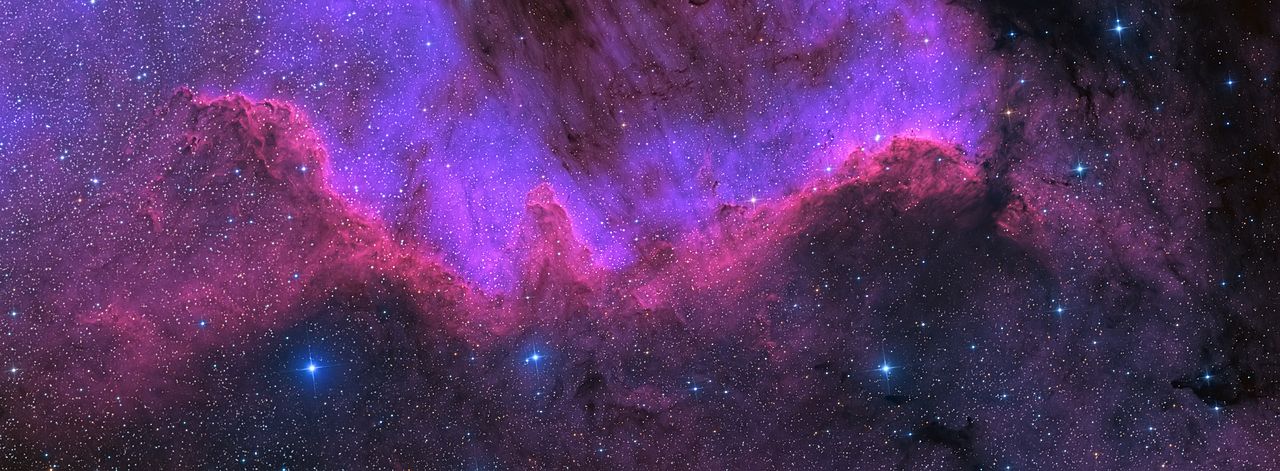
NGC7000 and The Cygnus Wall is part of the North American Nebula also known as Caldwell 20. This emission nebula is very large and this image shows the structures known as The Wall. The final picture required three panels stitched together from 7 different filters.
Credit: Ken Crawford - Under dark skies, compare unfiltered and filtered views. Make notes about averted vision results and any structural features you perceive.
Project 3: Wide-Field Milky Way Survey
Goals: Learn to read the Milky Way’s structure: bright star clouds, dust lanes, and embedded clusters. Best executed under Bortle 3 or darker skies.
- Center Deneb and drift east-west with low power or binoculars. Notice the bright cloud near Gamma Cygni (Sadr) and the fainter patches nearby.
- Slide slightly east of Deneb to search for the gentle glow of the North America Nebula; identify the “Gulf of Mexico” indentation if conditions allow.
- Trace the Milky Way down through Cygnus into Aquila, noting where dark lanes interrupt the star fields.
Observation log template
Use a simple, repeatable template to track your sessions. Consistent logging accelerates your learning and builds confidence.
Date & Time (UT/local):

Location & Bortle:

Conditions: Seeing (1-5), Transparency (1-5), Temp, Wind

Instrument & Magnification:

Target(s):

Star-hop route:

Notes (structure, color, averted vision, filter use):

Sketch (Y/N):

Next steps / targets:
For a curated, time-efficient session, consider a “Triangle Trifecta” night: begin with Epsilon Lyrae at dusk (steadier air), move to M57 as the sky darkens, then finish with a wide-field sweep through Cygnus before tackling M27.
Citizen Science: Variables, Doubles, and Photometry
The Summer Triangle region offers multiple opportunities to contribute observations that matter. With simple equipment and patience, you can estimate variable star brightness, measure double-star separations (qualitatively), and generate light curves useful for outreach and personal learning.
Beta Lyrae (Sheliak): An eclipsing binary to monitor
What it is: Beta Lyrae is a well-known eclipsing binary whose brightness varies as one star orbits and partially obscures the other. Over days, its light curve rises and falls in a smooth, continuous way—prototype behavior for its class.
How to observe: You can estimate its magnitude by comparing it to nearby reference stars of known brightness. Organizations like the American Association of Variable Star Observers (AAVSO) provide finder charts and guidelines. Even without submitting data, building your own light curve teaches careful seeing, patience, and the art of consistent estimation.
Albireo: Colors and the debate on companionship
Although Albireo’s components are a celebrated visual double, their gravitational relationship has been scrutinized with modern measurements. Regardless of the dynamic status, tracking the pair visually—recording color impressions, separation estimates, and position angles—sharpens your observing skills. Over short timescales you won’t see orbital motion, but practicing consistent methodology prepares you for future work on tighter doubles.
Photometry practice with small sensors
If you possess a modest camera or sensor, you can practice differential photometry by taking short exposures of stars like Beta Lyrae and comparing them to nearby standards. While rigorous submissions to professional databases require careful calibration (bias, dark, flat frames) and standardized filters, the conceptual workflow—measuring relative flux under similar conditions—builds a foundation for more formal projects. You can also use time-series imaging to explore microvariations in bright field stars, though signal-to-noise and systematic errors become crucial.
To complement these projects, spend time learning the sky geometry discussed in How to Find Vega, Deneb, and Altair; precise pointing and repetition are the heart of scientifically useful observing.
Frequently Asked Questions
Is Deneb the brightest star in the Summer Triangle?
To the eye, Vega is typically the brightest of the three. In terms of apparent brightness (what you see), Vega usually outshines Deneb and Altair in most observing conditions. However, in terms of intrinsic luminosity, Deneb is vastly more powerful—tens of thousands of times brighter than the Sun—yet appears fainter than Vega because it is so much farther away (on the order of a couple of thousand light-years compared to Vega’s ~25 light-years). This contrast underscores a key concept in astronomy: distance dramatically affects apparent brightness.
Can I see the Milky Way inside the Summer Triangle from the city?
Seeing the Milky Way’s distinct band from a bright urban core (Bortle 8–9) is very challenging. You will still be able to find Vega, Deneb, and Altair and enjoy targets like M57 and Albireo, but the faint, diffuse glow of the Milky Way generally requires darker skies—typically Bortle 4 or better. If you can travel even a short distance to suburban fringes (Bortle 5–6) on a moonless night, the Milky Way’s brighter portions may begin to emerge, especially near Cygnus.
Final Thoughts on Exploring the Summer Triangle
The Summer Triangle is a teacher in plain sight. It anchors you to three constellations, opens doors to planetary nebulae, doubles, and star clouds, and—through the astrophysics of Vega, Deneb, and Altair—invites you to consider stellar evolution and the structure of our galaxy. For newcomers, it is a navigational grid that makes the sky feel smaller and friendlier; for seasoned observers, it’s a perennial canvas for honing technique, sharpening perception, and sharing the night with friends and family.

Credit: Lviatour
On your next clear evening, step outside, find that bright, bluish star high overhead (likely Vega), trace the band of the Milky Way toward Deneb, and drop down to Altair’s flanking line. Then take your time exploring the treasures in Deep-Sky Sights Within and Around the Triangle. Keep simple logs, repeat observations, and return in different seasons to notice how altitude, humidity, and seeing affect what you can perceive.
If you enjoyed this guide and want more in-depth tours, science explainers, and seasonal checklists, consider subscribing to our newsletter. You’ll get curated observing plans, deep dives into stellar astrophysics, and updates on related topics tailored for clear-night inspiration and practical success under the stars.