
Table of Contents
- What Is the Orion Constellation in the Night Sky?
- Finding Orion: When and Where to Look
- Betelgeuse, Rigel, and Orion’s Brightest Stars
- Deep-Sky Wonders: M42, M43, Horsehead, and More
- Stellar Evolution and Physics within Orion
- Observing Orion Like a Pro: Naked Eye, Binoculars, and Telescopes
- Astrophotography Guide: Capturing Orion’s Nebulae and Belt
- Orion in Culture, History, and Scientific Discovery
- Planning Your Orion Season: Checklists and Star-Hops
- Frequently Asked Questions
- Final Thoughts on Exploring the Orion Constellation
What Is the Orion Constellation in the Night Sky?
Orion is one of the most recognizable constellations, visible from both hemispheres and renowned for its distinctive “hourglass” or “hunter” outline. In the Northern Hemisphere, it dominates the winter evening sky; in the Southern Hemisphere, it shines during the summer months. Orion serves as a gateway to some of the most educational and photogenic objects in astronomy: the red supergiant Betelgeuse, the blue supergiant Rigel, and the glowing star-forming complex that includes the Orion Nebula (M42), the Horsehead Nebula (Barnard 33), and the Flame Nebula (NGC 2024). This constellation is not just a pretty pattern—it’s a vast region of astrophysical activity, embedded in the larger Orion Molecular Cloud Complex.

Artist: Rogelio Bernal Andreo
The heart of Orion is its belt: three bright, nearly straight-line stars—Alnitak (ζ Orionis), Alnilam (ε Orionis), and Mintaka (δ Orionis). Hanging from the Belt is the Sword, which includes the Orion Nebula. To the northeast lies orange-red Betelgeuse, and to the southwest lies blue-white Rigel. This striking color contrast—cool, red supergiant versus hot, blue supergiant—is visible even to the unaided eye on a clear night.
For many observers, Orion is the sky’s best “first lesson.” If you can learn to find it, you can navigate to multiple bright stars and seasonal asterisms. The line of the Belt points southeast to Sirius in Canis Major and northwest toward Aldebaran in Taurus and the Pleiades star cluster. These intuitive star-hops make Orion a natural anchor for building your sky awareness. If you’re after a deeper dive, the region also teaches core astrophysical topics—from star formation and H II regions to massive star lifecycles—explored further in Stellar Evolution and Physics within Orion.
Finding Orion: When and Where to Look
Orion straddles the celestial equator, so observers around the world enjoy good views when the constellation is above the horizon. It culminates (reaches its highest point in the sky) around midnight in mid to late December and earlier in the evening by January and February. By March, Orion is slipping into the west soon after dusk for mid-northern latitudes.
- Best months (Northern Hemisphere): November through February for prime evening viewing.
- Best months (Southern Hemisphere): December through March for prime evening viewing.
- General coordinates: Orion’s core region lies around right ascension ~5h and declination near 0°, making it well placed for both hemispheres.
Practical strategies:
- Step outside on a clear night with minimal moonlight. Look for three bright stars in a tight line—the Belt. From there, trace up-left to Betelgeuse and down-right to Rigel.
- To verify, extend the Belt line down and left to the sky’s brightest star, Sirius; extend it up and right toward the orange star Aldebaran and the beautiful Pleiades cluster. These “pointers” are a classic star-hopping trick, detailed in Planning Your Orion Season.
- Use a stargazing app to overlay constellations and labels. As a beginner, toggling labels can help you memorize the pattern.
Tip: Under very dark skies, you may glimpse a faint glow in the Sword—this is the Orion Nebula. If you can spot that hazy patch with your naked eye, binoculars will reveal remarkable structure.
If you’re new to astronomy, Orion is a forgiving and visually rich target. Urban observers can usually see the bright stars even through light pollution, then turn to binoculars for the nebulae. Rural observers can sweep nearby regions (e.g., M78 and the Running Man Nebula) for a deeper experience.
Betelgeuse, Rigel, and Orion’s Brightest Stars
Several of Orion’s stars are among the most famous in the sky, notable both for their brilliance and their astrophysical importance. Their contrasting colors and evolutionary stages provide a living classroom for understanding how massive stars live and die.
Betelgeuse (Alpha Orionis): A red supergiant in late life
Betelgeuse shines with a distinctly reddish hue. It’s a red supergiant, an evolved massive star that has expanded and cooled after exhausting hydrogen in its core. Betelgeuse is semiregularly variable, with brightness changes visible to attentive observers. In 2019–2020, it experienced a widely reported “Great Dimming,” later attributed to a combination of factors that included dust formation following a mass ejection. The episode underscored how dynamic the late stages of massive stars can be.
- Distance: Approximately in the range of a few hundred light-years; modern estimates place it at roughly 550–650 light-years.
- Color and temperature: Cool for a supergiant, giving it its orange-red color.
- Future: Betelgeuse will eventually explode as a supernova—on astronomical timescales. When that occurs (sometime in the distant future), it will be safe to view with the naked eye but could rival the Moon in brightness for a short time.
Rigel (Beta Orionis): A luminous blue supergiant
Rigel is the bright, bluish star marking Orion’s western foot. It’s a blue supergiant and one of the intrinsically most luminous stars visible to the naked eye. Rigel is a multiple-star system, and in telescopes, a faint companion can be glimpsed under steady conditions.
- Distance: Roughly on the order of several hundred light-years; estimates commonly place it around 800–900 light-years.
- Appearance: A striking blue-white color, contrasting beautifully with Betelgeuse’s warm tone.
Bellatrix (Gamma Orionis), Saiph (Kappa Orionis), and the Belt trio
Bellatrix sits on Orion’s right shoulder (upper-right for Northern Hemisphere viewers), and Saiph lies opposite Rigel, marking the other foot. The famous Belt stars—Alnitak, Alnilam, and Mintaka—anchor much of the constellation’s deep-sky interest. Although they form a straight line to our eyes, these stars lie at different distances, with Alnilam often cited as the most distant of the trio.
- Bellatrix: Blue-white, historically used for navigation.
- Saiph: Blue-white, somewhat fainter than Rigel but still prominent in dark skies.
- Alnitak, Alnilam, Mintaka: Hot, massive stars whose intense radiation and stellar winds help sculpt nearby nebulae, including the Flame and Horsehead Nebulae.
These stars are members or neighbors of the Orion OB1 association, a population of young, massive, hot stars. Their combined ultraviolet output powers much of the region’s ionization, lighting up nearby clouds to produce the glowing structures that astrophotographers adore.
Deep-Sky Wonders: M42, M43, Horsehead, and More
Orion is packed with targets that reveal astrophysics in action. The constellation is part of the Orion Molecular Cloud Complex, a vast reservoir of gas and dust hosting active star formation. The following objects represent a range of nebular types—emission, reflection, and dark nebulae—all visible with different techniques and equipment. For an observing sequence pairing naked-eye, binocular, and telescope views, see Observing Orion Like a Pro.
Orion Nebula (M42) and De Mairan’s Nebula (M43)
The Orion Nebula (Messier 42) is among the most widely observed astro-objects of all time. To the unaided eye from dark locations, the Sword of Orion appears as a fuzzy patch. In binoculars, the nebula blossoms into a luminous fan. Through a small telescope, the central star group—the Trapezium—becomes visible, embedded in glowing hydrogen gas. The nebula is part of a huge H II region energized primarily by the O-type star Theta1 Orionis C and its neighbors.

Artist: NASA, ESA, M. Robberto (Space Telescope Science Institute/ESA) and the Hubble Space Telescope Orion Treasury Project Team
- Type: Emission nebula / H II region.
- Distance: Roughly 1,300–1,400 light-years (often cited near ~1,344 light-years).
- Highlights: Protoplanetary disks (proplyds) detected in high-resolution observations; a dynamic environment of stellar birth.
Just north of M42 and separated by a dark lane lies M43 (De Mairan’s Nebula), often seen as a distinct puff of light. While visually overshadowed by M42, M43 contributes to the broader picture of ongoing star formation within the complex.
Running Man Nebula (NGC 1977)
North of M42/M43 is the Running Man Nebula (NGC 1977), a reflection nebula whose bluish hues (in photographs) come from starlight scattering off dust. Visually under moderate apertures, you may notice a hazy glow with embedded stars; cameras will reveal its characteristic silhouette, which gives the nebula its nickname.
Horsehead Nebula (Barnard 33) and Flame Nebula (NGC 2024)
Near Alnitak—the easternmost Belt star—lies one of the sky’s most iconic dark nebulae: the Horsehead Nebula (B33), seen in silhouette against the emission nebula IC 434. This target is subtle visually and demands good transparency, dark skies, and in many cases a narrowband filter (an H-beta filter can help). Just to the east of Alnitak is the brilliant Flame Nebula (NGC 2024), an emission nebula crisscrossed by dark dust lanes.
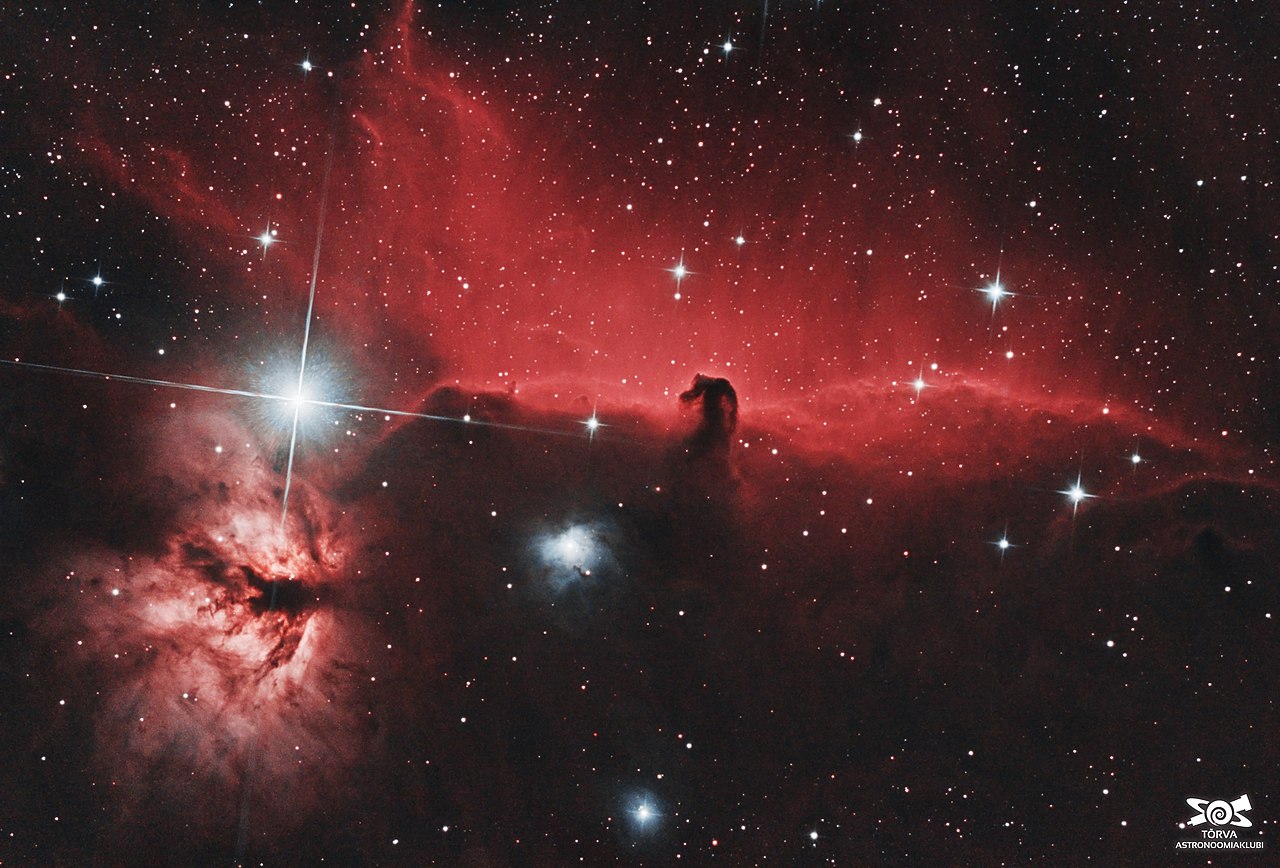
Artist: Taavi Niittee
- Horsehead (B33): A small, horse-head shaped dark notch in a glowing curtain of hydrogen.
- Flame (NGC 2024): A bright, branching appearance in photos; visually, a structured haze best seen with larger telescopes.
M78 and nearby reflection nebulae
M78, northeast of the Belt, is a bright reflection nebula that often serves as a satisfying binocular or small-telescope target. Long-exposure images reveal delicate dust filaments and fainter adjacent nebulae including NGC 2064 and NGC 2067.
Barnard’s Loop and the Orion–Eridanus superbubble
Wrapping around much of Orion is Barnard’s Loop, a vast, faint arc of emission that traces the remnant of large-scale episodes of stellar feedback—winds and supernovae—that have carved a superbubble in the interstellar medium. While Barnard’s Loop is extremely challenging to see visually, it appears beautifully in wide-field, deep, narrowband astrophotography. This loop contextualizes Orion’s nebulae as pieces of a grander structure, discussed more in Stellar Evolution and Physics within Orion.
Witch Head Nebula (IC 2118)
Just outside the constellation’s boundary near Rigel lies the Witch Head Nebula (IC 2118), a large reflection nebula illuminated by Rigel’s light. It’s exceedingly faint to the eye but a favorite for wide-field imagers who can devote hours of integration to bring out its ghostly blue.
Stellar Evolution and Physics within Orion
Beyond its beauty, Orion is a living laboratory for astrophysics. The constellation showcases every step of massive star life cycles: from cold molecular clouds and nascent protostars to blazing O- and B-type giants and the feedback-driven cavities they leave behind.
The Orion Molecular Cloud Complex
The Orion Molecular Cloud Complex spans hundreds of light-years and contains dense cold clouds, filamentary structures, and embedded young stellar objects. Within it are recognized subregions, including the Orion A and B clouds, which host prominent nebulae like M42 (Orion A) and the Horsehead/Flame region (Orion B). This complex gives rise to sequential star formation, where earlier generations of massive stars trigger new episodes by compressing adjacent gas with their winds and radiation.
Orion OB1 association
The Orion OB1 association includes several subgroups of hot, massive stars at different ages and distances. As these O- and B-type stars evolve, their intense ultraviolet radiation ionizes surrounding hydrogen (creating H II regions), while their winds and eventual supernovae inject energy and heavy elements into the interstellar medium. The result is a landscape of bubbles, shells, and ionization fronts—macrostructures you glimpse in features like Barnard’s Loop.
Ionization, H II regions, and the glow of M42
In emission nebulae such as M42, ultraviolet photons from massive stars excite electrons in hydrogen atoms. When these electrons recombine and cascade down energy levels, they emit photons, many in the visible red (H-alpha) and blue-green (O III) wavelengths. That’s why narrowband filters isolating these lines dramatically enhance contrast. The power source for the Orion Nebula’s glow includes Theta1 Orionis C, which floods the region with ionizing radiation.
Proplyds and young stellar objects
High-resolution imaging of the Orion Nebula reveals protoplanetary disks—compact disks of gas and dust surrounding young stars. These proplyds offer direct glimpses into the early stages of planetary system formation. The fierce radiation from nearby massive stars can erode these disks, sculpting their shapes and potentially influencing the types of planets that form.

Artist: (c) NASA, ESA, CSA / Science leads and image processing: M. McCaughrean, S. Pearson, CC BY-SA 3.0 IGO
Massive star evolution: Betelgeuse and Rigel
Betelgeuse exemplifies a massive star in a late evolutionary phase. Having expanded into a red supergiant, it undergoes pulsations and mass-loss events that feed dusty shells into space. The well-publicized dimming of 2019–2020 is consistent with an ejected cloud of material that condensed into dust, temporarily obscuring the star’s light along our line of sight. Rigel, by contrast, is a luminous blue supergiant—hotter and more compact—expected to end its life in a core-collapse supernova on a much longer timescale than human lifetimes.
Feedback and the superbubble
Orion’s superbubble—sometimes called the Orion–Eridanus superbubble—demonstrates how energy injection from massive stars reshapes galaxies. Powered by winds and past supernovae, these bubbles expand and sweep up gas, potentially triggering star formation in neighboring clouds. Features like Barnard’s Loop are believed to be visible signatures of this process, connecting wide-field astrophotography to high-energy astrophysics.

Artist: SimgDe
Observing Orion Like a Pro: Naked Eye, Binoculars, and Telescopes
Whether you’re a newcomer or a seasoned observer, Orion rewards careful attention and incremental steps. Start wide, then zoom in. Plan for the Moon phase, transparency, and seeing conditions. Cross-reference these tactics with Astrophotography Guide: Capturing Orion’s Nebulae and Belt if you plan to image as well.
Naked-eye highlights
- Contrast colors: Note the cool red of Betelgeuse versus the hot blue of Rigel.
- Star patterns: Identify the Belt and trace the Sword; look for the faint haze of M42 in truly dark skies.
- Seasonal geometry: Find the Winter Hexagon using Rigel as a vertex; spot the Winter Triangle with Betelgeuse, Procyon, and Sirius.
Binocular views (7×50, 10×50, 8×42)
- Orion Nebula: With 10×50 binoculars, the nebula’s fan shape emerges; look for the Trapezium’s core glow and surrounding wings.
- Running Man (NGC 1977): Under dark skies, a faint haze north of M42 becomes apparent.
- M78: A compact patch of light northeast of the Belt; star fields around it are rich and worth lingering over.
Small to medium telescopes (80–200 mm aperture)
- M42/M43: Use moderate magnification to split the Trapezium; an Ultra High Contrast (UHC) or O III filter enhances nebulosity. Watch how different exit pupils alter perceived contrast.
- Flame Nebula (NGC 2024): Best under dark skies with a nebula filter; beware of glare from Alnitak—use a field stop or slightly offset the star from the center.
- Horsehead (B33): A challenging target. An H-beta filter and averted vision are often essential. Patience helps—let your eyes adapt.
General observing tips
- Dark adaptation: Use a dim red light; avoid bright phone screens. Full adaptation can take 20–30 minutes.
- Stability: A reclining chair or tripod-mounted binoculars dramatically improve what you can see.
- Filters: UHC and O III for emission nebulae; H-beta for subtle hydrogen features like the Horsehead’s background (IC 434). See Deep-Sky Wonders for specific targets.
- Seeing vs transparency: Nebulae need transparency more than perfect seeing. Pick nights with low haze and steady air.
A common mistake is to over-magnify M42. Start wide to frame its sweeping arcs, then zoom in on the Trapezium to tease out fine detail.
Astrophotography Guide: Capturing Orion’s Nebulae and Belt
Orion is arguably the most photographed region of the night sky, offering breathtaking results from beginner to advanced levels. The key is to match your gear and approach to your goals—wide-field dust and loops, close-ups of the Orion Nebula, or both in a mosaic. If you’re transitioning from visual observing, start with short, wide-field exposures and build toward longer, tracked imaging as your skills grow. Cross-reference with Planning Your Orion Season for target lists and framing ideas.
Entry-level setups
- Fixed tripod + DSLR/mirrorless + wide or normal lens (e.g., 24–50 mm): Capture the Belt, Sword, and the surrounding winter sky. Use high ISO (800–3200), 8–20 s exposures to avoid star trails (rule of 500 as a rough guide), and stack multiple frames.
- Star tracker + 50–135 mm lens: Enables 30–120 s subexposures (or longer) at lower ISO, revealing Barnard’s Loop, Angelfish Nebula textures around Betelgeuse (in deep integrations), and the Witch Head if you frame wide enough and integrate for hours.
Intermediate and advanced rigs
- Small refractor (e.g., 60–100 mm) on an equatorial mount: Ideal for framed shots of M42/M43 + Running Man; use narrowband or dual-band filters under light pollution.
- Longer focal lengths (400–1000+ mm): Showcase Trapezium detail, dark lanes, and the transition from bright core to faint outer structures. High dynamic range (HDR) techniques prevent core blowout.
Managing dynamic range: HDR strategies
The Orion Nebula spans extraordinary brightness differences—from the blinding Trapezium to whisper-faint outer arcs. To preserve detail:

Artist: Astrofalls
- Blend short exposures (e.g., 5–15 s) for the core with longer subs (1–5+ minutes) for the faint wings.
- Use masks and careful stretching; consider tone mapping to retain local contrast without harsh transitions.
- Bracket gain/ISO to keep stars unsaturated while maximizing nebulosity.
Narrowband and light pollution
Narrowband imaging (H-alpha, O III, S II) or multi-bandpass filters can salvage contrast under urban skies. Emission nebulae such as M42, IC 434, and NGC 2024 respond well to H-alpha and O III. Reflection nebulae (e.g., M78, Witch Head) emit broadband light and are harder to record from cities, often requiring dark sites and long, clean integrations.
Calibration and processing tips
- Calibration frames: Take darks to remove thermal noise, flats to correct vignetting and dust motes, and bias or flat-darks per your camera’s best practices.
- Color balance: Orion’s nebulae span reds (H-alpha), blue-green (O III), and blue reflection nebulae. Aim for natural hues; avoid oversaturation that clips details.
- Deconvolution and star management: Apply lightly to protect nebular texture; use star masks to prevent halos.
Framing ideas
- 50 mm: Belt and Sword in context; catches a hint of Barnard’s Loop in long integrations.
- 85–135 mm: Belt, Flame, Horsehead, and Orion Nebula in one field for dramatic storytelling.
- 200–400 mm: Tighten composition around the Horsehead/Flame or focus on M42/M43 + Running Man.
For more discussion of specific targets and filters, consult Deep-Sky Wonders. If you’re new to imaging, consider starting with a tracked 50 mm lens and aim to reveal both the Belt region and the extended emission structures around the hunter.
Orion in Culture, History, and Scientific Discovery
Orion’s profile as a hunter originates in Greek tradition, but its stars and patterns are important in many cultures. In Arabic star lore, names like Betelgeuse and Rigel echo the region’s Golden Age of astronomy, when scholars cataloged and refined stellar positions and names. In Chinese astronomy, much of Orion falls within the White Tiger of the West, with asterisms such as Shen (a hunter or warrior). Māori traditions include names and stories for the Belt and Sword region; for instance, Tautoru can refer to the Belt. Across cultures, its bright, easily recognized figure has long served navigators, timekeepers, and storytellers.
Historically, Orion’s stars helped define navigational techniques due to their brightness and reliable seasonal positions. Modern astronomy has leveraged Orion’s richness as a testbed for theories of star formation and feedback. Observations from space- and ground-based observatories have detected proplyds in M42, mapped shocks and ionization fronts, and traced the kinematics of gas flows shaping the region’s architecture.
It is sometimes claimed that megalithic structures or pyramids align deliberately with Orion’s Belt. While alignments appear in several traditions, specific one-to-one correlations—such as those proposed for the Giza pyramids—are actively debated among archaeologists and archaeoastronomers. These ideas are interesting to explore as cultural narratives but remain controversial and should be distinguished from established astronomical science.
In recent years, Betelgeuse drew remarkable public attention with its unusual dimming event, offering a live case study in massive star variability. Multiwavelength observations—optical, infrared, and even interferometric imaging—helped build a consensus that dust formation from a mass ejection likely contributed to the dimming. This episode shows how modern instruments can witness stellar changes on humanly accessible timescales.
Planning Your Orion Season: Checklists and Star-Hops
To make the most of Orion, plan with intention. Whether you observe visually or image, a checklist and a few classic star-hops will maximize your time under dark skies.
Seasonal checklist
- Moon phase: Aim for the week surrounding New Moon for the faintest nebulae (e.g., Horsehead, Barnard’s Loop).
- Transparency before seeing: Nebula detail thrives under low humidity and minimal haze.
- Targets by aperture: Binoculars (M42, M78), small scopes (Running Man, Flame), medium/large scopes (Horsehead with H-beta).
- Filters packed: UHC, O III, and H-beta as needed; consider dual-band for imaging under light pollution.
- Backup plans: If thin clouds roll in, focus on bright stars (color contrast of Betelgeuse vs Rigel) and wide-field constellational photography.
Classic Orion star-hops
- Belt to Sword (M42): Center the Belt, drop down to the fuzzy patch—this is the Orion Nebula region. Use low power for the view, then increase magnification to split the Trapezium.
- Alnitak to Flame and Horsehead: Slide slightly east of Alnitak to detect the Flame (NGC 2024). For the Horsehead, move south to the dim notch in IC 434—use an H-beta filter and avert your vision.
- Alnilam to M78: From the central Belt star, hop northeast to a subtle glow; M78 shows well in binoculars and small scopes.
- Belt line to Sirius and Aldebaran: Extend the belt southeast to Sirius and northwest to Aldebaran and the Pleiades—excellent for beginners and for framing wide-field photos, as detailed in Astrophotography Guide.
Coordinates and framing references
Useful target coordinates for planning (approximate):
- M42 (Orion Nebula): RA ~ 05h 35m, Dec ~ -05° 23′
- Flame Nebula (NGC 2024): Near Alnitak (ζ Ori), RA ~ 05h 41m, Dec ~ -01° 51′
- Horsehead (B33) in IC 434: Near Alnitak, RA ~ 05h 41m, Dec ~ -02° 27′
- M78: RA ~ 05h 46m, Dec ~ +00° 03′
These values are sufficient for star-hopping diagrams or input into go-to mounts. For broader context, remember Orion’s core lies around RA ~ 5 hours, making it well-placed during mid-evening in midwinter for mid-northern latitudes.
Safety and comfort
- Dress warmly in layers; winter nights drop temperatures quickly when you’re inactive at the eyepiece.
- Use dew control: heaters or dew shields for refractors and SCTs; a simple hair dryer can rescue a fogged objective.
- Keep logs: Recording magnifications, filters, and sky conditions helps you improve and compare results across nights.
Frequently Asked Questions
When is Orion visible during the night, and how high will it get?
In mid-northern latitudes, Orion rises in the east during autumn evenings and culminates (peaks) around midnight in December. By January and February, it’s high in the southeast to south soon after nightfall. Because Orion is near the celestial equator, it climbs high for observers across a wide range of latitudes. In the Southern Hemisphere, it’s similarly well-placed in the summer months. To plan precise rise and set times for your location, use a planetarium app and set the date to your observing night.
What equipment do I need to see the Horsehead Nebula?
The Horsehead (Barnard 33) is challenging even for experienced observers. You will need very dark skies, excellent transparency, and a telescope with moderate aperture (many observers report success with 200 mm/8-inch or larger). An H-beta filter can significantly improve contrast because the Horsehead appears in silhouette against the H-beta-rich emission nebula IC 434. Practice averted vision and allow for full dark adaptation. As a stepping stone, try the adjacent Flame Nebula first—it’s typically easier to detect. For imaging, a modest refractor and a narrowband or dual-band filter can reveal the Horsehead in stacked exposures.
Final Thoughts on Exploring the Orion Constellation
Orion is the sky’s great teacher. It offers an accessible starting point for newcomers, a deep trove of subtle challenges for seasoned observers, and a spectacular canvas for astrophotographers. The constellation’s highlights—Betelgeuse, Rigel, the Orion Nebula, the Horsehead, and Barnard’s Loop—tie together color, structure, and physics in a single sweep of the sky. By learning the Belt and Sword, practicing a few star-hops, and matching your equipment to the night’s conditions, you can witness everything from the birthplaces of planets to the late stages of massive stars.
As you plan your sessions, revisit the targeted advice in Observing Orion Like a Pro and the exposure strategies in Astrophotography Guide. With patience and method, Orion will reward you with new detail every season—shifting colors at the eyepiece, new filaments in your stacked images, and a growing appreciation for the interplay between stars and their natal clouds.
If you found this deep-dive useful, explore our other seasonal guides and star-formation features, and consider subscribing to our newsletter to receive upcoming observing tips, equipment reviews, and science explainers delivered right to your inbox.