
Table of Contents
- What Is Dark Matter in Modern Astrophysics?
- Observational Evidence: From Galaxy Rotations to the Cosmic Web
- The Lambda-CDM Framework and Structure Formation
- Particle Candidates: WIMPs, Axions, and Sterile Neutrinos
- Compact Objects and Primordial Black Holes: How Much Room Is Left?
- Direct, Indirect, and Collider Searches: How We Hunt Dark Matter
- Gravitational Lensing: Mapping the Invisible Universe
- Small-Scale Challenges: Cores, Cusps, and Missing Satellites
- Alternatives to Dark Matter: MOND and Relativistic Extensions
- Data Frontiers: Surveys and Telescopes Shaping the Next Decade
- How to Read Dark Matter Papers Without the Hype
- Frequently Asked Questions
- Final Thoughts on Understanding Dark Matter Evidence and Searches
What Is Dark Matter in Modern Astrophysics?
Dark matter is the name given to the nonluminous, nonbaryonic matter that appears to make up the majority of the mass in the universe. It does not emit, absorb, or reflect light, which makes it invisible to telescopes. Yet its gravitational effects are unmistakable in observations that range from the rotation speeds of galaxies to the large-scale patterns imprinted in the cosmic microwave background (CMB). In the standard cosmological model, often called the ΛCDM (Lambda–Cold Dark Matter) model, dark matter accounts for roughly one quarter of the total energy density of the universe and about 85% of the matter, with the rest being ordinary (baryonic) matter and dark energy.

Artist: ESA and the Planck Collaboration
Importantly, dark matter is not just a single idea; it is a set of testable predictions and hypotheses that arise when we try to explain multiple independent lines of evidence. The term can encompass a variety of candidate particles—such as WIMPs (weakly interacting massive particles), axions, or sterile neutrinos—and also more exotic possibilities like primordial black holes. It also includes entire research programs devoted to direct detection, indirect detection, and collider searches.
In this article, we expand the search intent beyond the simple question nullWhat is dark matter?null to address: How do we know it exists? What are the leading candidates? How do experiments test the theories? and What are the biggest open problems? We also compare the dark matter hypothesis with modified gravity models that aim to explain some of the same phenomena without invoking a new kind of matter.
Throughout, we will link related sections so you can jump directly to details of interestnullfor example, evidence from galaxy rotation curves and gravitational lensing, or the small-scale cosmology puzzles that keep theorists and simulators busy.
Observational Evidence: From Galaxy Rotations to the Cosmic Web
The case for dark matter is not built on a single dataset. Rather, it resembles a geological core sample, with layers of independent observations pointing in the same direction. Here are the most compelling and widely studied lines of evidence:
1) Galaxy Rotation Curves
Spiral galaxies rotate faster than can be explained by their visible matter alone. If stars and gas were the only source of mass, the orbital speed of stars would decrease with distance from the galactic center, much like planets in our solar system. Instead, many galaxies show flat or even rising rotation curves at large radii.

Artist: Soonclaim
These observations, pioneered and systematically mapped by astronomers including Vera Rubin and colleagues, imply that galaxies are embedded in extended, roughly spherical dark matter halos that dominate the mass budget beyond the bright stellar disk. When we infer the mass profile from the rotation curve, we find a smooth, extended distribution that is consistent with the gravitational pull of unseen matter.
2) Galaxy Clusters and the Missing Mass
Galaxy clusters, the largest bound structures in the universe, provided early evidence that something more than luminous matter must exist. Fritz Zwicky, in the 1930s, used galaxy velocities in the Coma Cluster to estimate the total mass and found a large discrepancy: the cluster appeared to have far more mass than visible light indicated. Modern observations combining galaxy dynamics, hot intracluster gas seen in X-rays, and gravitational lensing show that dark matter dominates cluster mass by a wide margin.
3) Gravitational Lensing
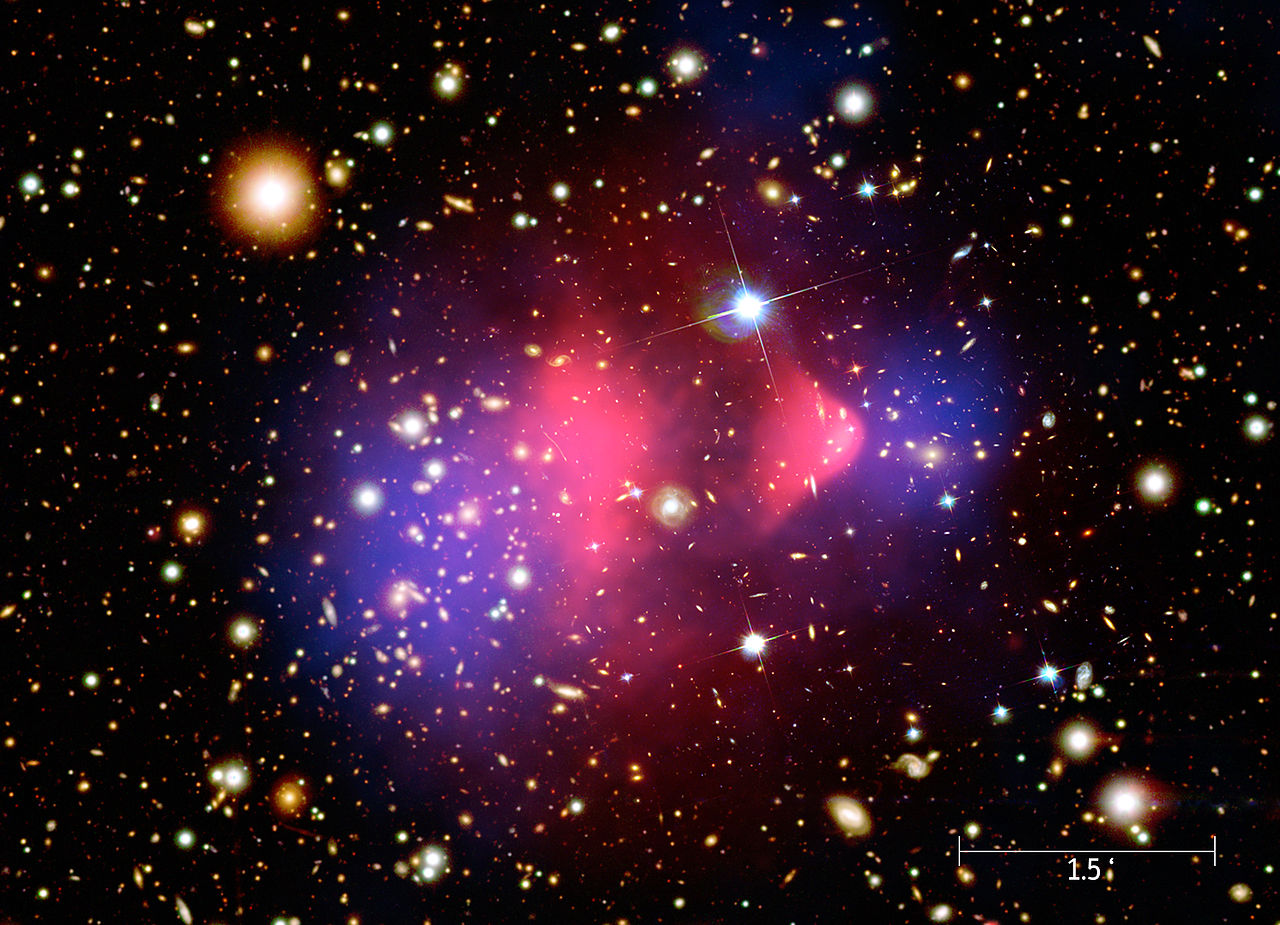
Einsteinnulls general relativity predicts that mass curves spacetime, bending the path of light. Both strong lensing (multiple images, arcs, and Einstein rings) and weak lensing (subtle statistical distortions of galaxy shapes) allow us to map the mass distribution regardless of whether it shines. Lensing maps consistently reveal mass concentrations that exceed what baryons alone can provide. In some spectacular cases, like the Bullet Cluster, the spatial separation between hot gas (baryonic matter) and the total mass peak (from lensing) offers a striking, geometry-based argument for dark matter as a distinct component.

Artist: User:Mac_Davis
4) Cosmic Microwave Background (CMB) Anisotropies
The CMB encodes a snapshot of the early universe, about 380,000 years after the Big Bang. The pattern of temperature and polarization anisotropies depends on the amounts of baryonic matter, dark matter, and dark energy. Observations from satellites such as WMAP and Planck fit extremely well with a model that includes a substantial cold dark matter component. Without it, the relative heights of the acoustic peaks in the power spectrum cannot be reproduced.
5) Large-Scale Structure and Baryon Acoustic Oscillations
Galaxies trace a cosmic web of filaments and voids. The growth of structure from tiny early fluctuations into this web is highly sensitive to the matter content of the universe. Simulations that include cold dark matter reproduce the observed clustering statistics and features such as baryon acoustic oscillations (BAO). Data from galaxy redshift surveys consistently support a cosmic matter density dominated by dark matter.
6) Big Bang Nucleosynthesis (BBN)
BBN predicts the primordial abundances of light elements like hydrogen, helium, and deuterium based on conditions in the early universe. Those predictions constrain the amount of baryonic matter and show that it is too low to account for the gravitational effects attributed to dark matter. In other words, most of the universenulls matter must be nonbaryonic.
Each of these observations alone is suggestive. Taken together, they form a coherent, cross-validated case for dark matter, which we examine within the ΛCDM framework and test with a broad portfolio of experiments.
The Lambda-CDM Framework and Structure Formation
The current concordance model of cosmology, ΛCDM, combines a cosmological constant (Λ) representing dark energy with cold dark matter (CDM) and ordinary baryons. It has become the standard because it consistently explains:
- the CMB power spectrum and polarization;
- the expansion history of the universe from supernovae and BAO;
- the statistics of large-scale structure and galaxy clustering;
- gravitational lensing signals from galaxies and clusters;
- galaxy rotation curves and cluster mass profiles.
In ΛCDM, cold dark matter is pressureless and moves nonrelativistically in the early universe, enabling small fluctuations to grow efficiently under gravity. Over billions of years, these fluctuations collapse into halos that merge into the hierarchical patterns we observe today. Ordinary matter falls into these potential wells, cools, and forms stars and galaxies. N-body and hydrodynamical simulations initialized with early-universe conditions reproduce the filamentary cosmic web with notable success.
While ΛCDM is remarkably successful on large scales, it has sparked intense discussion at galaxy and subgalaxy scales. Issues like the cuspnullcore problem and the missing satellites question (see Small-Scale Challenges) have inspired new theoretical models and improved simulations of baryonic physics (feedback from supernovae and active galactic nuclei, star formation, gas dynamics). Many previously perceived discrepancies have been reduced as simulations became more realistic about the rough-and-tumble astrophysical processes that shape small galaxies.
Despite these debates, a critical point remains: ΛCDMnulls predictive power draws simultaneously from independent empirical pillars, not just one measurement. That is what sets it apart as a scientific framework rather than a single, speculative idea.
Particle Candidates: WIMPs, Axions, and Sterile Neutrinos
If dark matter is made of particles beyond the Standard Model of particle physics, what could they be? Research has focused on a few leading candidates with complementary motivations and experimental approaches.
WIMPs (Weakly Interacting Massive Particles)
WIMPs are hypothetical particles that interact via the weak nuclear force and gravity, with masses roughly in the GeVnullTeV range. Their appeal springs from the so-called nullwimp miraclenull: a stable particle with weak-scale interactions naturally freezes out of the hot early universe with roughly the right relic abundance to be the dark matter. Many supersymmetric models once provided well-motivated WIMP candidates, though null results at the LHC have pushed some of these frameworks into more constrained corners.
Experiments looking for WIMPs follow three main paths, described in Direct, Indirect, and Collider Searches. As limits have improved, the classic parameter space of weak-scale WIMPs has been increasingly restricted, with leading direct detection limits now excluding spin-independent WIMP-nucleon cross sections down to roughly 10nullnull3null 10nullnull8 cm2 over tens of GeV in mass, depending on the experiment and assumptions. The continued lack of detection motivates diversified searches across mass scales and interaction types.
Axions
Axions were originally proposed to solve the strong CP problem in quantum chromodynamics (QCD). If axions exist within a certain mass and coupling range, they could also be produced in the early universe in sufficient quantities to be dark matter. Unlike WIMPs, axions are extremely light (often considered in the micro-eV range for QCD axions), and their interactions with electromagnetism are exploited by haloscope experiments such as ADMX and HAYSTAC. These use resonant microwave cavities in a strong magnetic field to convert dark matter axions into detectable photons.
Other concepts include axion-like particles (ALPs), which are motivated by broader theories and may not solve the strong CP problem but could still serve as dark matter. Future projects like IAXO (a dedicated axion helioscope) and dielectric haloscopes (e.g., initiatives like MADMAX) aim to probe more of the relevant parameter space.
Sterile Neutrinos
Sterile neutrinos are hypothetical neutrino states that do not interact via the weak force, only through gravity and mixing with active neutrinos. If they have keV-scale masses, they could be a form of warm dark matter, which has different small-scale structure predictions from cold dark matter. Certain X-ray line features (notably around 3.5 keV in some galaxy cluster and galaxy observations) have been debated as potential indirect signatures of decays from a sterile neutrino candidate around 7 keV, though the interpretation remains unsettled and alternative astrophysical explanations exist.
Other candidate classes extend even further: fuzzy dark matter with ultra-light bosons that suppress small-scale structure via quantum pressure; self-interacting dark matter models designed to alter halo cores; and hidden-sector frameworks that involve complex dark sectors with their own forces. These broadened possibilities mirror the experimental reality: we must test widely and cautiously.
Compact Objects and Primordial Black Holes: How Much Room Is Left?
Before particle dark matter rose to prominence, some proposed that a large fraction of dark matter might be in the form of compact astrophysical objects: faint stars, brown dwarfs, neutron stars, black holesnullcollectively called MACHOs (Massive Compact Halo Objects). Decades of microlensing surveys, however, have shown that MACHOs cannot make up the bulk of the Milky Waynulls dark halo in many mass ranges. Lensing events are simply too rare to account for all the needed mass.
Interest revived with the discovery of gravitational-wave events by LIGO/Virgo, some of which involve black hole mergers in the tens-of-solar-mass range. Could these be primordial black holes (PBHs), formed in the early universe rather than from collapsing stars? The possibility remains a subject of active research, but constraints from microlensing (surveys like EROS, MACHO, and OGLE), wide-binary disruption, CMB distortions, and accretion signatures typically leave limited windows where PBHs could be most of dark matter. While niche mass ranges remain less tightly constrained, current evidence does not favor PBHs as the dominant dark matter across most masses.
The status quo is nuanced: PBHs can exist and might even account for a fraction of dark matter, but a purely PBH-dominated universe conflicts with multiple data sets. For most researchers, PBHs are now one part of a broader portfolio of candidates, not the default explanation.
Direct, Indirect, and Collider Searches: How We Hunt Dark Matter
How do we go from inferences about mass to laboratory or astronomical detections? Dark matter searches fall into three cross-checking strategies. Each probes different couplings, masses, and astrophysical dependencies, and their combination offers the best prospects for discovery.
Direct Detection: Scattering in Underground Detectors
Direct detection experiments are designed to measure the tiny recoil of a nucleus or electron when a dark matter particle scatters off it. Because signals are incredibly faint, detectors are placed deep underground to shield cosmic rays, and they use materials and techniques with ultra-low radioactivity.
Key technologies include liquid xenon time projection chambers (TPCs), cryogenic crystal detectors, and novel targets designed for low-mass dark matter. Experiments such as XENONnT, LZ, PandaX, and SuperCDMS currently lead the field. State-of-the-art experiments now probe WIMP-nucleon scattering cross sections at or below the 10nullnull8 cm2 scale for certain masses, a remarkable achievement made possible by improved background rejection and scaling up target masses.
Future efforts aim for even lower backgrounds and novel targets to extend sensitivity to lighter masses and different interaction channels. As sensitivities approach the so-called neutrino floornullwhere solar and atmospheric neutrinos become an irreducible backgroundnullnew strategies for distinguishing signals will become crucial, such as direction-sensitive detectors that exploit the expected anisotropy of the dark matter wind.
Indirect Detection: Signals from Annihilation or Decay
If dark matter particles annihilate or decay into Standard Model particles, the by-products (gamma rays, cosmic rays, neutrinos) might be detectable. Indirect detection searches focus on regions with high dark matter density and relatively low astrophysical backgrounds, such as dwarf spheroidal galaxies of the Milky Way, the Galactic Center (challenging due to complex backgrounds), and galaxy clusters.
Key instruments and missions include the Fermi Large Area Telescope (Fermi-LAT), ground-based gamma-ray telescopes like H.E.S.S., MAGIC, and VERITAS, and cosmic-ray detectors like AMS-02. Neutrino observatories such as IceCube also search for signals from dark matter captured in the Sun. So far, no robust annihilation or decay signal has emerged that cannot be explained by known astrophysical processes, but upper limits significantly constrain parts of parameter space for certain candidates.
Collider Searches: Producing Dark Matter in the Lab
At colliders such as the Large Hadron Collider (LHC), physicists look for evidence of invisible particles carrying away energy and momentum, producing so-called nullmissing energynull signatures. These searches test simplified models and effective field theories describing dark matter interactions with quarks, gluons, or electroweak bosons. While no conclusive signals have been observed, collider searches provide complementary constraints, particularly on scenarios where dark matter interacts with Standard Model particles through new mediator fields.
Crucially, a true discovery claim would require a consistent picture across multiple fronts: a concurrent detection in direct searches, corroborating collider signatures pointing to the same particle, and an indirect detection signal with the right morphology and spectrum. The field is structured to seek exactly such cross-validation.
Gravitational Lensing: Mapping the Invisible Universe
Gravitational lensing is one of the most powerful tools for directly inferring mass distributions. It neither relies on the luminous matter distribution nor on dynamical equilibrium assumptions. Instead, it measures how mass curves spacetime and bends light. By comparing the observed shapes, positions, and magnifications of background galaxies to model predictions, astronomers can reconstruct the nullmass mapnull of cosmic structures.
Strong vs. Weak Lensing
Strong lensing occurs when a massive object (like a galaxy cluster) lies close to the line of sight to a background galaxy or quasar. The result: multiple images, elongated arcs, and sometimes nearly complete rings. The positions and magnifications of these features constrain the projected mass distribution, including its dark component.
Weak lensing is subtle. It appears as a coherent, percent-level distortion in the shapes of many faint background galaxies. By statistically analyzing the correlated shapes across wide areas of sky, surveys construct maps of the matter distribution and characterize the growth of structure over time. These measurements are central to testing ΛCDM and its alternatives, and to exploring any deviations in the clustering amplitude parameter combinations, such as those often quoted as S8.
Case Study: The Bullet Cluster
In the Bullet Cluster, two galaxy clusters have collided. The hot, X-ray emitting gasnullwhich contains most of the baryonic mass in clustersnullwas slowed by ram pressure and lags behind. But gravitational lensing maps reveal that the total mass peaks are offset from the gas and are centered near the galaxies, which are collisionless. This geometry is difficult to reconcile with a pure modification of gravity without additional unseen matter. While it is one system among many, it is illustrative: mass does not simply follow the brightest light.
Artist: NASA/CXC/M. Weiss
Lensing does not care whether matter glows. It measures gravitynulland gravity says there is more out there than meets the eye.
Lensing complements other probes reviewed in Observational Evidence and informs the design of future surveys discussed in Data Frontiers.
Small-Scale Challenges: Cores, Cusps, and Missing Satellites
Although ΛCDM performs exceptionally well on large scales, a suite of questions at galaxy and subgalaxy scales has motivated both new physics scenarios and more sophisticated astrophysical modeling.
The CuspnullCore Problem
Dark matter-only simulations predict a central density profile for halos that rises steeply toward the center (a nullcuspnull), often characterized by the NavarronullFrenknullWhite (NFW) profile. Observations of rotation curves in some dwarf and low-surface-brightness galaxies, however, suggest nullcorednull profiles with flatter central densities. This discrepancy may hint at additional dark matter physics (such as self-interactions) or, alternatively, reflect the impact of baryonic processes: repeated episodes of star formation and supernova feedback can transfer energy to dark matter and flatten cusps into cores in realistic hydrodynamical simulations.
Missing Satellites and Too-Big-to-Fail
Early simulations predicted more subhalos around Milky Way-like galaxies than the number of observed satellite galaxies, the so-called missing satellites problem. A related tension, too-big-to-fail, pointed to a handful of simulated subhalos that were too massive and dense to host the faint satellites we see. Once again, richer modeling of gas physics, reionization, and star formation efficiency offers plausible resolutions: many halos may remain dark (starless), and feedback can reduce central densities.
Planes of Satellites and Anisotropies
Some galaxies show satellites arranged in planar structures, sparking debates about their frequency and statistical significance within ΛCDM. Here, selection effects, small-number statistics, and the specifics of individual galaxy histories complicate the picture. Ongoing and future surveys will help quantify how exceptional or common such arrangements are.
Collectively, these small-scale challenges continue to shape our understanding of both particle dark matter properties and the messy astrophysics of galaxy formation. They are not fatal to ΛCDM but are valuable signposts for where the model may need refinement or where more detailed physics comes into play.
An Illustrative Calculation: Circular Velocity from a Mass Profile
Rotation curves derive from the enclosed mass M(r). Here is a schematic code block showing how one might compute a circular velocity profile v(r) from a given halo density profile ρ(r):
# Pseudocode: compute circular velocity profile

G = 6.674e-11  # gravitational constant
# rho(r): define your density profile, e.g., NFW or cored-isothermal
def rho(r):
# placeholder: returns density at radius r
return rho0 / ((r/rs) * (1 + r/rs)**2) # NFW-like (illustrative)
# M(r): integrate rho over volume up to r
def enclosed_mass(r):
# numeric integration over shells
M = 0
for i in range(1, N):
ri = i * r / N
dV = 4 * pi * ri**2 * (r/N)
M += rho(ri) * dV
return M
# Circular speed: v(r) = sqrt(G * M(r) / r)
def vcirc(r):
return sqrt(G * enclosed_mass(r) / r)
While simplified, this captures the logic used to fit observed rotation curves and infer halo parameters. Different choices of ρ(r) (e.g., NFW vs. cored) will produce distinct inner profiles, which observers can test against high-quality kinematic data.
Alternatives to Dark Matter: MOND and Relativistic Extensions
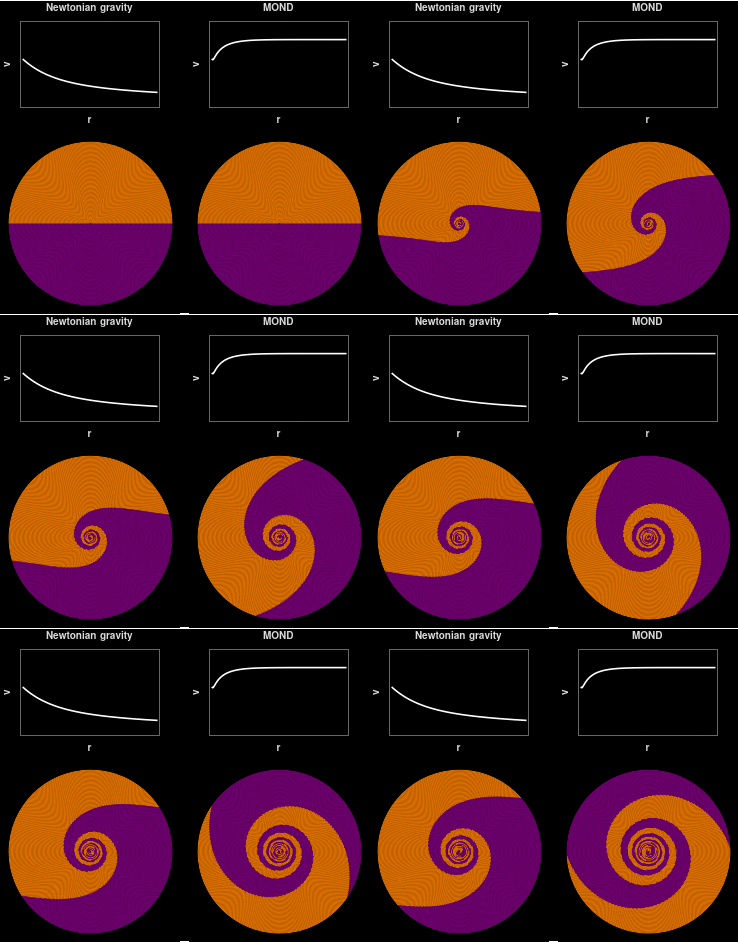
Could a modification of gravity remove the need for dark matter? The most well-known alternative is MOND (Modified Newtonian Dynamics), which posits that Newtonnulls law of gravity or inertia changes at very low accelerations, characteristic of galaxy outskirts. MOND can empirically fit many spiral galaxy rotation curves with fewer free parameters than some halo models, a legitimate and longstanding success at that scale.
Artist: Jacopo Bertolotti
However, fitting rotation curves is not the only test. Cosmology and galaxy clusters pose significant challenges. To address these, researchers have developed relativistic extensions of MOND (e.g., TeVeS-like frameworks) that attempt to incorporate lensing and cosmology. Nonetheless, reproducing the entire suite of observationsnullCMB anisotropies, lensing in systems like the Bullet Cluster, and the formation of large-scale structurenullhas proven difficult without reintroducing some form of additional unseen matter or fields.
It is reasonable to see modified gravity not as a settled replacement but as an active research approach that may illuminate why certain empirical galaxy relations (like the tightness of the baryonic TullynullFisher relation) are so striking. In that sense, modified gravity theories can provide valuable clues, even if the preponderance of current evidence still favors a dark matter component when considering the full cosmological dataset.
Data Frontiers: Surveys and Telescopes Shaping the Next Decade
Observational cosmology and particle astrophysics are experiencing a data renaissance. Multiple facilities will sharpen our maps of the dark universe and push searches for new physics into unexplored regimes.
Wide-Field Imaging and Weak Lensing
Surveys such as the Dark Energy Survey (DES), Hyper Suprime-Cam (HSC), and KiDS have delivered precise weak lensing measurements, revealing the distribution of matter and testing ΛCDM at late times. Some analyses have reported mildly lower clustering amplitudes (often summarized via S8) compared to Planck CMB inferences, spurring interest in systematic effects and potential new physics. Ongoing reanalyses and cross-survey comparisons continue to refine these results.

Artist: CTIO/NOIRLab/DOE/NSF/AURA; Image Processing: T.A. Rector & M. Zamani
Looking ahead, the Vera C. Rubin Observatory (Legacy Survey of Space and Time, LSST) is expected to map billions of galaxies over a wide area, dramatically increasing the statistical power of weak lensing and galaxy clustering probes. This will enable stringent tests of the growth of structure and, by extension, of the dark matter paradigm.
Space Missions: Euclid and Beyond
Euclid, an ESA mission launched in 2023, is designed to measure weak lensing shapes and galaxy clustering with exquisite precision over a large fraction of the sky. Its high-resolution space-based imaging and near-infrared spectroscopy will improve constraints on cosmological parameters and dark matter clustering properties.
NASAnulls Nancy Grace Roman Space Telescope is planned to bring a wide-field infrared view of the sky with high image quality later in the decade, complementing ground-based surveys. Its combination of area, depth, and resolution should be particularly valuable for weak lensing and high-redshift galaxy studies.
High-Energy and Multimessenger Observatories
Gamma-ray and cosmic-ray instruments (Fermi-LAT, H.E.S.S., MAGIC, VERITAS, AMS-02) continue to tighten indirect detection constraints and to explore intriguing signals that require careful astrophysical modeling. Neutrino telescopes like IceCube offer complementary reach, particularly in searches for dark matter accumulated in gravitational wells like the Sun.
On the particle front, upgraded direct detection experiments will probe fainter cross sections and broaden the target set for non-WIMP candidates; axion haloscopes extend their tuning ranges and sensitivity; and colliders pursue higher luminosities to test simplified models with more precision. Meanwhile, gravitational-wave observatories could set or sharpen constraints on compact dark matter scenarios by mapping the black hole merger population over time.
Galaxy Archeology and Local Tests
Within our own cosmic neighborhood, stellar streams and the dynamics of the Milky Waynulls halo stars offer a window into the small-scale structure of dark matter. Perturbations in streams can reveal encounters with dark subhalos, providing a novel test independent of luminous tracers. As astrometric datasets improve, these methods will become increasingly powerful cross-checks on small-scale predictions.
In short, the data front is broad and interconnected. As multiple lines of evidence refine our maps of matter, successes and tensions alike will inform whether dark matter is cold and collisionless, gently self-interacting, partially warm, or something more exotic.
How to Read Dark Matter Papers Without the Hype
The literature on dark matter is vast, and headlines can be exuberant. Here is a compact guide to reading new results critically while appreciating genuine advances.
- Start with the method. Is the paper a direct detection limit, an indirect search, a collider analysis, a lensing map, or a galaxy dynamics study? Each has different systematics and assumptions.
- Check the control samples and systematics. For indirect detection, are astrophysical backgrounds modeled and validated? For lensing, how are shape measurements and photometric redshifts calibrated? For rotation curves, what is the impact of noncircular motions and gas pressure support?
- Look for independent confirmations. Have other teams, instruments, or wavelengths seen the same signal? Is there a multi-probe consistency check?
- Beware the nulllook-elsewherenull effect. When scanning large parameter spaces, statistical fluctuations will occur. Are trials factors properly accounted for?
- Differentiate between discovery and constraints. Setting a stronger upper limit is progress, but it is not a detection. If a nullpossible signalnull is reported, are alternative explanations rigorously explored?
- Mind the priors and model dependence. Some inferences rely on halo models, substructure assumptions, or cross-section scaling laws. Results can shift with different model choices.
A balanced reading habit will help you connect new findings back to the foundations outlined in Observational Evidence and the theory context in ΛCDM and Candidate Particles.
Frequently Asked Questions
Is dark matter really necessary, or could we just change gravity?
Modified gravity models like MOND can fit many galaxy rotation curves using fewer parameters than some halo models, which is a legitimate success. However, when we examine the full suite of evidencenullCMB anisotropies, the Bullet Clusternulls lensingnullgas offset, and the growth of large-scale structurenullit becomes hard to match observations without invoking some additional unseen matter or fields. At present, most cosmologists favor a dark matter component within the ΛCDM framework because it consistently explains multiple independent datasets simultaneously. That said, continued testing of modified gravity remains scientifically valuable and could reveal deeper principles at work.
Why havennullt we detected dark matter particles yet?
Even if dark matter interacts with ordinary matter, those interactions may be far weaker than early theories anticipated. Parameter space is large: masses could range from ultra-light bosons to heavy, weak-scale particles, and couplings may be suppressed or occur through new mediators. Direct detection experiments have made stunning progress, but the absence of a signal so far mostly tells us that popular nulleasynull corners of WIMP parameter space are disfavored. It does not rule out dark matter particles in general. Our best chance for discovery is to pursue a diversified, complementary search strategy across many candidate classes, as outlined in How We Hunt Dark Matter.
Final Thoughts on Understanding Dark Matter Evidence and Searches
Dark matter remains one of the most profound scientific puzzles of our time. Its gravitational fingerprints are visible in galaxy rotation curves, in gravitational lensing maps, in the cosmic microwave backgroundnulls acoustic peaks, and in the very scaffolding of the cosmic web. The ΛCDM model weaves these disparate clues into a coherent narrative that has survived decades of scrutiny and increasingly precise data.
At the same time, the quest to determine the microscopic identity of dark matter is far from over. Leading candidates like WIMPs and axions are being tested by a mature ecosystem of experiments. Sterile neutrinos and other possibilities remain active frontiers, and primordial black holes persist in specific mass windows as partial contributors. Small-scale puzzles in galaxy formation continue to refine our expectations for how baryonic physics and dark matter interact to shape real galaxies.
What should you watch next? Pay attention to cross-probe consistency: weak lensing results from wide-field surveys, precision CMB constraints, ever-more-sensitive direct detection efforts (especially as they near the neutrino background), advances in axion haloscopes and helioscopes, and the steady grind of collider searches. Any convincing signal will likely emerge as a convergence across multiple methods.
If this deep dive helped clarify the landscape, consider exploring our related articles on galaxy formation, gravitational lensing, and the cosmic microwave background. And if you want expert, digestible updates on the latest results without the hype, subscribe to our newsletternullwenullll bring you the most meaningful developments and explain why they matter.