Table of Contents
- What Is Knullfhler Illumination and Why It Matters
- Optical Principles: Conjugate Planes, Numerical Aperture, and Resolution
- Roles of the Condenser, Diaphragms, and Light Source
- Knullfhler Illumination Setup: A Conceptual Step-Through
- How Knullfhler Illumination Controls Contrast, Resolution, and Depth
- Common Misconceptions and Practical Trade-offs
- Diagnosing Uneven Illumination and Artifacts
- Beyond Brightfield: Phase, DIC, Darkfield, and Epi-Illumination
- Maintenance, LED Retrofits, and Illumination Stability
- Frequently Asked Questions
- Final Thoughts on Mastering Knullfhler Illumination
Knullfhler Illumination: Theory, Setup, and Trade-offs

Images donated as part of a GLAM collaboration with Carl Zeiss Microscopy – please contact Andy Mabbett for details.
Artist: ZEISS Microscopy from Germany
Among all the adjustments available on a transmitted-light microscope, Knullfhler illumination is the one that most reliably separates crisp, evenly lit images from flat, hazy, or uneven views. It is not just a setup trick; it is an optical condition that aligns the microscopenulls conjugate image and aperture planes so that the specimen is illuminated uniformly with well-controlled angular light. When you understand Knullfhler illumination, other adjustmentsnullafnullafnullaffrom aperture diaphragms to contrast methodsnullafnullafnullafstart to make immediate, physical sense.
What Is Knullfhler Illumination and Why It Matters
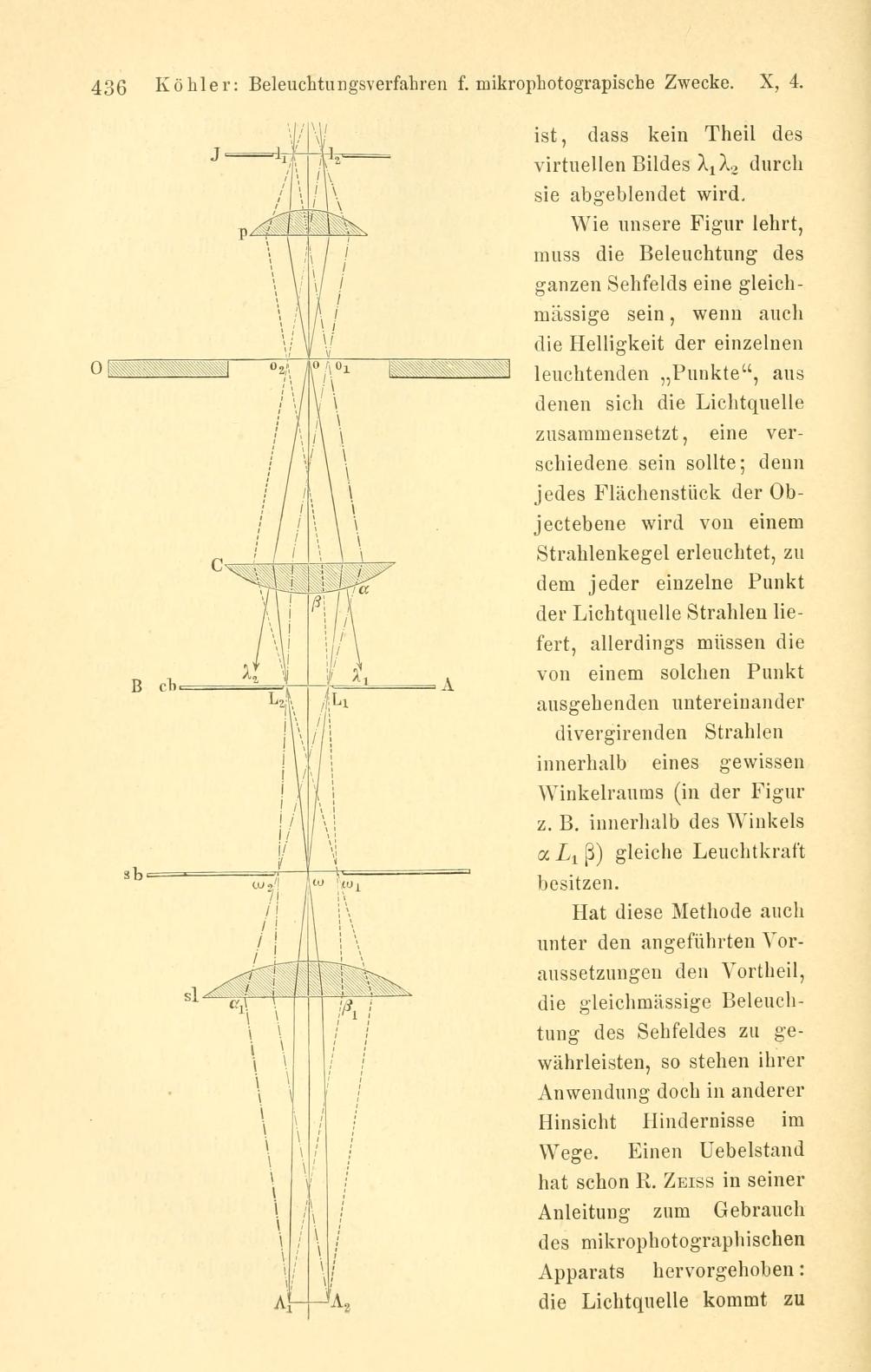
Knullfhler illumination is an illumination scheme for transmitted-light microscopy in which the light source and diaphragms are imaged into specific optical planes so that the specimen receives even, structure-free illumination. In Knullfhler illumination:
- The field diaphragm is imaged onto the specimen plane, defining the illuminated area without imprinting source structure onto the sample.
- The light source (e.g., filament or LED emitter) is imaged onto the objectivenulls back focal plane (a pupil plane), not onto the specimen. This prevents the sourcenulls texture from appearing in the image.
- The aperture diaphragm (in or near the condenser) is conjugate to the objectivenulls back focal plane, thereby controlling the illumination numerical aperture (NA) and the angular distribution of light reaching the sample.
By decoupling field size from illumination NA, Knullfhler illumination provides two independent controls: the field diaphragm governs what region of the slide is illuminated, and the aperture diaphragm governs the cone of illumination angles. This separation is the core advantage of Knullfhler compared with critical illumination, which images the light source directly onto the specimen and often produces uneven lighting.
Images donated as part of a GLAM collaboration with Carl Zeiss Microscopy – please contact Andy Mabbett for details.
Artist: ZEISS Microscopy from Germany
The practical payoffs are immediate:
- Uniformity: Even field brightness across the view, especially important for imaging and quantitative measurements.
- Resolution: The condenser can deliver an illumination NA that allows the objective to perform near its designed resolving power.
- Contrast control: By stopping down the aperture diaphragm, you can improve contrast at the expense of ultimate resolution and brightness.
- Stray-light suppression: A correctly adjusted field diaphragm reduces flare and enhances image clarity.
In short, Knullfhler illumination is the prerequisite for extracting the best optical performance from a brightfield microscope. Throughout this article, you will see how Knullfhler intersects with optical theory, how to achieve it in a conceptual setup sequence, and how to adapt its principles for other contrast methods.
Optical Principles: Conjugate Planes, Numerical Aperture, and Resolution
Understanding Knullfhler illumination benefits from a quick tour through three foundational ideas in optical microscopy: conjugate planes, numerical aperture, and resolution.
Conjugate Image and Aperture Planes
Microscope optics are often described as two overlapping sequences of conjugate planes:
- Field (image) conjugate planes: light source field, field diaphragm, specimen plane, intermediate image plane, camera/eyepiece field. Features at one of these planes are in focus simultaneously with features at the others.
- Aperture (pupil) conjugate planes: light source aperture (filament or LED die), condenser aperture diaphragm, objective back focal plane (rear pupil), eyepiece entrance pupil. Angular information is controlled here.
In Knullfhler illumination, the optical system is adjusted so that:
- The field diaphragm is sharply imaged at the specimen plane. Closing the field diaphragm should reveal a crisp polygonal or circular edge coincident with the specimen focus; opening it expands the illuminated region.
- The aperture diaphragm is imaged at the objective back focal plane. Adjusting it changes the cone of illumination angles that reach the sample.
This separation is powerful: it allows you to set the field of view independently from the illumination NA. Thatnulls why two diaphragms exist and serve different purposes.
Numerical Aperture (NA) and Illumination NA
Numerical aperture quantifies the angular acceptance of an optical element in a medium of refractive index n: NA = n nulld7 sin(nullbd nulld7 nullce), where nullce is the full included angle of the light cone. The objectivenulls NA dictates how finely it can resolve detail; higher NA yields finer resolution but typically shallower depth of field and reduced working distance.
The condenser has its own NA. The illumination NA is set by the condenser aperture diaphragm and the condenser design. In brightfield, to exploit the resolution potential of the objective, the condenser should provide an illumination NA approaching that of the objective (for dry objectives, commonly up to about 0.9; oil condensers can exceed 1.0 when used with immersion). If the condenser NA is significantly lower than the objective NA, high spatial frequencies in the specimen will be illuminated insufficiently and recorded with reduced contrast.
Practical rule of thumb: set the condenser aperture to roughly 70nullafnullaf80% of the objectivenulls NA for general brightfield. This maintains good resolution while boosting contrast and depth of field. You can open wider for maximum resolution and narrower for increased contrast, as discussed in How Knullfhler Illumination Controls Contrast, Resolution, and Depth.
Resolution Limits and Illumination
For incoherent imaging through a circular aperture (as in many brightfield scenarios), the objective-limited lateral resolution is approximated by the Rayleigh criterion:
d nulla0nullb1nulla0 0.61 nulld7 nullbb / NAobj
where nullbb is the wavelength and NAobj is the objectivenulls numerical aperture. This relationship assumes adequate illumination to excite specimen spatial frequencies. In practice, if the condenser NA is too small, the ultimate resolution will be limited by illumination rather than the objective. Conversely, opening the condenser aperture toward the objective NA allows the system to approach the objectivenulls designed resolving power.
Knullfhler illumination helps in two complementary ways:
- It supplies a uniform field so that spatial frequency contrast is not swamped by gradients or hot spots.
- It provides a tunable illumination NA (via the aperture diaphragm) so you can balance resolution against contrast and depth of field.
We return to these trade-offs in the performance section and address common misunderstandings in Common Misconceptions.
Roles of the Condenser, Diaphragms, and Light Source
Knullfhler illumination relies on a few key components working in concert. Knowing what each does makes the setup logical rather than mysterious.
Condenser and Its Aperture
The condenser focuses the illumination onto the specimen and shapes the angular distribution of rays. A typical brightfield condenser includes:
- A lens system (e.g., Abbe condenser, or aplanatic-achromatic condenser in higher-grade instruments) that can be raised or lowered.
- An aperture diaphragm placed at (or near) the condensernulls pupil plane. This diaphragm is conjugate with the objectivenulls back focal plane and sets the illumination NA.

Artist: Mikael Häggström, M.D.
Raise or lower the condenser to focus the field diaphragm image at the specimen plane. Then use the condenser aperture to adjust contrast and resolution. Opening the aperture admits higher-angle light; closing it reduces glare and increases depth of field but also reduces ultimate resolution and brightness.
Field Diaphragm
The field diaphragm sits near the light source and is conjugate to the specimen plane. Its function is to delimit the illuminated area to slightly larger than the field of view. This reduces stray light and helps achieve a homogenous field.
Key point: The field diaphragm does not control illumination NA. It primarily affects field size and stray-light suppression. Brightness changes you observe while closing it are mainly a side effect of reducing the illuminated area, not of changing the angular distribution.
Collector Optics and Light Source
Illuminators typically include collector lenses that image the light source onto the condenser aperture and help produce a uniform bundle of rays. Two common sources include:
- Halogen or tungsten lamps: Extended filaments that require centering and proper collector lens alignment for even illumination.
- LEDs: Solid-state emitters with diffusers or lenses that approximate an extended, uniform source. They usually need less frequent alignment but still benefit from proper Knullfhler adjustment.
Even with LEDs, Knullfhler principles apply: the source should be imaged to an aperture plane, not the specimen. If the source is inadvertently imaged into the field plane, you will see texture or mottling across the image.
Objective Back Focal Plane (BFP)
The objectivenulls back focal plane (rear pupil) is an aperture-conjugate plane. Many microscopes allow access to it via a phase telescope or Bertrand lens. Observing the BFP enables:
- Assessment of aperture diaphragm setting (visible as a bright opening).
- Alignment of phase rings in phase contrast.
- Inspection of darkfield stops or DIC prisms overlays.
Checking the BFP is one of the best ways to confirm correct Knullfhler alignment and diagnose issues like off-center condensers.
Knullfhler Illumination Setup: A Conceptual Step-Through

Images donated as part of a GLAM collaboration with Carl Zeiss Microscopy – please contact Andy Mabbett for details.
Artist: ZEISS Microscopy from Germany
This section outlines a general, educational sequence for achieving Knullfhler illumination on a transmitted-light microscope. Exact control names vary by instrument, but the logic is the same. Refer to your microscopenulls manual for model-specific instructions.
1) Begin with a Focused Specimen
Place a typical specimen and bring it into sharp focus with a moderate objective (e.g., 10nulld7 or 20nulld7). Center the area of interest in the field of view. A focused specimen plane provides a reference for subsequent adjustments.
2) Close the Field Diaphragm to a Small Aperture
Locate the field diaphragm control and close it until a small, polygonal or circular opening appears in the field of view. If you see no edge, the condenser is probably out of focus relative to the specimen plane. Proceed to the next step.
3) Focus the Condenser to Sharpen the Field Diaphragm Edge
Adjust the condenser height (raise or lower) until the field diaphragm edge is sharply in focus together with the specimen. The crispness of that edge confirms that the field diaphragm is correctly imaged onto the specimen plane. If available, use condenser centering screws to center the field diaphragm image in the field of view.
4) Open the Field Diaphragm to Slightly Oversize the Field
Open the field diaphragm until its edge barely disappears beyond the perimeter of your visible field. This ensures you illuminate only the specimen area you plan to observe or image, reducing glare and improving contrast. Remember: this step sets field size, not angular illumination.
5) Adjust the Condenser Aperture Diaphragm
Now set the aperture diaphragm to control the illumination NA. A reasonable starting point is about 70nullafnullaf80% of the objectivenulls NA. You will notice that closing the aperture improves contrast and apparent depth of field but softens the finest detail and dimly lit features. Opening it brightens the image and boosts resolution at the cost of increased glare and reduced depth of field. This is the essential performance trade-off described in the next section.
6) Confirm Alignment (Optional but Recommended)
If your microscope supports it, insert a phase telescope or engage a Bertrand lens to observe the objective back focal plane. Check that:
- The aperture diaphragm is centered and circular in the BFP.
- There are no gross asymmetries indicating condenser misalignment.
Any misalignment here can produce uneven illumination. Troubleshooting suggestions are detailed in Diagnosing Uneven Illumination and Artifacts.
7) Iterate as You Change Objectives
When you switch objectives, revisit steps 4nullafnullaf5 to reset the field diaphragm and aperture diaphragm relative to the new magnification and NA. Larger NA objectives usually benefit from opening the condenser aperture to maintain resolution. Lower NA objectives may require reducing the aperture to gain contrast.
Tip: If the field diaphragm never forms a sharp edge in the specimen plane, verify that the condenser lens group (especially any swing-in top lens) matches the objective range you are using. See Common Misconceptions and Practical Trade-offs.
How Knullfhler Illumination Controls Contrast, Resolution, and Depth
Because Knullfhler illumination isolates the control of field size from angular illumination, you can tune multiple image quality dimensions independently. Four aspects usually matter most to brightfield users: resolution, contrast, depth of field, and evenness of illumination.
Resolution and the Aperture Diaphragm
Resolution improves with higher effective NA. Opening the aperture diaphragm increases the illumination NA, which generally helps the objective approach its designed resolving power. If the condenser aperture is set too small relative to the objective NA, high spatial frequencies in the specimen receive insufficient high-angle illumination and are reproduced with reduced contrast or lost entirely.
That said, fully opening the aperture diaphragm isnnullt always optimal for practical imaging. Wide-open illumination can reduce micro-contrast, making subtle features less perceptible even if they are, in principle, resolvable. Many users settle on an aperture setting of about 70nullafnullaf80% of the objective NA for general brightfield, then adjust as needed for particular specimens.
Contrast, Glare, and Stray Light
Contrast in brightfield is a delicate interplay between aperture, specimen optical properties (absorption, phase, scattering), and stray light. Knullfhler illumination combats stray light in two ways:
- A properly sized field diaphragm reduces off-axis illumination that does not contribute to image formation but degrades contrast.
- An appropriately stopped-down aperture diaphragm (to a point) cuts glare from extreme marginal rays and increases phase gradients at edges, improving perceived contrast in many specimens.

Artist: Mikael Häggström, M.D.
However, close the aperture too much, and diffraction broadening of the illumination cone softens fine details. Finding the sweet spot is part of routine practice.
Depth of Field and the Illumination Cone
As NA increases, the depth of field decreases. In practical terms, opening the aperture diaphragm produces a broader illumination cone and shallower depth of field, which sharpens thin planes but makes thicker specimens more demanding to focus. Stopping down increases the axial extent over which the image appears in focus, useful for three-dimensional samples at the expense of ultimate lateral resolution.
Depth of field in microscopy is often approximated as inversely proportional to NA2 for a given wavelength and imaging medium. While precise values depend on multiple criteria (including the camera/eye acceptance and specimen properties), the qualitative rule holds: adjust the aperture diaphragm to navigate between razor-thin focus and forgiving depth.
Evenness and Field Size
Even illumination across the field is one of Knullfhlernulls signature benefits. If you observe brightness falloff or a center hotspot, it typically indicates one of the following:
- The field diaphragm isnnullt correctly conjugated to the specimen plane (condenser out of focus).
- The condenser is not centered.
- The collector optics or source are misaligned.
See Diagnosing Uneven Illumination and Artifacts for a systematic approach to finding the culprit.
Common Misconceptions and Practical Trade-offs
Several recurring misconceptions make Knullfhler illumination seem harder than it is. Clearing them up makes every knob turn count.
Misconception 1: The Field Diaphragm Is a Brightness Control
Reality: The field diaphragm sets the illuminated area, not the illumination NA. While closing it may make the image appear dimmer (because less of the slide is illuminated), it is not a substitute for precise control of angular illumination. Use the aperture diaphragm for brightness/contrast trade-offs and the field diaphragm to restrict the illuminated field to the area you actually observe.
Misconception 2: Always Open the Aperture Diaphragm Fully
Reality: Theoretical resolution increases with NA, but perceived image quality depends on contrast. Many specimens benefit from stopping down the aperture diaphragm slightly (often to ~70nullafnullaf80% of objective NA) to enhance edge gradients without unduly sacrificing fine detail. Opening to the limit may reduce micro-contrast and depth of field, especially with bright, low-absorption samples.
Misconception 3: Knullfhler Is Redundant with LED Illumination
Reality: Even with LEDs, you still need to align the field and aperture conjugates. A well-diffused LED can help with uniformity, but it cannot replace correct imaging of the field diaphragm at the specimen plane or proper adjustment of aperture NA. Knullfhler principles remain essential.
Misconception 4: The Condenser Top Lens Is Optional
Reality: Many condensers include a swing-in top lens to reach higher NA for medium-to-high-power objectives. Omitting this lens with high-NA objectives reduces the illumination NA, limiting resolution and evenness at the field edges. Conversely, leaving the top lens in place for low-power objectives may overfill the field and complicate alignment. Choose the condenser configuration to match the objective range.
Misconception 5: Critical Illumination Is Equivalent to Knullfhler
Reality: In critical illumination, the light source is imaged at the specimen plane, which often reveals filament structure or source texture as unevenness in the field. Knullfhler deliberately images the source into an aperture plane instead, decoupling source structure from the field and providing homogenous, adjustable illumination.
Trade-offs to Embrace
- Resolution vs. contrast: Opening the aperture diaphragm maximizes resolution; stopping down enhances contrast and depth of field.
- Evenness vs. speed: Skipping centering can be tempting, but a minute spent aligning the condenser pays off in uniform images.
- Brightness vs. heat/noise: With lamp-based systems, higher intensity can raise heat and optical noise (e.g., dust illumination). Adjust diaphragms first; add neutral density filters if necessary, as discussed in Maintenance and Upgrades.
Diagnosing Uneven Illumination and Artifacts
Even skilled users occasionally encounter brightness gradients, hot spots, or ghost images. A systematic approach grounded in Knullfhler optics helps locate the cause quickly.
Symptom: Bright Center, Dark Edges (Hot Spot)
Likely causes and checks:
- Field diaphragm too open or not conjugated: Close the field diaphragm and refocus the condenser until its edge is sharp at the specimen plane. Then reopen just beyond the field perimeter (setup step 4).
- Collector or source misalignment: On lamp-based systems, center the bulb and collector lens as prescribed by the manufacturer. For LEDs, verify any diffusers or lenses are properly seated.
- Condenser height or top lens mismatch: Ensure the condenser is focused and configured for the objective range (Misconception 4).
Symptom: One Side Darker Than the Other
Likely causes and checks:
- Condenser decentered: Use condenser centering screws to symmetrize the field. The field diaphragm image should be concentric with the field of view when the condenser is focused.
- Off-center aperture diaphragm: Observe the objective back focal plane (if possible) and center the aperture.
- Specimen tilt or slide thickness variation: Check mechanical stage level and coverslip flatness.
Symptom: Dust Shadows or Specks That Move with Focus
Interpretation via conjugate planes:
- Dust in field (image) planes such as the specimen, field diaphragm, or intermediate image may appear in focus at the specimen plane and move with focus adjustments.
- Dust in aperture (pupil) planes (e.g., condenser aperture, objective BFP) usually appears as diffuse veiling glare or stable spots that donnullt focus sharply with the specimen.
Cleaning the correct surface is more effective than indiscriminate cleaning. If you can view the back focal plane, contaminants in pupil planes are easier to spot.
Symptom: Uneven Color or Flicker with LED Illumination
Possible causes and remedies:
- PWM flicker aliasing with camera exposure: Some LED drivers pulse the current. Adjust camera exposure away from the PWM frequency or use a driver with high-frequency PWM or constant current output.
- Color temperature drift with dimming: Many LED systems maintain color temperature, but if yours shifts, consider neutral density (ND) filters for intensity control rather than changing LED drive current drastically. See Maintenance and Upgrades.
Symptom: Phase Artifacts in Brightfield
If phase rings or DIC prisms are left in the light path during brightfield observation, they can introduce vignetting or contrast anomalies. Ensure contrast accessories are removed or fully engaged and aligned when switching modes. See Beyond Brightfield for details.
Beyond Brightfield: Phase, DIC, Darkfield, and Epi-Illumination
Knullfhlernulls logic extends to other contrast modalities. While the specifics differ, the core idea of aligning field and aperture conjugates carries over.
Phase Contrast
Phase contrast converts phase shifts in transparent specimens into intensity differences. It uses an annular condenser stop matched to a phase ring in the objectivenulls back focal plane. Key points with respect to Knullfhler:
- The field diaphragm should still be imaged at the specimen plane for even illumination.
- The annulus in the condenser must be concentric with the phase plate in the objective BFP. A phase telescope or Bertrand lens is used to align them.
- Aperture control is largely dictated by the annulus geometry; additional stopping down is generally not used.
Good phase contrast alignment depends critically on viewing the back focal plane. The same is true for DIC and darkfield.
Differential Interference Contrast (DIC)
DIC inserts polarizing optics and shear prisms to convert optical path gradients into intensity differences. While the mechanism differs from phase contrast, the illumination foundation remains similar:
- Keep Knullfhler alignment for uniform, stray-light-minimized illumination at the specimen.
- Ensure the aperture diaphragm setting supports the intended DIC shear and contrast; overly small apertures can reduce micro-contrast.
- Follow manufacturer guidance for prism and polarizer orientation, but the general Knullfhler steps for field and condenser still apply.
Darkfield
Darkfield blocks the central illumination and illuminates the specimen with high-angle rays that the objective would not otherwise capture directly. The principle intersects with Knullfhler as follows:
- The darkfield stop resides in an aperture-conjugate plane (often in the condenser). It must be centered in the back focal plane to create a uniform dark background.
- The field diaphragm is still adjusted for clean field borders and minimal stray light.
If you see a bright central patch in darkfield, the stop is misaligned or too small for the objective NA. Centering in the BFP typically resolves this.
Epi-Illumination (Reflected Light)
Reflected-light microscopy (metallurgy, materials) illuminates through the objective. Knullfhler-like alignment occurs inside the epi-illuminator:

(b) Illustration of the principle
of the SDOM super-resolution technique. Two neighboring fluorophores with 100 nm distance and different dipole orientations (pseudocolor in red and green) emit periodic signals excited by rotating polarized light. By rotating the polarization of excitation, the emission ratio between the two molecules is modulated accordingly, resulting in their separation in the polarization domain. The sparsity deconvolution can achieve a super-resolution image of effective dipole intensities under polarization modulation; with least-squares fitting, the dipole orientation can be determined. Arrows indicate the directions of dipole orientations.
Artist: Maggie Li
- The epi field diaphragm is imaged at the specimen plane via the objective.
- The epi aperture diaphragm is conjugate to the objective pupil and controls the illumination NA on the specimen surface.
While the light path differs, the same benefits accrue: uniform field size, controlled angular illumination, and minimized stray light. Many of the troubleshooting approaches still apply, with the difference that the objective serves as both condenser and imaging lens.
Maintenance, LED Retrofits, and Illumination Stability
Consistent Knullfhler performance depends not only on alignment but also on the stability and cleanliness of the illumination path. This section outlines non-clinical, educational considerations for maintaining stable, high-quality illumination.
Clean Conjugate Planes Carefully
Dust and smudges in field planes (e.g., field lens, specimen, intermediate image optics) will often be visible in focus; contamination in aperture planes (e.g., condenser aperture, objective BFP) tends to produce veiling glare. Cleaning is most effective if you target the correct surface:
- Inspect visible optics with a loupe and gentle light.
- Use appropriate lens cleaning methods and materials for coated optics.
- Avoid unnecessary disassembly; many issues resolve with correct Knullfhler alignment rather than cleaning.
Lamp Alignment and Collector Lenses
For halogen or tungsten systems:
- Ensure the bulb is the correct type and is seated properly. Mis-seated bulbs displace the source relative to the collector optics.
- Center the collector lens and adjust the bulb position if your stand provides controls. This step improves uniformity and allows the source to be imaged correctly at an aperture plane.
- Use neutral density (ND) filters to moderate intensity rather than stopping down the aperture diaphragm solely for brightness control. The aperture should be reserved for contrast and resolution tuning.
LED Retrofits: Drivers, Diffusers, and Uniformity
LED conversions are popular for their long life, lower heat, and stable output. Considerations when retrofitting:
- Driver quality: A constant-current driver with high-frequency or DC output minimizes flicker. PWM drivers can alias with camera exposures, creating banding or flicker (
see Troubleshooting). - Optical coupling: Use appropriate diffusers or collector optics to create an extended, uniform source. A bare LED die imaged at the specimen plane can mimic critical illumination artifacts.
- Thermal stability: Adequate heat sinking maintains LED output and color over time.
- Color rendering: For educational brightfield imaging, broad-spectrum white LEDs work well. If color fidelity matters, select LEDs with suitable spectra for your dyes or specimens.
Neutral Density Filters vs. Aperture Dimming
To preserve optical performance, itnulls generally better to adjust image brightness with neutral density filters or lamp/LED intensity rather than drastically stopping down the aperture diaphragm. The aperture should be reserved for balancing contrast, resolution, and depth of field. ND filters reduce intensity without changing the angular distribution of light.
Verifying Knullfhler Periodically
After maintenance or objective changes, run a quick check:
- Close the field diaphragm to verify it images sharply at the specimen plane and is centered.
- Open the field diaphragm to just beyond the field of view.
- Adjust the aperture diaphragm to suit the objective NA and specimen contrast needs.
- Optionally, inspect the back focal plane to confirm centering and stop positions.
This two-minute check often prevents hours of frustration later. If problems persist, consult Diagnosing Uneven Illumination and Artifacts for a deeper dive.
Frequently Asked Questions
Is Knullfhler illumination possible on student microscopes without a field diaphragm?
Many student microscopes lack an adjustable field diaphragm or have a simplified illuminator. While you may not be able to form a sharp image of the field diaphragm at the specimen plane, you can still apply Knullfhler principles to improve outcomes:
- Ensure the condenser is centered and at the correct height so that the specimen receives a uniform bundle of rays.
- Use the aperture diaphragm to manage contrast and resolution as described in How Knullfhler Illumination Controls Contrast, Resolution, and Depth.
- Restrict stray light by masking the field (if safe and appropriate) or using the smallest practical field stop available in your illuminator.
While you may not achieve full formal Knullfhler without a field diaphragm, adopting these steps captures much of its benefit. For the complete method, see the conceptual setup and component roles.
What is the difference between the condenser aperture and the field diaphragm?
The field diaphragm is conjugate to the specimen plane and sets the illuminated field size. The condenser aperture diaphragm is conjugate to the objective back focal plane and sets the illumination NA and angular distribution of light.
In practice:
- Use the field diaphragm to clip the field just beyond the area you observe, minimizing stray light (Roles of the Diaphragms).
- Use the aperture diaphragm to tune contrast, resolution, and depth of field (performance trade-offs).
Confusing the two is a leading cause of suboptimal images. Keeping their roles distinct is central to Knullfhler illumination.
Final Thoughts on Mastering Knullfhler Illumination
Knullfhler illumination is far more than a ritual. It is the practical expression of how a microscope organizes light into two families of conjugate planesnullafnullaffield and aperturenullafnullafin order to deliver uniform, high-quality brightfield images. Mastering it means:
- Imaging the field diaphragm sharply at the specimen plane and sizing it just beyond the observable field.
- Using the aperture diaphragm to set the illumination NA, balancing resolution, contrast, and depth of field in line with your objectivenulls NA and your specimen.
- Centering the condenser and verifying alignment in the objective back focal plane when possible.
- Maintaining clean, stable illumination optics and revisiting alignment as you change objectives or specimens.
Once you internalize these relationships, every microscope adjustment becomes clearer and more purposeful. If you found this guide useful, explore related articles on illumination, contrast methods, and optical fundamentals, and consider subscribing to our newsletter for weekly, in-depth microscopy insights.