
Table of Contents
- What Is the Summer Triangle Asterism?
- How to Find Vega, Deneb, and Altair from City or Dark Skies
- Vega in Lyra: A Photometric Standard with a Debris Disk
- Deneb in Cygnus: A Far-Flung Supergiant Framing the Milky Way
- Altair in Aquila: Rapid Rotation and a Stellar Neighborhood
- Star-Hopping Inside the Summer Triangle: M57, Albireo, M27, and More
- Seasonal Visibility and Cultural Connections of the Summer Triangle
- Equipment, Techniques, and Light-Pollution Strategies
- Frequently Asked Questions
- Final Thoughts on Choosing the Right Summer Triangle Observing Plan
What Is the Summer Triangle Asterism?
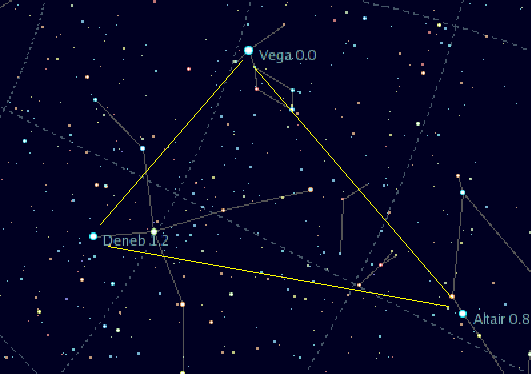
The Summer Triangle is a large, easily recognized asterism—an informal star pattern—anchored by three of the brightest stars in the northern sky: Vega (in the constellation Lyra), Deneb (in Cygnus), and Altair (in Aquila). Unlike official constellations recognized by the International Astronomical Union (IAU), an asterism like the Summer Triangle is not a formal boundary on the celestial sphere. Instead, it is a practical sky map feature: a pattern that helps observers find their way among constellations and deep-sky objects.
Artist: Jim Thomas
Spanning a huge region overhead on summer evenings in the Northern Hemisphere, the Triangle functions as a navigational signpost to the rich star fields of the Milky Way. Its corners trace an immense triangle that captures a swath of sky loaded with stellar clusters, glowing nebulae, and noteworthy double stars. Even under moderate light pollution, the three primary stars are prominent, and in truly dark skies the Milky Way pours through the asterism like a river of light.
Each corner star carries distinctive astrophysical interest:
- Vega (Alpha Lyrae), an A-type main-sequence star, is a cornerstone of astronomical photometry and hosts a well-studied debris disk.
- Deneb (Alpha Cygni), an A-type supergiant, is one of the most luminous stars visible to the naked eye, though its exact distance remains under active refinement.
- Altair (Alpha Aquilae), an A-type main-sequence star, rotates rapidly enough to become noticeably flattened—revealed by modern interferometry.
If you are a newcomer to stargazing, the Summer Triangle is a perfect starting point. It is bright, seasonally well-placed at convenient hours, and packed with nearby star-hopping targets. If you are a more experienced observer, its fields are a canvas for binocular sweeps, telescopic double-star work, and nebular hunting with filters. To plan your first session, jump to How to Find Vega, Deneb, and Altair from City or Dark Skies.
How to Find Vega, Deneb, and Altair from City or Dark Skies
Finding the Summer Triangle can be done with minimal equipment—your eyes are enough. The best times are summer and early autumn evenings in the Northern Hemisphere. In the Southern Hemisphere, it rides lower in the northern sky during winter months but remains accessible from many mid-latitudes.

Artist: Tomruen at en.wikipedia
Step-by-step: Locating the Three Corner Stars
- Start with Vega in Lyra. On northern summer evenings, look high overhead or slightly toward the east just after dusk. Vega is an intense bluish-white star, among the brightest in the sky. From light-polluted areas, it often pierces through haze before many other stars do.
- Find Deneb marking the tail of Cygnus, the Swan. Deneb lies to the northeast of Vega (roughly speaking). If you can trace a cross-shaped pattern spreading along the Milky Way, Deneb is at its top. This cross is the Northern Cross—the main stick figure of the constellation Cygnus.
- Spot Altair in Aquila. Look south or southeast of Vega to find Altair. Two fainter stars, Tarazed (Gamma Aquilae) and Alshain (Beta Aquilae), flank Altair along a line, making it distinctive. This trio helps lock in your sighting even under urban skies.
Connect Vega–Deneb–Altair to trace the triangle. In dark sites, the Milky Way streams from Cygnus through Vulpecula and Aquila, cutting across the asterism.
City vs. dark-sky strategies
- Urban/suburban observers: Start with Vega. Once found, sweep to locate Altair and Deneb. Deneb can be trickier in heavy light pollution because it sits amid the Milky Way’s glow; patience and averted vision help.
- Dark-sky observers: Use the Milky Way as a highway. Follow the bright river of starlight from the Northern Cross down through Vulpecula; targets in Star-Hopping Inside the Summer Triangle become easier to spot.
- Use a planisphere or app: A basic rotating star chart or a credible, up-to-date mobile app can forecast where the Triangle will be at your observing time and latitude.
New to the idea of asterisms vs constellations? See What Is the Summer Triangle Asterism? for context on how this sky marker fits into the IAU constellation system.
Vega in Lyra: A Photometric Standard with a Debris Disk
Vega (Alpha Lyrae) is an A0 V main-sequence star approximately 25 light-years from Earth. For decades, astronomers used Vega as a fundamental zero point in the optical magnitude system—effectively treating its brightness as a reference for calibrating observations. While modern photometric systems now rely on more nuanced calibrations and networks of standard stars, Vega’s legacy as a benchmark remains central to astronomical measurement.
Physical characteristics and rapid rotation
Although Vega looks like a simple, stable star to the eye, studies reveal it rotates rapidly and is observed from a vantage close to its rotational pole. This geometry means the poles appear hotter and brighter than the equator, a phenomenon known as gravity darkening. Interferometric observations have helped map Vega’s slightly oblate shape and uneven temperature distribution. The upshot: even a star that appears uniform to backyard observers can hide complex physics discernible only with high-resolution techniques.
A debris disk discovered in the infrared
Vega also hosts a well-documented debris disk, detected initially by its infrared excess—extra thermal radiation beyond what a solitary star would emit. Space-based infrared observatories first hinted at this disk, and subsequent observations refined the picture: Vega is encircled by dust thought to arise from collisions among icy bodies, an analog to our solar system’s Kuiper Belt. While no exoplanets are confirmed around Vega, the dynamics of its dust are consistent with gravitational sculpting that could, in principle, result from planetary-mass bodies. Ongoing surveys continue to probe the system.
Vega as a gateway to Lyra’s highlights
Beyond its scientific importance, Vega is your handle into the tiny harp of Lyra. Within a short hop lie several showpieces seen in the Star-Hopping section, notably the Ring Nebula (M57) and the famous double star Epsilon Lyrae, the “Double Double.” From an observing standpoint, Vega makes an excellent alignment star for binocular sweeps and for polar alignment routines in astrophotography mounts (when used alongside other bright stars in alignment procedures).

Artist: N.A.Sharp, REU program/NOIRLab/NSF/AURA
Deneb in Cygnus: A Far-Flung Supergiant Framing the Milky Way
Deneb (Alpha Cygni) crowns the Northern Cross asterism within the constellation Cygnus, the Swan. It is an A-type supergiant, vastly larger and more luminous than the Sun. Deneb’s precise distance remains an active area of study, but a rough value of a few thousand light-years is commonly cited. This uncertainty carries major implications for its intrinsic luminosity: the farther Deneb is, the more luminous it must be to appear at its observed brightness. Even at the nearer end of estimates, Deneb qualifies among the most luminous stars visible to the unaided eye.
Why Deneb is astrophysically special
- Evolutionary state: As a supergiant, Deneb is in an advanced stage of stellar evolution compared with main-sequence stars like the Sun or Altair. Its bright, extended atmosphere supports complex pulsations characteristic of some luminous A-type stars.
- Milky Way backdrop: Deneb sits against the dense star clouds and dark dust lanes of the Milky Way, providing an exquisite frame of contrast for binocular and telescopic observations.
- Measurement challenges: Determining distances to supergiants can be tricky due to their atmospheric complexity and potential systematics in parallax measurements at great distances. Thus, while modern astrometric missions have improved constraints, Deneb’s exact luminosity still carries some uncertainty.
Cygnus: The Northern Cross and deep-sky riches
Cygnus is a treasure chest for observers. Running along the Milky Way, it hosts breathtaking star fields and popular targets:
- Albireo (Beta Cygni): A colorful double star at the beak of the Swan, long celebrated for its blue-gold contrast. While historically debated, current data indicate the bright pair is an optical double—a line-of-sight alignment of two unrelated stars at different distances—rather than a tightly bound binary.
- Open clusters and nebulae: The region around Deneb contains multiple nebulae visible in wide-field images and through telescopes with filters. These include the North America Nebula (NGC 7000) and the Pelican Nebula (IC 5070). They are expansive, low-surface-brightness objects best appreciated with wide fields and narrowband filters under dark skies. For a practical route to these targets, see Star-Hopping Inside the Summer Triangle.
Because Deneb anchors the Milky Way’s path through the Triangle, scanning outward from it can reveal the Cygnus Rift—a series of dark dust lanes bisecting the star clouds. In binoculars, the interplay of glowing fields and inky voids makes for an unforgettable summer view.
Altair in Aquila: Rapid Rotation and a Stellar Neighborhood
Altair (Alpha Aquilae) completes the Summer Triangle to the south. Closer to Earth than Vega or Deneb at roughly the mid-teens of light-years, Altair is bright and easily recognized. Two nearby naked-eye companions—Tarazed (Gamma Aquilae) and Alshain (Beta Aquilae)—line up with Altair, making a straight pointer that observers can use as a distinctive regional signature.
What makes Altair stand out
- Rapid rotation: Altair spins quickly on its axis, enough to make it oblate rather than perfectly spherical. Interferometric observations have directly imaged this flattening, confirming theoretical expectations. Its equatorial regions are slightly cooler and dimmer than the poles—another example of gravity darkening in a bright A-type star.
- Proximity: Altair’s relative closeness makes it a laboratory for high-resolution studies. It is bright enough for careful photometry and interferometry while being free of the extreme uncertainties that come with very distant stars.
- Aquila’s pathway: The constellation Aquila traces the Milky Way southward from Cygnus. While Aquila does not host a single marquee deep-sky object as famous as M57 in Lyra, it is rich in star fields and dark lanes that reward slow binocular sweeps from Deneb in Cygnus down past Altair.
Because of its brightness and placement, Altair is often used in multi-star alignment procedures for GoTo and tracking mounts. Visual observers can use the Altair–Tarazed–Alshain line as a wayfinding arrow toward the small constellations enclosed by the Triangle, like Sagitta and Vulpecula.
Star-Hopping Inside the Summer Triangle: M57, Albireo, M27, and More
The Summer Triangle is more than three bright stars—its interior harbors some of the northern sky’s most beloved deep-sky targets. Whether you have binoculars, a small refractor, or a large reflector, there is something here for you. Below is a curated list with practical hopping tips and gear suggestions. As you explore, you will naturally move among the three corner stars; for context on each, you can jump back to Vega, Deneb, and Altair.
1) The Ring Nebula (M57) in Lyra
- Type: Planetary nebula
- How to find: Locate Sheliak (Beta Lyrae) and Sulafat (Gamma Lyrae), the two stars forming a small parallelogram with Vega. M57 sits almost exactly between Sheliak and Sulafat.
- What you’ll see: In small telescopes under reasonable skies, M57 appears as a small, grayish smoke ring. Higher magnifications can help separate it from the starry background. UHC or O III filters boost contrast.
- Why it matters: M57 is a classic planetary nebula, the ejected outer layers of a Sun-like star at the end of its life. It’s a vivid biology-free example of stellar recycling in action.

From Earth’s perspective, the nebula looks like a simple elliptical shape with a shaggy boundary. However, new observations combining existing ground-based data with new NASA/ESA Hubble Space Telescope data show that the nebula is shaped like a distorted doughnut. This doughnut has a rugby-ball-shaped region of lower-density material slotted into in its central “gap”, stretching towards and away from us.
Artist: NASA, ESA, and C. Robert O’Dell (Vanderbilt University)
2) The Double Double (Epsilon Lyrae)
- Type: Multiple star system
- How to find: Epsilon Lyrae sits just off Vega. In binoculars it often shows as an elongated star. In a small telescope at moderate to high power, each of the two components splits again—hence “Double Double.”
- What you’ll see: At sufficient magnification and steady seeing, two close pairs. It’s a beautiful test of optics and atmospheric stability.
3) Albireo (Beta Cygni)
- Type: Wide, colorful double star (optical pair)
- How to find: At the head of the Northern Cross in Cygnus. From Deneb, follow the spine of the Swan down to the beak. Switch to low power to frame both stars pleasingly.
- What you’ll see: A bright gold component alongside a fainter blue companion. The color contrast is a favorite for outreach.
- Note: Modern measurements indicate the pair is not a close gravitational binary, but the projected pairing remains gorgeous.
4) The Dumbbell Nebula (M27) in Vulpecula
- Type: Planetary nebula
- How to find: From Altair, move northward along the Milky Way glow into the small constellation Vulpecula, which lies near the center of the Summer Triangle. Star charts or a well-configured app help here; once in the right field, M27 stands out with a UHC or O III filter.
- What you’ll see: An oval or hourglass “dumbbell” of nebulosity. In moderate apertures, structure within the lobes becomes apparent, especially under dark skies.
5) The Coathanger (Brocchi’s Cluster, Cr 399) in Vulpecula
- Type: Asterism (not a true bound cluster)
- How to find: Best in binoculars or a very low-power telescope. From Altair, drift north into Vulpecula. The Coathanger appears as a distinct line of stars with a hook, matching the shape of a coat hanger.
- What you’ll see: A striking geometric pattern in wide fields. It’s a classic binocular target for beginners and a relaxing interlude for seasoned observers.
6) Open clusters and dark lanes in Cygnus
- Targets: Sweeps near Deneb reveal dense star fields and winding dark rifts. Under truly dark skies, the texture of the Milky Way here is mesmerizing.
- Technique: Use binoculars or a short focal-length refractor at low power. Pan slowly; averted vision brings out contrast in the dark lanes.
7) Bonus: Sagitta’s faint treasures
- Targets: The small constellation Sagitta—the Arrow—fits within the Summer Triangle. It hosts open cluster M71 and other faint targets. These are better from dark sites and benefit from small telescopes.
- Note: Exact framing varies with your latitude and the Triangle’s orientation; a chart will confirm positions on your observing date.
For equipment tips that boost views of these objects, jump to Equipment, Techniques, and Light-Pollution Strategies.
Seasonal Visibility and Cultural Connections of the Summer Triangle
The Summer Triangle serves both as a practical tool for seasonal orientation and as a window onto sky lore across multiple cultures. Understanding when and how it appears will help you plan optimal viewing—and appreciate its role in human storytelling.
Seasonal arc across the year

Artist: Yejianfei
- Northern Hemisphere: The Triangle rises in the east on late spring evenings, dominates the sky on summer nights (often near zenith at mid-northern latitudes), and shifts toward the west by autumn evenings. In winter, it is a pre-dawn or early evening object sinking toward the northwest, depending on your latitude.
- Southern Hemisphere: Visible during winter months as a large figure low in the northern sky at mid-southern latitudes. The Milky Way through Cygnus and Aquila can be appreciated from dark locations, though the Triangle never climbs as high as it does in the north.
- Best times: For northern observers, June through October evenings provide the most convenient hours. For southern observers, aim for May through August, with due allowance for latitude and local horizon obstructions.
Cultural stories: Vega, Altair, and a celestial river
In East Asian traditions, Vega and Altair are key characters in stories celebrated in festivals such as Tanabata (Japan) and Qixi (China). In these narratives, the stars represent a separated pair of lovers, placed on opposite sides of the river of heaven—the Milky Way. Once a year, a bridge allows them to meet. The imagery powerfully matches the visual impression of the Milky Way running between Vega and Altair on summer nights. In some variants, a third point star in the swan—the region of Deneb—is associated with the meeting or the bridge, although the details vary across time and place.
In Western sky lore, the names of the constellations Lyra (the Lyre), Cygnus (the Swan), and Aquila (the Eagle) reflect Greco-Roman traditions. The Summer Triangle itself, however, is a modern popularization used by observers and science communicators—a reminder that astronomy blends measurement with a heritage of shared navigation and storytelling.
For practical observing linked to these stories, consult How to Find Vega, Deneb, and Altair and plan an evening when the Milky Way flows conspicuously between the stars.
Equipment, Techniques, and Light-Pollution Strategies
Whether you are armed with only your eyes or a trunk full of gear, the Summer Triangle rewards attention to technique. Below are strategies for getting the most out of your session, arranged by equipment level and observing conditions.
Naked-eye and binocular observing
- Stance and adaptation: Use a reclining chair or lie on a blanket to scan for long periods without neck strain. Give your eyes 20–30 minutes to adapt to darkness.
- Binocular choice: 7×50 or 10×50 binoculars are classic all-rounders; 8×42 roof-prisms are lighter and popular for travel. Wider fields help frame the Milky Way structure across Cygnus and Aquila.
- Sky scanning: Start at Deneb and drift along the Milky Way. Look for the dark rift cutting the star clouds. Identify the Coathanger in Vulpecula, then jump to M27 with a star chart.
Small to medium telescope tips
- Low power first: Use a wide-field eyepiece (e.g., 25–30 mm in a short focal-length scope) to locate targets like M27 and M57. Then increase magnification to reveal structure.
- Narrowband filters: A UHC or O III filter can dramatically enhance planetary nebulae and emission nebulae. Try these on M27 and on the sprawling nebulae near Deneb under dark skies.
- Double-star work: The Double Double (Epsilon Lyrae) is an ideal test of optics and seeing. Use steady nights and moderate to high power to split the pairs cleanly.
- Finder alignment: Before dark, align your finder scope (or red-dot finder) on a distant terrestrial object. This saves precious observing time once the Triangle is up.
Light pollution and skyglow management
- Shield local lights: Use portable screens or simple barriers to block direct glare. Choose observing spots with trees or buildings shielding streetlights.
- Target choice: Under heavy skyglow, prioritize bright double stars (Albireo, Epsilon Lyrae) and the main asterism itself. Save faint nebulae for darker nights.
- Filters and expectations: Light-pollution filters do not fix broadband skyglow, but narrowband filters can still help emission nebulae by isolating key wavelengths. They will not improve galaxies or reflection nebulae significantly.
Planning and documentation
- Charts and apps: Print a simple chart of Lyra, Cygnus, and Aquila. For digital options, ensure your app is set to your exact location and time, and enable night mode (red theme) to preserve dark adaptation.
- Logs: Keep a notebook or voice recorder handy to log impressions, magnifications used, and transparency/seeing notes. This habit sharpens your skills over time.
- Weather and transparency: Transparency (haze, humidity) is as important as cloud cover. The Milky Way’s contrast depends on a clear, dry atmosphere.
For a target-by-target guide with finder tips, return to Star-Hopping Inside the Summer Triangle.
Frequently Asked Questions
Is the Summer Triangle a constellation?
No. The Summer Triangle is an asterism, an informal star pattern. It includes bright stars from three official constellations: Lyra (Vega), Cygnus (Deneb), and Aquila (Altair). Asterisms help observers navigate but do not define official sky boundaries—those are set by the IAU’s 88 constellations.
Can I see the Milky Way through the Summer Triangle from a city?
Usually not in full detail. The Milky Way’s structure crossing the Triangle is a low-contrast glow that requires dark skies to appreciate. However, you can still identify Vega, Deneb, and Altair from cities and enjoy bright double stars like Albireo or the Double Double. If you can travel to a darker site (lower Bortle number), the Milky Way becomes dramatically more apparent.
Final Thoughts on Choosing the Right Summer Triangle Observing Plan
The Summer Triangle offers one of the richest, most approachable sky tours available to observers at many latitudes. If you are just beginning, make your plan simple: start by finding Vega, Deneb, and Altair, then add a few classics from Star-Hopping Inside the Summer Triangle—M57, Albireo, and M27. If you have more experience or a darker site, expand outward: trace the Milky Way from Deneb through Altair, linger over the Cygnus Rift, and take your time with filters on expansive nebulae near Deneb.
For urban observers under brighter skies, lean into what shines through: bright asterisms, double stars, and learning the constellation stick figures. For darker sites, maximize low-power, wide-field views and slow binocular sweeps—these will reveal why the Milky Way’s passage through the Triangle is a perennial highlight of the northern summer.
As the seasons turn, the Summer Triangle remains a dependable guidepost. Use it to anchor your observing calendar, introduce friends and family to the night sky, and build experience reading star charts. To continue exploring topics like constellation navigation, stellar evolution, and seasonal observing guides, consider subscribing to our newsletter—you’ll get alerts for future deep dives and practical how-tos tailored to the evening sky.