
Table of Contents
- What Is Titan? Saturn’s Methane-Rich Moon Explained
- Discovery, Naming, and the Numbers That Define Titan
- Titan’s Atmosphere and Weather: Nitrogen, Methane, and Haze
- Surface and Geology: Dunes, Rivers, Lakes, and Seas
- Interior Structure and Evidence for a Subsurface Ocean
- The Methane Cycle and Long-Term Climate on Titan
- Organic Chemistry and Astrobiology Potential
- The Huygens Descent and Landing: What We Learned on the Ground
- Missions to Titan and What Comes Next with Dragonfly
- How to Observe Titan from Earth: Practical Tips
- Names and Landmarks: Understanding Titan’s Geographic Map
- Why Titan Matters for Planetary Science and Exoplanets
- Frequently Asked Questions
- Final Thoughts on Exploring Saturn’s Moon Titan
What Is Titan? Saturn’s Methane-Rich Moon Explained
Titan is Saturn’s largest moon and the second-largest moon in the solar system, exceeded in size only by Jupiter’s Ganymede. With a diameter of roughly 5,150 kilometers, Titan is bigger than the planet Mercury, though it is less massive. What makes Titan stand apart is its thick, nitrogen-rich atmosphere and an active hydrologic cycle—but instead of water, Titan’s rivers and lakes are filled with liquid hydrocarbons such as methane and ethane.
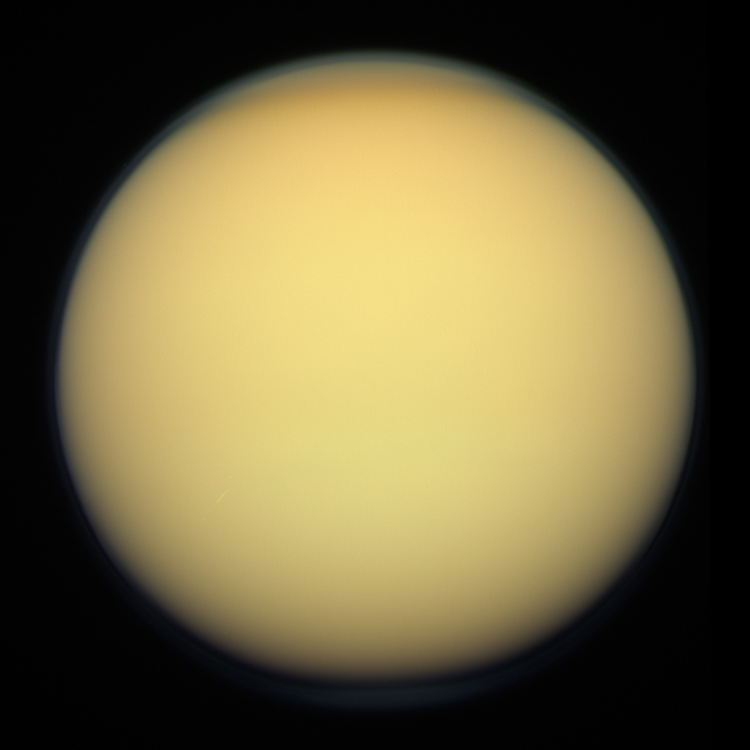
Artist: NASA/JPL-Caltech/SSI/Kevin M. Gill
Orbiting Saturn every ~15.95 Earth days in a tidally locked configuration, Titan constantly shows the same face to its host planet. At its frigid surface temperatures (around 94 K, or −179 °C), water behaves like rock, while organic compounds like methane take on the roles that water assumes on Earth. Titan’s landscape includes river channels, deltas, shoreline features, dunes, and possibly cryovolcanic landforms—features that were meticulously revealed by the Huygens probe and by the Cassini–Huygens mission as a whole.
Beyond its captivating scenery, Titan is a prime target in the search for prebiotic chemistry. Its dense atmosphere fosters complex photochemistry, producing organic molecules that rain down to the surface and accumulate into organic-rich sediments. Combined with evidence for a subsurface ocean, Titan offers two very different environments—an organic-rich surface and a liquid-water interior—that are relevant to studies of habitability and the chemical precursors of life.
Discovery, Naming, and the Numbers That Define Titan
Discovery: Titan was discovered in 1655 by the Dutch astronomer Christiaan Huygens, who first detected it with a telescope he had built. The modern name “Titan” was popularized in the mid-19th century by John Herschel, following a naming scheme rooted in mythological Titans.
Basic orbital and physical properties:
- Average orbital period around Saturn: ~15.95 Earth days
- Tidally locked rotation: Titan’s day equals its orbital period
- Mean radius: ~2,575 km (diameter ~5,150 km)
- Mass: ~1.345 × 10²³ kg
- Average density: ~1.88 g/cm3 (indicating a mix of ice and rock)
- Surface gravity: ~1.35 m/s2 (~0.14 g)
- Surface pressure: about 1.5 bar (roughly 50% higher than Earth’s)
- Surface temperature: ~94 K (−179 °C)

Artist: Lunar and Planetary Institute from Houston, TX, USA
Why these numbers matter: The combination of low temperature, significant surface pressure, and abundant methane creates conditions where methane can exist simultaneously as gas, liquid, and solid under Titan’s environmental range. That trifecta underpins the methane cycle that sculpts Titan’s landscape.
Titan’s Atmosphere and Weather: Nitrogen, Methane, and Haze
Titan is unique among moons for having a thick, stable atmosphere, dominated by nitrogen (around 98%) with methane making up roughly 1–2% near the surface and smaller amounts aloft. Trace species include hydrogen as well as a suite of hydrocarbons (ethane, acetylene, propane, benzene) and nitriles (hydrogen cyanide and others). High in the atmosphere, solar ultraviolet light and energetic particles drive photochemistry that breaks methane apart and reassembles the fragments into more complex organics, including solid aerosols often called tholins.
The result is a multi-layered orange haze that obscures Titan’s surface to visible-light instruments. Cassini’s radar mapped that surface through the haze, and infrared observations in selected “methane windows” allowed Cassini and Earth-based telescopes to glimpse surface details. The haze layers vary with altitude and season, producing features such as the polar hood—an enhancement of haze over the winter pole—as well as detached haze layers in the mesosphere/thermosphere.
Winds and circulation: Titan’s stratosphere exhibits superrotation, where winds at high altitude move much faster than the moon’s rotation. At lower altitudes, winds measured by the Huygens probe during descent were relatively gentle (a few meters per second), consistent with Titan’s calm surface environment punctuated by occasional storms. Seasonal changes (see methane cycle) influence cloud formation, shifting the distribution of clouds with Saturn’s 29.5-year solar orbit and Titan’s resultant 7.5-year-long seasons.
Clouds and precipitation: Methane clouds have been observed at various latitudes. The poles see more persistent cloud activity, particularly during their respective summers, fueling precipitation over the polar lakes and seas. Near equinox, transient cloud outbursts and storms can appear at lower latitudes, sometimes linked to rainfall events that darken the surface—signatures Cassini recorded during its mission.
Surface and Geology: Dunes, Rivers, Lakes, and Seas
Titan’s surface is a study in analogs. Processes we associate with Earth—river erosion, sediment transport, dune building, and possibly volcanism—occur on Titan under drastically different materials and temperatures. Instead of quartz sand, Titan’s dunes are made of organic grains; instead of water flowing to the sea, liquid methane and ethane travel through branching channels and feed polar seas.
Equatorial dunes
Longitudinal dunes—long, parallel ridges—cover large swaths of Titan’s equatorial regions. These dunes form in dark plains that girdle the moon’s waist. The grains are likely made of complex organics produced in the atmosphere and processed on the surface. Dune formation is guided by Titan’s wind regime, which, despite being generally weak at the surface, is sufficient over geologic timescales to mobilize the lightweight, possibly electrically charged dust-sized organics. Dune fields are especially prominent in regions such as Belet and across the broad equatorial dark terrains often nicknamed “seas” of sand by analogy.
Fluvial networks and deltas
Cassini’s radar and near-infrared imaging revealed extensive river channels, some with striking dendritic patterns indicative of sustained precipitation and runoff at some point in Titan’s recent geological past. Certain channel systems appear to feed into polar basins, carving deltas and distributary systems. The Huygens probe descended over a heavily dissected landscape and landed near a channel-laced plain, directly confirming a surface shaped by flowing liquids.
Polar lakes and seas
Titan’s most spectacular features reside at high latitudes: the hydrocarbon lakes and seas. Concentrated mostly near the north pole, these bodies include vast seas such as Kraken Mare, Ligeia Mare, and Punga Mare. Their surfaces are mirror-flat on calm days, with wind-roughened patches observed (“magic islands”) likely caused by small waves, bubbles, suspended solids, or transient phenomena. Depth measurements from Cassini radar altimetry and bathymetry indicate that Ligeia Mare is at least on the order of a hundred meters deep in places, while Kraken Mare is spatially extensive with regions that may reach substantial depths that are not yet fully constrained. In the southern hemisphere, Ontario Lacus stands out as the largest southern lake, relatively shallow and with a complex shoreline suggestive of changing liquid levels.

Artist: NASA / JPL-Caltech / Agenzia Spaziale Italiana / USGS
Mountains, impact craters, and possible cryovolcanism
Titan’s icy crust supports mountain chains and scattered impact craters. The relative scarcity of craters suggests a geologically young and frequently resurfaced exterior, whether by sedimentary deposition (organic sands and evaporites), fluvial erosion, or cryovolcanic activity. While cryovolcanism—the eruption of water-ammonia mixtures or other volatile-rich slurries—has been proposed to explain certain flow-like features and circular depressions, direct, unambiguous evidence remains limited. Several candidate sites have been studied, but the jury is still out on how common cryovolcanism is on Titan today.
Notably, bright terrains like Xanadu show rough topography, and impact structures such as Menrva and Selk provide geological windows into Titan’s crust and regolith; Selk, in particular, has intrigued mission planners because it may expose materials altered by warmth and liquids generated during the impact event.
Interior Structure and Evidence for a Subsurface Ocean
Data from Cassini have built a strong case that Titan harbors a global subsurface ocean beneath its icy crust. Several independent lines of evidence converge on this conclusion:
- Gravity and shape measurements: Variations in Titan’s gravitational field, coupled with its shape and rotational properties, are best explained if an internal layer of liquid decouples the outer icy shell from the deeper interior.
- Rotational librations: Observations of Titan’s small oscillations in rotation (librations) are larger than expected for a completely solid body, again suggesting a partially detached shell consistent with an internal ocean.
- Thermal and chemical context: Models of Titan’s thermal evolution, plus the presence of ammonia and possibly salts, support the idea that a water-rich ocean could persist over geologic time by lowering the freezing point and modifying the interior’s thermal conductivity.
The ocean’s composition likely includes water mixed with ammonia and possibly dissolved salts. The thickness of the overlying ice shell and the depth to the ocean may vary by location and remain active subjects of research. If ammonia-rich pockets or brines reach near-surface fractures, they might explain some flow-like or cryovolcanic features tentatively identified by radar and infrared observations, though confirming this requires in situ exploration.
From a habitability standpoint, the prospect of a water-based ocean is compelling, as organic molecules generated in the atmosphere may be transported downward, potentially providing chemical ingredients for prebiotic processes in the ocean or at the ice-ocean interface. How efficiently the surface and interior communicate is a central question for future missions.
The Methane Cycle and Long-Term Climate on Titan
Titan’s methane cycle is the analog of Earth’s water cycle. Methane evaporates from lakes and seas, condenses into clouds, falls as rain, flows through rivers, and collects again in basins. Ethane, a byproduct of methane’s atmospheric photochemistry, also accumulates and mixes into surface liquids. Over time, photolysis steadily destroys methane, implying that Titan must have a replenishment source—possibly from subsurface reservoirs, episodic outgassing, or clathrate destabilization—to maintain its atmospheric methane over millions of years.
Seasonality
Titan experiences long seasons because Saturn takes roughly 29.5 Earth years to orbit the Sun. Each Titan season lasts about 7.5 Earth years, modulating wind patterns, haze distribution, and cloud activity. During summer in the north, Titan’s northern polar lakes and seas are more active, with more frequent cloud formation and rainfall; the reverse holds during southern summer. Observations have recorded changes in lake shorelines and transient brightening from rainfall-induced surface wetting, as well as shifts in the appearance of the polar hood haze with season.
Climate over geologic time
On longer timescales, variations in Saturn’s orbital parameters and Titan’s obliquity could alter the distribution of insolation, reshaping the hydrologic balance between hemispheres. Some models suggest that lakes and dunes migrate in response to secular climate changes, leaving behind geomorphic evidence—such as abandoned shorelines or dune-field reorganization—that future missions can read like a climate archive. Titan may also experience “methane climate cycles,” where atmospheric methane waxes and wanes over millions of years, affecting precipitation intensity and the prevalence of lakes.
Crucially, the subsurface ocean and interior dynamics could influence surface processes via episodic outgassing of methane, possibly explaining why Titan still has a methane atmosphere despite continuous photochemical destruction aloft.
Organic Chemistry and Astrobiology Potential
Titan is a laboratory for prebiotic chemistry. High in the atmosphere, photochemical reactions transform methane and nitrogen into a medley of organics—ranging from simple molecules like ethane, acetylene, and hydrogen cyanide to larger aromatics and complex aerosols (tholins). These particles broadly settle, coating the surface with chemically rich material that can be reworked by winds and liquids.
Key molecular detections
- Hydrocarbons and nitriles: Ethane (C2H6), propane (C3H8), acetylene (C2H2), benzene (C6H6), hydrogen cyanide (HCN), and related species have been identified in Titan’s atmosphere and, in some cases, condensed onto the surface.
- Propylene (C3H6): Detected in the atmosphere by Cassini’s Composite Infrared Spectrometer, expanding the inventory of Titan’s hydrocarbons.
- Acrylonitrile (vinyl cyanide, C2H3CN): Radio observations have reported acrylonitrile in Titan’s atmosphere. Laboratory studies suggest it could assemble into membrane-like structures in liquid methane (sometimes called “azotosomes”), though this remains a theoretical avenue rather than a detected biological structure.
These detections highlight the diversity of Titan’s chemistry and invite speculation about the kinds of prebiotic pathways that could occur in non-aqueous solvents (methane/ethane) or at the boundary where water from a subsurface ocean might interact with surface organics.
Habitability and life’s building blocks
Two distinct environments matter for habitability:
- Surface lakes and seas of methane/ethane: In these extremely cold, non-polar solvents, chemistry proceeds slowly and quite differently than in liquid water. While life-as-we-know-it (water-based biochemistry) seems unlikely here, life-as-we-don’t-know-it has been hypothesized in methane solvents. At present, this remains speculative. Future in situ analyses would be needed to assess whether self-organizing structures or catalytic networks can arise under Titan conditions.
- Subsurface water ocean: If organic molecules delivered from the surface reach the ocean, a more Earth-like chemical environment could develop. The presence of antifreezes (like ammonia) and salts, plus energy sources from tidal or radiogenic heating, could create niches for prebiotic reactions. Whether there is exchange between ocean and surface is an outstanding question for planetary science.
Claims of biological activity on Titan have occasionally popped up—for example, discussions about hydrogen fluxes at the surface noted in some studies. These interpretations remain controversial and inconclusive. No evidence of life has been confirmed on Titan. The scientific focus remains on understanding the chemistry and geophysical processes that could set the stage for habitability.
The Huygens Descent and Landing: What We Learned on the Ground
On January 14, 2005, the European Space Agency’s Huygens probe separated from Cassini and parachuted through Titan’s atmosphere, becoming the first and only spacecraft to land on the moon’s surface. Huygens provided a treasure trove of in situ measurements and images during its descent and for more than an hour after touchdown, until Cassini’s geometry slipped beyond relay range.
Descent through an alien sky
Huygens’ instruments sampled atmospheric composition, temperature, and winds, and imaged the surface below through gaps in the haze. The descent imagery revealed branching channel networks and bright highlands abutting darker plains, consistent with a landscape carved by flowing liquids. Winds aloft were measured to be modest but enough to carry the probe laterally as it descended by parachute. The haze layers and their optical properties were directly measured, giving critical constraints for atmospheric models.
Touchdown on a fluvial plain
Huygens touched down on a relatively flat, dark plain characterized by rounded cobble-like clasts likely composed of water ice and hydrocarbon coatings. The surface had the mechanical character of damp sand or a crust overlying softer material. Spectral data indicated hydrocarbon-rich substances, and the immediate environment appeared consistent with past liquid flow and potential episodic wetting by methane rainfall. The lander transmitted for about 72 minutes from the surface before the relay was lost as Cassini sank below Titan’s horizon.
Huygens’ images and measurements underpin many of the inferences we now make about Titan’s active surface and methane-driven hydrology. The landing site lies near the boundary of bright highlands (e.g., Adiri) and extensive dark equatorial plains.
Missions to Titan and What Comes Next with Dragonfly
Titan has been a target of robotic exploration since the late 20th century, with each mission peeling back more of its mysteries.
Flybys that set the stage
- Pioneer 11 (1979): First flyby of Saturn system; very limited Titan data.
- Voyager 1 (1980): Obtained key observations of Titan’s dense atmosphere at visible and infrared wavelengths; the thickness of the haze thwarted views of the surface, but confirmed that Titan was not airless.
- Voyager 2 (1981): Focused on other Saturnian targets after Voyager 1’s Titan encounter, but the two Voyager flybys together established Titan as a high-priority target for future missions.
Cassini–Huygens (2004–2017): a revolution in Titan science
Cassini performed over a hundred targeted flybys of Titan. Its radar instrument mapped large portions of the surface through haze, discovering lakes and seas, dunes, channels, and putative cryovolcanic candidates. Infrared and visible instruments refined our understanding of atmospheric structure, chemistry, and clouds; radio science experiments probed interior structure and ionospheric properties. The Huygens probe provided ground truth for surface and atmospheric data, as detailed in The Huygens Descent and Landing.
Dragonfly: a rotorcraft to roam Titan

Artist: NASA
Dragonfly is a NASA mission concept now in development: a nuclear-powered, octocopter-style rotorcraft designed to fly from site to site on Titan, leveraging the moon’s dense air and low gravity to cover tens to hundreds of kilometers over its lifetime. Dragonfly plans to explore organic-rich equatorial dune fields and ultimately investigate areas associated with the relatively young impact crater Selk, where heat from the impact may have created transient liquid-water environments that processed organics.
As of the public information available prior to late 2024, Dragonfly has been targeted for a launch in the late 2020s (with planning around 2028) and arrival in the mid-2030s, after a cruise phase and gravity assists. Its scientific payload is expected to include instruments for surface composition analysis, atmospheric science, meteorology, imaging, and geophysics. The mission’s mobility will allow it to sample diverse geologic units—dunes, interdune areas, possible evaporite deposits, and ejecta-rich terrains—tying together the atmospheric organic chemistry with surface processes and the interior’s potential.
Dragonfly’s goals speak directly to Titan’s outstanding questions: How are complex organics assembled and altered on the surface? What energy sources drive chemistry? What does the stratigraphy of organic deposits reveal about climate history? How do impact-generated environments differ chemically from background dune terrains? The answers will reshape our understanding of Titan as a chemically active world.
How to Observe Titan from Earth: Practical Tips

Artist: NASA / JPL / Space Science Institute
Titan is bright enough for modest amateur telescopes and, with experience, can be followed across multiple nights as it orbits Saturn. While its disk is small (typically well under an arcsecond in apparent diameter) and its details hidden by haze, tracking Titan is rewarding for understanding Saturn’s system dynamics and timing events such as occultations and mutual phenomena.
Finding Titan
- Brightness: Titan shines around magnitude +8 to +9, making it accessible in small telescopes as a star-like point near Saturn.
- Separation: Its angular separation from Saturn ranges up to tens of arcseconds, depending on geometry during its 16-day orbit. It is generally the brightest “moon star” in the Saturnian field.
- Planning: Use a reputable planetarium program or an ephemeris service to plot Titan’s relative position on a given night. Watching it change night-by-night is a great exercise in orbital mechanics.
Observation tips
- Aperture and magnification: A 3–6 inch (75–150 mm) telescope is enough to spot Titan. Higher magnification (150–200×) helps separate Titan from Saturn’s glare.
- Filters: Broadband or neutral density filters can reduce Saturn’s brightness. For imaging, near-infrared filters may improve contrast for Saturn’s rings and disk, indirectly helping with Titan identification. Specialized methane-band filters are used for planetary imaging of gas giants, but Titan’s small disk makes band imaging challenging for amateurs.
- Steady air: Good seeing is crucial because Saturn’s glare can swamp faint points. Wait for stable atmospheric conditions and allow your telescope to thermally equilibrate.
For those who like a back-of-the-envelope calculation, Titan’s approximate angular diameter θ in arcseconds can be estimated with:
// Approximate angular diameter of Titan (arcseconds)
// D = Titan's diameter (km), about 5150 km
// d = distance from Earth to Titan (km)
// θ ≈ 206265 * D / d
// For d ≈ 1.3 × 10^9 km (when Saturn is near opposition),
// θ ≈ 206265 * 5150 / (1.3e9) ≈ 0.82 arcsec (order-of-magnitude)
This is an order-of-magnitude guide; actual values vary with Earth–Saturn distance. The takeaway: Titan is a small target, but bright and trackable.
Names and Landmarks: Understanding Titan’s Geographic Map
Planetary cartographers use IAU-approved nomenclature to standardize feature names on Titan. Given the moon’s global haze and the radar-centric mapping approach, many features are classified by morphology and location. Here are a few notable classes and examples:
- Maria (seas) and Lacus (lakes): Kraken Mare (the largest known sea), Ligeia Mare, Punga Mare, and Ontario Lacus. These are liquid hydrocarbon bodies with complex shorelines; their extents and depths vary seasonally and geographically.
- Flumina (river channels): Dendritic networks that deliver hydrocarbons into polar basins; complex channel patterns and deltas testify to fluvial erosion.
- Regiones (large albedo features/terrains): Xanadu (bright, mountainous terrain with rough topography) contrasted with dark equatorial plains where dunes dominate. Regions such as Adiri and dune-filled “sand seas” are major landscape elements.
- Montes (mountain ranges) and Colles (hills): Elevated terrains of water ice and organic coatings that likely formed via tectonism or crustal stress rather than plate tectonics in the terrestrial sense.
- Craters: Menrva (a large, double-ring basin) and Selk (a relatively young impact structure of special interest for Dragonfly), among others. Titan’s crater record is sparse due to resurfacing.
Maps of Titan blend radar backscatter, altimetry, and infrared mosaics to create a coherent geologic framework. The mosaic of data, with differing resolution and coverage, leaves open questions that future surveys will refine—especially regarding vertical stratigraphy and sediment thickness in dune fields and lacustrine basins.
Why Titan Matters for Planetary Science and Exoplanets
Studying Titan is akin to investigating a second laboratory for Earth-like processes—but with a twist: the ingredients are different, the temperatures are cryogenic, and the timescales can be long. Planetary scientists leverage Titan to test and extend theories of climate, geomorphology, and prebiotic chemistry:
- Comparative planetology: Titan’s methane cycle mirrors Earth’s hydrologic cycle, enabling head-to-head comparisons of precipitation, runoff, evaporation, and sediment transport under different physical regimes.
- Geomorphology under exotic materials: Titan’s dunes, river channels, and coastal features reveal how organic grains and hydrocarbon liquids behave, validating and challenging models developed for terrestrial sands and waters.
- Atmospheric dynamics and chemistry: Titan’s superrotating stratosphere, seasonal haze dynamics, and rich photochemistry test general circulation and microphysical models applicable across planetary atmospheres.
- Habitability and origins: The subsurface ocean and complex organics provide a natural experiment in the preconditions for life, pertinent to icy moons elsewhere (e.g., Enceladus, Europa) and to exoplanetary systems.
- Exoplanet analogs: Titan’s thick atmosphere and hydrocarbon haze resemble those hypothesized for some exoplanets and exomoons, including worlds with hazy, nitrogen-rich atmospheres or reduced, methane-bearing envelopes. Lessons from Titan guide interpretation of exoplanet transmission and emission spectra.
As observational tools like the James Webb Space Telescope push the frontier of exoplanet characterization, Titan’s repertoire of photochemistry and haze microphysics becomes a key local benchmark for understanding distant, hazy worlds.
Frequently Asked Questions
Is Titan bigger than Mercury?
Yes in diameter, no in mass. Titan’s diameter is about 5,150 km, which is larger than Mercury’s ~4,880 km. However, Mercury is much denser and more massive, so its surface gravity greatly exceeds Titan’s. Titan’s gravity is roughly 14% of Earth’s, while Mercury’s is about 38% of Earth’s.
Can humans breathe on Titan?
No. Titan’s atmosphere lacks oxygen; it is primarily nitrogen with a small fraction of methane and trace species. The pressure is about 1.5 times Earth’s, but the air is unbreathable and the temperature is around −179 °C. Any exploration requires full environmental protection, including heating and oxygen supply. The dense air and low gravity, however, are advantageous for flight—one reason Dragonfly will use rotors to move across the surface.
Final Thoughts on Exploring Saturn’s Moon Titan
Titan is a world that rewards patience and precision. Once a mere point of light shrouded in mystery, it has become a richly detailed system in its own right: an atmosphere alive with chemistry, a surface sculpted by methane rains and rivers, and an interior likely hosting a global ocean of water and antifreezes. Together, these components make Titan an unparalleled natural experiment in planetary processes and prebiotic chemistry.
Our present understanding rests on the shoulders of trailblazing missions and instruments—Voyager’s first hints, Cassini–Huygens’ revolutionary mapping and ground truth, and an array of telescopes that continue to monitor Titan’s changing clouds. The next leap will be Dragonfly, a rotorcraft poised to wander Titan’s dunes and impact terrains, sampling as it goes. Its measurements aim to knit together atmosphere, surface, and interior into a cohesive narrative of Titan’s evolution, climate cycles, and chemical complexity.
For observers on Earth, Titan offers a steadfast companion to Saturn in the eyepiece and a gateway to thinking beyond familiar Earthly geology. For scientists, it remains a proving ground for theories of climate, sediment transport, and prebiotic pathways. For the rest of us, it’s a reminder that the solar system is diverse beyond our daily imagination—worlds where water is rock, air is orange, and rain is made of methane.

Artist: Steve Gribben/NASA/Johns Hopkins APL
If you found this deep dive useful and want more expertly curated explorations of planets and moons, consider subscribing to our newsletter. You’ll get updates on new missions, observing guides, and in-depth features as we continue our tour of the solar system.