
Table of Contents
- What Do Astronomers Mean by Dark Matter?
- Why Galaxy Rotation Curves Point to Invisible Mass
- Gravitational Lensing: Mapping Mass with Curved Light
- The Cosmic Microwave Background and Large-Scale Structure
- Alternatives and Modified Gravity: What Still Works?
- How Scientists Search for Dark Matter Particles
- Astrophysical and Cosmological Probes Coming This Decade
- Common Misconceptions About Dark Matter
- Frequently Asked Questions
- Final Thoughts on Evaluating Dark Matter Evidence and Searches
What Do Astronomers Mean by Dark Matter?
Dark matter is a placeholder name for something very real: additional mass that reveals itself by gravity but emits little to no electromagnetic radiation. In other words, it does not shine, reflect, or absorb light in the familiar way that stars, gas, and dust do. We infer its presence because galaxies rotate too quickly in their outskirts, galaxy clusters need more mass to hold them together, and the geometry and growth of cosmic structure require more gravitating matter than we can account for with ordinary (baryonic) material.

Superimposed mass density contours, caused by gravitational lensing of dark matter. Photograph taken with Hubble Space Telescope.
Importantly, dark matter is not the same thing as dark energy. Dark energy is a separate phenomenon associated with the accelerated expansion of the Universe. Both are “dark” in the sense that they are not seen directly with light, but they influence the cosmos in distinct ways. In the standard cosmological model—often called Lambda-CDM or ΛCDM—roughly 5% of the Universe’s energy density is ordinary matter, about 25–27% is cold dark matter, and the rest, ~68–70%, is dark energy. Measurements of the Cosmic Microwave Background (CMB) and large-scale structure underpin these percentages.
When cosmologists call it “cold” dark matter (CDM), they are referring to the thermal motion and clustering properties of the dark matter particles in the early Universe. Cold dark matter species were moving slowly compared to the speed of light when structures began to form, allowing small clumps to grow into galaxies and larger assemblies. Alternatives include “warm” dark matter (slightly faster, smoothing out some small-scale clumps) or “hot” dark matter (fast-moving particles such as ordinary neutrinos), but observations strongly prefer something closer to the cold scenario to reproduce the observed web-like distribution of galaxies.
Multiple, independent lines of evidence all point to hidden mass. Throughout this article, we will examine the key pillars:
- Galaxy rotation curves and stellar velocity dispersions
- Gravitational lensing of background light by mass concentrations
- The CMB acoustic peaks, baryon acoustic oscillations, and structure growth
We will also explore what dark matter might be made of and how scientists are searching for it in laboratories and observatories. That includes direct detection experiments, collider searches, and astrophysical “indirect” searches. Because science thrives on alternatives, we will contrast these ideas with modified gravity frameworks that try to explain the same phenomena without new matter.
Before diving into details, here is a guiding principle for the rest of this guide:
Gravity measures mass—even when that mass does not glow. If the gravitational field is stronger than what visible matter explains, either there is additional unseen matter, or gravity behaves differently than expected. The data decide.
Why Galaxy Rotation Curves Point to Invisible Mass
One of the earliest, cleanest signatures of dark matter comes from how fast galaxies spin. In a simple Newtonian picture, orbital speed should decline with radius when most mass is concentrated near the center. Think of a solar system: planets closer to the Sun orbit faster, while the outer planets move more slowly. If galaxies were dominated by visible matter—stars and gas whose light we observe—the rotation speed v(r) at large radii should trend downward. Instead, in many spiral galaxies, the rotation curves are flat: v(r) stays roughly constant out to the outermost measured points. That implies mass keeps accumulating with radius beyond the visible disk.

A rotation curve of the Milky Way showing observed vs. predicted curves. Shaded region indicates measurement uncertainty for the observed data. Observed data taken from arXiv:1110.4431.
Technically, the enclosed mass M(r) relates to orbital speed by v(r) ≈ √(G·M(r)/r), where G is the gravitational constant. A flat rotation curve at large r means M(r) ∝ r, continuing to grow linearly with radius. Because starlight and observed gas do not increase that rapidly at large distances from the galactic center, there must be additional, extended mass: a roughly spherical dark matter halo that envelops the galaxy.
These results are not confined to a few galaxies. Systematic surveys of spiral galaxies—observing neutral hydrogen (HI) with radio telescopes and ionized gas with optical spectroscopy—consistently see flat or gently rising rotation curves out to tens of kiloparsecs. Moreover, similar mass discrepancies appear in galaxies of different types:
- Dwarf spheroidal galaxies orbiting the Milky Way and Andromeda are extremely faint but show high velocity dispersions for their stars. Given their meager starlight, the implied mass-to-light ratios suggest they are dominated by dark matter.
- Elliptical galaxies, which do not have well-defined rotation curves like spiral disks, reveal mass discrepancies through the random motions of stars and hot X-ray emitting gas in their halos.
- Galaxy clusters, the largest gravitationally bound systems, show even larger gaps between visible mass and the mass required by dynamics, as seen in galaxy velocities and the temperature of their intracluster gas.
Rotation curves do more than flag the presence of extra mass: they constrain the distribution of that mass. Different dark matter halo profiles—such as the Navarro–Frenk–White (NFW) profile predicted by cold dark matter simulations, or cored profiles sometimes favored by data—produce subtly different rotation curves. Astronomers model the combined contributions of stellar disks, bulges, gas, and halos to match observations.
A longstanding point of discussion is the apparent tight coupling between the distribution of baryons (stars and gas) and the resulting rotation curves. Empirical relations, like the radial acceleration relation, show that where baryons are denser, rotation curves rise accordingly. Some researchers see this as a success for modified gravity (see Alternatives and Modified Gravity), while others argue that it reflects how galaxy formation funnels baryons into dark matter potentials and how baryonic feedback sculpts halos. Crucially, when we expand the scope to gravitational lensing and cosmic background/structure data, the case for additional non-luminous matter remains strong.
Gravitational Lensing: Mapping Mass with Curved Light
General relativity predicts that mass curves spacetime and deflects light. We can “weigh” that mass by how it distorts background sources—this is gravitational lensing. Lensing provides a direct, geometric measure of the gravitational field, independent of how bright the mass is. This makes it a powerful tool to map dark matter in galaxies and clusters.
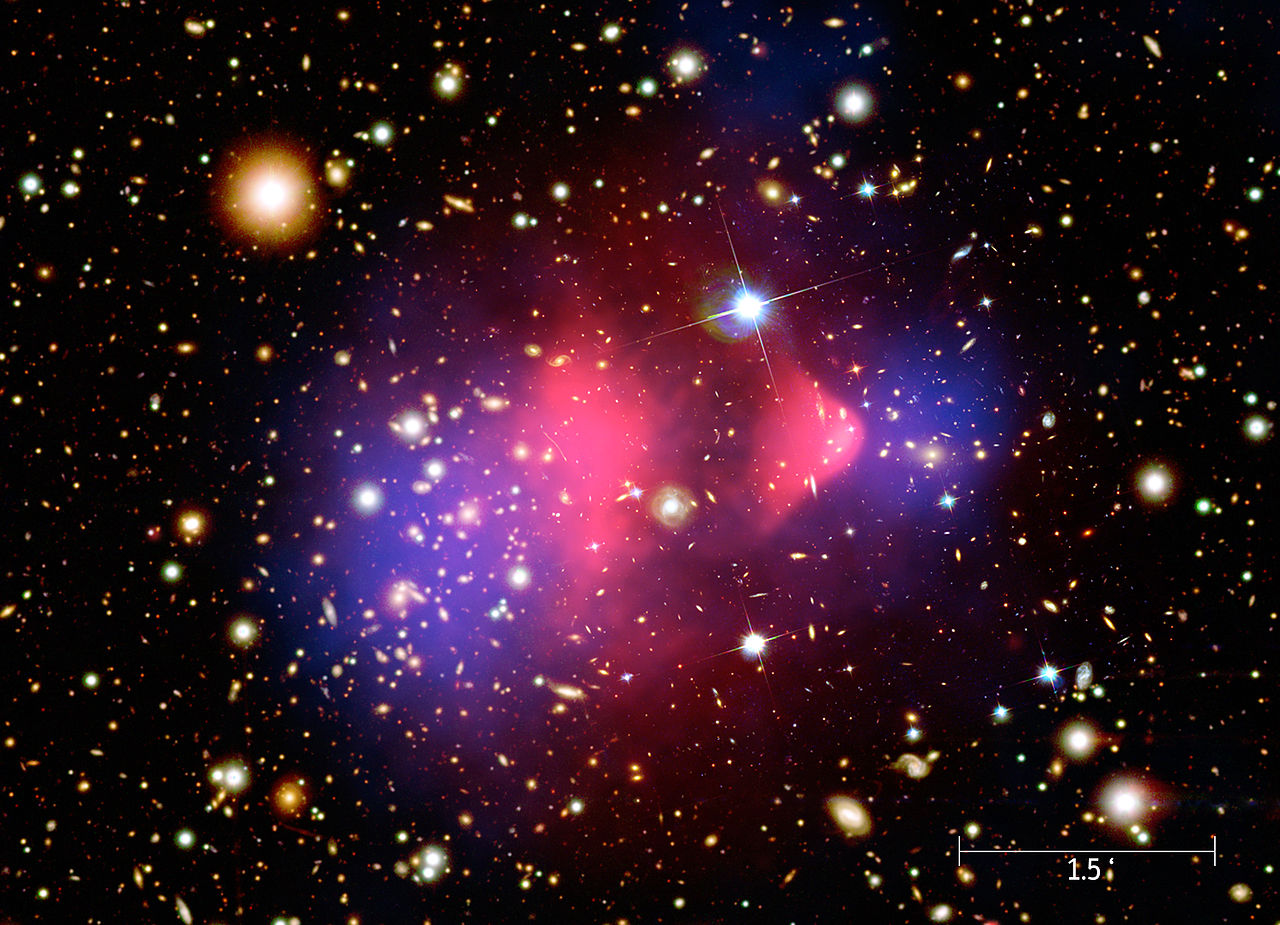
Composite image showing the galaxy cluster 1E 0657-56, better known as bullet cluster. The image in background showing the visible spectrum of light stems from Magellan and Hubble Space Telescope images. The pink overlay shows the x-ray emission (recorded by Chandra Telescope) of the colliding clusters, the blue one represents the mass distribution of the clusters calculated from gravitational lens effects. Scale: Full image is 7.5 arcmin wide, 5.4 arcmin high
There are three principal regimes:
- Strong lensing: Massive galaxies or clusters can produce multiple images, arcs, or Einstein rings of a single background galaxy. Modeling these distortions yields precise mass maps on small to intermediate scales.
- Weak lensing: The shapes of millions of background galaxies are sheared slightly by intervening matter. By stacking many galaxies, we statistically reconstruct large-scale mass distributions, a method called cosmic shear.
- Microlensing: Compact masses (like stars or planets) briefly magnify background sources as they pass in front of them. While this technique is most often used to find exoplanets and compact objects, it has also been employed to test whether galactic halos are made primarily of MACHOs (Massive Astrophysical Compact Halo Objects). The consensus from past surveys is that such objects cannot make up all of the dark matter in the relevant mass ranges.
Strong-lensing clusters provide particularly striking evidence that most of the gravitating mass does not coincide with the hot, X-ray emitting gas (the dominant visible mass). In so-called “bullet”-like cluster mergers, the collisional gas lags behind while the collisionless components—galaxies and presumably dark matter—forge ahead. Lensing maps place the mass peaks ahead of the gas, consistent with an invisible, weakly interacting component that remains unimpeded in the collision. This geometry is challenging to explain with modified gravity alone because the lensing mass does not simply follow the light from the (dominant) intracluster gas.
Beyond dramatic cluster events, weak-lensing surveys have charted the cosmic web over vast regions. Projects such as the Dark Energy Survey (DES), Kilo-Degree Survey (KiDS), and Hyper Suprime-Cam (HSC) have measured how structures grow and cluster. These measurements are sensitive to the total matter content and the amplitude of matter fluctuations. The results broadly support a Universe with substantial non-baryonic matter, in line with CMB-inferred parameters.
CMB lensing provides an independent window: small deflections of the 13.8-billion-year-old background light by intervening matter. Modern CMB experiments reconstruct lensing maps from high-resolution maps of the background temperature and polarization. These reconstructions—combined with galaxy lensing—strengthen the case for the matter budget implied by ΛCDM, including a dominant non-luminous component.
Taken together, gravitational lensing is a “mass-first” technique: it follows where gravity is, whether or not photons are. The alignment of lensing evidence with rotation curves and cosmic microwave background measurements is one reason dark matter remains the leading explanation.
The Cosmic Microwave Background and Large-Scale Structure
The Cosmic Microwave Background (CMB) is the afterglow of the hot Big Bang, a near-uniform bath of microwave radiation with tiny temperature fluctuations across the sky. Those fluctuations are imprints of density waves in the early Universe—compressions and rarefactions in the primordial plasma of photons and baryons. Their statistical pattern—the angular power spectrum—encodes the entire makeup of the Universe: the fractions of baryons and dark matter, the geometry, and the seeds of structure.

This map of the Cosmic Microwave Background radiation, imprinted on the sky when the universe was 370,000 years old, shows tiny temperature fluctuations that correspond to regions of slightly different densities.
In the CMB power spectrum, the positions and heights of the acoustic peaks depend sensitively on how much ordinary matter and dark matter were present. Baryons add inertia to the oscillations, affecting odd and even peak heights differently. Dark matter, which does not directly feel radiation pressure, seeds gravitational potentials that influence the timing and amplitude of the oscillations. Measurements by satellites and balloons—culminating in highly precise results from the Planck mission—consistently indicate a Universe with about 5% baryons and ~25–27% dark matter. The rest is dark energy driving cosmic acceleration.
These inferences are global, not tied to any one galaxy or cluster. They tell us the overall matter budget required to reproduce the observed pattern of CMB temperature and polarization fluctuations. When combined with other probes, like baryon acoustic oscillations (BAO) in galaxy surveys and supernova distances, a consistent picture emerges: a Universe in which non-baryonic matter dominates gravitational clustering on large scales.
Beyond the CMB, we test dark matter via structure formation—how galaxies and clusters emerge over time from tiny primordial seeds. Numerical simulations that start from CMB initial conditions and evolve a cold, collisionless matter component successfully produce a cosmic web resembling what galaxy surveys map today. These simulations predict a hierarchical buildup: small halos form first, then merge into larger ones, consistent with the observed distribution of galaxy masses and environments.
There are—as there should be—open questions and small-scale challenges. For example:
- Missing satellites problem: Early simulations predicted more small subhalos around Milky Way–like galaxies than the number of observed dwarf galaxies. Improved modeling and observations have narrowed the gap, with many faint dwarfs discovered and baryonic processes suppressing star formation in the smallest halos.
- Cusp–core problem: Simulations with pure cold dark matter often produce density profiles that rise steeply toward the center (“cuspy”), while some dwarf galaxies appear to have flatter (“cored”) central densities. Feedback from supernovae and stellar winds can redistribute matter and alleviate this tension in many cases, though debates continue.
- Too-big-to-fail: The most massive predicted subhalos around galaxies like the Milky Way sometimes appear too dense compared to the brightest observed dwarf satellites. Accounting for the complex interplay of baryons and environment helps reconcile predictions with data.
The crucial point is that these small-scale issues occur within a framework that otherwise excels at matching large-scale phenomena like the CMB, BAO, and the clustering of galaxies. They are areas of active research that help refine both our astrophysics of galaxy formation and the microphysics of dark matter candidates. For instance, if dark matter is slightly warm or self-interacting at a small level, that could subtly modify halo structures while preserving large-scale success—ideas testable with upcoming surveys and instruments.
Alternatives and Modified Gravity: What Still Works?
Whenever a field leans on an unseen component, alternative explanations deserve serious attention. Modified Newtonian Dynamics (MOND) and its relativistic extensions (e.g., TeVeS) attempt to change the laws of gravity or inertia at very low accelerations to reproduce galaxy rotation curves without invoking dark matter. MOND famously predicts many galaxy-scale phenomenologies with few parameters and can match the rotation curves of individual disk galaxies quite well, especially in regimes where baryons dominate the mass budget.
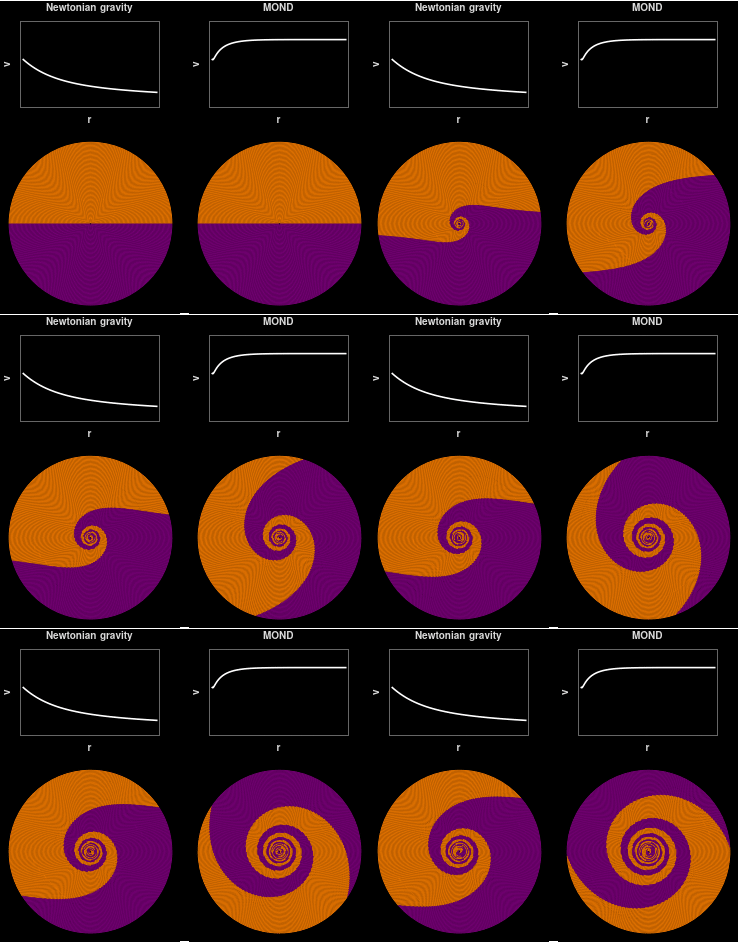
MOND is a possible explanation for the observed v(r) curve for stars in a galaxy (which is incompatible with Newtonian gravity). The observed behaviour is explained by assuming that Newton’s second law (F=m a) is modified for very small values of a.
However, any alternative must face the full suite of evidence—not just rotation curves. Here are the principal challenges for modified gravity frameworks:
- Galaxy clusters: Most modified gravity theories struggle to explain the level of mass discrepancy in clusters without adding some unseen matter anyway (e.g., additional unseen particles). The distribution of mass inferred from lensing in merging clusters—where mass peaks are offset from the collisional gas—poses a particular challenge.
- CMB acoustic peaks: The precise pattern of peaks needs a collisionless matter component to match observations robustly. The interplay of baryons and radiation alone cannot reproduce the relative peak heights and positions measured by Planck and predecessors.
- Structure growth: The observed large-scale distribution of galaxies, the matter power spectrum, and weak-lensing cosmic shear agree with cold dark matter predictions. Modified gravity must reproduce this agreement without contrivances, across redshifts and scales.
There are also hybrid ideas, such as adding a neutrino sector with larger masses than the standard model’s light neutrinos, or positing sterile neutrinos that do not interact weakly. While massive neutrinos do contribute to the matter density, cosmological data constrain their summed mass to be small, limiting their ability to replace cold dark matter. Similarly, warm dark matter scenarios, like a keV-mass sterile neutrino, face constraints from Lyman-alpha forest data and structure formation, which bound how much such particles can suppress small-scale structure.
Another line of alternatives involves self-interacting dark matter—still dark matter, but with non-negligible interactions among its own particles. This is not a modified gravity proposal; rather, it changes the microphysics of dark matter to see if small-scale discrepancies are softened. Self-interactions can produce cored density profiles in dwarfs while preserving large-scale success. Ongoing work compares these predictions with observations across mass scales.
The bottom line is nuanced: alternatives can reproduce certain phenomena well—particularly galaxy rotation curves—but have difficulty with the ensemble of constraints from CMB measurements and structure formation, and direct mass mapping via lensing. That is why non-baryonic dark matter remains the leading explanation.
How Scientists Search for Dark Matter Particles
Dark matter is not a single theory; it is a phenomenological requirement. The particles behind it could inhabit a wide range of masses and interactions, from ultra-light axion-like fields to primordial black holes and GeV–TeV-scale weakly interacting massive particles (WIMPs). Researchers cast a wide net with complementary strategies:
Direct detection: catching a particle in the lab
Direct-detection experiments are built deep underground to shield them from cosmic rays and other backgrounds. The core idea is simple but exacting: if a dark matter particle from the galactic halo scatters off a nucleus or electron in the detector, it will produce a tiny, measurable signal—scintillation light, ionization, or thermal phonons. Detectors must suppress backgrounds and distinguish rare signal-like events from noise.
Notable experiments and technologies include:
- Dual-phase liquid xenon time projection chambers such as XENONnT, LZ, and PandaX-4T. These ton-scale detectors have set world-leading upper limits on WIMP–nucleon cross sections across a wide range of masses, pushing sensitivities to around 10−47–10−48 cm2 for WIMPs of tens of GeV, depending on the analysis and mass point.
- Cryogenic solid-state detectors (e.g., SuperCDMS) that measure phonons and ionization with exquisite thresholds, improving sensitivity to lower-mass dark matter candidates where nuclear recoils carry only tiny energies.
- Skipper-CCD and silicon-based experiments (e.g., SENSEI, DAMIC-M) designed to detect low-energy electron recoils, opening sensitivity to sub-GeV dark matter that couples to electrons.
As exposures grow and backgrounds fall, experiments approach the “neutrino floor,” where coherent scattering of atmospheric and solar neutrinos mimics nuclear-recoil signals. Reaching and pushing beyond this background calls for directional sensitivity or clever target combinations. It does not mean discovery is impossible; it just becomes more challenging to distinguish signals from irreducible backgrounds.
Axions and axion-like particles: listening for a faint tone
Axions were first proposed to solve a problem in quantum chromodynamics (the strong CP problem). Remarkably, the parameter space for axions also provides a viable dark matter candidate. Haloscope experiments such as ADMX and HAYSTAC place a tunable microwave cavity in a strong magnetic field. If galactic axions convert to photons, they produce a faint signal at a frequency set by the axion mass. Experiments scan through frequencies, integrating long enough to dig below noise. New concepts—dielectric haloscopes, LC circuits, topological insulators—aim to broaden mass coverage.
Helioscopes like the planned IAXO search for axions streaming from the Sun converting into X-rays in a strong magnetic field. Laboratory “light-shining-through-a-wall” experiments, such as ALPS II, test for very weakly interacting light particles by attempting photon–axion–photon conversions across a barrier.
Indirect detection: watching the sky for annihilation or decay
If dark matter particles annihilate or decay into standard model particles, astrophysical instruments can catch the byproducts—gamma rays, cosmic rays, and neutrinos. The strategy is to look toward regions with high dark matter density where backgrounds are manageable:
- Gamma rays: The Fermi Large Area Telescope surveys the sky from tens of MeV to hundreds of GeV. Dwarf spheroidal galaxies—nearby, dark matter–dominated, and relatively quiescent—are prime targets. Stacking many dwarfs sets stringent limits on annihilation cross sections. The Galactic Center is denser but more complicated; debates continue about the nature of any excess emission. Ground-based Cherenkov telescopes (H.E.S.S., MAGIC, VERITAS; and the upcoming CTA) extend sensitivity to higher energies.
- Cosmic rays: Instruments like AMS-02 on the International Space Station measure positrons, antiprotons, and other species. While intriguing features occasionally appear (such as a high-energy positron rise), astrophysical sources like pulsars and supernovae contribute significantly. Careful modeling is essential to distinguish dark matter signals from ordinary astrophysical production.
- Neutrinos: Telescopes like IceCube search for neutrinos from the Sun or Earth, where dark matter could accumulate and annihilate. Null results set bounds on dark matter properties, complementary to direct detection.
Collider searches: make it at the LHC
At particle colliders, the idea is to produce dark matter—or mediator particles that connect dark matter to standard matter—directly. Since dark matter would escape undetected, experiments look for events with significant missing transverse energy balancing visible signatures such as a jet or photon (“monojet” or “monophoton” events). The Large Hadron Collider’s ATLAS and CMS collaborations present constraints in model frameworks that can be matched to direct- and indirect-detection limits, creating a more complete picture.
No conclusive dark matter signal has yet emerged from any search channel. But that is not failure—it is information. The absence of a signal in one mass and coupling range guides theory and experiment to explore others. Because the candidates span many orders of magnitude in mass and interaction strengths, a diverse and evolving program is essential.
Astrophysical and Cosmological Probes Coming This Decade
The 2020s and early 2030s promise a flood of data. New observatories will map matter and galaxies with unprecedented depth and precision, improving our ability to test dark matter on many fronts.

The Bullet Cluster is made up of two galaxy clusters that are colliding, one moving through the other, about 3.7 billion light-years away in the constellation Carina. These galaxy clusters act as gravitational lenses, magnifying the light of background galaxies. This phenomenon makes the Bullet Cluster a compelling piece of evidence supporting the existence of dark matter. This image was taken with the 570-megapixel U.S. Department of Energy-fabricated Dark Energy Camera (DECam), mounted on the U.S. National Science Foundation Víctor M. Blanco 4-meter Telescope at Cerro Tololo Inter-American Observatory (CTIO), a Program of NSF NOIRLab. View the Zoomable image to explore this stunning galaxyscape in more detail.
- Vera C. Rubin Observatory (LSST): Wide, deep, and fast optical imaging of the southern sky will revolutionize weak-lensing cosmic shear measurements, satellite galaxy counts, strong-lensing discoveries, and time-domain astrophysics. LSST will detect thousands of strong-lensing systems and chart the growth of structure, sharpening constraints on the matter power spectrum and testing small-scale predictions relevant to self-interacting or warm dark matter.
- Euclid: This European Space Agency mission, launched to study dark energy and dark matter, combines weak lensing and galaxy clustering to measure the geometry and growth rate of the Universe. Its high-resolution space-based imaging complements ground-based efforts and reduces certain systematics.
- Nancy Grace Roman Space Telescope: With a wide field of view and space-quality stability, Roman will produce exquisite weak-lensing maps and precise supernova distances. Its microlensing survey will also contribute to constraints on compact objects and the small end of halo substructure.
- DESI and spectroscopic surveys: The Dark Energy Spectroscopic Instrument and successor projects build 3D maps of galaxies and quasars, tracing baryon acoustic oscillations and redshift-space distortions. These probe the expansion history and matter clustering, testing ΛCDM and its alternatives.
- Simons Observatory and CMB-S4: Next-generation CMB experiments will deliver sharper maps, better lensing reconstructions, and tighter constraints on the matter content and its evolution. Cross-correlating CMB lensing with galaxy surveys reduces biases and amplifies information.
- Square Kilometre Array (SKA): SKA and its precursors will map neutral hydrogen across cosmic time, offering new measurements of large-scale structure, the growth of matter fluctuations, and possibly the subhalo population through absorption and emission studies.
- Cherenkov Telescope Array (CTA): Pushing gamma-ray sensitivity and energy reach, CTA will probe dwarf galaxies and the Galactic halo for annihilation signatures, potentially beating current limits and testing new channels.
Another frontier involves primordial black holes (PBHs) as a fraction of dark matter. Decades of microlensing surveys (e.g., MACHO, EROS, OGLE) constrain compact objects over wide mass ranges, but important windows remain. Gaia’s astrometric microlensing, combined with time-domain surveys, tightens constraints on compact-object dark matter. Meanwhile, gravitational-wave observatories (LIGO–Virgo–KAGRA) discover black hole mergers whose mass distribution might, in some models, trace PBH populations. Future space-based detectors like LISA will add sensitivity at lower frequencies, further testing models. Current data disfavors PBHs as all of the dark matter over many mass ranges but continue to allow partial contributions in certain windows—an area of active research.
Crucially, upcoming surveys intertwine. For example, weak-lensing maps from Rubin and Euclid, combined with CMB lensing, can break degeneracies and test whether matter clustering behaves as predicted with cold dark matter. Cross-correlations with galaxy redshift surveys pin down bias and growth rates, and strong-lensing time delays refine mass models of galaxies and clusters. The joint picture will pressure-test both dark matter microphysics and gravitational physics at cosmic scales.
Common Misconceptions About Dark Matter
Because dark matter is unseen, it is natural for misconceptions to arise. Clarifying these points helps keep the conversation on firm ground:
- “Dark matter is just a fudge factor.” In science, a placeholder is not a weakness if it is predictive and consistent across independent measurements. From rotation curves to lensing to the CMB and structure formation, the need for additional gravitating matter arises repeatedly and quantitatively. Dark matter is a coherent explanation, not an ad hoc patch for one anomaly.
- “Maybe it’s just lots of black holes or faint stars.” Compact objects like black holes, brown dwarfs, or planets are collectively called MACHOs. Microlensing surveys show that such objects cannot make up all of the Milky Way’s halo across a wide range of masses. Big populations of faint stars or gas would also leave signatures in starlight, gas dynamics, and nucleosynthesis that are not observed. See also the FAQ below.
- “We have not detected a particle, so dark matter is wrong.” Nondetections in specific experiments set limits; they do not falsify the entire dark matter paradigm. The parameter space is vast, and many well-motivated candidates exist beyond the traditional WIMP. Moreover, astronomical evidence does not disappear because a lab experiment is hard.
- “Modified gravity already explains everything.” Modified gravity can match many galaxy-scale observations, but it struggles with lensing in clusters and the CMB acoustic structure without adding additional components that play the role of dark matter. The full, multi-scale, multi-epoch dataset must be addressed.
- “Dark matter and dark energy are the same.” They are distinct. Dark matter clusters under gravity and helps form galaxies; dark energy acts more like a uniform energy density causing the expansion of the Universe to accelerate.
Frequently Asked Questions
Could dark matter just be ordinary objects like planets, faint stars, or black holes?
Observations indicate no. While some portion of a galaxy’s halo mass can be in compact objects, decades of microlensing surveys strongly limit the fraction over a broad range of masses. For example, searches for temporary brightening of background stars as compact lenses pass in front of them find too few events to support halos dominated by MACHOs in the mass ranges they are sensitive to. Additionally, ordinary baryonic matter is constrained by Big Bang nucleosynthesis and CMB measurements: the total amount of baryons is about 5% of the cosmic energy budget, far short of what is needed to account for the full gravitational mass inferred on galactic and cosmological scales. Black holes formed from stars thus cannot make up the missing mass in bulk. Primordial black holes—formed in the early Universe—remain possible as a fraction of dark matter in certain mass windows, but current data disfavor them as all of it across most ranges.
Could modified gravity replace dark matter entirely?
Modified gravity can elegantly describe many galaxy rotation curves with few parameters. However, the theory must also match cluster dynamics, gravitational lensing maps (especially in systems where mass and light separate), the CMB acoustic power spectrum, and the growth of large-scale structure. These present significant hurdles. Some alternative theories attempt to incorporate additional components to fix these issues, but then they begin to resemble dark matter in effect. At present, the simplest explanation consistent with all data is that there exists a non-baryonic matter component that gravitates and clusters while interacting weakly (or not at all) with light.
Final Thoughts on Evaluating Dark Matter Evidence and Searches
After decades of investigation, dark matter remains a robust, data-driven inference, not a mere conjecture. Three pillars—galaxy and cluster dynamics, gravitational lensing, and the cosmic microwave background/large-scale structure—independently demand more mass than meets the eye. Their mutual consistency is striking. The fact that we have not pinned down the particle or field responsible is a challenge, but it is also an opportunity: the breadth of viable candidates has spurred remarkable innovation across physics and astronomy.
On the astrophysics side, upcoming surveys will provide exquisite maps of mass and galaxies, testing the ΛCDM paradigm and sharpening small-scale predictions. On the particle side, laboratories are exploring enormous swaths of parameter space with state-of-the-art detectors and novel concepts, from xenon time projection chambers and cryogenic crystals to quantum sensors and radio-frequency haloscopes. Indirect searches scan the sky across wavelengths and messengers, triangulating possibilities.
If you are following or working in this field, consider a few pragmatic guidelines:
- Weigh theories—and their alternatives—against the full ensemble of evidence, not one dataset in isolation.
- Value null results: they refine models, spur new ideas, and build the map that leads to discovery.
- Watch the interfaces: cross-correlation of lensing, CMB, and spectroscopic surveys; combined direct/indirect/collider constraints; and astrophysical tests of halo structure.
The Universe has been generous: it left behind fossils of its earliest moments and ongoing signatures of its unseen scaffolding. Our instruments are now sensitive enough to read those fossils and signatures with unprecedented clarity. Whether the answer is a WIMP, an axion-like field, a novel sector, or a more radical twist remains open, but the method is clear: stack independent lines of evidence until the picture snaps into focus.
For more deep-dives into astrophysics and observational breakthroughs, explore our latest articles and consider subscribing to our newsletter. You will receive curated explainers, observing tips, and research updates as new results arrive from the next wave of cosmology and particle experiments.