
Table of Contents
- What Is the Summer Triangle Asterism?
- How to Find Vega, Deneb, and Altair From Any Sky
- Inside Vega: Rapid Rotation, Color, and Cultural Role
- Deneb’s Luminosity and the Uncertain Distance Problem
- Altair Up Close: Flattened Star with Fast Day Length
- Seasonal Visibility, Hemispheres, and Best Observing Months
- Asterism vs. Constellation: Why the Triangle Isn’t on Official Star Charts
- Stargazing Tips: Light Pollution, Dark Adaptation, and Apps
- From Backyard Pattern to Astrophysics: Distances, Spectra, and Evolution
- Mythology and History Across Cultures: The Triangle’s Stars in Story
- Beyond the Triangle: Milky Way Targets and Deep-Sky Neighbors
- Frequently Asked Questions
- Final Thoughts on Exploring the Summer Triangle
What Is the Summer Triangle Asterism?
The Summer Triangle is one of the sky’s most reliable seasonal guides, an expansive three-star pattern formed by Vega in Lyra, Deneb in Cygnus, and Altair in Aquila. Unlike a formal constellation, it is an asterism—a recognizable star pattern that spans multiple constellations. During northern summer evenings, the Triangle dominates the high sky, with the hazy band of the Milky Way pouring through its center. In the Southern Hemisphere’s winter months, the Triangle rides low in the north but remains easy to pick out thanks to its bright markers.
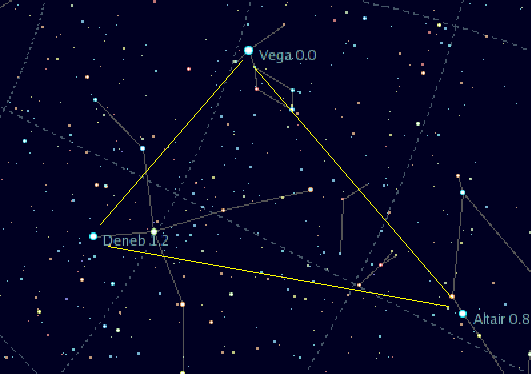
Why does this pattern matter? First, it is a superb orientation tool. If you can find the Summer Triangle, you can quickly hop to some of the night sky’s best double stars, planetary nebulae, and star fields. Second, its three vertex stars showcase a breadth of stellar physics: two relatively nearby main-sequence A-type stars (Vega and Altair) and one distant, luminous blue-white supergiant (Deneb). Finally, the Triangle connects practical stargazing with cultural astronomy—these same stars appear in myths and seasonal traditions across the world, as explored in Mythology and History Across Cultures.
At mid-northern latitudes, the Summer Triangle is visible for much of the year, but it is especially prominent from late spring through mid-autumn, when it forms a colossal pointer to the Milky Way. Observers under urban or suburban skies can usually see the three corner stars unaided; those under darker conditions will watch the Triangle become a luminous gateway into the star-clouds of Cygnus, Lyra, and Aquila. Whether you are a beginner finding your bearings or an experienced skywatcher planning a night of deep-sky object hopping, the Triangle serves as a faithful seasonal beacon.
In practical terms, astronomers and stargazers have used the Summer Triangle for decades to teach the sky’s layout. Its geometry is simple: draw a large triangle connecting the brightest star overhead (often Vega in summer) to a luminous blue-white star to the northeast (Deneb) and a bright white star to the southeast (Altair). Asterisms like the Triangle complement official constellations and help beginners avoid getting lost in the perceived randomness of stars—an idea we expand in Asterism vs. Constellation.
How to Find Vega, Deneb, and Altair From Any Sky
Finding the Summer Triangle is straightforward once you learn a few visual cues. The exact position depends on your local time, date, and latitude, but the strategy is consistent: identify one corner, then sweep to the others. Start with Vega, usually the easiest anchor, then use lines and relative brightness to complete the triangle, as detailed below.
Step-by-step sky-hopping

- Locate Vega (Alpha Lyrae). On northern summer evenings, Vega is often the brightest star high overhead or toward the east at dusk in late spring. It shines a crisp bluish-white, magnitude ~0.0. If you know the constellation Ursa Major (the Big Dipper), you can follow the Dipper’s handle arc past Arcturus and continue to a bright star higher in the sky—that bright target is typically Vega in season.
- Move to Deneb (Alpha Cygni). From Vega, sweep your gaze northward along the Milky Way’s hazy lane. Look for a brilliant star marking the tail of the Northern Cross—that’s Deneb. The Northern Cross is a familiar subset of Cygnus; Deneb sits at its top, with a vertical line of fainter stars running toward the horizon.
- Find Altair (Alpha Aquilae). From Vega, draw a mental line down and to the south. Altair sits in a line with two slightly fainter stars on either side, making a short row. This three-star alignment is hard to miss once you recognize it. Altair is bright, white, and distinctly separated from dense Milky Way star fields compared with the Deneb region.
Observation cues by environment
- City/suburban skies: You may not see the Milky Way, but Vega, Deneb, and Altair still punch through light pollution. Look for the three dominating points of light forming a large triangle spanning a big swath of sky. Deneb might be the faintest for you under heavy light pollution; use the Northern Cross shape as a guide.
- Rural/dark skies: The Milky Way bisects the Triangle from Cygnus down through Aquila. In dark skies, the star fields and dark nebulae of the Great Rift are visible as cloudy patches interlaced with darker lanes. This makes the Triangle especially attractive for binocular sweeping (see Beyond the Triangle).
- Hemispheric perspective: In the Northern Hemisphere, the Triangle soars high in summer evenings. In the Southern Hemisphere, it hangs low in the north during your winter, best seen from open horizons. We discuss months and altitudes in Seasonal Visibility.
Using tools and timing
Planetarium apps and simple star wheels (planispheres) help you anticipate when the Triangle is optimally placed. Set your date, time, and location, then look for Lyra, Cygnus, and Aquila. If you don’t have tools, note these simple seasonal heuristics: in mid-northern latitudes, Vega rises in the northeast by spring evenings, rides high in summer, and sets in the west by late autumn. Deneb follows slightly later; Altair trails after Vega but reaches high altitudes by midsummer nights. For deeper context on how these patterns relate to the celestial sphere and formal sky boundaries, see Asterism vs. Constellation.
Inside Vega: Rapid Rotation, Color, and Cultural Role
Vega (Alpha Lyrae) is one of the most studied stars in the sky. Roughly 25 light-years from Earth, Vega shines at magnitude ~0.0 and serves as a cornerstone for photometric calibration in astronomy. Its spectral classification is A0 V, placing it on the main sequence as a hot, white star with a surface temperature of around 9,500 K. Vega’s brightness and near-zenith vantage from mid-northern latitudes in summer made it historically significant for defining the magnitude system’s zero point.
Although Vega appears as a neat, round dot to the eye, it is not physically spherical. Interferometric observations show Vega to be a rapid rotator seen nearly pole-on, a geometry that causes gravity darkening: the equator, where centrifugal force reduces surface gravity, is cooler and dimmer than the poles. This gradient complicates precise measurements of its effective temperature and makes Vega a textbook case of how rotation modifies a star’s observable properties. If we could look edge-on, we would notice even more pronounced asymmetry; our near pole-on view minimizes the apparent flattening but accentuates the bright polar region in the integrated starlight.
Vega’s age is measured in hundreds of millions of years, not billions. Like other A-type main-sequence stars, it burns hydrogen in its core at a faster rate than the Sun. Eventually, it will evolve off the main sequence into a subgiant and then a red giant before shedding its outer layers and leaving behind a white dwarf. This evolutionary track is a standard part of the stellar evolution narrative for intermediate-mass stars—very different from the massive, short-lived supergiant fate of Deneb.
Vega also has a place in cultural and calendrical traditions. In East Asian sky lore it corresponds to the Weaving Girl (Chinese: Zhinü; Japanese: Orihime), part of a story celebrated in the Qixi and Tanabata festivals in summer. In Arabic naming conventions, its name derives from a word meaning “falling” or “swooping,” reflecting an association with a vulture or eagle. Western astronomers have long favored Vega both for its brightness and for its position in a compact constellation that offers rich targets nearby, such as the famous Ring Nebula (M57) and the Double-Double (Epsilon Lyrae), which we highlight in Beyond the Triangle.
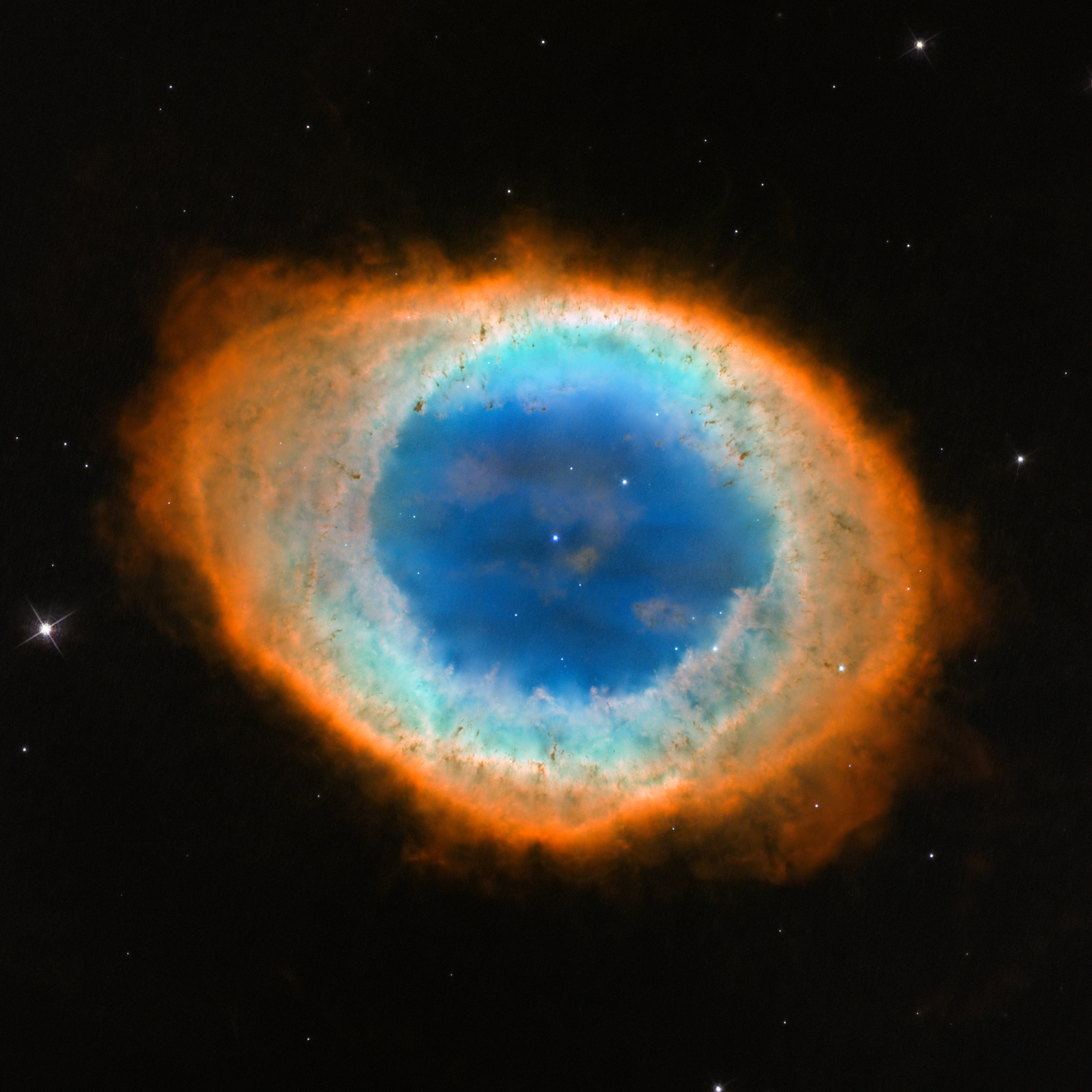
From Earth’s perspective, the nebula looks like a simple elliptical shape with a shaggy boundary. However, new observations combining existing ground-based data with new NASA/ESA Hubble Space Telescope data show that the nebula is shaped like a distorted doughnut. This doughnut has a rugby-ball-shaped region of lower-density material slotted into in its central “gap”, stretching towards and away from us. — Artist: NASA, ESA, and C. Robert O’Dell (Vanderbilt University)
To the observer, one of Vega’s delights is color: under steady, dark skies, it shows a crisp, icy-white hue with a subtle bluish tint. This color arises from its A0 spectrum, which features strong hydrogen Balmer lines. With binoculars, you can survey Lyra’s parallelogram of stars just south of Vega; with a small telescope, Epsilon Lyrae resolves into two pairs of close doubles—an instant test of optics and seeing. These practical ties between a naked-eye landmark and sub-arcminute targets make Vega a gateway from casual observing to the technical side of visual astronomy.
Deneb’s Luminosity and the Uncertain Distance Problem
Deneb (Alpha Cygni) sits at the tail of Cygnus the Swan and tops the asterism known as the Northern Cross. With a spectral type of A2 Ia, Deneb is a luminous blue-white supergiant—one of the most intrinsically bright first-magnitude stars in the sky. Its apparent magnitude hovers around 1.25, but its true energy output is colossal: estimates put Deneb’s luminosity on the order of tens to a few hundreds of thousands of times that of the Sun. Much of the uncertainty in that figure traces back to an enduring challenge: how far away is Deneb?
Distance to stars is often measured by parallax, the tiny shift in a star’s apparent position as Earth orbits the Sun. For nearby stars, space missions such as Hipparcos and Gaia have provided exquisitely precise parallaxes. Deneb, however, is far enough—and complex enough—that systematics and stellar atmosphere effects complicate the inference. Different studies have produced distances of roughly a couple of thousand light-years, making Deneb one of the most distant bright stars visible to the unaided eye. That uncertainty cascades into the luminosity calculation: luminosity scales with the square of distance, so even modest distance revisions shift its estimated energy output substantially.
Why does Deneb’s precise distance matter? Because it serves as a benchmark for modeling massive star evolution. Supergiants like Deneb are short-lived on cosmic timescales, with powerful stellar winds and large, distended atmospheres. These winds can carry away mass, affecting the future path the star will take toward a final fate—likely a supernova millions of years from now. Deneb’s spectrum contains diagnostics of these winds, and matching models to observations benefits from accurate distances and luminosities. The large physical size and extended atmosphere also help explain why interferometers and high-resolution spectroscopy are needed to tease out its properties compared with compact, faster-spinning stars like Altair.
From the standpoint of the backyard observer, Deneb is a springboard into one of the richest stretches of the Milky Way. If you drop from Deneb along the Northern Cross toward Albireo, the Swan’s head, you sweep through glittering star clouds and dark rifts. Just east of Deneb lie the North America Nebula (NGC 7000) and the Pelican Nebula (IC 5070). These luminous nebulae are best seen in wide-field images and with hydrogen-beta or oxygen-III filters under very dark skies, but their brightest knots can sometimes be hinted at in binoculars. We outline more accessible binocular and small-scope targets in Beyond the Triangle.
Visually, Deneb appears slightly cooler in color than Vega—still white, but leaning faintly toward blue-white rather than icy white. It stands as a stable anchor for navigating the structure of Cygnus, and even under moderate light pollution, the Northern Cross is a recognizable pattern. In that sense, Deneb is both a scientific keystone for massive-star astrophysics and a navigational keystone for summer skygazing.
Altair Up Close: Flattened Star with Fast Day Length
Altair (Alpha Aquilae) anchors the southern point of the Summer Triangle and shines at magnitude ~0.77 from a distance of about 17 light-years. With spectral type A7 V, it is cooler and slightly less massive than Vega but still a hot, white main-sequence star. What makes Altair stand out to astronomers is its fast rotation. Interferometric imaging has revealed Altair’s oblate shape—its equator bulges compared to its poles—caused by spinning once in roughly nine hours. That’s much faster than the Sun’s roughly 25-day equatorial rotation period, and even fast by the standards of A-type stars.
This rapid spin rate means Altair exhibits gravity darkening similar to Vega: the equator is cooler and dimmer than the poles. The effect is conspicuous enough that Earth-based optical interferometers can directly measure the star’s flattened profile. From a physics standpoint, such rapid rotation influences internal mixing, potentially affecting the star’s evolutionary path on the main sequence by moving fresh hydrogen into the core. While these details are primarily of interest to stellar modelers, they explain why Altair is a common target for high-angular-resolution experiments.
From an observer’s perspective, Altair has a reliable visual signature. It often forms a straight mini-line with two fainter stars on either side—this is an easy pattern to recognize, especially if light pollution makes the surrounding Milky Way less obvious. The star resides in Aquila the Eagle, a constellation that sits amid the Milky Way’s Great Rift. Under dark skies, the region south of Altair features patchy darkness where dust lanes block background starlight. Because Aquila’s star fields are less concentrated than those around Cygnus, the area can be a manageable stretch of the Milky Way to explore with binoculars even for beginners.
Altair’s cultural associations align with its Arabic name meaning “the flying (eagle),” and in East Asian traditions it pairs with Vega in the story of the separated lovers, as discussed in Mythology and History Across Cultures. Its proximity to Earth and distinctive shape in the sky make it a welcoming southern bright point to complete the Summer Triangle.
Seasonal Visibility, Hemispheres, and Best Observing Months
The Summer Triangle’s visibility depends on your latitude and the calendar, but fortunately it is present for a long stretch each year. Below is a practical guide to when and how high the Triangle rides for different observers. For precise rise and set times and altitudes, use a planetarium app, but these rules of thumb will get you oriented quickly.

Northern Hemisphere
- Late spring (May–June): Vega rises in the northeast by dusk, with Deneb and Altair following. By late evening, all three are easy to find, forming a gradually tilting triangle as they climb.
- Summer peak (July–August): Around mid-evening, the Triangle spans the high eastern-to-southern sky; at mid-northern latitudes (~40° N), Vega is often near the zenith. The Milky Way cuts through Cygnus overhead—prime time for binocular and naked-eye Milky Way watching.
- Early autumn (September–October): The Triangle shifts westward by evening. Cygnus still rides high early in the night, but by midnight the asterism begins its descent, remaining prominent until late autumn nights.
- Late autumn to winter: By November evenings, the Triangle is tilting down in the west. In December and January evenings it’s largely gone; you may catch it before sunrise in the east instead.
Southern Hemisphere
- Autumn to winter (April–August): The Triangle becomes visible in the northern sky after dusk, with the best visibility during your winter months. It never climbs as high as it does for northern observers, but with an open northern horizon, it remains easy to see.
- Spring (September–October): The asterism drifts toward the northwest during evening hours. By late spring nights, the Triangle sets not long after dusk.
At equatorial latitudes, the Triangle passes close to overhead in the appropriate season; at higher southern latitudes, it stays lower but remains a distinct giant marker. In all cases, the three bright stars ensure that even in light-polluted environments, you can lock onto the Triangle as a navigational scaffold for exploring the Milky Way’s northern arc.
Asterism vs. Constellation: Why the Triangle Isn’t on Official Star Charts
It’s common for newcomers to ask whether the Summer Triangle is a “constellation.” The short answer is no: it is an asterism, a recognizable pattern not officially recognized as a constellation. The International Astronomical Union (IAU) standardized 88 constellations and their boundaries in the 20th century. Those constellations are like regions on a map; all stars fall within one of them, whether or not they form a familiar picture. Asterisms, by contrast, are unofficial but culturally useful. They often span parts of multiple constellations and serve as visual mnemonics.
Famous asterisms include the Big Dipper (part of Ursa Major), the Teapot (in Sagittarius), and the Southern Cross-like shape of the Northern Cross (within Cygnus). The Summer Triangle encompasses bright stars from three constellations: Lyra (Vega), Cygnus (Deneb), and Aquila (Altair). This cross-constellation structure is a feature, not a bug—it helps observers tie the sky together, creating a larger-scale mental map anchored by high-contrast signposts.
The term “Summer Triangle” gained popularity in the mid-20th century and was used by astronomers and educators to help seasonal star parties and media outreach. Pilots and navigators have long relied on bright-star patterns for wayfinding at night; the triangle formed by Vega, Deneb, and Altair is simple enough to spot through cockpit windows, making it a natural practical reference. As we explore in Mythology and History Across Cultures, the individual stars carried names and stories long before the idea of a seasonal triangle took hold in modern stargazing.
Understanding the distinction between constellation and asterism helps clarify why the Triangle is ubiquitous in guides and talks, yet you won’t see it outlined in official IAU boundary maps. Still, as a pedagogical tool, it remains one of the best first targets to teach sky orientation, linking directly to hands-on observing plans like those in Stargazing Tips and to basic astrophysical concepts presented in From Backyard Pattern to Astrophysics.
Stargazing Tips: Light Pollution, Dark Adaptation, and Apps
Even though the Summer Triangle’s stars are bright, a bit of preparation transforms your viewing session from “found three points” into “explored the Milky Way.” These practical tips suit beginners and seasoned observers alike and complement the step-by-step sky-hopping in How to Find Vega, Deneb, and Altair.
Choose your site wisely
- Horizon and obstructions: Especially from southern latitudes, seek a clear northern horizon so Altair and Deneb aren’t hidden by buildings or trees.
- Light pollution: Use light-pollution maps or apps to target darker zones. Under brighter skies, focus on stellar showpieces (e.g., Epsilon Lyrae near Vega, Albireo in Cygnus) rather than faint nebulae.
- Moon phase: Plan Milky Way viewing around the new Moon. Even a half Moon can wash out the delicate contrast of the Great Rift threading the Triangle.
Maximize your night vision
- Dark adaptation: Give your eyes 20–30 minutes to adjust. Avoid white lights; use dim red light if needed.
- Averted vision and patience: Look slightly to the side of faint features. Let your brain integrate the scene; subtle details emerge with time.
- Comfort matters: A reclining chair keeps your neck from straining during overhead viewing, especially when the Triangle is high.
Tools: binoculars and small scopes
- Binoculars (7×50 or 10×50): Ideal for sweeping the star clouds between Deneb and Altair. Binoculars frame the Northern Cross, reveal clusters, and enhance color contrasts like the gold-blue pair of Albireo.
- Small telescope (60–130 mm): Resolve Epsilon Lyrae into two pairs with steady air, find the smoke ring of M57 near Vega, and track down M27 (the Dumbbell Nebula) in Vulpecula. Low-power, wide-field eyepieces excel in the dense Cygnus region.
- Filters: Narrowband filters (UHC/OIII) help on emission nebulae around Deneb under dark skies. They won’t help with reflection nebulae or with the Ring Nebula’s continuum-dominated glow as much as with strong-emission targets.
Apps and star wheels
- Planisphere: A physical star wheel instantly shows what’s up for your latitude and date—great for teaching the asterism vs. constellation distinction in the field.
- Planetarium apps: Set to night mode. Use them to confirm you’ve found the right stars and to practice jumping from Vega to M57 or from Deneb to NGC 7000.
- Checklists: Bring a short list of 4–6 targets near each corner star. This anchors your session and ensures you leave having seen highlights.
From Backyard Pattern to Astrophysics: Distances, Spectra, and Evolution
The Summer Triangle is more than a pretty shape; it encapsulates diverse stellar physics. Here we connect the dots between what you see and what the stars are, referencing details from Vega, Deneb, and Altair.
Distances and brightness
- Vega: ~25 light-years; magnitude ~0.0. Close enough for extremely precise parallax. Bright, bluish-white, serves as a photometric standard.
- Altair: ~17 light-years; magnitude ~0.77. Also nearby, with crisp parallax; its oblateness has been imaged directly by interferometry.
- Deneb: Distance measured in thousands of light-years; magnitude ~1.25. Intrinsically far more luminous, but distance uncertainty makes exact luminosity an active subject of research.
Spectral types and temperatures
- Vega: A0 V, ~9,500 K surface temperature. Strong hydrogen Balmer lines; slight gravity darkening from rapid rotation.
- Altair: A7 V, cooler than Vega, still white-hot; also gravity-darkened and oblate due to fast spin.
- Deneb: A2 Ia, a luminous supergiant with powerful stellar winds and an extended atmosphere. Hotter than the Sun but cooler than typical B-type supergiants.
Evolutionary stages
- Vega and Altair: Main-sequence stars fusing hydrogen in their cores. Their ultimate fates are to swell into red giants, shed outer layers, and end as white dwarfs.
- Deneb: An evolved massive star in a late stage of life. Its end will likely be a core-collapse supernova on million-year timescales, enriching the interstellar medium with heavier elements.
Rotation and shape
- Gravity darkening: Rapid rotation makes stars like Vega and Altair oblate and temperature-variable across latitudes. This changes the observed spectral energy distribution and interferometric profiles.
- Interferometry: Arrays like CHARA can resolve stellar shapes, measuring flattening and mapping brightness variations—technology directly responsible for confirming Altair’s and Vega’s distorted figures.
Why the uncertainties remain
For Deneb, distance measurements are hindered by small parallaxes and potential systematics in bright, extended supergiants. Improved calibrations and analysis continue to refine the figure, but even the range of plausible distances reinforces how unusual Deneb is: it is likely one of the most distant first-magnitude stars visible without optics. Meanwhile, the nearby Vega and Altair remind us that even well-understood stars can harbor complexities—in their case, fast rotation that pushes models beyond spherical symmetry.
Mythology and History Across Cultures: The Triangle’s Stars in Story
Long before modern astronomy, the bright beacons we call Vega, Deneb, and Altair drew human attention, inspiring names and stories that persist today. These narratives give seasonal skywatching a sense of tradition and connect observers across geography and time.
East Asian traditions: Weaver Girl and Cowherd
In Chinese and Japanese traditions, Vega and Altair represent separated lovers—the Weaver Girl (Zhinü/Orihime) and the Cowherd (Niulang/Hikoboshi)—parted by the River of Heaven (the Milky Way). According to legend, they are allowed to meet once a year on the seventh night of the seventh lunar month, a date celebrated as the Qixi or Tanabata festival. In some versions, a band of birds forms a temporary bridge across the river; Deneb is sometimes identified with that bridge or as a star guiding their reunion. The story aligns beautifully with the seasonal prominence of the Summer Triangle, peaking around late summer evenings in the Northern Hemisphere.
Arabic star names
The names Vega, Deneb, and Altair trace to Arabic roots, reflecting the medieval Islamic astronomers’ influence on star catalogs and navigation. Vega is derived from a term meaning “falling” or “swooping,” historically linked to a vulture or eagle. Deneb comes from a word meaning “tail,” appropriate for its position at the tail of the Swan. Altair means “the flying (eagle),” fitting for the constellation Aquila. These names passed into Latinized Western astronomy and remain in use worldwide.
European and modern astronomical culture
In European traditions, the constellation figures—Lyra (the Lyre), Cygnus (the Swan), and Aquila (the Eagle)—date back to classical sources. The modern term “Summer Triangle” emerged as educators and sky writers popularized seasonal asterisms to teach navigation. It caught on for a simple reason: the pattern is obvious, and it heralds the heart of Milky Way season. Today, astronomy clubs use the Triangle as a summer outreach staple, as it bundles beginner-friendly targets discussed in Beyond the Triangle with easy-to-remember names and shapes.
The Summer Triangle is not a constellation—but it behaves like one in your memory palace of the night sky. Learn its corners and the rest of the summer Milky Way falls into place.
Beyond the Triangle: Milky Way Targets and Deep-Sky Neighbors
Once you spot the Summer Triangle, the real fun begins. Each corner star anchors a neighborhood rich with binocular and small-telescope objects. Even without a telescope, naked-eye observers can revel in star clouds and dark lanes—features that come alive under dark skies. Below is a curated “star hop” list organized by corner, with practical notes for different sky conditions. Cross-reference with your favorite atlas or app for precise locations, and remember to check Stargazing Tips for gear suggestions.
Lyra: Around Vega
- Epsilon Lyrae (the Double-Double): A resolvable quadruple star. Binoculars split Epsilon Lyrae into two stars; a small telescope under steady seeing splits each into a closer pair. It’s a classic test of optics and atmospheric steadiness.
- Ring Nebula (M57): Between Beta and Gamma Lyrae, this planetary nebula appears as a small smoke ring at moderate magnifications. In heavy light pollution, it looks like a fuzzy star; under darker skies, the ring structure is evident. Narrowband filters can enhance contrast.

In this composite image, visible-light observations by NASA’s Hubble Space Telescope are combined with infrared data from the ground-based Large Binocular Telescope in Arizona to assemble a dramatic view of the well-known Ring Nebula. — Artist: NASA, ESA, C.R. Robert O’Dell (Vanderbilt University), G.J. Ferland (University of Kentucky), W.J. Henney and M. Peimbert (National Autonomous University of Mexico)
Credit for Large Binocular Telescope data: David Thompson (University of Arizona) - Sheliak (Beta Lyrae) and Sulafat (Gamma Lyrae): These frame M57. Beta Lyrae is a famous eclipsing binary system whose brightness varies over days. Even if the variability is subtle to the eye, it underscores Lyra’s scientific richness.
Cygnus: Around Deneb
- Northern Cross asterism: From Deneb down the Cross to Albireo, scan with binoculars to detect clumps and dark rivulets of the Milky Way’s Great Rift.
- Albireo (Beta Cygni): A classic color-contrast double. A small telescope resolves a golden primary and a bluish companion—always a crowd-pleaser. Modern data suggest the pair is likely an optical alignment rather than a bound system, but visually it is stunning.
- North America Nebula (NGC 7000) and Pelican Nebula (IC 5070): Very large nebulae just east of Deneb. These are wide-field objects best framed in binoculars under very dark skies or with imaging; UHC/OIII filters help reveal brighter knots visually.
- Open clusters in Cygnus: Clusters like M39 are accessible with binoculars. While not as compact as some Messier clusters, they contribute to the sense of star-rich fields near the Triangle’s northern edge.
Aquila and Vulpecula: Around Altair
- Dumbbell Nebula (M27) in Vulpecula: One of the brightest planetary nebulae. In a small telescope, it shows an apple-core or dumbbell shape. OIII/UHC filters can improve contrast even in suburban skies.
- Coathanger asterism (Brocchi’s Cluster) in Vulpecula: A striking binocular asterism of stars forming a hook-and-bar shape. While not a true gravitational cluster, it’s an unmistakable pattern and a fun stop on any Milky Way tour.
- Scutum Star Cloud and Great Rift edges: South of Altair, the Milky Way grows denser toward Scutum and Sagittarius. Even if these regions lie outside the Triangle proper, they are easy to access once you’re oriented.
By moving corner to corner, you can curate a varied session: doubles, clusters, nebulae, and naked-eye star fields. The How to Find section helps you lock in the Triangle quickly, while the Stargazing Tips section ensures your eyes, equipment, and conditions are tuned to make the most of what this summer landmark has to offer.
Frequently Asked Questions
Is the Summer Triangle a constellation or something else?
The Summer Triangle is an asterism, not a constellation. An asterism is a recognizable pattern that may span multiple constellations. The Triangle links Vega (in Lyra), Deneb (in Cygnus), and Altair (in Aquila). The International Astronomical Union recognizes 88 constellations with defined boundaries; the Triangle crosses three of them. See Asterism vs. Constellation for more detail.
Can I see the Summer Triangle from the Southern Hemisphere?
Yes. In the Southern Hemisphere, the Summer Triangle is best seen during your winter months, hanging low in the northern sky after dusk. It does not climb as high as it does for northern observers, so choose a site with an open northern horizon. The three corner stars—Vega, Deneb, and Altair—are still bright enough to spot even with moderate light pollution. For monthly timing and altitude guidance, see Seasonal Visibility, Hemispheres, and Best Observing Months.
Final Thoughts on Exploring the Summer Triangle
The Summer Triangle is more than a trio of bright stars—it is a framework for learning the Milky Way’s northern arc, a crossroads where beginner-friendly highlights meet advanced astrophysical narratives. With Vega you meet a nearby A-type standard shining with pole-brightened light; with Deneb you glimpse the scale and uncertainty of massive supergiants; with Altair you watch rotation sculpt a star’s very shape. Together they create a seasonal stage set where double stars, planetary nebulae, and luminous star clouds play under summer skies.
To make the most of your next clear night, carry a short target list from Beyond the Triangle, practice the hop-through method from How to Find Vega, Deneb, and Altair, and apply the practical advice in Stargazing Tips. Each corner of the Triangle opens a different chapter of the sky, and revisiting these routes through the season reveals new subtleties in color, structure, and contrast—especially when you vary your site, moon phase, and magnifications.
If you enjoyed this guide, consider exploring our related articles on constellations and seasonal observing to deepen your sky fluency. And don’t forget to subscribe to our newsletter for weekly observing tips, science explainers, and curated targets tailored to the changing night sky. Clear skies and happy hunting under the Summer Triangle.