
Gravitational Lensing Explained: Types, Physics, and Uses
Gravitational lensing turns the universe into a natural observatory by using mass to bend light. In this guide, we unpack the physics, survey the types of lensing, and explore how astronomers use lensing to weigh dark matter halos, find distant galaxies, measure the expansion of the universe, and even detect exoplanets.

Table of Contents
- What Is Gravitational Lensing in Astrophysics?
- How Light Bends: Relativity, Curvature, and Deflection Angles
- Types of Gravitational Lensing: Strong, Weak, and Microlensing
- Measuring the Invisible: Dark Matter and Mass Mapping with Lensing
- Time Delays, Hubble Constant, and Cosmology with Lensed Quasars
- Galaxy Clusters as Natural Telescopes for the Early Universe
- Microlensing for Exoplanets and Compact Objects
- Observational Techniques, Surveys, and Data Analysis
- Common Pitfalls, Systematics, and Model Degeneracies
- Frequently Asked Questions
- Final Thoughts on Understanding Gravitational Lensing
What Is Gravitational Lensing in Astrophysics?
Gravitational lensing is the deflection and distortion of light as it travels past massive objects like galaxies or galaxy clusters. According to general relativity, mass curves spacetime; light follows the straightest possible path through this curved geometry, so to an observer, the path appears bent. Depending on the alignment and mass involved, lensing can generate multiple images of a single background source, stretch objects into arcs, amplify faint galaxies, or produce subtle shape distortions across wide areas of sky.
Three broad regimes capture most observational cases—strong lensing, weak lensing, and microlensing—each with distinct signatures and scientific uses. We explore these in depth in Types of Gravitational Lensing: Strong, Weak, and Microlensing, and then show how lensing becomes a precision tool to map dark matter (Measuring the Invisible: Dark Matter and Mass Mapping with Lensing), measure the expansion rate of the universe (Time Delays, Hubble Constant, and Cosmology with Lensed Quasars), and even detect exoplanets (Microlensing for Exoplanets and Compact Objects).
Historical note: General relativity, formulated by Albert Einstein in 1915, predicted the deflection of starlight by the Sun. The effect was famously measured during the 1919 solar eclipse, providing early evidence for the theory. Einstein later discussed the concept of an “Einstein ring,” a perfect circular image formed when a background source, lens, and observer are precisely aligned.
Gravitational lensing is now one of the cornerstones of modern observational cosmology. Because gravity affects all forms of matter and energy, including dark matter that does not emit or absorb light, lensing provides a direct measure of the total mass along a line of sight, independent of luminous tracers like stars or hot gas.
How Light Bends: Relativity, Curvature, and Deflection Angles
In Newtonian physics, one might imagine gravity acting as a force tugging on photons. General relativity replaces this picture: mass–energy curves spacetime, and light follows geodesics in that curved geometry. The apparent “bending” emerges from straight-line motion in a curved manifold.
For a point-mass approximation, the deflection angle can be estimated as:
# Approximate light deflection by a point mass (weak field)
# alpha = 4GM / (c^2 b)
# G: gravitational constant, M: lens mass, c: speed of light, b: impact parameter

deflection_angle(alpha_arcsec) = 4 * G * M / (c**2 * b)
# Convert radians to arcseconds for astronomical convenience
This simplified expression captures the basic scaling: more massive lenses and smaller impact parameters yield larger deflections. In practice, lenses are extended and structured—galaxies have bulges, disks, and dark halos; clusters contain subhalos and intracluster gas—so realistic models distribute mass in 2D or 3D and solve the lens equation that maps source positions to observed image positions.
The Einstein radius, a critical angular scale for lensing, arises when the average projected mass within a certain radius focuses light just enough to align source and image:
# Einstein radius (theta_E) for a point mass lens
# theta_E = sqrt( (4GM/c^2) * (D_ls / (D_l * D_s)) )
# D_l: angular diameter distance to lens; D_s: to source; D_ls: lens-to-source

import math

def einstein_radius_arcsec(M, D_l, D_s, D_ls):
    theta_E = math.sqrt( (4*G*M/c**2) * (D_ls / (D_l*D_s)) )
    return theta_E * (206265)  # radians to arcseconds
Two key takeaways flow from these relations:
- Stronger lensing (larger Einstein radii) occurs for more massive lenses and favorable geometry (large Dls relative to Dl and Ds).
- Cosmology matters: angular diameter distances depend on the expansion history of the universe, which means precise lensing measurements can constrain cosmological parameters when combined with robust models, as we discuss in Time Delays, Hubble Constant, and Cosmology with Lensed Quasars.
Physically, lensing conserves surface brightness: the brightness per unit solid angle remains unchanged even when an image is stretched or magnified. This conservation underpins methods for reconstructing the unlensed source morphology and for correcting counts of background galaxies magnified by foreground clusters.
Types of Gravitational Lensing: Strong, Weak, and Microlensing
Astrophysicists classify lensing by the strength of the effect and by how easily it can be discerned in imaging data. Each regime reveals different information about the cosmos and calls for distinct analysis techniques.
Strong Lensing
Strong lensing produces dramatic, easily visible effects:
- Multiple images of the same background object (e.g., quasars or galaxies)
- Giant arcs stretched tangentially around galaxy clusters
- Einstein rings where near-perfect alignment creates nearly circular images

Because strong lensing heavily depends on the precise mass distribution of the lens, it is a sensitive probe of the inner mass profile, substructure within halos, and even the presence of satellite galaxies that may be too faint to observe directly. Strong lensing systems often enable exquisite measurements of time delays between multiple lensed images of a variable source (like a quasar), which we will use later to infer the Hubble constant in Time Delays, Hubble Constant, and Cosmology with Lensed Quasars.
Weak Lensing
Weak lensing causes small, statistical distortions in the shapes of many background galaxies. Any single galaxy’s shape is dominated by its intrinsic morphology, but averaging over millions of galaxies reveals a coherent shear pattern produced by foreground mass distributions. Two key modes are:
- Galaxy–galaxy lensing: stacking background shapes around lenses (individual galaxies) to measure average halo masses and density profiles.
- Cosmic shear: mapping shear correlations across vast areas of sky to probe the growth of structure, dark matter clustering, and dark energy properties.
Weak lensing is a cornerstone of modern cosmological surveys, demanding precise shape measurement, point-spread function (PSF) modeling, accurate photometric redshifts, and sophisticated statistical inference. We delve deeper into analysis approaches in Observational Techniques, Surveys, and Data Analysis.
Microlensing
Microlensing occurs when individual stars, stellar remnants, or exoplanets act as lenses. The resulting magnification is transient and does not typically produce resolved multiple images; instead, an otherwise steady star brightens and fades according to a characteristic light curve. Microlensing is used to detect:
- Exoplanets via short-lived anomalies in the magnification curve when a planet perturbs the light path.
- Compact objects such as brown dwarfs, white dwarfs, neutron stars, and black holes through the duration and shape of events.
Because microlensing does not depend on the light from the lens, it is uniquely sensitive to otherwise dark or faint bodies. We explore observational strategies in Microlensing for Exoplanets and Compact Objects.
Measuring the Invisible: Dark Matter and Mass Mapping with Lensing
Gravitational lensing is a direct probe of total mass—luminous and dark—along the line of the line of sight. This makes lensing one of the best tools to study dark matter, the predominant mass component in galaxies and clusters that does not emit light but exerts gravity.
Mass Reconstruction from Strong Lensing
In strong lensing, the positions, shapes, and relative magnifications of multiple images constrain the inner mass distribution of the lens. Analysts often adopt parameterized models such as:
- Singular isothermal ellipsoid (SIE): captures a roughly isothermal mass profile (density ∝ r−2) with ellipticity.
- Navarro–Frenk–White (NFW) profiles: motivated by cosmological simulations, describing dark matter halos with characteristic concentration and scale radius.
- Composite models: luminous components (e.g., de Vaucouleurs profiles) plus dark halo terms to reflect baryonic and non-baryonic contributions.
These models, coupled with lens equations, are optimized to reproduce observed arcs and image configurations. The output includes mass within the Einstein radius, radial density slopes, and constraints on substructure. Cross-checks with stellar dynamics and gas kinematics help break degeneracies, as described in Common Pitfalls, Systematics, and Model Degeneracies.
Weak Lensing Shear and Convergence Maps
Weak lensing analyses derive two fields from galaxy shape distortions:
- Shear (γ): describes anisotropic stretching.
- Convergence (κ): effectively the projected surface mass density in units of a critical density for lensing.
In Fourier space, shear and convergence are related through well-known transforms; by inverting the shear field, astronomers reconstruct mass maps of galaxy clusters and large-scale structure. These maps reveal the distribution of dark matter independent of baryons.
Evidence for Dark Matter from Lensing
Several observational phenomena strongly support dark matter’s presence:
- Mass–light offsets in clusters: In merging clusters, weak-lensing mass peaks can be spatially offset from hot X-ray gas, indicating a collisionless component consistent with dark matter.
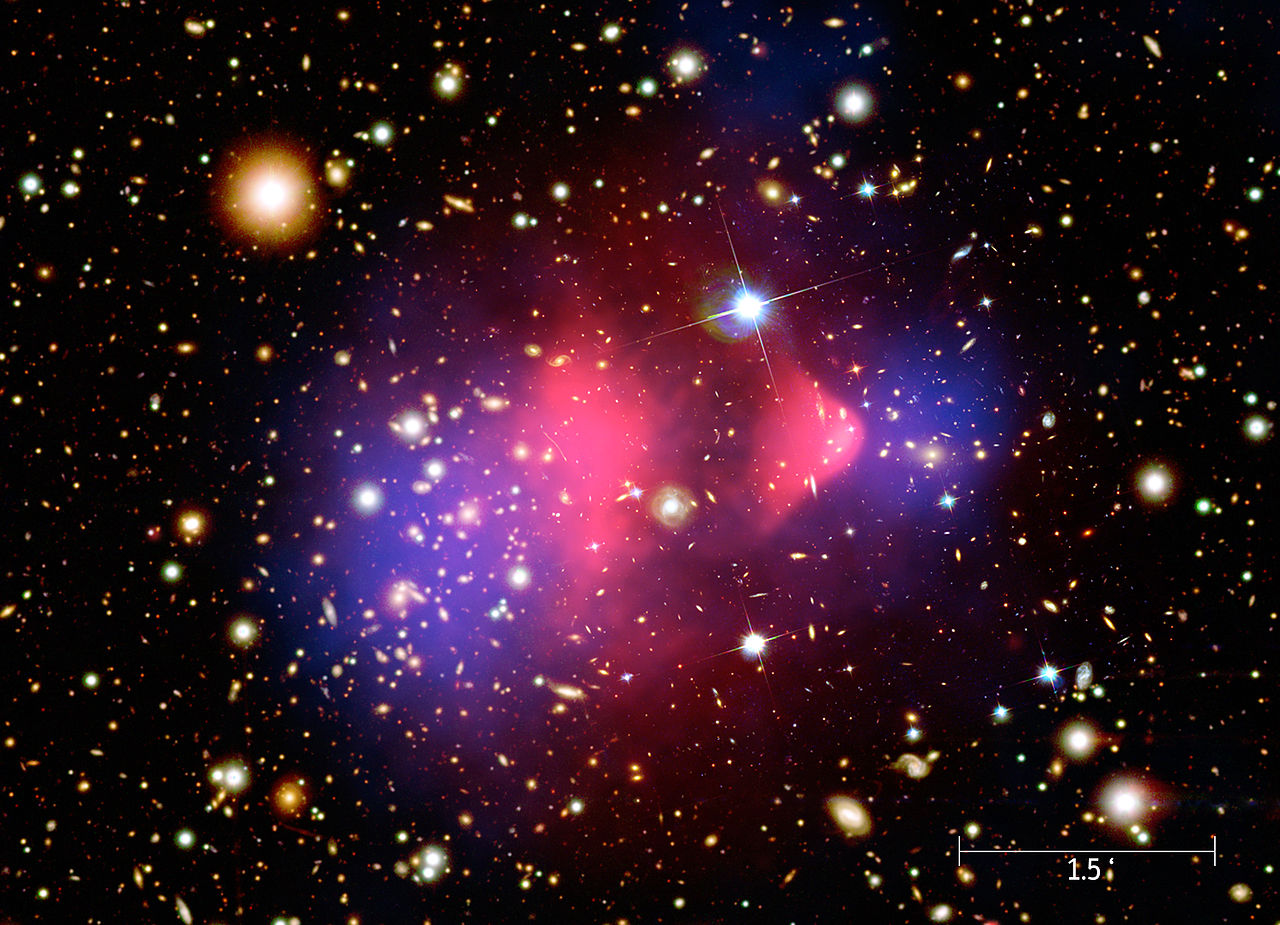
Artist: NASA/CXC/M. Weiss - Halo masses from galaxy–galaxy lensing: Statistical lensing around galaxies measures halo masses exceeding stellar masses by large factors, aligning with ΛCDM predictions.
- Substructure lensing: Flux ratio anomalies in strongly lensed quasar images hint at dark subhalos, which are hard to detect via starlight.
Lensing’s sensitivity to total mass, unaffected by the complexities of baryonic physics (e.g., star formation, feedback), makes it a critical arbiter between theories of gravity and dark matter frameworks. When combined with other probes—redshift-space distortions, galaxy clustering, and cosmic microwave background data—the case for non-luminous dark matter is compelling.
Time Delays, Hubble Constant, and Cosmology with Lensed Quasars
Strongly lensed quasars offer a time-domain twist: light traveling along different paths around a lens arrives at different times due to path length differences and gravitational time dilation. When the background quasar varies, these changes appear in each lensed image after different delays. Measuring these time delays and modeling the lens mass allows determination of the so-called time-delay distance, which scales inversely with the Hubble constant, H0.
The Time-Delay Method
Key ingredients include:
- Long-term photometric monitoring: to record the intrinsic variability of the quasar as seen in each image.
- Precise relative astrometry: to fix image positions and lens geometry.
- Lens mass modeling: to connect observed configuration and time delays to cosmological distances.
The inferred H0 depends on accurately accounting for mass structures along the line of sight, including galaxies and groups not part of the main lens. Such “external convergence” affects the effective focusing power and thus the distances inferred. This is one reason systematics and degeneracies receive so much attention in lensing cosmology.
Why Time Delays Matter for Cosmology
Independent pathways to H0 help cross-check the cosmic distance ladder and early-universe inferences from the cosmic microwave background. Lensed-quasar time delays provide a geometric distance estimate that does not rely on Cepheids or Type Ia supernova calibrations, making it an important complement. As monitoring datasets grow and modeling methods mature, lensed time delays will continue refining constraints on the expansion rate and potentially other parameters like spatial curvature when combined with external data.
Galaxy Clusters as Natural Telescopes for the Early Universe
Massive galaxy clusters are nature’s most powerful lenses. Their deep gravitational wells can magnify background sources by factors of tens or more, transforming glimpses of the early universe into observable targets. This “gravitational telescope” effect accomplishes two goals simultaneously:

- Increases angular size of high-redshift galaxies, letting astronomers resolve internal structures that would otherwise be too small.
- Boosts flux from intrinsically faint galaxies, enabling spectroscopic follow-up and measurements of stellar populations, metallicities, and star-formation rates.
Survey programs targeting cluster fields capitalize on this effect to push to higher redshifts and lower luminosities than blank-field observations alone. Because lensing magnification varies across the field, careful modeling of the cluster mass distribution is critical to recover intrinsic source properties. This modeling typically blends strong-lensing constraints (multiple-image systems near the core) with weak-lensing shear (at larger radii), producing a high-resolution, multi-scale mass map.
Mosaic observations and multi-wavelength data—optical, near-infrared, submillimeter, and radio—create a fuller picture of lensed galaxies, including dust content, molecular gas, and star-forming regions. The synergy between deep imaging and precise lens models has revealed galaxies in the first billion years after the Big Bang that would be inaccessible otherwise.
For practical examples of how lens models inform science returns, see Measuring the Invisible: Dark Matter and Mass Mapping with Lensing and the role of image configurations explored in Types of Gravitational Lensing.
Microlensing for Exoplanets and Compact Objects
Microlensing leverages rare alignments between foreground lenses and background source stars. When alignment is close, the apparent brightness of the source temporarily rises according to a symmetric, achromatic curve for a single-lens event. Departures from this pattern—brief deviations, asymmetries, or caustic crossings—can signal binary lenses or exoplanets.
Microlensing Light Curves
For a point lens and point source, the magnification A(u) depends on the dimensionless separation u (in units of the angular Einstein radius, θE):
# Point-source, point-lens microlensing magnification
# A(u) = (u^2 + 2) / (u * sqrt(u^2 + 4))
# u(t) = sqrt(u_0^2 + ((t - t_0)/t_E)^2)
# t_E: Einstein timescale; u_0: minimum impact parameter; t_0: time of peak

A = (u**2 + 2) / (u * math.sqrt(u**2 + 4))
The event duration, characterized by the Einstein timescale tE, encodes a combination of lens mass, distances, and relative proper motion. Planetary companions introduce additional caustics that can produce short-lived spikes or dips in the light curve, sometimes lasting mere hours to days, requiring dense temporal coverage.
Why Microlensing Finds Unique Exoplanets
Unlike transit and radial-velocity techniques, microlensing does not require light from the host star and is more sensitive to planets at or beyond the “snow line,” typically at a few astronomical units from their stars. Microlensing is also sensitive to free-floating planets if a lensing event shows no detectable host star. As discussed in Types of Gravitational Lensing, this method complements other detection techniques, filling gaps in the demographics of planetary systems.
Compact Objects and Stellar Remnants
Long-duration microlensing events can indicate massive compact lenses, including candidate black holes or neutron stars. Follow-up astrometry and parallax effects (from Earth’s orbital motion) can help break degeneracies and estimate lens masses. Combining light-curve fitting with high-resolution imaging years after the event can sometimes reveal the lens’s proper motion relative to the source, further constraining mass.
Observational Techniques, Surveys, and Data Analysis
Lensing science spans a spectrum of observing modes, from deep, high-resolution imaging of individual strong-lens systems to panoramic sky surveys measuring weak-lensing shear across thousands of square degrees. The basic workflow combines careful image processing, accurate photometry/astrometry, and rigorous statistical modeling.
Finding and Confirming Strong Lenses
Strong lenses can be discovered through several routes:
- Visual and machine-learning searches in wide-field imaging for arc-like features around massive galaxies or clusters.
- Quasar spectroscopy revealing multiple redshift systems, prompting high-resolution follow-up to detect image multiplicity.
- Color and morphology filters tailored to pick out arc candidates near bright ellipticals.
Confirmation involves high-resolution imaging to resolve multiple images and spectroscopy to establish lens and source redshifts. With precise astrometry, the next step is forward modeling the mass distribution to replicate the image configuration and predict time delays and magnifications.
Weak-Lensing Pipeline Essentials
Weak lensing’s power lies in statistics and systematics control. A typical pipeline includes:
- Image calibration and PSF modeling: Correct raw images for detector effects (bias, flat fielding, cosmic rays) and model the PSF, which blurs and anisotropically distorts galaxy images.
- Shape measurement: Extract ellipticities using methods like model fitting or moments-based techniques, correcting for PSF convolution and noise bias.
- Photometric redshifts (photo-z): Estimate source redshifts from multi-band photometry, with rigorous calibration via spectroscopic samples and cross-correlation techniques.
- Shear correlation functions: Compute two-point (and higher-order) statistics across the survey area to infer matter power spectra and cosmological parameters.
- Mass mapping: Invert shear fields to convergence maps; combine with external data like galaxy clustering for cross-correlation studies.
Controlling biases is crucial: residual PSF anisotropy, multiplicative shear bias, selection effects, and photo-z errors all propagate into cosmological inferences. For a discussion of these challenges, see Common Pitfalls, Systematics, and Model Degeneracies.
Microlensing Networks and Cadence
Microlensing surveys rely on high-cadence monitoring of dense stellar fields, often toward the Galactic bulge. Global networks of telescopes mitigate weather and day-night gaps, providing the continuous coverage needed to capture brief planetary signals. Alerts are issued in near real time so follow-up facilities can intensify monitoring during anomalies.
Multi-Wavelength and Multi-Messenger Synergies
Combining lensing with other probes multiplies its impact:
- X-ray and Sunyaev–Zel’dovich (SZ) observations of galaxy clusters constrain hot gas pressure and density, complementing lensing-based mass maps.
- Spectroscopy provides redshifts and dynamical information to test mass models.
- Radio interferometry can resolve fine structure in lensed jets, enabling precision constraints on substructure and time delays.

Data fusion helps isolate systematics and break degeneracies inherent to lensing alone.
Common Pitfalls, Systematics, and Model Degeneracies
Extracting precise, unbiased information from lensing demands vigilance against subtle errors and theoretical ambiguities. Below are some of the most important issues researchers confront.
Mass–Sheet Degeneracy
The mass–sheet degeneracy describes how adding a uniform sheet of mass (or equivalently rescaling the convergence) can reproduce similar lensing observables with different inferred mass distributions. This degeneracy affects absolute magnification and time-delay inferences. Breaking it requires external information—stellar kinematics of the lens, standardizable source properties, or independent mass tracers.
Source–Lens Alignment Uncertainties
Strong-lensing solutions depend sensitively on the source position relative to critical curves. Small misestimates of source structure or centroid can bias mass profile slopes and substructure estimates. High-resolution imaging and multi-band data help by better constraining source morphology and lens light subtraction.
Line-of-Sight Structures
Galaxies and groups along the sightline can contribute extra convergence and shear, altering inferred lens strengths and cosmological distances. Accounting for these requires spectroscopic and photometric surveys around lens fields, along with simulations to quantify expected contributions. This issue is especially relevant for H0 inference from time delays.
PSF and Detector Systematics in Weak Lensing
For weak lensing, inaccurate PSF models or uncorrected detector effects (e.g., charge transfer inefficiency) imprint spurious shear signals. Calibration using stars, overlapping tilings, and cross-correlated systematics maps, as well as blind challenges on simulated data, are common safeguards.
Photometric Redshift Biases
Photo-z estimates anchor the geometric efficiency of lensing and the growth of structure versus redshift. Systematic biases—caused by template mismatches, limited spectroscopic training sets, or dust—propagate into shear–distance relations. Mitigations include improved templates, hierarchical Bayesian methods, and direct calibration via clustering redshifts.
Selection Effects and Blending
Selection biases creep in when galaxies are chosen for shape measurement based on apparent properties that correlate with shear or with observing conditions. In crowded fields, blending of sources artificially alters shapes and fluxes. Modern pipelines model blending explicitly or use deblenders trained on realistic simulations.
Model Flexibility vs. Overfitting
Strong-lensing models must balance flexibility (to fit complex data) with physical plausibility. Overly flexible models can fit noise or artifacts, while overly rigid models bias results. Cross-validation, Bayesian evidence comparisons, and independent tests (e.g., predicting image configurations of sources not used in the fit) help ensure robustness.
Frequently Asked Questions
How can gravitational lensing “magnify” light without violating energy conservation?
Lensing conserves surface brightness but redistributes light over angles on the sky. When a distant source lies behind a mass concentration, its apparent area on the sky can increase, so the total flux received from the source direction rises. However, this does not create energy out of nothing: magnification is balanced by a reduced solid angle, and globally the average energy flux across the sky remains unchanged. Observers see brighter, larger images because the lens has focused light that would have otherwise missed the telescope.
Why do weak-lensing cosmology results emphasize PSF modeling and shape biases so much?
Weak lensing signals are small—typical shear distortions are at the percent level or less—so tiny systematic errors in shape measurement can rival or exceed the cosmic signal. The atmosphere and telescopes blur and distort images in ways that can mimic shear if not corrected. Accurate PSF models, calibrated shape estimators, and realistic image simulations are essential so that residual biases are well below the statistical uncertainties of the survey.
Final Thoughts on Understanding Gravitational Lensing
Gravitational lensing offers a rare combination in astrophysics: visual elegance and analytic power. From the striking arcs of strong lensing to the subtle shear patterns of weak lensing and the fleeting brightenings of microlensing, the phenomenon turns gravity into an instrument—one that measures mass without light, reveals galaxies in the early universe, tests the growth of cosmic structure, and extends the reach of planet discovery.
The key to extracting reliable science is rigor. Accurate mass models, careful treatment of systematic uncertainties, and synergy with complementary observations make lensing a premier cosmological tool. As surveys expand and instrumentation improves, the fidelity of mass maps and the reach of lensing discoveries will continue to grow, sharpening constraints on dark matter, dark energy, and the cosmic expansion rate.
If this deep dive clarified how and why lensing works, explore our related articles linked throughout—for example, the role of different lensing regimes or how clusters act as natural telescopes. For more weekly insights at the intersection of observation and theory, subscribe to our newsletter and never miss an update.
