
Table of Contents
- What Is Polaris, the North Star?
- Where to Find Polaris in the Night Sky
- Brightness and Variability: Polaris as a Classical Cepheid
- How Far Away Is Polaris? Distance and Physical Properties
- Practical Navigation: Using Polaris for Direction and Latitude
- Observing Polaris: Equipment, Techniques, and Star-Hopping
- Cultural History: Myths, Names, and Navigation Lore
- Earth’s Precession and Past/Future North Stars
- Astrophysical Significance: What Polaris Teaches Us
- Common Misconceptions About Polaris
- Frequently Asked Questions
- Final Thoughts on Understanding Polaris, the North Star
What Is Polaris, the North Star?
Polaris, also known as Alpha Ursae Minoris, is the famed “North Star” of our era. It lies very close to the North Celestial Pole (NCP), the point in the sky toward which Earth’s axis of rotation is currently oriented in the northern hemisphere. Because it is nearly aligned with Earth’s axis, Polaris appears to hold almost still as the rest of the sky slowly rotates around it every sidereal day. This near-fixity is why it has served as a reliable beacon of direction for navigators, travelers, and skywatchers for centuries.
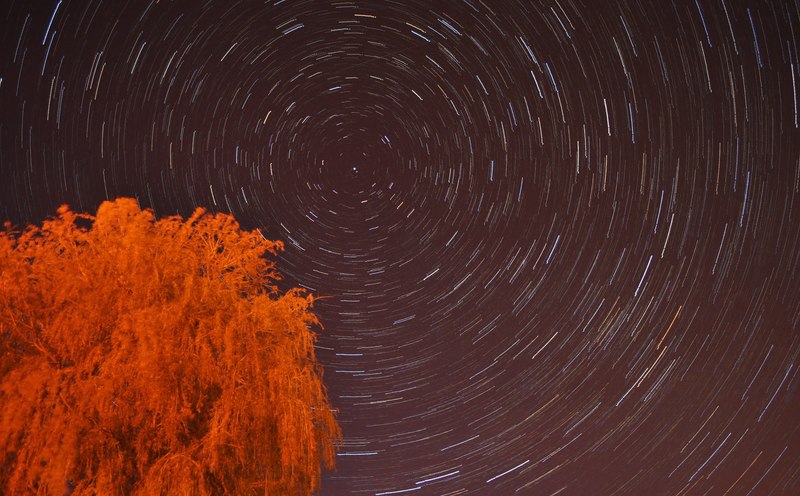
Credit: Ashley Dace
While many people know Polaris by reputation, fewer realize that it is not a single star but a multiple-star system. The primary star, Polaris Aa, is a yellow-white supergiant and a recognized classical Cepheid variable—a type of pulsating star pivotal to measuring cosmic distances. Polaris also has at least two companions: a close, faint partner (Polaris Ab) and a more distant companion (Polaris B) visible in small telescopes under steady seeing.
Polaris is part of the constellation Ursa Minor (the Little Bear), marking the end of the Little Dipper’s handle. Its special role in the sky comes down to geometry: the tilt and slow wobble of Earth’s axis, a motion known as axial precession, periodically bring different stars close to the celestial pole across millennia. In our time, Polaris is the closest bright star to that pole, making it extraordinarily useful for orientation, alignment, and instruction in basic positional astronomy. If you want to learn how to locate and use it for direction, see Practical Navigation and Observing Polaris.
Where to Find Polaris in the Night Sky
Polaris is almost directly due north for observers in the northern hemisphere. Its declination is close to +89°, putting it less than a degree from the North Celestial Pole. For most practical purposes, if you face true north and look up to a height roughly equal to your latitude, you will be looking near Polaris. For example, at 40° N latitude, Polaris will appear about 40° above the northern horizon.
However, finding Polaris is easiest through star-hopping from familiar asterisms. Two classic methods are widely taught to beginners and remain the quickest ways to get oriented:
- From the Big Dipper (Ursa Major): Draw a line from the bowl’s outer edge through the two “pointer stars,” Merak and Dubhe. Extend that line about five times the distance between them—this takes you straight to Polaris. In many seasons and mid-northern latitudes, the Big Dipper is bright and obvious, making this a dependable technique.
- From Cassiopeia (the W-shape): If the Big Dipper is low or hard to see, turn to Cassiopeia’s distinctive W or M shape on the opposite side of Polaris. The star opposite the center of the W points roughly toward Polaris. This works particularly well in autumn and early winter when Cassiopeia is high.

Credit: Internet Archive Book Images
As a reference point, Polaris is the tip of the Little Dipper’s handle. The rest of the Little Dipper is composed of fainter stars, which can be washed out by light pollution. If you cannot see the full Little Dipper, don’t worry—Polaris and perhaps one or two of its nearest neighbors may be all that’s visible in bright urban skies. Once you’ve found Polaris, you are oriented. For more detailed star-hopping tips and a simple ASCII diagram, skip ahead to Observing Polaris.
Notably, Polaris never rises or sets for observers sufficiently far north; it is circumpolar, always above the horizon. For all observers south of the equator, Polaris never rises—it remains permanently below the horizon. If you observe near the equator, it hovers very close to the northern horizon and can be challenging due to haze and extinction. These visibility constraints are critical when using Polaris for field navigation; for regions beyond its visibility, other methods are necessary. To learn why its position changes so slowly over centuries, see Earth’s Precession and Past/Future North Stars.
Brightness and Variability: Polaris as a Classical Cepheid

Credit: Heyzeuss
Polaris is famous for being steady in direction, but not strictly steady in brightness. Its primary star, Polaris Aa, is a classical Cepheid variable, a pulsating supergiant whose periodic changes in radius and temperature subtly alter its luminosity. Cepheids occupy a well-defined region of the Hertzsprung–Russell (H–R) diagram known as the instability strip, where partial ionization zones in the stellar envelope drive rhythmic pulsations.
Key facts about Polaris’s variability:
- Period: Approximately 3.97 days. Polaris brightens and dims on roughly this timescale, though the amplitude is small compared to many other Cepheids.
- Amplitude: Historically low and variable. The amplitude fell to just a few hundredths of a magnitude late in the 20th century and has since shown changes at similarly small levels. For unaided eyes, Polaris looks essentially constant.
- Apparent Magnitude: Around +2.0 on average, varying by a few hundredths to tenths of a magnitude over the pulsation cycle. This places Polaris among the brighter stars in the sky, but it is far from the brightest; for instance, Sirius is about magnitude −1.46.
A remarkable aspect of Polaris is how its pulsation characteristics have evolved over decades of study. The pulsation period itself has shown a slow drift over time—on the order of a few seconds per year—consistent with changes in the star’s interior structure as it evolves. The small amplitude makes Polaris a valuable laboratory for understanding the low-amplitude end of Cepheid behavior and for testing models of stellar evolution as supergiants cross the instability strip.
From a cosmological perspective, Cepheid variables are crucial because of the period–luminosity (P–L) relation, which links pulsation period to intrinsic luminosity. Although Polaris is bright and relatively nearby, it presents certain challenges for calibration work due to the small amplitude of its pulsations and complexities related to its companions. Nevertheless, as a Cepheid close to Earth, it is deeply woven into the tapestry of distance-scale studies and stellar astrophysics.
In short, while Polaris’s position in the sky seems unwavering, its interior is literally breathing with a steady beat of a few days, a reminder that even the most dependable guidepost in the sky is a dynamic, evolving star.
How Far Away Is Polaris? Distance and Physical Properties
Polaris is roughly 430–440 light-years away from Earth, a distance broadly consistent with modern astrometric measurements. Parallax observations by space missions have refined our understanding, although the brightest stars can pose challenges for some instruments due to saturation and systematics. The consensus places Polaris at a distance near a few hundred light-years, and a commonly cited value is about 433 light-years (approximately 133 parsecs).
Polaris is a multiple-star system composed of at least three stars:
- Polaris Aa: An F-type (roughly F7 Ib) yellow-white supergiant. This is the Cepheid variable responsible for the observed pulsations. As a supergiant, it has a radius tens of times that of the Sun and shines thousands of times more brightly in total energy output.
- Polaris Ab: A close, faint companion detected via high-resolution techniques. It orbits fairly near the primary and is too close to be easily split by backyard telescopes.
- Polaris B: A more distant companion (an F-type main-sequence star) discovered telescopically in the 18th century. It lies about 18 arcseconds from Polaris Aa and, under steady seeing, can be observed with small to medium amateur instruments at moderate magnifications.
Together, these stars form a bound system and have been the subject of detailed studies to constrain masses and orbits. Determining accurate stellar masses for Cepheids like Polaris is particularly valuable, as it can test and refine stellar evolution models and pulsation theory. The proximity of the Polaris system makes it one of the best laboratories for such work.
Additional physical characteristics of the primary:
- Spectral Type: F-type supergiant (commonly classified near F7 Ib), indicating a relatively hot star compared to the Sun, with a yellow-white hue.
- Effective Temperature: Typical of F-type supergiants, around 6000–6500 K, though the exact value depends on the pulsation phase.
- Luminosity: Thousands of times the Sun’s total luminosity, again depending on pulsation phase and detailed calibrations.
- Radius: Tens of solar radii, varying slightly during the pulsation cycle as the star expands and contracts.
Beyond its intrinsic properties, Polaris’s celestial coordinates give it special status. Its right ascension and declination shift slowly due to proper motion and the precessional motion of Earth, but a rough J2000 position often cited is around RA 02h 31m and Dec +89°. Regardless of the epoch, its declination stays near +90°, anchoring it in the extreme northern sky and ensuring its enduring value to navigators and observers alike. For the implications of axial precession on Polaris’s status, see Earth’s Precession and Past/Future North Stars.
Practical Navigation: Using Polaris for Direction and Latitude
Polaris has guided travelers across oceans and deserts, as well as hikers and astronomers closer to home. Its utility stems from a simple geometric truth: the altitude of Polaris (its angle above the horizon) is roughly equal to your latitude in the northern hemisphere. Because Polaris is within about a degree of the true pole, this makes it a precise yet accessible tool for orientation.
Here’s how to leverage Polaris effectively:
- Find true north: Once you locate Polaris (see Where to Find Polaris), face it. You are now facing true north within about a degree, depending on the current offset of Polaris from the pole and any local horizon irregularities.
- Estimate your latitude: Measure the altitude of Polaris above your horizon. A simple inclinometer, a smartphone clinometer app, or a sextant can all work. The reading is a close approximation of your latitude (N), subject to a small correction.
- Account for small errors: Polaris is not exactly at the pole; its offset is currently well under 1°. It will be closest around the early 2100s. Near the horizon, atmospheric refraction can lift objects slightly, introducing small errors. For field use, though, the method is accurate enough.
// Face Polaris ≈ face true north
// Altitude of Polaris ≈ your latitude (N)
// Example: If Polaris is 52° above the horizon, latitude ≈ 52° N
Credit: Internet Archive Book Images
Mariners historically combined Polaris altitude with tables to refine latitude estimates. On land, hikers and campers can use the same principle for rough orientation without a compass. Amateur astronomers also rely on Polaris for polar aligning equatorial mounts. Because Polaris is slightly offset from the true pole, many polar scopes provide a reticle pattern showing where to place Polaris relative to the pole for accurate alignment. The reticle’s placement depends on the date and time, reflecting how Polaris traces a tiny circle around the NCP.
Why is Polaris not exactly at the pole? Two main reasons: Earth’s axis slowly wobbles due to gravitational torques (see precession), and stars themselves have proper motions—their own motions through space relative to the Sun. The combined effect means the identity of the “North Star” is not permanent across millennia.
For celestial navigation enthusiasts or those aligning telescopes, understanding Polaris’s small angular offset matters. For more on how astronomers capitalize on its near-polar placement, including alignment workflows and practical tips in light-polluted skies, continue to Observing Polaris.
Observing Polaris: Equipment, Techniques, and Star-Hopping
Observing Polaris is rewarding for both beginners and seasoned skywatchers. Its brightness and fixed position make it an anchor for learning the sky, calibrating equipment, and testing seeing conditions. Even when the rest of the Little Dipper is washed out, Polaris usually shines through. Below are techniques and tips to get the most from this star system.
Unaided Eye and Binocular Observing
With the naked eye, Polaris is a bright point that scarcely moves as the hours pass, aside from tracing a tiny circle around the NCP over a day. If you mark its position relative to foreground objects and revisit it later, you can get a visceral sense of Earth’s rotation and the daily motion of the sky.
Handheld binoculars (7×50 or 10×50) reveal a richer context: faint nearby stars of Ursa Minor and sometimes Polaris B under good conditions. While Polaris B is separated by about 18 arcseconds, it generally requires a telescope and steady air to split reliably; binoculars may show only the primary’s glow.

Credit: Kevin Hadley
Backyard Telescopes and Splitting Polaris B
With a small telescope (e.g., 80–100 mm refractor or a 4–6 inch reflector) under decent seeing, you can often detect Polaris B as a faint companion star offset from the glittering primary. Moderate magnifications (100×–150×) help by separating the two stars enough to counteract the primary’s glare. Patience with focus, cooling, and seeing conditions pays dividends. Observing from sites with calm air, even if light-polluted, can sometimes be better than darker sites with unsteady seeing.
Polaris Ab, the close and faint companion, remains beyond visual reach for most amateur instruments and requires advanced imaging or space-based observatories to resolve. Don’t be disappointed—Polaris B is a satisfying and achievable target, particularly for developing skills in star-hopping and evaluating atmospheric steadiness.
Star-Hopping: Two Reliable Paths to Polaris
When the Big Dipper is visible, use its pointers. When it is low in the sky or seasonally awkward, switch to Cassiopeia.
Big Dipper method:

     Dubhe (*)        Polaris (*)
        |
        |                 |
     Merak (*)-----------/ (extend 5× the Merak–Dubhe gap)

Cassiopeia method:

   Cassiopeia (W)            Polaris (*)
      *   *                     ^
       * *                      |
        *                       (Opposite side of the sky from Big Dipper)
Polar Alignment for Astrophotography
For equatorial mounts, aligning on the true NCP is crucial to minimize field rotation during long exposures. Because Polaris is offset from the pole, polar scopes include a reticle to place Polaris at the correct position relative to the NCP at a given time and date. Software-assisted alignment (e.g., via plate solving) can refine this further, but Polaris remains the starting reference point for many setups. If you’re curious about how Polaris’s variability might affect imaging, the effect on single exposures is negligible due to its small amplitude; its main role is geometric, not photometric. For a deeper dive into how its pulsations inform stellar physics, see Brightness and Variability.
Practical Tips
- Urban observing: Polaris is usually visible even from city centers. Stray light and heat plumes can degrade seeing, though—try to observe away from rooftops and asphalt where possible.
- Stability before magnification: To split Polaris B, prioritize steady seeing and precise focus over raw magnification. Often 120× with excellent focus beats 200× in turbulent air.
- Check transparency: Near the horizon, haze can complicate matters. If you observe from lower latitudes (Polaris lower in the sky), wait for nights of good transparency.
- Reticle familiarity: If using a polar scope, familiarize yourself with the manual’s reticle diagram. Practice during twilight while the sky is still bright enough to see markings but dark enough to spot Polaris.
Cultural History: Myths, Names, and Navigation Lore
Polaris has accumulated layers of names and meanings across cultures. The Latinized Polaris means “of the pole,” while Stella Polaris and Polaris Australis historically distinguished the northern and southern pole stars (the latter referring to different stars at different times, not a direct analog to Polaris today). The Greek-derived Cynosure (“dog’s tail”) evokes its role as a guiding point, while “North Star” and “Pole Star” are common English terms. In Northern European lore and across maritime cultures, it has symbolized steadfastness, guidance, and orientation.
Long before magnetic compasses became widespread in navigation, Polaris was a dependable marker of true north. Its height above the horizon provided a direct read on latitude, invaluable for seafaring peoples who navigated by the stars. Medieval and early modern mariners routinely measured Polaris’s altitude with simple sighting instruments and consulted tables to correct for its small offset from the true pole and for refraction near the horizon.
Because Polaris hardly shifts while every other star wheeled by, countless travelers came to view it as the sky’s anchor. In practical terms, it was—and remains—a natural compass rose etched onto the night sky.
As astronomical knowledge systematized in the Renaissance and Enlightenment eras, the Little Dipper and Ursa Minor were standardized in star atlases, and Polaris’s formal catalog designations (including Alpha Ursae Minoris) became universal. In the 18th century, telescopes revealed the fainter companion Polaris B, expanding our view from a guiding point to a dynamic system of stars. Today, Polaris features prominently in everything from scout handbooks to astrophysics papers, bridging practical skycraft with frontiers of scientific research.
Earth’s Precession and Past/Future North Stars

Credit: Pablo Carlos Budassi
Earth does not point at Polaris forever. Our planet’s rotation axis traces a slow, conical motion in space—axial precession—with a period of roughly 26,000 years. This gradual wobble shifts the celestial poles against the stellar background, which means that, over millennia, different stars assume the role of “pole star.”
Key milestones of past and future pole stars:
- Past North Star — Thuban (Alpha Draconis): Around 2700 BCE, Thuban in Draco lay near the NCP and served as the ancient world’s North Star. It is considerably fainter than Polaris.
- The “Guardians of the Pole” — Kochab and Pherkad: For centuries around the first millennium BCE, Beta and Gamma Ursae Minoris bracketed the pole and were used as reference markers. They were never as close to the NCP as Polaris is today, but they stood out helpfully in the sky.
- Current Era — Polaris: Presently less than a degree from the NCP, Polaris is closer to the pole than these earlier candidates and is particularly conspicuous due to its brightness.
- Future North Stars: Due to ongoing precession, the NCP will drift away from Polaris. In a few millennia, Gamma Cephei (Errai) will come close to the pole, and in roughly 12,000 years, Vega in Lyra will be nearer the NCP than it is today, though not perfectly centered.
Throughout this cycle, Polaris’s apparent position traces a tiny skyward circle around the NCP over a single day, but over centuries the NCP itself migrates, drawing a much larger circle around the ecliptic pole. This is why, when aligning a telescope, a date and time–dependent reference is needed for precise polar alignment, and why lists of “pole stars” change across epochs. To understand how this plays into today’s practical use of Polaris, see Practical Navigation and Observing Polaris.
Astrophysical Significance: What Polaris Teaches Us
Beyond serving as a stellar compass, Polaris is a prized astrophysical target. Its status as a nearby classical Cepheid—and as a member of a multiple-star system—provides a rare combination of attributes for testing theories of stellar structure, pulsation, and evolution.
Cepheid Pulsations and the Instability Strip
Cepheid variables like Polaris pulsate due to opacity changes in their outer layers, driven by partial ionization of helium. When the star compresses, temperature and opacity rise, trapping heat and causing pressure to build until the star expands. As it expands, the outer layers cool and become more transparent, allowing heat to escape and the star to contract again. This self-regulating cycle produces a stable rhythm of brightening and dimming, which is reflected in both light curves and radial velocity measurements.
Polaris’s relatively low pulsation amplitude and long-term period changes provide data to test models of how supergiants evolve across the instability strip—whether the star is on its first, second, or third crossing affects the expected direction and rate of period change. Sensitive, long-term monitoring helps distinguish among scenarios by tracking how the pulsation period drifts over time.
Calibrating the Cosmic Distance Scale
Cepheids underpin a key rung of the cosmic distance ladder via the period–luminosity relation. While Polaris’s small amplitude and multiple-star system complicate some calibrations, its proximity and brightness make it valuable for parallax measurements and for constraining system parameters like mass and luminosity. Combined with data from other Cepheids, Polaris contributes to refining absolute magnitudes and reducing uncertainties in distances to nearby galaxies where Cepheids can be resolved.
Binary Dynamics and Stellar Masses
Because Polaris is a multiple system, dynamical measurements can in principle yield robust mass estimates for the primary. Accurate masses are vital inputs for stellar models, which must also reproduce the observed pulsation period and amplitude. Tracking orbital motions of Polaris Ab and B over time, along with spectroscopy of the primary, helps disentangle system geometry and component masses. These efforts sharpen constraints on evolutionary state, interior structure, and energy transport mechanisms in supergiants.
Why Small Amplitude Still Matters
One might think a low-amplitude Cepheid is less informative than a large-amplitude analogue. In practice, the opposite can be true for certain questions. Subtle pulsators like Polaris probe the threshold physics of the instability strip, including how convection, opacity, and ionization zones interact to set oscillation amplitude. Such stars help map the edges of the instability strip and test predictions of how metallicity and mass influence pulsation behavior.
Observationally, precise photometry and spectroscopy of bright, nearby Cepheids enable long-term monitoring at high cadence. Even a few hundredths of a magnitude, tracked accurately over decades, becomes a powerful diagnostic. These data, when combined with astrometric baselines and interferometric angular diameter measurements, give a multi-pronged view of how a supergiant breathes and evolves.
Common Misconceptions About Polaris
Despite its fame, Polaris is often surrounded by myths. Here are clarifications grounded in observational astronomy:
- “Polaris is the brightest star in the night sky.” False. Polaris is bright but not the brightest; Sirius holds that title. Polaris averages around magnitude +2.0.
- “Polaris sits exactly at the North Celestial Pole.” Not exactly. It’s within a degree of the pole today and will be closest around the early 2100s. For practical navigation, it’s close enough, but precision alignment requires accounting for the offset.
- “You can see Polaris from anywhere on Earth.” No. Polaris never rises for observers south of the equator. At the equator, it sits at the horizon and is generally difficult to observe due to atmospheric effects.
- “Polaris doesn’t move at all.” Relative to the rest of the sky, it barely moves, tracing a small circle around the NCP over 24 hours. Over centuries, its position changes more due to Earth’s precession.
- “Polaris’s variability is obvious to the eye.” Typically not. Its Cepheid amplitude is small, and you need careful photometry to detect its periodic changes reliably.
If you want to dig deeper into why Polaris is a Cepheid at all and how its pulsations work, revisit Brightness and Variability. For practical techniques to find it under different sky conditions, see Where to Find Polaris in the Night Sky and Observing Polaris.
Frequently Asked Questions
How accurate is Polaris for finding true north and latitude?
Polaris provides a very good approximation for true north and for latitude in the northern hemisphere. Its current offset from the North Celestial Pole is well under a degree, which means that for field navigation and general orientation it is more than sufficient. For tasks requiring arcminute precision—such as long-exposure astrophotography or precise surveying—you should account for the exact offset using a polar scope reticle or software-assisted alignment. Keep in mind that atmospheric refraction can slightly affect altitude measurements, especially near the horizon, and that your local horizon’s irregularities can introduce small errors.
Can I see Polaris from the southern hemisphere at all?
No. Polaris lies almost exactly over the northern hemisphere and never rises for observers south of the equator. At the equator (0° latitude), Polaris would appear on the northern horizon and is generally very difficult to see. As you move northward, it climbs higher in the sky by one degree for each degree of latitude. Observers in the southern hemisphere use other methods and asterisms—such as the Southern Cross (Crux) and the two “Pointers”—to find the south celestial pole.
Final Thoughts on Understanding Polaris, the North Star
Polaris stands at a rare crossroads of accessibility and scientific richness. To backyard observers, it is a steadfast anchor point for learning constellations, for finding true north, and for aligning telescopes. To navigators and hikers, it provides a practical, equipment-light way to orient in the field. To astronomers and astrophysicists, its subtle but steady pulsations, proximity, and multi-star dynamics turn it into a critical data point for models of stellar structure and for the cosmic distance scale.
While its reign as the North Star is temporary on geologic timescales, Polaris is exceptionally well placed and bright in our era, making it one of the easiest and most instructive stars to teach and to learn. If you are starting out in stargazing, make Polaris your first waypoint—use the Big Dipper’s pointers or Cassiopeia’s “W,” then practice night after night until it becomes second nature. From there, you can expand outward to the circumpolar constellations and beyond.
Key takeaways:
- Polaris is a nearby classical Cepheid and part of a multiple-star system, valuable to both observers and researchers.
- Its altitude approximates your latitude in the northern hemisphere, and facing Polaris aligns you close to true north.
- It’s an excellent visual anchor for star-hopping and for polar alignment in astrophotography, with small offsets from the true pole to consider for precision work.
- Earth’s precession ensures that Polaris’s role changes over millennia; it is one chapter in a long story of shifting pole stars.
If you found this guide helpful, explore more of our constellation and stellar profiles, and subscribe to our newsletter for future deep dives into the night sky—from practical observing tips to the latest in stellar astrophysics. Clear skies!