
Table of Contents
- What Is the Orion Constellation? Shape, Location, and Signposts
- When and Where to See Orion Throughout the Year
- Orion’s Bright Stars and Asterisms: Belt, Sword, and Supergiants
- Stellar Evolution Stories Written Across Orion
- Inside the Orion Nebula and the Orion Molecular Cloud Complex
- Deep-Sky Observing Guide: Easy Targets to Advanced Challenges
- Astrophotography in Orion: Planning, Gear, and Processing Tips
- Cultural History and Star Names Linked to Orion
- Meteor Showers and Celestial Navigation with Orion
- Frequently Asked Questions
- Final Thoughts on Choosing the Right Orion Observing Plan
What Is the Orion Constellation? Shape, Location, and Signposts
Few regions of the night sky are as instantly recognizable as Orion, the Hunter. Centered roughly near right ascension 5 hours and declination 0°, Orion straddles the celestial equator. That makes it visible from most inhabited parts of Earth for at least part of the year, and it appears prominently in evening skies during local winter (Northern Hemisphere) and summer (Southern Hemisphere). The constellation covers a generous patch of sky—on the order of several hundred square degrees—so even casual stargazers can recognize its pattern of bright stars and distinctive lines.
Orion’s shape, at once compact and expansive, is marked by three near-aligned stars forming the famous “Belt.” Hanging below is the “Sword,” a short line that includes a fuzzy star to the unaided eye—that glow belongs to the Orion Nebula (Messier 42). Two luminous corner stars—orange-red Betelgeuse and brilliant blue-white Rigel—anchor Orion’s shoulders and knees, forming a striking color contrast even under modest light pollution.

Artist: Rogelio Bernal Andreo
Because Orion sits near the Milky Way’s local spiral feature known as the Orion Arm (also called the Local Spur), this part of the sky contains a tapestry of star-forming clouds, bright emission nebulae, reflection nebulae, and young clusters. For observers, it’s a convenient “sky classroom”: you can learn stellar colors, brightness scales, nebular varieties, and the steps of star-hopping all within a single, easily spotted constellation.
In this in-depth guide we’ll explore Orion’s brightest stars and asterisms, the star-forming regions inside the Orion Molecular Cloud Complex, seasonal visibility tips, deep-sky challenges, astrophotography strategies, cultural history, and more. Along the way, we’ll link related sections so you can jump directly to detail-rich topics—look for inline pointers such as “see Deep-Sky Observing Guide.”
When and Where to See Orion Throughout the Year
Because Orion lies along the celestial equator, skywatchers north and south of Earth’s equator can enjoy the constellation. Its prominence and orientation vary by season and hemisphere:
- Northern Hemisphere evening skies: Orion rises in the east during late autumn, dominates the south on winter evenings (roughly December through February), and sinks into the west by spring.
- Southern Hemisphere evening skies: Orion is a summer feature (roughly December through February), arcing high overhead in mid to low southern latitudes and appearing “upside down” compared to typical Northern Hemisphere depictions.
In practical observing terms:
- By late October or early November, you can spot the Belt stars clearing the eastern horizon in the evening for mid-northern latitudes. Each week, Orion rises about 30–40 minutes earlier.
- From December to January evenings, Orion is well placed for extended observing sessions. The constellation culminates—crosses the local meridian—around midnight in December and around 8–9 p.m. in January (mid-northern latitudes), providing dark-sky hours on either side of its peak altitude.
- By March, Orion drops into the western evening sky after twilight and sets earlier with each passing week.
Altitude and visibility depend on your latitude. Near the equator, Orion travels nearly overhead, giving superb views and minimal atmospheric distortion. Farther north, Orion skims lower in the south, but the bright guide stars remain easy to pick out even from urban areas. If your observing site suffers from horizon haze or light domes, wait until Orion climbs above 30° altitude for better clarity, especially when attempting fainter nebulae in the Deep-Sky Observing Guide.
Light pollution strongly affects views of diffuse nebulae and the Milky Way backdrop but has less impact on bright stars like Rigel and Betelgeuse. Under suburban skies (Bortle class 5–6), you can still spot the Belt, Sword, and the core of the Orion Nebula. In rural skies (Bortle 3–4 and darker), Orion reveals far more structure, including extended nebulosity around M42 and the Running Man Nebula. Visit the Astrophotography section for filter and planning advice tailored to different sky conditions.
Orion’s Bright Stars and Asterisms: Belt, Sword, and Supergiants
Orion’s star pattern is compact and vivid, making it a staple in beginner sky tours.
Corner stars and color contrast
- Betelgeuse (Alpha Orionis): The reddish star marking the Hunter’s right shoulder is a red supergiant with a cool surface temperature compared to blue stars. Its distance has uncertainties because of its size and complex atmosphere, but current estimates place it roughly within the 500–700 light-year range. Betelgeuse is semiregularly variable and famously experienced the “Great Dimming” in 2019–2020, likely caused by a combination of surface activity and a dust cloud from a stellar outburst, before returning to near-normal brightness.
- Rigel (Beta Orionis): The blue-white knee star opposite Betelgeuse is a luminous blue supergiant, one of the brightest stars in the night sky. Rigel is about 860 light-years away (approximate) and part of a multiple-star system; observers with moderate apertures and steady seeing can sometimes split a fainter companion.
- Bellatrix (Gamma Orionis): The “Amazon Star” marks Orion’s left shoulder. A hot blue giant, it appears slightly fainter than Betelgeuse and Rigel and lies roughly a couple hundred light-years away. Its crisp blue-white hue is noticeable in binoculars.
- Saiph (Kappa Orionis): Diagonally opposite Bellatrix, Saiph is another blue supergiant forming Orion’s right knee. Though less celebrated than Rigel, it contributes to the constellation’s trapezoid frame and has a similarly hot surface temperature.
The Belt: Alnitak, Alnilam, and Mintaka
The short, nearly straight line at Orion’s waist is among the most famous asterisms in the sky:
- Alnitak (Zeta Orionis), on the eastern end, is a multiple system including hot O-type stars. It sits near bright emission and reflection nebulae like the Flame Nebula (NGC 2024) and the famous Horsehead silhouette (Barnard 33), discussed in Inside the Orion Nebula and the Orion Molecular Cloud Complex.
- Alnilam (Epsilon Orionis) is a luminous blue supergiant roughly in the middle of the Belt, radiating intense energy that illuminates nearby dust as reflection nebulosity.
- Mintaka (Delta Orionis), on the western end, is also a multiple star. Small telescopes can reveal its complexity under steady skies.
Together, these three stars are relatively young and very hot, dominating their neighborhoods with energetic ultraviolet light that powers nearby emission nebulae. Their distances are on the order of many hundreds to more than a thousand light-years, emphasizing that the Belt is not a chance lineup of nearby stars but part of a broader, physically meaningful stellar association.
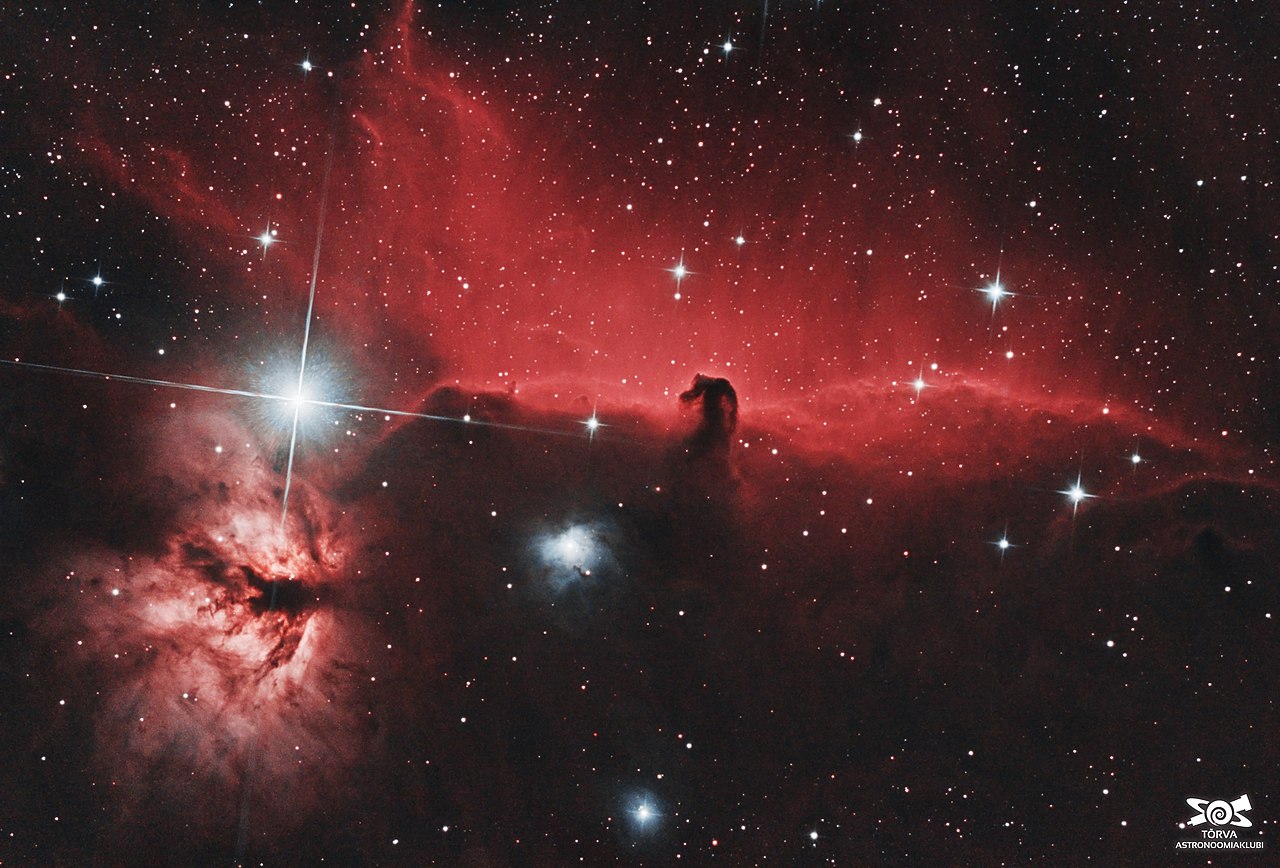
Artist: Taavi Niittee
The Sword and Orion’s nebular heart
Hanging below the Belt is the Sword—a short chain of stars and nebulae. To the unaided eye, one “star” in the Sword looks fuzzy: this is the Orion Nebula (M42), one of the nearest massive star-forming regions to Earth. Next to M42 is M43, a related patch of emission separated by a dust lane. Above them glows the Running Man Nebula (NGC 1977), a bluish reflection nebula in small telescopes and a rewarding photography target. For details on what instruments and magnifications work best, see Deep-Sky Observing Guide.
Stellar Evolution Stories Written Across Orion
Orion is a living laboratory for stellar evolution, showing multiple stages at once:
- Massive stars on the main sequence and beyond: Rigel and the Belt stars are hot, massive, and short-lived by stellar standards. Their strong winds sculpt gas and dust, shaping the glowing regions we see as emission nebulae.
- Red supergiant phase: Betelgeuse represents a later life stage of a massive star. Having exhausted hydrogen in its core, it has expanded and cooled at the surface while fusing heavier elements in shells. This phase precedes a future core-collapse supernova, though the timeline is uncertain on human timescales.
- Star birth in progress: The Orion Molecular Cloud Complex hosts active star formation. The Trapezium Cluster inside M42 contains very young, hot stars that energize their surroundings. Protostars, protoplanetary disks, and outflows (including Herbig–Haro objects) are abundant in Orion’s dark clouds.
Astronomers often group young, massive stars in Orion into sub-associations (commonly referred to as Orion OB1 groups) that trace sequential star formation over millions of years. The process runs roughly like this: dense material in a giant molecular cloud collapses to form stars; massive stars quickly heat and erode their birth clouds, compressing adjacent regions and triggering new generations of star formation. In Orion, you can see both the eroding, radiation-sculpted surfaces and the hidden nurseries still incubating future suns.
This “assembly line” of stellar birth and feedback, visible to binoculars and small telescopes, is also a prime target for professional observatories. From radio arrays that map cold molecular gas to space telescopes that pierce dusty veils in infrared and ultraviolet light, Orion yields high-resolution case studies on how clusters emerge and how massive stars influence galactic ecology. For backyard observers, it’s thrilling to know that the slight haze in your eyepiece around M42 is literally gas excited by newly minted, extremely hot stars.
Inside the Orion Nebula and the Orion Molecular Cloud Complex
Centered around the Sword and extending across a wide swath of sky, the Orion Molecular Cloud Complex is a vast, interconnected system of gas, dust, and young stars. Highlights include:
The Orion Nebula (M42) and M43
At about 1,300–1,400 light-years away (approximate range used in the literature), the Orion Nebula is the nearest region where high-mass stars are forming in large numbers. Its bright central cavity is carved by the Trapezium Cluster, a handful of hot, massive stars that pump ultraviolet light into the surrounding gas. Through binoculars, M42 appears as a small, luminous cloud. In a small telescope, you’ll begin to notice complex structure—sweeping wings, brighter knots, and darker lanes. Under darker skies and with moderate apertures (e.g., 6–10 inches/150–250 mm), the nebula’s subtle textures unfold generously.

Orion Nebula in NIRCam long-wavelength channel
This image shows the full survey of the inner Orion Nebula and Trapezium Cluster made using the NIRCam instrument on the NASA/ESA/CSA James Webb Space Telescope. This is the long-wavelength colour composite, which focuses on the gas, dust, and molecules in the region with unprecedented sensitivity in the thermal infrared.
The cavity is mostly filled with ionised gas, seen here in purple, while the surroundings have a mix of dust and molecular gas seen in reds, browns, and greens. The Bright Bay to the upper left is being eroded by the massive stars at the centre of the region and there are many pillars of gas and dust which are being carved.
This young star-forming region is just a million years old and contains thousands of new stars spanning a range of masses from 40 down to less than 0.1 times the mass of the Sun. The most massive and hottest stars in the region, notably the Trapezium in the centre, have sculpted a cavity in the surface of the giant molecular cloud from which they were born, which can be readily seen in this image.
The Orion Nebula lies roughly 1300 light-years from Earth in the so-called ‘sword’ of the constellation of Orion the Hunter, and the image shows a region that is 4 by 2.75 light years in size.
Image description: An image of a young star-forming region filled with with wispy purple, green, and red nebulosity. The purple ionised gas is seen mostly towards the centre, with browns, greens, and reds behind, while the periphery is mostly bright green and darker brown to the left. There is a large spray of yellow, orange, red, and purple towards the top centre, and the nebula fades to near black to the right. There are thousands of stars sprinkled across the field, concentrated towards the centre, but they generally appear fainter at longer wavelengths, with some exceptions. The brightest sources in the field have extensive diffraction spikes characteristic of Webb.
Artist: (c) NASA, ESA, CSA / Science leads and image processing: M. McCaughrean, S. Pearson, CC BY-SA 3.0 IGO
Just to the north, separated by a dust lane, is M43 (De Mairan’s Nebula), a bright patch that is part of the same physical complex. Observers often note M43’s curved appearance around a central star. UHC and O-III filters can enhance contrast in both M42 and M43, especially from suburban skies. See Deep-Sky Observing Guide for filter guidance.
The Running Man Nebula (NGC 1977) and NGC 1981
Above M42/M43 lies the reflection nebula NGC 1977, known colloquially as the Running Man. Its blue-tinged sheen is light from hot stars scattered off dust, making broadband light-pollution filters less effective than for emission nebulae. The adjacent open cluster NGC 1981 provides a pleasing wide-field pairing for binoculars and small telescopes.
The Flame Nebula (NGC 2024) and the Horsehead (Barnard 33)
East of the Belt’s leftmost star, Alnitak, sits the glowing Flame Nebula (NGC 2024), its dark river-like lane splitting bright gas into petal-like segments. Just south of Alnitak lies the iconic Horsehead Nebula (Barnard 33), a dark nebula silhouetted against the emission region IC 434. The Horsehead is notoriously challenging visually: it demands very dark, transparent skies, stable seeing, low magnification for wider exit pupils, and typically an H-beta filter. The Flame, by contrast, is within reach of small to moderate apertures under suburban-to-dark skies and brightens considerably with a UHC filter.
Barnard’s Loop and the wider complex
Spanning a vast arc across Orion is Barnard’s Loop, a faint, dusty and gaseous structure best captured in wide-field astrophotography using narrowband filters. It is thought to be associated with past massive-star activity in Orion. This giant arc, together with the Lambda Orionis ring around the star Meissa (at the head of Orion), hints at the powerful forces and feedback cycles shaping Orion over millions of years.
Beyond these eye-catching highlights, the complex includes the long Orion A and Orion B molecular clouds, hosting clusters of protostars, jets, and infalling envelopes. Infrared observations reveal populations of young stellar objects (YSOs) invisible in visible light, giving astronomers a more complete census of emerging stars and protoplanetary disks. The Orion Nebula’s famous “proplyds” (protoplanetary disks) showcase the early phases of potential planet formation, sculpted by intense ultraviolet radiation from nearby massive stars.
Deep-Sky Observing Guide: Easy Targets to Advanced Challenges
Orion offers targets for every level of experience and every instrument, from naked-eye viewing to advanced telescopic pursuits. Below is a tiered roadmap you can use for solo sessions or to lead a star party. When planning, note your sky brightness (Bortle class), transparency, seeing, and altitude of the targets. Use red-light preservation for night vision and give your eyes 20–30 minutes to dark-adapt.
Start with the naked eye
- Spot the Belt and Sword: The Belt’s trio is unmistakable. Look for the Sword’s middle “star” appearing fuzzy—that’s the Orion Nebula. In dark skies, you might glimpse hints of nebulosity around the Sword unaided.
- Color contrast: Compare the cool, orange-red hue of Betelgeuse with the steely blue-white of Rigel. Color perception improves as your eyes dark-adapt.
- Star pathfinding: Extend a line through the Belt stars down and left (southeast, for Northern Hemisphere observers) to find Sirius, the brightest star in the night sky. Extend the line the other way to reach Aldebaran and the Pleiades in Taurus—see Meteor Showers and Celestial Navigation.
Binocular delights (7×50 to 10×50)
- M42/M43: Even handheld, binoculars show the bright core of the Orion Nebula as a luminous patch. Mounting binoculars on a tripod reveals more structure and the separateness of M43.
- NGC 1981 and NGC 1977: A sweeping, pleasing duo north of M42. The Running Man’s reflection glow may be subtle; scan with averted vision.
- Collinder 70: The wide Belt region is an expansive open cluster field, great for wide-angle binoculars or rich-field refractors.
Small telescopes (60–130 mm aperture)
- Trapezium Cluster: Inside M42, try 50×–120× magnification to split the four main Trapezium stars (Theta1 Orionis). On steady nights, larger small scopes may detect additional faint companions.
- The Flame Nebula: With a UHC filter and low-to-medium power, the Flame emerges as a textured glow east of Alnitak. Shield Alnitak’s glare just outside the field if needed.
- Double stars: Split Mintaka and try for a companion to Rigel in good seeing. Sigma Orionis, a beautiful multiple system near the Horsehead area, is a favorite in small to medium apertures.
Medium to large telescopes (150–300+ mm)
- Horsehead Nebula (Barnard 33): Use a wide-field eyepiece, an H-beta filter, and averted vision from very dark sites. Start with IC 434 as a pale backdrop and look for the distinctive notch of the Horsehead.
- Fainter nebulae and knots: Explore fainter emission and reflection patches along the Sword and Belt. An O-III filter can isolate emission regions in M42’s outskirts.
- Fine structure in M42: Push magnification to 150×–250× to pick out dark lanes, ripples, and bright arcs, returning to lower power for the full panoramic view.
Filters and techniques
- UHC (Ultra High Contrast): Excellent general-purpose filter for bright emission nebulae like M42 and the Flame.
- O-III: Strongly enhances certain emission features, can help darken skyglow and reveal delicate filaments in M42.
- H-beta: The go-to for the Horsehead; also useful for broader, faint hydrogen emission features.
- Averted vision: Look slightly to the side of the target to engage more light-sensitive retinal cells.
- Shielding bright stars: Edge a bright star out of the field to reduce glare when hunting nearby faint nebulosity.

The field of view is 50° × 39°. Equatorial center coordinates are RA=4h36m and DEC=3°. North is up.
Artist: SimgDe
If you’re eager to record Orion’s vistas, skip ahead to Astrophotography in Orion for capture and processing strategies. For cultural context while you observe, see Cultural History and Star Names.
Astrophotography in Orion: Planning, Gear, and Processing Tips
From the very first test frames, Orion rewards imagers. Bright emission regions, blue reflection clouds, and inky dark nebulae combine into scenes that range from postcard-simple to research-grade complex. Whether you use a smartphone on a tripod, a DSLR on a star tracker, or a cooled astro camera, Orion offers projects at every level.
Planning and framing
- Season and timing: Aim for nights when Orion crosses the meridian during your session. Higher altitude reduces atmospheric dispersion and improves sharpness and color fidelity.
- Framing ideas:
- Wide field (24–50 mm lenses): Capture the entire constellation, the Belt and Sword, Barnard’s Loop, and surrounding constellations. Narrowband filters or dual-band filters (e.g., Hα/O-III) help from light-polluted sites.
- Moderate field (85–135 mm): Frame the Belt with the Flame and Horsehead, or isolate the Sword region including M42, M43, and the Running Man.
- Narrow field (200–600+ mm or small telescopes): Go for the core of M42 with HDR composites, the intricate structure of NGC 2024, or a deep Horsehead/IC 434 portrait.
- Moon phase: Emission targets like M42 can tolerate some lunar interference, but fainter structures (Barnard’s Loop, Horsehead) benefit from moonless nights.
Exposure strategies
- Dynamic range in M42: The Trapezium area saturates quickly. Create an HDR blend by capturing short sub-exposures (e.g., 5–20 seconds) for the core and longer subs (e.g., 60–300 seconds, depending on tracking and sky brightness) for the faint outer nebulosity. Combine during processing.

Here’s an image I captured this last week of the Orion Nebula M42. Everyone who has done any astronomy is probably quite familiar with this star-forming region that sits in the middle of Orion’s sword. The colors will not be familiar to most people, since the colors are falsely introduced by using narrowband filters. Red represents Sii emission, green/orange represents H-alpha emission, and blue represents Oiii emissions. The most interesting photographic thing about the Orion nebula is the immense brightness dynamic range in the area. The inner core, the trapezium, can be seen well in just small fifteen second exposures in most amateur telescopes, but the outer wispy clouds took me over 16hrs of exposure to properly show. This also presents a problem in how one can show both the dim and faint at the same time, which is actually quite easily solved in post-processing using HDR composition and adaptive histogram transformations. Technical details:
Equipment:
Orion ed80tcf refractor
SBIG ST8300m CCD
Baader narrowband filters
Paramount MyT equatorial mount
Exposure:
28*1800″ Ha
35*120″ Ha
15*1800″ Oiii
30*120″ Oiii
10*1800″ SiiTotal: 30hrs
Artist: Astrofalls - Light pollution mitigation: Dual-band narrowband filters can dramatically increase contrast for emission nebulae from urban/suburban sites. Use broadband UV/IR cut for color balance with OSC cameras.
- Calibration frames: Flats are essential for Orion’s rich star fields to correct vignetting and dust motes. Darks and bias frames help reduce noise, especially in longer integrations.
Gear choices
- Tripod and tracker: A stable tripod is non-negotiable. A compact star tracker (e.g., with polar alignment) allows longer exposures and lower ISO for improved signal-to-noise.
- Optics: Fast lenses (f/1.4–f/2.8) excel for wide fields. Small apochromatic refractors (e.g., 60–100 mm) paired with a dedicated astro camera provide high-quality data for nebula close-ups.
- Focusing: Use live view on a bright star or a Bahtinov mask. Recheck focus as temperature changes.
Processing workflow
- Stacking: Integrate many sub-exposures to improve depth and reduce noise. Tools include DeepSkyStacker, Siril, AstroPixelProcessor, PixInsight, and others.
- Color calibration and gradients: Orion’s mix of emission red and reflection blue is a hallmark; careful color calibration preserves realism. Apply gradient removal to address sky glow.
- Noise reduction and sharpening: Apply these steps conservatively to avoid “plastic” textures and halos around stars. Masked processing helps protect star colors and nebular detail.
- HDR combination: Blend short- and long-exposure data with range masks to reveal the Trapezium while maintaining the faint wings of M42.
For challenging projects like the Horsehead, refer to the visual tips in Deep-Sky Observing Guide—many of the same principles (filters, field placement, patience) apply in imaging. If you’re documenting Orion’s seasonal arc or tracking the visibility of the Orionids meteor shower, see Meteor Showers and Celestial Navigation.
Cultural History and Star Names Linked to Orion
Orion’s distinctive shape has inspired stories across many cultures for millennia. In classical Greek mythology, Orion was a mighty hunter, associated with a club or shield and often depicted pursuing the Pleiades. The constellation’s bright stars carried forward through medieval astronomy and into modern catalogs, retaining many names of Arabic origin—Betelgeuse, Rigel, Bellatrix, Mintaka, Alnilam, and Alnitak—reflecting the historical arc of astronomical scholarship through the Islamic Golden Age and later European adoption.
In ancient Egyptian tradition, Orion was linked with Osiris, god of the afterlife, and the constellation’s seasonal appearances were woven into symbolic cosmology and ritual calendars. In many Indigenous sky traditions around the world, constellations incorporating Orion’s bright pattern often represented hunters, warriors, or culturally significant figures, an intuitive match to the shape’s dynamic posture. While interpretations vary, the universal visibility of Orion has ensured it remains a touchstone in both northern and southern latitudes.
Today, Orion’s names are standardized by the International Astronomical Union (IAU), but the stories still accompany outreach programs and public observing nights. Combining factual exploration—such as a telescopic tour of the Orion Nebula—with storytelling can turn a sky session into a memorable cultural and scientific experience.
Meteor Showers and Celestial Navigation with Orion
Orionids meteor shower
The Orionids peak in October and are associated with debris from Halley’s Comet. The shower’s radiant—the point in the sky from which meteors appear to originate—lies in the vicinity of Orion, typically near the raised club. Under dark skies, observers might see on the order of a couple dozen meteors per hour around peak activity, though rates vary year to year and with sky conditions. Orionids meteors tend to be swift and can leave persistent trains.
Plan your observing session after midnight when the radiant is higher in the sky, increasing the chance of long, bright streaks. A reclining chair, warm clothing, and a clear view of the sky are your best tools. Cameras with wide-angle lenses (e.g., 14–24 mm) can capture sweeping meteor trails, especially if you stack multiple frames or run continuous exposures through the night—see Astrophotography in Orion for imaging basics.
Using Orion as a celestial signpost
- Belt pointer to Sirius: Draw a line through the Belt stars toward the southeast (Northern Hemisphere perspective) to find Sirius in Canis Major, the brightest star in the night sky.
- Belt pointer to Aldebaran and the Pleiades: Extend the line in the other direction to reach Aldebaran in Taurus and onward to the Pleiades (M45).
- Nearby constellations: Orion neighbors Taurus (the Bull), Gemini (the Twins), Canis Major and Canis Minor (the Greater and Lesser Dogs), Lepus (the Hare), and Eridanus (the River). Linking these patterns can help you build a wider sky map.
Because Orion straddles the celestial equator, the constellation stands astride the celestial sphere’s midline. This makes it a useful anchor when introducing coordinate systems (right ascension and declination) to newcomers: point out that Orion’s location ensures it can be seen widely across Earth, unlike far-northern or far-southern constellations.
Frequently Asked Questions
Is Betelgeuse about to explode as a supernova?
Short answer: Not imminently on human timescales. Betelgeuse is a red supergiant nearing the end of its life and will eventually undergo a core-collapse supernova. However, “eventually” likely spans tens of thousands to perhaps 100,000 years or more. The highly publicized “Great Dimming” of 2019–2020 prompted speculation, but studies point to a surface mass ejection and dust formation, along with changes in surface temperature, as primary causes. The star recovered to near-normal brightness afterward. When Betelgeuse does explode—as far as current understanding suggests—it will be a spectacular sight but not harmful to life on Earth due to its distance.
What equipment do I need to see the Horsehead Nebula?
The Horsehead (Barnard 33) is a subtle target. Visual detection usually requires:
- Very dark skies (rural, moonless, excellent transparency).
- Moderate to large aperture (often 200 mm/8 inches or more is recommended, though skilled observers sometimes succeed with smaller under exceptional conditions).
- H-beta filter to boost contrast against the IC 434 emission background.
- Low magnification to ensure a wide exit pupil and maintain surface brightness.
Imagers can capture the Horsehead with smaller optics using long integrations and appropriate filters. For nearby, easier nebulae, start with the Flame (NGC 2024) and M42/M43; see Deep-Sky Observing Guide and Astrophotography in Orion for step-by-step advice.
Final Thoughts on Choosing the Right Orion Observing Plan
Orion rewards every observing plan—from a five-minute glance at the Belt and Sword to an all-night deep dive that teases out the faintest filaments in M42 and the shadowy notch of the Horsehead. The constellation’s balanced mix of bright guide stars, instructive stellar colors, and abundant nebulae makes it one of the best all-in-one classrooms in the night sky. If you’re just starting, begin with naked-eye and binocular tours, then graduate to small-telescope views of the Trapezium and the Flame. As your confidence grows, pursue advanced challenges like Barnard 33 or experiment with HDR imaging to capture the full dynamic range of the Orion Nebula.

At approximately 1375 light-years away, the Horsehead—visible as a dark cloud shaped like a horse’s head—is the closest giant star-forming region to Earth. It sits just to the south of star Alnitak, the easternmost of Orion’s famous three-star belt, and is part of the vast Orion molecular cloud.
Many other telescopes have taken images of the Horsehead Nebula, but none of them are able to create such a sharp and wide view as Euclid can with just one observation. Euclid captured this image of the Horsehead in about one hour, which showcases the mission’s ability to very quickly image an unprecedented area of the sky in high detail.
[Technical details: The data in this image were taken in just five hours of observation. This colour image was obtained by combining VIS data and NISP photometry in Y and H bands; its size is 8800 x 8800 pixels. VIS and NISP enable observing astronomical sources in four different wavelength ranges. Aesthetics choices led to the selection of three out of these four bands to be cast onto the traditional Red-Green-Blue colour channels used to represent images on our digital screens (RGB). The blue, green, red channels capture the Universe seen by Euclid around the wavelength 0.7, 1.1, and 1.7 micron respectively. This gives Euclid a distinctive colour palette: hot stars have a white-blue hue, excited hydrogen gas appears in the blue channel, and regions rich in dust and molecular gas have a clear red hue. Distant redshifted background galaxies appear very red. In the image, the stars have six prominent spikes due to how light interacts with the optical system of the telescope in the process of diffraction. Another signature of Euclid special optics is the presence of a few, very faint and small round regions of a fuzzy blue colour. These are normal artefacts of complex optical systems, so-called ‘optical ghost’; easily identifiable during data analysis, they do not cause any problem for the science goals. ]
[Image description: This square astronomical image is divided horizontally by a waving line between a white-orange cloudscape forming a nebula along the bottom portion and a comparatively blue-purple-pink upper portion. From the nebula in the bottom half of the image, an orange cloud shaped like a horsehead sticks out. In the bottom left of the image, a white round glow is visible. The clouds from the bottom half of the image shine purple/blue light into the upper half. The top of the image shows the black expanse of space. Speckled across both portions is a starfield, showing stars of varying sizes and colours. Blue stars are younger and red stars are older.]
Artist: ESA/Euclid/Euclid Consortium/NASA image processing by J.-C. Cuillandre (CEA Paris-Saclay) G. Anselmi
To keep learning, revisit sections tailored to your interests: explore Orion’s star formation narrative in Stellar Evolution Stories, refine your visual technique in the Deep-Sky Observing Guide, and hone your imaging workflow in Astrophotography in Orion. Clear skies are never guaranteed, but Orion returns each year—make a plan, adapt to conditions, and let the Hunter guide you to a deeper understanding of the cosmos.
If you enjoyed this guide, consider subscribing to our newsletter to get notified about new observing articles, seasonal sky tours, and in-depth explainers on constellations, stars, and deep-sky imaging. Explore related topics in our archive and share your favorite Orion observations with the community.