
Table of Contents
- What Is the Orion Constellation? Pattern, Myth, and Science
- How to Find Orion in the Night Sky by Season and Latitude
- Bright Stars of Orion: Betelgeuse, Rigel, and the Belt
- Inside the Orion Molecular Cloud Complex and the Orion Nebula (M42)
- Hunting the Horsehead and Flame Nebulae near Alnitak
- Orion for Beginners: Binocular and Small Telescope Targets
- Stellar Evolution Insights from Orion: From Protostars to Supergiants
- Astrophotography Tips for Orion: Wide-Field to Deep-Sky
- Cultural and Historical Perspectives on Orion Across Civilizations
- Frequently Asked Questions
- Final Thoughts on Choosing the Right Orion Stargazing Setup
What Is the Orion Constellation? Pattern, Myth, and Science
Orion is one of the most recognizable constellations in the night sky, celebrated across cultures and seasons for its striking arrangement of bright stars and its rich tapestry of nebulae. To the naked eye, Orion forms the shape of a hunter: a distinct three-star Belt flanked by two brilliant stars—orange-red Betelgeuse (the Hunter’s shoulder) and blue-white Rigel (the Hunter’s foot). Beneath the Belt hangs the Sword, where the famous Orion Nebula (M42) resides, glowing as a hazy patch even in light-polluted skies.

Attribution: Rogelio Bernal Andreo
But Orion is more than a pattern. Astronomically, it is a window into stellar birth and death: it hosts young, forming stars in the Orion Molecular Cloud Complex and massive, evolved stars like Betelgeuse nearing the final stages of their lives. For observers, Orion is a cornerstone of winter skywatching in the Northern Hemisphere and summer evenings in the Southern Hemisphere. For scientists, it is a natural laboratory for studying star formation, protoplanetary disks, and the life cycles of massive stars.
Even if you are new to stargazing, Orion’s symmetry and brightness make it an ideal starting point. In this guide, we will cover how to locate Orion, explore its brightest stars, tour its nebulae, and gather practical tips for observing and imaging. We will also connect these observational highlights to the astrophysics that makes Orion such a fascinating constellation. If you want to jump straight to viewing advice, visit How to Find Orion and Orion for Beginners. For deeper science, see Inside the Orion Molecular Cloud Complex and Stellar Evolution Insights.
How to Find Orion in the Night Sky by Season and Latitude
Because of its bright stars and distinctive geometry, Orion is one of the easiest constellations to spot—if you know when and where to look. Here are practical, latitude-aware pointers for finding the Hunter throughout the year.
Seasonal windows
- Northern Hemisphere: Best in the evening from late fall to early spring. In December and January, Orion is high in the south around local midnight and well placed by early evening. By March, it tilts toward the west after dusk.
- Southern Hemisphere: Orion graces summer evenings. In December–February, it climbs high in the northern sky after dusk, culminating near midnight.
Where to look
- Early evening (prime months): Face south if you are in the Northern Hemisphere (north if you are in the Southern Hemisphere). Look for three bright stars in a short, straight, evenly spaced line—that’s the Belt of Orion.
- Reference stars: Above-left of the Belt (north-eastward in the sky) sits the reddish Betelgeuse; below-right (south-westward) is the bluish Rigel. These color contrasts are obvious even to the unaided eye.
Sky coordinates (approximate)
For those using star charts or astronomy apps, Orion is centered approximately around right ascension (RA) 5 hours and declination (Dec) +5 degrees. The Orion Nebula (M42) is south of the Belt at roughly:
Orion Nebula (M42)

RA ~ 05h 35m

Dec ~ -05° 23′
Star-hopping tip
If city lights make the Sword hard to see, begin with the Belt. Draw an imaginary line through the Belt downward (southward) about the same spacing as between Belt stars; a faint, misty patch marks the Orion Nebula. You can confirm with binoculars, which reveal the nebula as an extended glow even from suburban locations. For more observing details, see Orion for Beginners.
Bright Stars of Orion: Betelgeuse, Rigel, and the Belt
Orion’s visual drama owes much to its contrasting supergiants and the iconic Belt. These stars differ significantly in temperature, mass, age, and evolutionary stage, providing a vivid stellar “classroom” for observers and students alike. When you look at Orion, you are seeing stars at various distances, luminosities, and life phases all layered along our line of sight.
Betelgeuse (Alpha Orionis)
- Color and type: A red supergiant, cooler at the surface than the Sun but vastly larger in radius. Its deep orange-red tint is obvious to the naked eye.
- Brightness: Betelgeuse is a semiregular variable that has brightened and dimmed over historical records. It can vary by more than a magnitude; typical brightness is around magnitude 0.5 to 1.0. In late 2019 and early 2020, it notably dimmed, a phenomenon studied intensively.
- Distance: Estimates place it roughly in the 500–700 light-year range based on parallax measurements and modeling; exact values are challenging due to its size and variability.
- Evolutionary stage: Near the end of its life, having exhausted core hydrogen and expanded dramatically. It will eventually end as a supernova, though the timing is uncertain on astronomical timescales. For more on this, see the Frequently Asked Questions.
Rigel (Beta Orionis)
- Color and type: A blue-white supergiant, much hotter and more luminous than the Sun. Its intense blue-white hue contrasts with Betelgeuse’s warm tone.
- Brightness: Around magnitude 0.1–0.3, often vying with Betelgeuse for brightest star in Orion depending on Betelgeuse’s variability.
- Distance: Roughly 800–900 light-years away; commonly cited near 860 light-years.
- Notes: Rigel is a multiple-star system; the primary outshines its companions by a wide margin.
Bellatrix (Gamma Orionis) and Saiph (Kappa Orionis)
- Bellatrix: A hot, blue giant of around magnitude 1.6; distance roughly 240–250 light-years. It marks Orion’s other shoulder.
- Saiph: A bluish supergiant around magnitude 2.0; distance on the order of 700+ light-years, anchoring Orion’s other foot.
The Belt: Alnitak, Alnilam, and Mintaka
- Alnitak (Zeta Orionis): Hot O-type star, magnitude ~1.7; distance roughly 1,200–1,300 light-years.
- Alnilam (Epsilon Orionis): A luminous B-type supergiant, magnitude ~1.7; distance about 2,000 light-years.
- Mintaka (Delta Orionis): Multiple system, magnitude ~2.2; distance around 1,200 light-years.
Together, these Belt stars offer a convenient navigational line across the sky and a gateway to deep-sky treasures. Near Alnitak lie the Flame Nebula (NGC 2024) and the Horsehead Nebula (Barnard 33 silhouetted against IC 434). Down the Sword is M42, discussed in detail in Inside the Orion Molecular Cloud Complex.
Inside the Orion Molecular Cloud Complex and the Orion Nebula (M42)
The Orion region is a stellar nursery on a grand scale. The Orion Molecular Cloud Complex spans hundreds of light-years and harbors numerous star-forming regions, reflection nebulae, dark dust lanes, and clusters. The showpiece for observers is the Orion Nebula (M42), a vast emission nebula roughly 1,300–1,400 light-years away. Even small binoculars reveal it as a fuzzy glow; modest telescopes show structural detail and the four primary stars of the Trapezium Cluster, a tight group of hot, young stars whose intense radiation lights up the nebula.

Attribution: (c) NASA, ESA, CSA / Science leads and image processing: M. McCaughrean, S. Pearson, CC BY-SA 3.0 IGO
What you are seeing in M42
- Ionized gas (H II region): Ultraviolet light from the Trapezium’s massive stars ionizes hydrogen, causing it to emit the characteristic red glow (H-alpha) and green-blue oxygen lines (O III). Visual observers often glimpse a greenish tint under dark skies.
- Protoplanetary disks (proplyds): High-resolution imaging has revealed disks of dust and gas around young stars—potential sites of future planets. These are embedded in the nebula’s bright emission.
- Outflows and shocks: Young stars often produce bipolar jets. In nebulae like M42, these can form bow shocks and Herbig–Haro objects as they plow into surrounding gas.
Companions to M42
- M43 (De Mairan’s Nebula): Separated from M42 by a dark dust lane, this bright knot is often visible in the same low-power field.
- NGC 1977 (Running Man Nebula): A nearby reflection nebula north of M42/M43, visible in wider fields with moderate aperture under dark skies.
Observing advice for M42
- Eyepieces and magnification: Start wide (25–40 mm eyepiece on an 8-inch, for example) to frame the entire nebula, then increase magnification gradually to tease out the Trapezium’s multiple components.
- Filters: A UHC (ultra-high contrast) or O III filter can markedly improve contrast from suburban skies, highlighting nebulosity while dimming background light pollution.
- Dark adaptation: Give your eyes 20–30 minutes without bright screens or white lights. Shield your observing area to block stray light.
Beyond the Sword, the broader Orion Complex includes features such as Barnard’s Loop, a large arc of emission spanning much of the constellation. While too faint for most visual observers, it reveals itself beautifully in wide-field, long-exposure images. See Astrophotography Tips for Orion for how to capture these faint structures with modern cameras.
Hunting the Horsehead and Flame Nebulae near Alnitak
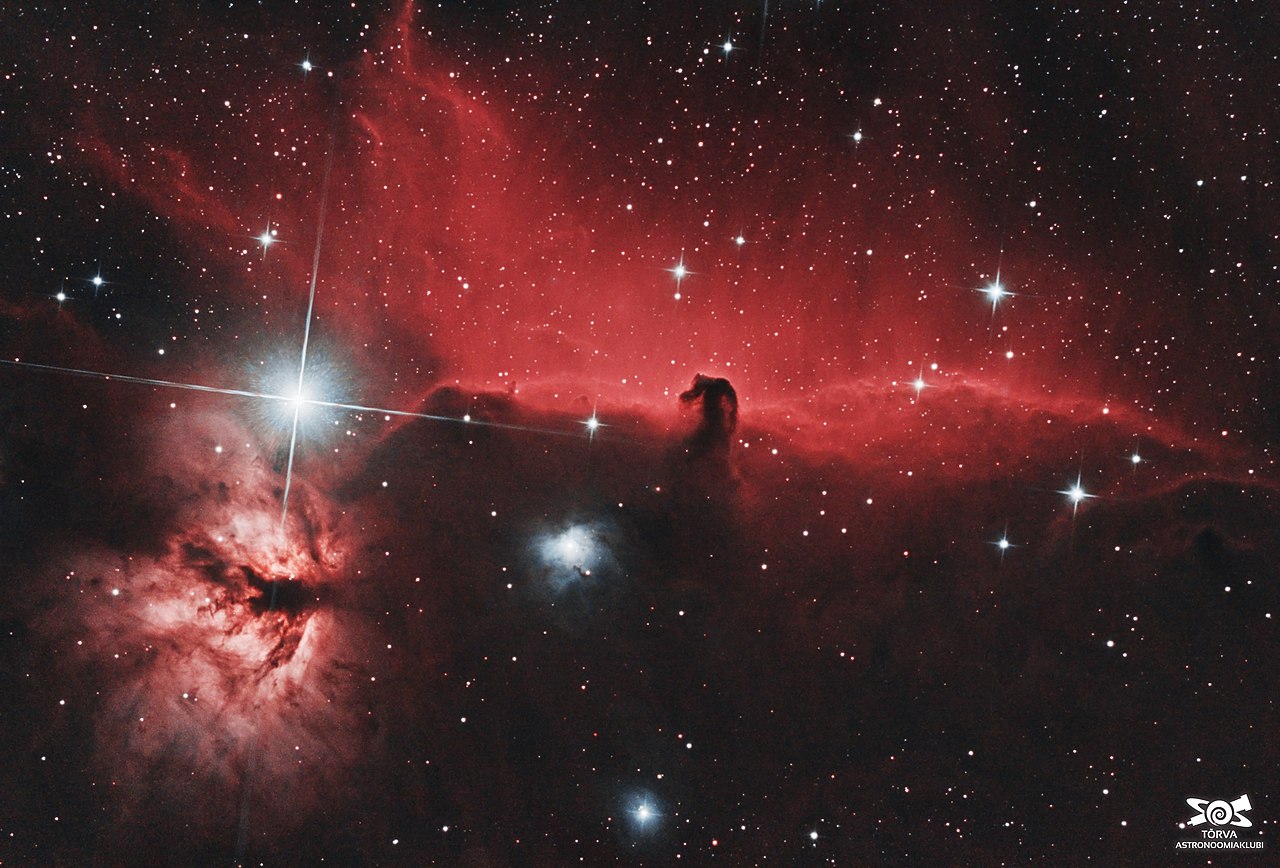
Attribution: Taavi Niittee
Near the easternmost Belt star, Alnitak, lie two enticing but challenging nebulae: the Flame Nebula (NGC 2024) and the Horsehead Nebula (Barnard 33, silhouetted against IC 434). These objects are steeped in dust and bathed in the radiation of massive stars. They are signatures of the dust-and-gas architecture sculpting new stellar systems within Orion.
The Flame Nebula (NGC 2024)
- Appearance: A bright emission nebula bisected by dark dust lanes, resembling a flickering flame in images. Visually, under dark skies and with a narrowband filter, observers can trace its glow around Alnitak.
- Challenges: Alnitak’s brightness can overwhelm the view; use averted vision and experiment with magnifications to place the star just outside the field.
The Horsehead Nebula (Barnard 33)
- What it is: A dark nebula—essentially a thick dust cloud—seen in silhouette against the emission backdrop of IC 434. The “horse’s head” shape is subtle visually and requires patience and excellent sky conditions.
- Visibility: From very dark locations with a larger aperture (8 inches and up) and an H-beta filter, experienced observers may glimpse its outline. For many, the Horsehead is primarily an imaging target.
- Distance: Part of the Orion Complex, broadly in the ~1,300–1,400 light-year range, similar to M42’s distance.
If these targets intrigue you, start with the Flame, then work toward the Horsehead as skills and conditions improve. For imaging strategies to separate the Horsehead from IC 434’s glow, see Astrophotography Tips for Orion.
Orion for Beginners: Binocular and Small Telescope Targets
Orion’s best virtue is accessibility. You do not need large telescopes or complex gear to enjoy the region. With binoculars and small scopes, you can build a rewarding tour of the constellation.
Binocular highlights (7×50, 8×42, 10×50)
- The Belt and Sword: The Belt’s geometry is crisp in binoculars, and the Sword reveals the soft glow of M42, even in suburban skies. Try a slow sweep around the area to notice faint star chains.
- M42/M43: The Orion Nebula resolves into a wing-like shape with a bright core. Under darker skies, the nebular glow fills a surprisingly large area.
- NGC 1981: An open cluster just north of M42, often overlooked, but easy in binoculars.

Attribution: NASA, ESA, M. Robberto (Space Telescope Science Institute/ESA) and the Hubble Space Telescope Orion Treasury Project Team
Small telescope gems (60–130 mm aperture)
- Trapezium Cluster: At higher magnifications (80–150×), a small refractor can cleanly split the four principal stars (Theta1 Orionis A, B, C, D). Under steady seeing, larger scopes reveal additional components.
- Rigel’s companion: Rigel is a fine double; a small scope under good seeing can split its much fainter companion.
- Running Man Nebula (NGC 1977): Visible from dark skies as a delicate reflection nebula.
- Sigma Orionis multiple system: Near the Horsehead region, sigma Orionis is a striking multiple star in small to medium apertures.
Light pollution workarounds
- Filters: UHC or narrowband filters can help isolate emission nebulae from skyglow. They are especially effective for M42.
- Timing: Observe when Orion culminates (reaches its highest altitude) to look through less atmosphere and reduce extinction.
- Site selection: Even a small move to a park’s open space or a hilltop can improve transparency and reduce glare from ground lights.
If you plan to move from visual observing to imaging, the same regions—M42, the Belt, and dark nebulae—anchor a satisfying early portfolio. Continue to Astrophotography Tips for Orion to map a progression from wide-field to close-up frames.
Stellar Evolution Insights from Orion: From Protostars to Supergiants
Orion is often described as a live-action diagram of stellar evolution. A wide-field view collects stars from infancy to near-death, all within a few hundred square degrees. Even if you are primarily an observer, understanding the astrophysical context can deepen what you see through the eyepiece.
Star formation: collapsing clouds and jets
- Molecular clouds: Cold, dense molecular gas (primarily hydrogen molecules with traces of dust and heavier molecules) can collapse under gravity to form protostars. The Orion Molecular Cloud is one of the nearest active regions of this type.
- Protostars and accretion disks: As a protostar gathers mass, material flows in through a rotating disk. Magnetic fields channel some material into jets that blast away from the poles, carving cavities in the surrounding gas.
- Feedback: Intense radiation and stellar winds from young massive stars heat and ionize the surroundings, slowing or triggering further star formation in a complex feedback loop.
Young clusters and the Trapezium
- Massive, short-lived stars: The Trapezium’s hottest members formed relatively recently (astronomically speaking). Their high luminosity dominates the region’s energy output but will also lead to early demise as supernovae compared to sun-like stars.
- Protoplanetary disks: Observations have revealed dozens of “proplyds” around young stars within M42, direct evidence that planet formation can begin in these active environments.
Red supergiants and blue supergiants
- Betelgeuse as a red supergiant: Having expanded dramatically, it has a cool surface temperature and a huge radius. It sheds mass into the surrounding space, building a complex environment that will shape its eventual supernova remnant.
- Rigel as a blue supergiant: Hotter and more compact than red supergiants, blue supergiants radiate intensely in the ultraviolet, generating strong stellar winds and ionizing nearby gas.
Why Orion looks so colorful in images
- Emission nebulae (e.g., M42, IC 434): Dominated by hydrogen-alpha and oxygen-III lines; in visual observing, subtle greens and greys predominate, but long exposures capture dramatic reds and cyans.
- Reflection nebulae (e.g., NGC 1977): Dust grains scatter blue light from nearby stars, creating soft, bluish glows.
- Dark nebulae (e.g., Barnard 33): Dense dust clouds absorb and block background light, seen in silhouette against brighter regions.
When you sketch or image Orion, you are producing a snapshot of processes that unfold over hundreds of thousands to millions of years. Each bright knot or dark lane has a story in the stellar life cycle. To explore these visually, revisit Inside the Orion Molecular Cloud Complex and target specific structures a few at a time.
Astrophotography Tips for Orion: Wide-Field to Deep-Sky
Orion rewards imagers at every level—from a smartphone on a tripod to a guided telescope with narrowband filters. The constellation’s composition makes it ideal for building skills progressively: begin with wide-field frames of the Belt and Sword, then zoom into the Orion Nebula, and finally take on the Horsehead and Flame as advanced projects.
Wide-field landscapes (14–50 mm lenses)
- Framing: Use a 24–35 mm lens to encompass Orion, Taurus, and the winter Milky Way. At 14–24 mm, include terrestrial foregrounds—trees, snow, or desert rock formations—for nightscape compositions.
- Exposure: On a fixed tripod, apply the “500 rule” or more conservatively the “NPF rule” to limit star trailing. For example, with a 24 mm full-frame lens, 10–15 seconds at ISO 1600–3200 and f/2–f/2.8 is a good starting point.
- Stacking: Take multiple short exposures and stack them with software to reduce noise while preserving point-like stars.
Tracked mid-field (50–135 mm lenses)
- Star trackers: Compact equatorial trackers allow 1–3 minute sub-exposures at moderate focal lengths. Balance and polar alignment are key to sharp results.
- Targets: Frame the Belt and Sword together to capture M42, M43, NGC 1977, the Belt stars, and hints of Barnard’s Loop. At 85–135 mm, structure within M42 becomes compelling while preserving context.
Deep-sky telescopic imaging
- M42 dynamic range: The Orion Nebula’s core saturates quickly. Blend short exposures (e.g., 5–15 seconds) for the Trapezium with longer subs (1–5 minutes) for the faint outer wings. High dynamic range (HDR) processing is essential.
- Filters: In light-polluted areas, consider a dual-band or narrowband filter to isolate H-alpha and O III for emission nebulae. For reflection nebulae like the Running Man, broad-band (RGB) captures dust scattering more naturally.
- Horsehead strategy: An H-beta filter enhances the background glow of IC 434 for visual, but for imaging, H-alpha often produces stronger signal. Use careful framing to avoid bloating from Alnitak; dithering and robust calibration (flats, darks) help tame gradients.
- Mosaics and arcs: Barnard’s Loop and the large-scale dust arcs require mosaics or short telephoto lenses. Consider multi-panel projects across clear winter nights.

Attribution: SimgDe
Processing considerations
- Color balance: Preserve the natural blue of reflection nebulae while allowing controlled red in emission regions. Avoid over-saturation that masks faint dust.
- Deconvolution and noise reduction: Apply sparingly to keep stars natural. Star-masks or star-reduction tools can help emphasize nebulosity without creating artifacts.
- Annotation: Labeling frames with object names (M42, NGC 1977, IC 434, B33) helps you and viewers connect features to their astrophysical context.
As your skills grow, return to Orion each season to create a personal time-lapse of your progress—from first stacked wide-field to a refined mosaic of the entire molecular complex. For an object acquisition plan, revisit Hunting the Horsehead and Flame Nebulae and Inside the Orion Molecular Cloud Complex.
Cultural and Historical Perspectives on Orion Across Civilizations
Orion’s brightness and symmetry have anchored sky lore for millennia. Though names and stories differ, the constellation’s three-star Belt often stands out as a cultural touchstone.
- Greco-Roman tradition: The Greeks recognized Orion as a mighty hunter. In classical star atlases, he is depicted raising a club and shielded by a lion’s pelt. The bright stars Betelgeuse and Rigel mark his shoulder and foot, respectively.
- Arabic heritage: Many star names in Orion are Arabic in origin. “Alnitak,” “Alnilam,” and “Mintaka” derive from terms associated with a belt or girdle. The Arabic name often associated with Orion as a figure is “al-Jabbār,” meaning “the giant.”
- Egyptian associations: In ancient Egypt, Orion was linked with the figure of Sah and associated with Osiris in some texts, reflecting the constellation’s significance in ritual and calendar traditions.
- Chinese astronomy: Parts of Orion are encompassed within the White Tiger of the West and other traditional asterisms. The Belt was recognized within Chinese star maps, and Orion’s region hosted multiple named enclosures and mansions in traditional sky lore.
- Polynesian and Māori traditions: In New Zealand, the Belt is known as Tautoru. Across Polynesia, Orion’s prominent stars often served as navigational markers for ocean voyaging.
- European folk names: The Belt is widely known colloquially as “The Three Kings” or “Three Marys” in various languages, especially linked to seasonal markers in winter.
These shared recognitions across cultures underscore Orion’s role as both a practical guidepost and a canvas for human storytelling. As you observe, it is worth reflecting that many generations have used these same stars to mark seasons, navigate, and pass on traditions.
Orion is more than a hunting pose in the sky; it is a nexus where human timekeeping, navigation, and scientific inquiry meet the slow choreography of stellar evolution.
Frequently Asked Questions
When will Betelgeuse go supernova, and will it be safe?
Betelgeuse is a red supergiant nearing the end of its life and will eventually explode as a supernova. However, predicting the exact timing is not possible with current models; “soon” in astronomical terms could mean tens of thousands to hundreds of thousands of years. When it does happen, the event would be a spectacular sight visible from Earth, potentially brightening the night sky for weeks. Betelgeuse is located hundreds of light-years away, far enough that the supernova’s radiation is not expected to pose a hazard to life on Earth. For more on Betelgeuse’s properties and variability, see Bright Stars of Orion.
Can I see the Horsehead Nebula with binoculars?
The Horsehead Nebula (Barnard 33) is an extremely challenging visual target because it is a dark nebula—its visibility depends on contrasting a faint silhouette against an already dim emission background. Under excellent, very dark skies, experienced observers using larger telescopes and specialized filters (particularly H-beta) may detect it. It is generally beyond the reach of handheld binoculars. Consider imaging techniques or start with the Flame Nebula, as described in Hunting the Horsehead and Flame Nebulae, and then return to the Horsehead as conditions and experience allow.
Final Thoughts on Choosing the Right Orion Stargazing Setup
Orion is a gift to every level of skywatcher. With nothing more than your eyes, you can trace the grand architecture of the Hunter—Belt, shoulders, feet, and Sword. Binoculars add nuance: star chains, haze around M42, and neighboring clusters. Small telescopes open intricate structure in the Orion Nebula and resolve the Trapezium, while larger apertures and filters tease out difficult nebulae near Alnitak. For photographers, Orion is the perfect seasonal workshop: it offers wide-field landscapes, mid-field molecular arcs, and high-contrast deep-sky challenges that hone tracking, calibration, and processing skills.
If you are selecting gear, choose based on your immediate observing goals:
- Casual stargazing: A comfortable lounge chair, warm clothing, and a paper or app-based star chart are enough to explore the constellation’s layout.
- Beginner visual astronomy: A pair of 8×42 or 10×50 binoculars plus a red-light flashlight unlocks the Belt and Sword tour. Add a small refractor (60–100 mm) with a UHC filter to elevate views of M42.
- Deep-sky enthusiast: An 8–10 inch Dobsonian under dark skies provides excellent reach for structure in M42/M43 and can attempt the Horsehead with a suitable filter.
- Astrophotography: A star tracker and a 50–135 mm lens form a nimble starting kit; graduate to a guided telescope and narrowband filters for detailed work on emission regions.
Whichever path you take, make Orion a seasonal tradition. Revisit it each year to compare your notes, sketches, or images, and to appreciate how familiar stars and nebulae can still reveal something new. If you enjoyed this guide, explore our other deep-sky and constellation articles, and subscribe to our newsletter to get notified about future observing guides, astrophysics explainers, and equipment tips.