
Table of Contents
- What Is the Summer Triangle Asterism?
- When and Where to See the Summer Triangle
- Meet the Stars: Vega, Deneb, and Altair
- Constellations Framing the Triangle: Lyra, Cygnus, and Aquila
- Star-Hopping and Naked-Eye Patterns Inside the Triangle
- Deep-Sky Highlights Within and Around the Triangle
- Cultural and Historical Significance Across Civilizations
- Practical Observing Tips: From City to Dark Skies
- Astrophotography of the Summer Triangle: Wide-Field to Narrowband
- Planning Tools and Simple Field Sketching
- Frequently Asked Questions
- Final Thoughts on Observing the Summer Triangle
What Is the Summer Triangle Asterism?
The Summer Triangle is one of the Northern Hemisphere’s most recognizable stellar patterns, defined by three of the night sky’s brightest stars: Vega in Lyra, Deneb in Cygnus, and Altair in Aquila. It is an asterism—a prominent star pattern that is not, itself, an official constellation. These three stars form a large, scalene triangle that dominates evening skies in the warm months (and lingers well into autumn). The Milky Way flows right through its expanse, turning the Summer Triangle into a guidebook for both beginner stargazers and seasoned deep-sky observers.
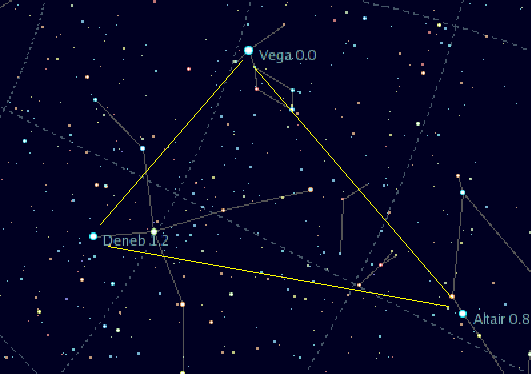
Artist: Jim Thomas
Unlike a formal constellation, which is a defined region of the sky with strict boundaries, an asterism can span several constellations. The Summer Triangle does exactly that, linking Lyra, Cygnus, and Aquila across a generous patch of sky. Its visibility and simplicity make it an ideal starting point to learn sky orientation, to begin star-hopping, and to discover nearby treasures like the Ring Nebula (M57), the Double-Double star Epsilon Lyrae, the Veil Nebula in Cygnus, and the Dumbbell Nebula (M27) in Vulpecula.
The term “Summer Triangle” was popularized in the mid-20th century, particularly through the work of communicators such as British astronomer Sir Patrick Moore, and subsequently adopted widely by astronomy magazines. Yet the pattern itself—three brilliant stars standing sentinel above the hazy stream of the Milky Way—has been recognized by skywatchers for centuries across different cultures in various forms. Today, the triangle serves as a stellar landmark: if you can locate the Summer Triangle, you can orient yourself to a rich swath of the northern celestial hemisphere.
For new observers, the Triangle quickly becomes a celestial compass. Once you’ve found its three vertices, you can branch out to the constellations they anchor, practice naked-eye and binocular star-hopping, and explore the abundant deep-sky objects within and around its borders. If you are interested in imaging, the Triangle’s region is also a gateway to wide-field astrophotography of the Milky Way and narrowband emissions from glowing nebulae.
When and Where to See the Summer Triangle
Seasonal visibility is one of the Summer Triangle’s strengths. In the Northern Hemisphere, it begins to rise in the northeast during late spring evenings. By mid to late June, all three stars are visible after dusk, climbing higher as the night progresses. In July and August, the Summer Triangle towers high (often near the zenith from mid-northern latitudes) during prime evening hours—making it a perfect target for casual backyard observing. Through September and October, the Triangle shifts toward the west after dusk but remains conspicuous. Even in November, the three vertices can still be spotted in the early evening, though lower in the west; the pattern finally departs the evening stage as winter takes hold.
From the Southern Hemisphere, the Summer Triangle is a winter asterism, hovering above the northern horizon. It’s comfortably visible from many southern latitudes, though altitude varies because its stars have northern declinations (Deneb and Vega, especially). Deneb, at roughly +45° declination, is the limiting case: it is visible down to about 45° south latitude. Vega, at about +39°, remains visible farther south (to roughly 51°–52° S), while Altair (+9°) can be seen from even more southerly latitudes. As a practical guide, if you live south of about 45° S, you may lose Deneb below the horizon; from 35° S (e.g., many locations in Australia, Chile, and South Africa), all three stars can be seen, but the triangle sits low in the north.
Best times to look include summer evenings after astronomical twilight (when the Milky Way’s glow is more apparent), but you can also enjoy the Triangle at dusk if you’re aiming for brighter landmarks like Vega and Altair. Dark-sky conditions make a dramatic difference to the Milky Way’s texture across the Triangle; under Bortle 1–3 skies you’ll discern the star clouds of Cygnus, the dark rifts of interstellar dust, and (with binoculars) granular sparkles over the region. Under Bortle 7–9 urban skies, you’ll still easily see the triangle’s vertices, and with a small telescope you can target the brighter deep-sky objects mentioned in Deep-Sky Highlights.
If you like planning ahead, notice this rule of thumb: a star’s maximum altitude at culmination is approximately 90° − |latitude − declination|. That means from 40° N, Deneb (~+45°) can pass nearly overhead; Vega (~+39°) also climbs very high; Altair (~+9°) peaks decently high toward the south. This geometric relationship helps anticipate how comfortably placed the Triangle will be at your observing site, and complements the more practical advice in Practical Observing Tips.
Meet the Stars: Vega, Deneb, and Altair
The Summer Triangle’s three stars are bright for different reasons—proximity, intrinsic luminosity, and a bit of both. Together they form an instructive trio for understanding basic stellar astronomy.
Vega (Alpha Lyrae)
Vega is a blue-white main-sequence star of spectral type A0 V, located about 25 light-years from Earth. Its visual magnitude hovers around 0.0 (roughly +0.03), making it one of the brightest stars in the entire sky. Historically, Vega has served as a photometric calibration standard—many magnitude systems were once defined relative to its brightness. Vega rotates rapidly and is viewed nearly pole-on, leading to subtle effects on its observed properties. It also possesses a debris disk, revealed by infrared observations, hinting at planet formation processes in its past or present.
To the observer, Vega is an unmistakable beacon. It anchors the small constellation Lyra, which includes the famed Double-Double star Epsilon Lyrae and the Ring Nebula (M57), both discussed in Deep-Sky Highlights. The color of Vega is subtly bluish-white, a hue that becomes more apparent when you compare it to the orange giant Tarazed (Gamma Aquilae) near Altair.
Deneb (Alpha Cygni)
Deneb is a luminous blue-white supergiant of spectral type A2 Ia. It is much farther than the other two vertices—on the order of around 2,600 light-years, though its exact distance carries uncertainties because measuring tiny parallaxes at such distances is challenging. Despite that huge distance, Deneb shines at a visual magnitude of ~1.25, which implies an enormous intrinsic luminosity (tens to hundreds of thousands of times the Sun’s). Deneb marks the tail of Cygnus the Swan (hence the name, from Arabic dhānab, meaning “tail”).
Because Deneb lies along the galactic plane, its surroundings are rich with emission and reflection nebulae, dark lanes of dust, and beautiful star fields. Under very dark skies, you’ll notice a granulated density of stars around Cygnus, especially near Sadr (Gamma Cygni), the heart of the Northern Cross asterism inside Cygnus. These vistas prime you for the targets listed in Deep-Sky Highlights, including the North America Nebula and the Veil Nebula.
Altair (Alpha Aquilae)
Altair is a nearby A-type main-sequence star (A7 V) about 17 light-years away, shining at magnitude ~0.76. It is a rapid rotator—its equatorial region spins so quickly that the star becomes oblate, with a noticeable difference between equatorial and polar radii. This fast spin also produces temperature and brightness variations across its surface (a phenomenon known as gravity darkening), studied in detail with modern interferometry.
Altair forms a small naked-eye sequence with Tarazed (Gamma Aquilae, orange) and Alshain (Beta Aquilae, yellowish), an attractive color contrast for binocular users. Altair is the brightest star in Aquila, a constellation that, like Cygnus, resides along the Milky Way’s course. Its vicinity hosts a number of subtle deep-sky targets you can tackle after becoming comfortable with the brighter prizes near Vega and Deneb.
Constellations Framing the Triangle: Lyra, Cygnus, and Aquila
The Summer Triangle is a tour of three constellations that lie on or near the glowing spine of our Galaxy. Learning the shapes of Lyra, Cygnus, and Aquila accelerates your ability to star-hop and discover objects beyond the three guide stars.
Lyra, the Lyre
Lyra is compact and distinct. Look for Vega, then notice the small parallelogram of stars south-east of it: Sulafat (Gamma Lyrae) and Sheliak (Beta Lyrae) define the two “wide” corners. Between them, telescopes reveal the Ring Nebula (M57), one of the sky’s classic planetary nebulae. Just northeast of Vega lies Epsilon Lyrae, a naked-eye star that splits into two with binoculars or a small telescope—and each component itself splits into a close pair in modest-to-larger apertures, earning the designation “Double-Double.”
Cygnus, the Swan (the Northern Cross)
Cygnus is among the most evocative constellations. Deneb marks the tail of the Swan; fly down the long neck to Albireo (Beta Cygni), a famous double star of contrasting gold and blue hues in small telescopes. Crossing the swan at right angles is the bar of the Northern Cross asterism, with Sadr (Gamma Cygni) at the intersection. The Milky Way in this region is complex and photogenic—rich star clouds, dark nebulae, and emission nebulae abound, including the North America and Pelican Nebulae near Deneb and the Veil Nebula arc in the wing.
Aquila, the Eagle
Aquila stretches along the Milky Way south of Cygnus. Altair is flanked by Alshain (Beta Aql) and Tarazed (Gamma Aql), forming a small line visible even in light-polluted settings. The constellation includes subtle targets for binoculars and telescopes: open clusters, a planetary nebula (NGC 6781), and distinctive dark nebulae like Barnard’s E (B142–B143) near Tarazed. South of Aquila lies Scutum and the glorious Scutum Star Cloud—a reminder that once you’ve mastered the Triangle, the rest of the summer Milky Way opens up to you.
Star-Hopping and Naked-Eye Patterns Inside the Triangle
Star-hopping is the art of navigating from bright stars to fainter targets using recognizable patterns. The Summer Triangle, by virtue of its size and brightness, is a prime classroom. Here are practical routes and patterns to build your skills and, in the process, set up successful excursions to the objects in Deep-Sky Highlights.
- Vega to Epsilon Lyrae: From Vega, move a short hop to the northeast. Even in good binoculars (10×50), Epsilon Lyrae reveals itself as a pair. A small telescope at low-to-moderate magnification resolves the famous Double-Double with patience and steady seeing.
- Vega to the Ring Nebula (M57): Draw an imaginary line between Sulafat (Gamma Lyrae) and Sheliak (Beta Lyrae). The Ring Nebula sits just off-center of this line, slightly closer to Sheliak. It appears as a small smoke ring in moderate aperture; higher magnification and good transparency help.
- Deneb to the North America Nebula (NGC 7000): Aim your binoculars just east of Deneb. Under dark skies, you’ll notice a large, misty glow; with a UHC or O III filter in a telescope, the North America Nebula shows its continental outline.
- Sadr to the Veil Nebula: From Sadr (Gamma Cygni), slide westward across the wing. The Veil Nebula (NGC 6992/6995 and NGC 6960) is sprawling and best appreciated with a wide field of view and an O III filter. In binoculars under pristine skies, you may pick up hints of its arc.
- Altair to Barnard’s E (B142–B143): Move to Tarazed (Gamma Aql), then nudge west. This prominent dark nebula complex looks like a capital “E” cutting into the Milky Way’s star fields. Best in binoculars or a rich-field telescope from dark sites.
For naked-eye practice, trace the Milky Way through the Triangle: begin in Cassiopeia to the northeast, sweep through Cygnus past Deneb and Sadr, and continue southward through Aquila near Altair. The brighter the sky, the fainter this river of starlight will appear; even so, the Triangle remains an anchor for orientation and for planning routes to your targets in Practical Observing Tips.
Deep-Sky Highlights Within and Around the Triangle
The Summer Triangle is not just a visual signpost; it encloses and borders a remarkably rich deep-sky neighborhood. These highlights are observable with binoculars and small-to-medium telescopes, with filters and dark skies extending what you can see.
Showpieces Near Vega in Lyra
- Ring Nebula (M57): A classic planetary nebula between Beta and Gamma Lyrae. In small scopes it shows as a smoke ring; in larger apertures, the ring’s irregular brightness and central dimness become clearer. High magnification on steady nights helps.

This new image shows the dramatic shape and colour of the Ring Nebula, otherwise known as Messier 57.
From Earth’s perspective, the nebula looks like a simple elliptical shape with a shaggy boundary. However, new observations combining existing ground-based data with new NASA/ESA Hubble Space Telescope data show that the nebula is shaped like a distorted doughnut. This doughnut has a rugby-ball-shaped region of lower-density material slotted into in its central “gap”, stretching towards and away from us.
Artist: NASA, ESA, and C. Robert O’Dell (Vanderbilt University) - Epsilon Lyrae (the Double-Double): An attractive test of resolution for small telescopes. Two pairs, each separated by a few arcseconds, require magnification and steady air to split cleanly. Binoculars show the wider pair.
Cygnus Riches: Emission, Reflection, and Shocked Filaments
- North America Nebula (NGC 7000) and Pelican Nebula (IC 5070): Enormous emission nebula complex near Deneb. Best under dark skies with wide fields and UHC/O III filters; in photographs or with night-vision devices, the continental outlines become striking.
- Veil Nebula (NGC 6960/6992/6995): A vast supernova remnant with lace-like filaments. The western segment (NGC 6960) crosses the star 52 Cygni. The eastern arcs (NGC 6992/6995) are brighter and extensive.

NGC 6960 or the Veil Nebula is a cloud of heated and ionized gas and dust in the constellation Cygnus. The analysis of the emissions from the nebula indicate the presence of oxygen, sulfur, and hydrogen. This is also one of the largest, brightest features in the x-ray sky. It is the Western Veil of the nebula (also known as Caldwell 34), consisting of NGC 6960 (the \”Witch’s Broom\”, \”Finger of God\”, or \”Filamentary Nebula\”) near the foreground star 52 Cygni. The image details of NGC6960 is a three frame mosaic taken with 5 different filters, standard Red – Green – Blue with details enhanced with narrowband data of Hydrogen (Ha) and Oxygen (OIII). The Ha was color mapped to Red and the OIII to teal. So it is a representative color image consisting of over 39 hours of exposure time.
Artist: Ken Crawford - M39: A loose open cluster northeast of Deneb. Binoculars reveal a scattering of bright members; a rich-field telescope puts it in a pleasing context of starry background.
- NGC 6888 (Crescent Nebula): A wind-blown bubble around the Wolf–Rayet star WR 136, near Sadr. Requires filters and dark skies; in images, the crescent and shock fronts glow vividly in Hα and O III.
Inside the Triangle: Vulpecula and Sagitta
- Dumbbell Nebula (M27): In Vulpecula, roughly mid-way inside the Triangle, M27 is one of the sky’s brightest planetary nebulae. Appears as an apple-core or dumbbell shape in small telescopes; takes magnification and filters very well.
- Brocchi’s Cluster (Cr 399, the Coathanger): A binocular asterism in Vulpecula that resembles a hanger. Best in wide-field binoculars (7× to 10×); telescopes often narrow the view too much to appreciate the shape.
- M71: A loose, compact globular (or very rich cluster) in Sagitta, once debated in classification. In small telescopes it looks like a grainy patch; larger apertures begin to resolve stars.
Aquila’s Subtle Treats
- NGC 6781: A faint planetary nebula that resembles a dim ring. Benefits from O III/UHC filters; moderate magnification brings out its annular character.
- Barnard’s E (B142–B143): A striking dark nebula complex cutting into the Milky Way near Tarazed. Binoculars from a dark site are ideal; you’ll see an E-shaped void against the starry backdrop.
- Open clusters NGC 6709, NGC 6755, NGC 6756: Modest, scattered clusters rewarding to sweep at low power. They are excellent targets once you’ve warmed up on the brighter showpieces.
Keep in mind that contrast is everything. Under suburban skies, bright planetaries like M27 and M57 are forgiving; diffuse nebulae near Deneb demand darker skies and, ideally, an O III or UHC filter. For imaging tips that can overcome light pollution, see Astrophotography of the Summer Triangle.
Cultural and Historical Significance Across Civilizations
Long before the phrase “Summer Triangle” gained currency, the stars Vega, Deneb, and Altair occupied meaningful roles in diverse sky traditions. By exploring their cultural history, we enrich our understanding of the sky as a human inheritance.
- Classical and Arabic Traditions: Deneb’s name stems from the Arabic for “tail,” reflecting its place in Cygnus. Altair (from al-nasr al-ta’ir) means the “flying eagle,” while Vega (from an older transliteration related to al-nasr al-wāqi‘) was associated with a “swooping” or “falling” eagle in medieval Arabic star lore. These linguistic traces preserve ancient observers’ mappings of animal figures onto the Milky Way’s bright river.
- Greek Mythology: Cygnus—the Swan—appears in various tales, and Lyra represents the lyre of Orpheus, famed for music that could charm the underworld. Aquila, the Eagle, is linked with Zeus, often depicted as a messenger or bearer of divine thunderbolts.
- East Asian Sky Lore: In Chinese tradition, Vega is Zhinü (the Weaving Girl) and Altair is Niulang (the Cowherd), lovers separated by the Milky Way who reunite once a year—marked by the Qixi festival and echoed in Japan’s Tanabata. The story highlights the Milky Way’s role as a celestial river dividing and connecting worlds.
- Modern Astronomy and Media: The label “Summer Triangle” was popularized in the twentieth century, notably by communicators like Sir Patrick Moore and in magazines and broadcasts that brought practical skywatching to a wider audience. The asterism’s catchiness made it a natural classroom for teaching celestial navigation and seasonal sky changes.
Scientific discovery also threads through this region. Cygnus, in particular, hosts notable X-ray sources, including Cygnus X-1, one of the first strong black hole candidates identified via X-ray astronomy. While such sources are invisible to the eye, they testify that the serene Swan overlays a dynamic and energetic galactic neighborhood. As your observing deepens, moving from the cultural to the scientific, the Summer Triangle becomes a portal to both myth and modern astrophysics.
Practical Observing Tips: From City to Dark Skies
Whether you observe from a city balcony or a dark-sky campsite, you can extract rewarding views from the Summer Triangle. The following practical steps complement the routes in Star-Hopping and the targets in Deep-Sky Highlights.
Start with the Basics
- Know your sky window: If you observe from a fixed location, map out your obstructions (trees, buildings). The Triangle ranges high to the northeast/east in early evenings of summer and shifts westward as the season progresses.
- Dark adaptation: Give your eyes 20–30 minutes to adjust. Use a red flashlight and avoid phone screens or switch them to red-night mode and low brightness.
- Binoculars first: A 7×50 or 10×50 binocular transforms the Triangle from three bright points into a microcosm of the Milky Way—ideal for scanning the North America Nebula region and spotting open clusters.
Telescopes and Filters
- Small telescopes excel: Short focal-length refractors and small reflectors (80–150 mm) at low-to-moderate power are perfect for the Veil, M27, and M39. Planetary nebulae (M57, M27, NGC 6781) reward higher magnification once located.
- Nebula filters: A UHC or O III filter dramatically improves contrast on emission nebulae (North America, Pelican, Veil, Crescent). Under light pollution, these filters can be transformative.
- Stability and seeing: For double stars like Epsilon Lyrae, prioritize a steady mount and allow your telescope to thermally equilibrate. Use higher magnification only when the air is steady.
Light Pollution Workarounds
- Target bright objects: In city skies (Bortle 8–9), go for M57, M27, Epsilon Lyrae, Albireo, and the Altair–Tarazed–Alshain color trio. Save the Veil and North America Nebula for darker trips.
- Time your session: Even in cities, the late-night hours often experience less skyglow and better transparency. After a cold front, dust and humidity can drop, improving contrast.
- Use shielding: Block stray light with a hood, dew shield, or by positioning yourself strategically relative to local lights.
Finally, keep notes. Jot down what you saw and how you found it. Over time, your personal log becomes a tailored guide more useful than any generic checklist—and it prepares you for deeper dives into imaging, discussed in Astrophotography of the Summer Triangle.
Astrophotography of the Summer Triangle: Wide-Field to Narrowband
The Summer Triangle is a paradise for imagers. From sweeping Milky Way panoramas to narrowband close-ups of emission nebulae, the region offers a progression of targets for every skill level.
Wide-Field Landscapes (14–35 mm)
- What to capture: Aim for the Milky Way arc passing through Cygnus and Aquila, with the Summer Triangle’s stars punctuating the glow. In truly dark skies, the Cygnus Rift—dark nebulae bisecting the Milky Way—emerges starkly.
- Exposure guidance: On a fixed tripod, use the 500-rule or, better, the NPF rule to estimate maximum shutter time without trailing. A starting point might be ISO 3200, f/2–f/2.8, 10–20 s at 24 mm. Adjust for your sky conditions and lens.
- Stacking: Take dozens of short exposures. Stack them with software (e.g., DeepSkyStacker or other stacking tools) and apply gradient reduction to manage light pollution. Keep a separate set of calibration frames (darks, flats, biases) for cleaner results.
Tracked Wide-Field (50–135 mm)
- Star tracker: A lightweight equatorial tracker allows 1–3 minute subs at moderate focal lengths if polar alignment is good. Use this to frame NGC 7000 and IC 5070 together, or to catch the entire Veil Nebula complex.
- Filters: In light-polluted areas, a dual-band (Hα + O III) filter on a color camera boosts nebula contrast. Unmodified DSLRs are less sensitive to Hα; a modified DSLR or a modern mirrorless camera with higher Hα response helps.
- Framing cues: Use Deneb as an anchor to frame the North America/Pelican duo; for the Veil, center midway between 52 Cygni and the brighter eastern arc.
Telescopic Narrowband (200–800+ mm)
- Planetary nebulae: M27 and M57 respond well to LRGB imaging and narrowband blends (e.g., Hα + O III). Even small telescopes can produce detailed structures with sufficient integration time.
- Emission complexes: The Crescent Nebula and the North America/Pelican fields dazzle in Hα/O III/S II combinations. With monochrome cameras and filters, blend narrowband channels into a false-color palette to emphasize shock fronts and ionization zones.
- Dealing with bright stars: Vega can easily saturate; use shorter exposures for star color frames and layer them over longer nebula integrations. Consider mild star reduction during processing to keep emphasis on nebulosity.

Artist: Mikael Svalgaard (Homepage: http://www.leif.org/mikael/ )
Workflow Tips
- Focus: Use a Bahtinov mask or software-assisted focus. Re-check after temperature changes.
- Dithering and calibration: Dither between sub-exposures to improve noise characteristics. Flats are crucial for vignetting and dust motes, especially with fast lenses.
- Color balance: Milky Way fields tend to skew green from light pollution; remove gradients and calibrate colors early in processing. Maintain star color for realism—Altair’s subtle warmth (compared to Vega) and Tarazed’s orange tint add depth.
As you progress, you can combine wide-field mosaics with telescopic close-ups, creating a portfolio that mirrors the tour in Deep-Sky Highlights. The Triangle’s mix of point sources and diffuse structures makes it a complete astrophotography curriculum in one sky patch.
Planning Tools and Simple Field Sketching
Good planning and record-keeping turn a pleasant night into a productive one. Here are practical tools and a simple method to understand visibility and to document your sessions near the Summer Triangle.
Coordinates and Culmination
Approximate equatorial coordinates for the three stars are:
- Vega: RA ~ 18h 37m, Dec ~ +38° 47′
- Altair: RA ~ 19h 51m, Dec ~ +08° 52′
- Deneb: RA ~ 20h 41m, Dec ~ +45° 16′

Artist: Tomruen at en.wikipedia
To estimate how high a star will appear when it crosses your meridian (due south or due north, depending on hemisphere), use the simple relation: Altitude at culmination ≈ 90° − |latitude − declination|. This is surprisingly accurate and helps in session planning, complementing the seasonal guidance in When and Where to See the Summer Triangle.
Quick Planning Snippet
If you like coding your own tools, here’s a conceptual Python snippet for estimating culmination altitude using latitude and declination. This example avoids external libraries for simplicity:
# Simple culmination altitude estimator
# Input latitude (deg) and declination (deg)

def culmination_altitude(latitude_deg, declination_deg):
    return 90.0 - abs(latitude_deg - declination_deg)

# Examples (approximate declinations):
print("Vega @ 40N:", culmination_altitude(40.0, 38.8))
print("Altair @ 40N:", culmination_altitude(40.0, 8.9))
print("Deneb @ 40N:", culmination_altitude(40.0, 45.3))
Use these numbers to prioritize targets that will be highest (and therefore seen through less atmosphere) during your session. For detailed transit times and full-sky simulations, a planetarium app remains invaluable.
Field Sketching
Sketching is an enjoyable way to sharpen your observational skills and to preserve what you see through the eyepiece. Try this approach with, say, M27 or the Veil Nebula inside the Summer Triangle:
- Frame the field: At low power, lightly draw a circle to represent your field of view. Place the brightest stars you see.
- Scale and orientation: Use relative positions—distances and angles between stars—to keep proportions believable. North and east can be noted on the margin.
- Object rendering: For nebulosity, shade gently and build up density where you see brighter areas. If using a filter, note it on your sketch.
- Annotations: Record date, time, location, transparency, seeing, instrument, magnification, and filters. This meta-data makes your sketch scientifically useful.
Over time, your sketchbook becomes a personalized atlas of the Summer Triangle region and a complement to the routes in Star-Hopping.
Frequently Asked Questions
Is the Summer Triangle a constellation?
No. The Summer Triangle is an asterism, a recognizable pattern of stars not defined as a formal constellation. It spans three different constellations: Lyra (Vega), Cygnus (Deneb), and Aquila (Altair). Asterisms like the Big Dipper and the Summer Triangle are used as wayfinding tools to access the official constellations and their deep-sky objects, such as the Ring Nebula (M57) in Lyra and the Veil Nebula in Cygnus.
Can I see the Milky Way from my city—and does the Summer Triangle help?
In most cities (Bortle 8–9), the Milky Way’s diffuse glow is extremely difficult or impossible to see. However, you can still use the Summer Triangle to find brighter targets that punch through light pollution: M57, M27, Epsilon Lyrae, and the colorful double Albireo. If you can travel to darker skies, the Triangle becomes a superb guide to the Milky Way’s structure, making features like the Cygnus Rift and star clouds readily visible, as discussed in Practical Observing Tips.
Final Thoughts on Observing the Summer Triangle
The Summer Triangle is more than a seasonal landmark—it’s an observing curriculum that can carry you from your first naked-eye outings to advanced astrophotography projects. Its three cornerstones—Vega, Deneb, and Altair—anchor constellations rich with double stars, planetary nebulae, emission complexes, and dark nebulae. With the routes in Star-Hopping and the targets in Deep-Sky Highlights, you can build a rewarding, season-long exploration plan.
As the Milky Way arcs through the Triangle, you experience the Galaxy’s diversity: nearby A-type stars, a distant supergiant, delicate supernova filaments, and vast hydrogen clouds glowing under the pressure of stellar winds. Even if you observe from a city, the Triangle offers bright, resilient targets; from dark sites, it blossoms into a deep-sky feast. Consider keeping a logbook, trying a sketch or two, and—if you’re inclined—capturing images following the advice in Astrophotography of the Summer Triangle.
We’ll continue to publish practical sky guides and deep dives into the science behind what you see. If you found this helpful, explore more of our night-sky tutorials and subscribe to our newsletter to receive upcoming guides, observing calendars, and astrophotography tips straight to your inbox.