
Table of Contents
- What Is Collimation on a Newtonian Reflector?
- Tools You Need for Accurate Newtonian Collimation
- Understanding Secondary Mirror Geometry and Offset
- Step-by-Step Newtonian Collimation Procedure
- The Barlowed Laser and Cheshire: Why They Work
- Collimation Tolerances Across Focal Ratios
- Diagnosing and Fixing Common Collimation Problems
- Star Testing and On-Sky Verification
- Collimation with Coma Correctors and Imaging Setups
- Maintenance, Safety, and Re-Spotting the Primary
- Frequently Asked Questions
- Final Thoughts on Perfecting Newtonian Collimation
What Is Collimation on a Newtonian Reflector?
Collimation is the process of aligning the optical elements of your Newtonian reflector so that the light path from the primary mirror, to the secondary mirror, and through the focuser is precisely coaxial. When collimation is correct, your telescope delivers its full resolving power, maximizes contrast, and reveals crisp, pinpoint stars on-axis. When collimation is off, stars bloat and smear, fine planetary details fade away, and deep-sky objects lose snap and definition.

The Science Museum UK
A Newtonian telescope uses a large primary mirror at the bottom of the tube to collect light, a flat secondary mirror near the top to redirect that light 90 degrees, and a focuser to bring the image to your eyepiece or camera. Each component must be aligned so that:
- The focuser points squarely toward the center of the primary mirror (focuser axis alignment).
- The secondary mirror is properly positioned and tilted to reflect the primary’s center into the focuser (secondary placement and tilt).
- The primary mirror is tilted so its optical axis returns exactly to the center of the focuser drawtube (primary axis alignment).
Accurate collimation matters more as the telescope’s focal ratio gets faster (smaller f-number). An f/4 Dobsonian is far less forgiving than an f/8 instrument. Fast optics magnify small alignment errors, so tools and method matter. If you own a fast Dobsonian or a Newtonian astrograph, plan to build reliable habits—especially the step-by-step process and the star test—to keep performance at its best.
Rule of thumb: Good collimation gives you sharper stars, cleaner planetary detail, and more contrast. Poor collimation wastes aperture.
Tools You Need for Accurate Newtonian Collimation
There are many ways to collimate a Newtonian, from a simple DIY cap to premium autocollimators. The best approach depends on your scope’s focal ratio, your experience, and whether you are observing visually or imaging.
Essential tools (start here)
- Collimation cap: A simple peep-hole cap, often included with beginner scopes. It helps center the primary mirror’s reflection and is surprisingly effective for slower scopes (f/6–f/8). It is not ideal for fast systems.
- Combination sight tube/Cheshire (combo tool): A non-powered tool that combines a sight tube (for secondary positioning) with a Cheshire (for primary tilt). This is a highly capable, budget-friendly solution.
- Center spot (donut) on the primary: A thin, non-reflective paper or vinyl ring stuck at the exact center of the primary mirror. This is critical because many tools reference the center spot; it does not affect the image because it lies in the shadow of the secondary.
Advanced and time-saving tools
- Laser collimator: Projects a beam down the focuser. You can align the secondary by steering the beam to the center spot. However, lasers themselves must be collimated to be trustworthy; always verify the laser’s internal alignment.
- Barlowed laser: A laser used with a Barlow lens (or an integrated Barlow screen). The Barlowed method measures the primary tilt via the shadow of the center spot projected back to the focuser screen. It is robust and less sensitive to focuser axial errors, making it excellent for fast optics. See The Barlowed Laser and Cheshire.
- Autocollimator: A reflective, multi-mirror tool that magnifies residual axial errors. It is particularly useful to chase down the last few arcminutes of misalignment in fast imaging Newts or premium visual scopes.
- Hex keys / screwdrivers: For adjusting secondary and primary collimation screws. Some cells use spring-loaded hand knobs; others require tools.
- Good illumination: A small, dimmable white light helps you see the center spot and reflections without blinding you at night.
Notes on tool choice
- For f/6 and slower scopes: a combo tool (sight tube + Cheshire) is enough to achieve very good collimation.
- For f/5 and faster: add a laser and use the Barlowed laser method or a quality Cheshire for primary tilt; consider an autocollimator to refine the final alignment.
- Imaging Newtonians benefit from repeatable, tool-based procedures to control tilt and fast-optics tolerances; see coma correctors and imaging.
Understanding Secondary Mirror Geometry and Offset
Before twisting any screws, it helps to visualize the geometry. The secondary mirror is an ellipse that must sit under the focuser so the focuser sees the primary mirror’s full aperture. Three aspects matter:
- Secondary placement (centering under the focuser): The secondary’s outline should look centered in the focuser view when using a sight tube. This often requires sliding the secondary spider up/down the tube and adjusting secondary height along the focuser axis.
- Secondary rotation: The ellipse must be rotated so that the primary mirror appears centered in the secondary, without skew toward the primary end of the tube.
- Secondary tilt: Once placement and rotation are right, you tilt the secondary so the focuser axis points to the primary’s center spot.
A complication called secondary offset ensures even field illumination. Because the secondary is intercepting a converging light cone, the mirror is offset slightly in two directions: toward the primary mirror and away from the focuser. On many commercial scopes, the spider and holder are built to naturally accommodate this; on others, you may see the secondary appear slightly decentered when everything is actually correct.
The geometric offset distance along the tube axis is approximately the secondary’s minor axis divided by 4 × the focal ratio:
offset ≈ minor_axis / (4 × f/#)
Example: a 50 mm minor-axis secondary in an f/5 Newtonian has an offset of ≈ 50 / (4 × 5) = 2.5 mm toward the primary.
Don’t be surprised if, when perfectly aligned, the secondary silhouette looks slightly shifted toward the primary end of the tube and slightly away from the focuser. That is normal offset. Your goal is not to “visually center the secondary silhouette” at all costs—you want correct placement, rotation, and tilt so the optical axes line up and the field is illuminated evenly.
Practical tip: perform secondary placement in daylight with a combo tool so you can clearly see the edges of the secondary and primary. Once placement is right, you rarely need to revisit it; the regular, nightly collimation sequence usually involves only secondary tilt followed by primary tilt.
Step-by-Step Newtonian Collimation Procedure
Below is a reliable sequence that works with either a combo tool or a laser + Barlowed laser. Resist the temptation to jump ahead; large errors in secondary placement cannot be fixed with tilt alone.
Preparation
- Work in good light (daylight or a dim, even lamp) so you can see the center spot and mirror edges clearly.
- Ensure the primary has a center spot. If not, see Re-Spotting the Primary for a safe method.
- Remove caps and covers; avoid pointing the telescope toward the Sun.
- If using a laser, verify that the laser itself is collimated (rotate the laser in the focuser and confirm the beam doesn’t circle). If it circles, adjust the laser or use a combo tool instead.
1) Secondary placement (with a sight tube)
Insert the combo tool and rack the focuser until the inner edge of the sight tube just encompasses the outer edge of the secondary. You want to see three circular outlines: the sight-tube edge, the secondary outline, and the primary mirror edge.
- Center the secondary under the focuser: Adjust the secondary’s up/down position along the tube (by moving the spider or the secondary stalk) until the secondary’s outline looks centered within the sight tube.
- Adjust secondary rotation: Rotate the secondary so that the primary mirror appears centered in the secondary, with the mirror clips (if visible) evenly spaced.
- Keep your eye centered in the peep-hole to avoid parallax errors.
At this point, the secondary tilt might still be wrong. That’s fine. You should, however, see the primary more or less centered inside the secondary when rotation is correct.
2) Secondary tilt to aim at the primary center
If you’re using a laser, adjust the secondary’s tilt screws to steer the outgoing beam precisely onto the primary’s center spot. If you’re using a combo tool, use the crosshairs to aim at the center spot. Make small, deliberate adjustments; loosen one screw before tightening another to avoid stressing the holder.
- Avoid over-tightening: keep a modest, even tension on all secondary screws.
- Re-check rotation: if you see the aiming changing rapidly as you tilt, your rotation may be slightly off. Correct rotation first, then refine tilt.
3) Primary tilt (with a Cheshire or Barlowed laser)

Tim van Werkhoven
Now adjust the primary mirror so the optical axis returns to the center of the focuser:
- Cheshire method: Look at the bright, reflective face of the Cheshire. Adjust the primary collimation knobs so that the center spot’s reflection is centered in the Cheshire’s bright ring. When the donut is precisely centered, the primary axis is aligned.
- Barlowed laser method: Insert the Barlow and laser. You will see the shadow of the center spot projected on the Barlow’s screen (or a target face). Adjust the primary knobs until that shadow is centered on the screen’s cross or circle.
The Barlowed laser is preferred for fast optics because the method is insensitive to small focuser-axial errors. If you only have a plain laser, be aware that aligning the return beam alone can be misleading unless the laser and focuser/secondary axes are already very accurate.
4) Lock and verify
- Gently snug any lock screws on the primary (if your cell has them), alternating between pairs to avoid shifting the alignment.
- Re-check the secondary tilt after setting the primary. Tiny interactions are normal. Finish with the primary again if needed.
- Perform an on-sky star test at high power to confirm excellent axial alignment.
Quick-reference sequence
1) Place and rotate secondary (sight tube)

2) Tilt secondary to aim at primary center (laser or crosshairs)

3) Tilt primary (Cheshire or Barlowed laser)

4) Verify and fine-tune (optional autocollimator, then star test)
When you’ve mastered this flow, a nightly touch-up before observing typically takes less than five minutes. If you transport your Dobsonian or frequently change focusers or imaging trains, expect to check collimation each session.
The Barlowed Laser and Cheshire: Why They Work
It helps to know why these methods are dependable, especially for fast Newtonians.
Cheshire collimator principles
A Cheshire has a reflective 45° face that is brightly illuminated. When you look through the peep hole, you see the center spot on the primary superimposed on the Cheshire’s bright annulus. Adjusting the primary until the spot sits dead-center in that annulus aligns the primary axial ray with the focuser axis. The Cheshire is simple, mechanical, and reliable; it does not depend on laser alignment.
Barlowed laser principles
A plain laser sends a narrow beam down to the primary and back. Any small error in secondary tilt or laser squareness can cause the return beam to miss—giving a false reading. In the Barlowed method, the Barlow lens expands the beam into a diffuse cone. The center spot’s shadow returns to the Barlow’s screen. You center the shadow, not the beam, to align the primary. Because this relies on a shadow of the center mark and a broad cone, it is largely insensitive to small focuser-axial errors, making it a robust way to set primary tilt accurately.
For a very fast f/4 system, pairing the Barlowed laser (for primary tilt) with an accurate laser or crosshair sight tube (for secondary tilt) gives consistent, repeatable results. Many observers then finish with an autocollimator to chase residual misalignments. If you’re imaging, a quick on-camera star evaluation can confirm the result after the star test.
Collimation Tolerances Across Focal Ratios
How close is “close enough”? The answer depends on focal ratio and use case. Fast optics (e.g., f/3.5–f/5) have shallow depth of focus and stronger off-axis coma, which means even tiny axial errors degrade on-axis sharpness and broaden stars. Slower systems (f/6–f/8) are more forgiving.
Practical, experience-based guidelines
- f/6 to f/8 visual Dobsonians: A careful Cheshire alignment generally yields excellent performance. A collimation cap can suffice if you’re meticulous.
- f/5 visual or mixed use: Use a sight tube to nail secondary placement, a laser or crosshair for secondary tilt, and finish with a Cheshire or Barlowed laser for primary tilt. Consider an autocollimator to refine.
- f/4 to f/4.5 (fast visual or imaging): Use a Barlowed laser or Cheshire for primary tilt, and verify with an autocollimator. Expect to spend a bit more time on secondary geometry and mechanical stability.
- Imaging Newtonians: Exact collimation is critical; verify with star shapes on-axis and off-axis. Add checks for sensor tilt and corrector spacing (see coma corrector section).
Spencer Bliven
Regardless of f-ratio, the primary tilt is usually the final and most impactful adjustment for on-axis sharpness. The secondary tilt and placement determine whether the primary’s center is correctly targeted and whether the field is evenly illuminated.
Why tolerances tighten with speed
As focal ratio decreases, the light cone becomes steeper and the depth of focus narrows. Small axial errors translate into noticeable blurring and asymmetric diffraction on-axis. That’s why fast astrographs and large, fast Dobsonians benefit most from the Barlowed laser + autocollimator workflow and a diligent star test.
Diagnosing and Fixing Common Collimation Problems
Even with a solid process, you may encounter issues that masquerade as collimation errors. Here are common pitfalls and fixes.
1) The laser dot won’t stay put when I rotate the laser
Your laser is out of collimation. Either adjust the laser (some provide small set screws for this) or switch to a combo tool. Relying on a misaligned laser can send you in circles. If you must continue with it, use the Barlowed method for the primary and a sight tube for the secondary.
2) Collimation shifts when I change altitude on my Dob
This suggests mechanical slop. Common culprits:
- Primary mirror cell springs: Weak springs allow the mirror to tilt as gravity changes. Upgrade to stiffer springs or add proper lock knobs.
- Secondary holder: Ensure the center bolt and tilt screws have even, firm tension. Add a small washer if necessary to improve friction, but avoid overtightening.
- Focuser drawtube play: Check for wobble. Tighten the focuser’s tension and guide screws; if play remains, consider a tune-up or upgrade.
3) Star images look triangular or weird even when collimated
Triangular stars can indicate pinched optics. Ensure there is a slight gap under the primary mirror clips—about the thickness of a business card. The secondary should also be held gently, not clamped hard. Thermal issues and high-altitude winds can also deform star images; allow the mirror to reach ambient temperature and use a fan to hasten cooldown.
4) I can’t see all three primary mirror clips in the sight tube
This points to secondary placement or rotation errors. Revisit secondary geometry: center the secondary under the focuser first, then rotate it so the primary is evenly framed. Only after that should you set secondary tilt.
5) The return laser method says I’m good, but images are soft
A plain, un-Barlowed return-beam alignment can be misleading unless the focuser axis and the laser are both accurate. Verify primary tilt with a Cheshire or a Barlowed laser, then double-check on a star.
6) Diffraction spikes look asymmetric
Asymmetric or rotated spikes can result from secondary rotation/placement errors or from vanes that aren’t orthogonal. Confirm the secondary geometry, then check that spider vanes are straight and evenly tensioned.
7) The center spot looks off-center
If you suspect the center spot was applied inaccurately, verify by measuring and re-spotting (see maintenance). A significantly off-center spot compromises every tool that references it.
8) Collimation is perfect, but off-axis stars are coma-shaped
That’s expected in fast Newtonians without a coma corrector. On-axis stars should still be tight and symmetric when collimation is right. Off-axis coma is an inherent Seidel aberration in parabolic mirrors; a corrector can mitigate it if desired. See coma correctors.
Star Testing and On-Sky Verification
Tool-based collimation gets you very close—even spot on. A quick star test confirms the result and can reveal residual issues that tools can miss, such as focuser sag at night or thermal currents.
How to star test for collimation

Anaqreon
- Pick the right star: Choose a moderately bright star high in the sky to minimize atmospheric dispersion and seeing. Polaris is convenient because it hardly drifts, but any high star will do.
- Use high magnification: Aim for 30–50× per inch of aperture if seeing permits. With an 8-inch (200 mm) scope, 240–400× is often enough to reveal axial errors.
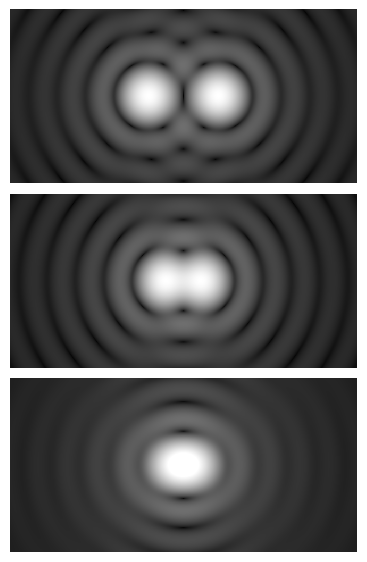
- Defocus slightly: Rack inside and outside of focus to see concentric diffraction rings. On-axis, those rings should be centered and round. If they are egg-shaped or decentered, fine-tune primary tilt.
- Check in-focus Airy pattern: In steady seeing, a bright star should show a small, clean disk with a faint first ring. If the disk is skewed or the ring is brighter on one side, revisit collimation.
Take your time and wait for moments of steady air. If the pattern rapidly dances, that’s poor seeing, not necessarily collimation. Also ensure your mirrors have thermally stabilized; a warm mirror produces tube currents that mimic defocus or astigmatism.
Distinguishing common patterns
- Axial miscollimation: On-axis star has a bright rim on one side and a soft fade on the other (a comet-like hint). Adjust primary tilt to center the pattern.
- Off-axis coma: Move the star off-center; the comet-tail shape grows. That’s normal without a corrector. Return to the center to evaluate collimation.
- Astigmatism: Inside focus, the defocused pattern elongates one way; outside focus, it flips 90°. Could be optics, focuser tilt under load, or pinching. Rotate the eyepiece to rule out eyepiece astigmatism.
- Tube currents/thermal: Boiling, shimmering rings. Allow more cooldown; use a fan behind the primary.
Once on-axis symmetry looks good, you have validated the heart of your alignment. For imaging rigs, confirm with a short exposure on a bright star and inspect FWHM and eccentricity on-axis; then verify the corners to assess corrector spacing and tilt.
Collimation with Coma Correctors and Imaging Setups
Coma correctors and imaging trains add mechanical complexity and reduce your margin for error—but the core alignment steps remain the same. Here’s how to keep things under control.
Visual use with coma correctors
Visual coma correctors (e.g., models with a tunable top) require the eyepiece to sit at a specific optical distance from the corrector to neutralize coma across much of the field. Collimate the telescope without the corrector in place using your usual tools, then insert the corrector and fine-tune focus and eyepiece position per the manufacturer’s guidance. Keep in mind that a corrector will not fix axial miscollimation; it reduces off-axis coma. Verify on-axis star symmetry after installation.
Imaging Newtonians with correctors
- Backfocus spacing: Imaging coma correctors typically require a specific sensor distance (often around 55 mm for many designs, but always follow the manufacturer’s specification). Incorrect spacing leads to residual coma, astigmatism, or field curvature.
- Sensor orthogonality (tilt): If one corner shows bloated or elongated stars while the opposite corner looks sharp, check camera tilt. Collimation can be perfect while the camera is tilted relative to the optical axis. Use a tilt adapter or shims to correct.
- Mechanical rigidity: Heavy cameras or filter wheels can introduce focuser sag. Lock focusers carefully and consider a sturdier focuser or reinforcement rings if needed.
- Repeatability: Mark your drawtube and adapters so you can return to the same insertion depth and orientation. Consistency simplifies diagnosis.
After a careful tool-based alignment, verify with 5–10 second exposures of a rich star field near the zenith. Inspect star shapes center-to-corner. If the center is symmetric but corners vary, you’re chasing spacing and tilt, not basic collimation. If the center is asymmetric, revisit primary tilt and confirm with the Barlowed laser or Cheshire.
Maintenance, Safety, and Re-Spotting the Primary
Good collimation is easier when the telescope is mechanically sound and the reference marks are accurate. Here are practices that prevent recurring headaches.
Primary mirror center spot: verifying and re-spotting
If your primary lacks a center spot or you suspect it’s off, you can add or replace it:
- Make a template: Use a sheet of paper or thin card cut to the mirror’s exact diameter. Fold twice to find the center. Poke a small center hole.
- Remove the primary cell: Follow your telescope’s manual. Mark the mirror’s rotational orientation relative to the cell with painter’s tape for reassembly.
- Apply the spot: Lay the template over the mirror, align carefully, and apply a thin, non-reflective donut sticker through the center hole. A common hack is a reinforcement ring (paper donut) for loose-leaf binders—thin and effective.
- Reinstall gently: Ensure the mirror clips do not press on the glass—leave a paper-thin gap. Secure the cell without overtightening fasteners.
Work on a clean, padded surface; avoid touching the mirror surface. The center spot sits in the secondary’s shadow, so it does not degrade contrast or resolution when properly applied.
Safe handling and working environment
- Never let direct sunlight enter the tube when the secondary is in place; it can focus dangerously on flammable surfaces.
- When using a laser, keep the beam away from eyes and reflective jewelry. Treat it as you would any laser device.
- Support the tube securely to avoid bumps that can chip edges or knock alignment off mid-procedure.
Mirror cleaning and thermal management
- Keep mirrors reasonably clean; heavy dust scatters light. That said, don’t over-clean—coatings are delicate. A gentle rinse and distilled-water final pour, followed by air-drying, is usually sufficient when needed.
- Use a rear fan to bring the primary to ambient temperature more quickly. Stable temperatures reduce tube currents and stabilize collimation.
How often should you collimate?
- Portable Dobsonians: Check every session. A quick tweak is normal and fast once you’re practiced.
- Fixed-pier or minimally moved scopes: You may go several sessions with only minor touch-ups.
- Expect to revisit after significant temperature swings or after long transport, as materials expand/contract and hardware shifts slightly.
Frequently Asked Questions
Do I need an autocollimator if I already have a Cheshire and laser?
Not necessarily. A combination sight tube/Cheshire plus a Barlowed laser can achieve excellent alignment for most visual use, even at f/5. An autocollimator becomes more compelling with very fast systems (f/4 and faster) or for imagers who want to minimize residual axial error that can subtly inflate star sizes or degrade planetary detail. It’s a refinement tool—useful but not mandatory for all setups.
Should I collimate with the coma corrector or camera in place?
Perform the baseline alignment without the corrector to establish accurate optical axes. Then install your coma corrector or camera and verify star shapes on-axis and in the corners. For imaging trains, mechanical tilt and backfocus spacing are as critical as collimation; diagnose them separately. For visual correctors with tunable tops, follow the maker’s settings after collimation. If you notice significant shifts after installing the train, check for focuser sag or adapter slop and correct the mechanical issue.
Final Thoughts on Perfecting Newtonian Collimation
Newtonian collimation is a learnable craft. With a sensible toolset and a consistent sequence—place and rotate the secondary, tilt the secondary to the center spot, set primary tilt with a Cheshire or Barlowed laser, and verify on a star—you can unlock the full potential of your telescope. Fast optics demand tighter discipline, but the rewards are immediate: tack-sharp planetary detail, crisp double-star splits, and pinpoint globular cores that tell you the mirror is performing at its peak.
If you are new, start with a combination sight tube/Cheshire and a properly applied center spot. Add a Barlowed laser if you regularly use f/5 or faster, and an autocollimator if you want to polish away the last traces of error. Keep your mechanics sound—firm springs, smooth focuser, gently held mirrors—and your collimation will hold better through the night.
Next clear night, run through the step-by-step procedure and finish with a careful star test. You will see the difference. And if you found this guide useful, consider subscribing to our newsletter—stay tuned for deep dives on secondary sizing, focuser upgrades, and Newtonian imaging workflows that build on the foundation you’ve set with precise collimation.

The original uploader was Worldtraveller at English Wikipedia.