
Table of Contents
- What Are Maksutov‑Cassegrain and Schmidt‑Cassegrain Telescopes?
- Optical Design Differences: Meniscus vs. Schmidt Corrector
- Real‑World Performance: Planets, Deep‑Sky, and Imaging
- Thermal Behavior, Cooldown, and Collimation Stability
- Focusing, Back Focus, and Mount Requirements
- Buying Guide: Aperture, Focal Ratio, and Budget Tiers
- Eyepieces, Diagonals, and Essential Accessories
- Astrophotography with Catadioptrics: Pros, Cons, and Workflows
- Use Cases and Decision Matrix for Different Observers
- Setup, Maintenance, and Best Practices
- Frequently Asked Questions
- Final Thoughts on Choosing the Right Catadioptric Telescope
What Are Maksutov‑Cassegrain and Schmidt‑Cassegrain Telescopes?
Maksutov‑Cassegrain (Mak or MCT) and Schmidt‑Cassegrain (SCT) telescopes are compact, folded‑optics designs that use both mirrors and lenses—hence the term catadioptric. They are popular with backyard observers because they pack long focal lengths and substantial aperture into short, easy‑to‑transport tubes. If you are deciding between these two designs, understanding their optical layouts, strengths, trade‑offs, and practical handling will help you match a scope to your observing goals.

Artist: Marie-Lan Nguyen (Jastrow)
Both designs share a common Cassegrain heritage: a concave primary mirror collects light and reflects it forward to a convex secondary mirror, which then directs the image through a central hole in the primary to the back of the telescope. The differences lie in the corrector at the front of the tube and in the details of how aberrations are controlled.
- Maksutov‑Cassegrain: Uses a thick meniscus corrector lens with a gentle curve. Many small‑ to medium‑aperture Maks implement a Gregory variant in which a reflective spot on the meniscus serves as the secondary mirror. Larger Maks often use a separate secondary mirror.
- Schmidt‑Cassegrain: Uses a thin, aspherized Schmidt corrector plate. The secondary is a separate mirror attached to the corrector. Many SCTs include standardized rear threads and a wide ecosystem of accessories.
Because both are f/long systems with central obstructions, they are sometimes discussed together. Yet there are meaningful differences in optical performance, mechanical behavior, and accessories. In this guide you will find a practical comparison across optical design (see Optical Design Differences), performance on planets and deep sky (Real‑World Performance), cooldown and collimation (Thermal Behavior), mounts and focusing (Focusing and Mounts), and imaging (Astrophotography), culminating in a purchase framework you can actually use (Buying Guide).
Optical Design Differences: Meniscus vs. Schmidt Corrector
While both scope families correct for spherical aberration and deliver long effective focal lengths, their correctors and secondary implementations produce distinct characteristics in contrast, field illumination, cooldown, and accessory compatibility.
Correctors and aberration control

Artist: Szőcs Tamás (Tamasflex)
- Maksutov Meniscus: The thick meniscus tends to correct spherical aberration very effectively across the on‑axis field and can suppress off‑axis aberrations well in small to medium apertures. The secondary mirror is often formed by an aluminized spot on the inside of the meniscus in Gregory Maks, simplifying alignment and reducing the number of optical surfaces.
- Schmidt Corrector Plate: The thin, aspherized plate corrects spherical aberration while allowing more rapid temperature equalization. SCTs typically rely more on mirror figures and secondary power for fine optical correction. Modern SCT families include variants with built‑in field flattening and coma control in the baffle design; for example, some models integrate additional lenses at the rear to produce a flatter field for imaging.
Typical focal ratios and fields
- Maks: Common consumer Maks range from about f/12 to f/15. The narrow native field is fantastic for high‑power, high‑contrast work but makes truly wide‑field views challenging, especially with smaller visual backs limited to 1.25‑inch accessories.
- SCTs: Standard SCTs are often f/10 natively. They can accept widely available 0.63× focal reducers to yield about f/6.3, opening up wider fields and shorter exposures for imaging. Some specialized variants come optimized for flatter fields at f/10 or faster with dedicated reducers.
Central obstruction and contrast
Both designs use a secondary mirror that blocks some portion of the incoming beam, known as the central obstruction (CO). The CO reduces effective contrast compared to unobstructed refractors of the same aperture, but the larger apertures available in catadioptrics often more than compensate by resolving finer detail at the eyepiece.
- Maks: Often have somewhat smaller central obstructions compared with similar‑aperture SCTs, which can improve perceived contrast on bright, high‑frequency detail (planetary belts, lunar rilles). The difference is subtle and depends on the specific models and apertures.
- SCTs: Typically a bit larger CO to maintain wide compatibility with accessories and to meet design goals across a broad field. This trade‑off is part of what makes SCTs highly flexible for visual and imaging use.
Field illumination and vignetting
The baffle tubes of both designs limit how large a fully illuminated image circle can be. Many small Maks are engineered primarily for 1.25‑inch visual paths, whereas standard SCTs often support 2‑inch accessories with appropriate diagonals and adapters. As a result, SCTs are usually better suited to low‑power, wide‑angle visual sweeps and to pairing with larger sensors—especially when used with focal reducers and flatteners.
Tip: If your goal includes 2‑inch eyepiece use or larger camera sensors, verify rear thread standards and back‑focus distances before buying. SCTs usually have a clearer path to 2‑inch visual and imaging setups.
Real‑World Performance: Planets, Deep‑Sky, and Imaging

Artist: WHS-2V
On paper, both Maks and SCTs offer long focal lengths in compact tubes. On the sky, their behavior diverges in contrast rendition, field coverage, and practicality with various targets. Here is what observers typically report when using each design across major target classes.
Moon and planets
- Maks: A well‑cooled Mak is widely regarded as a planetary specialist for its size. The combination of long focal ratio and generally smaller central obstruction can yield tight star images and slightly higher perceived contrast on features like Jupiter’s festoons or Saturn’s Cassini Division. Small to medium Maks (90–150 mm) often punch above their weight on lunar and planetary detail under steady seeing.
- SCTs: Larger apertures commonly found in SCT lines (e.g., 8–11 inches) resolve finer detail when seeing allows. Even though contrast per aperture may be fractionally lower than a comparable Mak, the sheer resolution from a bigger mirror often dominates. If planetary resolution is your top priority and you can handle the size, an 8‑inch or larger SCT can be formidable.
Bottom line: For compact, grab‑and‑go planetary viewing, small to mid‑size Maks are excellent. For maximum planetary resolution potential, larger SCTs are favored when conditions and budgets allow.
Double stars and small bright targets
- Maks: The clean diffraction pattern and long focal length help with close doubles, especially those with moderate magnitude differences. The narrow field is not a downside here and can reduce background clutter.
- SCTs: Equally capable, with larger apertures helping to split challenging pairs when seeing permits. Collimation accuracy is critical; a well‑collimated SCT will perform very strongly on doubles.
Deep‑sky objects (DSOs)
- Open clusters and nebulae: SCTs with 2‑inch eyepieces or 0.63× reducers provide wider true fields than most Maks of similar aperture, making them better for framing large open clusters or bright nebulae with filters. Small Maks can frame compact planetary nebulae beautifully at high power but struggle with large, extended DSOs.
- Galaxies and globular clusters: Aperture is king. An 8‑inch SCT typically outperforms a 5‑ or 6‑inch Mak on faint fuzzies and brings out granularity in globular clusters. Under dark skies, the advantage grows more noticeable.
For sweeping the Milky Way with rich‑field views, neither design is ideal at native focal length—wide‑field refractors excel here. However, an SCT with a reducer and 2‑inch eyepieces comes closer to the experience than a typical small Mak.
Electronically Assisted Astronomy (EAA)
EAA leverages short, near‑real‑time stacked exposures. SCTs at f/6.3 (via reducer) are a proven match for common small‑format cameras; the faster focal ratio means shorter exposures and broader fields. Maks, with longer f/ratios and more limited reducer options, are less convenient for EAA unless you target small objects and accept slower systems.
For a deeper dive into imaging considerations, jump to Astrophotography with Catadioptrics. For thermal behavior that affects high‑power views, see Thermal Behavior, Cooldown, and Collimation Stability.
Thermal Behavior, Cooldown, and Collimation Stability
Catadioptric scopes must equilibrate with outdoor temperatures to deliver steady, sharp images. Internal heat plumes and mirror boundary layers can soften detail at high power. Both Maks and SCTs need cooldown, but they differ in how quickly they settle and how often they need collimation.
Cooldown dynamics
- Maks: The thick meniscus stores heat and can extend cooldown time, especially in larger apertures. Small Maks (90–127 mm) usually settle in a reasonable timeframe, but 150 mm and larger versions may require more patience in significant temperature deltas. Passive cooling (simply allowing time) is common; some advanced users add rear vents or place the scope in a shaded, ambient‑temperature area before observing.
- SCTs: The thin Schmidt corrector brings the telescope to thermal equilibrium faster than an equivalently sized Mak. Some SCT models include vents or optional fans to speed cool‑down. As aperture increases, thermal management still matters; an 11‑inch SCT benefits from setup time before pushing high magnification.
Dew susceptibility
Both designs place glass at the front of the tube, which promotes dew formation. Dew shields, heaters, and simple anti‑dew strategies are important accessories. An SCT’s larger, thinner corrector is particularly prone to radiative cooling, so dew control is frequently a must. Maks dew up too, though the thick meniscus can sometimes lag in radiative loss. In practice, plan on a dew shield and, in humid climates, a heater strip for either design.
Collimation stability and ease
- Maks: Many small Gregory Maks leave the factory with fixed or rarely adjusted secondaries; they often hold collimation well over time. Larger or separate‑secondary Maks may include collimation adjustments, but they are still known for stability if handled with care.
- SCTs: Most SCTs require occasional collimation—usually small tweaks of the secondary mirror to stay at peak performance. The process is straightforward using a star test at high magnification. Collimation must be done carefully but is not difficult with practice.
Good practice: Collimate your SCT under actual observing conditions on a moderately bright star at high power. A slightly defocused airy disk should appear concentric. Perfect collimation pays large dividends on planetary and double‑star work.
Focusing, Back Focus, and Mount Requirements
In day‑to‑day use, the way a scope focuses, balances, and mounts can matter as much as optics. Here is what to expect when pairing these designs with tripods, diagonals, cameras, and electronics.
Focusing mechanisms and mirror shift

Artist: Mungany
- Moving‑mirror focusing: Most consumer Maks and SCTs focus by translating the primary mirror. This offers a wide focus range to accommodate diagonals, cameras, and accessories. It can also introduce a small image shift during focusing, especially at high power.
- Mitigation: Allow fine motions to settle, use two‑speed focus knobs or add an external Crayford focuser to the rear port (common on SCTs). Many observers refocus slowly in one direction to minimize backlash.
Back focus and accessory standards
- SCT rear threads: Standard rear threads on many SCTs simplify attachment of visual backs, 2‑inch diagonals, focal reducers, filter wheels, and cameras. The generous back focus in typical SCTs supports a wide range of imaging trains. Always check your scope’s specified back‑focus distance for best optical correction, especially when using reducers.
- Maks: Some Maks provide proprietary or metric threads and may have shorter optimal back‑focus windows. 1.25‑inch diagonals are common. Larger Maks can accept 2‑inch diagonals with the right adapters, but vignetting and balance should be evaluated on a case‑by‑case basis.
Mounting and balance
- Alt‑az mounts: Excellent for visual use, quick setup, and outreach. GoTo alt‑az mounts are popular for small Maks and medium SCTs.
- Equatorial (EQ) mounts: Preferred for long‑exposure imaging and for tracking at high power with minimal field rotation. An 8‑inch SCT commonly rides on a medium EQ mount for mixed visual and imaging use.
- Weight and moment arm: Although compact, larger catadioptrics still put weight high above the mount and require sturdy tripods. As a reference, a typical 127 mm Mak OTA often weighs in the single‑digit pounds range, while an 8‑inch SCT OTA is commonly in the low‑teens. Check your specific model’s specs and choose a mount with a comfortable capacity buffer.
Buying Guide: Aperture, Focal Ratio, and Budget Tiers
This section translates design principles into concrete purchase decisions. While exact prices and configurations vary by brand and region, the tiers below illustrate common trade‑offs. When in doubt, anchor your choice to what you observe most often and the conditions you actually have.
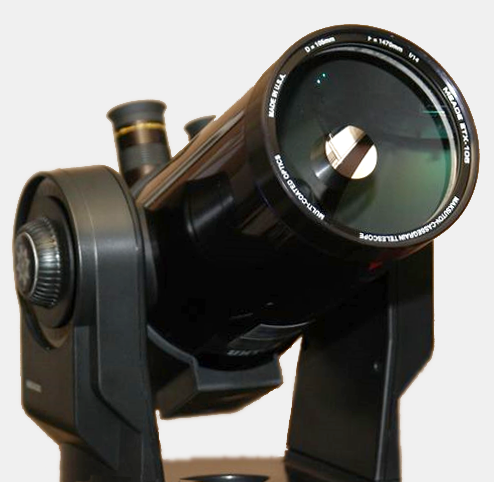
Artist: Original uploader was Caseman at nl.wikipedia
Small Maks (90–102 mm)
- Best for: Grab‑and‑go lunar/planetary, double stars, quick looks from a balcony or suburban yard.
- Pros: Ultra‑portable, minimal collimation fuss, long focal ratio makes high power easy with standard eyepieces.
- Cons: Limited aperture for faint DSOs, narrow fields, often 1.25‑inch only.
- Mount pairing: Light manual or small GoTo alt‑az mounts.
Mid‑size Maks (127–150 mm)
- Best for: Planetary and lunar detail, double stars, compact planetaries, brighter galaxies and clusters under dark skies.
- Pros: Excellent high‑contrast views for the size, still portable, usually stable collimation.
- Cons: Longer cooldown than small Maks, narrow native fields; 2‑inch paths may be constrained by baffles.
- Mount pairing: Robust alt‑az or mid‑range EQ for steady high‑power work.
Entry‑level SCTs (5–6 inches)
- Best for: All‑round visual astronomy with a tilt toward versatility; family and outreach use.
- Pros: Wider accessory ecosystem, 0.63× reducers available, 2‑inch accessories more feasible.
- Cons: Smaller aperture than popular 8‑inch class; still benefits from accurate collimation.
- Mount pairing: Compact GoTo alt‑az or light EQ for mixed visual/EAA.
Workhorse SCTs (8 inches)
- Best for: A balanced mix of lunar/planetary, deep‑sky, EAA, and introductory long‑exposure imaging.
- Pros: Significant aperture in a portable package; reducers open wider fields; abundant accessories.
- Cons: Requires good mount, dew control, and periodic collimation; mirror shift might be more noticeable during critical focus.
- Mount pairing: Solid alt‑az for visual; medium EQ for imaging.
Larger SCTs (9.25–11 inches and up)
- Best for: Deep‑sky reach, resolving globular clusters, high‑resolution planetary under excellent seeing, small galaxies for imaging with reducers.
- Pros: Aperture advantage; strong EAA/long‑exposure potential with reducers and guide solutions.
- Cons: Heavier, more demanding on mounts and cooldown; careful thermal management and collimation required.
- Mount pairing: Heavy alt‑az for visual; robust EQ for imaging.
Rule of thumb: Buy the largest aperture you will use often. A lighter, easier‑to‑deploy scope that sees the sky three nights a week will show you more than a heavy rig that stays in the closet.
Eyepieces, Diagonals, and Essential Accessories
Accessories shape your experience as much as the OTA. Catadioptrics especially benefit from a thoughtful visual path and environmental control. Here’s how to build a practical kit around a Mak or SCT.
Eyepiece strategy and exit pupil
Because Maks and SCTs have long focal lengths, you can achieve high magnification with comfortable eyepiece focal lengths—great news for eye relief and viewing comfort. Two to four eyepieces plus a quality Barlow can cover most needs.
- Low power: Seek the widest true field your baffle and diagonal support. For SCTs with 2‑inch diagonals, a long‑focal‑length widefield eyepiece can transform your view of open clusters. For small Maks, a 1.25‑inch 32 mm Plössl typically delivers the maximum true field.
- Medium power: Excellent for most DSOs, lunar framing, and double‑star scouting.
- High power: Choose focal lengths that yield 0.5–1 mm exit pupil for lunar/planetary and double‑star work. Under fair seeing, that range is often the sweet spot for contrast and eye comfort.
Handy formulas:
Magnification = Telescope focal length / Eyepiece focal length
Exit pupil (mm) = Eyepiece focal length (mm) / Telescope f-ratio
True field (degrees) ≈ Apparent field (deg) / Magnification
Diagonals and visual backs
- 1.25‑inch diagonals: Standard for small Maks and many SCT packages. Light and sufficient for high power.
- 2‑inch diagonals: Popular on SCTs to unlock wide‑field eyepieces. Larger Maks may support them with adapter rings; check baffle size to avoid severe vignetting.
Filters
- Lunar filters: Neutral density or variable polarizers improve comfort on the bright Moon.
- Narrowband/UHC: Help on emission nebulae, especially with SCTs running reducers for wider fields.
- Color filters: Optional for planetary contrast tweaks; preferences vary widely among observers.
Dew control
- Dew shield: A simple shield both reduces dew formation and blocks stray light.
- Heater strip + controller: Essential in humid climates. Wrap the strip near the corrector and manage power to stay just above dew point.
Finders and alignment
- Unit‑power finder: Invaluable for initial alignment and locating bright stars.
- Right‑angle finderscope: Helpful for star‑hopping and for observers who prefer a magnified finder view.
Reducers, focusers, and threads
- SCT reducers: 0.63× is a common standard, flattening and widening the field for visual and imaging. Use within specified back focus for optimal performance.
- External focusers: Rear Crayford focusers on SCTs provide fine control, reduce image shift during focusing, and are helpful for imaging trains.
- Mak adapters: Verify thread compatibility and back focus to ensure diagonals and cameras achieve focus without compromising edge performance.
Astrophotography with Catadioptrics: Pros, Cons, and Workflows

Artist: Pelligton
Maks and SCTs can image planets, the Moon, and deep‑sky targets—but they do so differently. Understanding focal length, field curvature, reducer options, guiding methods, and mount demands will save you time and money.
Planetary and lunar imaging
- Maks: Long native focal ratios are advantageous for high‑resolution lunar and planetary imaging. Small sensors and high‑frame‑rate cameras pair well, capturing fine detail with lucky‑imaging stacks. Ensure solid cooldown and stable seeing.
- SCTs: Equally strong and often more flexible. Larger SCTs resolve very fine detail when seeing cooperates. Many planetary imagers use 2×–3× Barlows to reach desired sampling rates.
Workflow highlights:
- Achieve precise collimation (especially on SCTs).
- Let the scope reach thermal equilibrium (see Cooldown).
- Use a high‑speed camera and short exposures; stack thousands of frames.
- Apply wavelet sharpening or deconvolution during processing.
Deep‑sky imaging
- SCTs with reducers: A common path for intermediate imagers. At f/6.3 and with good guiding, SCTs can capture galaxies, planetary nebulae, and smaller emission targets efficiently. Back‑focus spacing is critical for reducer performance and field shape.
- Maks: Long focal ratios and limited reducer options make DSOs more challenging—exposures are longer, fields narrower, and guiding more demanding. Some imagers use Maks for small planetaries or compact galaxies, but this is a niche compared with SCT workflows.
Guiding and back focus considerations
- Off‑axis guiding (OAG): Favored with SCTs to avoid differential flexure at long focal lengths. Ensure your reducer‑camera‑OAG chain honors the reducer’s back‑focus spec for optimal stars across the frame.
- Mirror flop: Moving mirrors can shift slightly with altitude changes. Some SCTs include mirror locks; otherwise, guide corrections and careful balance mitigate the effect.
If deep‑sky imaging is a priority, an SCT with a reducer and a capable EQ mount is the typical catadioptric path. If you mainly observe visually and occasionally image the Moon and planets, a Mak can be a compact, rewarding partner.
Use Cases and Decision Matrix for Different Observers
Here is a practical way to align your goals with the appropriate design. Consider sky conditions, portability needs, targets, and your appetite for accessories and technique.
Urban or suburban observer with limited time
- Recommended: 127 mm Mak or 5–6 inch SCT on a GoTo alt‑az mount.
- Why: Fast setup, excellent lunar/planetary performance, and GoTo helps cut through light pollution for smaller DSOs.
- Accessories: Dew shield, small case of eyepieces, neutral density lunar filter. Consider a simple planetary camera for the Moon and planets.
Planetary enthusiast under steady seeing
- Recommended: 6‑inch Mak for portable sharpness or 8‑inch+ SCT for maximum resolution.
- Why: High‑power work benefits from aperture and precise collimation. Seeing often limits performance more than optics.
- Accessories: High‑quality diagonal, fine focus solution, collimation tools, dew heaters, and a high‑frame‑rate camera.
Deep‑sky visual generalist
- Recommended: 8‑inch SCT with 2‑inch diagonal and 0.63× reducer.
- Why: Versatility for clusters, galaxies, and nebulae with a single OTA; reducer expands low‑power options.
- Accessories: 2‑inch widefield eyepiece, UHC filter, dew control, comfortable observing chair.
EAA or beginner imaging
- Recommended: SCT with reducer on a capable GoTo mount; small CMOS camera.
- Why: Faster f/ratio and wide accessory support; easier to achieve pleasing live‑stack results.
- Accessories: Reducer, camera adapters, light pollution filter as needed, software for live stacking.
Travel and portability first
- Recommended: 90–127 mm Mak or 5‑inch SCT with compact alt‑az mount.
- Why: Short tubes pack easily; good performance on the Moon and planets even from remote sites.
- Accessories: Lightweight tripod, padded backpack case, dew shield, minimal eyepiece set.
For more on thermal considerations that particularly affect planetary enthusiasts, revisit Thermal Behavior, Cooldown, and Collimation Stability. If you are leaning toward EAA or imaging, compare reducers and back‑focus in Astrophotography with Catadioptrics before finalizing a kit.
Setup, Maintenance, and Best Practices
Even the best telescope will underperform without basic handling, alignment, and environmental control. The following practices will help you extract the most from a Mak or SCT on any given night.
Star testing and collimation
- Choose a moderately bright star high in the sky to minimize atmospheric dispersion.
- Center the star and defocus slightly to view the diffraction pattern.
- On SCTs, adjust the secondary screws in very small increments to center the airy pattern; always recentre the star after each tweak.
- On Maks with adjustments, follow the manufacturer’s instructions. Many small Maks ship well‑aligned and rarely need user collimation.
Dew and temperature management
- Attach a dew shield before observing; it also reduces stray light.
- Power dew heaters only as much as needed—excess heat can induce tube currents.
- Set the scope outside early to equilibrate. Avoid placing it on sun‑warmed concrete.
- During large temperature drops, periodic refocus will maintain sharpness.
Focusing technique
- Use slow, steady turns at high power to avoid overshoot.
- Approach final focus from the same direction each time to reduce backlash effects.
- Consider a dual‑speed or external focuser for imaging or critical planetary work.
Cleaning and care
- Clean correctors sparingly. Dust rarely harms views; frequent cleaning risks sleeks and scratches.
- When necessary, use blower bulbs and appropriate optical cleaning solutions with gentle technique.
- Transport in padded cases; secure caps firmly to avoid debris inside the tube.
Balancing and cable management
- Balance the OTA with typical accessories installed. Slightly bias toward the east on EQ mounts to keep gears engaged.
- Secure cables to avoid snags and weight shifts, especially for imaging rigs.
Remember: Small improvements in setup—accurate collimation, stable temperature, gentle focusing—can reveal details you may have thought were beyond your telescope’s reach.
Frequently Asked Questions
Which is better for planets: a 150 mm Mak or an 8‑inch SCT?
Both can deliver excellent planetary views. A well‑cooled 150 mm Mak is renowned for crisp, high‑contrast images and is comparatively compact. An 8‑inch SCT offers more resolving power and light‑gathering ability; under steady seeing, it can reveal finer detail. If portability and cooldown are primary concerns, the Mak is compelling. If maximum resolution potential is the goal and you can accommodate the size and mount, the 8‑inch SCT typically wins.
Can I do deep‑sky imaging with a Mak or SCT?
Yes, but with different expectations. SCTs paired with common 0.63× reducers are a popular path to deep‑sky imaging and EAA; they offer manageable focal lengths and a mature accessory ecosystem. Maks can image compact targets, especially the Moon and planets, but their longer focal ratios and limited reducer options make deep‑sky work more demanding, with narrower fields and longer exposures. If deep‑sky imaging is central to your plans, an SCT is generally the more flexible choice.
Final Thoughts on Choosing the Right Catadioptric Telescope
Maksutov‑Cassegrain and Schmidt‑Cassegrain telescopes both deliver powerful, compact astronomy experiences. Maks shine as focused, high‑contrast instruments for lunar and planetary observing in small to medium apertures, often with excellent collimation stability. SCTs stand out for their versatility: broader accessory support, reducer options, and a wide range of apertures make them capable all‑rounders for visual, EAA, and imaging.
Let your sky and habits drive the decision. If you crave quick planetary sessions with minimal fuss, a mid‑size Mak will delight you. If you want an expandable platform to explore everything from globular clusters to live‑stacked galaxies—and to grow into imaging—an 8‑inch class SCT is a proven workhorse. Whichever path you choose, invest in dew control, careful collimation (especially for SCTs), and a stable mount. Those fundamentals will do more for your views than any incremental spec on paper.
Want more deep dives like this? Subscribe to our newsletter to get future guides on telescopes, optics, and practical observing tips delivered to your inbox—and explore related topics across our site to keep your observing nights productive and inspiring.