
Table of Contents
- What Are Jupiter’s Galilean Moons?
- Orbital Mechanics and the Laplace Resonance Explained
- How to Observe the Galilean Moons with Binoculars and Small Telescopes
- Identifying Each Moon: Appearance, Brightness, and Motion
- Transits, Eclipses, and Shadow Phenomena: What to Watch
- Surface and Interior Science: Io, Europa, Ganymede, Callisto
- When to Look: Opposition, Elongation, and Finding Jupiter
- Timing Tools, Logs, and Predictive Ephemerides
- Spacecraft Discoveries and What’s Next
- Frequently Asked Questions
- Final Thoughts on Choosing the Right Jupiter Observing Setup
What Are Jupiter’s Galilean Moons?
Jupiter’s four largest satellites—Io, Europa, Ganymede, and Callisto—are collectively known as the Galilean moons, named after Galileo Galilei, who first reported seeing them in early 1610. These worlds are bright, dynamic, and scientifically compelling. For observers, they are also some of the most rewarding and accessible targets in the night sky. Even handheld binoculars can show the tiny, star-like points flanking Jupiter’s brilliant disk, while a small telescope reveals their changing positions night by night and, when conditions cooperate, their transits and shadows crossing the planet’s face.

Beyond their visual appeal, the Galilean moons are a solar system in miniature: volcanic activity (Io), signs of a global ocean underneath an icy crust (Europa), the only moon with its own intrinsic magnetic field (Ganymede), and an ancient, heavily cratered surface preserving the solar system’s history (Callisto). The gravitational interplay between these worlds and Jupiter provides a natural laboratory for understanding tides, orbital resonances, and planetary system evolution. If you want to deepen your solar system observing skills while learning real planetary science, few targets offer more than the Galilean quartet.
This guide brings together the key scientific insights, practical observing advice, and timing strategies you need. We will explore their orbital mechanics in Orbital Mechanics and the Laplace Resonance Explained, step-by-step observing tips in How to Observe the Galilean Moons, and highlight dramatic events such as transits and eclipses in Transits, Eclipses, and Shadow Phenomena. For deeper science, jump to Surface and Interior Science, or learn how to time your viewing around Jupiter’s opposition in When to Look. We’ll also point to the best prediction tools in Timing Tools, Logs, and Predictive Ephemerides and summarize spacecraft insights in Spacecraft Discoveries and What’s Next.
Orbital Mechanics and the Laplace Resonance Explained
The inner three Galilean satellites—Io, Europa, and Ganymede—are locked in a 1:2:4 orbital resonance known as the Laplace resonance. In this configuration, for every orbit Ganymede completes around Jupiter, Europa completes two, and Io completes four. As a result, their orbital longitudes are interrelated: a particular combination of their mean longitudes (λ) remains nearly constant over time, reflecting a dynamical balance.
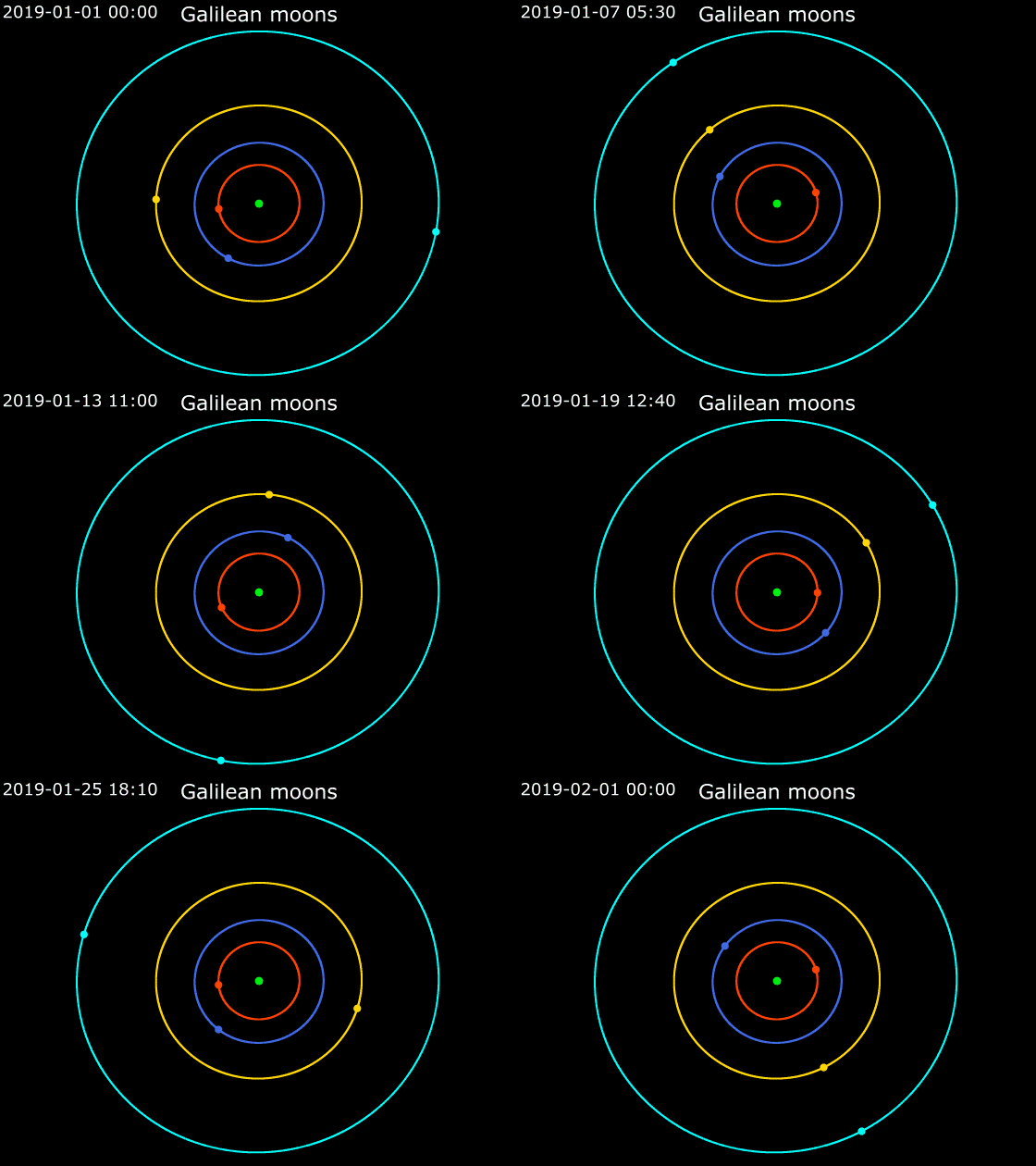
This resonance has profound consequences:
- Tidal heating: The resonance forces Io and Europa, in particular, into slightly eccentric orbits. As they move closer to and farther from Jupiter across each orbit, Jupiter’s immense gravity flexes the moons. The continuous flexing dissipates energy as heat—dramatic on Io, more subtle but vital on Europa.
- Orbital stability: Resonances can stabilize orbital relationships over long timescales. Although perturbations occur (e.g., from solar tides and Jupiter’s oblateness), the resonance helps maintain a quasi-regular configuration.
- Phase protection: The resonance phases the moons such that close encounters are minimized, reducing the likelihood of destabilizing gravitational kicks.
Callisto, the outermost of the four, is not in the Laplace resonance. Its more distant, slightly inclined orbit leaves it less tidally heated and more geologically quiescent, preserving a heavily cratered surface that offers a time capsule of early solar system conditions.
Orbital periods (approximate):
- Io: ~1.77 Earth days
- Europa: ~3.55 Earth days
- Ganymede: ~7.15 Earth days
- Callisto: ~16.69 Earth days
Because the periods are short (especially for Io and Europa), their shifting positions relative to Jupiter are noticeable within hours. That’s part of the joy of visual observation: check in on Jupiter at dusk, then again near midnight, and you may see a moon that was east of Jupiter swing to the west, or a shadow appear and drift across the cloud tops. The mechanics you read about turn into movements you can watch.
For a deeper dive into interpreting these configurations, see the planning section in Timing Tools, Logs, and Predictive Ephemerides, where we walk through how to use ephemerides to predict elongations, transits, and eclipses.
How to Observe the Galilean Moons with Binoculars and Small Telescopes
The Galilean moons are among the most accessible “dynamic” targets in amateur astronomy. Unlike many deep-sky objects that require dark skies and large apertures, you can appreciate Jupiter and its four bright companions from suburban locations. Still, careful technique greatly improves what you can see. This section focuses on practical, reproducible steps for binocular and small-telescope observers.
Finding Jupiter
Jupiter is typically the brightest star-like object in the night sky when it is well placed, shining steady with a pale cream hue. To locate it:
- Use a planetarium app or printed monthly chart to identify Jupiter’s position along the ecliptic.
- Look for a brilliant, non-twinkling “star.” Even in light pollution, Jupiter is prominent.
- Note that Jupiter’s altitude at a given season depends on your latitude and the geometry of the ecliptic. See When to Look: Opposition, Elongation, and Finding Jupiter for seasonal guidance.
Binocular observing
Standard 7×50 or 10×50 binoculars will usually show the four moons as pinpoints in a row alongside Jupiter’s glare. Tips for success:

- Stabilize: Rest your elbows on a solid surface or mount the binoculars on a tripod to reduce shake. Stability is key to seeing fainter moons, particularly when they are near Jupiter’s bright disk.
- Glare control: Slightly defocus or move Jupiter just outside the field edge to reduce glare and make the moons more apparent.
- Check repeatedly: A moon can be near superior or inferior conjunction with Jupiter’s disk and get lost in the glare. Revisit after 30–60 minutes to catch it reappearing further from the limb.
Small telescope observing
A 60–130 mm refractor or a 130–200 mm Dobsonian/newtonian is ideal for showcasing the moons and their interactions. Use quality eyepieces that provide a range of magnifications. Start low (40–60×), then increase (100–200×) as seeing allows.
- Magnification basics: magnification = telescope_focal_length / eyepiece_focal_length. For example, a 1000 mm focal length telescope with a 10 mm eyepiece yields 100×.
- Field of view: A wider apparent field (e.g., 68°–82°) helps frame Jupiter and all four moons when they are widely separated. Narrower fields can clip one or two moons at maximum elongation.
- Seeing and transparency: “Seeing” refers to atmospheric steadiness; it controls how sharp Jupiter’s limb appears and whether tiny moon disks are resolved. “Transparency” is clarity; it affects how easily you detect fainter moons (especially when low on the horizon).
- Filters: A neutral density filter or variable polarizer can temper Jupiter’s brightness, enhancing contrast for shadows during transits. Light yellow or blue filters can subtly enhance cloud belt contrast, but they are not necessary for the moons themselves.
- Focus discipline: Gently tweak focus on a moon and then on Jupiter’s limb. Fine focus can make the difference between seeing a perfectly dark round shadow and none at all.
Resolving the moons as disks
While the Galilean moons often look like star points at low power, sufficient aperture and steady air can resolve them as tiny disks, with Ganymede most readily resolved due to its larger diameter. Under excellent seeing, a 100–150 mm aperture at 200× or more may show slight differences in apparent size between Io (smallest) and Ganymede (largest). Color tones can also be subtly different—Io slightly yellowish, Europa gray-white, Ganymede faintly tawny, Callisto darker gray—but these impressions are delicate and depend on conditions.
Track motion over hours
The moons’ orbital periods mean you can watch them move relative to Jupiter over a single evening. Practice this skill:
- Sketch their positions every 30–60 minutes.
- Note which side of Jupiter is east or west using drift: turn off tracking and watch which way Jupiter drifts to the field edge—westward with Earth’s rotation. Mark your sketch accordingly.
- Compare with predictions from an ephemeris (see Timing Tools) to build confidence in your identifications.
As your experience grows, you’ll be ready to chase the most dramatic spectacles—transits, occultations, and shadow passages—covered in detail in Transits, Eclipses, and Shadow Phenomena.
Identifying Each Moon: Appearance, Brightness, and Motion
At a glance through binoculars or a small scope, the four moons can be mistaken for field stars. Accurate identification relies on observing sequence, brightness, and context. Here are practical profiles you can lean on at the eyepiece:
- Io (innermost)
- Orbital period: ~1.77 days; moves fastest.
- Brightness: Among the brighter, but often closer to Jupiter where glare interferes.
- Appearance: Sometimes shows a warm, slightly yellow tint at high power under steady seeing.
- Observing tip: Io’s rapid motion makes it the easiest to catch entering or exiting transit over a single session.
- Europa
- Orbital period: ~3.55 days.
- Brightness: Slightly fainter than Io in many conditions; more neutral-white.
- Appearance: Small disk at high magnification; often close in.
- Observing tip: Europa’s shadow during transit is tiny but very dark; excellent contrast on Jupiter’s belts.
- Ganymede (largest moon in the solar system)
- Orbital period: ~7.15 days; largest apparent disk.
- Brightness: Brightest of the four, frequently easiest to resolve as a disk.
- Appearance: Subtle albedo shadings are beyond small apertures, but the larger disk often stands out.
- Observing tip: Because of its size, Ganymede’s transit shadow is conspicuous in small telescopes when timing and seeing align.
- Callisto (outermost)
- Orbital period: ~16.69 days; slowest apparent motion.
- Brightness: Comparable to or slightly fainter than Ganymede, but often farther out and easier to separate from Jupiter’s glare.
- Appearance: Darker gray tone when resolved at high magnification.
- Observing tip: Because of its more inclined orbit, Callisto’s transits and eclipses are not as frequent as the inner three.
When in doubt, consult an ephemeris or a real-time app: it will list which moons are on Jupiter’s east or west side and whether any are in front of or behind the disk. Cross-check your view by comparing the relative distances from Jupiter; Timing Tools explains how to read these tables. With practice, you’ll learn to recognize Ganymede by size, Io by speed, Europa by its proximity and neutral tone, and Callisto by its greater separation and slightly dimmer, grayer aspect.
Transits, Eclipses, and Shadow Phenomena: What to Watch
Because the Galilean moons orbit in roughly the same plane as Jupiter’s equator and Earth’s line of sight, they frequently pass in front of or behind the planet, leading to a rich variety of phenomena. These events are the highlights of Jupiter observing, and they are within reach of modest amateur equipment when seeing cooperates.
Key event types

- Transit: A moon crosses in front of Jupiter’s disk. The moon itself can be hard to distinguish against the bright clouds, especially for Europa and Io, which have lower contrast. Ganymede’s disk is more noticeable. During a transit, the moon’s shadow may also be visible elsewhere on the disk if geometry allows.
- Shadow transit: The moon’s shadow is cast onto Jupiter’s cloud tops. The shadow appears as a round, inky, sharply defined spot drifting across the belts. These are the most dramatic and easiest events to see—target them first.
- Occultation: A moon passes behind Jupiter (as seen from Earth). The moon fades and disappears at Jupiter’s limb, then reappears on the opposite limb later.
- Eclipse: A moon enters Jupiter’s shadow and is darkened even when not behind the planet’s disk. The moon can fade while still off to the side of Jupiter and then brighten again as it exits the shadow.
Double and triple events
Sometimes, two or even three moons may be involved in visible events at once—for example, one moon transiting while another’s shadow is crossing, or two shadows on the disk simultaneously. These “double shadow transits” are favorite targets in public outreach because of their undeniable drama. Their occurrence depends on the precise orbital geometry and Earth’s viewing angle. Prediction tools (see Timing Tools) will list the timing and visibility of such events from your location.
How to observe events effectively
- Start early: Be at the telescope 15–30 minutes before the predicted start. Allow your eyes to adapt to the light level and your optics to reach thermal equilibrium.
- Use moderate to high power: 120–200× often provides the best balance between sharpness and contrast. Increase magnification if seeing is steady.
- Track the limb: For occultations and transits, focus on Jupiter’s limb where the moon will enter or exit; watching the exact moment of disappearance or emergence is especially satisfying.
- Tune contrast: A variable polarizer can dim Jupiter’s glare just enough to make a small, dark Europa shadow pop.
- Record: Sketch or jot timestamps for contact points (ingress/egress). This builds your skill and lets you compare with predicted times afterward.
What about the Great Red Spot?
Though not a moon-related phenomenon, the Great Red Spot (GRS) often shares the stage during transits and shadows. If your schedule permits, plan sessions when the GRS is crossing the central meridian of Jupiter. The juxtaposition of a black moon shadow on the belts near the GRS is an eye-catching scene. Many timing tools list both moon events and GRS transit times, allowing you to combine targets in a single session. For more on planning these, jump to Timing Tools, Logs, and Predictive Ephemerides.
Surface and Interior Science: Io, Europa, Ganymede, Callisto
Observing the Galilean moons connects you to some of the most intriguing planetary science of the past few decades. Each of the four is a world-class subject of study in its own right. Here’s a concise survey of the major findings and why they matter.
Io: A volcanic world driven by tides
Io is the most volcanically active body in the solar system. The energy comes from tidal flexing induced by Jupiter’s gravity and maintained by the Laplace resonance with Europa and Ganymede. Spacecraft and telescopic observations have recorded towering plumes, lakes of molten sulfurous material, and constantly resurfaced plains. This extreme activity means Io’s surface is geologically young, with bright and dark patches reshaping over months to years.

- Composition: Silicate rock with abundant sulfur compounds; a relatively thin crust over a warm mantle.
- Atmosphere: A tenuous sulfur dioxide atmosphere that varies with volcanic output and day-night cycles.
- Notable features: Giant calderas and hot spots; plume activity observed at locations such as Pele in spacecraft imagery.
For the observer, Io’s most noticeable features are its speed and the crispness of its shadow during transits. Although Io’s surface coloration can be hinted at in moderate telescopes under excellent seeing, differentiating detailed albedo is challenging visually.
Europa: An ice shell over a global ocean
Europa likely harbors a global subsurface ocean beneath an ice shell, inferred from induced magnetic fields, surface geology, and heat budgets. The ocean may be in contact with a rocky seafloor, raising the possibility of hydrothermal activity—an environment of astrobiological interest. Linear fractures and “chaos terrains” crisscross the bright, relatively smooth surface.
- Composition: Water ice surface; subsurface ocean; rocky interior.
- Evidence for ocean: Magnetic induction measurements, surface geology consistent with ice shell movement, and thermal models driven by tidal heating.
- Astrobiology: If chemical energy sources exist at the seafloor, Europa’s ocean could be habitable, at least in principle.
Visually, Europa appears as a small, clean-white disk, with its shadow transits offering high contrast. The science story makes it especially compelling to share at the eyepiece during public outreach.
Ganymede: The giant moon with a magnetic field
Ganymede is the largest moon in the solar system, bigger than Mercury in diameter. Remarkably, it has its own intrinsic magnetic field, thought to be generated by a partially liquid iron-nickel core. Its surface shows contrasting dark, older regions and somewhat brighter grooved terrain that reflects episodes of tectonism and icy resurfacing.
- Interior: Differentiated, with metallic core, rocky mantle, and outer ice layers; multiple stacked ocean layers are possible.
- Magnetosphere: A mini-magnetosphere embedded within Jupiter’s vast magnetic environment; auroral emissions have been detected.
- Albedo features: Beyond small telescopes, spacecraft imagery reveals a complex history; in amateur views, Ganymede’s larger disk is the main distinguishing characteristic.
Ganymede’s size and brightness make it the easiest moon to resolve as a disk. During transits, its shadow is larger and usually the boldest to the eye, second only to Io’s in frequency and clarity.
Callisto: Ancient, cratered, and quietly telling the story of time
Callisto is heavily cratered and geologically quieter than its siblings. Its surface preserves a record of impacts dating back billions of years. Unlike the other three, Callisto is not locked in the inner resonance, experiences less tidal heating, and appears to have remained more structurally intact.
- Surface: Dark, densely cratered plains; multi-ring impact structures such as Valhalla are prominent in spacecraft images.
- Interior: Possibly partially differentiated with substantial ice-rock mixture; subsurface briny layers are possible.
- Orbital inclination: Slightly greater inclination affects the frequency and geometry of transits and eclipses as seen from Earth.
At the eyepiece, Callisto is often the far-flung sentinel, a bit dimmer in hue and removed from Jupiter’s strong glare—a helpful clue to identification when you’re comparing views with an ephemeris in Timing Tools.
When to Look: Opposition, Elongation, and Finding Jupiter
Seeing the Galilean moons is possible whenever Jupiter is above the horizon in a dark or twilight sky. However, some times of year offer much better views than others. Understanding opposition and Jupiter’s seasonal path will maximize your success.
Opposition and why it matters
Jupiter is at opposition when Earth lies between Jupiter and the Sun. Around opposition, Jupiter is:
- Brighter: It attains peak apparent brightness.
- Larger: Its apparent diameter is at or near its yearly maximum, typically around 40–50 arcseconds.
- Visible all night: It rises at sunset and sets at sunrise, giving maximum observing time and more opportunities to catch multiple moon events in one night.
While the exact date of opposition varies annually, it occurs approximately every 13 months due to Earth’s faster orbit. You can quickly find the next opposition date with a planetarium app or an almanac. For many observers, the weeks around opposition are prime time to chase double shadow transits and to resolve the moons as disks in steady seeing. See Timing Tools for ways to plan precisely.
Altitude and season
Jupiter’s altitude at culmination (its highest point in the sky) depends on your latitude and the planet’s declination. A higher altitude means you’re looking through less atmosphere, improving seeing and contrast. If Jupiter is riding high during your local prime hours, you’ll have better chances to resolve fine details on the planet and detect tiny moon-disk features like limb darkening during transits. In seasons when Jupiter is low from your location, plan to observe near culmination and be patient with the seeing.
Good times within a night
Even on nights of mediocre seeing, there are often brief steady intervals. Practical advice:
- Try multiple sessions: dusk, midnight, and pre-dawn can each offer different seeing profiles as the ground cools and local thermal plumes die down.
- Avoid rooftops and nearby heat sources; set up on grass or bare earth if possible.
- Allow your telescope’s optics to thermally stabilize for sharper, steadier views—especially important for larger mirrors and closed-tube designs.
Timing Tools, Logs, and Predictive Ephemerides
Planning is half the fun. Knowing exactly when a moon’s shadow will touch Jupiter’s limb or when a moon will reappear from behind the disk helps you make the most of limited clear nights. Fortunately, the necessary tools are widely available and often free.
Where to get predictions
- Online almanacs and calculators: Reputable astronomy magazines and observatories host real-time Galilean moon calculators. They provide tables listing each moon’s position (east/west, in transit, behind, or in eclipse) by time and date for your location.
- Planetarium software and apps: Desktop and mobile apps simulate the sky, animate time, and label each moon. Many also display predicted transits, shadow events, and the Great Red Spot’s central meridian times.
- JPL Horizons: For those who want high-precision ephemerides, NASA/JPL’s Horizons service can generate topocentric (observer-based) positions of the moons and Jupiter. It’s more technical but exceptionally accurate.
Reading ephemerides
A typical Galilean moons table lists the moons’ status at intervals (e.g., every 15 minutes), using abbreviations such as:
- E: east of Jupiter
- W: west of Jupiter
- T: in transit
- S: shadow on Jupiter
- O: occulted (behind Jupiter)
- X: eclipsed (in Jupiter’s shadow off-disk)
Armed with this, you can plan to observe, for example, “Io S 22:18–00:34” indicating a shadow transit spanning that interval. If you’re new to these tables, compare what you see at the eyepiece for a few nights with what your app predicts; you’ll quickly grow adept at deciphering the shorthand.
Keeping an observing log
Logs help you become a better observer. They make subtle progress visible: the first time you resolve Ganymede as a disk, the first double shadow transit, or how different magnifications affect contrast. Consider a template like the following:
Date (YYYY-MM-DD):\nTime (UT/local):\nLocation (lat, lon, elevation):\nInstrument(s):\nEyepiece(s) / Magnification(s):\nSeeing (1–5) and Transparency (1–5):\nJupiter CM (System II) at midpoint (optional):\nGRS predicted visibility (if any):\nEvent(s) targeted (e.g., Europa shadow, Io egress):\nNotes/sketch:\nTo estimate magnification and field framing when planning, you can also note approximate true field of view (TFOV):
TFOV ≈ Apparent Field of View (AFOV) / Magnification\nExample: AFOV 68°, Mag 150× → TFOV ≈ 68° / 150 ≈ 0.45°\nLogging builds intuition and helps you select the right gear for the right event—remember to revisit How to Observe the Galilean Moons for gear considerations as you refine your setup.
Spacecraft Discoveries and What’s Next
Spacecraft have revolutionized our understanding of Jupiter and its moons, complementing what you see at the eyepiece. A concise timeline of key contributions includes:

- Voyager 1 and 2 (1979): First close-up surveys, discovering Io’s active volcanism and revealing detailed surfaces of Europa, Ganymede, and Callisto—including Europa’s fractured ice and Callisto’s ancient impact structures.
- Galileo orbiter (1995–2003): The first dedicated Jupiter orbiter. It made multiple flybys of the Galilean moons, measuring Europa’s likely subsurface ocean via magnetic induction, mapping volcanic hot spots on Io, and characterizing Ganymede’s magnetic field.
- Juno (arrived 2016): A polar orbiter focused primarily on Jupiter’s atmosphere, interior structure, and magnetosphere. Its extended mission includes close passes near some moons, returning high-value context for the Jovian system.
- ESA’s JUICE (Jupiter Icy Moons Explorer; launched 2023): Set to perform detailed studies of Ganymede, Europa, and Callisto, with a particular focus on Ganymede—including orbital operations around it after arrival in the 2030s.
- NASA’s Europa Clipper: Planned to conduct dozens of Europa flybys to characterize the ice shell and subsurface ocean properties, advancing our understanding of its potential habitability. As of 2024 planning, launch was targeted for the mid-2020s.
These missions weave a coherent story: tidal forces sculpt this mini-system; oceans and ice interact over geologic time; and Jupiter’s radiation and magnetic environment shape surface chemistry and tenuous atmospheres. For amateur observers, tying spacecraft findings to visual sessions makes outreach more engaging. When you show a visitor Europa’s diminutive disk, you can explain how instruments detect induced magnetic fields signaling a global saline ocean. When a dark shadow crosses Jupiter, you can talk about the physics that maintains Io’s ceaseless volcanism. For planning synergy between spacecraft data and backyard observation, check current mission pages and pair with the scheduling recommendations in When to Look and the tools in Timing Tools.
Frequently Asked Questions
Can I see the Galilean moons in a city with light pollution?
Yes. The moons are bright enough to pierce city skyglow, and Jupiter itself is extremely bright. Light pollution affects faint deep-sky objects most; planetary and lunar targets remain highly rewarding. The main challenge is atmospheric steadiness (seeing). Choose nights when stars appear steady, observe when Jupiter is highest above the horizon, and use moderate magnifications. Glare from Jupiter can hide a moon near conjunction with the disk; patience and repeated checks help. Also try the “field-edge” trick: gently nudge Jupiter just outside the field to reveal a nearby moon hiding in the glare. For a step-by-step gear and technique refresher, return to How to Observe the Galilean Moons.
What’s the minimum equipment to catch a moon’s shadow transit?
A small, well-collimated telescope (80–130 mm aperture) and steady seeing are the biggest factors. While shadow transits have been reported in smaller scopes under excellent conditions, a 100–150 mm instrument at 120–200× provides a reliable experience for most observers. A variable polarizer to slightly dim Jupiter can improve perceived contrast. Timing is everything—use the resources in Timing Tools, Logs, and Predictive Ephemerides to arrive early and be ready to watch the shadow’s crisp round spot emerge at the limb and drift across the belts.
Final Thoughts on Choosing the Right Jupiter Observing Setup
Jupiter and its Galilean moons deliver a uniquely satisfying blend of accessible observing and rich science. You can begin with binoculars tonight, confirming the linear arrangement of moons. With a small, portable telescope and a couple of eyepieces, you add layer upon layer: identifying each moon by brightness and position, timing a first shadow transit, resolving Ganymede’s disk, or catching a delicate Europa egress. As your ambition grows, you can refine your gear choices—stable mount, comfortable observing chair, a neutral density or variable polarizer, and a selection of eyepieces that provide 50× for framing and 150–250× for detail when seeing allows. If you are deciding among options, err toward stability and ease of use; the best telescope is the one you set up often.
The broader lesson is that planetary observing rewards preparation. A simple routine—check predictions, plan an event or two, set up early, and log what you see—turns ordinary nights into memorable ones. The moons’ quick motions offer immediate feedback: compare your notes across an evening and watch orbital mechanics unfold in real time. Tie what you see to the science in Surface and Interior Science and the planning tools in Timing Tools, and your backyard sessions will connect to frontier exploration by spacecraft like Juno, JUICE, and Europa Clipper.
If you enjoyed this guide, consider exploring related topics—such as techniques for observing Saturn’s moons or understanding orbital resonances in other systems. For more in-depth, practical astronomy content delivered regularly, subscribe to our newsletter so you don’t miss the next installment.