
Table of Contents
- What Is Titan, Saturn’s Hydrocarbon-Rich Moon?
- Discovery, Naming, and Orbital Dance Around Saturn
- Thick Nitrogen Atmosphere and Methane Weather
- Surface Geology: Lakes, Dunes, and Cryovolcanic Hints
- Interior Structure, Subsurface Ocean, and Habitability
- Organic Chemistry and Prebiotic Pathways on Titan
- From Pioneer to Cassini–Huygens: How We Know What We Know
- NASA’s Dragonfly Rotorcraft Lander: Goals, Instruments, and Sites
- How to Observe Titan from Earth: Amateur Tips and Pro Techniques
- Comparing Titan to Earth, Mars, and Europa: Climate and Chemistry Contrasts
- Key Datasets, Maps, and Spectra for Titan Researchers
- Frequently Asked Questions
- Final Thoughts on Exploring Titan’s Methane Seas
What Is Titan, Saturn’s Hydrocarbon-Rich Moon?
Titan is Saturn’s largest moon and, after Jupiter’s Ganymede, the second-largest natural satellite in the solar system. With a radius of about 2,575 kilometers—larger than the planet Mercury—Titan is unique among moons for possessing a thick, nitrogen-dominated atmosphere and an active methane–ethane hydrological cycle. This alien world features clouds, rain, rivers, lakes, and seas, all sculpted not by liquid water at the surface but by hydrocarbons. Beneath its frigid crust, multiple lines of evidence point to a global subsurface ocean of liquid water mixed with ammonia or other antifreezes, making Titan a compelling target in the search for prebiotic chemistry and potentially habitable environments.
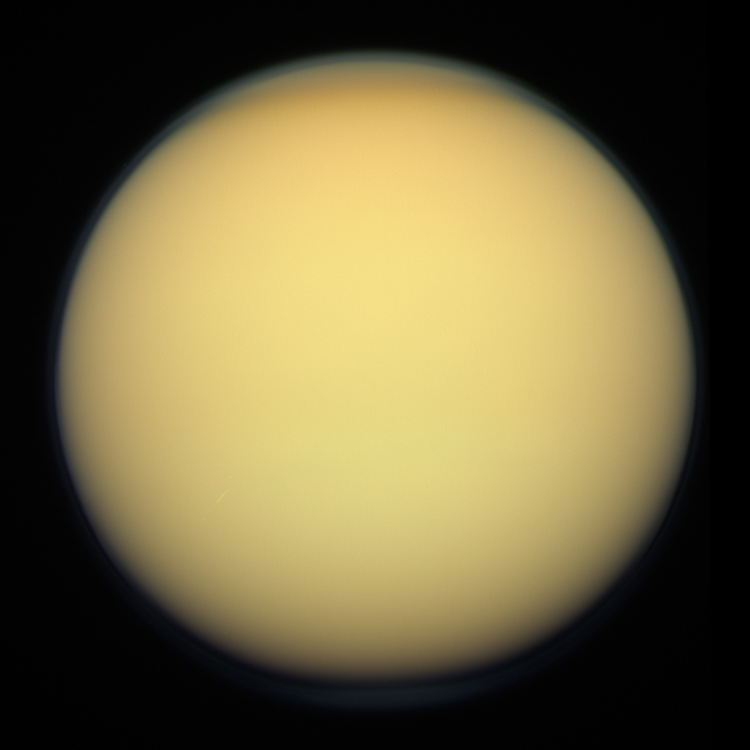
Artist: NASA/JPL-Caltech/SSI/Kevin M. Gill
Titan’s surface temperature hovers near 94 K (−179 °C), and the atmospheric pressure at the ground is roughly 1.5 bar—about 50% higher than Earth’s sea-level pressure. The thick haze in its upper atmosphere filters sunlight to an orange twilight even at local noon, giving the world a muted, copper-toned palette. That same organic haze, produced by complex photochemistry, settles slowly onto the surface, supplying material for equatorial dune fields and chemically diverse sediments around its polar seas.
When we talk about Titan as an “ocean–atmosphere” world, we mean it in two senses: the interior liquid water ocean that likely underlies the ice shell and the surface–atmosphere methane cycle that mirrors Earth’s water cycle in several striking ways. This dual character makes Titan a natural laboratory for understanding climate processes, planetary evolution, and the chemical steps that may precede biology.
Discovery, Naming, and Orbital Dance Around Saturn
Titan was discovered in 1655 by the Dutch astronomer Christiaan Huygens, not long after the invention of the astronomical telescope. For centuries it was known simply as “Saturn’s moon,” and later by the designation “Saturn VI” (based on the order in which Saturn’s moons were cataloged). The name “Titan” reflects the mythological Titans of ancient Greece—siblings of the Olympian gods—matching the tradition of naming Saturn’s moons after figures associated with the Roman god Saturn.
Orbiting Saturn at a mean distance of about 1.22 million kilometers, Titan completes a revolution in roughly 15.95 Earth days. Like many large moons, it is in tidal lock with its parent planet, always showing the same hemisphere to Saturn. This synchronous rotation keeps Titan’s sub-Saturnian hemisphere permanently oriented toward the ringed giant. The orbit is slightly eccentric and modestly inclined, factors that may contribute to internal tidal heating and subtle librations—wobbles that, when measured precisely, inform models of its interior structure and the likely presence of an internal ocean.
Titan’s gravitational sphere of influence and orbital interactions with other Saturnian moons produce a dynamic environment of resonances and tides. The gravity of Titan, which is about 0.14 g at the surface, also shapes Saturn’s magnetospheric plasma flow and contributes to a complex electromagnetic environment that affects atmospheric escape and ionospheric chemistry.
Orbital geometry also affects what we can observe from Earth. Titan’s maximum apparent angular separation from Saturn is on the order of a few arcminutes, which is large enough that small telescopes—or even good binoculars under excellent conditions—can pick it out from Saturn’s glare. Practical guidance for backyard observers is covered in How to Observe Titan from Earth.
Thick Nitrogen Atmosphere and Methane Weather
For planetary scientists, Titan’s atmosphere is a crown jewel: it is thick, complex, and chemically rich. The bulk composition is nitrogen (N2)—similar to Earth—with methane (CH4) as the second most abundant constituent, typically a few percent by volume depending on altitude and local conditions. Trace species include ethane (C2H6), acetylene, hydrogen cyanide (HCN), and a suite of hydrocarbons and nitriles that reveal themselves in infrared and radio spectra.

Artist: NASA / JPL
High in the atmosphere, ultraviolet sunlight and energetic particles drive photochemical reactions that break apart methane and nitrogen, enabling the formation of complex molecules. These eventually polymerize into tholins—a catch-all name for complex organic solids—that aggregate into aerosols and haze layers. The haze stratification and microphysics are central to Titan’s radiative balance, shaping surface temperatures and cloud formation.
Pressure, Temperature, and Vertical Structure
Near the surface, Titan’s pressure is roughly 1.5 bar, and the temperature sits near 94 K. Moving upward, the atmosphere cools in the troposphere before warming in the stratosphere due to haze absorption and chemical heating, then transitions again in the mesosphere and thermosphere. The altitude of Titan’s tropopause is higher than Earth’s—tens of kilometers up—while the stratospheric temperature inversion is sustained by a persistent haze layer that is both a greenhouse and anti-greenhouse agent.
A key property of Titan’s atmosphere is its methane humidity, especially near the surface. Methane behaves on Titan much as water does on Earth: it can evaporate, condense, form clouds, and precipitate as rain. Measurements from the Huygens probe during its 2005 descent recorded methane saturation levels near the surface and a richly structured troposphere with wind shear and turbulence.
Winds, Superrotation, and Seasonal Cycles
Global circulation models and spacecraft data reveal that Titan’s upper atmosphere exhibits superrotation, where winds in the stratosphere can circle the globe faster than the moon rotates. In the lower atmosphere, wind speeds are generally gentler but can intensify during storm events. Seasonal changes, driven by Saturn’s nearly 29.5-year orbit around the Sun, modulate cloud patterns, polar vortex strength, and the exchange of volatile species between poles and equator. Around equinox, large methane convective storms have been observed, producing intense rain that reshapes surface channels.
The Methane–Ethane Hydrological Cycle
At Titan’s frigid temperatures, water is rock, and methane/ethane are the working fluids. The cycle includes:
- Evaporation from polar lakes and seas (e.g., Kraken Mare, Ligeia Mare, Punga Mare)
- Cloud formation in suitable atmospheric layers
- Precipitation as methane rain, especially during seasonal storm periods
- Runoff through dendritic channels to basins and shorelines
- Infiltration into porous regolith and potential subsurface flow
Cassini’s radar and near-infrared instruments detected rainfall-darkened surfaces, transient cloud decks, and lake level changes. The longevity and composition of these seas depend on regional climate balance and the photochemical destruction of methane, which must be replenished over geologic time, possibly through cryovolcanic outgassing or other internal processes.
For readers who want to connect climate to observation, the interplay between atmospheric opacity, surface reflectivity, and seasonal winds helps explain why observing Titan in the near-infrared from Earth can sometimes reveal surface albedo patterns while visible-light views are muted by haze.
Surface Geology: Lakes, Dunes, and Cryovolcanic Hints
Titan’s surface is geologically diverse, with landforms created by fluid erosion, sediment deposition, tectonism, and possibly cryovolcanism. Because water ice is mechanically strong at 94 K, it behaves like rock does on Earth, while organic solids and ices can play the role of sediments.
Methane Seas and Lakes
The most dramatic features are in the polar regions, where radar-bright shorelines trace out vast seas. Notable bodies include:
- Kraken Mare: The largest known sea, with labyrinthine inlets and islands
- Ligeia Mare: A deep, relatively pure methane-dominated sea
- Punga Mare: A smaller polar sea with complex shoreline morphology

Artist: NASA / JPL-Caltech / Agenzia Spaziale Italiana / USGS
These seas are connected by river networks and smaller lakes, some perched, some karst-like, likely controlled by bedrock permeability and regional subsidence. Radar altimetry and wave observations have hinted at surface winds and even possible tides influenced by Saturn’s gravity.
Equatorial Dune Seas of Organic Sand
The equatorial latitudes are dominated by vast fields of longitudinal dunes that stretch hundreds of kilometers. The sand-sized grains are not quartz but likely solid organics—complex molecules produced in the atmosphere and modified at the surface. The dunes are aligned with prevailing winds and are interleaved with bright, more cohesive materials, possibly water ice-rich bedrock or indurated organic deposits. These dune systems document Titan’s climate over long timescales and are central to landing site choices for NASA’s Dragonfly mission.
Fluvial Channels, Alluvial Fans, and Erosional Landscapes
Cassini radar swaths revealed dendritic channel networks, alluvial fans, and what look like river deltas. Such features argue strongly for sustained precipitation and runoff episodes. Dark streaks and surface albedo changes over time lines up with storm events, painting a picture of ongoing landscape activity.
Mountains, Tectonics, and Possible Cryovolcanoes
Titan hosts mountain chains and plateaus with relief of up to ~1–2 km. The tectonic drivers could include global contraction/expansion from thermal evolution, tidal stress cycles, and crustal loading near the poles. Several structures—such as the region known as Sotra (also called Doom Mons/Sotra Patera)—have been proposed as cryovolcanic constructs. These would be places where ammonia–water or brine slurries erupted, potentially delivering methane and other volatiles to the surface. While evidence remains debated, cryovolcanism could be an important source for replenishing atmospheric methane over geologic timescales.
For implications on habitability and atmospheric maintenance, see Interior Structure, Subsurface Ocean, and Habitability. If cryovolcanic activity connects Titan’s interior to its surface, it would have strong consequences for the longevity of the methane cycle and the recycling of organic material.
Interior Structure, Subsurface Ocean, and Habitability
Multiple lines of evidence—gravity measurements, topographic flexure, rotational dynamics, and magnetic induction in other icy moons—support the idea that Titan contains a global subsurface ocean beneath an outer ice shell. The ocean is likely a water–ammonia solution, which lowers the freezing point. The thickness of the ice shell may be on the order of tens of kilometers, with the ocean extending for perhaps 100 kilometers or more below it, eventually transitioning into high-pressure ice phases atop a rocky core.
Libration and Gravity Clues
The amplitude of Titan’s physical libration—the slight oscillation in its rotation—has been used to argue for a decoupling between the surface ice shell and the deeper interior. This decoupling is consistent with a liquid layer acting as a mechanical slip zone. Gravity and shape data from flybys indicate regional variations in crustal thickness, potentially pointing to thermal anomalies or long-lived basins associated with seas.
Ocean Chemistry and Energy Sources
An internal ocean raises questions of habitability. Habitability does not guarantee life but requires energy sources, solvents, and nutrients. On Titan, plausible energy sources include tidal dissipation, radiogenic heating in the core, and chemical gradients between the ocean and rocky materials. The ocean’s composition—if rich in ammonia, salts, and organics—could support complex chemistry. However, the thickness of the ice shell may limit exchange with the surface, affecting how surface organics might reach the ocean (and vice versa).
Surface Habitability vs. Prebiotic Chemistry
The surface environment is far too cold for liquid water, but transient melt zones could occur during large impacts, forming temporary warm-water pools that mix with abundant organics. Such environments may favor prebiotic chemistry—the synthesis of biologically relevant molecules without life. The Dragonfly mission’s selected target region involves an impact structure that could have generated these warm, chemically rich settings. More on this is detailed in NASA’s Dragonfly Rotorcraft Lander.
Organic Chemistry and Prebiotic Pathways on Titan
Titan’s atmosphere is a vast chemistry experiment. Photolysis of methane and nitrogen yields a cascade of reactions leading to ethane, propane, acetylene, benzene, and nitriles such as HCN. These molecules can further polymerize, creating aerosols that sediment to the surface as tholins. Laboratory simulations of Titan’s atmospheric chemistry have produced amino acid precursors and other prebiotic molecules when hydrolyzed, suggesting that when organics encounter liquid water—however transiently—they could form more complex compounds.
From Haze to Sand to Sediment
The journey of Titan’s organics often starts in the upper atmosphere. Aerosol particles agglomerate and fall, undergoing chemical and physical changes en route. At the surface, they can be reworked by wind into dune sand, dissolved in methane/ethane rain, or trapped in porous regolith. Over geological time, these processes may sort organics into chemically distinct facies—dunes, interdune flats, evaporite-like deposits near lake shores, and impact ejecta blankets.
Solvents Beyond Water
At Titan’s surface, liquid methane and ethane act as solvents. Their non-polar character means they dissolve hydrocarbons more readily than salts or polar molecules. This has created speculation about alternative biochemistries, though any such scenarios remain hypothetical. Still, the interplay of methane lakes, evaporite deposits, and atmospheric input fosters an environment where complex organic reactions are likely ongoing, making Titan a prime location for investigating chemical steps on the road to life.
Instrument data from both the Cassini orbiter and the Huygens probe, such as mass spectra and near-infrared reflectance, support the presence of a broad range of hydrocarbons and nitriles. The details of composition can vary by region, which is one reason Dragonfly will hop between geologic units to gather comparative measurements in situ.
From Pioneer to Cassini–Huygens: How We Know What We Know

Artist: NASA / JPL
Titan’s secrets have been revealed progressively across decades of exploration. Key milestones include:
- Pioneer 11 (1979) and Voyager 1/2 (1980–81): Early flybys established the presence of a thick atmosphere and detected organic chemistry. Voyager 1’s trajectory was specifically adjusted to study Titan, sacrificing a close encounter with Uranus in exchange.
- Ground-based and Hubble observations: Spectroscopy and adaptive optics imaging refined knowledge of Titan’s atmospheric composition, haze layers, and seasonal behavior. Near-infrared windows enabled glimpses of the surface.
- Cassini–Huygens (2004–2017): The flagship mission for Titan. Cassini performed more than a hundred flybys, mapping the surface with radar and imaging systems, characterizing the atmosphere with spectrometers and particle detectors, and tracking gravity to infer internal structure.
- Huygens Probe (2005): The European-built lander descended through Titan’s atmosphere and successfully landed on the surface, transmitting images of pebbly, water-ice cobbles and measuring atmospheric profiles and surface properties for over an hour.
The Huygens Descent Imager/Spectral Radiometer (DISR) captured unprecedented views during descent, revealing a landscape of drainage networks and eroded highlands. The Gas Chromatograph Mass Spectrometer (GCMS) measured atmospheric composition, confirming nitrogen dominance, methane abundance, and radiogenic argon that hints at interior activity. Cassini’s RADAR instrument, operating in synthetic-aperture mode, imaged dunes, channels, mountains, and the polar seas. The Visual and Infrared Mapping Spectrometer (VIMS) peered through atmospheric windows to map albedo patterns and constrain surface composition.
Huygens showed that Titan’s surface is geologically young in many places, shaped by fluid erosion and sediment transport, while Cassini’s radar unveiled lakes and seas that completed the picture of an active methane hydrological cycle.
The Cassini mission ended with a planned plunge into Saturn in 2017, but its Titan dataset remains a treasure trove for research—see Key Datasets, Maps, and Spectra for Titan Researchers for pointers to archives and map products.
NASA’s Dragonfly Rotorcraft Lander: Goals, Instruments, and Sites

Artist: NASA
NASA’s Dragonfly mission is a rotorcraft lander designed to explore Titan’s surface by flying from site to site. Selected in 2019 under the New Frontiers program, Dragonfly aims to assess Titan’s prebiotic chemistry, habitability, and active processes. As of late 2024, NASA announced an updated launch timeline targeting the late 2020s. The mission will leverage Titan’s dense air and low gravity to achieve efficient powered flight.
Why a Rotorcraft for Titan?
Titan’s atmosphere offers a unique combination of low gravity (~1/7 Earth’s) and high density (1.5 bar at the surface), reducing the power needed for rotor-borne flight. This enables Dragonfly to hop tens to hundreds of kilometers between science stops, sampling varied terrains that include dunes, interdune flats, and impact-related deposits.
Primary Science Objectives
- Survey prebiotic organic chemistry across multiple surface environments
- Characterize geological processes, including sediment transport and possible cryovolcanism
- Measure meteorology, boundary-layer processes, and atmospheric dynamics near the surface
- Assess habitability in potential transient liquid-water settings generated by impacts
Instruments and Payload
Publicly described instruments include:
- DraMS (Dragonfly Mass Spectrometer): For analyzing organic molecules, patterned after concepts used successfully on Mars missions.
- DraGNS (Dragonfly Gamma-Ray and Neutron Spectrometer): For measuring elemental composition of the surface materials without extensive sample preparation.
- DraGMet (Dragonfly Geophysics and Meteorology package): For monitoring winds, temperature, pressure, and seismic activity to understand Titan’s environment and interior signals.
- DragonCam: A suite of cameras for navigation, context imaging, and microscopic inspection of surface materials.
Power will be supplied by a radioisotope thermoelectric generator, providing steady electrical power and waste heat. Flights are planned during Titan’s local daytime for navigation and power management, with science operations and data relays during periods of rest.
Landing Zone Strategy
Dragonfly’s initial target region lies within the equatorial Shangri-La dune fields near the Selk impact crater. Selk is of special interest because an impact could have transiently melted the water–ice crust, producing warm, liquid-water pools that mixed with abundant atmospheric organics—an ideal natural reactor for prebiotic synthesis. By moving between geologic units—dark dunes, brighter interdune surfaces, and impact ejecta—Dragonfly can assemble a comparative dataset on how chemistry and geology vary across Titan’s surface.
If successful, Dragonfly will provide ground truth to interpret orbital data, refining our understanding of dune composition, evaporite-like deposits, and the mechanical properties of Titan’s surface materials. It will also shed light on methane cycling at ground level, complementing the atmospheric perspective discussed in Thick Nitrogen Atmosphere and Methane Weather.
How to Observe Titan from Earth: Amateur Tips and Pro Techniques
Titan is accessible to amateur astronomers and an exciting target for both visual observers and imagers. While you will not see surface details visually—the haze is too thick—you can track Titan’s position relative to Saturn, estimate its brightness, and attempt near-infrared imaging to peer through spectral windows.
Finding Titan
- Brightness: Titan typically shines around magnitude 8–9, making it detectable in small telescopes and, in dark skies, with quality binoculars.
- Separation: At maximum elongation, Titan sits a few arcminutes from Saturn, which helps avoid glare. Use a star chart or an app that plots Saturnian moons.
- Timing: Observing near Saturn’s opposition improves visibility, as the system is closer and higher in the night sky for many observers.
Visual Observing Tips
- Even a small refractor (60–90 mm) can show Titan as a distinct point near Saturn.
- A moderate aperture (150–200 mm) can reveal additional bright Saturnian moons under steady seeing.
- Use moderate magnifications (100–200×) to separate Titan from Saturn’s glare while maintaining image brightness.
Imaging and Spectral Windows
Advanced amateurs can attempt near-infrared imaging in methane windows, particularly near 1.08, 1.28, 1.59, and 2.0 microns, where Titan’s atmosphere is partially transparent. While resolving surface details from the ground is challenging and typically requires large telescopes with adaptive optics, careful photometry can detect brightness variations tied to rotation and atmospheric conditions.
Professional observatories use adaptive optics on large telescopes to image Titan’s surface albedo features and track cloud events. Coordinated campaigns around seasonal transitions have documented storm outbreaks and polar hood dynamics—data that complement spacecraft observations summarized in From Pioneer to Cassini–Huygens.
Comparing Titan to Earth, Mars, and Europa: Climate and Chemistry Contrasts

Artist: Lunar and Planetary Institute from Houston, TX, USA
Planetary scientists often compare worlds to understand their processes. Titan invites comparison with multiple solar system bodies:
Titan vs. Earth
- Common ground: Nitrogen-rich atmosphere, hydrological cycle (methane on Titan vs. water on Earth), clouds, rain, rivers, seas.
- Key differences: Surface temperature (~94 K vs. 288 K), solvent chemistry (hydrocarbons vs. water), photochemical haze (major on Titan).
- Climate feedbacks: Haze acts as both a greenhouse (absorbing IR) and an anti-greenhouse (reflecting solar), a dual role with few Earth analogs.
Titan vs. Mars
- Atmospheres: Titan’s is dense and nitrogen-dominated; Mars’s is thin and CO2-dominated.
- Surface activity: Aeolian dunes on both, but Mars’s dunes are basaltic/mineral while Titan’s are organic sands.
- Liquid stability: Methane is stable as a liquid on Titan; on Mars, liquid water is rarely stable on the surface today.
Titan vs. Europa (and other ocean worlds)
- Oceans: Both likely have internal oceans; Europa’s is closer to the surface, potentially exchanging materials via plumes and fractures.
- Surface: Europa’s ice is tectonically deformed with chaos terrains; Titan’s is blanketed by organics and eroded by methane rain.
- Habitability: Europa’s ocean may have stronger rock–water interaction; Titan adds an atmosphere and abundant organics to the mix, providing a different prebiotic laboratory.
These contrasts help frame scientific priorities for upcoming missions to ocean worlds and for understanding how planetary atmospheres and climates evolve over time.
Key Datasets, Maps, and Spectra for Titan Researchers
Researchers and advanced amateurs can access a wealth of Titan data from mission archives and planetary mapping centers. Although this article provides a high-level synthesis, the primary datasets are open for exploration, enabling independent analyses and new discoveries.
Where to Find the Data
- NASA Planetary Data System (PDS): Cassini–Huygens instrument data including RADAR SAR swaths, VIMS cubes, ISS images, INMS particle spectra, and Huygens descent/lander measurements.
- USGS Astrogeology Science Center: Global and regional basemaps, geomorphic interpretations, and controlled mosaics in Titan map projections.
- Mission Sites and Peer-Reviewed Literature: Instrument user guides, calibration notes, and science publications provide essential context.
Technical Tip: Titan Constants and Windows
Below is a compact reference to commonly used Titan parameters and atmospheric windows (approximate values for quick-look work):
{

  "name": "Titan",

  "radius_km": 2575,

  "mean_density_g_cm3": 1.88,

  "surface_gravity_m_s2": 1.35,

  "surface_pressure_bar": 1.5,

  "surface_temperature_K": 94,

  "bulk_atmosphere": {"N2": ">= 95%", "CH4": "~1-5%", "traces": ["C2H6", "HCN", "C2H2", "C3H8"]},

  "orbit_period_days": 15.95,

  "semi_major_axis_km": 1221870,

  "rotation": "Synchronous",

  "nir_windows_microns": [1.08, 1.28, 1.59, 2.0]

}
For detailed, instrument-specific spectral windows and calibration files, consult the relevant PDS instrument node. The numbers above are suitable for back-of-the-envelope estimates and planning.
How to Cross-Link Datasets
A robust Titan study often combines RADAR SAR geomorphology with VIMS compositional mapping and topography (from SAR altimetry or stereo). For atmospheric work, correlate ISS/VIMS cloud monitoring with INMS/CAPS upper-atmosphere composition to track weather events and photochemical byproducts. For a survey of how such syntheses illuminate climate and geology, revisit Thick Nitrogen Atmosphere and Methane Weather and Surface Geology: Lakes, Dunes, and Cryovolcanic Hints.
Frequently Asked Questions
Is Titan’s methane stable over geologic time?
No. Photolysis destroys methane in Titan’s atmosphere on timescales much shorter than the age of the solar system. This implies there must be replenishment mechanisms, such as release from subsurface reservoirs, thermochemical production, or cryovolcanic outgassing. Understanding this replenishment is a core motivation for ongoing research and for Dragonfly’s in situ chemical investigations.
Could there be life on Titan?
There is no evidence for life on Titan today. However, Titan is scientifically compelling because it hosts prebiotic chemistry in abundance and may have transient environments where liquid water mixes with complex organics (e.g., post-impact zones). The internal ocean could also be a habitable environment if chemical energy sources and nutrient exchange are sufficient. Future missions and Earth-based studies will continue to refine these possibilities.
Final Thoughts on Exploring Titan’s Methane Seas
Titan stands alone in the solar system as a moon with a thick, nitrogen-rich atmosphere, active weather, and stable surface liquids—not of water, but of methane and ethane. From the monumental discoveries of Cassini–Huygens to the upcoming era of aerial exploration with NASA’s Dragonfly rotorcraft lander, Titan has transformed from a hazy enigma into a sophisticated research frontier. Its dunes, rivers, and seas record climate and sediment transport; its atmosphere encodes complex photochemistry; and its interior likely conceals a global ocean that raises profound questions about habitability.
For observers, Titan is a rewarding companion to Saturn in the eyepiece, a point of orange-tinged light that invites deeper inquiry. For students and researchers, it is a cross-disciplinary challenge blending atmospheric science, geology, physical chemistry, and astrobiology. And for mission planners, it is an ideal proving ground for innovative mobility in extraterrestrial skies.
Key takeaways include:
- Titan’s methane cycle is a climate engine, analogous in form (but not in chemistry) to Earth’s water cycle.
- Equatorial dunes document wind regimes and organic sediment processing over long timescales.
- Polar seas are dynamic basins whose composition and levels reflect regional and seasonal balances.
- An internal ocean, hinted at by geophysical data, reframes Titan as a potential ocean world with astrobiological interest.
- Dragonfly’s in situ exploration could bridge laboratory simulations, orbital data, and ground truth to answer longstanding questions.
If you found this deep dive useful, consider exploring more articles in our series and subscribe to our newsletter for future pieces on planets and moons, mission updates, and practical observing guides. Titan’s story is still unfolding—and the next chapters promise to be some of the most exciting yet.