
Table of Contents
- What Are Jupiter’s Galilean Moons? Discovery and Why They Matter
- Orbital Periods, Resonances, and Quick Physical Facts
- Io’s Extreme Volcanism and the Physics of Tidal Heating
- Europa’s Subsurface Ocean and Astrobiology Potential
- Ganymede’s Magnetosphere and Layered Interior
- Callisto’s Ancient Surface and What It Preserves
- How to See the Galilean Moons with Binoculars and Telescopes
- Transits, Eclipses, and Occultations: Timings and Tips
- Past and Upcoming Missions: Voyager, Galileo, Juno, JUICE, Europa Clipper
- Useful Data Tables and Back-of-the-Envelope Calculations
- Frequently Asked Questions
- Final Thoughts on Exploring Jupiter’s Galilean Moons
What Are Jupiter’s Galilean Moons? Discovery and Why They Matter
In January 1610, Galileo Galilei pointed a small refracting telescope toward Jupiter and documented four points of light changing position night after night. These were not background stars but moons in orbit around the giant planet: Io, Europa, Ganymede, and Callisto. Together, they are now known as the Galilean moons. Their discovery was revolutionary—it offered direct, observable evidence that not everything in the cosmos orbited Earth. Today, the Galilean moons remain central to planetary science, providing laboratories for understanding tidal heating, cryovolcanism, magnetism, and the prospects for life in subsurface oceans.
Each of the four moons has a distinct personality:
- Io is the most volcanically active world in the solar system.
- Europa likely harbors a global subsurface ocean beneath an icy crust, making it a prime target in the search for life beyond Earth.
- Ganymede is the largest moon in the solar system and the only known moon with a global intrinsic magnetic field.
- Callisto is heavily cratered and geologically ancient, preserving a record of early solar system events, and it may also host a deep subsurface ocean.

Attribution: NASA/JPL/DLR
The Galilean system is a gravitationally intricate and scientifically rich environment. The three inner moons—Io, Europa, and Ganymede—participate in a 1:2:4 orbital resonance, known as the Laplace resonance, which helps maintain their orbital eccentricities and drives intense tidal dynamics within their interiors. These processes shape not only the moons’ surfaces but also their potential habitability. As you explore the sections below, you’ll find connections between their dynamics in Orbital Periods, Resonances, and Quick Physical Facts, the mechanisms that power Io’s volcanoes in Io’s Extreme Volcanism and the Physics of Tidal Heating, and the astrobiological implications discussed in Europa’s Subsurface Ocean and Astrobiology Potential.
Orbital Periods, Resonances, and Quick Physical Facts
Understanding the Galilean moons begins with their orbits and bulk properties. Here are essential facts that set the stage for the science and observing techniques described later in How to See the Galilean Moons with Binoculars and Telescopes and Transits, Eclipses, and Occultations: Timings and Tips.
- Io: Mean orbital radius ~421,700 km; orbital period ~1.769 days; diameter ~3,643 km; density ~3.5 g/cm³; silicate-rich interior with metallic core.
- Europa: Mean orbital radius ~671,100 km; orbital period ~3.551 days; diameter ~3,122 km; density ~3.0 g/cm³; rocky interior with an overlying global ice shell and likely ocean.
- Ganymede: Mean orbital radius ~1,070,400 km; orbital period ~7.155 days; diameter ~5,268 km (larger than Mercury); density ~1.9 g/cm³; differentiated interior with a metallic core and multiple ice/rock layers; intrinsic magnetic field.
- Callisto: Mean orbital radius ~1,882,700 km; orbital period ~16.689 days; diameter ~4,821 km; density ~1.8 g/cm³; less-differentiated interior with a possible deep subsurface ocean; ancient, heavily cratered crust.
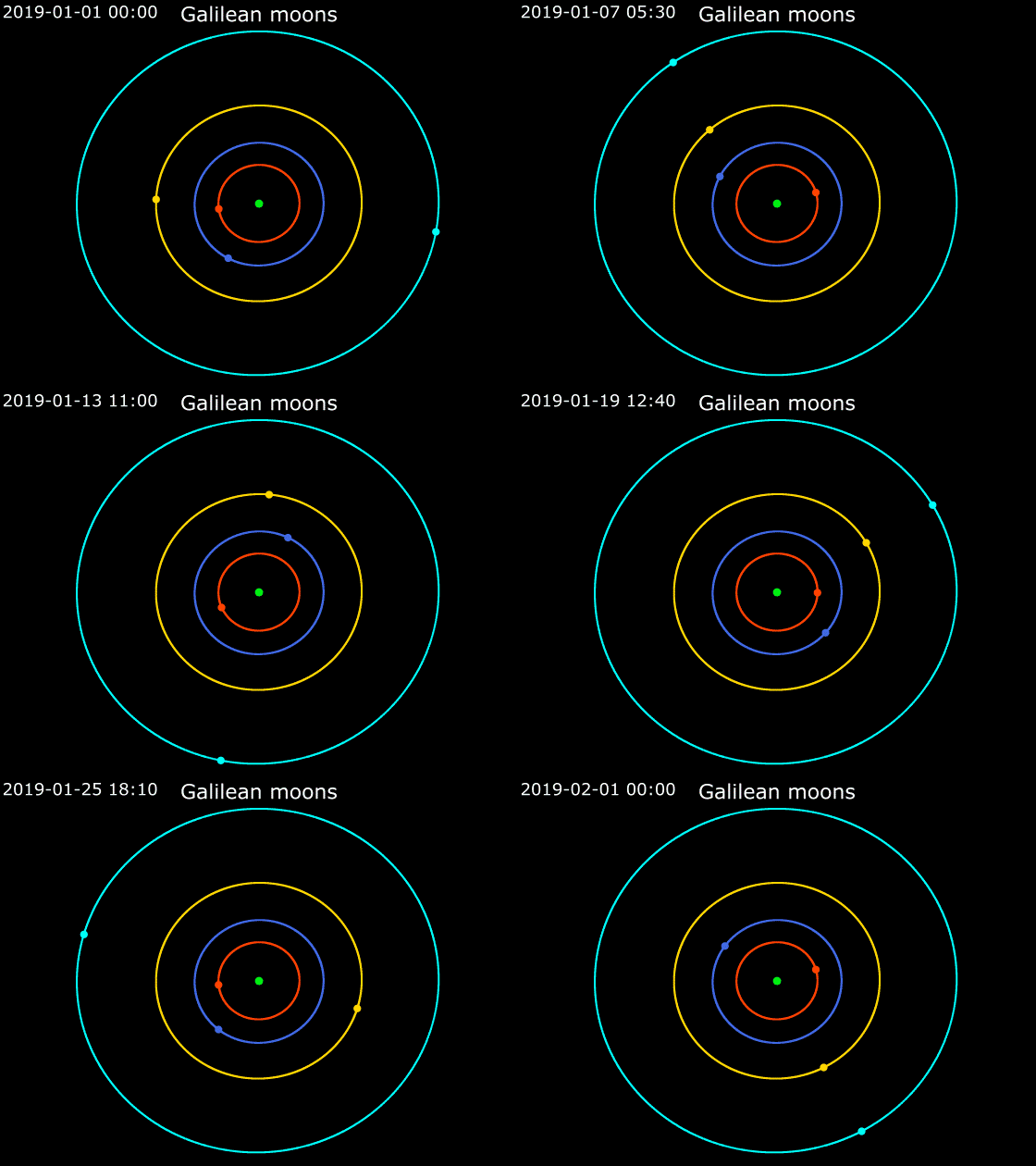
The resonance that couples Io, Europa, and Ganymede locks their orbital periods in a 1:2:4 ratio. Every time Io orbits Jupiter twice, Europa completes one orbit; similarly, when Europa orbits twice, Ganymede orbits once. This commensurability maintains nonzero orbital eccentricities, ensuring that tides raised by Jupiter (and to a lesser extent, by neighboring moons) knead their interiors. The result: continuous tidal heating in Io and, to a subtler degree, internal energy sources in Europa and Ganymede.
Attribution: Phoenix7777
From Earth, the moons’ maximum apparent elongations from Jupiter are small but resolvable with modest optics, especially near Jupiter’s opposition:
- Io: up to roughly 2–3 arcminutes from Jupiter’s disk.
- Europa: about 3–4 arcminutes.
- Ganymede: about 5–6 arcminutes.
- Callisto: up to roughly 10 arcminutes.
These separations vary because Jupiter’s distance from Earth changes throughout the year. When Jupiter is near opposition, the system is closest and most favorable for detail-rich observations, as discussed in How to See the Galilean Moons with Binoculars and Telescopes.
Io’s Extreme Volcanism and the Physics of Tidal Heating
Io is famous for its sulfurous plumes and lava fountains that can soar hundreds of kilometers above the surface. Volcanism on Io is not driven by plate tectonics like on Earth; instead, it is powered by tidal heating: the dissipation of mechanical energy into heat as Io’s interior flexes in Jupiter’s gravitational field.
Here’s why this happens. Because the Laplace resonance maintains a small but persistent eccentricity in Io’s orbit, Io’s distance from Jupiter varies slightly throughout each orbit. The changing gravitational force creates time-varying tides that deform Io’s interior. As Io circles Jupiter roughly every 1.769 days, this flexing acts like repeatedly bending a metal coat hanger—the energy input heats the interior. The generated heat drives extensive partial melting in the mantle, leading to frequent and widespread volcanic eruptions.

Attribution: NASA/JPL-Caltech/SwRI/MSSS
Key observational highlights:
- Voyager 1 and 2 (1979) provided the first direct images of active volcanic plumes, overturning assumptions that moons were geologically dead.
- Galileo orbiter (1995–2003) mapped Io’s hotspots in infrared, revealing numerous persistent volcanic centers like Loki Patera and Pele.
- Earth-based telescopes, using adaptive optics, continue to monitor thermal outbursts, catching changes in hotspot brightness associated with eruptive cycles.
- Juno has conducted targeted flybys, acquiring valuable, high-resolution imaging and data that add to decades of observations of Io’s dynamic activity.
The colors seen on Io’s surface—yellows, oranges, reds, and blacks—reflect sulfur allotropes and silicate lava (including basaltic compositions). Plumes deposit frosts and fine particles downwind, constantly repainting the landscape. Io’s thin atmosphere is primarily sulfur dioxide and varies with volcanic activity and sunlight.
From a physics standpoint, a back-of-the-envelope estimate of tidal power P involves Io’s orbital parameters, the eccentricity e, Love numbers (which quantify the response to tidal forces), and dissipation factors. While the full calculation is intricate, the essential insight is that the Laplace resonance (see orbital resonance) is the lever arm that keeps Io’s interior flexing, preventing the moon from settling into a relaxed, low-heat state.
For observers, Io’s volcanic influence is visible indirectly. Io frequently transits Jupiter, and its shadow—a tiny, sharp black dot—can be observed crossing the cloud tops with small backyard telescopes under steady seeing. Tracking these events is a gateway to appreciating the dynamism of the Jovian system (more on this in Transits, Eclipses, and Occultations).
Europa’s Subsurface Ocean and Astrobiology Potential
Europa’s glistening, striated ice shell hides one of the most compelling environments in the solar system: a global, salty ocean beneath the surface. Multiple lines of evidence support the ocean hypothesis. Magnetic field measurements from the Galileo mission detected an induced magnetic signature consistent with a conductive layer—most readily explained by a briny ocean. Surface geology shows evidence of widespread ice tectonics: fractures, ridges, and disrupted terrains known as chaos regions, suggesting the ice shell is mobile over time and occasionally communicates with the ocean below. Thermal modeling and Europa’s modest but nonzero eccentricity point to tidal heating as a key internal energy source.

Attribution: NASA/JPL-Caltech/University of Arizona
Why does this matter? Where liquid water, energy, and the right chemistry coexist, life could potentially arise or endure. Europa’s ocean is thought to be in contact with a rocky seafloor, enabling water–rock interactions that could provide chemical energy. On Earth, similar interactions fuel chemosynthetic ecosystems at hydrothermal vents, independent of sunlight. Whether Europa hosts analogous environments is an open question, but the possibility has guided mission priorities for decades.
Important considerations for habitability:
- Energy: Tidal heating supplies internal energy, while radiolysis (surface chemistry altered by radiation) could produce oxidants that might be transported downward into the ocean.
- Chemistry: Salts detected on the surface, potentially magnesium or sodium-based, hint at ocean composition and possible geochemical cycles.
- Communication Between Surface and Ocean: If fractures, brine percolation, or cryovolcanic events allow exchange, surface materials could carry biosignature clues upward and ocean-derived materials could be sampled indirectly.
There is suggestive—but not definitive—evidence for intermittent plumes of water vapor emanating from Europa, based on remote sensing observations. If active vents exist, they would offer an extraordinary opportunity to study ocean chemistry without drilling through the ice. Confirming their frequency, strength, and composition remains a priority for upcoming missions outlined in Past and Upcoming Missions.
From an observer’s standpoint, Europa’s smooth, bright disk is beyond the reach of typical backyard resolution, but its movements are not. You can watch Europa appear as a pinprick of light that shuttles from one side of Jupiter to the other over a few nights. With moderate apertures, Europa’s inky black shadow occasionally traces a path across Jupiter’s cloud tops during transit seasons, a sight that underscores the three-dimensional ballet of the Jovian system (see timings and tips).
Ganymede’s Magnetosphere and Layered Interior
Ganymede is a world of superlatives. Larger than Mercury by diameter, it is the only known moon with a global, internally generated magnetic field. This intrinsic magnetosphere carves out a mini-magnetospheric cavity within Jupiter’s broader magnetosphere, complete with auroral emissions modulated by interactions with Jupiter’s field.
Magnetic field measurements indicate that Ganymede’s field is generated by a dynamo operating in its metallic core. Galileo’s observations also support a complex internal layering: silicate rock and metal at the center, overlain by high-pressure ice phases and perhaps a deep ocean layer. Surface terrains show a mix of dark, heavily cratered regions and brighter, younger, grooved terrains, implying a history of tectonism and cryovolcanic resurfacing at some epochs.
Why does Ganymede’s magnetism matter? Comparing dynamo action in different bodies helps us understand how cores cool and how electrical conductivity and convective vigor sustain magnetic fields. Ganymede’s field also shapes particle environments around the moon, affecting surface sputtering and the formation of tenuous atmospheres. From Earth, we cannot see its magnetosphere directly, but telescopes and space missions have detected auroral emissions influenced by the interplay of Ganymede’s and Jupiter’s magnetic fields.
Observationally, Ganymede is the easiest Galilean moon to spot due to its brightness. In small telescopes, you won’t resolve surface details, but you may notice it is often the brightest of the four (though brightness varies with phase angle and distance). When conditions align, Ganymede’s shadow transit is an especially crisp, high-contrast dot on Jupiter’s cloud tops (see observing tips).
Callisto’s Ancient Surface and What It Preserves
Callisto, the outermost of the Galilean moons, bears an ancient, heavily cratered surface that likely records a long history of impacts. Unlike Ganymede, Callisto shows no large-scale grooved terrains associated with tectonism, suggesting a different thermal and geological evolution. Many models propose that Callisto either never fully differentiated or did so only partially; nonetheless, magnetic signatures observed by Galileo are consistent with the presence of a deep, salty ocean layer.
Callisto’s distance from Jupiter reduces the strength of tidal interactions and, thus, internal heating. As a result, its surface has remained comparatively static over geologic time, preserving a record of the early outer solar system’s bombardment history. Its subdued topography and ancient surface make it a valuable counterpoint to the rest of the Galilean family: while Io and Europa are geologically youthful and active, and Ganymede shows mixed terrains, Callisto offers a window into primordial conditions.
From Earth, Callisto’s greater orbital radius means it can stray farther from Jupiter’s glare than the other moons—up to nearly 10 arcminutes during favorable geometry. For observers using binoculars or small telescopes, that separation can make Callisto relatively easy to pick out, especially when it lies well to one side of Jupiter. As with the other moons, you will see a star-like point; resolving any surface features from the ground is beyond amateur instruments.
How to See the Galilean Moons with Binoculars and Telescopes
One of the great joys of backyard astronomy is how accessible the Galilean moons are. With steady hands or, better yet, a monopod or tripod, a pair of 7×50 or 10×50 binoculars will reveal at least two, and often three or four, of the moons as tiny points flanking Jupiter’s bright disk. A small telescope—an 80 mm refractor or a 130–150 mm Newtonian—will show them clearly and may allow you to follow transits and eclipses under good seeing.

Attribution: Freak-Line-Community
Tips for reliable observations:
- Stabilize your optics: Even a light tripod dramatically improves sharpness with binoculars, helping you overcome Jupiter’s glare.
- Use low to moderate magnification: Start around 40–80× to frame Jupiter and the moons comfortably. Increase magnification if the atmosphere is steady.
- Shield stray light: Jupiter is bright. An eyepiece hood or simply cupping your hands can improve contrast. An adjustable aperture mask may help if your telescope suffers from glare.
- Note orientation: Depending on your optical train (refractors with diagonals, Newtonians), east-west may appear flipped. Compare what you see to a planetarium app to match the layout.
- Track motion over time: Sketch the system hourly, or photograph through the eyepiece (afocal method). You’ll see the moons change position within a single night, especially Io and Europa.
- Pick the right time: The weeks around opposition (when Jupiter is opposite the Sun in the sky) offer the best angular size and brightness. Jupiter’s altitude above the horizon also matters—higher is better to minimize atmospheric distortion.
Although you cannot resolve disks in small telescopes, the changing arrangement can tell you which moon is which. Io and Europa move the fastest and stay relatively close to Jupiter; Ganymede appears bright and moderately distant; Callisto often lingers farthest away. Planetarium software will label them unambiguously and help you plan sessions that include events described in Transits, Eclipses, and Occultations.
Transits, Eclipses, and Occultations: Timings and Tips
The Galilean system produces a wealth of time-variable phenomena, many visible with amateur gear. Understanding the geometry helps you predict what you’ll see on a given night.
- Transit: A moon passes in front of Jupiter, appearing as a tiny dot against the cloud tops. Its shadow transit can be even more dramatic—a pin-sharp black spot crossing Jupiter’s disk. Io and Europa transits are frequent due to their short periods.
- Eclipse: A moon enters Jupiter’s shadow and disappears from view, then reappears dramatically as it exits.
- Occultation: A moon slips behind Jupiter’s limb (as seen from Earth), momentarily hidden by the planet itself.
Observational strategies:
- Plan with ephemerides: Astronomy apps and almanacs list precise times for moon and shadow transits, eclipses, and occultations. Because the moons orbit quickly, even a short session may catch a phase of an event.
- Watch the ingress and egress: These moments are especially rewarding. Ingress for a transit can be subtle—look for the moon near the limb and note when the shadow pops into view. Egress often offers crisp views as the moon reappears from behind Jupiter.
- Use color filters sparingly: Light blue or green filters can slightly enhance contrast between the moon/shadow and Jupiter’s clouds under some conditions. The improvement is subtle but can help during steady seeing.
- Log your observations: Record times and impressions. Over several nights you’ll build intuition about the system’s rhythm, linking what you see to the orbital periods in Orbital Periods, Resonances, and Quick Physical Facts.
With experience, you may also catch rarer multi-shadow transits, when two moons cast shadows simultaneously. While less common, these events are unforgettable and illustrate just how clockwork-precise the Jovian system is.
Past and Upcoming Missions: Voyager, Galileo, Juno, JUICE, Europa Clipper
Spacecraft have transformed the Galilean moons from points of light into worlds with geologies, atmospheres, and complex interactions.
- Pioneer and Voyager flybys: Early flybys laid the groundwork, with Voyager 1 and 2 (1979) providing the first close-up views. Io’s plumes stunned scientists, and Europa’s cracked, icy surface was revealed in detail.
- Galileo orbiter (1995–2003): Galileo revolutionized our understanding, mapping Io’s hotspots, collecting magnetic data that suggested subsurface oceans at Europa and possibly Ganymede and Callisto, and providing high-resolution images of all four moons.
- Juno (arrived 2016): Although designed primarily to study Jupiter’s interior, atmosphere, and magnetosphere, Juno has executed targeted flybys of Ganymede and Europa and multiple close passes of Io. These encounters have returned valuable imagery and additional measurements of the moons and their environments.
- ESA’s JUICE mission: Launched in 2023, the Jupiter Icy Moons Explorer is en route to study Ganymede, Europa, and Callisto in depth, with plans to enter orbit around Ganymede. JUICE will investigate the moons’ oceans, surfaces, and exospheres, and contextualize them within Jupiter’s vast magnetosphere.
- NASA’s Europa Clipper: Planned to launch in 2024, Europa Clipper will perform dozens of close flybys of Europa to assess its habitability, mapping the ice shell, measuring ocean-related signatures, characterizing the surface composition, and searching for current activity such as plumes.

Attribution: NASA/JPL-Caltech/SwRI/MSSS/Kevin M. Gill
Together, JUICE and Europa Clipper will provide complementary data sets: one focusing on a comprehensive survey of the icy moons with an orbital finale at Ganymede, and the other zooming in on Europa’s habitability. Their results will anchor decades of hypotheses inspired by Galileo’s magnetometer and imaging data and will shape the next steps, from landers to potential sample-return concepts.
For observers and enthusiasts, following mission operations and data releases brings the Galilean system to life. New images and spectra put fresh context around what you can see through the eyepiece in How to See the Galilean Moons with Binoculars and Telescopes, bridging professional and amateur astronomy.
Useful Data Tables and Back-of-the-Envelope Calculations
A few simple calculations can enrich your observing sessions and ground discussions in basic physics. Below are compact examples that tie sky geometry to what you’ll see, and tidal heating to what you’ll read in Io’s Extreme Volcanism and the Physics of Tidal Heating.
Estimating Maximum Angular Separation
The maximum angular separation θ (in radians) of a moon from Jupiter as seen from Earth is approximately its orbital radius around Jupiter divided by the Earth–Jupiter distance at the time of observation:
θ ≈ a_moon / D_Earth–Jupiter

Example near opposition (D ≈ 6.3×10^8 km):
  Io:      a ≈ 4.22×10^5 km  → θ ≈ 6.7×10^-4 rad ≈ 2.3 arcmin
  Europa:  a ≈ 6.71×10^5 km  → θ ≈ 1.1×10^-3 rad ≈ 3.7 arcmin
  Ganymede:a ≈ 1.07×10^6 km  → θ ≈ 1.7×10^-3 rad ≈ 5.9 arcmin
  Callisto:a ≈ 1.88×10^6 km  → θ ≈ 3.0×10^-3 rad ≈ 10.3 arcmin
These values are rough but align well with what you’ll observe in a low-power eyepiece. They also explain why Callisto often stands off farther from Jupiter’s glare than the other moons (see Callisto).
Sketching the 1:2:4 Laplace Resonance
To visualize the resonance among Io, Europa, and Ganymede, imagine marking their positions at a fixed reference line each time Io completes one orbit. After two Io orbits, Europa crosses the line once; after four Io orbits, Ganymede crosses once. This rhythm keeps eccentricities from fully damping out, sustaining the tidal energy that drives Io’s volcanism and influences Europa’s and Ganymede’s interiors (resonance overview).
Very Simple Tidal Heating Insight
While full tidal heating models require detailed parameters (Love numbers, quality factors), a minimalist insight is that tidal power scales strongly with eccentricity and inversely with the sixth power of orbital distance in simplified formulations. The takeaway: small changes in eccentricity and orbital radius can have large effects on heating. That’s why Io, the closest resonant moon, is a volcanic powerhouse, whereas Europa and Ganymede appear less extreme—but still dynamically interesting.
Tracking Motion with a Stopwatch
You can quantify orbital motion with basic timing. Choose Europa (period ~3.55 days). At maximum elongation, it appears roughly 3–4 arcminutes from Jupiter. Across one night (say, 4 hours), Europa traverses a noticeable fraction of its orbit as projected on the sky. If you mark its position relative to a field star and return an hour later, you will detect movement. Repeating over several nights lets you estimate a crude orbital period that you can compare to the known value in Orbital Periods, Resonances, and Quick Physical Facts.
Frequently Asked Questions
Can the Galilean moons be seen with the naked eye?
Under typical conditions, no—the moons are too close to Jupiter’s bright glare and not bright enough to stand out unaided. There are rare anecdotal reports of very keen-eyed observers glimpsing a moon at extreme separation, but this is not reliably repeatable. In practice, even modest binoculars or a small telescope are the right tools and will reveal the moons cleanly.
Which Galilean moon is most likely to host life?
Europa is the leading candidate because strong evidence points to a global subsurface ocean in contact with a rocky seafloor, providing potential energy sources and chemistry compatible with life. Ganymede and Callisto may also harbor deep oceans, but Europa’s combination of ocean, energy, and probable surface–ocean exchange makes it especially compelling. Current and upcoming missions such as Europa Clipper and JUICE are designed to assess habitability in far more detail.
Final Thoughts on Exploring Jupiter’s Galilean Moons
The Galilean moons offer a complete mini-solar system in microcosm: a volcanic world driven by tides, an ocean world with astrobiological promise, a magnetized giant moon with layered complexity, and an ancient, cratered relic that preserves early history. That diversity is why they continue to captivate both professional scientists and backyard observers.
For newcomers, start simple: use binoculars to spot the moons and track their nightly motion. Graduating to a small telescope opens the door to observing transits, eclipses, and shadow events that reveal the elegant clockwork of the system. Meanwhile, keep an eye on mission updates. As JUICE and Europa Clipper return data, we will learn whether Europa’s ocean teems with interesting chemistry, how Ganymede’s magnetosphere operates in detail, and whether Callisto’s deep interior hides more surprises.
Whether you follow the moons from your backyard or through mission releases, the Galilean system rewards curiosity with layers of discovery. If you enjoyed this guide, consider subscribing to our newsletter for future deep dives into planetary science, observing tips, and mission highlights—so you never miss the next breakthrough among Jupiter’s remarkable moons.