
Table of Contents
- What Is Dark Matter in Astrophysics?
- Observational Evidence: From Galaxy Rotation to the CMB
- Particle Candidates: WIMPs, Axions, and Other Possibilities
- How Scientists Search for Dark Matter Today
- Alternative Ideas: Modified Gravity and Other Frameworks
- Simulations and the Cosmic Web in Lambda-CDM
- Dark Matter’s Role in Galaxy Formation and Evolution
- Upcoming Missions and Experiments to Watch
- Frequently Asked Questions
- Final Thoughts on Understanding Dark Matter
What Is Dark Matter in Astrophysics?
Dark matter is a form of matter that does not emit, absorb, or reflect light. It interacts very weakly—if at all—with electromagnetic radiation, which is why astronomers call it “dark.” Its existence is inferred from gravitational effects on visible matter, radiation such as the cosmic microwave background (CMB), and the large-scale structure of the universe. In modern cosmology, the standard model known as Lambda–Cold Dark Matter (ΛCDM) suggests that the universe is composed of roughly 5% ordinary (baryonic) matter, about 25–27% dark matter, and the remainder dark energy.
While the identity of dark matter remains unknown, its astrophysical fingerprints are abundant. From the unexpected speeds of stars orbiting in the outskirts of galaxies to the way massive clusters bend background light through gravitational lensing, the case for dark matter is built on multiple, independent lines of evidence. These signatures guide current searches ranging from underground detectors to space telescopes, particle colliders, and precision cosmological surveys.

To set expectations: astronomers have not yet detected dark matter particles directly. However, the hypothesis that an unseen mass component dominates galactic and cosmological dynamics consistently explains a broad range of observations. In the sections below, we’ll explore the most compelling observational evidence, leading particle candidates, the range of experimental searches now underway, and key alternatives that attempt to modify gravity instead of adding unseen matter.
Observational Evidence: From Galaxy Rotation to the CMB
The case for dark matter has grown over decades and across multiple scales—from individual galaxies to clusters and the observable universe. Here are the pillars of evidence that point toward a dominant, invisible mass component.
Galaxy Rotation Curves
In spiral galaxies, stars and gas orbit the center under gravity. According to Newtonian dynamics, the orbital speed v(r) at a distance r from the center should follow the enclosed mass profile:
v(r) ≈ sqrt(G · M(r) / r)

If most of the mass were concentrated in the luminous disk and bulge, we would expect a “Keplerian decline” in velocity at large radii, similar to how outer planets orbit more slowly than inner ones. Instead, astronomers observe that rotation curves remain roughly flat far beyond the visible edges of galaxies. This implies the mass continues to rise with radius, as if each galaxy is embedded in an extended, massive halo of non-luminous matter.
- Flat rotation curves are widespread across many spiral galaxies, not a special case.
- The phenomenon persists in different wavelengths (e.g., optical and 21 cm radio observations of neutral hydrogen) and observational techniques.
- Dwarf galaxies, which are low in luminosity, often appear to be even more strongly dominated by dark matter, given their dynamics.
Gravitational Lensing in Galaxies and Clusters
General relativity predicts that mass curves spacetime, bending the path of light from background sources. Galaxy clusters, the most massive gravitationally bound structures, are powerful lenses:
- Strong lensing produces dramatic arcs and multiple images of background galaxies.
- Weak lensing produces subtle, statistical distortions in galaxy shapes, allowing astronomers to map the total mass distribution in a region.
Mass maps derived from lensing consistently show that galaxy clusters contain far more mass than is present in their luminous components (stars and hot gas). This excess aligns with the presence of substantial dark matter. When compared to X-ray observations of the hot intracluster gas (which traces baryonic matter), lensing-derived mass peaks and gas distributions often reveal separations that reinforce the dark matter picture.
Colliding Clusters and the Bullet Cluster
Some of the clearest empirical evidence for dark matter comes from colliding galaxy clusters. The well-known “Bullet Cluster” (1E 0657−56) is a system where two clusters have passed through each other. Observations show:
- X-ray images reveal the hot intracluster gas—containing a large share of the baryonic mass—lagging behind due to drag during the collision.
- Gravitational lensing maps indicate where the total mass resides, which in this system aligns more closely with the galaxies than with the X-ray gas.
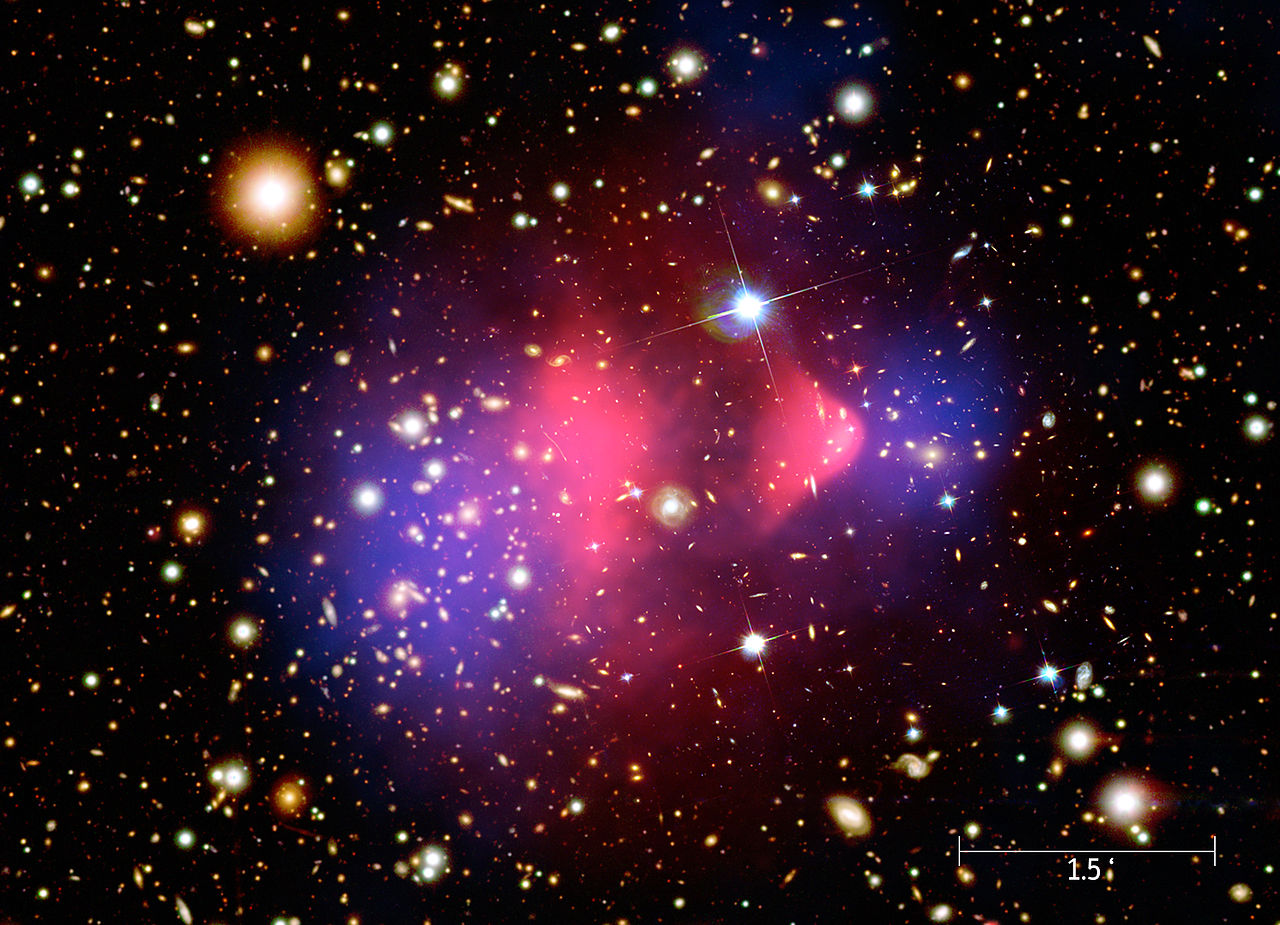
This separation between the baryonic gas and the inferred total mass suggests a collisionless component—consistent with dark matter—that passed through with minimal interaction. While alternative gravity theories can sometimes model lensing, the Bullet Cluster and similar systems (e.g., the “Train Wreck” cluster Abell 520 and others) provide strong support for an unseen matter component that is largely collisionless.
Cosmic Microwave Background (CMB) and the Early Universe
The CMB provides a snapshot of the universe about 380,000 years after the Big Bang. Tiny temperature fluctuations encode a wealth of cosmological information. Analyses of the CMB power spectrum—from missions such as WMAP and Planck—show that a model including non-baryonic dark matter fits the observed acoustic peak structure remarkably well. The relative heights and positions of these peaks are sensitive to the total matter density, baryon fraction, and other cosmological parameters.

- Models without dark matter struggle to reproduce the detailed CMB anisotropy pattern.
- Independent constraints from baryon acoustic oscillations (BAO) and Type Ia supernovae jointly reinforce the ΛCDM picture, including a substantial cold dark matter component.
Large-Scale Structure and Growth of Cosmic Web
The distribution of galaxies across cosmic time traces the growth of primordial density fluctuations into today’s cosmic web of filaments, walls, and voids. Cold dark matter naturally seeds structure formation because it begins clumping before photons decouple from baryons. Simulations that include cold dark matter reproduce the observed large-scale distribution and clustering statistics of galaxies with high fidelity when combined with reasonable models for gas physics and star formation.
Taken together—rotation curves, lensing, colliding clusters, the CMB, and large-scale structure—these independent probes converge on a consistent conclusion: a dominant, non-luminous matter component shapes the universe’s dynamics and structure. In later sections, we will link these lines of evidence to ongoing detection efforts and to alternative ideas trying to explain the data without new particles.
Particle Candidates: WIMPs, Axions, and Other Possibilities
If dark matter is particulate, what might those particles be? The leading ideas arise from extensions to the Standard Model of particle physics, astrophysical constraints, and cosmological requirements. Here are the most discussed candidates and categories.
WIMPs (Weakly Interacting Massive Particles)
WIMPs are hypothetical particles with masses typically in the GeV–TeV range and interactions comparable in strength to the weak nuclear force. A key appeal is the so-called “WIMP miracle”: a particle with weak-scale interactions naturally freezes out of the early universe at a relic density close to what we infer for dark matter today. While this coincidence is not proof, it motivated decades of experimental searches.
- Supersymmetry (SUSY) models often provide WIMP candidates, such as the neutralino.
- Other frameworks (e.g., extra dimensions) can also yield WIMP-like states.
- Despite extensive searches, no WIMP signal has been confirmed to date; leading experiments continue to push limits to smaller cross-sections.
Axions and Axion-Like Particles (ALPs)
Axions were introduced to solve a distinct problem in quantum chromodynamics (the strong CP problem). If produced in the early universe, they can be cold dark matter candidates with tiny masses (often in the micro-eV to milli-eV range, depending on the model). “Axion-like particles” generalize the idea beyond the original QCD axion; they appear in various theoretical contexts, including string theory.
- Axions can convert to photons in the presence of strong magnetic fields—a property used in experimental searches.
- Laboratory experiments like haloscopes (e.g., microwave cavity searches) and helioscopes (searching for solar axions) place limits on axion parameter space.
- Astrophysical observations can also constrain axion properties through stellar evolution, supernova cooling, and spectral signatures.
Sterile Neutrinos
Sterile neutrinos are hypothetical neutrinos that do not interact via the weak force (unlike active neutrinos), coupling only through gravity and mixing with active species. Depending on their mass, sterile neutrinos could behave as warm dark matter, potentially affecting small-scale structure like the abundance and internal structure of dwarf galaxies.
- X-ray observations of galaxies and clusters place constraints based on potential decay signatures of sterile neutrinos (e.g., narrow X-ray lines).
- The parameter space remains under investigation, with astrophysical and laboratory probes narrowing possibilities.
MACHOs and Astrophysical Compact Objects
MACHOs (Massive Astrophysical Compact Halo Objects) include dim stars, brown dwarfs, neutron stars, and black holes. Microlensing surveys have placed strong limits on MACHOs as the dominant form of dark matter in galactic halos. While some ranges remain allowed (particularly for compact objects in limited mass windows), MACHOs cannot explain the bulk of dark matter.
Primordial black holes (PBHs), formed in the early universe rather than from stellar collapse, remain a topic of active study. Lensing constraints, dynamical effects, and accretion signatures collectively limit the fraction of dark matter that can be PBHs over wide mass ranges, though some parameter space remains under discussion.
Other Hypotheses
Theoretical work spans a wide space: hidden-sector dark matter, self-interacting dark matter (SIDM), fuzzy or ultra-light dark matter with wave-like behavior on kiloparsec scales, and composite dark matter, among others. Each class aims to address some combination of cosmological consistency and small-scale astrophysical puzzles, which we will revisit in Simulations and the Cosmic Web and Galaxy Formation.
Key takeaway: Diverse candidates reflect the fact that “dark matter” is a gravitational phenomenon in the data, not yet an identified particle. Multiple well-motivated theories remain viable under current experimental limits.
How Scientists Search for Dark Matter Today
Efforts to detect dark matter span complementary strategies, each sensitive to different particle properties. No approach has yielded a confirmed detection, but together they steadily carve away at the possible parameter space.
Direct Detection Experiments
Direct detection looks for rare interactions between dark matter particles and atomic nuclei (or electrons) in underground detectors protected from cosmic-ray backgrounds. Experiments deploy large target masses and ultra-low-background techniques, aiming to measure tiny energy deposits from potential collisions.
- Noble-liquid detectors (e.g., xenon or argon) set some of the strongest limits on WIMP-nucleon scattering cross-sections. Recent generations—such as XENONnT and LUX-ZEPLIN (LZ)—have reported increasingly stringent null results, pushing sensitivity to very small interaction rates.
- Cryogenic detectors leverage extremely low temperatures and phonon/ionization readouts to probe low-mass dark matter candidates.
- Electron-recoil searches target sub-GeV dark matter with specialized materials and readout schemes.
As sensitivities improve, experiments approach the so-called “neutrino floor,” where coherent neutrino scattering becomes an irreducible background. Innovative detector technologies and new analysis strategies aim to separate potential dark matter signals from this background.
Axion Searches
Axion haloscopes use resonant microwave cavities or other resonator concepts immersed in high magnetic fields to look for the extremely faint conversion of axions into photons. Tuning the cavity frequency allows scanning through axion mass ranges. Experiments also explore dielectric haloscopes and other novel platforms to broaden coverage.
- Haloscopes probe galactic axion dark matter, seeking narrow signals at specific frequencies linked to the axion mass.
- Helioscopes search for axions from the Sun, using powerful magnets and X-ray detection systems.
- Laboratory light-shining-through-wall experiments test axion-like particle couplings with all-optical setups.
Indirect Detection
If dark matter particles can annihilate or decay into Standard Model particles, these processes might produce detectable cosmic-ray signatures or gamma rays from regions with high dark matter density (e.g., galactic center, dwarf spheroidal galaxies, or clusters). Instruments include space telescopes and ground-based observatories.
- Gamma-ray telescopes examine spectral features or spatial excesses from candidate regions.
- Cosmic-ray detectors measure electrons, positrons, antiprotons, and other species for anomalies that could hint at dark matter contributions, though astrophysical sources (like pulsars and supernova remnants) often provide alternative explanations.
- Neutrino observatories target potential signals from the Sun or Earth if dark matter accumulates and annihilates within them.
Interpretation can be challenging due to complex astrophysical backgrounds. Cross-checks using multiple messengers and targets are crucial for robust claims.
Collider Searches
Particle colliders, notably the Large Hadron Collider (LHC), search for dark matter candidates produced in high-energy collisions. Since dark matter would not interact with the detector directly, its presence might be inferred from missing transverse energy (MET) signatures, often accompanied by a high-energy jet or photon. Collider results set constraints on simplified models and effective field theories describing potential dark matter couplings.
Astrophysical and Cosmological Constraints
Even in the absence of a direct detection, astrophysical observations limit dark matter properties:
- Microlensing surveys constrain compact object populations across wide mass ranges, limiting MACHO contributions to the dark matter halo.
- Structure formation constraints (e.g., Lyman-alpha forest) disfavor dark matter candidates that are too “warm,” as they would erase small-scale structure more than observed.
- Galaxy dynamics and cluster mass profiles test self-interactions; for example, too-strong self-interactions would alter halo shapes and core densities beyond observations.
Taken together, the detection landscape is a multi-pronged campaign. As sensitivities grow, the viable parameter space for leading candidates narrows, informing both experiment and theory. Readers interested in theoretical counterpoints can explore alternatives to particle dark matter, while those focused on cosmological tests may jump to Simulations and the Cosmic Web.
Alternative Ideas: Modified Gravity and Other Frameworks
Because dark matter has not been directly observed as a particle, some researchers explore whether changing the laws of gravity could explain the observations. These approaches generally attempt to reproduce galaxy rotation curves and other phenomena without invoking unseen mass. While such models can fit certain datasets, they face challenges when confronted with the full suite of evidence.
MOND (Modified Newtonian Dynamics)
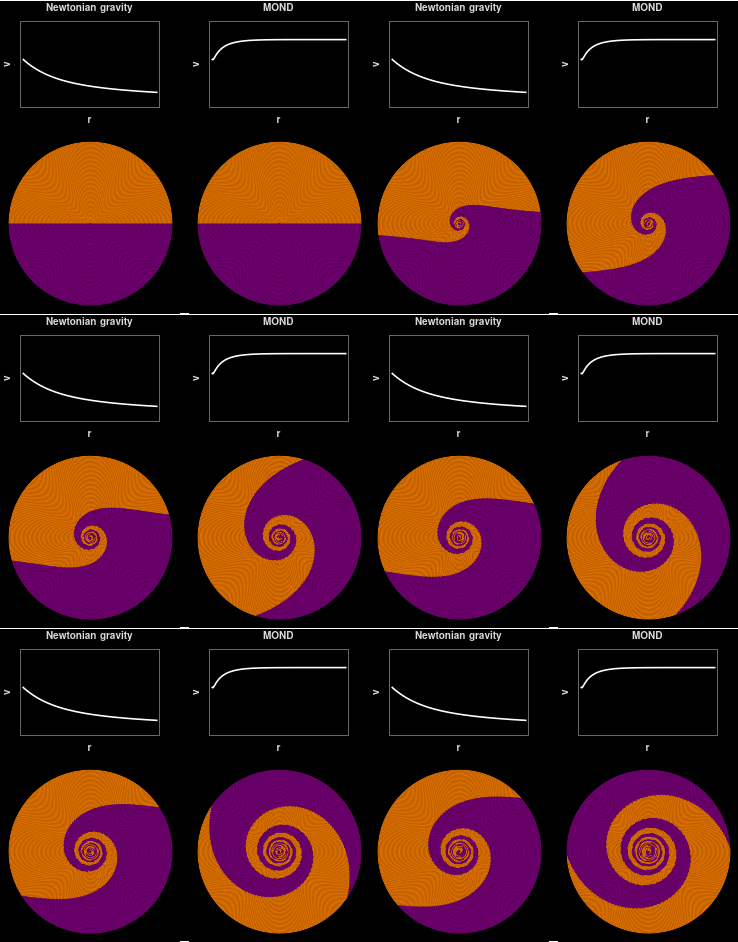
MOND modifies Newton’s second law or the gravitational force at very low accelerations, introducing a characteristic scale below which gravity effectively behaves differently. MOND can fit many galaxy rotation curves with fewer free parameters than some halo models and has had notable predictive successes in that domain. However, MOND by itself is a non-relativistic framework and must be extended to a relativistic theory to address lensing and cosmology.
Relativistic Extensions (e.g., TeVeS)
To be compatible with general relativity’s successes and to explain lensing, MOND-inspired theories have relativistic extensions. While these frameworks can accommodate some lensing observations, matching the detailed CMB anisotropy pattern and the mass distribution in galaxy clusters remains difficult without reintroducing additional mass components (which then resemble dark matter in practice).
Other Modified Gravity Proposals
Additional ideas include emergent gravity, f(R) gravity, and scalar-tensor theories. These can alter galactic and cosmological dynamics in testable ways. Nonetheless, the combined constraints from the CMB, BAO, lensing, and structure growth typically favor ΛCDM’s dark matter over these modifications—unless the modified gravity model becomes complex and introduces new fields that function similarly to dark matter.
Bottom line: Modified gravity can mimic some dark matter effects in specific regimes, particularly galaxy rotation curves. But the convergence of evidence across scales—especially the CMB and colliding clusters—has kept particle dark matter the leading explanation.
Simulations and the Cosmic Web in Lambda-CDM
Numerical simulations are the bridge between fundamental cosmology and the observed universe. In ΛCDM, small initial fluctuations grow under gravity into an intricate web of dark matter filaments. Gas falls into these potential wells, cools, and forms stars, leading to the galaxies we observe. Modern simulations include billions of particles and sophisticated prescriptions for baryonic physics.

N-Body Foundations
At the core of dark matter simulations are N-body techniques, where particles represent “fluid elements” of the dark matter distribution. Gravity evolves these particles over cosmic time, producing halos—gravitationally bound structures that host galaxies—and a filamentary cosmic web.
- Halo mass functions and clustering statistics from simulations match large-scale observations when appropriate cosmological parameters are used.
- Halo profiles are often described by analytical functions (e.g., NFW-like profiles), though real halos show diversity.
Baryonic Physics and Feedback
Adding gas dynamics, star formation, and feedback (from supernovae and active galactic nuclei) is essential for connecting dark matter halos to galaxy properties. Baryonic feedback can modify the inner density profiles of halos, redistribute angular momentum, and regulate star formation efficiency.
Small-Scale Challenges and Tensions
While ΛCDM excels on large scales, several small-scale issues are under active study. These tensions are not necessarily failures but areas where complex baryonic physics and/or new dark matter properties could be relevant:
- Core–cusp problem: Pure N-body simulations often produce cuspy inner halo density profiles, while some dwarf galaxies appear to have shallower cores. Feedback-driven core formation is a leading explanation, but the issue depends on the details of galaxy formation histories.
- Missing satellites problem: Early simulations predicted more subhalos around Milky Way-like galaxies than the number of observed dwarf satellites. Improved observations, better understanding of selection effects, and the realization that many halos remain dark have reduced this tension.
- Too-big-to-fail: Some of the most massive subhalos in simulations seemed too dense to host the bright dwarfs we see. Baryonic effects and more precise Milky Way mass estimates soften this discrepancy.
Alternative dark matter physics—such as self-interacting or ultra-light dark matter—has been proposed to address certain small-scale features. However, any modification must remain consistent with the CMB, BAO, and large-scale structure constraints, which strongly support cold dark matter’s success on large scales.
Connecting to Observations
Weak lensing surveys, galaxy clustering measurements, and redshift-space distortions provide detailed statistical tests of ΛCDM. Simulations help interpret these observables and connect them to fundamental parameters, including the dark matter density and properties. Cross-correlations—e.g., lensing maps with galaxy surveys—further tighten constraints.
For readers focused on tangible astrophysical consequences, the next section—Dark Matter’s Role in Galaxy Formation—highlights how dark matter influences the demographics and structures of galaxies.
Dark Matter’s Role in Galaxy Formation and Evolution
Dark matter provides the gravitational scaffolding on which galaxies assemble. Its influence is most apparent in three broad areas: how galaxies form within halos, how their dynamics are shaped by halo properties, and how satellite systems and environments reflect hierarchical growth.
Halo Occupation and the Galaxy–Halo Connection
Empirical models map galaxies to dark matter halos using observed abundance and clustering. Key insights include:
- Star formation efficiency peaks near halo masses of roughly 10^12 solar masses (Milky Way scale) and declines at both lower and higher masses.
- Central galaxies reside near the halo centers; satellite galaxies orbit within larger host halos, experiencing tidal forces and environmental quenching.
- Scaling relations—such as the stellar-to-halo mass relation—provide powerful tests for galaxy formation models.
Rotation Curves, Velocity Dispersions, and Mass Modeling
Galactic dynamics are a classic probe of mass distributions. In spirals, the combination of disk, bulge, and halo contributions can reproduce observed rotation curves across radii, though degeneracies between components persist. In elliptical galaxies, velocity dispersion profiles, stellar populations, and lensing constraints jointly inform the total mass distribution, often revealing substantial dark matter within and beyond the effective radius.
Dwarfs and Low-Surface-Brightness Galaxies
Dwarf galaxies are laboratories for dark matter physics due to their high mass-to-light ratios. Low-surface-brightness (LSB) galaxies also exhibit slowly rising rotation curves, consistent with prominent dark matter domination. These systems are sensitive to feedback processes that can alter inner density profiles, potentially alleviating the core–cusp tension.
Clusters and the Baryon Budget
Galaxy clusters contain vast reservoirs of hot, X-ray–emitting gas. Accounting for stars, gas, and total mass via lensing shows that the majority of cluster mass is dark matter. Clusters thus serve as critical laboratories for testing both halo physics and cosmological parameters, complementing cosmological probes such as the CMB and BAO.
Environmental Effects and Hierarchical Growth
In ΛCDM, structure builds hierarchically: small halos form first and merge into larger systems. This process shapes galaxy morphology, star formation histories, and the diversity of satellite systems. Tidal interactions and mergers within dark matter halos drive morphological transformations and can redistribute baryons, sometimes creating cores in the central dark matter distribution.
In short, dark matter is more than a placeholder in equations: it’s the backbone of structure formation, guiding the growth of galaxies from the earliest times to the present day.
Upcoming Missions and Experiments to Watch
Progress in understanding dark matter depends on better data and improved experimental sensitivity. The coming years feature a suite of observational and experimental programs poised to sharpen our view.
Space Missions and Sky Surveys
- Euclid (ESA): Launched in 2023, Euclid is designed to map the geometry of the dark universe using weak gravitational lensing and galaxy clustering over a large swath of sky. Its high-precision shape measurements and photometric redshifts will refine constraints on the matter distribution and structure growth.
- Vera C. Rubin Observatory (LSST): The Rubin Observatory’s Legacy Survey of Space and Time will repeatedly image the southern sky over a decade, enabling exquisite weak lensing maps, supernova cosmology, and discovery of faint satellites. LSST data will be central to testing ΛCDM and any small-scale deviations that might hint at new dark matter physics.
- Nancy Grace Roman Space Telescope: Planned for launch in the later 2020s, Roman will conduct wide-field infrared surveys and microlensing campaigns. Its weak lensing capabilities and high-resolution imaging will complement Euclid and ground-based surveys, enabling cross-calibration and joint analyses.
Direct Detection and Axion Experiments
- Next-generation noble-liquid detectors: Larger target masses, improved background rejection, and new readout technologies aim to push WIMP sensitivities closer to the neutrino floor while broadening coverage to lower masses.
- Direction-sensitive detectors: Concepts that measure recoil directions could distinguish dark matter signals from isotropic backgrounds, offering a powerful handle if feasible at the required scales.
- Axion haloscopes and novel resonators: Expanded frequency coverage, quantum-limited amplifiers, and new resonator designs aim to accelerate scans across axion mass space, probing well-motivated ranges associated with QCD axion models and ALPs.
Indirect and Multimessenger Probes
- Gamma-ray and X-ray observatories: Continued observations of the Galactic Center, dwarf spheroidals, and clusters will refine limits on annihilation and decay signals, with improved modeling of astrophysical backgrounds.
- Cosmic-ray instruments: High-precision measurements of charged particles across wide energies help assess potential excesses, while multiwavelength studies seek cross-confirmation.
- Neutrino telescopes: Better sensitivity to potential neutrino signals from solar or terrestrial capture and annihilation channels provides complementary constraints.
Together, these programs promise unprecedented statistical power and systematics control, crucial for distinguishing between ΛCDM and any subtle deviations that might betray new dark matter physics. For connections to theory and data interpretation, revisit Simulations and the Cosmic Web and How Scientists Search for Dark Matter.
Frequently Asked Questions
Is dark matter just ordinary matter we can’t see?
No. Ordinary (baryonic) matter that is merely dim or cold—like faint stars, brown dwarfs, or gas—cannot account for the observed gravitational effects. Multiple lines of evidence, including the CMB and big bang nucleosynthesis, tightly constrain the amount of baryonic matter in the universe. The required mass to explain galaxy dynamics and structure formation exceeds those limits, pointing to a non-baryonic component.
Could dark matter be a mixture of different things?
It could. While many searches focus on a dominant component (e.g., a single particle species), nature might include a combination: for example, a primary cold dark matter particle plus subcomponents such as axions or a small fraction in compact objects. Observations constrain the total and relative contributions, and future experiments will continue to test mixed scenarios. For more on possibilities, see Particle Candidates and how different signatures are tested in Detection Methods.
Final Thoughts on Understanding Dark Matter
Dark matter lies at the heart of modern cosmology and galaxy formation. The hypothesis is supported by converging evidence across scales: flat rotation curves in spirals, lensing mass maps in clusters, colliding systems like the Bullet Cluster, the acoustic peaks of the cosmic microwave background, and the growth of the cosmic web. While alternative gravity ideas can replicate certain features—especially galaxy-scale dynamics—the comprehensive success of ΛCDM across disparate datasets keeps particle dark matter as the leading explanation.
On the experimental front, the absence of a detection is itself informative, steadily shaping theory by eliminating swaths of parameter space. Direct detection, axion experiments, indirect searches, collider studies, and precision cosmology form a complementary portfolio. New facilities, from Euclid and the Rubin Observatory to next-generation underground detectors, ensure that the coming years will be especially revealing.
If you’re following this field, keep an eye on the interplay between small-scale astrophysics and fundamental physics: core–cusp transformations, satellite demographics, halo shapes, and lensing systematics all offer windows into dark matter’s nature. To dive deeper into specific aspects, revisit Observational Evidence, explore the breadth of Particle Candidates, and track the evolving Upcoming Missions and Experiments.
Thanks for reading. For more science explainers and deep dives into astrophysics and cosmology, subscribe to our newsletter—you’ll get new articles, curated resources, and timely updates on the latest results as they emerge.