
Table of Contents
- What Is a Dobsonian Telescope?
- Key Advantages and Trade-offs of the Dobsonian Design
- Aperture, Focal Ratio, and Optical Performance Explained
- Mounts and Mechanics: Bases, Bearings, and Motions
- Dobsonian Types: Classic, Tabletop, Truss, and GoTo
- Essential Accessories: Eyepieces, Finders, and Filters
- Collimation and Cooling: Step-by-Step for Sharper Views
- Observing Targets: What You Can See From City and Dark Skies
- Comparing Dobsonians to Refractors and SCTs
- Budget and Buying Guide: Sizes and Portability
- Setup, Transport, and Maintenance Best Practices
- Frequently Asked Questions
- Final Thoughts on Choosing the Right Dobsonian Telescope
What Is a Dobsonian Telescope?
A Dobsonian telescope is a Newtonian reflector optical tube mounted on a simple, ground-standing, altazimuth base. Popularized by amateur astronomer John Dobson in the late twentieth century, the Dobsonian design emphasizes large aperture, low cost, and ease of use. The optical path uses a primary parabolic mirror at the bottom of the tube to gather light, a flat secondary mirror near the top to redirect the image 90 degrees, and a focuser mounted on the side for eyepieces. The mount relies on friction and wide bearings to deliver smooth movement in altitude (up-down) and azimuth (left-right), making manual tracking natural and intuitive.
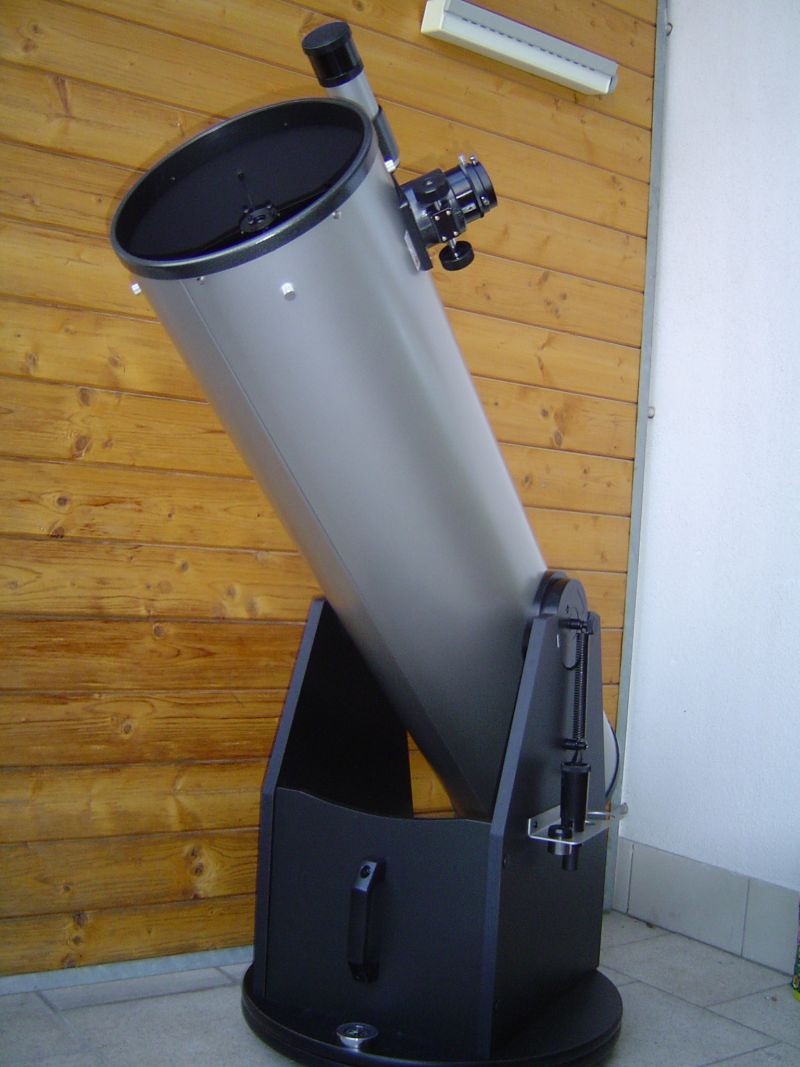
Credit: first uploaded on the English-speaking Wikipedia under the same filename
What makes the Dobsonian unique is this combination of a simple alt-az base and a Newtonian reflector. You get a lot of light-gathering power per dollar, because most of your budget goes into the primary mirror rather than a complex mount. For observers whose main goals are visually exploring the Moon, planets, star clusters, nebulae, and galaxies, a Dobsonian often delivers the most satisfying views for the least money.
If you are entirely new to telescopes, remember: aperture (the mirror’s diameter) is the key to seeing faint objects. A 6-inch or 8-inch Dobsonian will reveal deep-sky objects that are invisible in most small refractors, especially under darker skies. We’ll explore how aperture, focal ratio, and mount design interact in the sections on optical performance and mechanics, and we’ll close with practical buying advice to match a telescope to your observing conditions, car space, and budget.
Key Advantages and Trade-offs of the Dobsonian Design
Dobsonians became a movement because they solve practical problems for backyard astronomers. Still, like any design, they shine in some areas and demand compromises in others.
Advantages that matter at the eyepiece
- Large aperture per dollar: Simple plywood or particle-board bases and Newtonian optics keep costs low, letting you afford 6–12 inches (or more) of aperture at a fraction of the price of other designs.
- Bright, contrasty deep-sky views: More aperture means increased light grasp, revealing faint nebulae and galaxies, resolving star clusters, and brightening planetary detail when seeing is steady.
- Intuitive manual tracking: Push-to pointing and friction bearings make following objects smooth and natural. Many observers find this tactile experience enjoyable and distraction-free.
- Minimal setup time: A solid-tube Dobsonian goes from car to first target in minutes. There are no counterweights or polar alignments to fuss with.
- Stable, seated observing: The low center of gravity and simple base let you observe comfortably from a chair—good ergonomics encourage longer sessions.
Trade-offs to understand before you buy
- Size and weight: Aperture scales the tube diameter and length; 10–12-inch models can be bulky to move through doorways or load into small vehicles. See Budget and Buying Guide for portability tips.
- Collimation required: Newtonian reflectors need periodic alignment of mirrors. With practice, it’s quick, but beginners should be prepared to learn the routine in Collimation and Cooling.
- Coma in fast mirrors: At lower focal ratios (e.g., f/4–f/5), off-axis stars can appear stretched without a coma corrector. We explain focal ratio trade-offs in Aperture, Focal Ratio, and Optical Performance.
- Manual tracking challenges at high power: While manual nudging is fine up to moderate magnifications, very high power viewing of planets or double stars can be more demanding without tracking aids. Some models add push-to encoders or full GoTo tracking (Dobsonian Types).
- Not ideal for long-exposure astrophotography: The alt-az base does not track equatorially, causing field rotation over time. Dobsonians excel at visual observing; for imaging, see our comparisons in Refractors and SCTs.
For most beginners and many seasoned observers, those trade-offs are acceptable because the aperture-for-price proposition is so strong. If you are primarily a visual observer eager to see more deep-sky detail, a Dobsonian is often the most impactful upgrade you can make.
Aperture, Focal Ratio, and Optical Performance Explained
Choosing the “right” Dobsonian starts with understanding how aperture and focal ratio affect real-world observing. Here’s how these parameters translate to what you see at the eyepiece.
Aperture: the single biggest driver of what you can see
Aperture is the diameter of the primary mirror, typically measured in inches or millimeters. Light-gathering power increases with the square of aperture: a 10-inch mirror gathers more than twice the light of a 7-inch. That extra light raises the brightness of faint deep-sky objects and improves the visibility of low-contrast details. Aperture also sets the theoretical angular resolution (smaller is better), though in practice the atmosphere (seeing) often limits fine detail, especially on planets.
- 6-inch (150 mm): Compact and affordable. Great for the Moon, planets, bright nebulae, and open clusters; under dark skies, shows many Messier objects.
- 8-inch (200 mm): A sweet spot for beginners—manageable size, big step up in deep-sky reach. Starts resolving globular clusters into stars and reveals structure in bright galaxies.
- 10–12-inch (250–300 mm): Serious deep-sky performance under good skies. Galaxies gain detail, planetary nebulae show intricate structure, and globulars become spectacular.
- 14-inch and larger: Stunning reach for dedicated observers with space and transport capacity. Truss designs often become necessary for portability.
As aperture increases, cool-down time, collimation sensitivity, and bulk also increase. The best telescope is the one you use frequently; choose a size that fits your lifestyle.
Focal length and focal ratio (f/number): speed, field, and coma
The focal length is the distance from the primary mirror to the focal plane. The focal ratio (f/number) is focal length divided by aperture (e.g., 1200 mm focal length with a 200 mm mirror is f/6). Focal ratio affects the field of view, sensitivity to eyepiece aberrations, and off-axis coma:

Artist: Tmoore
- Slower optics (f/6–f/8): Easier on inexpensive eyepieces; less coma; narrower maximum true field for a given eyepiece and focuser size; often deliver “forgiving” collimation.
- Faster optics (f/4–f/5): Wider fields at given eyepiece; more compact tube for a given aperture; but increased coma toward edges and more demanding of precise collimation and quality eyepieces. Many observers use a coma corrector with fast mirrors.
Visual observers often favor f/5 to f/6 as a practical balance—relatively compact, capable of wide fields, and manageable without premium eyepieces or a coma corrector. If wide-field sweeping of star clouds and large nebulae is your priority, a fast f/5 Dob with a quality wide-angle eyepiece is a compelling choice. If planetary observing at high magnification is your focus, an f/6–f/7 instrument’s reduced coma and longer focal length can be beneficial.
Exit pupil, magnification, and brightness
Magnification equals telescope focal length divided by eyepiece focal length. The exit pupil (eyepiece focal length divided by focal ratio) tells you how bright and how large the image appears to your eye. Typical useful ranges:
- Low power (4–7 mm exit pupil): Maximum field for star hopping, large open clusters, and bright nebulae with filters.
- Medium power (2–4 mm exit pupil): A sweet spot for many galaxies, globular clusters, and general deep-sky observing.
- High power (0.5–2 mm exit pupil): Planetary and lunar detail, tight double stars, small planetary nebulae—seeing conditions are the limiting factor.
While there are rule-of-thumb maximum magnifications quoted for telescopes, real-world limits are usually set by atmospheric steadiness and optical collimation quality.
Mounts and Mechanics: Bases, Bearings, and Motions
The Dobsonian base is a study in practical mechanics. While it looks simple, good design choices in materials, bearing surfaces, and balance make a big difference in how enjoyable the scope is to use.
Altitude and azimuth bearings
- Altitude bearings: Large, semicircular or circular bearings spread friction over a wider surface, improving smoothness and balance. Smaller bearings can feel stiffer or more prone to imbalance with heavy eyepieces.
- Azimuth bearing: A turntable rotates on pads made of low-friction materials. The goal is a consistent, predictable push, not ultra-loose rotation.
Some commercial models use engineered plastics or Teflon-like materials against laminated surfaces to achieve the desired feel. Owners sometimes tune their bearings with different pads or shims to dial in motion and stiction.
Balance, springs, and clutches
As you change eyepieces, the telescope’s center of gravity shifts. Designs manage this with larger altitude bearings, adjustable trunnions, spring tension, or clutches. If you plan to use heavy 2-inch eyepieces, consider a model with robust altitude bearings or balancing aids.
Focuser, finder, and tube ergonomics
- Focuser: A smooth dual-speed Crayford-style focuser is a valuable upgrade for achieving fine focus at high power. Many modern Dobsonians include 2-inch focusers with a 1.25-inch adapter.
- Finder: Comfortable finder placement and the ability to use both a unit-power reflex finder and a magnifying finder simplify star-hopping.
- Tubes and trusses: Solid tubes are robust and protect optics; trusses reduce weight and bulk for larger apertures. See Dobsonian Types for more.
Even subtle ergonomic improvements—like setting eyepiece height to match your chair or adjusting friction—can transform a session from a struggle into a flow state where objects drift effortlessly and focusing snaps to perfection.
Dobsonian Types: Classic, Tabletop, Truss, and GoTo
Dobsonians come in several configurations. Matching the format to your observing style matters as much as choosing aperture. Here are the main types you’ll encounter and how they differ in use.
Classic solid-tube Dobsonians
These are the iconic full-sized instruments in the 6–12-inch range with a single solid optical tube assembly (OTA) that rests in cradle-like altitude bearings. Advantages include mechanical simplicity, fast setup, and good protection of optics from dew and stray light. The trade-off is bulk: tubes longer than about 48 inches can be awkward to transport in small cars.
Tabletop Dobsonians
Compact reflectors (often 4.5 to 6 inches) on miniature Dobsonian bases intended to sit on a sturdy table or stool. They are extremely portable and budget-friendly, ideal for quick looks and travel. You must provide a stable surface, and the short focal length models can be quite fast (f/4–f/5), benefiting from careful collimation and decent eyepieces.

Artist: Morn
Collapsible and truss-tube designs
For apertures above 10 inches, many Dobsonians switch to collapsible struts or full truss frames. The OTA breaks down into a mirror box, upper cage, and poles, reducing bulk and enabling large apertures to fit in standard vehicles. Assembly time increases, and a shroud is often used to block stray light. Truss scopes typically require collimation each session but reward you with big-aperture performance that travels.

Artist: Rob Teeter
Push-to and GoTo Dobsonians
Push-to models add digital setting circles (encoders) and a handheld controller or app to guide you to targets by manual pushing. GoTo Dobsonians add motorized pointing and tracking, which is helpful for high-power planetary work and group outreach. The trade-offs include increased cost, added weight, and the need for power. If you’re drawn to manual star-hopping, you may prefer the simplicity of non-motorized designs; if you want help finding dim galaxies from a light-polluted yard, push-to can be transformative.
Essential Accessories: Eyepieces, Finders, and Filters
Accessories can unlock your telescope’s full potential. While many Dobsonians ship with starter eyepieces and a finder, thoughtful upgrades have an outsized impact on your experience.
Eyepieces: building a practical set
A well-rounded set typically includes low-, medium-, and high-power options. Consider starting with three:
- Low power, wide field: A 2-inch eyepiece in the 28–35 mm range (for f/5–f/6 scopes) maximizes true field for star-hopping and large nebulae. In 1.25-inch format, a 24–26 mm wide-angle is a versatile option.
- Medium power workhorse: A 12–14 mm eyepiece (or zoom) frames many deep-sky targets ideally and is forgiving of seeing.
- High power for detail: A 5–7 mm eyepiece for lunar, planetary, and close double stars, as seeing allows. A quality Barlow lens can split the difference and extend a smaller eyepiece collection.
Fast focal ratio scopes place higher demands on eyepiece design. If your Dob is f/5 or faster, investing in well-corrected eyepieces improves edge-of-field star shapes. For slower f/6–f/8 scopes, many mid-priced eyepieces perform admirably.
Finders and aiming aids
- Reflex finders: Unity-power sights (red dot or circle projectors) make pointing intuitive—place the dot where you want to go in the sky.
- Magnifying finders: A 6×30 or 8×50 right-angle finder shows fainter stars and helps zero in on targets after the reflex finder sets the general direction.
- Push-to encoders: For star-hopping averse observers, digital setting circles can rapidly direct you to objects while you retain manual control of movement.
Filters and other helpful gear
- Nebula filters: UHC (ultra-high contrast) and O III filters selectively transmit emission lines to improve contrast on many nebulae. They’re particularly effective under light-polluted skies.
- Light shroud (for truss scopes): Reduces stray light and dew, improving contrast.
- Dew control: Secondary mirrors and finders can dew over; simple dew shields or gentle heaters help on humid nights.
- Observing chair: Adjustable-height chairs stabilize your posture and enhance fine detail detection at high power.
- Collimation tools: A collimation cap is a minimal start; a Cheshire/sight-tube combo and a simple laser can speed alignment. See Collimation and Cooling for workflow.
Collimation and Cooling: Step-by-Step for Sharper Views
Collimation is the alignment of your telescope’s optical elements. It sounds intimidating, but with the right tools and a repeatable routine, it becomes a five-minute task. Cooling (or thermal equilibrium) is equally important: a primary mirror at ambient temperature performs significantly better than one with warm air currents streaming off of it.
How to collimate a Newtonian Dobsonian
There are multiple valid workflows. The outline below uses a sight-tube/Cheshire and a simple laser as optional verification. You do not need premium tools to achieve excellent results.
- Center-mark the primary: Most commercial mirrors have a small paper ring at the center for reference. If yours doesn’t, there are non-invasive center-marking techniques with templates.
- Roughly center the secondary under the focuser: With a sight-tube, adjust secondary position (via the spider’s central bolt, not the tilt screws) so the secondary outline appears centered and circular when viewed through the focuser.
- Set secondary tilt: Adjust the secondary’s tilt screws so that the focuser’s sight-tube crosshairs point at the center mark on the primary. If using a laser, adjust until the dot hits the primary’s center mark.
- Adjust primary tilt with a Cheshire: Using the Cheshire (or the barlowed laser method), tweak the primary’s collimation knobs until the reflected center mark aligns with the Cheshire’s reference. This step typically produces the largest visual improvement.
- Star test fine-tuning: On a steady night, defocus a bright star slightly at high power. In good collimation, the diffraction pattern is concentric. Make tiny adjustments to the primary if needed.
Keep a simple checklist at the scope. Consistency beats perfectionism. Here’s a compact reminder you can print:
Checklist: Fast Collimation (Dobsonian)

1) Cap/Cheshire in focuser, remove eyepieces

2) Secondary centered? (position first, not tilt)

3) Secondary tilt to primary center mark

4) Primary tilt to center the Cheshire reflection

5) Verify on a star at high power
Cooling and thermal management
Mirrors and tubes store heat. As a warm mirror cools, internal air currents degrade images. Simple practices help:
- Pre-cool time: Place the scope outside 30–60 minutes before observing. Larger mirrors may need longer, especially in winter.
- Primary mirror fan: A quiet fan blowing on the back of the primary accelerates equilibrium and reduces the boundary layer on the mirror’s surface.
- Ventilation and shrouds: Truss scopes benefit from airflow; use a breathable shroud and avoid trapping heat in the mirror box.
- Avoid heat sources: Don’t observe over rooftops or asphalt radiating heat, and shield yourself from body heat rising into the light path.
Well-collimated optics at ambient temperature will outperform larger, miscollimated, warm optics. Master these basics and you’ll extract the best your aperture can offer.
Observing Targets: What You Can See From City and Dark Skies
What will you actually see through a Dobsonian? Expectations matter. Visual observing is not like long-exposure astrophotography; your eyes collect far fewer photons than a camera sensor. Yet with practice, adaptation, and the right targets, the live, dynamic view can be deeply rewarding.
From light-polluted backyards
- The Moon: A showpiece at all phases. Rilles, domes, and crater terraces pop in 6–10 inches of aperture. Use neutral density or variable polarizing filters to tame brightness.
- Planets: Jupiter’s belts and Great Red Spot, Saturn’s rings and Cassini Division, Mars’ polar caps and dark albedo features (near opposition), Venus’ phases. Steady seeing and patient observation reveal detail.
- Double stars and bright clusters: Color contrasts and tight separations are satisfying. Open clusters like the Double Cluster sparkle even under city lights.
- Bright planetary and emission nebulae with filters: Objects such as the Orion Nebula (M42) and planetary nebulae can show structure with a UHC or O III filter.
Under suburban skies
- Globular clusters: 8–10 inches begin to resolve outer stars; 12 inches yields granular cores on many favorites (M13, M3, M5).
- Brighter galaxies: M81/M82 show shape; M51 displays hints of spiral arms in good transparency.
- Nebula complexes: The Lagoon (M8), Trifid (M20), and Swan (M17) are rewarding with filters at low power.
In dark, rural skies
- Faint galaxies and clusters abound: Aperture shines here. You’ll surf galaxy groups, trace dust lanes, and pick out edge-on silhouettes.
- Wide-field Milky Way: Fast Dobs with 2-inch widefields reveal star clouds, dark nebulae, and vast emission regions with striking contrast using filters.
- Subtle planetary detail: With steady seeing, large apertures show festoons, ovals, and albedo variations on gas giants in fleeting moments of clarity.
Train your observing eye with averted vision (looking slightly off target), sketching, and repeated visits. Your brain learns to extract more from subtle contrast. A Dobsonian’s generous aperture rewards that journey.
Comparing Dobsonians to Refractors and SCTs

Artist: OpenStax
Is a Dobsonian the best choice for you? It depends on your priorities. Here’s how they stack up against popular alternatives: refractors and Schmidt-Cassegrain telescopes (SCTs).
Dobsonian vs. refractor
- Value per inch: Reflectors deliver far more aperture per dollar. A quality 8-inch Dob often costs less than a small apochromatic refractor.
- Optical behavior: Refractors are sealed, low maintenance, and excel at contrast, but most affordable models have small apertures that limit deep-sky reach. Reflectors offer raw light grasp and resolution potential, with the trade-offs of collimation and larger size.
- Mount complexity: Refractors generally ride on separate mounts (alt-az or equatorial), adding cost and setup. A Dobsonian’s integrated base is fast and sturdy.
- Imaging: Short, high-quality refractors are favored for wide-field astrophotography. For visual deep-sky impact, most observers choose Dobsonian aperture.
Dobsonian vs. SCT
- Form factor: SCTs pack long focal lengths into compact tubes, great for travel and high magnification, but their mounts (often fork or EQ) add complexity and weight.
- Cool-down and dew: Closed-tube SCTs can take time to reach thermal equilibrium and are susceptible to corrector plate dew, requiring heaters or shields. Dobsonians with fans can cool efficiently; truss Dobs need shrouds and attention to dew on the secondary.
- Field of view: Fast Dobsonians can achieve very wide true fields—ideal for sweeping star clouds—while SCTs offer narrower fields at given eyepiece focal lengths.
- Tracking and imaging: SCTs with equatorial mounts are more suitable for long-exposure astrophotography. Dobsonians are optimized for visual use, with some GoTo models adding convenient tracking for outreach and high-power viewing.
If your passion is visually hunting faint galaxies and nebulae, aperture wins—favor a Dobsonian. If you want a compact, tracked system that can pivot to imaging later, an SCT has appeal. If you’re drawn to wide-field imaging or ultra-portability, a small refractor is compelling. Clarify your primary use case first.
Budget and Buying Guide: Sizes and Portability
Ready to choose? Use this section to map your use case to a specific format and size. Combine it with the sections on optical parameters and Dobsonian types to fine-tune your pick.
Quick recommendations by scenario
- Urban backyard, first scope: 6- or 8-inch solid-tube Dob. Easy to store, quick to set up, excellent lunar/planetary and bright deep-sky capability.
- Suburban observer seeking deep-sky reach: 8- to 10-inch Dob. Consider push-to encoders if star-hopping is tough under light pollution.
- Dark-sky pilgrim with compact car: 10- to 12-inch collapsible or truss Dob. Breaks down for transport; plan for a shroud and routine collimation.
- Outreach and group viewing: 8- to 12-inch GoTo Dob for tracking planets and keeping targets centered while people take turns.
- Travel and camping: 4.5- to 6-inch tabletop Dob plus a sturdy tripod table or observing stool.

Celestron FirstScope 76 tabletop Dobsonian telescope. Its aperture is 3″ and the focal length is 300 mm, so its focal ratio is approximately f/4. (The photo was taken in a lightbox, see Flickr album at [1], so it almost looks like an official Celestron product shot, but it’s not.)
Artist: Wutthichai Charoenburi
Portability and ergonomics checklist
- Fit test: Measure your vehicle openings and interior before you buy. Check tube length and base diameter.
- One-piece carry vs. component carry: Many observers prefer to separate the base and tube for transport. For truss designs, mirror box weight matters.
- Eyepiece height: Ensure comfortable seated observing at typical target altitudes. A small step stool may be necessary for larger apertures at zenith.
- Storage space: Dry, temperature-stable storage prolongs coatings and maintains alignment.
Where to allocate your budget
- Optics first: Good primary and secondary mirrors are the heart of performance. Most commercial Dobs deliver solid optics for visual use.
- Focuser and bearings: Upgrading to a dual-speed focuser and ensuring smooth, balanced bearings elevate usability.
- Eyepieces and filters: A few well-chosen eyepieces and a UHC/O III filter likely improve views more than most accessory gadgets.
- Cooling aids: A rear fan is inexpensive insurance for crisp planetary views.
When in doubt, choose the largest aperture you will frequently deploy. A portable 8-inch used often will show more than a 12-inch that rarely leaves the closet.
Setup, Transport, and Maintenance Best Practices
A Dobsonian rewards care in setup and gentle maintenance. The following practices keep performance consistent and extend the telescope’s lifespan.
Smart setup workflow
- Site selection: Choose firm, level ground with a clear view of the sky. Avoid radiant heat sources and bright streetlights; use a portable screen if needed.
- Base first, then tube: Carry the base to position, then seat the tube or mirror box. Lock in any truss clamps or struts per your model’s instructions.
- Balance and friction: Before dark, load your heaviest eyepiece and balance the scope. Adjust altitude tension if available. Test azimuth smoothness.
- Cooling: Start the fan early, remove caps to equilibrate, and set sensitive accessories (filters, eyepieces) in a closed case to minimize dew.
- Collimation check: Verify alignment quickly with a collimation cap or Cheshire, especially after transport.
Transport tips
- Protect optics: Keep primary mirror covered; secure the secondary with a simple cover or sock when transporting truss scopes. Cushion the tube with blankets or foam.
- Straps and dollies: A hand truck/dolly and webbing straps make moving larger bases safe and easy. Always lift with your legs, not your back.
- Component bags: For truss poles and upper cages, use dedicated bags to prevent scratches and mix-ups.
Maintenance and care
- Mirror cleaning: Only when necessary. Dust rarely harms views. When cleaning is due, use gentle distilled water rinses and mild soap with minimal contact. Allow to air dry; avoid wiping if possible.
- Collimation screws: Learn your scope’s hardware; small tweaks go a long way. Avoid over-tightening.
- Coating longevity: Store in a dry space; cap ends to deter dust and insects. Recoating is infrequent for most users with good storage habits.
- Hardware checks: Periodically verify that spider vanes, focuser bolts, and base hardware remain snug.
These simple habits maintain optical performance and ensure your Dobsonian feels well-tuned every time you observe. Revisit Collimation and Cooling seasonally to refresh best practices.
Frequently Asked Questions
Is a Dobsonian good for beginners who have never owned a telescope?
Yes—especially if your primary goal is visual observing. The Dobsonian’s straightforward setup, intuitive pointing, and strong aperture-per-dollar value make it one of the most beginner-friendly designs. Start with a 6- or 8-inch model to balance capability and portability. Practice on the Moon and bright planets to learn focusing and tracking, then expand to bright clusters and nebulae. If finding objects is daunting under light pollution, consider a push-to model with digital encoders or use an app-based star chart for guidance.
Can I do astrophotography with a Dobsonian?
Dobsonians excel at visual observing. The alt-az mount complicates long-exposure imaging due to field rotation, and manual tracking is impractical for long subs. However, you can capture satisfying images of the Moon and planets using short, high-frame-rate video and stacking techniques with a simple camera or smartphone adapter. For deep-sky astrophotography, an equatorially mounted telescope (often a small refractor) is a more suitable choice. If you want occasional tracked views for high-power observing or outreach, some Dobsonians offer motorized GoTo and tracking, which help keep targets centered.
Final Thoughts on Choosing the Right Dobsonian Telescope
A Dobsonian telescope distills what matters for visual astronomy: generous aperture, fast setup, and an observing experience that keeps your attention on the night sky rather than on gear. Start by clarifying your constraints—storage, transport, and budget—then choose the largest aperture you will deploy often. Match focal ratio and eyepieces to your interests: fast optics and wide fields for sweeping nebulae, or slightly slower optics for forgiving planetary performance. Add a comfortable observing chair, a nebula filter, and a simple collimation routine, and you have a system that will deliver rewarding views for years.
If this guide helped you focus your decision, explore related topics like eyepiece selection, star-hopping techniques, and seasonal target lists in our resource sections. For ongoing tips, observing challenges, and gear deep-dives, subscribe to our newsletter—new articles each week will help you get more from every clear night.