
Table of Contents
- What Is a Deep-Sky Astrophotography Workflow?
- Planning: Tools, Sky Quality, and Framing
- Choosing Equipment and Building a Reliable Optical Train
- Exposure Strategy: Gain/ISO, Sub-Exposure Length, and Histograms
- Calibration Frames and Image Calibration
- Guiding, Dithering, and Tracking Accuracy
- Stacking: Registration, Rejection, and Integration
- Post-Processing: Noise Reduction, Stars, and Color
- Troubleshooting Common Artifacts in Deep-Sky Images
- Frequently Asked Questions
- Final Thoughts on Mastering Your Deep-Sky Astrophotography Workflow
What Is a Deep-Sky Astrophotography Workflow?
Deep-sky astrophotography targets faint objects beyond our solar system—nebulae, galaxies, star clusters—captured through long exposures and stacked images to reveal detail invisible to the eye. A workflow is the repeatable sequence that takes you from planning and acquisition to stacking and final processing. When you refine a workflow, you remove guesswork, reduce errors, and improve image quality in a measurable way.

At its core, the deep-sky workflow integrates three pillars:
- Planning: Choosing targets, timing, filters, and exposure strategy based on sky conditions and equipment.
- Acquisition: Executing stable tracking, guiding, dithering, accurate focus, and collecting calibration frames.
- Processing: Calibrating and registering frames, rejecting outliers, integrating stacks, and applying noise reduction, color calibration, and detail enhancement.
New imagers often focus on gear while underestimating planning and processing. In practice, signal-to-noise ratio (SNR) depends most on total integration time, sky quality, and careful calibration. Great images are built from many small, consistent choices across your workflow.
In this guide, we’ll establish a field-proven path from sky selection to final color balance. If you’re transitioning from nightscape photography, the sections on exposure strategy and histograms and stacking and rejection will ground your expectations and help you avoid common pitfalls.
Planning: Tools, Sky Quality, and Framing
Deep-sky imaging begins long before you set up a tripod. High-quality data depends on choosing the right target for your conditions and equipment while maximizing sky time.
Assessing Sky Quality
Light pollution sets your noise floor. Under brighter skies, the background skyglow accumulates quickly, limiting how long you can expose before saturating the histogram. Consider:
- Bortle scale: Bortle 1–2 (dark) is ideal; Bortle 5–7 (suburban) demands shorter subs and often favors narrowband filters for emission nebulae.
- Transparency and seeing: Clear, dry nights with steady seeing benefit galaxies and small targets; hazy or humid nights can still be productive for bright nebulae with narrowband filters.
- Moon phase: Broadband targets like galaxies are best near new moon. Narrowband imaging with H-alpha, OIII, and SII filters can tolerate bright moonlight.
Target Selection and Seasonality
Choose targets that are high in the sky when you image. Altitude reduces atmospheric extinction and improves contrast. Most planning apps and planetarium tools provide altitude vs. time graphs and visibility windows for your latitude.
- Emission nebulae: Great for narrowband imaging. Examples include the North America Nebula (NGC 7000) and the Rosette Nebula (NGC 2237).
- Galaxies: Benefit from dark skies and good seeing (e.g., M51, M81, M101). Use broadband filters or no filter for color cameras.
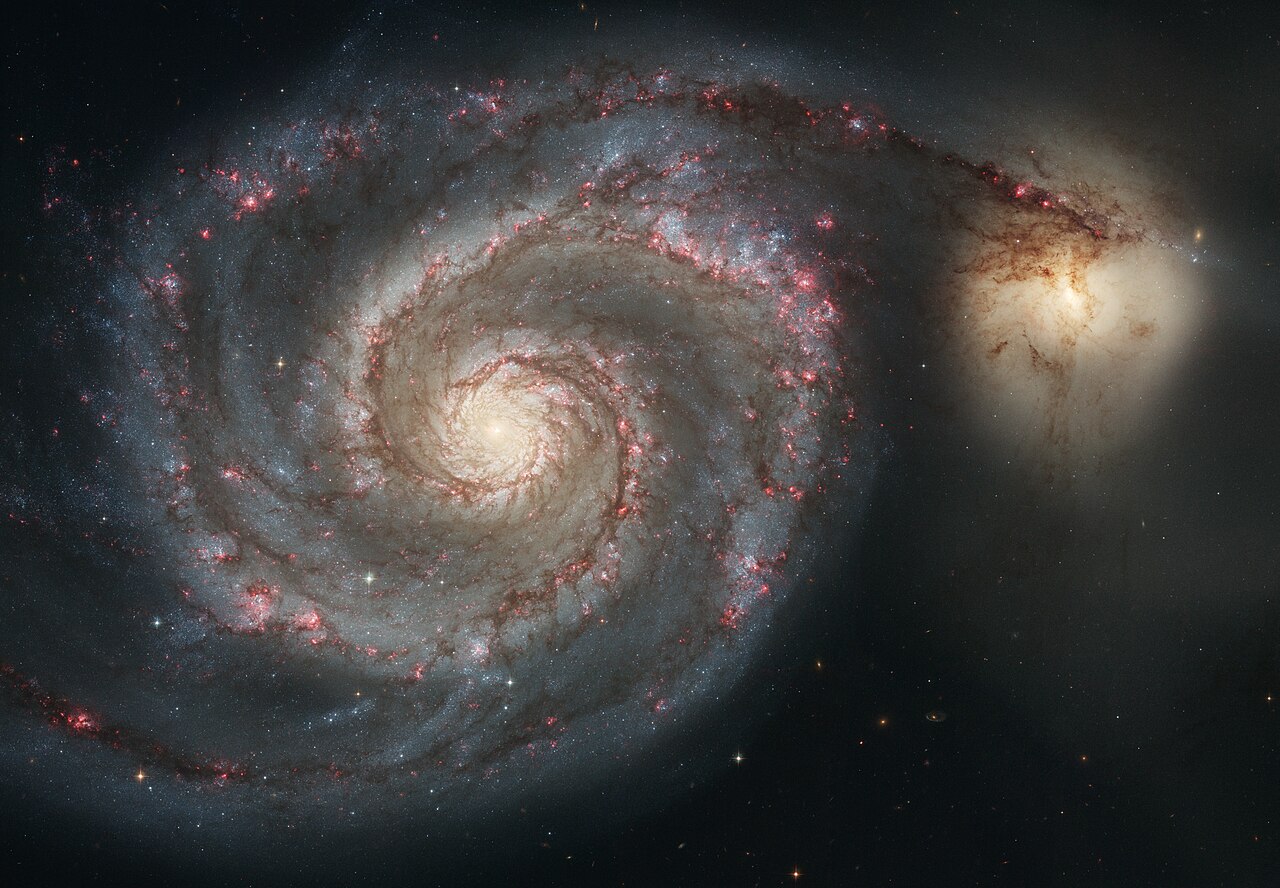
The Whirlpool Galaxy (Spiral Galaxy M51, NGC 5194), a classic spiral galaxy located in the Canes Venatici constellation, and its companion NGC 5195. Attribution: NASA and European Space Agency. - Clusters and reflection nebulae: Often demand broadband acquisition and careful color calibration.
Align your target with your scope’s focal length and sensor size. Wide fields (200–400 mm) suit large nebulae and complexes. Longer focal lengths (800–1500 mm+) suit galaxies and small planetary nebulae.
Framing and Rotation
Framing determines aesthetic impact and data efficiency. Use a field-of-view (FOV) simulator to preview composition and set the camera rotation ahead of time. Plate solving can refine framing in the field, especially when building mosaics.
- Frame the target with complementary star fields and dark nebulae.
- Include space for diffraction spikes, halos, or outflows if you’re using filters prone to haloing.
- Mosaics benefit from 10–20% overlap to ensure stable registration and blending.
Good framing reduces the need for aggressive cropping later and preserves resolution for small-scale detail enhancements during post-processing.
Planning Tools
Common planning tools and features include:
- Planetarium software with altitude charts and FOV overlays.
- Weather and astro-forecast services for cloud cover, transparency, seeing, wind, and temperature.
- Moon position and phase planning to schedule broadband vs. narrowband sessions.
- Framing assistants and mosaic planners integrated with plate solving platforms.
Plan an exposure strategy per target—especially whether you’ll work in narrowband or broadband—and confirm that with the guidelines in Exposure Strategy.
Choosing Equipment and Building a Reliable Optical Train
You can produce excellent deep-sky images with modest gear if your optical train is solid and repeatable. A typical imaging train includes the telescope or lens, corrector/reducer, filters, off-axis guider or guide scope, camera, and spacers to set backfocus.
Mount and Stability First
The mount is the foundation. An equatorial mount with accurate polar alignment and autoguiding enables longer subs and higher SNR integration. Capacity margins matter: keep the total payload under the mount’s imaging capacity guideline, and balance axes carefully to avoid periodic error amplification.

- Use a rigid tripod or pier and shelter from wind where possible.
- Allow gear to thermally equilibrate for stable focus and tracking.
- Calibrate guiding near the target’s declination and reduce backlash in RA/Dec.
For unguided imaging, shorter focal lengths and well-aligned mounts can still yield round stars with short subs; see Guiding and Tracking for trade-offs.
Optics, Correctors, and Backfocus
Triplet refractors or well-corrected reflectors provide flat fields and minimal chromatic aberration. Match flatteners or reducers designed for your scope. Backfocus spacing is critical: even a 1–2 mm error can cause elongated stars at the corners.
- Start with manufacturer’s backfocus specification, then fine-tune by inspecting star shapes in corners.
- If tilt is visible, verify orthogonality; shim or adjust tilt plates to correct corner asymmetry.
- Collimation matters for reflectors and RCs; check under the stars for symmetrical star images.
Filters: Broadband, Narrowband, and Multi-band
Your filters should match both your camera and sky:
- Broadband (UV/IR cut, luminance, RGB): Best under dark skies for galaxies and reflection nebulae.
- Narrowband (Hα, OIII, SII): Isolates emission lines; excellent in light pollution and moonlight for emission nebulae. Requires longer exposures and higher total integration time.
- Dual-band/tri-band filters: Simplify narrowband acquisition with one-shot color (OSC) cameras, capturing Hα and OIII in a single integration.
Be aware of filter halos around bright stars, especially with OIII and some dual-band filters. If a target includes bright stars, plan your framing accordingly or select a low-halo filter.
Cameras and Sampling
For deep-sky objects, both cooled CMOS and CCD (legacy) cameras are widely used. Modern cooled CMOS sensors offer low read noise, high quantum efficiency, and flexible gains. The key considerations are:
- Pixel scale: Match arcseconds per pixel to your seeing. Oversampling reduces SNR; undersampling can cause square stars. Typical targets: ~1–2.5 arcsec/px depending on seeing.
- Cooling: A stable sensor temperature (e.g., −10°C to −20°C) simplifies calibration and reduces thermal noise.
- Full well and dynamic range: Works with gain/ISO and sub length to avoid star saturation while capturing faint signal.
Autofocusers and motorized filter wheels increase repeatability, especially for multi-night projects. For manual setups, a reliable Bahtinov mask and frequent focus checks can be effective.
Exposure Strategy: Gain/ISO, Sub-Exposure Length, and Histograms
Your exposure settings define how efficiently you convert photons to usable signal. The goal is to place the sky background above read noise while avoiding saturation of stars and bright features.
Gain and ISO
On cooled CMOS astro cameras, “gain” sets the conversion between electrons and ADU (analog-to-digital units). On DSLRs/mirrorless cameras, ISO adjusts analog amplification and sometimes digital scaling. Practical guidance:
- CMOS astro cams: Choose a gain near the sensor’s “low read noise” or “unity gain” point published by the manufacturer. This typically balances dynamic range and read noise.
- DSLR/mirrorless: Use a native ISO where dynamic range is high and read noise modest. Many modern cameras perform well around ISO 800–1600, but test your specific model.
Sub-Exposure Length
Exposure time depends on sky brightness and filter bandwidth:
- Dark skies, broadband: Often 180–300 s subs (or more) without saturating too many stars.
- Suburban skies, broadband: 60–180 s subs to keep histograms from clipping highlights and to control gradients.
- Narrowband (Hα, OIII, SII): 180–600 s subs are common due to tight passbands; adjust to manage star saturation and tracking limitations.

I captured the nebula firstly in a narrowband test against the full moon. This means only collecting a small sliver of light with filters. The result was pretty cool, but the colours are false. Attribution: Dylan O’Donnell, deography.com.
There is no single “correct” sub length. For a fixed total integration time, sub length influences read noise contribution and star saturation. Use test frames and histograms to converge on the sweet spot.
Reading the Histogram
A useful rule of thumb is to place the sky background peak clearly off the left wall. For many setups, the sky peak 1/3 to 1/4 from the left is workable, but prioritize avoiding clipped blacks and excessive highlight saturation. Examine star cores: if they saturate widely, reduce sub length or gain.
Tip: Use your stacking software or capture tool’s statistics to ensure the median ADU is comfortably above the bias level, and monitor the number of saturated pixels across test subs.
Balancing SNR and Star Saturation
To maintain color in bright stars, consider a dual-exposure approach: standard long subs for faint detail plus a set of shorter subs to preserve star color. These can be combined later during post-processing using star replacement or masked blends.
Total Integration Time
SNR scales approximately with the square root of integration time. Doubling your total time improves SNR by about 1.4×. Many targets require several hours to days of data for clean structure, especially in narrowband. Plan sessions across multiple nights and use a consistent workflow to make those hours additive.
// Pseudocode: Evaluate sub length under your sky
if (median_background < (bias + 10 * read_noise)) {
  // background too close to read noise
  increase_sub_length();
}
if (saturated_pixels > threshold) {
  // too many clipped stars
  decrease_gain_or_time();
}
Calibration Frames and Image Calibration
Calibration frames remove systematic noise patterns and optical artifacts so that stacking can work efficiently. Skipping calibration sacrifices detail and color fidelity, especially in faint structures.
Bias, Darks, and Flats
- Bias frames: Very short exposures with the lens cap on. They capture the camera’s readout pattern. Some modern CMOS sensors blur the distinction between true bias and very short darks; follow your stacking tool’s guidance.
- Dark frames: Same gain, temperature, and duration as your lights, with the scope covered. They remove thermal noise and hot pixels. For cooled cameras, build a dark library at common sub lengths and temperatures.
- Flats: Expose to ~30–50% histogram using an evenly illuminated source. Flats correct vignetting and dust motes and must match focus and optical train orientation used for lights.
Take new flats anytime you rotate the camera, change focus significantly, or alter the optical path (e.g., add/remove a filter or spacer). Dark-flats (or bias) should match flats’ exposure settings if your software requires them.
Calibration Workflow
A common sequence is:
- Calibrate flats with bias or dark-flats.
- Create a master flat.
- Create a master bias (if used) and master dark at each exposure length/temperature.
- Calibrate light frames with master dark and master flat (and bias if appropriate).
Inspect calibrated lights to confirm dust motes are removed and background is even. If dust donuts remain, your flats may be mismatched or over/underexposed. Re-shoot flats before proceeding to stacking.
Ensuring Repeatability
Consistency is critical. Keep notes on:
- Sensor temperature, gain/ISO, sub length.
- Filter used, focus offset, backfocus spacing.
- Flat panel settings and flat ADU target.
These records help you maintain a reusable calibration library and reduce setup time on future sessions.
Guiding, Dithering, and Tracking Accuracy
Guiding and dithering improve star quality and noise characteristics, enabling deeper integrations without elongated stars or fixed-pattern noise.
Autoguiding Basics
Autoguiding uses a guide camera and a guide scope or off-axis guider (OAG) to correct mount tracking errors in real time. Choose guide exposures that balance SNR and responsiveness (often 1–3 seconds). Calibrate guiding near your target to account for declination and mount geometry.
- OAGs are rigid and prevent differential flexure at long focal lengths.
- Guide scopes are simpler and excellent at shorter focal lengths (e.g., 200–600 mm).
Monitor RMS error, but judge results by star shapes. A low guiding RMS does not guarantee round stars if there’s flexure, wind, or focus issues.
Dithering Reduces Pattern Noise
Dithering randomly shifts the telescope a few pixels between exposures. This breaks up fixed pattern noise and walking noise so that rejection algorithms can remove it during integration. Dither every 1–3 subs, with enough offset that hot pixels and banding shift position.
Polar Alignment and Periodic Error
Accurate polar alignment limits field rotation and reduces the workload on declination guiding. Many mounts also benefit from periodic error correction (PEC). Record a PEC curve and enable it if supported, then let guiding handle residual errors.
Focus and Temperature Drift
As temperatures fall, focus shifts, especially in refractors. Automated focus routines or periodic manual checks improve sharpness. Use short test frames and half-flux diameter (HFD) or full width at half maximum (FWHM) metrics to monitor focus quality.
Stacking: Registration, Rejection, and Integration
Stacking consolidates many calibrated sub-exposures into a single high-SNR master image. The choices you make here—quality weighting, star alignment, and outlier rejection—play a major role in the final result.
Pre-Stack Quality Control
Before alignment, “blink” your subs quickly to filter out problems. Reject frames with trailed stars, clouds, or aircraft. Many stacking tools provide FWHM, eccentricity, and SNR estimates per sub. Rejecting the worst 10–30% can improve the final image more than adding extra marginal frames.
- Use subframe weighting to prefer sharp, low-background frames.
- Consider separating nights with different seeing into different stacks to prevent mixed star profiles.
Star Alignment and Distortion
Registration aligns stars across all subs. For short focal lengths, similarity or projective transforms may suffice; for longer scopes or wide fields with distortion, thin-plate-spline or polynomial models can yield tighter alignment.
Plate solving ensures accurate alignment for mosaics and multi-night data. When combining narrowband and broadband, align everything to a common reference frame—often the highest SNR luminance or Hα integration.
Outlier Rejection
Outlier rejection removes satellites, planes, cosmic ray hits, and residual hot pixels:
- Winsorized sigma clipping is robust for large datasets.
- Linear fit clipping accounts for varying transparency among subs.
- Percentile clipping or average sigma clipping can work with smaller stacks.
Use large enough stacks for reliable statistics. If your target has moving elements (e.g., a comet), use comet-aligned stacking for the target and star-aligned stacking for the background, then combine with masks.
Drizzle and Integration Options
Drizzle integration can recover resolution from undersampled data if you have sub-pixel dithers and many frames. It increases file size and noise, so use it judiciously and apply strong noise reduction later. Save registered frames and weight maps; they’re handy for diagnosing issues discussed in Troubleshooting.
# Example: a high-level stacking script outline
calibrate lights with master_darks, master_flats
register calibrated_lights to reference_frame
weight frames by FWHM, eccentricity, background_noise
integrate using winsorized_sigma_clip, low_rejection=4, high_rejection=3
output master_light
Post-Processing: Noise Reduction, Stars, and Color
Post-processing transforms your linear master into a finished image. Work carefully in the linear stage before stretching to preserve faint signal. The order of operations matters, but flexibility is key—adapt to the data in front of you.
Linear Stage Essentials
- Background extraction: Remove gradients caused by light pollution, moonlight, or filter halos. Use a careful set of background samples to avoid removing nebulosity.
- Color calibration: For broadband, photometric color calibration aligns star colors to catalog values. For narrowband, you will assign channels (e.g., SHO/Hubble palette, HOO) and fine-tune white balance.
- Noise reduction: Linear denoising works well while the data are unstretched. Apply masks (e.g., luminance or range masks) to protect stars and bright structures.
Inspect your stars and background after each step. If gradients persist, revisit background extraction—don’t jump forward until your linear image is flat and clean.
Stretching from Linear to Nonlinear
Stretching reveals faint nebulosity. Use a gentle, multi-step approach:
- Apply an initial stretch (e.g., histogram transformation) while protecting highlights.
- Incrementally boost midtones to prevent over-saturating stars and blowing out cores.
- Use masks to protect star colors and bright knots.
If your stars are growing too quickly, consider star separation techniques next.
Star Management: Separation, Reduction, and Color
Managing stars helps emphasize nebulosity and galactic structure:
- Star separation: Generate starless and stars-only images. Process the starless layer for contrast and color, and the stars layer for controlled size and saturation.
- Star reduction: Apply mild morphological transformations or targeted shrink filters to prevent stars from dominating the scene.
- Star color: Recover star color if necessary using shorter sub sets or by reducing saturation clipping.
Recombine stars at the end, with a gentle blend that avoids halos. This approach pairs well with the star color preservation strategy described in Exposure Strategy.
Color Palettes for Narrowband
For narrowband data, you’ll map channels to colors creatively, while maintaining astrophysical plausibility:
- SHO (Hubble palette): SII → R, Hα → G, OIII → B. Creates golden/brown hydrogen regions and teal oxygen regions.
- HOO: Hα → R, OIII → G+B. A natural-looking palette with strong red and cyan structures.
- For OSC dual-band: Split Hα and OIII contributions via channel extraction and color masks to balance hues.

Use selective color tools and masks to avoid color blotching. Preserve detail by blending a clean luminance layer derived from Hα or an L channel.
Detail Enhancement and Final Polish
Small-scale and large-scale contrast adjustments bring the object to life:
- Use local contrast or multiscale processing to reveal dust lanes and filaments.
- Apply sharpening selectively to high-SNR regions, avoiding noise in dim areas.
- Finish with gentle saturation and hue tweaks to maintain natural star colors.
At the end, downsample slightly if needed to reduce noise perception and improve online presentation. Ensure the image is free of residual gradients or color casts before exporting.
Troubleshooting Common Artifacts in Deep-Sky Images
Every imager encounters artifacts. Recognizing them quickly saves nights of work and makes your workflow resilient.
Elongated Stars
Causes and fixes:
- Polar alignment error: Improve polar alignment; use drift alignment or iterative tools.
- Poor guiding or wind: Adjust aggressiveness, increase guide exposure for SNR, shield from wind.
- Field curvature or tilt: Check backfocus spacing; use tilt adjusters and inspect corner star shapes.
- Differential flexure: Consider OAG at longer focal lengths or reinforce guide scope mounting.
Walking Noise and Banding
Walking noise appears as streaks after stacking due to fixed-pattern noise that “walks” across frames with small drifts. Use larger dither amplitudes and random directions. In integration, enable robust rejection and evaluate cosmetic correction if needed.
Halos and Internal Reflections
Bright stars may produce halos with some filters, particularly OIII. Solutions:
- Choose filters designed to minimize halos.
- Frame targets to keep bright stars out of critical areas.
- In processing, use star masks and halo reduction techniques sparingly.
Color Casts and Gradients
Strong gradients are common under urban skies. Use careful background sampling for extraction. If a color cast persists after color calibration, revisit the gradient removal step or build a spectrally neutral reference from background patches.
Clipped Highlights
Blown-out star cores lose color and detail. Capture short subs alongside long ones and blend them back. During stretching, monitor highlight clipping and reduce midtone pushes.
Dust Donuts That Survive Flats
If dust motes remain, your flats likely didn’t match focus or rotation, or the flat illumination was uneven. Re-shoot flats at the same focus and orientation, and ensure a uniform, sufficiently bright light source.
Soft Focus Over Time
Temperature drops can shift focus. Implement autofocus routines or schedule manual re-focus checks by monitoring star HFD/FWHM each hour or with significant temperature changes.
Frequently Asked Questions
How many sub-exposures do I need for a clean deep-sky image?
There is no fixed number. Aim for total integration time that matches your target, filter, and sky quality. Under dark skies with broadband imaging, 3–6 hours can produce strong results for bright nebulae or clusters, while faint galaxies and narrowband projects often benefit from 10+ hours spread across multiple nights. If you’re unsure, start around 100–200 minutes and evaluate the stacked result; add more time to improve SNR. Remember, SNR improves with the square root of total time, so each additional hour provides diminishing but still meaningful returns.
Can I do deep-sky astrophotography without guiding?
Yes—especially at short focal lengths (e.g., 200–400 mm) with a well-aligned equatorial mount. Keep subs short to avoid trailing, enable dithering between exposures, and collect many frames for stacking. As focal length increases or if you need longer exposures (e.g., narrowband), autoguiding becomes increasingly valuable. If you’re imaging unguided, ensure precise polar alignment and consider a mount with low periodic error. See Guiding, Dithering, and Tracking Accuracy for trade-offs.

Final Thoughts on Mastering Your Deep-Sky Astrophotography Workflow
Deep-sky astrophotography is equal parts patience, planning, and process. A robust workflow starts with choosing targets that match your sky and optics, continues with stable tracking and rigorous calibration, and ends with careful stacking and restrained, insightful processing. Small improvements at each stage compound into striking results.
As you iterate, track your settings, analyze what worked, and refine weak links—perhaps optimizing your exposure strategy, tightening guiding and dithering, or fine-tuning post-processing. Consistency across multi-night projects is the most reliable path to high SNR and clean, colorful images.
If this guide helped clarify your approach, explore our other deep-sky topics, and consider subscribing to our newsletter for future field-tested workflows, processing techniques, and seasonal target suggestions. Clear skies and productive integrations!