
Table of Contents
- What Is the Cygnus Constellation in the Northern Sky?
- How to Find Cygnus and the Northern Cross All Season Long
- Bright and Notable Stars of Cygnus: Deneb, Albireo, Sadr, and More
- Deep-Sky Treasures in Cygnus: Nebulae, Clusters, and the Veil
- The Milky Way Spine Through Cygnus and the Great Rift
- High-Energy and Extragalactic Wonders: Cygnus X-1, Cyg OB2, and Cygnus A
- Exoplanets and the Kepler Field in Cygnus
- Mythology, Etymology, and Cultural History of the Swan
- Practical Observing Guide: Gear, Filters, and Star-Hopping
- Planning, Conditions, and Safety for Night-Sky Visits
- Frequently Asked Questions
- Final Thoughts on Exploring the Cygnus Constellation
What Is the Cygnus Constellation in the Northern Sky?
Cygnus, the Swan, is one of the northern sky’s great showpieces: a broad winged bird gliding directly along the band of the Milky Way. To naked-eye observers, the constellation outlines the well-known Northern Cross asterism, anchored by the star Deneb (Alpha Cygni) at the top of the cross and the beautiful double star Albireo (Beta Cygni) as the base. Because the rich star fields of the Milky Way run right through Cygnus, the constellation is packed with stellar associations, open clusters, and spectacular emission and supernova-remnant nebulae—making it a rewarding target for binocular users and telescope owners at all experience levels.

Located at mid to high declinations in the north celestial hemisphere, Cygnus is visible from most of the Northern Hemisphere for much of the year, with prime visibility in late summer and early autumn evenings. From the Southern Hemisphere, observers at mid-latitudes can still see the constellation skimming the northern horizon at the best times of year. Its prominent stars and distinctive cross shape make it a reliable guidepost for finding deep-sky wonders and as a springboard for star-hopping across nearby constellations like Lyra, Vulpecula, and Cepheus. If you’re just learning the sky, learning to locate the Northern Cross is one of the most satisfying first steps you can take.
Beyond its observational appeal, Cygnus is also an astrophysical laboratory. It hosts the black-hole binary Cygnus X-1, lies along the line of sight to one of the Galaxy’s richest OB associations (Cyg OB2), and overlaps the primary field of NASA’s Kepler mission, which discovered thousands of exoplanet candidates by monitoring stellar brightness variations. If you are curious about stellar evolution, interstellar medium physics, or exoplanet demographics, a tour of Cygnus offers a direct connection between backyard observing and forefront research. Later sections such as high-energy and extragalactic wonders and exoplanets in the Kepler field expand on these themes.
How to Find Cygnus and the Northern Cross All Season Long
The Northern Cross is one of the easiest asterisms to spot once you know when and where to look. Its long axis points almost exactly along the Milky Way’s bright stream in the northern sky, making it useful both for orientation and for finding targets. Here’s a practical approach to locating Cygnus from different latitudes and seasons.
Best months and times
- Peak season: late July through October in the Northern Hemisphere, when the Northern Cross stands prominently overhead or high in the east at dusk.
- Early season: from late spring, look for it rising in the northeast before midnight; by June nights it climbs high by late evening.
- Southern Hemisphere: mid-latitudes can catch Cygnus low in the north during winter and spring evenings (June–September). The higher the latitude north you are, the higher Cygnus climbs.
Using bright nearby reference stars
- From Lyra: Find brilliant Vega. Scan eastward (left if facing south from northern latitudes) along the Milky Way to the next very bright star—that’s Deneb.
- From the Summer Triangle: Deneb, Vega, and Altair in Aquila form a large triangle. Deneb marks the apex nearest the Milky Way’s brightest band.
- From Cepheus and Cassiopeia: If you’re familiar with the “W” of Cassiopeia, trace the Milky Way southward to reach Deneb and the “top” of the Northern Cross.
Recognizing the Northern Cross shape
The long spine of the cross runs from Deneb down through Sadr (Gamma Cygni) and terminates at Albireo. The crossbar extends roughly east–west from Delta Cygni to Gienah (Epsilon Cygni). In darker skies, myriad background stars make the cross even more striking, but the five principal stars are bright enough to trace even from many suburban locations.
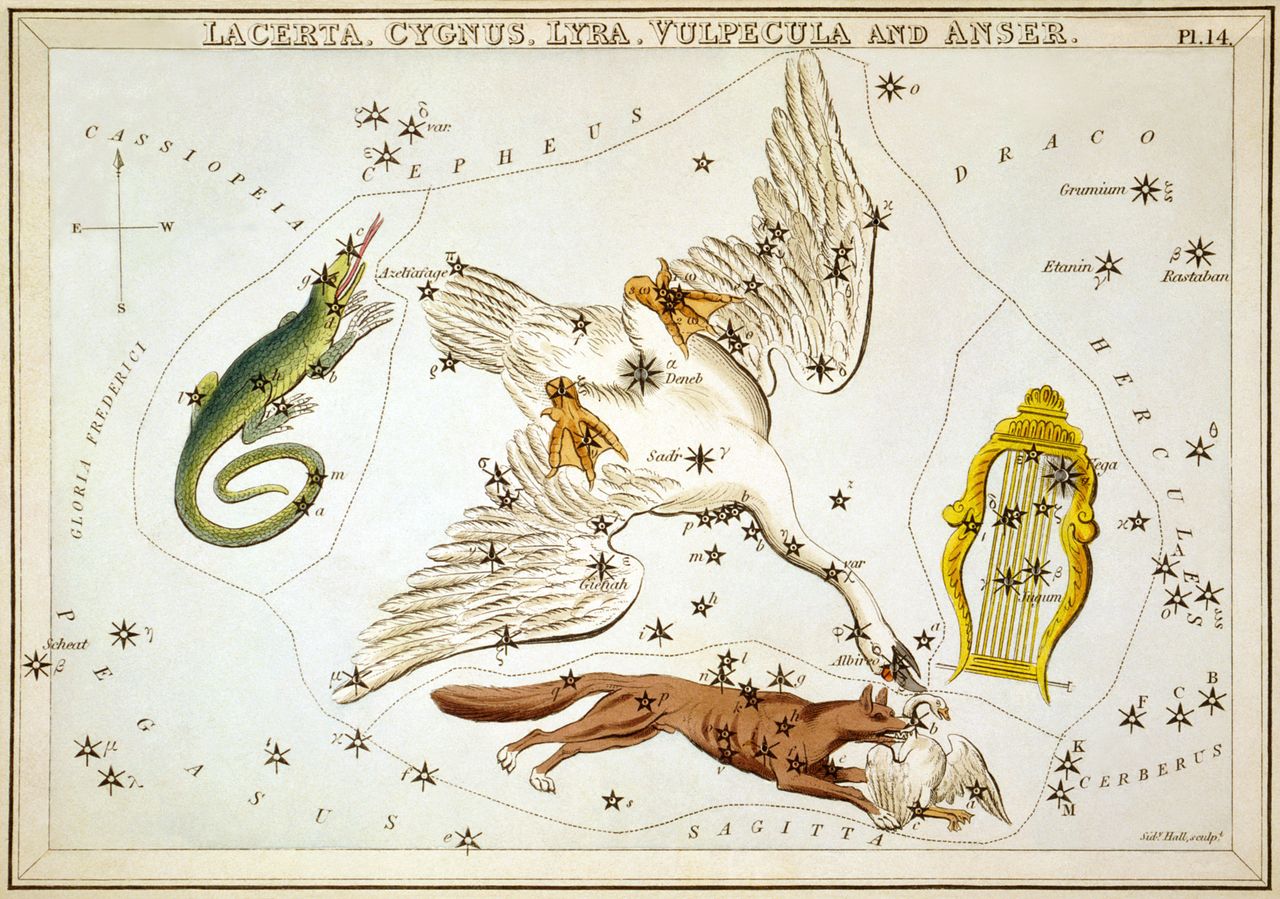
If you are planning a deep-sky tour, consider starting near Deneb and sweeping along the spine toward Albireo; this path covers many of the highlights detailed in Deep-Sky Treasures in Cygnus. For identifying dark nebula lanes and rich star clouds, consult the guidance in The Milky Way Spine Through Cygnus and the Great Rift where we discuss how dust obscures and structures the Milky Way in this region.
Bright and Notable Stars of Cygnus: Deneb, Albireo, Sadr, and More
Cygnus shines with several standout stars that anchor both the constellation’s outline and a wealth of scientific interest. Knowing these stars—how to identify them, what they are physically, and why they matter—enhances every observing session.
Deneb (Alpha Cygni): a luminous supergiant beacon
Deneb is among the most luminous stars visible to the naked eye. Spectroscopically classified around A2 Ia, Deneb is a blue-white supergiant likely located roughly a few thousand light-years from Earth; modern parallax measurements place it on the order of ~2,600 light-years, though uncertainties have historically complicated precise distance estimates. Even at that distance, Deneb shines at magnitude ~1.25, a testament to an intrinsic luminosity tens of thousands to over a hundred thousand times that of the Sun. It’s a cornerstone of the Summer Triangle, and the anchor point for many star-hops in Cygnus.
From an astrophysical perspective, Deneb is in a late stage of stellar evolution. With a mass several times that of the Sun, it is fated to end life far more dramatically, perhaps as a core-collapse supernova—though the timescale is vast. Deneb’s powerful stellar wind and variability (a prototype of the Alpha Cygni class of non-radially pulsating supergiants) make it a valuable target for spectroscopic study.
Albireo (Beta Cygni): the showpiece double
Albireo, at the base of the Northern Cross, is one of the sky’s most beloved double stars. Through small telescopes at low magnification, Albireo splits into a striking pair with contrasting colors—an amber-gold primary and a blue secondary—offering a dramatic visual complement to the dense Milky Way background. Although long thought to be a gravitationally bound system, more recent astrometric data indicate that the wide pair seen in small telescopes is likely an optical double; however, Albireo’s brighter component is itself a close binary. For observers, the color contrast is the main draw, and it remains a must-see in any tour of Cygnus.
Sadr (Gamma Cygni): the heart of the cross
Sadr sits at the intersection of the Northern Cross. A yellow-white supergiant of type around F8 Ib, Sadr illuminates a region rich with nebulosity and star fields. Through binoculars and small telescopes, the area surrounding Sadr is teeming with stars nestled in the Milky Way’s bright band. The so-called Gamma Cygni Nebula (IC 1318) is a complex of emission nebulae in the vicinity, best revealed under dark skies with line filters described in the observing guide.
Gienah (Epsilon Cygni) and Delta Cygni: the crossbar sentinels
The crossbar of the Northern Cross is marked by Gienah (Epsilon Cygni), an orange giant star, and Delta Cygni, a fascinating multiple-star system. Delta Cygni is a double star challenge at moderate aperture and steady seeing, making it a good test of optical and atmospheric conditions. Both stars help define the wide shape of Cygnus and serve as signposts for nearby clusters and nebulae.
61 Cygni: high proper motion and parallax pioneer
Just outside the obvious cross shape lies 61 Cygni, a pair of nearby K-type dwarf stars famous for having the first reliably measured stellar parallax in 1838 by Friedrich Bessel. About 11 light-years away, 61 Cygni has a notably large proper motion across the sky, observable in historical records spanning decades. Even in small telescopes, the pair is a pleasing sight, with subtle color differences that reward patient viewing.
Once you familiarize yourself with these stars, you’ll find them invaluable as waypoints for deeper explorations. Virtually every deep-sky highlight of the Swan can be reached by hopping from Deneb, Sadr, or Albireo, as outlined in Deep-Sky Treasures in Cygnus.
Deep-Sky Treasures in Cygnus: Nebulae, Clusters, and the Veil
Cygnus is a deep-sky playground. Because the Milky Way passes through its body, the constellation’s fields are stuffed with open clusters, gas clouds, and remnants of stellar death. Many are accessible in small instruments under dark skies; others reward larger apertures and narrowband filters.
NGC 7000, the North America Nebula, and IC 5070, the Pelican Nebula
Near Deneb lies one of the most iconic emission nebulae: the North America Nebula (NGC 7000). Its broad swath of glowing hydrogen forms a recognizable outline reminiscent of the North American continent. Just adjacent is the Pelican Nebula (IC 5070), framing intricate dark lanes and bright arcs. The pair lies in a massive star-forming complex energized by ultraviolet radiation from hot, young stars, likely including luminous members hidden behind dust.

- Best equipment: Wide-field binoculars (7× or 10×) can show the region’s brightness gradients in very dark skies. A small refractor at low power with a UHC or O III filter can reveal the shapes more clearly.
- Technique: Center Deneb in a low-power field and drift eastward to sweep across the nebulous expanse. As described in the observing guide, filters are key here.
NGC 6960/6992/6995, the Veil Nebula (Cygnus Loop)
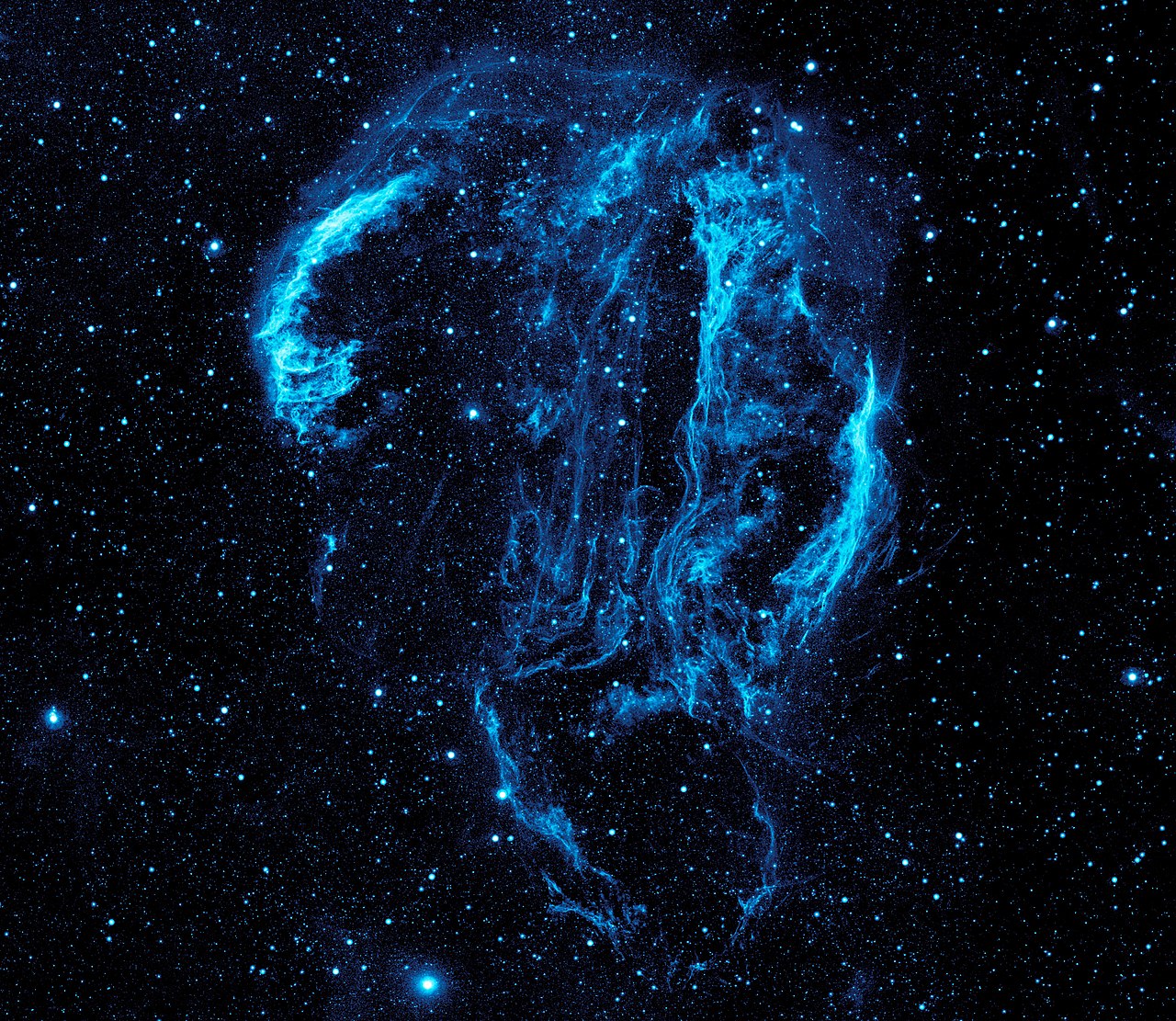
The Veil Nebula is a spectacular supernova remnant spreading across several degrees of sky, with distinct components often cataloged as NGC 6960 (the Western Veil, overlapping the star 52 Cygni) and NGC 6992/6995 (the Eastern Veil). The Veil is the visible shockwave debris of a massive star that exploded thousands of years ago. Wisps and filaments of ionized gas reveal a delicate lacework when viewed with an O III filter, even in modest apertures under dark skies.
- Best equipment: 8-inch or larger telescopes highlight fine filaments with an O III filter; however, 4–5-inch scopes and even binoculars under pristine skies can show the brighter arcs.
- Technique: Start at 52 Cygni for the Western Veil, then pan east across the field to intercept the brighter Eastern Veil. A wide-field eyepiece is advantageous because the complex is enormous.

Western Veil (NGC 6960, Witch’s Broom) near 52 Cygni; RGB image enhanced with narrowband H-alpha and OIII data. Artist: Ken Crawford
NGC 6888, the Crescent Nebula
The Crescent Nebula (NGC 6888) is a wind-blown bubble sculpted by the powerful outflows of a Wolf–Rayet star (WR 136). These evolved, massive stars shed their outer layers at high velocity, colliding with previous ejections and the surrounding interstellar medium to form arcs and filaments. In the eyepiece, the Crescent can look like a glowing comma or shell, with brighter rims and textured interior knots.
- Best equipment: 6–10-inch scopes with O III filters; higher magnification can help tease out arcs once you have the object centered.
- Technique: Star-hop from Sadr using detailed charts. Spend time with averted vision; the nebula’s subtle contrast changes become more apparent the longer you look.
IC 5146, the Cocoon Nebula, and the dark nebula Barnard 168
The Cocoon Nebula is a compact star-forming region surrounding a young cluster. A dark nebula, Barnard 168, appears as a sinuous lane threading away from the Cocoon, creating a dramatic juxtaposition of glowing gas and obscuring dust. The pair sits near the edge of Cygnus bordering Lacerta and Cepheus, rewarding careful exploration from a dark site.
- Best equipment: 4–8-inch telescopes with UHC filters; wide-field views help trace the adjacent dark lane.
- Technique: Low to moderate power reveals the embedded star cluster and the nebula’s soft glow; shift the field to enhance contrast between glow and dark dust.
M29 and M39: accessible open clusters
Messier 29 (near Sadr) and Messier 39 (north of Deneb) are two open clusters ideal for small telescopes and binoculars. M29 is compact and sometimes described as a small “pocket cluster,” while M39’s loose, triangular sprinkling stands out even at low magnifications.
- Best equipment: Binoculars or small refractors; excellent for beginner star-hopping practice.
- Technique: For M29, start at Sadr and center a low-power field; for M39, sweep northward from Deneb in binoculars and look for a coarse scatter of stars.
These highlights are just a starting point. The region around Sadr brims with diffuse emission nebulosity, while the Deneb area hosts dark lanes and bright patches that transform as your eyes adapt. For structured exploration, see the star-hop sequences in Practical Observing Guide.
The Milky Way Spine Through Cygnus and the Great Rift
When Cygnus rides high on a moonless night, it reveals a luminous seam of the Milky Way crisscrossed by dark, sinuous lanes. This striking contrast is the Great Rift, where foreground clouds of interstellar dust obscure the Galaxy’s star fields. In Cygnus, the Rift interleaves with bright star clouds to create one of the most dramatic naked-eye sights in the sky.
What is the Great Rift?
The Great Rift is a series of overlapping dark nebulae—cold molecular clouds laced with dust grains—that block and redden the light of background stars. While not as compact as the dense dust lanes you might see in external galaxies, these clouds span thousands of light-years through the inner spiral arms. In Cygnus, they frame bright clouds of stars so that the Milky Way appears cloven into brighter and dimmer sections.
Observing the Rift and star clouds
- From very dark sites, the Rift appears as a subtle, branching river of darkness dividing brighter swaths of star light. Binoculars enhance the view to show scalloped edges and embedded dark concentrations.
- Look for the Cygnus Star Cloud near Deneb and Sadr: these are regions where the Milky Way’s stellar density is particularly high, forming textured backdrops for nebulae like the North America and Gamma Cygni complex.
- Use low power in small telescopes to maintain image brightness. Sweep along the spine of the Northern Cross, comparing the brightness and grain of star fields with and without a narrowband filter to see how emission regions pop against the dark lanes.
The interplay of emission nebulae, open clusters, and dark clouds is a vivid lesson in Galactic ecology. Giant molecular clouds collapse into clusters of hot young stars; their radiation sculpts and ionizes surrounding gas; and supernovae from massive stars seed the interstellar medium with heavy elements while carving out expanding shells like the Veil. You can trace this cycle step by step by visiting the objects in Deep-Sky Treasures and relating them to the dust structures in this section.
High-Energy and Extragalactic Wonders: Cygnus X-1, Cyg OB2, and Cygnus A
Cygnus is not only a visual feast; it’s also where astrophysics comes alive. From stellar nurseries to black holes and powerful radio galaxies, the Swan showcases extremes that probe gravity, magnetic fields, and the life cycles of massive stars.
Cygnus X-1: a famous black-hole binary
Cygnus X-1 is one of the earliest and most studied black-hole candidates, discovered as a bright X-ray source. It consists of a stellar-mass black hole in orbit with a blue supergiant companion. Gas drawn from the companion forms an accretion disk around the black hole, heated to extreme temperatures that emit intense X-rays. Changes in the X-ray flux over time, combined with orbital studies, have helped astronomers infer the system’s mass distribution and dynamics. While not visually accessible through amateur telescopes, it’s a prime example of how multiwavelength astronomy—X-ray, optical, and radio—reveals phenomena invisible to the human eye. If you’re sweeping near the bright stars of Cygnus, it’s awe-inspiring to remember that a famous black hole lurks in the same patch of sky.
Cygnus OB2 and the Cygnus X complex
Embedded in Cygnus is one of the Galaxy’s richest associations of massive, hot, young stars: Cyg OB2. Packed with O- and B-type stars, this association is part of a broader complex of star formation often referred to as Cygnus X in radio studies. Cyg OB2’s UV radiation and stellar winds sculpt nearby gas and dust, energizing emission regions and possibly triggering new bouts of star formation. This complex ties together multiple visual showpieces in Cygnus, linking what you see in the eyepiece with the physics of star birth and feedback.
Cygnus A: a powerful radio galaxy in the swan’s field
Cygnus A (3C 405) is one of the brightest extragalactic radio sources in the sky, a distant active galaxy whose supermassive black hole launches relativistic jets that inflate radio lobes spanning hundreds of thousands of light-years. Although Cygnus A is far too faint in visible light for casual observation, it is a staple in radio astronomy and a key object in understanding the connection between black holes and galaxy evolution. Its presence in the constellation is a reminder that Cygnus stitches together astrophysical stories from stellar to cosmic scales.
Together these high-energy objects and associations demonstrate why Cygnus attracts intense study. By pairing a night’s visual sweep with reading on Cyg OB2 or Cygnus X-1, you can build a bridge between backyard impressions and the data-driven narratives of modern astrophysics, complementing the object-based lists in Deep-Sky Treasures.
Exoplanets and the Kepler Field in Cygnus
From 2009 onward, NASA’s Kepler space telescope stared continuously at a fixed region of the sky that overlapped parts of Cygnus (and neighboring Lyra), monitoring the brightness of over 100,000 stars to detect the tiny dips caused by transiting exoplanets. This mission transformed exoplanet science, revealing that planets are common and diverse in size and orbital configuration.
Many of the exoplanet host stars identified by Kepler carry catalog names like Kepler-10, Kepler-22, and thousands more. Some of these stars lie within the boundaries of Cygnus, though they are generally too faint for casual visual observation. The significance for observers is broader: when you look into the star-rich lanes of Cygnus, you are gazing into a laboratory where the demographics of planetary systems were quantified. The mission’s follow-up observations, refined by later work (including TESS), continue to build on the catalog of confirmed planets and candidates.
For outreach and educational observing, noting the Kepler field’s position can be an inspiring talking point, linking the dazzling star fields of the Swan with the hidden planetary systems that orbit them. Pair this with the seasonal visibility guidance in How to Find Cygnus to time your sessions when the former Kepler field rides highest.
Mythology, Etymology, and Cultural History of the Swan
The name Cygnus comes from the Latin for “swan,” a bird motif with multiple strands in classical lore. In one tale, the swan is associated with the tragic story of Phaethon, whose friend Cycnus mourned him and was transformed into a swan. In other traditions, the swan ties to the god Zeus. In most star atlases, the swan flies southward along the Milky Way, wings outstretched, head lowered toward Albireo.
Historically, Cygnus has been recognized by many cultures, often with avian symbolism. The prominence of the Northern Cross asterism—a pattern of bright stars that is easy to remember—has made it a mainstay in popular navigation of the summer sky for northern observers. Its role in the Summer Triangle, alongside Vega and Altair, also appears throughout late 20th-century sky guides and planetarium programs. If you are giving a talk or leading a star party, connecting the asterism’s geometry to seasonal directions can serve as a memorable orientation trick, supported by practical finding cues from the section on locating Cygnus.
Practical Observing Guide: Gear, Filters, and Star-Hopping
From city limits to remote dark-sky sites, Cygnus rewards a thoughtful observing plan. The following guide focuses on practical choices in equipment and observing technique for nebulae and clusters mentioned in Deep-Sky Treasures, while tying in general tactics for navigating the rich Milky Way fields.
Binoculars: the wide-field advantage
- 7×50 and 10×50: Excellent for scanning the Milky Way through Cygnus. The North America Nebula region shows as a textured glow in dark skies; M39 stands out well.
- 12×–15× class: More reach for tracing the outlines of the North America and Pelican, especially under very dark skies. A tripod or monopod steadies the view.
- Technique: Sweep slowly. Pause at Deneb and drift east to sample nebulosity; then move to Sadr and pan along the crossbar to appreciate star density and dark lanes discussed in The Milky Way Spine.
Small telescopes (60–120 mm): contrast and filters
- Low power, wide field: Use 2–3° true fields to frame the North America and Pelican complex. A narrowband UHC or an O III filter is transformative on emission nebulae.
- Moderate power: Good for the Crescent Nebula once found at low power. Albireo doubles beautifully at 30–60×.
- Filter choice: For the Veil Nebula, an O III often yields the most dramatic contrast; UHC shows more background stars and can be preferable for larger structures like NGC 7000.
Medium to large telescopes (150–300 mm+): detail and structure
- Veil filaments: Trace hairline threads in both Eastern and Western arcs. Increase magnification while maintaining image brightness; dark adaptation is critical.
- Crescent Nebula arcs: Look for the bright rim and internal knots. Subtle features grow conspicuous with time at the eyepiece.
- Dark nebulae: The contrasty lanes of Barnard 168 near the Cocoon Nebula and the Rift segments near Sadr become more obvious in larger apertures with low-power, wide-field eyepieces.
Star-hop sequences
The following outlines are written like “observing code”—stepwise moves guiding you from bright waypoints to fainter targets. Use a detailed atlas or a planetarium app for precise star patterns.
  # Hop 1: Deneb → North America Nebula (NGC 7000)

  start = Deneb

  field = 3 degrees, low power, UHC filter

  action: shift ~2 degrees east to enter the bright haze (NGC 7000)

  check: look for Gulf of Mexico dark indentation; Pelican (IC 5070) just to the east
  # Hop 2: 52 Cygni → Western Veil (NGC 6960)

  start = 52 Cygni (bright star with faint diffuse glow in O III)

  field = 2 degrees, O III filter

  action: center 52 Cygni; sweep slightly west/east to trace the filament crossing the star

  check: pan east 2–3 degrees to catch the brighter Eastern Veil (NGC 6992/6995)
  # Hop 3: Sadr (Gamma Cygni) → Crescent Nebula (NGC 6888)

  start = Sadr

  field = 1 degree, O III filter

  action: consult chart; hop southeast through asterisms forming a gentle arc

  check: look for a faint comma-shaped glow; increase magnification modestly once centered
Observing techniques that pay off
- Dark adaptation: Give your eyes 20–30 minutes to fully adapt. Shield them from stray light—use a hood or observing cloth if needed.
- Averted vision: Look slightly off-target to engage more sensitive retinal cells. Faint filaments and borders often pop into view.
- Filter discipline: Swap filters according to target. Try UHC first on broad emission regions; use O III for supernova remnants; pause unfiltered to appreciate the star fields.
- Patience: Nebulae often reveal structure after sustained viewing. Linger on each object and let detail accumulate.
While the section emphasizes visual observing, many of the same targeting principles apply to imaging plans—though this article intentionally focuses on eyepiece-based exploration to complement the astrophysical context in High-Energy Wonders and Exoplanets in the Kepler Field.
Planning, Conditions, and Safety for Night-Sky Visits
Good planning transforms a pleasant session into an unforgettable one. Cygnus offers so much to see that prioritizing targets, matching them to conditions, and preparing simple comforts will make your time under the stars both productive and enjoyable.
Match targets to sky conditions
- Transparency vs. seeing: For extended nebulae (North America, Veil), prioritize nights of high transparency and low skyglow. For doubles like Delta Cygni, steady seeing trumps transparency.
- Moon phase: Aim for moonless windows to tackle the Veil and faint nebulosity near Sadr. The brighter clusters (M39, M29) and Albireo remain fine even with some moonlight.
- Light pollution: Under suburban skies, filters can recover some contrast for the Veil, but the North America Nebula is much more elusive; pick darker sites for these showpieces.
Plan your route and time budget
- Start with one showcase object per hour and add two “secondary” targets nearby. For example, pair the Veil with the Crescent Nebula in one session.
- Use a planetarium app to set altitude filters; prioritize objects when they are highest to minimize atmospheric extinction.
- Build in time for unaided-eye and binocular sweeps along the Milky Way to appreciate the Great Rift discussed in The Milky Way Spine.
Comfort, safety, and etiquette
- Comfort: Bring warm layers, a reclining chair for binocular viewing, and a dew control plan (dew shields, heaters, or absorbent cloths).
- Safety: If observing in remote areas, let someone know your plan, carry a charged phone, and pack a small first-aid kit. Use red lights to preserve night vision.
- Etiquette: At group sessions, keep white lights off, manage laptops or device screens with red filters or night-mode brightness, and announce when using bright headlamps.
With thoughtful preparation, you’ll be positioned to take full advantage of Cygnus’s seasonal displays, moving smoothly among the highlights in Deep-Sky Treasures and punctuating your tour with learning moments from High-Energy Wonders and Exoplanets.
Frequently Asked Questions
Can I see Cygnus from the Southern Hemisphere, and how high will it get?
Yes, observers in much of the Southern Hemisphere can see Cygnus, but its altitude depends on your latitude. The constellation’s brightest stars (like Deneb at about +45° declination) culminate higher for northern observers and lower for southern observers. For example, at latitude −30°, Deneb climbs roughly 15° above the northern horizon at its highest. That is low but still observable in clear conditions. The farther south you go, the lower the Northern Cross sits, and from deep southern latitudes some parts may be hidden.
Is Albireo a true binary star, and what magnification should I use?
The well-known wide pair of Albireo as seen in small telescopes is likely an optical double—two stars that appear close together from our perspective but are not gravitationally bound. The brighter component itself is a closer binary system. For the classic color-contrast view, try magnifications of 30–80× depending on your telescope and seeing. A slightly defocused view at low power can even enhance the color impression, but don’t overdo it—sharp, steady focus at modest power is typically the most pleasing.
Final Thoughts on Exploring the Cygnus Constellation
Few constellations reward observers like Cygnus. It marries easy star-hopping and seasonal familiarity—the Northern Cross and the Summer Triangle—with deep scientific resonance: stellar nurseries and massive associations, the delicacy of a supernova remnant’s filigree, a famous stellar-mass black hole, and the exoplanetary treasure trove of the Kepler field. Whether you begin with Albireo’s textbook color contrast, sweep the North America and Pelican in a small refractor with a UHC filter, or spend an hour threading the Veil’s filaments with an O III, each session can feel like a new chapter in the Swan’s story.

As you plan your next clear, moonless night, return to the anchors throughout this guide: use finding techniques to place Cygnus optimally in your schedule, consult deep-sky highlights for your target list, and lean on the observing strategies that maximize contrast and detail. If you found this guide useful, consider subscribing to our newsletter for future articles on constellations, deep-sky tours, and the science behind what you see—so you can keep exploring, learning, and sharing the sky with confidence.