
Table of Contents
- What Is the Summer Triangle in Astronomy?
- How to Find the Summer Triangle from Any Sky
- Vega, Deneb, and Altair: Facts, Spectra, and Distances
- Star-Hopping Paths and Naked-Eye Navigation
- Deep-Sky Treasures Inside and Around the Triangle
- Seasonal Visibility and Latitude Considerations
- Cultural Lore and Historical Significance
- Astrophysics Behind These Bright Beacons
- Observing Gear, Light Pollution, and Practical Tips
- Frequently Asked Questions
- Final Thoughts on Exploring the Summer Triangle
What Is the Summer Triangle in Astronomy?
The Summer Triangle is one of the night sky’s most recognizable asterisms—a prominent pattern of stars that is not itself a formal constellation. The three vertices of this giant triangle are the bright stars Vega (in Lyra), Deneb (in Cygnus), and Altair (in Aquila). Each star is bright enough to pierce typical suburban light pollution, making the Summer Triangle a reliable seasonal guidepost for skywatchers across much of the globe.
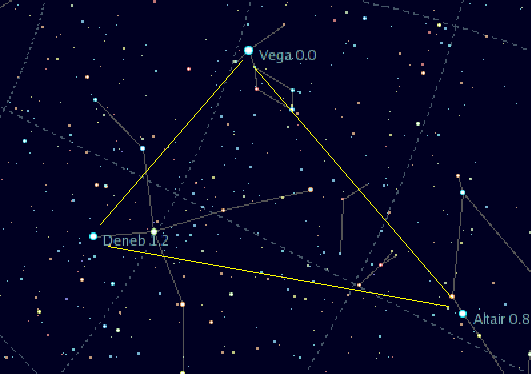
Diagram showing the summer triangle, a triangluar configuration of the stars Vega (α Lyrae), Altair (α Aquilae), et Deneb (α Cygni). Made by taking a screen snapshot of KStars, adding the lines in the triangle with OpenOffice sdraw, and cropping with the GIMP.
Unlike official constellations defined by the International Astronomical Union (IAU), an asterism can cross constellation boundaries. The Summer Triangle does exactly that: it stitches together parts of Lyra, Cygnus, and Aquila into a bold geometric figure that dominates northern-hemisphere evenings from late spring through autumn. Even in the southern hemisphere, it rises during local winter months, hovering toward the northern sky.
Why does this triangle matter? First, it’s a sky-navigation tool. Spotting the Triangle helps you leap to nearby celestial landmarks along the Milky Way’s brightest stretch. Second, the Triangle’s stars are scientifically significant. Vega has anchored astronomical brightness scales; Altair spins so fast it’s noticeably flattened; and Deneb is a distant, luminous supergiant, a kind of star that shapes and enriches the interstellar medium. Third, the space framed by the Triangle brims with deep-sky objects—planetary nebulae, open clusters, and extensive nebula complexes—ideal for binoculars and small telescopes.
In short, the Summer Triangle is both a dependable signpost for practical observing and a gateway to physics-rich stories about stellar life cycles, circumstellar disks, and the Milky Way’s dusty lanes. If you are new to stargazing, start here. If you are experienced, revisit the Triangle to deepen your appreciation of the astrophysics driving these beacons and their neighborhood.
How to Find the Summer Triangle from Any Sky
You don’t need a telescope to find the Summer Triangle—just your unaided eyes and a bit of orientation. The Triangle spans a huge chunk of sky: roughly the width of an outstretched hand plus a thumb (or more), depending on your viewing distance. Its stars are bright: Vega (~magnitude 0), Altair (~0.8), and Deneb (~1.3), so they punch through haze and moderate light pollution.
Northern Hemisphere quick-start
- Late spring (May–June): Look east to east-northeast in mid-evening. Vega leads the parade. Deneb rises more slowly to the left of Vega, and Altair follows south of the line between them.
- Summer (July–August): By mid-evening, the Triangle rides high in the east to southeast. In late evening, it climbs nearly overhead at mid-northern latitudes. Vega is usually the easiest to spot first—cool-white and brilliant.
- Autumn (September–October): The Triangle shifts toward the west by late evening. Use it as a farewell to summer and a bridge to autumn constellations.

Southern Hemisphere quick-start
- Winter (June–August): Look north in early to mid-evening. The Triangle is lower than for northern observers, with Altair highest of the three.
- Spring (September–October): The Triangle drifts toward the northwest across evening hours.
One of the most reliable entry points is to find Vega, which often sits high and commands attention. Vega anchors the small parallelogram of Lyra. Draw an imaginary line from Vega to the fainter star pattern of the Lyra parallelogram; extending that line roughly points toward Deneb in the cross-shaped constellation Cygnus. From Deneb, sweep downward (southward) to find Altair, flanked closely by two dimmer stars (Tarazed and Alshain) forming a little line through Altair. If you get lost, return to Vega and try again—its brilliance is an anchor. For more detailed route options, jump to Star-Hopping Paths and Naked-Eye Navigation.
Vega, Deneb, and Altair: Facts, Spectra, and Distances
Although they look similar to the eye—bright, blue-white stars in a triangle—the three vertices are profoundly different in intrinsic brightness, distance, and stellar life stage. Their diversity makes the Triangle an on-sky classroom for understanding stellar astrophysics. Below are concise profiles with widely used, observationally supported facts as of recent catalogs.
Vega (Alpha Lyrae)
- Brightness: Around magnitude 0.0—one of the brightest stars in the night sky.
- Distance: Approximately 25 light-years from Earth.
- Spectral type: A0 V (a hot, blue-white main-sequence star).
- Notable science: Vega historically served as a photometric standard; magnitudes were long referenced so that Vega was near zero by definition in many filters. Today, modern systems (such as the AB magnitude scale) use different calibrations, but Vega remains a critical standard star for observational astronomy. Space-based infrared observations (e.g., IRAS in the 1980s) revealed that Vega hosts a debris disk, likely composed of dust from comet- and asteroid-like bodies—evidence of ongoing planetary system evolution.
- Appearance: Cool-white to blue-white, striking to the unaided eye.
Vega rotates rapidly, and our vantage point is close to its rotational pole, a geometry that influences detailed measurements of its surface temperature distribution. These advanced nuances don’t change your view at the eyepiece, but they underscore how much physics astronomers can extract from a bright “standard” star.
Deneb (Alpha Cygni)
- Brightness: About magnitude 1.25–1.35, plainly visible even from town.
- Distance: On the order of a few thousand light-years; commonly cited estimates place Deneb roughly around 2,600 light-years away. Because Deneb is so bright and distant, parallax measurements are challenging, and distance estimates come with uncertainties.
- Spectral type: A2 Ia (a luminous blue-white supergiant).
- Notable science: Deneb is a massive, evolved star that shines with well over one hundred thousand times the Sun’s luminosity. It has a stellar wind that sheds material into space. Deneb also belongs to a class of subtle pulsating supergiants known as Alpha Cygni variables, varying slightly in brightness over time at the level of only a few hundredths of a magnitude.
- Appearance: Glistening white, marking the tail of the Swan (Cygnus), at the apex of the Northern Cross asterism.
Because Deneb is so far away, its naked-eye brightness tells you just how intrinsically powerful it is. Stars like Deneb profoundly shape their surroundings with radiation and winds, contributing to the ecology of the interstellar medium.
Altair (Alpha Aquilae)
- Brightness: Roughly magnitude 0.77.
- Distance: About 16.7 light-years.
- Spectral type: A7 V (a hot main-sequence star, cooler than Vega).
- Notable science: Altair spins extraordinarily fast, completing a rotation in roughly hours rather than days. This rapid spin flattens it into an oblate spheroid and produces gravity darkening: the poles are hotter and brighter than the equator. Interferometric imaging has directly measured this effect.
- Appearance: Bright and white, flanked closely by two fainter stars (Tarazed and Alshain) that line up with Altair).
Altair’s rapid rotation makes it a showcase for stellar physics you can’t see directly with your eye yet can appreciate conceptually. It’s also one of Earth’s closer bright stars, which helps explain its prominence even though it’s less intrinsically luminous than Vega or Deneb.
If you prefer coordinates, these are approximate J2000 right ascension/declination values: Vega ~18h36m +38.8°, Deneb ~20h41m +45.3°, and Altair ~19h51m +8.9°. Use these as reference points in star charts or apps to cross-check the hops described later.
Star-Hopping Paths and Naked-Eye Navigation
Once you’ve found the Triangle, use it to explore nearby constellations, locate deep-sky highlights, and verify your orientation along the Milky Way. The following routes work well for naked-eye and binocular observers. If at any point you lose the pattern, return to the finding tips and start again from Vega.
From Vega to Deneb via Lyra
Stand facing east to southeast on a summer evening (northern hemisphere). Lock onto Vega. Just below it, the small parallelogram of Lyra forms a compact marker. Draw a mental line through the long axis of the parallelogram and push outward about two to three “parallelogram lengths”—you will arrive near Deneb, brightest star in the Northern Cross.
From Vega to Altair and the line of Aquila
From Vega, sweep down and right (south) toward a very bright star—that’s Altair. Confirm you’ve got it by noticing two nearby fainter stars that make a distinct line through Altair. This line belongs to Aquila, the Eagle, and runs roughly along the Milky Way’s path.
From Deneb along the Northern Cross
Visualize the Northern Cross within Cygnus. Deneb is the top of the cross; from there, slide down the shaft to reach the bright star Albireo at the foot. Albireo is a lovely color-contrast double in small telescopes, though its pair is a line-of-sight alignment rather than a tightly bound system. En route, you’re scanning one of the richest parts of the Milky Way for binocular views.
“Triangle as compass” star-hop sketch
# Summer Triangle compass-style star-hop (mid-northern latitudes)
1. Find Vega high in the east or overhead (summer evenings).
2. Trace a line Vega → Deneb: you’re moving along the Milky Way’s bright band.
3. From Deneb, drop down the Northern Cross to Albireo.
4. From Vega, sweep down to Altair; note the line Tarazed–Altair–Alshain.
5. Center the Triangle; scan within it for star clouds and dark lanes (the Great Rift).
6. Use binoculars to probe the space between Vega and Deneb for M57; between Deneb and Sagitta/Vulpecula for M27.
These simple hops connect you to many of the Triangle’s deep-sky treasures. If you are using a star atlas or app, keep magnification low and fields wide—most of these features are best appreciated with context.
Deep-Sky Treasures Inside and Around the Triangle
The Summer Triangle straddles the Milky Way’s brightest northern stretch, an area thick with star clouds and dust lanes. Even modest binoculars reveal a wealth of structure. Here are highlights that are reliable crowd-pleasers and scientifically instructive.
M57 — The Ring Nebula (Lyra)
- Type: Planetary nebula.
- How to find it: Between the Lyra stars Sheliak (Beta Lyrae) and Sulafat (Gamma Lyrae), roughly along the line connecting them.
- What you’ll see: In small telescopes under decent skies, a tiny smoke ring. It’s faint and compact; higher magnification helps. In larger apertures, the oval annulus and a slightly darker center stand out.

This new image shows the dramatic shape and colour of the Ring Nebula, otherwise known as Messier 57.
From Earth’s perspective, the nebula looks like a simple elliptical shape with a shaggy boundary. However, new observations combining existing ground-based data with new NASA/ESA Hubble Space Telescope data show that the nebula is shaped like a distorted doughnut. This doughnut has a rugby-ball-shaped region of lower-density material slotted into in its central “gap”, stretching towards and away from us.
M57 represents a dying Sun-like star sloughing off its outer layers. The hot central remnant (a white dwarf) ionizes the gas, making it glow. Filters that transmit O-III and H-beta light can enhance contrast, but the object is small; steady seeing and careful focus matter as much as darkness.
Epsilon Lyrae — The “Double-Double”
- Type: Multiple-star system.
- How to find it: A short hop from Vega; many charts show the offset clearly. In binoculars, it appears as a close pair. In a small telescope at moderate power, each star splits again.
- What you’ll see: Two pairs of close stars—an exquisite test of optics and seeing. On steady nights, ~100–150× reveals the double nature of each component in typical small telescopes.
This is a classic optical test and a satisfying sight. It’s also a gateway to thinking about stellar multiplicity, from wide pairs to tight, spectroscopic binaries that must be inferred from line shifts.
M27 — The Dumbbell Nebula (Vulpecula)
- Type: Planetary nebula.
- How to find it: Look between the small arrow-shaped constellation Sagitta and the dim stars of Vulpecula, inside the Triangle. Many observers start at the “Coathanger” asterism (see below) and nudge northward.
- What you’ll see: A bright, oval puff of light; in small scopes, a barbell or apple-core shape. Binoculars under dark skies often show it as a soft, oblong glow.
M27 is larger and brighter than M57, rewarding even small optics. O-III and UHC filters can give a substantial boost in contrast, especially from suburban sites. You’re seeing another planetary nebula—gas fluorescing under ultraviolet radiation from a hot central stellar remnant.
NGC 7000 — The North America Nebula (near Deneb)
- Type: Emission nebula complex.
- How to find it: Close to Deneb; wide-field views are essential. Start by centering Deneb in binoculars and drift a little eastward to find faint patches; a nebula filter can help.
- What you’ll see: In dark skies with binoculars or a very short focal length telescope, you may discern the continental outline—especially the “Gulf of Mexico” cleft. From light-polluted areas, a filter is often necessary to perceive structure.

The North America Nebula (NGC 7000), named for its resemblance to the North American Continent here on Earth, is located in the constellation of Cygnus. Most of the nebulosity shown here is in the foreground (superimposed) of the band of the Milky Way. The stars are very dense towards this spiral arm and where the dust and gas thins, their numbers are plain to see.This four frame mosaic subtends more than 4 degrees of the sky. You could easily fit over 30 Moons in this picture! The very bright star on the right of the frame is Deneb, and surprisingly it is not associated with the nebula as it is well over 1,500 light years away. Indeed, if Deneb were 50 times closer (30 light years, I am insinuating absolute magnitude) it would be brighter than Venus in the sky and rival the moon! (-7.2 in magnitude).But the wonderfully glowing clouds shown here are closer, and until recently the star (or stars) responsible for making them glow was a mystery. In the fall of 2004 two astronomers, Fernando Comeron and Anna Pasquali, published a paper that seems to identify this secretive star. The star is hidden behind thick clouds of dust that attenuate its light. By observing in the infrared and looking for stars that are intrinsically hot and bright (OB)- only one seemed to fit the shoe! Click HERE to the same high-resolution image you get when you click on the image below… but with an arrow indicating this stealthy star. Look just off the coast of \”Florida\” in the Atlantic Ocean.This image was taken as part of Advanced Observing Program (AOP) program at Kitt Peak Visitor Center during 2014.
Albireo (Beta Cygni) — A striking color-contrast double
- Type: Double star (optical pair).
- How to find it: At the bottom of the Northern Cross. Slide down the shaft from Deneb.
- What you’ll see: A bright pair with warm gold and cool blue components in small scopes. The colors are more easily appreciated at moderate magnification under steady skies.
Albireo has long charmed observers with its color contrast. Modern astrometric data indicate that the two visible components are not a tight, gravitationally bound pair but rather an optical double—still a beautiful sight and a wonderful teaching tool for stellar colors and perception.
Collinder 399 — The Coathanger (Brocchi’s Cluster)
- Type: Asterism (not a true cluster).
- How to find it: In Vulpecula, easily framed in binoculars. From Altair, sweep northward along the Milky Way.
- What you’ll see: A pattern of stars unmistakably shaped like a coat hanger. Under dark skies, it leaps out in 7×–10× binoculars.
Once thought to be a loose open cluster, careful analysis using proper motions and distances shows that the Coathanger is a chance alignment in our line of sight. It’s a reminder that pattern recognition is in our heads, while nature’s organization is subtler.
Dark lanes and star clouds — The Great Rift
Between Vega and Deneb, and stretching beyond toward Aquila, you’ll notice luminous star clouds split by dark fissures. These are dust lanes—cold molecular material obscuring background starlight, creating the Great Rift. Binoculars reveal texture and gradations within the Milky Way here, particularly from dark, transparent skies.
Seasonal Visibility and Latitude Considerations
When and how you see the Summer Triangle depends on your latitude and time of year. The asterism is a seasonal fixture for northern observers but also accessible to southerners, especially during their winter months.
Mid-northern latitudes (~30°–50° N)
- Best months: June through September for prime-time evening viewing.
- Altitude: Vega and Deneb can pass high overhead. Altair rides lower but still comfortably placed.
- Circumpolar effects: At higher latitudes in this band, Deneb may be nearly circumpolar, dipping less below the horizon than Altair.
High northern latitudes (>50° N)
- Twilight considerations: Summer twilight can be lengthy or even persistent, but the Triangle’s bright stars remain visible even under twilight and noctilucent-cloud season conditions.
- Altitude: Deneb and Vega attain very high altitudes; Altair remains modestly high to the south.
Tropical latitudes
- Balance: The Triangle stands attractively placed. All three stars achieve healthy elevations, improving clarity and reducing atmospheric extinction.
Southern hemisphere (0° to ~40° S)
- Best months: June through September (southern winter) during evening hours.
- Altitude: The Triangle sits lower toward the northern horizon. Altair climbs highest; Deneb is lowest but still generally visible from much of the southern temperate zone.
Use your latitude to set expectations: the higher a star climbs, the less air you look through and the steadier it will appear. If you are at the edge of visibility for Deneb in the far south, patience and low-haze nights help. Regardless of hemisphere, combine these seasonal notes with the finding guide and observing tips to plan your session.
Cultural Lore and Historical Significance
The Summer Triangle’s stars have inspired stories across cultures. In East Asian tradition, the Triangle connects a celebrated tale of love and separation; in the West, the Swan and the Eagle flit across mythic narratives. These associations offer a human bridge to the sky and give context to your time at the eyepiece.
Vega, Altair, and the Milky Way in East Asian lore
In Chinese lore (and mirrored in Japanese Tanabata and Korean Chilseok festivals), the stars Vega and Altair are Zhinü and Niulang—a weaver girl and a cowherd—separated by the celestial river, the Milky Way. Once a year, magpies form a bridge so they can meet. In many tellings, Deneb marks either the magpie bridge or a distant way-station along that path. During Tanabata, people write wishes on colorful paper and hang them on bamboo, looking to the stars as symbols of hope and reunion.
“The river of heaven parts two lovers; on the seventh night, a bridge of wings arises.” — A paraphrase of the Tanabata legend
Seeing the Milky Way split the Triangle with dark rifts brings this story alive. On a transparent night, it’s easy to imagine the celestial river flowing between them.
Cygnus the Swan and Aquila the Eagle
In Greco-Roman tradition, Cygnus is the Swan and Aquila is the Eagle. Deneb forms the Swan’s tail, with the Northern Cross tracing the Swan’s body and outstretched wings. Aquila, the Eagle, soars along the Milky Way with Altair at its heart. Lyra, Vega’s constellation, is the harp of Orpheus in Greek myth—placed in the sky after his death, a symbol of sublime music. These images aren’t just antique storytelling; they’re mnemonic devices for navigating the sky.
Asterisms as practical sky aids
The term Summer Triangle gained popularity in the 20th century through astronomy communicators who emphasized its utility as a seasonal landmark. While professional catalogs rely on coordinates and precise charts, asterisms remain a powerful way for enthusiasts to connect with the sky’s vastness, guiding sight lines and building star-hopping muscle memory.
Astrophysics Behind These Bright Beacons
Vega, Deneb, and Altair are laboratories for fundamental astrophysics. Each illustrates different processes: standard-star calibration, massive-star evolution, and rotation-driven surface physics. Here are key concepts you can appreciate during an observing session—even as you simply enjoy their brightness and color.
Why the three stars look similarly bright
Brightness at Earth depends on intrinsic luminosity and distance. Vega and Altair are relatively nearby A-type stars, while Deneb is vastly farther away but intrinsically enormous in power output. Deneb’s distance is measured in thousands of light-years, yet it still appears bright—evidence that it radiates far more energy than the Sun. This contrast underpins the basic inverse-square law of light: double the distance, and the apparent brightness drops by four; to compensate, a star must be much more luminous.
Vega and the magnitude system
Historically, the astronomical magnitude system has its zero point tied closely to Vega in many filter bands. While modern photometry increasingly uses AB magnitudes—a system defined by a constant flux per unit frequency—Vega-based magnitudes remain common and useful. This legacy influences how we compare observations across instruments and eras. That’s why you’ll often see object brightness reported in “Vega mags” (e.g., in the near-infrared) or “AB mags” depending on context.
Altair’s rapid rotation and gravity darkening
Altair rotates so fast that centrifugal force causes significant equatorial bulging. The equator, under lower effective gravity, becomes slightly cooler and dimmer than the poles, an effect called gravity darkening. Interferometric arrays—telescopes combining light from multiple apertures—have resolved this shape and temperature gradient. In the eyepiece, Altair looks starlike, but knowing this physics adds depth to what you’re seeing.
Deneb’s supergiant status
Deneb’s spectral type A2 Ia signals a massive, evolved star with a high mass-loss rate. Radiation pressure drives a stellar wind that expels material into space, where it can later seed star formation and planet formation in new systems. Deneb’s small-amplitude variability (the Alpha Cygni class) arises from pulsations in its outer layers. Deneb also teaches us humility: distance measurements for very bright, faraway stars remain challenging, and uncertainties persist despite modern astrometry.
Dust, the Great Rift, and star formation

The Cygnus Wall, part of the North America Nebula (NGC 7000) was created using Ha, OIII, and SII filters using the Hubble Palette.
Imaging Telescope:
Explore Scientific 127mm ED Refractor (952 focal length)
Mount:
Celestron CGX
Polar Alignment:
QHYCCD PoleMaster
Imaging Camera:
ZWO ASI1600MM-Cool
Ha=80x180s
OIII=60x120s
SII=40x180s
Total Time: 10.8 hours
Gain: 139, Offset: 21
Guide scope:
Orion ST80
Guide Camera:
Lodestar X2
Guide Software:
PHD2
Calibration Frames:
Darks: 50, Bias: 50, Flats: 50
Capture software:
Sequence Generator Pro (SGP)
Stacking software:
PixInsight
Post Processing:
PixInsight
Dew Shield, Dew Heater Strip
Planetary nebulae as stellar endgames
Both M57 and M27 are the last gasps of Sun-like stars. After exhausting core hydrogen and helium, a star sheds its envelope, exposing a hot core: a white dwarf. Ultraviolet light from that core ionizes the expelled gas, which glows for thousands to tens of thousands of years—a brief spectacle in cosmic terms. Observing the shapes and brightness variations of planetary nebulae lets amateurs taste the physics of stellar winds, ionization, and recombination.
Debris disks and planetary system evolution
Infrared observations of Vega revealed excess emission beyond what its stellar photosphere alone should produce, evidence of a surrounding dust disk. Such debris disks are thought to arise from collisions among planetesimals—rocky and icy bodies left over from planetary formation. They become laboratories for exploring how planetary systems evolve after their initial formation. While no long-confirmed exoplanets have been established for Vega as of widely cited catalogs, the dust indicates a dynamically active environment.
Observing Gear, Light Pollution, and Practical Tips
You can savor the Summer Triangle with nothing more than your eyes. But the right accessories and strategies multiply what you can see, particularly from towns and suburbs where skyglow dims faint nebulosity. The advice below complements routes from Star-Hopping Paths and targets in Deep-Sky Treasures.
Naked-eye and binocular basics
- Dark adaptation: Give your eyes 20–30 minutes in darkness; avoid white light. Use a dim red flashlight if needed.
- Binoculars: A 7×50 or 10×50 pair is ideal for hand-held scanning. Image-stabilized binoculars can be transformative in urban settings. For wide nebulosity (e.g., NGC 7000), smaller binoculars with wider fields (e.g., 7×35) can help frame entire structures.
- Tripods and mounts: A simple photo tripod with a binocular adapter reduces shake. For extended sessions, a reclining chair or zero-gravity chair is an affordable upgrade.
Small telescope strategies
- Low power first: Use a 25–40 mm eyepiece to create a bright, wide field. Then step up magnification to study compact targets like M57 or Epsilon Lyrae.
- Narrowband filters: O-III or UHC filters boost contrast on planetary and emission nebulae (M27, NGC 7000). They do not help on star clusters or galaxies.
- Star charts/apps: Keep an atlas or app handy for precise hops. Turn down the screen brightness and switch apps to “red night mode.”
Light pollution and transparency
- Bortle scale awareness: Under Bortle 7–8 urban skies, focus on bright double stars and planetary nebulae like M57, which tolerate skyglow better. Under Bortle 3–4 rural skies, scan broadly for Milky Way texture and extended nebulosity.
- Humidity and haze: Even if the sky is “clear,” high humidity scatters city lights, muting contrast. Wait for dry, transparent nights to chase faint nebulae.
- Moon phase: Go for moonless windows (around new Moon) to see the Milky Way’s Great Rift. Planetary nebulae and doubles are less affected than diffuse nebulae.
Comfort, safety, and etiquette
- Dress and dew: Summer nights can still cool rapidly. Bring layers and a dew shield or hair dryer for telescopes in humid climates.
- Avoid the Sun: Never use binoculars or telescopes near the Sun unless you have proper solar filters and training. Daytime slews can be dangerous to eyes and equipment.
- Dark-site etiquette: Use red lights, park cars with headlights facing away, and announce when you intend to switch on any bright light for packing up.
Planning a session
- Check weather and transparency forecasts; prioritize clear, dry nights.
- Choose a Moon phase in your favor—new to crescent for faint nebulae.
- Make a short target list, mixing easy showpieces with a stretch goal.
- Begin with naked-eye orientation, then sweep with binoculars to warm up.
- Use the telescope for specific objects (M57, M27, Epsilon Lyrae) after your eyes are dark-adapted.
- End the night with a wide, contemplative sweep along the Milky Way from Deneb to Altair.
Frequently Asked Questions
Is the Summer Triangle a constellation?
No. The Summer Triangle is an asterism, which means it’s a star pattern recognized by observers but not an official constellation. It spans three constellations—Lyra, Cygnus, and Aquila. Constellations are defined by formal boundaries set by the IAU, while asterisms are informal guides that help us navigate.
Can I see the Summer Triangle from the southern hemisphere?
Yes. During the southern winter (June–August), the Summer Triangle is visible in the northern part of the sky during evening hours from much of the southern temperate zone. It sits lower than it does for northern observers, with Altair highest of the three. For planning specifics, see Seasonal Visibility and Latitude Considerations.
Final Thoughts on Exploring the Summer Triangle
The Summer Triangle is a rare combination of beauty, accessibility, and scientific richness. It’s bright enough to guide a first-time stargazer and deep enough in content to fascinate seasoned observers night after night. Within its boundaries, you’ll find the architecture of the Milky Way—luminous star clouds cut by the Great Rift—and stellar stories spanning the life cycle from formative disks (Vega’s debris) to final exhalations (M27 and M57). The Triangle’s vertices themselves illustrate how apparent brightness is only half the tale; distance and intrinsic luminosity finish the picture. Meanwhile, the cultural narratives—from Tanabata’s meeting on the magpie bridge to the Swan’s flight—invite you to connect what you see with centuries of human skywatching.
If you’re observing under bright city lights, start with doubles and planetary nebulae, and work your way toward faint nebulae as you gain experience and perhaps travel to darker skies. Use the star-hops here as a scaffold, and adapt them to your horizons and habits. Keep a small notebook; note dates, transparency, eyepiece choices, and impressions. Over time, the Triangle will shift from a seasonal landmark to a personal neighborhood—familiar yet always yielding new detail with patience and practice.
For more guides to star-hopping, deep-sky objects, and the physics that animates them, explore related topics on our site. If you enjoyed this article and want timely alerts on new observing guides and astrophysics explainers, subscribe to our newsletter—you’ll get practical tips and curated targets for every season.

North America Nebula, as seen in Belgium (Hamois)