
Table of Contents
- What Is Dark Matter in Modern Cosmology?
- Observational Evidence: Rotation Curves, Lensing, and the CMB
- How Dark Matter Shapes Structure Formation
- Dark Matter Candidates: WIMPs, Axions, Sterile Neutrinos
- How We Search: Direct, Indirect, and Collider Probes
- Alternatives and Modified Gravity: What They Explain and Miss
- Status of Current Experiments and Surveys
- Cosmological Parameters and the ΛCDM Model
- Dark Matter in Galaxies: Halos, Cores vs. Cusps, Satellites
- Numerical Simulations and Baryonic Physics
- Key Terms, Units, and Reading the Literature
- Frequently Asked Questions
- Final Thoughts on Understanding Dark Matter
What Is Dark Matter in Modern Cosmology?
Dark matter is the name astronomers and physicists give to a form of matter that does not emit, absorb, or reflect enough light to be directly detected with telescopes, yet reveals itself through gravity. Its presence is inferred from multiple, independent lines of evidence that point to more mass than we can see in stars, gas, and dust. In the prevailing cosmological picture—often called the Lambda Cold Dark Matter model (ΛCDM)—dark matter makes up the bulk of the matter in the universe and plays a leading role in forming galaxies and large-scale structure.
In everyday terms, dark matter behaves like a cosmic scaffold. It forms extended halos around galaxies, binds galaxy clusters together, and seeds the formation of cosmic web filaments. Although we cannot hold a piece of dark matter in the lab (yet), we can map where it is by how it bends light (gravitational lensing), how galaxies move (dynamics), and by its imprint on the tiny temperature variations in the cosmic microwave background (CMB). These methods consistently indicate that the matter we can see—called baryonic matter—is only a small fraction of the total.

Crucially, the term “dark” in dark matter means non-luminous and (so far) non-interacting with light. It does not mean mysterious in the sense of being beyond science. As you will see in Observational Evidence: Rotation Curves, Lensing, and the CMB, we possess a great deal of robust, testable evidence that sets constraints on what dark matter can and cannot be. And in How We Search: Direct, Indirect, and Collider Probes, we will survey the powerful experiments designed to catch a glimpse of dark matter particles or their effects.
In broad terms, dark matter candidates are often grouped by their kinematic behavior in the early universe: cold, warm, or hot, referring to their typical velocities. The ΛCDM model posits cold dark matter (CDM), which moves slowly relative to the speed of light by the time structures begin to form. This slow motion allows small-scale structure to grow, an expectation well supported by observations of galaxy clustering and the Lyman-alpha forest. We will return to the details of structure growth in How Dark Matter Shapes Structure Formation.
Observational Evidence: Rotation Curves, Lensing, and the CMB
No single observation reveals the whole dark matter story. Instead, a web of independent measurements—galaxy rotation curves, gravitational lensing, galaxy cluster dynamics, hot gas in clusters, and the CMB—converges on the same conclusion: most mass is invisible and collisionless.
Flat galaxy rotation curves
In the 1970s and 1980s, detailed measurements of the rotational speeds of stars and gas in spiral galaxies showed that velocities stay nearly constant (“flat”) far beyond the visible disk. If mass were concentrated where the light is, orbital velocities should drop with distance, like planets in the Solar System. Instead, the speeds remain high, implying a massive halo of unseen matter extending well past the luminous regions. This behavior is seen in many spirals and also probed in other galaxy types via stellar motions or gas kinematics.

Gravitational lensing: bending light to weigh mass
General Relativity tells us that mass curves spacetime, and light follows curved paths in such a gravitational field. Astronomers can therefore use lensing to “weigh” mass, regardless of whether it’s luminous. Two modes are particularly informative:
- Strong lensing produces arcs, multiple images, or Einstein rings when a foreground mass (galaxy or cluster) lies closely aligned with a background galaxy or quasar. The geometry and separations of these images tightly constrain the mass distribution of the lens, including dark matter.
- Weak lensing uses subtle, coherent distortions in the shapes of vast numbers of background galaxies to map mass statistically. By stacking many lines of sight, astronomers reconstruct dark matter maps over large areas, revealing cosmic web filaments and quantifying the matter power spectrum.
Weak lensing studies of galaxy clusters and large areas of sky find much more mass than accounts for the light alone. Striking colliding systems like the Bullet Cluster further show that most mass (traced by lensing) is spatially separated from hot X-ray emitting gas, consistent with a collisionless component—just what we expect from dark matter. This spatial offset is difficult to explain with modified gravity alone, as we discuss in Alternatives and Modified Gravity.
Galaxy clusters: dynamics and X-rays
Galaxy clusters are the largest gravitationally bound systems in the universe. We can estimate their mass in multiple ways—galaxy velocities, hot intracluster gas profiles (from X-rays and Sunyaev–Zel’dovich effect), and lensing—and they agree that clusters contain much more mass than visible matter alone. The hot gas itself outweighs the stars by a wide margin, but still falls short of the total required mass. The remainder is attributed to dark matter.
Cosmic microwave background (CMB) anisotropies
The CMB is the afterglow of the Big Bang, carrying tiny temperature and polarization fluctuations. The pattern of these anisotropies depends sensitively on the contents of the universe, including dark matter and baryons. Analyses of the CMB power spectrum indicate that about a quarter of the present-day energy density is non-baryonic matter, with the rest mostly dark energy and a small fraction in baryons. These results independently corroborate inferences from galaxies and clusters. Because the CMB encodes physics at the time of recombination, it provides a clean, early-universe confirmation of dark matter’s presence.

When you weave together rotation curves, lensing, cluster dynamics, and the CMB, a consistent picture emerges: a dominant, non-luminous, weakly interacting form of matter pervades the cosmos. For a broader context on the role this matter plays in building the cosmic web, see How Dark Matter Shapes Structure Formation.
How Dark Matter Shapes Structure Formation
Dark matter acts as the gravitational backbone of the universe. Small initial density ripples in the early universe grow over time under gravity, with dark matter collapsing first because it does not interact with radiation or pressure in the same way baryons do. These growing clumps provide the potential wells into which baryonic gas eventually falls, cools, and forms stars and galaxies.
From linear growth to non-linear collapse
Early on, density perturbations are small and evolve predictably (linearly). As time passes, overdense regions decouple from the cosmic expansion and undergo non-linear collapse, forming halos. The spherical collapse model offers a simple lens for this transition, while full Numerical Simulations and Baryonic Physics capture the complex network of filaments, nodes, and voids known as the cosmic web.
Power spectrum and the matter distribution
The matter power spectrum summarizes the distribution of mass fluctuations as a function of scale. Cold dark matter predicts abundant small-scale power, meaning many low-mass halos. Observational tracers—galaxy clustering, weak lensing, and Lyman-alpha forest absorption in quasar spectra—are broadly consistent with this picture, while also highlighting the need to model baryonic processes (feedback, star formation) that alter the distribution of visible matter within halos.
The role of baryons
Baryonic matter cools and forms stars, but it also changes the inner structure of halos. Supernova explosions, radiation pressure, and active galactic nuclei (AGN) can heat and expel gas, potentially flattening central density cusps and affecting the number and brightness of satellite galaxies. This interplay helps reconcile some tensions between early, dark-matter-only predictions and observations, a theme explored more in Dark Matter in Galaxies: Halos, Cores vs. Cusps, Satellites.
In sum, structure formation under CDM naturally yields a universe that looks like ours: a filamentary web with galaxy clusters at the nodes, galaxies along the filaments, and vast voids between them. Fine details depend on both the microphysics of dark matter and the astrophysics of baryons.
Dark Matter Candidates: WIMPs, Axions, Sterile Neutrinos
What could dark matter be, at the particle level? While ordinary matter is made of protons, neutrons, and electrons, the leading candidates for dark matter are new particles beyond the Standard Model of particle physics. Here are three of the best-studied possibilities:
WIMPs (Weakly Interacting Massive Particles)
WIMPs are hypothetical particles with masses roughly in the GeV–TeV range that interact with ordinary matter via the weak nuclear force and gravity. Their appeal partly stems from the “WIMP miracle”: a particle with weak-scale interactions that was once in thermal equilibrium in the early universe naturally freezes out with a relic abundance remarkably close to what we infer for dark matter today. Many supersymmetric models predict stable, weakly interacting particles that could play this role, though years of searches have yet to find a definitive signal.
Axions
Axions were originally proposed to solve the strong CP problem in quantum chromodynamics (QCD), a puzzle about why the strong force appears to conserve CP symmetry extremely well. These axions, if very light and produced non-thermally in the early universe, would be a cold dark matter candidate. Experiments called haloscopes (such as microwave cavity experiments) search for axions converting into photons in the presence of a strong magnetic field. A broader family of axion-like particles (ALPs) also arises in many theories and is the subject of intensive searches.
Sterile neutrinos
Sterile neutrinos are hypothetical neutrinos that do not interact via the weak force like ordinary (active) neutrinos, but can mix with them. Depending on mass and production, they can behave as warm or cold dark matter. Sterile neutrinos with keV-scale masses could leave imprints on small-scale structure and potentially produce X-ray lines via decay. Observational constraints from structure formation and X-ray observations place tight bounds on their parameter space.
Other ideas
There are many other dark matter candidates: light dark photons, fuzzy (ultra-light) dark matter with wave-like behavior on kiloparsec scales, primordial black holes in certain mass windows, and more complex hidden-sector models. Each carries distinct experimental signatures. Although intriguing, many of these are significantly constrained by data, and the most viable versions remain under active investigation. To see how these possibilities are probed, continue to How We Search: Direct, Indirect, and Collider Probes.
How We Search: Direct, Indirect, and Collider Probes
Dark matter searches fall into three complementary strategies: looking for dark matter hitting a detector (direct detection), for its annihilation or decay products (indirect detection), or for its production in high-energy collisions (collider searches). Using multiple channels provides cross-checks and broad coverage of candidate models.
Direct detection
Direct detection experiments sit deep underground to shield from cosmic rays and seek the tiny energy deposit when a dark matter particle scatters off a nucleus or electron in the detector. Key technologies include:
- Dual-phase xenon time-projection chambers measure prompt scintillation and ionization to reconstruct events and reject backgrounds.
- Cryogenic crystals detect phonons and ionization at millikelvin temperatures, enabling sensitivity to low-mass dark matter.
- Skipper CCDs and semiconductors count single electrons with ultra-low noise, probing sub-GeV dark matter-electron scattering.
These experiments set upper limits on the interaction cross section as a function of mass. Despite null results so far, sensitivities have improved by orders of magnitude over the past decade, excluding many once-plausible regions of parameter space. The landscape of current instruments is described further in Status of Current Experiments and Surveys.
Indirect detection
If dark matter can annihilate or decay into Standard Model particles, telescopes might catch the byproducts: gamma rays, cosmic-ray positrons and antiprotons, or neutrinos. Observations focus on dark-matter-dense targets (dwarf spheroidal galaxies, the Galactic Center, galaxy clusters) and on spectral features difficult to produce astrophysically. Interpretation is challenging because astrophysical sources (pulsars, supernova remnants, accretion onto black holes) also produce high-energy signals. Nonetheless, combined analyses place stringent constraints on annihilation cross sections and decay lifetimes for many models.
Collider searches
At particle colliders, dark matter might be produced in energetic collisions and escape the detector unseen, resulting in events with “missing energy” balanced by a visible particle (e.g., a jet or photon). Colliders also probe mediator particles that could couple dark matter to quarks or leptons. While colliders cannot confirm cosmological stability on their own, they provide powerful tests of the particle properties relevant to early-universe production and to candidate models.
Complementarity and consistency
To claim a discovery, signals from different approaches should point to compatible masses and interaction strengths. For instance, a direct detection signal could be matched with an indirect signal in a known target and with collider hints of a relevant mediator. The field is therefore designed around complementarity, and many analyses now combine constraints across methods to carve out or support viable parameter space.
Alternatives and Modified Gravity: What They Explain and Miss
Because dark matter has not yet been detected in laboratories, it is reasonable to ask whether gravity itself needs modification on galactic scales. Modified Newtonian Dynamics (MOND) and its relativistic extensions attempt to explain galaxy rotation curves and some scaling relations without invoking invisible mass. These theories adjust the laws of motion or gravity at low accelerations, and can describe certain galactic phenomena with relatively few parameters.
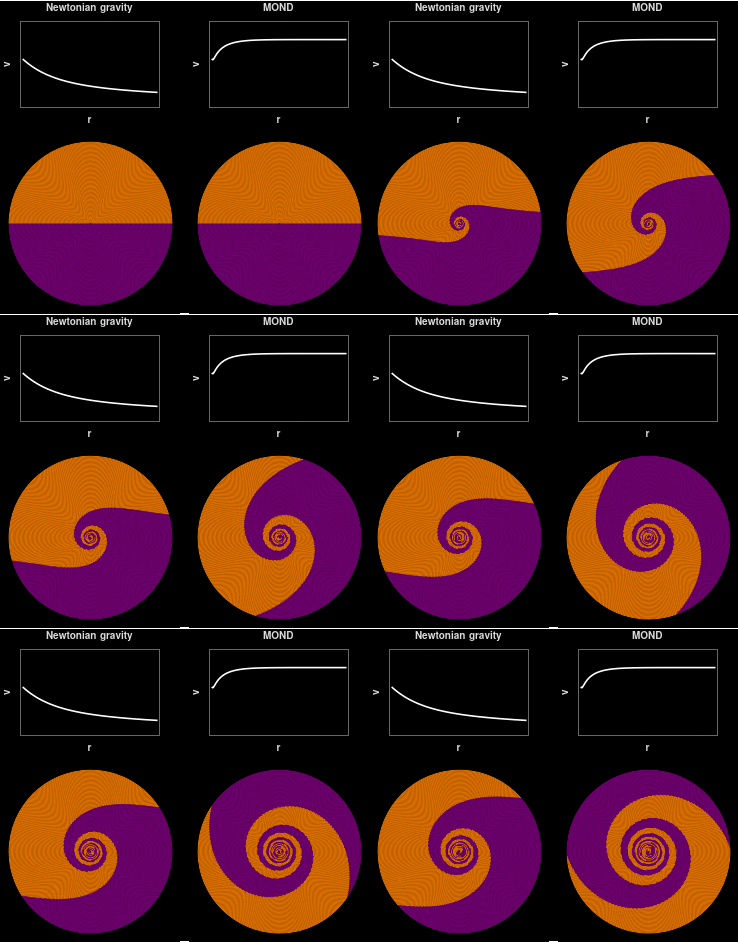
The observed behaviour is explained by assuming that Newton’s second law (F=m a) is modified for very small values of a. Attribution: Jacopo Bertolotti
However, alternatives face significant challenges:
- Galaxy clusters: The mass discrepancy in clusters is severe and not fully addressed by modified gravity alone; additional unseen mass (e.g., massive neutrinos) is usually required in such frameworks.
- Gravitational lensing in mergers: Systems like the Bullet Cluster show mass peaks offset from baryonic gas. This behavior is naturally explained by collisionless dark matter and is difficult to reproduce with modified gravity without additional assumptions.
- CMB and large-scale structure: The detailed pattern of CMB anisotropies and the inferred matter power spectrum align closely with ΛCDM and are not straightforward to match in modified gravity-only scenarios.
These points do not rule out all modified gravity ideas; some hybrid models combine new gravitational physics with dark matter. Nonetheless, the simplest, most comprehensive description of the data remains ΛCDM, featuring cold dark matter plus a cosmological constant. For a quantitative perspective on the parameters involved, see Cosmological Parameters and the ΛCDM Model.
Status of Current Experiments and Surveys
A range of experiments on the ground and in space target dark matter’s possible signatures. The brief snapshots below provide a sense of the approaches and progress as of recent years.
Direct detection experiments
- Liquid xenon detectors: Experiments using large volumes of ultrapure xenon have set leading constraints over a wide mass range for nuclear recoils. Progressive improvements in mass, background reduction, and calibration have steadily tightened limits.
- Cryogenic detectors: Low-temperature germanium and silicon crystals are pushing to lower masses, where traditional nuclear recoil searches are less sensitive. These platforms also pursue electron-recoil channels to access sub-GeV candidates.
- Skipper CCDs and novel semiconductors: Ultra-low-noise CCDs and new materials enable detection of single- or few-electron events, opening sensitivity to very light dark matter scattering off electrons or causing phonon excitations.
Across these technologies, collaborations report increasingly stringent null results that exclude many benchmark WIMP models. Ongoing and next-generation runs aim to reach the so-called neutrino floor, where coherent neutrino scattering becomes an irreducible background, demanding clever discrimination strategies and new ideas.
Axion and ALP searches
Microwave cavity experiments (haloscopes) continue to scan well-motivated mass ranges for QCD axions by resonantly converting axions into photons within strong magnetic fields. A suite of complementary techniques—including dielectric haloscopes, nuclear magnetic resonance concepts, and optical experiments—covers different masses and couplings, progressively excluding large swaths of parameter space relevant to QCD axions and ALPs.
Indirect detection facilities
- Gamma-ray telescopes: Space-based and ground-based gamma-ray observatories monitor the sky for potential dark matter annihilation or decay signatures, especially from dwarf spheroidal galaxies known for high mass-to-light ratios.
- Cosmic-ray detectors: Instruments measuring positrons, antiprotons, and other species test for excesses above astrophysical expectations. Interpreting these data requires careful modeling of cosmic-ray propagation and astrophysical sources.
- Neutrino observatories: Large Cherenkov detectors search for neutrinos that could arise if dark matter accumulates in celestial bodies and annihilates, producing neutrino fluxes above background expectations.
Analyses typically provide upper limits on annihilation cross sections or decay lifetimes for specific final states (e.g., b-quarks, tau leptons, W bosons). While no definitive signal has emerged, the constraints significantly guide theory, especially when combined with direct and collider limits.
Collider program
High-energy colliders search for missing-energy signatures and for mediator particles that could connect dark matter to the Standard Model. Run periods in recent years have extended sensitivity to higher masses and rarer processes. While no unambiguous discovery has been made, collider data sharpen the viable space for simplified models and set important bounds complementary to astrophysical probes.
Cosmological surveys
On the largest scales, wide-field imaging and spectroscopic surveys map the distribution of galaxies and the weak lensing shear field, constraining the matter density, clustering amplitude, and geometry of the universe. Space-based missions and ground-based observatories provide mass maps (from lensing) and galaxy clustering measurements that test ΛCDM with high precision, as well as sharpen constraints on alternatives. These data connect directly to the theory of structure formation and to cosmological parameters governing growth and expansion.

This image was taken with the 570-megapixel Dark Energy Camera (DECam) … Attribution: CTIO/NOIRLab/DOE/NSF/AURA Image Processing: T.A. Rector (University of Alaska Anchorage/NSF NOIRLab) & M. Zamani (NSF NOIRLab)
Cosmological Parameters and the ΛCDM Model
ΛCDM is a remarkably economical model characterized by a handful of parameters that describe the contents of the universe and the initial conditions of fluctuations. Of particular interest to dark matter are:
- Ωch2: The physical density of cold dark matter, where h is the Hubble parameter divided by 100 km s−1 Mpc−1.
- Ωbh2: The physical density of baryons.
- H0 (or h): The present-day expansion rate of the universe.
- σ8: The amplitude of matter clustering on 8 h−1 Mpc scales.
- ns: The scalar spectral index describing the tilt of the primordial power spectrum.
Analyses of the CMB, combined with other probes, indicate that today’s universe is composed roughly of ~5% baryonic matter, ~25–27% cold dark matter, and the remainder dark energy. Although there are tensions—most notably differing measurements of H0 and some differences in clustering amplitude inferred by various probes—ΛCDM continues to provide an excellent fit to a wide range of data.
Reading likelihoods and posteriors
Cosmological constraints are often presented as contour plots in parameter planes (e.g., Ωm vs. σ8). These show credible regions containing, say, 68% and 95% of the posterior probability under a given model. When multiple datasets are combined, overlapping contours bolster confidence and shrink parameter uncertainties. The inclusion or exclusion of specific priors and systematics (e.g., modeling of astrophysical foregrounds) can shift these contours; careful, transparent analysis is crucial.
# Navarro-Frenk-White (NFW) density profile
# r: radius, r_s: scale radius, rho_s: characteristic density
rho(r) = rho_s / ((r/r_s) * (1 + r/r_s)**2)

# Circular velocity V_c(r) relates to enclosed mass M(
Understanding how these parameters relate to observables helps interpret where dark matter fits into the cosmic energy budget and how it influences the growth and distribution of structure. For the astrophysical consequences in galaxies, see Dark Matter in Galaxies.
Dark Matter in Galaxies: Halos, Cores vs. Cusps, Satellites
Zooming in from the cosmic web to individual galaxies reveals a rich interplay between dark matter and baryons. Observations of stellar motions, gas kinematics, lensing, and satellite populations inform our understanding of halo structure and evolution.
Halo profiles and the cusp–core issue
Dark-matter-only simulations often produce halos with centrally steep ("cuspy") density profiles, like the NFW form shown in Cosmological Parameters and the ΛCDM Model. Some low-surface-brightness and dwarf galaxies, however, appear to favor flatter ("cored") central densities when inferred from rotation curves. Two broad explanations compete:
- Baryonic feedback: Repeated, energetic outflows driven by supernovae or stellar winds can rearrange matter and lower central densities, generating apparent cores without changing dark matter microphysics.
- Alternative dark matter: Warm or self-interacting dark matter can naturally alter inner halo structure. Such models are constrained by structure-formation data but remain areas of active research.
State-of-the-art simulations that include realistic feedback often reproduce cored profiles in dwarfs while retaining cusps in more massive systems, consistent with many observations. The exact balance depends on star formation histories, gas dynamics, and halo assembly.
Mass–concentration relation
Halos are characterized by mass and concentration, a measure of how centrally peaked the density is. Observations using lensing and dynamics find a mass–concentration relation broadly consistent with ΛCDM expectations, with some scatter driven by formation time and environment. This relation influences galaxy rotation curves and the efficiency with which galaxies turn gas into stars.
Satellite galaxies and small-scale puzzles
Classic small-scale challenges include the "missing satellites" problem (fewer observed dwarf satellites than predicted subhalos), the "too-big-to-fail" problem (subhalos in simulations too dense to host known dwarfs), and planes-of-satellites alignments. While early dark-matter-only simulations highlighted tensions, improved modeling and deeper surveys have eased several of these discrepancies:
- Reionization and feedback can suppress star formation in many low-mass halos, making some subhalos dark and hard to detect.
- Survey completeness matters: wider and deeper imaging continues to find ultra-faint dwarfs, moving observed counts closer to predictions.
- Environmental effects such as tidal stripping and ram-pressure stripping modify satellite profiles and kinematics, complicating naive comparisons.
These issues remain valuable probes of dark matter's microphysics and of galaxy formation. Kinematic studies of dwarf spheroidals, for instance, provide some of the tightest astrophysical constraints on annihilation cross sections in indirect detection analyses.
Key idea: the luminous galaxy is just the tip of the mass iceberg; most gravitational support in the outer regions comes from the surrounding dark halo.
Numerical Simulations and Baryonic Physics
Numerical simulations are laboratories for cosmic structure, evolving billions of particles under gravity (and, for full-physics runs, hydrodynamics, cooling, star formation, and feedback). They bridge the gap between fundamental theory and observed sky maps, helping us interpret observational evidence and design new tests.
N-body simulations
Dark-matter-only (N-body) simulations reveal the hierarchical growth of structure: small halos form first and merge into larger ones, leaving behind subhalos orbiting within hosts. These runs established universal-looking halo profiles and substructure statistics that undergird many semi-analytic models of galaxy formation.
Hydrodynamic simulations
Adding gas dynamics and feedback yields far more realistic galaxies, but at the cost of complexity and subgrid modeling. Simulations with different feedback prescriptions can produce noticeably different galaxy morphologies and inner density slopes. Comparing simulated scaling relations—stellar mass–halo mass, Tully–Fisher, star-formation histories—with observations is an ongoing feedback calibration exercise.
Resolution, convergence, and caveats
Resolution limits, numerical methods (e.g., smoothed particle hydrodynamics vs. mesh codes), and subgrid models affect predictions, especially on small scales. Convergence tests and cross-code comparisons are vital to ensure robust conclusions. When using simulations to infer dark matter properties, it is essential to quantify how baryonic uncertainties map onto observables.
Despite these caveats, modern suites successfully reproduce many galaxy statistics, clustering patterns, and lensing signals. They also forecast observables for upcoming surveys, helping maximize the scientific return of experiments summarized in Status of Current Experiments and Surveys.
Key Terms, Units, and Reading the Literature
Dark matter publications can be jargon-heavy. Here is a compact guide to common terms and how to read papers and preprints productively.
Glossary of essential terms
- ΛCDM: The standard cosmological model with a cosmological constant (Λ) and cold dark matter (CDM).
- Halo: The extended, roughly spherical distribution of dark matter that surrounds a galaxy or cluster.
- NFW profile: A commonly used analytic form for halo density with a central cusp (see code snippet in Cosmological Parameters).
- Weak/strong lensing: Statistical vs. dramatic distortions of background sources used to map mass.
- WIMP/axion/ALP: Leading categories of particle dark matter candidates.
- Direct/indirect detection: Searching for scattering in detectors vs. annihilation/decay products.
- Power spectrum: The variance of matter fluctuations as a function of scale.
- σ8: The RMS mass fluctuation on 8 h−1 Mpc scales, a key clustering metric.
Units that frequently appear
- GeV, TeV: Particle masses and energies (giga/tera electronvolts).
- cm2, pb (picobarn): Cross-sectional area units in scattering and collider physics.
- M⊙ (solar mass): Standard mass unit in astrophysics, ~2 × 1030 kg.
- kpc, Mpc: Kiloparsec and megaparsec distances; 1 kpc ≈ 3,260 light-years, 1 Mpc ≈ 3.26 million light-years.
Reading strategy for dark matter papers
- Skim the abstract and conclusions to identify the main claim and how it compares to previous limits or measurements.
- Check the assumptions and systematics: What astrophysical uncertainties or background models enter?
- Look for complementary constraints: Are the results consistent with other search channels and with ΛCDM parameters?
- Assess robustness: Are the results driven by a small number of events, specific priors, or model choices?
Staying grounded in cross-validated evidence across techniques is the best way to build intuition and avoid overinterpreting any single dataset.
Frequently Asked Questions
Is dark matter just ordinary stuff that’s too dim to see?
No. Ordinary matter—protons, neutrons, electrons—interacts with light in ways that would leave detectable signatures, especially in the early universe. The CMB and Big Bang nucleosynthesis tightly constrain the amount of baryonic matter, and it falls far short of the total mass inferred from gravity. Moreover, the distribution and dynamics of mass on galactic and cluster scales are inconsistent with being composed solely of faint stars, brown dwarfs, cold gas, or black holes at the required levels. The bulk of the matter appears to be non-baryonic and weakly interacting.
Could dark matter be primordial black holes?
Primordial black holes (PBHs), formed in the early universe, are an interesting possibility. However, a wide range of astrophysical and cosmological constraints (microlensing surveys, dynamical heating, CMB distortions, and accretion signatures) limit the fraction of dark matter that PBHs can compose across many mass ranges. There remain allowed windows for certain masses, but PBHs are unlikely to account for all dark matter. Ongoing observational campaigns continue to refine these bounds.
Final Thoughts on Understanding Dark Matter
Dark matter is one of the most compelling puzzles at the intersection of astronomy, cosmology, and particle physics. The case for its existence is not built on any single observation, but on a robust, interlocking framework: flat rotation curves, gravitational lensing, galaxy cluster dynamics, and the exquisitely measured CMB all point to a dominant, non-luminous component shaping the universe. The ΛCDM model captures this picture with a small set of parameters that successfully predict a vast range of phenomena, from the cosmic web to the statistical properties of galaxies.
At the same time, the nature of dark matter remains open. A diverse experimental program—direct detection, indirect searches, collider experiments, and precision cosmology—presses forward, closing gaps and testing theories from WIMPs and axions to more exotic possibilities. On galactic scales, detailed observations and sophisticated simulations continue to probe how dark matter halos interact with baryonic physics, refining our understanding of cores, cusps, and satellites.
As readers and enthusiasts, the most valuable stance is a balanced one: skeptical of overhyped claims, optimistic about progress, and attentive to cross-checks that bind ideas together. If you’ve found this guide helpful, explore related deep dives in our archives—such as halo modeling, gravitational lensing techniques, and the physics of the early universe—and consider subscribing to our newsletter. You’ll get concise updates on new results, readable explainers that connect the dots, and early access to future long-form articles.
