
Table of Contents
- What Is the Summer Triangle Asterism?
- When and Where to See the Summer Triangle
- How to Find Vega, Deneb, and Altair: A Star-Hopping Guide
- Vega: Blue-White Beacon of Lyra and a Photometric Standard
- Deneb: A Distant Supergiant at the Tail of the Swan
- Altair: A Fast-Spinning Star in the Eagle
- Through the Milky Way: Dust Lanes, Rifts, and Star Clouds
- Best Binocular and Small-Telescope Targets Inside the Triangle
- Cultural History and Legends of the Triangle’s Stars
- Science Notes: Stellar Types, Distances, and Evolution
- Practical Observing Tips for Urban and Dark-Sky Viewers
- Astrophotography Strategies for the Summer Triangle
- Frequently Asked Questions
- Final Thoughts on Exploring the Summer Triangle
What Is the Summer Triangle Asterism?
The Summer Triangle is one of the night sky’s most recognizable asterisms, formed by the first-magnitude stars Vega (in the constellation Lyra), Deneb (in Cygnus), and Altair (in Aquila). An asterism is a pattern of stars that is not a formal constellation; rather, it is a popular grouping used by skywatchers to navigate. The Summer Triangle is not only a guidepost to rich regions of the Milky Way but also a doorway to learning about stellar physics, deep-sky observing, and cultural astronomy.
Attribution: Jim Thomas
Although the name emphasizes its dominance in northern summer evenings, the Triangle spans seasons. In late spring it rises in the east after twilight; in high summer it arches high overhead; and by autumn it sinks into the west after dusk. This seasonal arc gives observers multiple opportunities to explore its stars and the deep-sky treasures threaded among them.
What makes this asterism particularly valuable to beginners is that all three stars are bright, well spaced, and easy to pick out even from light-polluted locations. Once you can identify the Triangle, you can use it to hop to classic objects like the Ring Nebula in Lyra and the Dumbbell Nebula in Vulpecula, or to trace the dark river of dust that splits the Milky Way through Cygnus’s Great Rift.
Advanced observers also prize the Triangle for its astrophysical diversity: Vega is a nearby A-type main-sequence star with a dusty debris disk, Deneb is a luminous A-type supergiant thousands of light-years away, and Altair is a rapidly rotating A-type dwarf whose shape is measurably oblate. Those contrasts make this sky-triangle a natural laboratory to discuss stellar evolution, rotation, and photometry—topics we explore in more depth in Science Notes.
When and Where to See the Summer Triangle
The Summer Triangle is visible from most of the globe. Observers in the Northern Hemisphere enjoy the best view, but skywatchers in the Southern Hemisphere can also see it, especially the vertex marked by Altair, which lies close to the celestial equator.
Seasonality by month (Northern Hemisphere)
- May–June: The Triangle rises in the east during late evening. By midnight it climbs well above the horizon.
- July–August: Prime time. Around mid-evening the asterism is high—Vega near the zenith at mid-northern latitudes.
- September–October: The Triangle slides into the west during evening hours but remains prominent after dusk.
- November: Still visible early in the evening low in the west, setting mid-to-late evening.
Visibility by latitude
- Northern Hemisphere (0° to 60° N): Excellent visibility. Deneb and Vega rise very high; Altair climbs comfortably above the horizon.
- High northern latitudes (60°–70° N): The Triangle can arc across the sky on summer nights that never turn fully dark, offering twilight views.
- Southern Hemisphere (0° to 50° S): All three stars are visible, though Deneb becomes low in the north as you travel farther south. Around 50° S, Deneb can sit very low or skim the horizon.
For best results, choose nights with low humidity and minimal moonlight. In late summer and early autumn, the Milky Way runs conspicuously through the Triangle, especially via Cygnus. If you’re planning deep-sky observing, consult the lunar phase and aim for a moonless window. Light pollution dims the Milky Way and hides faint nebulae; however, the three Triangle stars remain easy to spot even in urban skies.
New observers sometimes wonder whether the Summer Triangle is equally good in spring or winter. While visible outside summer, it simply sits less favorably: as winter approaches, the Triangle dives toward the western horizon early in the evening. This seasonal drift is a feature, not a bug—it’s part of the sky’s annual rhythm and makes the Triangle a handy calendar. When Vega gleams nearly overhead at dusk, you know it’s midsummer.
How to Find Vega, Deneb, and Altair: A Star-Hopping Guide

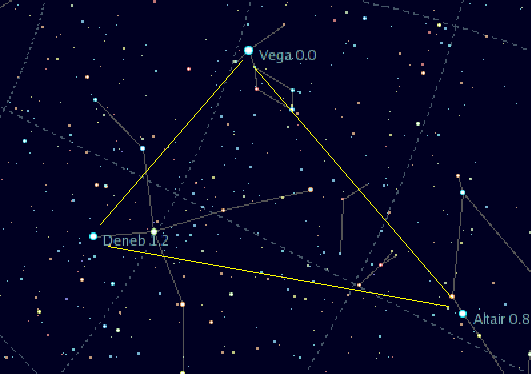
Attribution: Tomruen at en.wikipedia
Here’s a simple, repeatable way to identify the Summer Triangle without a chart. Practice it a few times and you’ll be able to point out the Triangle for the rest of your life.
Step 1: Find Vega first
- Face east in late spring or south in midsummer evenings. Look for the very bright, bluish-white star—this is Vega.
- Vega sits in a small, neat parallelogram of stars known as Lyra, the Lyre.
Step 2: From Vega, slide to Deneb
- Trace a line roughly northeast from Vega to a bright, slightly dimmer star. That’s Deneb, at the tail of Cygnus the Swan (also called the Northern Cross).
- Visualize the Swan flying down the Milky Way. Deneb marks the tail, while the star Albireo at the beak is a lovely double star you can visit later (see Best Binocular and Small-Telescope Targets).
Step 3: Drop from Vega to Altair
- Now look southeast of Vega for another bright star flanked by two fainter companions. That’s Altair in Aquila the Eagle.
- Altair forms a striking line with Alshain and Tarazed, creating a little arrow or mini-line that helps confirm you’ve got the right star.
Close the triangle
- Deneb, Vega, and Altair form a large, near-isosceles triangle occupying a generous patch of sky. Once you see it, it becomes obvious on future nights.
- Use the triangle edges as star-hopping highways to scan for nebulae and clusters described in the deep-sky section.
If you’re starting under bright city lights, begin with Vega and Altair as your two anchors—they’re the easiest. On clearer nights or at darker sites, Deneb and the Milky Way band will leap out.
Vega: Blue-White Beacon of Lyra and a Photometric Standard
Vega (Alpha Lyrae) is among the brightest stars in the entire sky and a lynchpin of astronomical measurement. It’s an A-type main-sequence star roughly 25 light-years away. Historically, astronomers used Vega as the zero-point calibration for the visible magnitude system—on the classic Vega scale, Vega was set to magnitude 0, and other stars were measured relative to it. Modern photometry often uses broader systems (including the AB magnitude system), yet Vega remains an essential reference and calibration source.
Vega is also a pioneering case in the study of circumstellar dust. Infrared observations in the 1980s revealed excess emission beyond what its photosphere would produce, signifying a debris disk—a belt of dust and possibly small planetesimals encircling the star. That finding helped spark decades of research into “Vega-like” disks and planetary system formation. While no confirmed planets have been announced around Vega, the dust suggests ongoing collisional processes in a young-to-middle-aged system by stellar standards.
What to see near Vega
- Epsilon Lyrae, the “Double-Double”: Just off Vega, binoculars show a delicate pair of stars. A small telescope on a steady night can split each of those into two, forming a celebrated four-star system.
- M57, the Ring Nebula: One of the most famous planetary nebulae, located between Beta and Gamma Lyrae. Small telescopes show it as a smoke-ring; larger apertures and filters reveal texture in the ring.

This new image shows the dramatic shape and colour of the Ring Nebula, otherwise known as Messier 57.
From Earth’s perspective, the nebula looks like a simple elliptical shape with a shaggy boundary. However, new observations combining existing ground-based data with new NASA/ESA Hubble Space Telescope data show that the nebula is shaped like a distorted doughnut. This doughnut has a rugby-ball-shaped region of lower-density material slotted into in its central “gap”, stretching towards and away from us.
Attribution: NASA, ESA, and C. Robert O’Dell (Vanderbilt University)
- NGC 6791: A rich, old open cluster in Lyra. Modest telescopes under dark skies begin to resolve its stars; larger instruments show a dense, sparkling field.
If you are planning a deep-sky sweep around Vega, consider the recommendations in Practical Observing Tips on filters and magnification. An OIII or UHC filter on M57 can enhance contrast, while the Double-Double benefits from good seeing and careful focus.
Deneb: A Distant Supergiant at the Tail of the Swan
Deneb (Alpha Cygni) anchors the Northern Cross asterism and is a luminous A-type supergiant. Unlike nearby Vega and Altair, Deneb lies at a vast and less precisely constrained distance—commonly estimated to be roughly 2,600 light-years. Its brightness at that range implies tremendous intrinsic luminosity, making Deneb one of the most luminous stars visible to the naked eye. In terms of stellar evolution, Deneb is an evolved star that has left the main sequence; it is expected to change further over millions of years.
Deneb’s constellation, Cygnus, runs along the bright lane of the Milky Way, with fields rich in star clouds, dark rifts, and emission nebulae. The Swan’s body stretches from Deneb through the star Sadr to Albireo at the beak. The abundance of targets in this region is exceptional, particularly for wide-field binoculars and fast camera lenses as discussed in Astrophotography Strategies.
What to see near Deneb
- NGC 7000, the North America Nebula: A large emission nebula near Deneb that resembles the outline of North America. Best viewed with wide fields and a nebula filter; under very dark skies, large binoculars can hint at shape.

The North America Nebula (NGC 7000), named for its resemblance to the North American Continent here on Earth, is located in the constellation of Cygnus. Most of the nebulosity shown here is in the foreground (superimposed) of the band of the Milky Way. The stars are very dense towards this spiral arm and where the dust and gas thins, their numbers are plain to see.This four frame mosaic subtends more than 4 degrees of the sky. You could easily fit over 30 Moons in this picture! The very bright star on the right of the frame is Deneb, and surprisingly it is not associated with the nebula as it is well over 1,500 light years away. Indeed, if Deneb were 50 times closer (30 light years, I am insinuating absolute magnitude) it would be brighter than Venus in the sky and rival the moon! (-7.2 in magnitude).But the wonderfully glowing clouds shown here are closer, and until recently the star (or stars) responsible for making them glow was a mystery. In the fall of 2004 two astronomers, Fernando Comeron and Anna Pasquali, published a paper that seems to identify this secretive star. The star is hidden behind thick clouds of dust that attenuate its light. By observing in the infrared and looking for stars that are intrinsically hot and bright (OB)- only one seemed to fit the shoe! Click HERE to the same high-resolution image you get when you click on the image below… but with an arrow indicating this stealthy star. Look just off the coast of \”Florida\” in the Atlantic Ocean.This image was taken as part of Advanced Observing Program (AOP) program at Kitt Peak Visitor Center during 2014.
Attribution: KPNO/NOIRLab/NSF/AURA/Adam Block
- IC 5070, the Pelican Nebula: Adjacent to NGC 7000, this complex blends beautifully in wide-field images, especially with narrowband filters.
- Gamma Cygni (Sadr) Region: Dense star fields and faint nebulosity surround Sadr, midway along the Swan’s body. Sweep slowly in binoculars or a small scope with a wide-field eyepiece.
- Albireo (Beta Cygni): A famous contrasting-color double at the Swan’s beak. Even a small telescope reveals warm gold and cool blue components.
Because Deneb’s neighborhood brims with faint emission nebulae, using an OIII or general-purpose UHC filter can noticeably improve contrast. However, some of these nebulae are expansive, so pairing filters with a wider field of view is crucial. See Best Binocular and Small-Telescope Targets for additional highlights and observing tips.
Altair: A Fast-Spinning Star in the Eagle
Altair (Alpha Aquilae) lies about 17 light-years away and is an A-type main-sequence star. It is a remarkable laboratory for stellar rotation: high-resolution interferometry has measured Altair’s oblateness—it spins so rapidly that the star bulges at the equator and flattens slightly at the poles. Such fast rotation leads to gravity darkening, where equatorial regions are cooler and dimmer than the poles.
Altair is also visually distinctive. Look for the line formed by Alshain (Beta Aquilae) and Tarazed (Gamma Aquilae) adjacent to Altair. This trio makes a reliable pattern for verifying you have the right vertex of the Summer Triangle.
What to see near Altair
- Delphinus the Dolphin: A compact, diamond-shaped constellation near Altair. Pretty in binoculars on a dark night.
- NGC 6709: An open cluster in Aquila; a small telescope reveals a sprinkling of stars.
- Scutum Star Cloud (nearby region): Although in adjacent Scutum, this bright patch of the Milky Way lies not far south of Altair’s line of sight. It’s a rich binocular field under dark skies.
Aquila’s region of the Milky Way blends star clouds with subtle dark-lane structure. If you’re exploring from a bright city, you might not see the Milky Way glow, but Altair’s brightness still makes it an easy landmark for star-hopping. Consider visiting the showpiece targets listed in the deep-sky section—many lie between Altair and Deneb.
Through the Milky Way: Dust Lanes, Rifts, and Star Clouds
One of the most dramatic features threading the Summer Triangle is the Milky Way itself—especially the Great Rift of dark nebulae that divides the bright star fields. In Cygnus, this dust-laden region is sometimes called the Cygnus Rift. It’s not an empty gap but a swath of interstellar dust dense enough to obscure the background starlight, much like high-altitude cloud banks.
Some pointers to make the structure pop:
- Averted vision: Gaze slightly away from the feature you want to see. This puts light on the more sensitive part of your retina.
- Dark adaptation: Give your eyes at least 20–30 minutes to adjust, and avoid white light.
- Compare edges: Trace the boundary between bright star clouds and darker lanes. The contrasts reveal the Rift’s snaking path.
As you sweep from Deneb toward Altair, you’ll notice bright patches of unresolved starlight—star clouds—interleaved with darker woods of dust. These star clouds are the combined light of countless distant suns along the spiral arm in which our Solar System sits. The dust itself is part of the interstellar medium: carbon- and silicate-rich grains that absorb and scatter light, reddening the background stars and sculpting the Milky Way’s mottled appearance.
This region offers an accessible introduction to extinction (dimming) and reddening (preferential scattering of blue light). If you compare star fields on either side of a dark lane, you may notice subtler hues due to interstellar dust. For a deeper dive into the physical implications, see Science Notes.
Best Binocular and Small-Telescope Targets Inside the Triangle
The Summer Triangle encloses or abuts a rich catalog of binocular delights and beginner-friendly telescopic targets. Below is a curated list you can explore over multiple nights, arranged by ease of observation and enhanced by practical advice. Many of these targets are highlighted elsewhere in the article; this section collects them in one place for convenience.
Binocular-friendly showpieces
- Brocchi’s Cluster (Collinder 399), the Coathanger in Vulpecula: A striking asterism that truly looks like its name. Best in 7×50 or 10×50 binoculars; it can be too large for many telescopes.
- Delphinus the Dolphin: The small constellation near Altair forms a charming diamond and tail.
- Milky Way star clouds between Deneb and Altair: Sweep slowly to discern bright patches and dark river-like lanes. Ideal at dark sites.
Classic nebulae and clusters for small telescopes
- M57, the Ring Nebula (Lyra): Visible even in modest apertures as a smoke ring. Higher magnifications and an OIII/UHC filter reveal more structure.
- M27, the Dumbbell Nebula (Vulpecula): Larger and brighter than M57, often shows a rectangular or hourglass shape. Filters help under light pollution.
- Albireo (Beta Cygni): A gorgeous color-contrast double. Its separation is comfortable for small scopes at moderate power.
- NGC 7000, North America Nebula (Cygnus): Best with wide fields; try a nebula filter and dark skies. The “Gulf of Mexico” indentation stands out well in images.
- IC 5070, Pelican Nebula (Cygnus): Adjacent to NGC 7000; a challenge visually but rewarding with filters and imaging setups.
- NGC 6888, Crescent Nebula (Cygnus): More challenging visually; an OIII filter and larger apertures enhance contrast. Excellent narrowband imaging target.
- NGC 6709 and nearby open clusters in Aquila: Good stepping stones while navigating around Altair.
Double stars to savor
- Epsilon Lyrae, the Double-Double: A showcase for steady air and good optics.
- Gamma Delphini: Near the Triangle’s southeastern side; a pleasing pair for small telescopes.
Use the star-hopping guide to reach each target from Vega, Deneb, or Altair. If you only have time for a quick tour, combine M57, Albireo, and M27 for three different types of objects—planetary nebula, double star, and emission nebula—without straying far from the Triangle’s central routes.
Cultural History and Legends of the Triangle’s Stars
While modern astronomy names the pattern the “Summer Triangle,” the individual stars have deep roots in world traditions.
- Arabic and Latin star names: Vega derives from an Arabic phrase referring to a swooping eagle or vulture; Altair also reflects an Arabic origin meaning “the flying one”; Deneb comes from a root meaning “tail,” fitting for its place at the tail of the Swan.
- East Asian lore: In a well-known story, Vega and Altair represent the weaver girl and the cowherd separated by the river of heaven (the Milky Way). In some tellings, the stars meet once a year, a tradition reflected in seasonal festivals. Deneb is sometimes linked with the bridge that spans the river.
- European sky guides: The term “Summer Triangle” gained popularity in the mid-20th century through widely read sky guides and broadcasts, helping casual observers find their way around the northern summer sky.
Across cultures and centuries, the same bright points become different stories. The Summer Triangle is a reminder that astronomy is both a scientific and a human endeavor, connecting physical truths with shared skywatching traditions.
If cultural astronomy intrigues you, try pairing a stargazing session with reading about seasonal festivals and old constellation maps. Recognizing the Swan’s cross, the Eagle’s flight, and the Lyre’s harp can enrich your night-sky practice as much as finding a faint nebula.
Science Notes: Stellar Types, Distances, and Evolution
The three Summer Triangle stars are all A-type in spectral classification, but they sit at different life stages and distances, offering a study in contrasts:
- Vega (A0 V): A main-sequence star emitting a blue-white hue, about 25 light-years away. It has served as a photometric zero-point in the Vega magnitude system. Infrared observations indicate a circumstellar debris disk.
- Deneb (A2 Ia): A luminous supergiant at a distance commonly estimated near 2,600 light-years. Its enormous luminosity allows it to shine brightly despite the vast distance. Parallax measurements for such bright, distant stars can be challenging, leading to uncertainty in the exact distance.
- Altair (A7 V): A nearby main-sequence star about 17 light-years away, notable for rapid rotation and an oblate shape measured by optical interferometry. Different stellar latitudes on Altair have different effective temperatures—a case study in gravity darkening.
Color, temperature, and spectra
A-type stars are generally hot and appear bluish-white to the eye. Spectroscopically, they are characterized by strong hydrogen Balmer lines. Within the A-class, subtypes from A0 to A9 span an intrinsic temperature gradient; Vega’s subtype is earlier (hotter) than Altair’s. Deneb’s classification as a luminous supergiant (Ia) reflects very different surface gravity and atmospheric conditions compared to main-sequence A-type stars.
Distances and brightness
Apparent brightness depends both on intrinsic luminosity and distance. Vega and Altair appear bright because they are nearby; Deneb appears bright because it is extraordinarily luminous. This trio is a perfect demonstration of the distance-luminosity interplay. While numerical values can vary with improved measurements, the qualitative picture is robust: Deneb outshines the Sun by many orders of magnitude, whereas Vega and Altair are bright, hot dwarfs relatively close to Earth.
Stellar evolution highlights
- Vega: A relatively young main-sequence star by solar standards. Its debris disk suggests ongoing dust production via collisions among planetesimals—useful analogs for early planetary system evolution.
- Deneb: Having left the main sequence, it is evolving across the upper Hertzsprung–Russell diagram. Over astronomical timescales of millions of years, such supergiants can undergo significant changes and eventually end life violently. Deneb’s great distance means any future outburst would be visually spectacular but not hazardous to Earth.
- Altair: Its rapid rotation makes it a touchstone for understanding how angular momentum affects stellar structure and surface temperature distributions.
Photometric systems and Vega
Historically, the Vega magnitude system set Vega as magnitude 0 in specific passbands, with other stars measured relative to it. Many modern datasets use the AB magnitude system (a flux-based system defined so that a flat spectrum in frequency space corresponds to a fixed magnitude across bands). In practice, astronomers work carefully across systems and calibrations, yet Vega continues as a practical spectrophotometric reference and a household name in observational calibration.
A brief, practical computation example
If you want to compute where Vega will be from your location at a given time, you can use astronomy libraries to calculate altitude and azimuth. Here’s a simple Python example using Astropy to transform Vega’s coordinates into your local sky. Replace the location and time with your own details.
from astropy.coordinates import SkyCoord, EarthLocation, AltAz
from astropy.time import Time
import astropy.units as u

# Vega's approximate J2000 coordinates (RA/Dec)
vega = SkyCoord(ra=279.23473479*u.deg, dec=38.78368896*u.deg, frame='icrs')

# Your observing site and time (example: Denver, CO)
site = EarthLocation(lat=39.7392*u.deg, lon=-104.9903*u.deg, height=1609*u.m)
obs_time = Time('2026-08-01 03:00:00')  # UTC

# Alt-az frame for that time and place
altaz = AltAz(obstime=obs_time, location=site)
vega_altaz = vega.transform_to(altaz)

print(f"Altitude: {vega_altaz.alt:.2f}, Azimuth: {vega_altaz.az:.2f}")
This snippet demonstrates how modern coordinate transformations work for practical planning. It can be extended to track Deneb and Altair or to visualize target lists from our observing catalog.
Practical Observing Tips for Urban and Dark-Sky Viewers
Regardless of your sky conditions, the Summer Triangle offers rewarding views. The key is matching your expectations and tools to your environment.
In the city (heavy light pollution)
- Start with Vega and Altair. They punch through skyglow easily.
- Use binoculars (7×50 or 10×50) to improve contrast and star counts; even from urban sites, you can frame the Lyre and Northern Cross patterns.
- Planetary nebulae like M57 are compact; a small telescope with moderate magnification can reveal them despite light pollution.
- Double stars (Albireo, Epsilon Lyrae) are ideal city targets that rely on resolution, not faint nebulosity.
Suburban skies (moderate light pollution)
- Try for the Coathanger in Vulpecula with binoculars; it’s forgiving and bright.
- M27 often pops out in small scopes; a UHC/OIII filter helps reveal structure.
- With patience and averted vision, you may detect the brighter sweep of the Milky Way through Cygnus.
Dark-sky sites
- Spend time tracing the Great Rift and comparing the brightness of star clouds. These are best appreciated with the unaided eye and binoculars.
- Try large, faint nebulae around Deneb with a wide-field eyepiece and nebula filter.
- Work through the full target list in Best Binocular and Small-Telescope Targets. Plan multiple sessions; there is too much to cover in one night.
General best practices
- Dark adaptation: 20–30 minutes without white light improves what you can see. Use a dim red light if needed.
- Magnification strategy: Start low to find the object; increase power to study detail. Some targets (like M57) handle magnification well.
- Filters: A UHC or OIII filter is valuable for emission and planetary nebulae. For star clusters and doubles, skip filters to preserve starlight.
- Comfort and patience: A reclining chair and unhurried scans can transform a session. Objects often reveal more with time.
Astrophotography Strategies for the Summer Triangle
The Summer Triangle is a gift to imagers, from casual smartphone users on tripods to seasoned astrophotographers running tracked mosaics. Whether your goal is a wide-field Milky Way panorama or a narrowband portrait of the Crescent Nebula, the region repays planning.
Untracked shots (tripod only)
- Wide lenses (14–24 mm, full-frame): Use the “500 rule” as a rough starting point for maximum exposure before stars trail: exposure (s) ≈ 500 / focal length (mm). Modern high-resolution sensors may need a more conservative rule (e.g., 300) or the NPF formula; test and pixel-peep.
- Target: Frame the entire Triangle with the Milky Way flowing through Cygnus. Aim for high summer when the band is prominent.
- Stacking: Take many short exposures at high ISO and stack them with calibration frames to reduce noise and improve faint detail.
Tracked wide-field
- Star trackers: With a small equatorial tracker, extend sub-exposures and lower ISO. This reveals nebulae like NGC 7000 and the surrounding H II complexes more clearly.
- Focal lengths (35–135 mm): At 50 mm, the Swan’s spine and North America Nebula become distinct; at 85–135 mm, frame individual complexes with better resolution.
- Filters: Clip-in or front-mounted light-pollution filters can help; narrowband (dual-band) filters are effective on emission nebulae with modern color cameras.
Narrowband and telescopic imaging

Imaging Telescope:
Explore Scientific 127mm ED Refractor (952 focal length)
Mount:
Celestron CGX
Polar Alignment:
QHYCCD PoleMaster
Imaging Camera:
ZWO ASI1600MM-Cool
Ha=80x180s
OIII=60x120s
SII=40x180s
Total Time: 10.8 hours
Gain: 139, Offset: 21
Guide scope:
Orion ST80
Guide Camera:
Lodestar X2
Guide Software:
PHD2
Calibration Frames:
Darks: 50, Bias: 50, Flats: 50
Capture software:
Sequence Generator Pro (SGP)
Stacking software:
PixInsight
Post Processing:
PixInsight
Dew Shield, Dew Heater Strip
Attribution: Chuck Ayoub
- Narrowband: H-alpha, OIII, and SII filters isolate emission lines, excellent for NGC 7000, IC 5070, and NGC 6888. Mono cameras with filter wheels or modern dual/tri-band filters on OSC cameras both work.
- Planetary nebulae: M27 and M57 reward longer focal lengths and higher sampling. OIII often dominates their signal, giving dramatic teal hues.
- Mosaics: The Cygnus region is expansive. Plan mosaics with generous overlap and flat-fielding to tame gradients.
Data acquisition and processing tips
- Calibration frames: Darks, flats, and bias frames improve results markedly, especially in nebulous fields with subtle gradients.
- Gradient control: Light pollution gradients can be mitigated with careful background extraction during processing.
- Color balance: Preserve star colors. Over-aggressive noise reduction or saturation can produce unnatural results.
For an introductory imaging itinerary, try a tracked 50 mm shot centered near Deneb to capture the North America and Pelican Nebulae. Then, switch to a small telescope for M27 and M57. These three images alone illustrate the Triangle’s range—from sprawling H II regions to compact planetary nebulae.
Frequently Asked Questions
Is the Summer Triangle a constellation?
No. The Summer Triangle is an asterism—a widely recognized star pattern that spans parts of three constellations: Lyra (Vega), Cygnus (Deneb), and Aquila (Altair). It is helpful for navigation and planning but is not an official constellation.
Can you see the Summer Triangle from the Southern Hemisphere?
Yes, from much of the Southern Hemisphere the Triangle is visible, although Deneb rides low in the north and may be difficult or, at far-southern latitudes, out of view. Altair and Vega are typically easier from southern locales. The best time is the Southern Hemisphere’s winter months, which correspond to the Northern Hemisphere’s summer.
Final Thoughts on Exploring the Summer Triangle
The Summer Triangle is more than a trio of bright stars—it’s an orientation grid to a densely structured corner of the Milky Way, a sampler of stellar physics from rapid rotation to supergiant luminosity, and a canvas rich with binocular and telescopic targets. Learn to spot Vega, Deneb, and Altair quickly, then branch into observing the Ring and Dumbbell Nebulae, the Coathanger, and Cygnus’s great nebulae. On moonless, transparent nights, take time to savor the Milky Way’s interlaced star clouds and rifts—they are among the sky’s finest naked-eye spectacles.
Whether you observe from a city balcony or a rural mountaintop, the Triangle rewards patience and curiosity. Share the pattern with friends, revisit it across the seasons, and slowly add new targets to your repertoire. If you enjoyed this guide, explore our other star-hopping articles and consider subscribing to our newsletter so you never miss future deep dives into the night sky.