
Table of Contents
- What Is Dark Matter? Evidence Across Cosmic Scales
- Galaxy Rotation Curves: The First Compelling Clues
- Gravitational Lensing and Mapping Invisible Mass
- CMB Acoustic Peaks: Early-Universe Fingerprints of Dark Matter
- Large-Scale Structure and N-Body Simulations in ΛCDM
- Dwarf Galaxies and the Small-Scale Dark Matter Laboratory
- Galaxy Clusters, Hot Gas, and Collisions as Crucial Tests
- Direct, Indirect, and Collider Searches for Particle Dark Matter
- Alternatives to Dark Matter: MOND, TeVeS, and Novel Proposals
- How We Infer Invisible Mass: From Dynamics to Bayesian Modeling
- What Upcoming Surveys Will Reveal About Dark Matter
- Frequently Asked Questions
- Final Thoughts on Understanding Dark Matter Evidence
What Is Dark Matter? Evidence Across Cosmic Scales
Dark matter is the name astrophysicists give to a pervasive, nonluminous form of matter whose presence is inferred from gravity. It does not emit, absorb, or reflect light at observable levels, but it gravitationally shapes the motions of stars and gas in galaxies, bends the paths of background light via gravitational lensing, seeds the growth of cosmic structures, and leaves subtle imprints in the cosmic microwave background (CMB). Across independent measurements and techniques, its effects are consistent with a matter component that interacts very weakly—if at all—with electromagnetic radiation but dominates the mass budget of galaxies and clusters.

In the standard cosmological model (ΛCDM, or Lambda–Cold Dark Matter), the Universe consists of roughly 5% ordinary baryonic matter (protons, neutrons, electrons), ~27% dark matter, and ~68% dark energy. The “cold” in CDM means the dark matter particles moved slowly compared to the speed of light at the time structures formed, allowing small clumps to grow into the cosmic web that we map in galaxy surveys today.
Although we do not yet know the particle identity of dark matter, the evidence for its gravitational effects is extensive and multilayered. This article compiles the most widely cited lines of evidence—galaxy rotation curves, gravitational lensing, CMB acoustic peaks, large-scale structure, dynamics of dwarf galaxies, and cluster collisions—and places them alongside ongoing particle searches and alternative theories. By cross-checking across different scales, epochs, and methods, researchers build a coherent picture of what dark matter must be like and where it might be hiding.
Key idea: dark matter is not a single piece of evidence. It is a web of independent observations—dynamics, lensing, background radiation, and structure formation—that point to the same invisible mass component.
Galaxy Rotation Curves: The First Compelling Clues
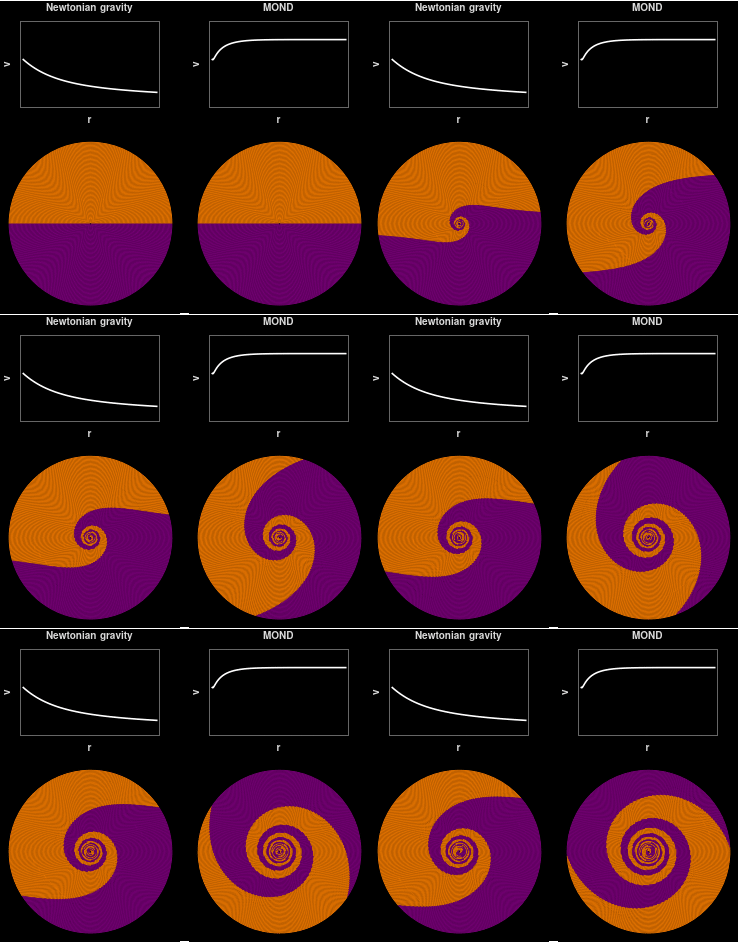
One of the earliest, clearest signals for dark matter arises within spiral galaxies. If most of a galaxy’s mass were in the visible stars and gas, orbital speeds would be expected to decrease with radius outside the bright stellar disk, roughly as v(r) ∝ 1/√r. Instead, observations beginning in the latter half of the 20th century, notably by Vera Rubin and Kent Ford, revealed that rotation curves—orbital speeds as a function of distance from the center—often remain approximately flat far beyond where luminous matter drops off.

This “flatness problem” points to additional mass in an extended halo, distributed more diffusely than the visible disk. The simplest interpretation is a roughly spherical dark matter halo whose density profile declines slowly enough to keep the circular speed nearly constant with radius. A canonical mass model for a spiral galaxy includes three components:
- A central bulge (if present),
- A thin disk of stars and gas, and
- An extended dark matter halo.
The rotational speed follows from the sum of gravitational contributions from these components. If v_b(r), v_d(r), and v_h(r) are the circular speeds from bulge, disk, and halo, the total is approximately:
v_total(r) = √( v_b(r)^2 + v_d(r)^2 + v_h(r)^2 )
Fitting observed rotation curves across many galaxies consistently requires a dark halo term to explain the outer velocities. Independent surveys using neutral hydrogen (21 cm) and ionized gas tracers confirm the persistence of flat or slowly declining rotation curves beyond the optical disk.
Scaling Relations: Tully–Fisher and the MDAR
The Tully–Fisher relation connects a galaxy’s luminosity (or baryonic mass) with its rotation velocity: more massive galaxies rotate faster. A refined form, the baryonic Tully–Fisher relation (BTFR), links total baryonic mass to the asymptotic rotation speed, showing a tight power-law correlation across several orders of magnitude. Another empirical trend, the mass-discrepancy–acceleration relation (MDAR), shows that the apparent need for dark matter correlates with the local acceleration scale in galaxies.
These regularities have been used both to support the CDM framework (as emergent from complex baryon–halo interactions) and to motivate alternative theories such as MOND, which introduces a characteristic acceleration scale. We revisit these alternatives in Alternatives to Dark Matter. Regardless of interpretation, the ubiquity and coherence of rotation-curve anomalies are foundational evidence for a mass component beyond the luminous matter.
Uncertainties and Systematics
Assessing rotation curves involves nontrivial systematics: inclination angle uncertainties, noncircular motions due to bars or spiral arms, beam smearing (especially in radio data), asymmetric drift in stellar tracers, and assumptions about the stellar mass-to-light ratio. While these factors can shift details, they do not remove the broad need for extra mass in galaxy outskirts. Cross-checks with independent probes—like gravitational lensing and structure formation—reinforce the dark halo picture.
Gravitational Lensing and Mapping Invisible Mass
Einstein’s general relativity predicts that mass curves spacetime and bends light. This gravitational lensing effect provides a direct way to map the total mass—luminous and dark—without relying on how matter moves. Lensing comes in two main observational regimes:
- Strong lensing: Multiple images, arcs, or Einstein rings of a background source produced by a massive foreground galaxy or cluster.
- Weak lensing: Tiny, coherent distortions (shear) in the shapes of large populations of background galaxies, used statistically to trace the foreground mass distribution.
Strong lensing allows precise mass measurements within the inner regions of massive galaxies and clusters. The positions and shapes of arcs constrain the mass enclosed by the lens’s Einstein radius. In galaxy clusters, mass maps built from strong and weak lensing often reveal mass concentrations that exceed what the luminous galaxies and hot intracluster gas can explain.
Cluster Collisions and Offsets
Collisions between clusters provide striking lensing-based evidence. In some mergers, the centroid of mass inferred from lensing is offset from the bulk of the hot X-ray emitting gas, which contains most of the baryonic mass in clusters. The classic example is the “Bullet Cluster” (1E 0657–56), where the collision appears to have separated the dominant mass (traced by lensing, moving relatively unimpeded like collisionless particles) from the decelerated gas (which experienced drag and shock heating). This segregation is naturally explained if the bulk of the mass is in a weakly interacting, noncollisional component—dark matter.
Other merging systems (e.g., MACS J0025, “El Gordo,” the “Musket Ball” cluster) show related patterns, though the detailed dynamics vary and measurement uncertainties remain. Alternative gravity theories without dark matter have difficulty simultaneously reproducing the full suite of lensing observables and the gas–mass offsets across different clusters.
Cosmic Shear and the Matter Power Spectrum
On very large scales, weak lensing surveys measure the statistical shear pattern known as cosmic shear, yielding constraints on the amplitude of matter fluctuations and the matter density parameter. These measurements are sensitive to the integrated matter distribution along the line of sight and complement galaxy clustering studies. Combining weak lensing with galaxy dynamics and CMB constraints yields a consistent cosmological model featuring a dominant dark matter component.
Although weak lensing analysis must control shape-measurement biases, photometric redshift uncertainties, and intrinsic alignments, extensive calibration efforts and cross-correlations with other probes have made cosmic shear a workhorse for mapping dark matter in projection.
CMB Acoustic Peaks: Early-Universe Fingerprints of Dark Matter
The CMB provides a snapshot of the Universe ~380,000 years after the Big Bang, when photons decoupled from baryons. The pattern of temperature and polarization anisotropies encodes the physics of primordial fluctuations and the composition of the Universe. A key feature is a series of acoustic peaks at different angular scales (multipoles), arising from sound waves in the photon–baryon plasma before decoupling.

Dark matter influences these peaks in several ways. Because dark matter does not couple to radiation, it began clumping earlier than baryonic matter could. This nonbaryonic component provides deep gravitational wells into which baryons later fall, altering the relative heights and positions of the acoustic peaks. Broadly speaking:
- Adding baryons enhances compression peaks relative to rarefaction peaks (affecting odd/even peak heights).
- Cold dark matter sets the overall matter content that shapes the amplitude and damping tail of fluctuations.
- The third peak height, in particular, is sensitive to the dark matter density; precision measurements favor a substantial nonbaryonic matter component.
Space missions and ground-based experiments (e.g., WMAP and Planck satellites, as well as high-resolution ground telescopes) have mapped the CMB power spectra in exquisite detail. The resulting parameters robustly indicate a Universe with significant cold dark matter, consistent with the levels required to explain structure formation and lensing. CMB lensing—the deflection of CMB photons by intervening large-scale structure—provides an additional, independent map of the matter distribution that matches expectations from ΛCDM.
Crucially, the CMB probes a much earlier epoch than galaxy dynamics or lensing, yet it independently points to the same dark matter component. The cross-consistency across cosmic time is a powerful argument for dark matter’s reality, not an artifact of any single observational method.
Large-Scale Structure and N-Body Simulations in ΛCDM
The large-scale distribution of galaxies is not random—it arranges into a vast cosmic web of filaments, sheets, nodes (clusters), and voids. Numerical N-body simulations that assume cold dark matter and a cosmological constant (Λ) reproduce this web with striking realism. They match the observed clustering of galaxies over a broad range of scales and times when baryonic physics is incorporated appropriately.
Dark matter’s properties shape the distribution of halo masses, merger histories, and the statistics of voids and filaments. Observationally, galaxy redshift surveys measure the two-point correlation function and power spectrum of galaxies, along with features like the baryon acoustic oscillation (BAO) scale—an imprint of primordial sound waves preserved in the late-time matter distribution. In the ΛCDM framework, the BAO scale in galaxy clustering aligns with that seen in the CMB acoustic peaks, linking early-universe physics to present-day structure. This concordance across epochs is difficult to replicate without a nonbaryonic dark component.
Hydrodynamics and the Role of Feedback
Modern simulations include not just dark matter but also gas dynamics, star formation, and feedback from stars and supermassive black holes. These processes can redistribute baryons, thicken or thin galactic disks, and even alter the inner slope of dark matter density profiles through gravitational coupling. Incorporating realistic feedback helps reconcile several small-scale tensions (discussed next) between naive CDM-only predictions and observations.

Small-Scale Challenges and Proposed Remedies
While ΛCDM excels on large scales, several small-scale issues have spurred active research:
- Core–cusp problem: Pure CDM simulations tend to produce central density cusps (steep inner profiles), whereas some dwarf galaxies appear to have flatter cores. Baryonic feedback and dynamical heating can transform cusps into cores in many cases, reducing the tension.
- Missing satellites: Early CDM predictions suggested more low-mass subhalos than the number of observed dwarf satellites around galaxies like the Milky Way. Improved observational completeness, reionization effects, and feedback that suppress star formation in small halos help bridge the gap.
- Too-big-to-fail: Some subhalos in simulations appear too dense to have failed to form stars, yet we do not see corresponding bright satellites. Revisions to the Milky Way’s mass, the stochasticity of star formation, and baryonic processes again alleviate this issue.
Alternative dark matter models—such as warm dark matter (WDM) that suppresses small-scale structure or self-interacting dark matter (SIDM) that can produce shallower cores—remain under investigation. However, baryonically informed ΛCDM simulations continue to make substantial progress in matching observations across these scales.
Dwarf Galaxies and the Small-Scale Dark Matter Laboratory
Dwarf galaxies, especially the faint satellites of the Milky Way and Andromeda, are extreme testbeds for dark matter because they are dark-matter-dominated even in their inner regions. Their high mass-to-light ratios—sometimes exceeding 100—indicate that the visible stars are only a tiny tracer of their gravitational potential.
Jeans Modeling and Velocity Dispersions
In pressure-supported systems (no ordered rotation), stellar velocity dispersions carry information about the underlying mass. The spherical Jeans equation relates the velocity dispersion profile to the gravitational potential and stellar density. In practice, researchers model the line-of-sight dispersion of member stars, accounting for orbital anisotropy and contamination by foreground stars, to infer the mass profile and total mass within a characteristic radius (e.g., half-light radius). Dwarf spheroidals nearly always require substantial dark matter to reconcile their stellar kinematics with their limited luminous mass.
Ultra-Diffuse Galaxies and Edge Cases
Ultra-diffuse galaxies (UDGs) broaden the landscape. Some appear to be low-surface-brightness systems with significant dark matter, while others have been reported to have unusually low dark matter content. A widely discussed case involved galaxies such as NGC1052-DF2 and NGC1052-DF4, which early velocity measurements of their globular clusters suggested were deficient in dark matter. Later work re-examined distances and kinematics, leading to a more nuanced picture and, in some analyses, reduced the tension. These debates highlight the complexities of distance estimation, tracer selection, and statistical inference in low-signal regimes, rather than undermining the broader evidence for dark matter across the population.
Environmental Effects
Tidal interactions with host galaxies can strip stars and dark matter from dwarfs, complicating mass estimates. Careful membership catalogs, proper motions (e.g., from Gaia), and chemo-dynamical tagging help distinguish bound systems from tidal debris. Even with these complexities, dwarf galaxy dynamics remain among the cleanest astrophysical arguments for substantial dark matter content on galactic scales.
Galaxy Clusters, Hot Gas, and Collisions as Crucial Tests
Galaxy clusters are the most massive bound structures in the Universe, combining galaxies, a dominant component of hot intracluster gas (detectable in X-rays and via the Sunyaev–Zel’dovich effect), and a massive dark matter halo. Three complementary mass estimators often agree within uncertainties:
- Gravitational lensing (strong and weak) measures the projected mass directly from light deflection.
- X-ray and SZ analyses infer mass assuming approximate hydrostatic equilibrium of the hot gas in the cluster potential.
- Galaxy dynamics use member velocities and the virial theorem.
Consistent mass budgets from these independent methods argue for a large nonluminous component. In merging clusters, offsets between the collisional gas and collisionless mass (inferred from lensing) provide particularly vivid evidence for a component that interacts weakly other than by gravity.
Constraints on Dark Matter Self-Interactions
Mergers also constrain how often dark matter particles scatter off each other. If the self-interaction cross-section per unit mass were large, the dark matter would lag behind the galaxies more noticeably as clusters collided, in tension with some observed systems. Analyses commonly report constraints of order less than a few cm²/g, with exact numbers depending on assumptions and system modeling. While not yet definitive across all velocity scales, these studies guide particle physics models, ruling out strong self-interactions for the dominant dark matter component in many contexts.
Systematic Effects
Mass modeling of clusters must consider departures from equilibrium, triaxiality, line-of-sight structure, and projection effects. In merging systems, shock fronts and complex gas physics add further subtleties. Even so, the convergence of multiple methods on a large mass excess beyond baryons is robust.
Direct, Indirect, and Collider Searches for Particle Dark Matter
The astrophysical case for dark matter is compelling, but its microphysical identity remains unsolved. Three complementary strategies aim to detect or constrain particle dark matter:
- Direct detection: Look for dark matter scattering off nuclei or electrons in underground detectors.
- Indirect detection: Search for excesses of gamma rays, neutrinos, or cosmic rays from dark matter annihilation or decay.
- Collider production: Create dark matter in high-energy collisions (e.g., at the LHC) and infer it from missing energy signatures.
Direct Detection: Pushing Toward the Neutrino Floor
Experiments using large volumes of liquid xenon or argon have set some of the most stringent limits on dark matter–nucleon scattering cross-sections over a wide range of masses. Instruments such as XENON (including XENON1T and XENONnT), LZ, PandaX, and the DarkSide program employ ultra-low-background techniques deep underground. So far, no unambiguous dark matter signal has emerged, driving limits downward and approaching the so-called neutrino floor, where backgrounds from solar and atmospheric neutrinos become significant. Future detectors aim for larger target masses and improved background discrimination to probe even weaker interactions.
Axions and Axion-Like Particles
Axions—hypothetical light particles originally proposed to solve the strong CP problem—are well-motivated dark matter candidates. Microwave cavity experiments such as ADMX and haloscope/helioscope efforts search for axion–photon conversion in strong magnetic fields, scanning over mass ranges. Multiple experimental concepts are expanding the search bandwidth and sensitivity, with no confirmed detection yet.
Indirect Detection from the Sky
Gamma-ray telescopes (e.g., Fermi-LAT) and ground-based atmospheric Cherenkov telescopes search for excess emission from regions where dark matter density is high, such as the Galactic center and dwarf spheroidal galaxies. Dwarf galaxies, having little astrophysical background, yield especially clean constraints. So far, the absence of a clear, consistent excess across targets has set strong upper limits on annihilation cross-sections for various final states. Cosmic-ray measurements (e.g., by AMS-02) and neutrino observatories also contribute constraints and candidate anomalies, though astrophysical explanations often compete.
Collider Searches
At the Large Hadron Collider, searches for events with large missing transverse energy alongside visible particles (monojet, monophoton, etc.) probe dark matter production and related mediator particles. To date, no dark matter signal has appeared in collider data; the results impose constraints on simplified models and help map out viable parameter space. Collider bounds complement direct and indirect limits, particularly for low-mass candidates or those with complex interaction structures.
Altogether, the null results so far are highly informative: they prune candidate models and steer theory and instrumentation toward new regions of parameter space, including sub-GeV dark matter, inelastic or momentum-suppressed interactions, and non-WIMP paradigms.
Alternatives to Dark Matter: MOND, TeVeS, and Novel Proposals
Because rotation curves and some galaxy scaling relations can be described by modifying the law of gravity or inertia at low accelerations, researchers have explored alternatives to particle dark matter. The most famous is MOND (MOdified Newtonian Dynamics), which introduces a characteristic acceleration scale below which gravity effectively strengthens. MOND can fit many galaxy rotation curves with remarkable economy and predicts certain scaling relations.
Relativistic Extensions and Challenges
To be viable cosmologically, any modification must have a relativistic formulation. Tensor–vector–scalar (TeVeS) theory provides one such extension. However, alternatives face several hurdles:
- Gravitational lensing: Reproducing cluster-scale lensing without additional dark components is difficult. Some proposals add sterile neutrinos or other new species, reintroducing unseen mass.
- CMB peaks: Matching the full CMB anisotropy spectrum has proven challenging without a nonbaryonic component that plays the role of dark matter in the early Universe.
- Structure growth: Explaining the observed growth of large-scale structure across cosmic time is problematic under many modified gravity scenarios without extra fields or dark components.
Other creative ideas—emergent gravity, superfluid dark matter, dipolar dark matter—aim to capture both galaxy phenomenology and cosmology. These models are intellectually stimulating and prompt novel tests, but none yet rival the empirical breadth and predictive success of ΛCDM accompanied by baryonic physics for galaxies, lensing, the CMB, and large-scale structure.
How We Infer Invisible Mass: From Dynamics to Bayesian Modeling
Inferring mass distributions from astronomical data requires careful modeling and uncertainty quantification. Several pillars underpin mass inference, each with its own assumptions and pitfalls.
Virial Theorem and Jeans Analysis
For systems in approximate equilibrium, the virial theorem relates average kinetic and potential energies:
2⟨T⟩ + ⟨U⟩ = 0
In galaxies and clusters, measured velocity dispersions and sizes can produce mass estimates. More detailed modeling uses the Jeans equations (moments of the collisionless Boltzmann equation) to connect observed velocity distributions and density profiles to the gravitational potential. However, degeneracies—such as between mass profile slope and orbital anisotropy—limit precision, especially with line-of-sight data alone. Adding proper motions, higher-order moments, and multiple tracers improves constraints.
Rotation Curve Decomposition
In spirals, one fits the observed rotation curve by adjusting the contributions of the stellar disk, gas, and halo. Stellar mass-to-light ratios (M/L) depend on stellar populations and initial mass functions; gas masses come from HI and CO observations. The halo is often described by parameterized profiles, such as the Navarro–Frenk–White (NFW) profile or cored alternatives. Bayesian methods with priors informed by simulations help regularize fits across many galaxies.
Lensing Inversion and Mass Mapping
In strong lensing, the lens equation connects source, lens, and image positions. Modeling typically involves parameterized mass distributions for the lens and reconstructed source morphologies. Degeneracies like the mass-sheet degeneracy require additional constraints (e.g., multiple sources at different redshifts, time delays in lensed quasars). In weak lensing, statistical estimators reconstruct the shear field, which is then inverted (with smoothing and priors) into a convergence (projected mass) map.
Systematic Control and Cross-Validation
Across methods, systematic uncertainties—beam smearing, point spread function (PSF) modeling in lensing, photometric redshift calibration, intrinsic galaxy alignments, selection effects—can bias mass inference. Modern surveys employ image simulations, blind analyses, and end-to-end pipelines to keep biases below statistical errors. The strongest evidence for dark matter emerges when different methods, each with different systematics, converge on the same answer, as they do for lensing, rotation curves, and the CMB.
What Upcoming Surveys Will Reveal About Dark Matter
Next-generation observatories will sharpen the dark matter picture, either revealing signatures of particular candidates or further narrowing their parameter spaces.
- Wide-field imaging and lensing: Facilities designed for deep, wide imaging will map billions of galaxies, dramatically improving weak lensing constraints and cluster mass calibration. Time-domain capabilities will capture strong-lensing time delays to probe the mass distribution in lenses with precision.
- Spectroscopic mapping: Large spectroscopic surveys will refine the growth rate of structure, redshift-space distortions, and BAO measurements, tightly linking late-time structure to early-universe parameters.
- 21-cm and radio surveys: Neutral hydrogen mapping will chart gas in and around galaxies across cosmic time, informing halo–galaxy connections and small-scale structure.
- High-energy astrophysics: Future gamma-ray and neutrino facilities aim to push sensitivity to dark matter annihilation or decay in dwarfs and clusters.
- CMB Stage-4 and beyond: Higher sensitivity to primary anisotropy, lensing, and polarization will further constrain the matter content, neutrino sector, and possibly dark sector interactions.
- Direct detection and axion experiments: Larger target masses, reduced backgrounds, and novel detection channels will probe down to and below the neutrino floor, while axion searches expand in bandwidth and sensitivity.
As data improve and systematics are better controlled, we expect tighter tests of small-scale structure (e.g., subhalo mass functions via strong lensing and stellar streams), more precise measurements of the matter power spectrum from weak lensing and clustering, and refined halo–galaxy connection models that link baryonic observables to underlying dark matter halos.
Frequently Asked Questions
Is dark matter just a placeholder for unknown physics?
In a sense, yes—dark matter is a model for unseen mass that fits a wide range of data. But it is not an arbitrary placeholder: it is a quantitatively predictive framework embedded in general relativity and tested against multiple, independent observations. The same dark matter density that explains galaxy rotation curves also fits CMB acoustic peaks, lensing mass maps, and large-scale structure. Alternative hypotheses must reproduces this cross-consistency; to date, none do so as comprehensively without invoking additional unseen components that effectively play the role of dark matter.
What if direct detection never finds a particle?
If conventional WIMP-like particles remain elusive despite future advances, it would push the field toward lighter-mass candidates (sub-GeV), hidden-sector models, axion-like particles, or even nonparticle explanations. However, astrophysical and cosmological evidence for an effective nonbaryonic matter component would remain strong unless alternative gravity models simultaneously match all the data. Non-detections are scientifically valuable: they prune models, sharpen theory, and redirect experimental efforts. The history of science includes many cases where persistent null results led to paradigm-shifting discoveries.
Final Thoughts on Understanding Dark Matter Evidence
From the flat rotation curves of spiral galaxies to the arcs of strongly lensed quasars, from the acoustic peaks of the CMB to the filamentary cosmic web, the case for dark matter rests on a remarkably coherent network of observations across time and scale. No single measurement bears the whole weight; rather, it is the convergence—dynamics, lensing, early-universe imprints, and structure growth—that demands an unseen mass component.

Open questions remain compelling: What is the particle identity of dark matter? How do its microphysical properties shape small-scale structure? Are there multiple components or subtle interactions? The next decade’s surveys and experiments will test these questions with unprecedented precision. In the meantime, the ΛCDM framework continues to succeed quantitatively, while alternatives strive to match its reach.
If you found this deep dive helpful, explore related topics in our archive, share it with a curious friend, and subscribe to our newsletter for future articles on astrophysics, cosmology, and the evolving search for the dark sector.