
Table of Contents
- What Are Red Dwarf Stars (M Dwarfs)?
- Structure, Fusion, and Lifetimes of M Dwarfs
- Magnetic Activity, Flares, and Red Dwarf Space Weather
- Habitability Around Red Dwarfs: Prospects and Pitfalls
- Notable Red Dwarf Systems and What We’ve Learned
- How to Observe Red Dwarf Stars from Your Backyard
- Astrophotography and Amateur Spectroscopy of M Dwarfs
- Current Research Frontiers with JWST, TESS, and Ground Observatories
- Key Terms and Concepts for Understanding M Dwarfs
- Frequently Asked Questions
- Final Thoughts on Exploring Red Dwarf Stars
What Are Red Dwarf Stars (M Dwarfs)?
Red dwarf stars, or M dwarfs, are the smallest, coolest, and most common hydrogen-burning stars in the Milky Way. Accounting for roughly 70% or more of the Galaxy’s stellar population, these stars quietly dominate the census of suns, even if they seldom dominate our night sky. Most are simply too faint to see with the naked eye. Yet their outsized role in galactic demographics, planet formation, and the long-term habitability of worlds makes them central to modern astronomy and astrobiology.

Artist: ESA/Hubble & NASA; Credit: http://www.spacetelescope.org/images/potw1343a/; License: CC BY 4.0
M dwarfs are classified in the spectral class M, with surface (effective) temperatures typically between about 2400 and 3900 K. They range in mass from just above the hydrogen-burning threshold—around 0.072–0.075 times the mass of the Sun—up to roughly 0.6 solar masses. Many M dwarfs are “fully convective,” meaning their interiors churn from core to surface, mixing material so thoroughly that, unlike the Sun, there is no stable radiative core. This physical difference has big implications for how these stars evolve, how long they live, and how their magnetic fields behave.
Common synonyms and related terms you’ll encounter include: late-type dwarf, ultracool dwarf (often used for the coolest M dwarfs and L dwarfs), and flare star (often written dMe for “dwarf, M-type, emission lines”). You might also see distinctions based on luminosity class: a red dwarf is a main-sequence star (luminosity class V), whereas famous red stars like Betelgeuse and Antares are red supergiants (luminosity class I) and not dwarfs at all, even though they share the letter M in their spectral types.
Why do M dwarfs matter so much today? Three reasons stand out:
- They are numerous: Because they make up the majority of stars, most planets in the Milky Way likely orbit M dwarfs.
- They are long-lived: Red dwarfs can burn for trillions of years, potentially providing exceptionally stable environments for planets—if those planets can surmount early hazards.
- They are observationally accessible to exoplanet surveys: Small, cool stars make it easier to detect Earth-sized planets via transits and radial velocity because the signals are larger than around Sun-like stars.
In short, M dwarfs frame some of the most important questions in modern astrophysics and astrobiology—questions we’ll explore in detail below, from their inner workings (structure and evolution) to the intense magnetic activity that can shape planetary atmospheres (space weather), to the evolving evidence for and against life-friendly conditions around these cool suns (habitability), and how you can see a few of them from your backyard (observing guide).
Structure, Fusion, and Lifetimes of M Dwarfs
M dwarfs are defined by low mass, cool surface temperatures, and correspondingly low luminosities. Their radii span roughly 0.1–0.6 times the Sun’s. Luminosities can be as meager as 0.01% of the Sun’s power output for the coolest M dwarfs, reaching perhaps a few percent of solar luminosity for the warmest M0–M1 stars. Despite their dimness, they are prodigious timekeepers of the cosmos: theoretical models predict main-sequence lifetimes of many tens to hundreds of billions of years, extending up into the trillions for the least massive red dwarfs. Because the Universe itself is only about 13.8 billion years old, no M dwarf has yet exhausted its core hydrogen. We have never witnessed a red dwarf die of old age.
The key to these long lifetimes is the way M dwarfs convert hydrogen into helium. They primarily rely on the proton–proton chain (pp-chain) of nuclear fusion, the same fundamental process that powers the Sun. But in M dwarfs, the lower core temperatures and pressures slow the rate of fusion, stretching the clock of stellar evolution. Stars below roughly 0.35 solar masses are expected to be fully convective. Convection replenishes core hydrogen fuel by transporting it from the outer layers to the center and returns fusion byproducts outward. This efficient mixing means red dwarfs can “sip” their fuel far more completely than stars like the Sun.
Another difference follows as these stars evolve. Stars with masses like the Sun’s eventually form a degenerate helium core and expand into a red giant. Very low-mass red dwarfs, however, are not expected to become classical red giants. Instead, they are projected to brighten and grow bluer late in life in a theoretical stage sometimes called a “blue dwarf,” before eventually cooling and fading as white dwarfs over unimaginably long timescales. These stages are informed by models rather than observations—we simply haven’t had enough time in cosmic history to see this play out for real stars.
From structure to surface, the photospheres of M dwarfs showcase strong molecular absorption features, especially titanium oxide (TiO) and vanadium oxide (VO) in the optical, along with water features in the infrared. These leave unmistakable fingerprints in spectra and are one reason their true colors skew to deep red and near-infrared. To human eyes at a telescope, however, most M dwarfs look faint and not dramatically colorful, especially at small apertures. Bright naked-eye “red” stars are usually giants or supergiants, not M-type dwarfs.
Key takeaway: M dwarfs are efficient, slow-burning, and often fully convective nuclear engines. Their longevity and ubiquity make them natural laboratories for studying planetary systems across cosmic time.
Later sections connect these structural facts to planetary environments and observations—see Habitability Around Red Dwarfs and How to Observe Red Dwarfs for practical implications.
Magnetic Activity, Flares, and Red Dwarf Space Weather
One of the paradoxes of M dwarfs is that they are both calm and tempestuous. Calm, because they burn fuel slowly and change little over eons. Tempestuous, because many exhibit strong magnetic activity: starspots, flares, ultraviolet (UV) and X-ray emission, and sometimes intense stellar winds. These phenomena constitute “space weather” that can significantly influence the atmospheres and surfaces of nearby planets.
Magnetic activity in M dwarfs correlates with rotation: rapidly spinning young M dwarfs typically flare more. Over time, stellar winds carry away angular momentum—a process known as magnetic braking—and the star spins down, often reducing activity. However, fully convective interiors may generate magnetic fields differently from Sun-like stars, complicating simple age–activity relations. The upshot is that some M dwarfs remain magnetically energetic longer than you might expect.

Artist: NASA, ESA, CSA, J. Olmsted (STScI), T. P. Greene (NASA Ames), T. Bell (BAERI), E. Ducrot (CEA), P. Lagage (CEA); Credit: https://esawebb.org/images/weic2309a; License: CC BY 4.0
Flares on M dwarfs can be enormous, sometimes releasing more energy in minutes than the Sun emits over many hours. These events can produce energetic particles, boost X-ray and UV fluxes, and even generate optical brightenings visible in modest telescopes. Networks like TESS (the Transiting Exoplanet Survey Satellite) and ground-based surveys have cataloged countless flares, revealing both frequent microflares and rarer “superflares.”
For planets, this space weather matters because M dwarf habitable zones (HZs) sit close to the star—often between roughly 0.02 and 0.4 AU depending on stellar luminosity and the adopted definition of habitability. At such distances, planets can receive high doses of UV radiation during flares and persistent exposure to stellar winds and coronal mass ejections (CMEs), potentially stripping atmospheres over time if magnetic shielding and atmospheric replenishment are insufficient.
- UV/X-ray fluxes: Elevated high-energy radiation can drive atmospheric chemistry (e.g., photodissociation of water, methane, and CO2) and affect surface conditions. Some UV is essential for prebiotic chemistry, but too much can erode biosignatures or sterilize surfaces.
- Particle events and CMEs: Energetic particles can heat upper atmospheres and enhance atmospheric escape, especially for unmagnetized or thinly magnetized planets.
- Starspot cycles: Like the Sun, many M dwarfs have activity cycles, though details vary. Starspots modulate brightness and can complicate exoplanet detection by mimicking signals or masking small transits.
As we’ll see in Habitability Around Red Dwarfs, the net effect of space weather is still an area of active research. It doesn’t preclude habitability, but it reframes it: robust atmospheres, magnetic fields, and volatile-rich inventories may be especially important for M dwarf planets.
Habitability Around Red Dwarfs: Prospects and Pitfalls
M dwarfs complicate—but do not extinguish—the dream of life-bearing worlds. Because they are so common, and because Earth-sized planets are relatively easier to detect around them, many of today’s most intriguing exoplanets orbit M dwarfs. Yet their close-in habitable zones raise unique challenges and trade-offs that go beyond simple comparisons with Earth’s orbit around the Sun.
Where is the habitable zone around M dwarfs?
The classic habitable zone (HZ) is the range of distances where a rocky planet with a sufficiently thick atmosphere could maintain liquid water on its surface. For an M dwarf radiating a small fraction of the Sun’s power, the HZ moves inward, sometimes to orbits of just a few days to a few weeks. For example, an M5 dwarf might host an HZ centered tens of millions of kilometers from the star, while for an earlier-type M0–M1, the HZ lies farther out but still much closer than Earth’s 1 AU.

Artist: NASA/JPL-Caltech; Credit: https://photojournal.jpl.nasa.gov/catalog/PIA24371; License: Public domain
These tight orbits have two important consequences:
- Tidal locking: Planets can become tidally locked, presenting one hemisphere perpetually to the star and the other to darkness. Atmospheric and oceanic circulation could, in principle, redistribute heat to avert atmospheric collapse on the nightside, but details depend on atmospheric mass, composition, and rotation state.
- Space weather exposure: Proximity amplifies exposure to flares, stellar winds, and X-ray/UV radiation. Magnetic shielding and atmospheric replenishment mechanisms (e.g., volcanism, outgassing) may be critical to long-term habitability.
Pre-main-sequence luminosity and water loss
Another subtlety is that M dwarfs can spend a long time in a luminous pre-main-sequence phase, tens to hundreds of millions of years for the lowest masses. During this time, a would-be habitable planet located at the later main-sequence HZ distance could receive far more irradiation than it would later, potentially driving strong greenhouse conditions and large-scale loss of volatiles like water. Models suggest that many such planets could lose surface oceans early, unless they start with massive water inventories, retain steam atmospheres that later condense, or otherwise find ways to shield and resupply water. Some scenarios invoke “magma ocean” phases that sequester water in planetary interiors for later release—possibilities actively researched today.
Atmospheric resilience and chemistry
Even after the pre-main-sequence, ongoing flaring can alter atmospheric chemistry. Increased UV can break apart molecules (photolysis), creating reactive species that change greenhouse gas concentrations. Whether this ultimately harms or helps habitability depends on the net balance between destruction and replenishment. Thicker atmospheres, abundant volatiles, and possibly protective magnetic fields can improve odds.
Another aspect concerns biosignature detection. Around M dwarfs, spectral features like oxygen, ozone, methane, and carbon dioxide may be more or less favorable to detect depending on instrument sensitivity and the planet’s cloud cover and temperature. However, abiotic processes driven by strong UV can also mimic biosignatures, complicating interpretation. This interplay is one reason why an entire section of this article focuses on Current Research Frontiers with space- and ground-based observatories.
Bottom line
Habitability around M dwarfs is not a simple yes-or-no proposition. It is a landscape of possibilities bounded by stellar activity, planetary composition, and atmospheric resilience. What is clear is that M dwarfs host many rocky planets in or near their habitable zones. The unanswered question is how many of those worlds can retain clement surfaces for billions of years. Recent observational campaigns, particularly with the James Webb Space Telescope (JWST), are beginning to constrain these questions planet by planet, as we outline in Notable Red Dwarf Systems.
Notable Red Dwarf Systems and What We’ve Learned
High-profile exoplanet systems around M dwarfs have become touchstones for discussions of habitability, atmospheric escape, and observational methods. The following systems highlight the diversity of outcomes around these stars and illustrate why red dwarf planets are central to exoplanet science.
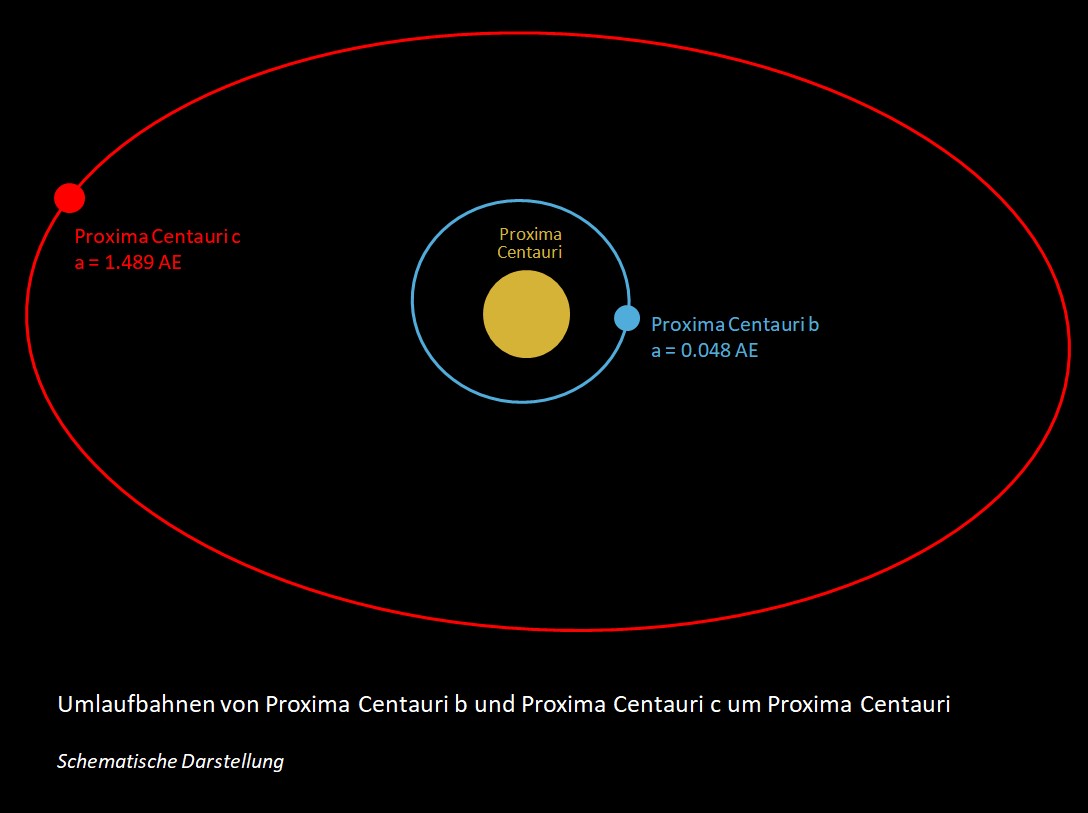
Proxima Centauri
Proxima Centauri, our nearest stellar neighbor at just over four light-years, is an M5.5V red dwarf that hosts at least one roughly Earth-mass planet, Proxima b, on an 11-day orbit near the inner edge of the habitable zone. Proxima is known for significant flare activity, including powerful outbursts observed across multiple wavelengths. These flares complicate atmospheric survival on Proxima b, but they also make the system a natural laboratory for studying star–planet interactions up close. Because of its proximity, Proxima remains a top target for detailed follow-up across radio to X-ray bands, and for future direct imaging attempts that might one day probe the planet’s atmosphere reflected light.
Artist: Stephan Tournay; Credit: Own work; License: CC BY-SA 4.0
TRAPPIST-1
Perhaps the most famous M dwarf planetary system, TRAPPIST-1 is an ultracool dwarf (late M) that hosts seven Earth-sized planets in a tightly packed, resonant chain. The planets span orbits that place several near or within nominal habitable zone distances. Because the star is so small and cool, transits by Earth-sized planets produce relatively large, frequent signals, enabling precise measurements of planet radii, densities, and dynamics. Recent JWST observations have begun to test the presence of substantial atmospheres on the inner planets. Early results suggest that at least the innermost worlds likely lack thick, hydrogen-rich envelopes, and there are indications that some may possess little or no substantial atmosphere. For potentially habitable-zone planets farther out, constraints are pending or evolving as additional data accumulate. TRAPPIST-1 is a proving ground for the techniques we will use to assess rocky exoplanets for decades.

Artist: NASA/JPL-Caltech; Credit: https://photojournal.jpl.nasa.gov/catalog/PIA24372; License: Public domain
LHS 1140
LHS 1140, a nearby mid-M dwarf, hosts at least one super-Earth/sub-Neptune in or near the habitable zone (LHS 1140 b). Its relatively large size and favorable transit geometry have made it a top target for atmospheric characterization. Observations continue to refine its mass, radius, and potential atmospheric properties, with interest in whether a thick atmosphere persists and whether the planet could sustain temperate conditions.
Kepler-186, TOI-700, and other TESS/K2 highlights
Kepler-186f orbits an early M dwarf and was among the first Earth-sized planets found in the habitable zone of another star. TESS has contributed additional nearby transiting planets around M dwarfs, including TOI-700 with multiple small planets and at least one in the habitable zone. These systems demonstrate that compact, multi-planet architectures around M dwarfs are common, providing rich laboratories for testing formation and evolution scenarios.
K2-18 and GJ 1214
K2-18 b, orbiting an early M dwarf, has garnered attention for JWST observations that revealed carbon-bearing gases such as methane (CH4) and carbon dioxide (CO2) consistent with a high-metallicity atmosphere. The planet’s size suggests it is not a rocky Earth analogue but a sub-Neptune, and its potential for a water-rich environment has been discussed in the literature. GJ 1214 b, around a mid-M dwarf, has likewise seen groundbreaking JWST phase-curve and transmission spectroscopy studies that point to a high-altitude aerosol layer and a metal-rich atmosphere. While these worlds are not Earth-like, they serve as essential benchmarks for how atmospheres around M dwarfs look and evolve across a range of planet sizes.
Taken together, these systems provide crucial evidence for how intense irradiation, atmospheric escape, and planetary bulk composition interplay. They also showcase the observational leverage that small host stars provide on transit depths and radial-velocity signals—one reason why surveys continue to prioritize M dwarf targets (see Research Frontiers).
How to Observe Red Dwarf Stars from Your Backyard
You may not be able to see most M dwarfs with the naked eye, but with a modest telescope or even binoculars you can track down a handful of nearby examples. Observing red dwarfs is different from chasing bright nebulae or planets: it’s an exercise in star-hopping, patient dark adaptation, and learning the sky’s subtlety. Here are some practical suggestions to get started.
Bright(ish) targets to try
- Lalande 21185 (Gliese 411): A relatively bright M2 dwarf at about magnitude 7.5 in Ursa Major, visible with binoculars from dark sites. Its high proper motion has carried it noticeably across the sky over decades.
- Barnard’s Star: One of the closest single stars to the Sun (about six light-years) and famous for its high proper motion. At around magnitude 9.5, it is accessible to small telescopes under reasonable skies. It lies in Ophiuchus, best seen from late spring into summer in the Northern Hemisphere.
- Kapteyn’s Star: An old, high-velocity M-type subdwarf in Pictor (Southern Hemisphere), around magnitude 8.9, observable in small telescopes.
- Wolf 359: Among the nearest stars to the Sun and a very cool M dwarf, but much fainter (approximately magnitude 13.5). This is a challenge object for moderate to larger amateur telescopes.
- Proxima Centauri: The closest star to the Sun, in Centaurus, around magnitude 11–11.5 and visible from southerly latitudes with a small telescope under good conditions.

Artist: ESO/Digitized Sky Survey 2 (Acknowledgement: Davide De Martin); Credit: https://www.eso.org/public/poland/images/eso1837d/; License: CC BY 4.0
None of these stars show disks or obvious color saturation at the eyepiece the way bright giants might. The observation is about finding and confirming a specific, historically or astrophysically interesting star. Over years, you can even follow their proper motions using careful sketches or astrophotography.
Planning tools
- Star charts and planetarium apps: Software like Stellarium, SkySafari, or desktop planetarium programs can help you locate targets and perform accurate star hops. Use field-of-view circles matched to your eyepieces and finderscope.
- Check magnitude and color index: Many catalogs list V magnitude and B–V color. M dwarfs typically have large B–V (very red), which helps distinguish them in a field if you compare relative brightness across filters.
- Use proper motion for confirmation: For stars like Barnard’s or Lalande 21185, comparing your field to older charts can reveal the shift—an engaging long-term project.
Equipment tips
- Binoculars (7×50, 10×50): Enough to catch Lalande 21185 from a dark site and to support star-hopping.
- Small telescopes (80–130 mm refractors, 150–200 mm reflectors): Ideal for Barnard’s Star and Kapteyn’s Star under moderate skies. A good finder and a low-power eyepiece are essential for identifying fields.
- Light pollution filters: Not especially helpful for stellar targets, but dark skies always help. For high proper motion studies, filters aren’t necessary; precision and patience are.
- Timing: Observe when targets are highest in the sky to minimize atmospheric extinction and improve contrast.
If you want to go beyond simple visual observation, jump to Astrophotography and Amateur Spectroscopy to learn how to record and analyze your targets.
Astrophotography and Amateur Spectroscopy of M Dwarfs
Imaging and spectroscopy push your red dwarf observing to the next level. Because these stars are faint, they reward careful technique and incremental goals. Here are practical pathways for both imaging and basic spectroscopy.
Photometry: measuring light curves
Photometry is the art of turning images into brightness measurements. For M dwarfs, photometry can capture flares, rotation-induced modulations from starspots, and—if you are ambitious and equipped—transits of exoplanets.
- Equipment: A stable equatorial mount, a cooled CMOS/CCD camera, and a telescope with good tracking are the essentials. For bright targets, even DSLR photometry can work, but dedicated astro cameras improve precision.
- Filters: Standard Johnson–Cousins or Sloan filters help calibrate results. For flare detection, unfiltered or wideband imaging can capture sudden brightenings; for more scientific value, use standardized filters (e.g., V or R).
- Technique: Take a series of short exposures (seconds to minutes), dither occasionally to reduce fixed pattern noise, and perform differential photometry using nearby comparison stars of similar color when possible.
- Targets: Flaring M dwarfs, rotational variables (look for periodicity of hours to days), and known transiting systems if your setup’s precision and timing accuracy are sufficient.
Data analysis software such as AstroImageJ, Maxim DL, or Python-based packages (e.g., photutils) can extract light curves. If you capture a flare, note the amplitude and timescale; short, impulsive events are common. Contributing your data to variable star organizations can provide value to the broader community.
Amateur spectroscopy: TiO bands and H-alpha
Low-resolution spectroscopy can reveal the molecular bands characteristic of M dwarfs. With a simple transmission grating (e.g., around 100 lines/mm) mounted in front of your camera, you can disperse a star’s light into a spectrum across your sensor.
- Features to look for: Deep TiO absorption in the red part of the spectrum and robust red/near-infrared flux compared to the blue. In active M dwarfs, the H-alpha line (656.3 nm) can appear in emission.
- Calibration: Use a known bright star or a compact fluorescent lamp spectrum for wavelength calibration. Flat-field and dark subtraction improve quality.
- Practical tips: Keep exposures short enough to avoid trailing. For faint targets, stack multiple exposures and subtract the sky background carefully, as red sky glow can be significant.
Even rudimentary spectra teach you a lot about stellar physics. It’s one thing to read that M dwarfs are cool, molecule-rich photospheres; it’s another to see TiO bands imprinted in your own data. This also builds intuition for exoplanet spectroscopy discussed in Research Frontiers.
Current Research Frontiers with JWST, TESS, and Ground Observatories
The last decade has transformed the study of M dwarfs and their planets. Space missions like TESS and JWST, together with high-precision spectrographs and imagers on the ground, are moving us from discovery to diagnosis—characterizing atmospheres, measuring masses and radii precisely, and studying star–planet interactions in unprecedented detail.
Transit and eclipse spectroscopy
Transmission spectroscopy during planetary transits samples starlight filtered through a planet’s atmosphere, while emission/thermal phase measurements during secondary eclipses and orbital phase curves probe heat redistribution and day–night contrasts. Around M dwarfs, where host stars are small and cool, the contrast for small planets improves relative to Sun-like hosts. This is why systems like TRAPPIST-1, LHS 1140, and K2-18 have been center stage for JWST’s early exoplanet programs.
- What we’re learning: For some close-in, Earth-sized M dwarf planets, strong evidence for thick hydrogen-dominated atmospheres is lacking. In several cases, data point to thin or absent atmospheres on the hottest rocky worlds. For larger sub-Neptunes and mini-Neptunes, metal-rich atmospheres and high-altitude hazes or clouds appear common.
- Implications: The trend that the smallest, hottest planets struggle to retain atmospheres aligns with models of atmospheric escape. For habitable-zone candidates, the jury is still out and planet-by-planet assessments are ongoing.
Radial velocity advances on small stars
High-resolution spectrographs using stabilized instruments and novel calibration (e.g., laser frequency combs) are pushing radial-velocity (RV) precision to the point where Earth-mass planets around M dwarfs are detectable. This is aided by the lower mass of the star: the same planet induces a larger reflex motion in an M dwarf than in a Sun-like star. However, starspot-induced RV noise can mimic planetary signals, making careful modeling of stellar activity crucial.
Stellar activity monitoring
Photometric surveys and spectroscopic activity indicators (like H-alpha and Ca II H&K proxies) allow astronomers to track rotation periods, flare rates, and magnetic cycles. For exoplanet studies, this monitoring helps disentangle stellar noise from planetary signals, improving confidence in detections and inferences about masses and atmospheric properties.
Atmospheric escape and star–planet interactions
Ultraviolet observations, especially of Lyman-alpha (121.6 nm), have revealed extended, escaping atmospheres around some close-in exoplanets. Though the coolest M dwarfs are faint in the UV compared to earlier-type stars, flares can deliver bursts of ionizing radiation. Modeling the cumulative exposure over billions of years is essential to estimate volatile loss on habitable-zone candidates—and to identify cases where robust atmospheres might endure. Radio and submillimeter observations are also probing star–planet magnetic interactions, offering another angle on whether planets host protective magnetospheres.
Population-level insights
As sample sizes grow, we can place individual systems in context. Early patterns include:
- Compact multi-planet systems: Dynamically packed worlds are common around M dwarfs. Resonant chains like TRAPPIST-1’s may be relics of migration within protoplanetary disks.
- High occurrence of small planets: Earth- to super-Earth-size planets are frequent, with occurrence rates suggesting many nearby targets for future characterization.
- Activity dependence: Smaller, cooler, and more rapidly rotating M dwarfs tend to be more active, impacting the detectability and survival of atmospheres.
This is an active, evolving field—results continue to refine as new data arrive. For specific, currently topical systems and interpretations, refer back to Notable Red Dwarf Systems.
Key Terms and Concepts for Understanding M Dwarfs
- Proton–proton chain (pp-chain): The dominant fusion pathway in low-mass stars that converts hydrogen into helium at relatively low core temperatures.
- Fully convective: A star whose interior is wholly convective, enabling efficient mixing of fuel and fusion products throughout the entire star.
- H-alpha (656.3 nm): A spectral line of hydrogen often seen in emission in active M dwarfs, tracing chromospheric activity and flares.
- Habitable zone (HZ): The circumstellar region where a planet with the right atmosphere could maintain liquid water on its surface.
- Tidal locking: A rotational state where a planet’s rotation period equals its orbital period, keeping one hemisphere permanently facing the star.
- Transit spectroscopy: A technique to study exoplanet atmospheres by analyzing starlight that filters through the planetary limb during transit.
- Radial velocity (RV): The motion of a star along our line of sight due to orbiting planets, measured as Doppler shifts in the stellar spectrum.
- Ultracool dwarf: A term for very low-temperature M dwarfs and objects cooler than M (L and T dwarfs), often at or below about 2700 K.
- Initial mass function (IMF): A statistical distribution describing the initial numbers of stars as a function of mass at birth in a stellar population; it peaks at low mass, near the M-dwarf regime.
Frequently Asked Questions
Are red dwarfs really red when seen through a telescope?
Visually, most M dwarfs are too faint for our eyes to perceive a strong red hue at small telescope apertures. Under dark skies and with larger telescopes, some may show a subtle ruddy tint, but the effect is nothing like the rich orange-red of bright giants such as Betelgeuse or Antares. Their “redness” is obvious in spectra and in long-exposure images, not usually at the eyepiece. For maximizing your chance to notice color, choose relatively brighter M dwarfs such as Lalande 21185, use low to moderate magnification, and ensure your eyes are well dark-adapted. If you’re curious about capturing their spectral imprint, see Amateur Spectroscopy.
Can planets around M dwarfs be habitable if they are tidally locked?
Yes, tidal locking does not automatically rule out habitability. Atmospheric and oceanic circulation can redistribute heat from the dayside to the nightside, potentially preventing atmospheric collapse. Climate models show that, with sufficient atmospheric mass and greenhouse gases, a tidally locked planet can sustain temperate conditions over wide regions, particularly near the day–night terminator. However, space weather and the planet’s early history (e.g., pre-main-sequence heating and water loss) remain critical factors. For broader context on the balances involved, revisit Habitability Around Red Dwarfs and the observations discussed in Notable Systems.
Final Thoughts on Exploring Red Dwarf Stars
Red dwarf stars are humble powerhouses: diminutive, cool, and dim—but cosmically consequential. They are the quiet majority builders of planetary systems and the stage for some of astronomy’s most compelling experiments in habitability. The physics of their interiors reveals how convection and fusion operate in regimes that our Sun only hints at. Their magnetism challenges straightforward relations between age, rotation, and flare activity. And their planets, more numerous and more measurable than ever, are forcing us to refine what we mean by a habitable world.
For observers, M dwarfs offer both patience and discovery. With binoculars or a small telescope you can tick off nearby examples, learn their proper motions, and track activity. With a camera and simple grating, you can pull the fingerprints of molecules from a star no larger than Jupiter. For professionals and amateurs alike, these stars bridge stellar astrophysics and exoplanet science in a way few other targets can.
Looking ahead, the synergy of JWST, TESS, and new ground-based spectrographs will sharpen the picture: which rocky planets hold onto atmospheres, how often life-friendly conditions persist, and how stellar activity cycles influence the long-term stability of planetary climates. As we gather more spectra, phase curves, and flare statistics, population-level patterns will emerge that turn today’s case studies into tomorrow’s laws.
If this overview deepened your appreciation for the coolest, smallest stars, explore related topics like planetary formation and atmospheric escape, or jump straight into backyard projects outlined in How to Observe Red Dwarfs and Astrophotography and Spectroscopy. And if you’d like more weekly deep dives like this—ranging from stellar physics to exoplanet discoveries—subscribe to our newsletter so you never miss a new article.