
Table of Contents
- What Is the Interstellar Medium? Gas, Dust, and Plasma Between Stars
- Components of the Interstellar Medium: Atomic, Molecular, Ionized, and Dust
- Physical Conditions: Density, Temperature, Pressure, and Turbulence
- Interstellar Dust, Extinction Curves, and Polarization
- Cosmic Chemistry: Molecules, Ices, and Complex Organics
- How We Observe the ISM: Radio to X-ray Diagnostics
- Star Formation and Feedback: A Cyclical Ecosystem
- The Interstellar Medium Across Galaxy Types and Cosmic Time
- Magnetic Fields, Cosmic Rays, and Multiphase Balance
- Simulations and Theory: Multiscale Models of the ISM
- Key Missions, Surveys, and Instruments Mapping the ISM
- Hands-On Learning: How Amateurs Can Explore the ISM
- Frequently Asked Questions
- Final Thoughts on Exploring the Interstellar Medium
What Is the Interstellar Medium? Gas, Dust, and Plasma Between Stars
The interstellar medium (ISM) is the matter—primarily gas and dust—that fills the space between stars within galaxies. It may be tenuous compared to Earth’s atmosphere, but it is far from empty. The ISM contains the raw materials that form new stars and planets, it regulates how galaxies evolve, and it sculpts what we see when we look at the night sky. From cold molecular clouds to million-degree plasma, the ISM spans a vast range of temperatures, densities, and ionization states, tying together microscopic atomic processes and macroscopic galactic dynamics.

In one of the most detailed astronomical images ever produced, NASA/ESA’s Hubble Space Telescope captured an unprecedented look at the Orion Nebula. This extensive study took 105 Hubble orbits to complete. All imaging instruments aboard the telescope were used simultaneously to study Orion. The Advanced Camera mosaic covers approximately the apparent angular size of the full moon.
Key reasons the ISM matters include:
- Star formation: Dense pockets of the ISM collapse to create stellar nurseries. Understanding the ISM clarifies why star formation is slow, bursty, or quenched in different environments.
- Feedback and recycling: Massive stars inject energy and material back into the ISM through winds and supernovae, enriching it with heavy elements and reshaping its structure.
- Observational effects: Dust in the ISM dims and reddens starlight, while gas emits and absorbs at characteristic wavelengths. Interpreting astronomical data requires accounting for these effects.
- Planet-forming chemistry: The ISM’s molecules and ices set the stage for the chemical inventory inherited by protoplanetary disks and, ultimately, planets.
Despite its crucial role, the ISM is not a monolithic entity. It is multiphase: a dynamic tapestry of cold, warm, and hot gas that coexist in approximate pressure balance, punctuated by magnetic fields, turbulence, and cosmic rays. To navigate this complexity, astronomers often break the ISM into physically motivated components, as we explore in Components of the Interstellar Medium.
Components of the Interstellar Medium: Atomic, Molecular, Ionized, and Dust
The ISM is commonly categorized by phase (temperature and density), composition (atomic, molecular, ionized), and by environmental zone (e.g., photodissociation regions near bright stars). While boundaries are fuzzy, this structure helps observers choose diagnostic lines and helps theorists model the ISM’s energy balance.
Cold Neutral Medium (CNM) and Warm Neutral Medium (WNM)
The neutral atomic phase comes in two canonical flavors:
- CNM: Dense and cold neutral hydrogen (H I). Typical densities n ≈ 10–100 cm−3, temperatures T ≈ 50–100 K. Clumpy, often organized into filaments and sheets.
- WNM: More diffuse and warmer neutral hydrogen. n ≈ 0.2–0.5 cm−3, T ≈ 6,000–10,000 K. Occupies larger volumes and forms the backdrop for much of the Milky Way’s H I emission.
Transitions between CNM and WNM are mediated by heating and cooling processes, pressure forces, and turbulence (see Physical Conditions). The 21-cm hyperfine line of H I is the key tracer of both CNM and WNM, with line widths and absorption/emission ratios providing temperature and density diagnostics (see How We Observe the ISM).
Warm Ionized Medium (WIM) and Hot Ionized Medium (HIM)
Ionized gas pervades galaxies in multiple contexts:
- WIM: Diffuse, warm (~8,000 K) plasma with ne ≈ 0.03–0.1 cm−3. Ionized by ultraviolet photons from massive stars that escape H II regions into the wider ISM.
- HIM: Very hot (T ≈ 106 K) and tenuous (n ≲ 0.003 cm−3) plasma generated by supernova shocks and stellar winds. Fills bubbles and superbubbles that sometimes break out of the galactic disk.
These ionized phases are crucial for understanding diffuse Hα emission, X-ray background from hot plasma, and Faraday rotation of polarized radio sources tracing magneto-ionic structure (see Magnetic Fields, Cosmic Rays, and Multiphase Balance).
Molecular Clouds and Photodissociation Regions (PDRs)

This image shows the full survey of the inner Orion Nebula and Trapezium Cluster made using the NIRCam instrument on the NASA/ESA/CSA James Webb Space Telescope. This is the long-wavelength colour composite, which focuses on the gas, dust, and molecules in the region with unprecedented sensitivity in the thermal infrared.
Molecular gas—primarily H2—resides in cold, dense clouds where dust shields molecules from destructive ultraviolet radiation. Typical giant molecular cloud conditions: n ≈ 102–105 cm−3, T ≈ 10–20 K. These clouds host star formation in their densest cores.
PDRs are the interfaces between H II regions and molecular clouds where far-ultraviolet photons heat gas and dissociate molecules. They are bright in infrared fine-structure lines (e.g., [C II] 158 μm) and in polycyclic aromatic hydrocarbon (PAH) features (see Cosmic Chemistry).
Interstellar Dust
Dust grains—submicron particles of silicates, carbonaceous material, and ices—represent about 1% of the ISM mass but have outsized influence. Dust absorbs and scatters starlight (extinction), re-radiates in the infrared, catalyzes the formation of H2, and aligns with magnetic fields to polarize light (see Interstellar Dust, Extinction Curves, and Polarization).
Together, these components create a multiphase ecosystem that constantly exchanges mass and energy via shocks, radiation, and turbulent mixing. The next step is to quantify the conditions within and between these phases.
Physical Conditions: Density, Temperature, Pressure, and Turbulence
The ISM spans extreme parameter space. A few characteristic numbers anchor our intuition:
- Density (n): From ~106 cm−3 in dense cores to ~10−4 cm−3 in hot, diffuse halos.
- Temperature (T): From ~10 K in cold molecular regions to ~106 K in hot ionized bubbles.
- Thermal pressure (P/kB): Often a few 103–104 K cm−3 in the Milky Way’s disk, though local variations are substantial.
- Magnetic fields (B): Typically a few microgauss (μG) in the Galactic disk, with enhanced fields in dense clouds and star-forming regions.
Heating and Cooling
Thermal balance in the ISM arises from the competition between heating and cooling. Major heating channels include photoelectric emission from dust grains (especially small grains/PAHs), cosmic-ray ionization, and shock/compressional heating. Cooling is provided by line emission from abundant species: [C II] 158 μm and [O I] 63 μm in neutral gas, infrared molecular lines (e.g., CO rotational ladder) in cold regions, optical/UV lines from ions (e.g., [N II], [O III]) in ionized gas, and X-ray lines in hot plasmas.
The resulting thermal structure is bimodal in neutral gas: CNM and WNM phases are thermally stable at different pressures; intermediate temperatures can be unstable. This classic two-phase model is expanded in modern contexts to include warm ionized and hot ionized phases, resulting in a multiphase medium.
Turbulence and Structure
The ISM is turbulent, with energy injected at large scales by stellar feedback (supernovae, winds) and possibly by galactic rotation/shear. Turbulent cascades transport energy to smaller scales, where it dissipates by shocks and ion-neutral friction. Observational evidence includes power-law power spectra of emission fluctuations and linewidth-size relations in molecular clouds. Magnetohydrodynamic (MHD) turbulence introduces anisotropy, aligning eddies with magnetic fields and modifying cascade properties (see Magnetic Fields, Cosmic Rays, and Multiphase Balance).
Gravity, Support, and the Jeans Criterion
Whether a cloud collapses depends on the competition between self-gravity and support from thermal pressure, turbulence, and magnetic fields. The Jeans mass sets a characteristic scale above which gravity wins, but in practice the multiphase, turbulent nature of the ISM means collapse proceeds hierarchically and intermittently. Observations indicate that only a small fraction of molecular gas forms stars per free-fall time, a key clue to the role of turbulence and magnetic support (explored further in Star Formation and Feedback).
Interstellar Dust, Extinction Curves, and Polarization

This image shows a colour composite of visible and near-infrared images of the dark cloud Barnard 68 . It was obtained with the 8.2-m VLT ANTU telescope and the multimode FORS1 instrument in March 1999. At these wavelengths, the small cloud is completely opaque because of the obscuring effect of dust particles in its interior.
Dust grains shape our view of the cosmos. Their absorption and scattering cause extinction, dimming and reddening starlight along the line of sight. The wavelength dependence is encapsulated in the extinction curve, often parameterized by RV = A(V)/E(B−V). Typical diffuse Milky Way sightlines have RV ≈ 3.1, while dense regions can exhibit higher values (e.g., RV ≈ 4–5), reflecting larger average grain sizes.
Composition and Spectral Features
Interstellar dust shows distinct spectral signatures:
- Silicate features at ~9.7 μm and ~18 μm in absorption (Si–O stretching and O–Si–O bending).
- Carbonaceous features, including the ~2175 Å UV bump, likely linked to aromatic carbon or small graphite-like grains.
- Diffuse interstellar bands (DIBs)—hundreds of broad absorption features in the optical/near-IR, with carriers including complex molecules; some have been linked to specific ions (e.g., C60+).
Dust composition and grain size distributions evolve due to processes like accretion of mantles (e.g., icy coatings in cold clouds), grain growth by coagulation, and destruction by shocks and sputtering in hot gas.
Polarization and Magnetic Fields
Aspherical dust grains tend to align their short axes with the local magnetic field, likely via radiative alignment torques. This alignment polarizes starlight (by selective extinction) and polarizes dust thermal emission. Polarization maps, especially at submillimeter wavelengths, trace the plane-of-sky magnetic field morphology and have revealed filamentary structures aligned with magnetic fields in diffuse gas.
Practical Consequences of Extinction
For observers, extinction implies that measured magnitudes and colors require dereddening using an extinction law appropriate to the line of sight. Infrared observations help peer through dusty regions, while UV observations are particularly sensitive to dust attenuation. Extinction also affects inferred distances and luminosities, a theme that recurs in observational diagnostics and in planning hands-on projects.
Cosmic Chemistry: Molecules, Ices, and Complex Organics
The ISM is a chemical factory. Despite low densities and temperatures, reactions proceed over astronomical timescales, catalyzed by dust grain surfaces and driven by radiation fields and cosmic rays. Molecular gas begins with the formation of H2, which predominantly occurs on dust grains where two H atoms can meet and bond, then desorb back into the gas phase.
Key Molecules and Tracers
Carbon monoxide (CO) is the most commonly used tracer of molecular gas due to its bright rotational lines, especially the J=1→0 transition at 115 GHz. Other important molecules include OH, HCO+, HCN, CN, and NH3, each probing different densities and temperatures. In cold cores, deuterated species (e.g., N2D+) trace extremely cold, dense gas where CO freezes out onto grains.
Ice Mantles and Complex Organic Molecules (COMs)
In shielded, cold environments, molecules freeze onto dust grains forming ice mantles dominated by H2O, CO, CO2, CH3OH, and others. Ultraviolet photons and cosmic rays can process these ices, producing more complex species. Observations in star-forming regions and cold cores have revealed complex organic molecules—including methanol derivatives, formamide (NH2CHO), and others—indicating that prebiotic chemistry can begin in the ISM well before planet formation.
Photodissociation Regions and Chemical Stratification
In PDRs, intense UV radiation dissociates molecules and heats gas through the photoelectric effect. Chemical stratification arises: atomic species dominate the outer layers (e.g., C+), CO survives deeper inside where shielding is effective, and ices form in the coldest, densest regions. PDRs are strong in [C II], [O I], and PAH emission, and they anchor empirical diagnostics linking star formation with ISM line luminosities.
Isotopologues and Abundances
Isotopologues (e.g., 13CO, C18O) allow optical-depth corrections and chemical abundance studies. Fractionation and selective photodissociation can alter isotopologue ratios relative to elemental abundances, a key consideration when converting line intensities to masses.
How We Observe the ISM: Radio to X-ray Diagnostics
No single wavelength reveals the ISM. Instead, astronomers combine observations across the electromagnetic spectrum to decipher gas phases, dust properties, magnetic fields, and kinematics. Below are the cornerstone diagnostics used to study the ISM’s components described in Components of the ISM and the conditions in Physical Conditions.
Radio and (Sub)Millimeter
- H I 21-cm line (1.42040575177 GHz): The workhorse for mapping atomic hydrogen. Emission reveals column density and velocity structure; absorption against background continuum sources gives spin temperatures and CNM/WNM decomposition.
- CO rotational lines: CO(1–0) at 115.271 GHz and higher-J lines trace molecular gas. Combined with a conversion factor (XCO), they estimate H2 mass, though XCO depends on metallicity, radiation field, and dynamics.
- Dense gas tracers: HCN, HCO+, CS transitions probe n ≳ 104–105 cm−3 regions within molecular clouds.
- Continuum emission: Synchrotron radiation from cosmic-ray electrons traces magnetic fields and relativistic particle densities; free-free emission traces ionized gas; thermal dust emission becomes strong into the submillimeter/far-infrared.
Infrared and Far-Infrared

This wide-field view of the Orion Nebula (Messier 42), lying about 1350 light-years from Earth, was taken with the VISTA infrared survey telescope at ESO’s Paranal Observatory in Chile. The new telescope’s huge field of view allows the whole nebula and its surroundings to be imaged in a single picture and its infrared vision also means that it can peer deep into the normally hidden dusty regions and reveal the curious antics of the very active young stars buried there.
- Dust thermal emission: Peaks at ~100 μm for typical diffuse ISM temperatures. Allows mapping of dust column density and temperature.
- Fine-structure lines: [C II] 158 μm, [O I] 63 μm, [N II] 122/205 μm probe gas heating and ionization in PDRs and H II regions.
- PAH features: Mid-infrared emission bands trace small aromatic molecules excited by UV photons, often associated with star-forming regions.
Optical and Ultraviolet
- Recombination and forbidden lines: Hα maps ionized gas; [S II], [N II], [O III] diagnose temperature, density, and ionization states.
- Absorption-line spectroscopy: Against bright stars or quasars, UV absorption reveals column densities of ions (e.g., Si II, C IV) and molecules (e.g., H2, CO), providing precise abundances and kinematics.
- Extinction and DIBs: Optical photometry and spectroscopy measure reddening and reveal DIB carriers, connecting to dust properties.
X-ray and Gamma-ray
- Soft X-ray emission/absorption: Traces hot (106 K) gas in bubbles and halos via metal lines (e.g., O VII, O VIII).
- Gamma rays: Arise from cosmic-ray interactions (e.g., pion decay), correlating with total gas content and helping calibrate cosmic-ray densities.
Magnetic Field Probes
- Polarization: Starlight polarization (absorption) and submillimeter dust polarization (emission) trace plane-of-sky magnetic field orientation.
- Faraday rotation: Frequency-dependent rotation of polarization angle in radio sources constrains line-of-sight magnetic fields and electron densities.
- Zeeman effect: Splitting of spectral lines (e.g., H I, OH, CN) directly measures magnetic field strength along the line of sight in selected regions.
By synthesizing these diagnostics, astronomers build a coherent picture of the ISM’s phases and dynamics, a prerequisite for understanding star formation and feedback.
Star Formation and Feedback: A Cyclical Ecosystem
Star formation transforms dense molecular gas into stars, but the process is inefficient and self-regulating. Only a few percent of gas converts into stars per free-fall time in typical molecular clouds. Feedback from newly formed stars then injects energy and momentum into the surrounding ISM, disrupting clouds, driving turbulence, and enriching gas with metals.
From Clouds to Cores to Stars
Star formation begins when gravitational instabilities focus gas into dense filaments and clumps. Magnetic fields and turbulence create a complex landscape of over- and under-densities. Dense cores (n ≳ 105 cm−3) form within filaments, eventually collapsing into protostars. Angular momentum and magnetic braking channel inflow into disks, where planet formation seeds are laid. Observations of core mass functions resemble the stellar initial mass function (IMF) with an offset, hinting at an imprint of cloud fragmentation on stellar masses.
Feedback Mechanisms
- Radiation pressure and photoionization: Massive stars emit copious UV photons that ionize and heat surrounding gas, creating H II regions and PDRs that can both compress and erode molecular material.
- Stellar winds and outflows: Protostellar jets and winds clear cavities; O-star winds carve bubbles in the ISM, injecting turbulent energy.
- Supernova explosions: Endpoints of massive stars that drive strong shocks, heat gas to X-ray emitting temperatures, and seed the ISM with heavy elements and dust.
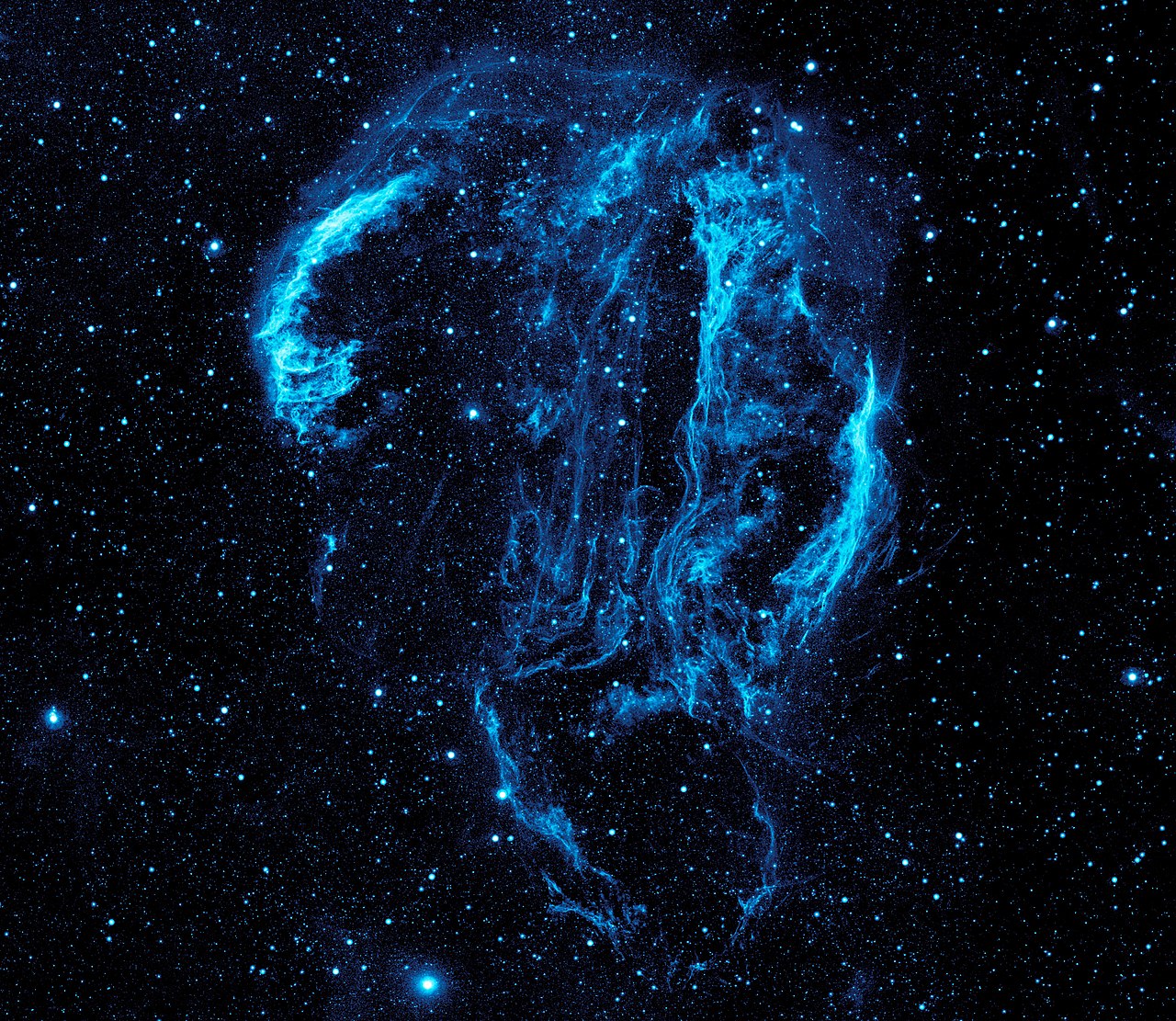
Artist: NASA/JPL-Caltech
Wispy tendrils of hot dust and gas glow brightly in this ultraviolet image of the Cygnus Loop Nebula, taken by NASA’s Galaxy Evolution Explorer. The nebula lies about 1,500 light-years away, and is a supernova remnant, left over from a massive stellar explosion that occurred 5,000-8,000 years ago.
- Cosmic rays: Accelerated in shocks, they permeate the ISM, heating and ionizing gas, and exerting pressure that can drive large-scale flows.
The interplay of these processes shapes giant bubbles and superbubbles. Some blow out of galactic disks, launching fountains of gas that later rain back, mixing metals and sustaining a galactic baryon cycle.
Global Star Formation Laws
On kiloparsec scales, the star formation rate surface density correlates with the gas surface density, a relationship often expressed as the Kennicutt–Schmidt law. While its slope and normalization vary with environment and gas phase, the broad trend underscores the link between gas supply and star formation output. Understanding the microphysics within clouds informs how this global relation emerges.
The Interstellar Medium Across Galaxy Types and Cosmic Time
The ISM’s properties vary strongly with galactic environment. Spiral galaxies like the Milky Way host multiphase disks with organized magnetic fields, molecular rings, and hot halos. Dwarf galaxies, with lower metallicities and weaker gravity, often have reduced dust-to-gas ratios, affecting molecular cloud formation and the visibility of CO. Starburst galaxies—undergoing intense star formation—exhibit high pressures, elevated dense gas fractions, and powerful outflows that reshape their circumgalactic media.
Low Metallicity and the CO–H2 Connection
At low metallicity, dust shielding is reduced, allowing UV photons to dissociate CO more easily while H2 can still self-shield. This creates “CO-dark” molecular gas, complicating mass estimates based solely on CO. Alternative tracers (e.g., [C II]) and dust-based methods help fill the gap.
Elliptical Galaxies and Hot Halo Gas
Ellipticals and bulge-dominated systems often contain relatively little cold gas but substantial hot X-ray emitting halos. Nevertheless, molecular gas and dust are sometimes present, acquired via mergers or residual cooling, and can fuel low-level star formation or active galactic nuclei (AGN) activity.
High-Redshift ISM
In the early universe, galaxies were gas-rich, and the ISM was often more turbulent and clumpy. Observations with millimeter arrays have revealed abundant molecular gas and dust in galaxies at z > 1, with scaling relations between gas fraction, star formation rate, and stellar mass that evolve over cosmic time. These data provide boundary conditions for
simulations seeking to connect small-scale physics to galaxy formation.
Magnetic Fields, Cosmic Rays, and Multiphase Balance
Magnetic fields and cosmic rays are integral to the ISM’s energy budget. In the Milky Way, the energy densities of turbulence, magnetic fields, and cosmic rays are each of order ~1 eV cm−3, suggesting near-equipartition. This parity means that neither gravity nor thermal pressure alone dictates ISM structure: MHD forces, cosmic-ray pressure, and turbulent ram pressure are equally consequential.
Field Morphology and Dynamics
Galactic magnetic fields contain both ordered (large-scale) and random (turbulent) components. Dynamo processes, differential rotation, and turbulence maintain these fields. In dense molecular regions, magnetic fields can slow collapse (ambipolar diffusion mediates ion-neutral drift), whereas in diffuse gas they guide and anisotropically distribute turbulent energy.
Cosmic-Ray Transport and Heating
Cosmic rays propagate along magnetic field lines, scattering off MHD waves. Their streaming and diffusion are central to how they heat gas and exert pressure gradients. Observationally, gamma rays from cosmic-ray interactions trace total gas columns and constrain cosmic-ray densities; radio synchrotron provides complementary constraints on electrons and magnetic fields.
Thermal Instability and Phase Balance
In the neutral medium, the cooling curve shape can render intermediate temperatures thermally unstable, driving gas to either CNM or WNM (
see Components). Turbulent mixing, conduction, and local heating reconcile the coexistence of phases under comparable pressures. The addition of cosmic-ray and magnetic pressures further stabilizes structures, particularly filaments and shells seen in both H I and dust emission.
Simulations and Theory: Multiscale Models of the ISM
Numerical simulations are indispensable because the ISM is non-linear, multiphase, and spans orders of magnitude in scale. Modern codes solve the MHD equations with self-gravity, chemistry, radiative cooling/heating, and feedback sources. Simulations face a tension: capturing galactic environments (tens of kiloparsecs) while resolving core scales (sub-parsec). Strategies include adaptive mesh refinement, moving meshes, and subgrid models for star formation and feedback.
From Supernova-Driven Turbulence to Cloud Lifecycles
Simulations show that clustered supernovae carve superbubbles, drive turbulence, and produce a patchwork of hot, warm, and cold gas. Molecular clouds can be assembled by large-scale flows and spiral-arm dynamics, then destroyed by feedback from the stars they form. The emerging picture emphasizes a short lifecycle for molecular clouds—tens of millions of years—regulated by the balance of accretion and destruction.
Coupled Chemistry and Radiation
Including simplified chemical networks and radiative transfer enables simulations to predict CO and H I emission, dust extinction, and line diagnostics comparable to observations. These models are crucial to interpret surveys like those in Key Missions and Surveys and to test theories of efficiency and feedback.
Open Challenges
- Resolving the role of magnetic reconnection and non-ideal MHD effects (e.g., ambipolar diffusion, Hall effect) in cloud evolution.
- Predicting star formation rates and dense gas fractions across environments without fine-tuning parameters.
- Modeling cosmic-ray transport self-consistently with MHD turbulence and feedback.
Key Missions, Surveys, and Instruments Mapping the ISM
Progress in ISM science is inseparable from advances in instrumentation and survey design. A non-exhaustive tour:
Neutral and Molecular Gas
- HI4PI: An all-sky H I survey combining multiple facilities to deliver high-resolution 21-cm maps of the Milky Way’s atomic gas.
- ALFALFA: A blind extragalactic H I survey with the Arecibo Observatory, cataloging thousands of galaxies and mapping their atomic gas content.
- PHANGS-ALMA: A high-resolution CO survey of nearby galaxies, connecting molecular cloud populations to star formation on kiloparsec scales.
Dust and Infrared Diagnostics
- Planck: All-sky maps of dust emission and polarization, revolutionizing our view of Galactic magnetic fields and the diffuse ISM.
- Herschel: Far-infrared imaging and spectroscopy that traced cold dust and key cooling lines ([C II], [O I]).
- Spitzer: Mid-infrared imaging and spectroscopy, including PAH features and warm dust emission in star-forming regions.
Ionized Gas and Hot Plasma
- Hα surveys: Wide-field optical surveys mapping diffuse ionized gas in the Milky Way and external galaxies.
- eROSITA: X-ray all-sky survey revealing hot gas structures in the Milky Way and galaxy clusters.
Magnetic Fields and Cosmic Rays
- LOFAR and VLA polarization programs: Measure Faraday rotation and synchrotron emission to map magnetic field structure.
- Fermi-LAT: Gamma-ray observations constraining cosmic-ray interactions with gas and radiation fields.
Stellar and 3D Dust Mapping
- Gaia: Precise parallaxes and photometry enabling three-dimensional dust maps when combined with stellar colors.
- Pan-STARRS and other optical surveys: Photometric data sets underpinning extinction mapping and ISM tomography.
New and Upcoming Facilities
- JWST: Infrared spectroscopy (e.g., NIRSpec, MIRI) probing ices, PAHs, and warm molecular gas in unprecedented detail.
- SKA and pathfinders (ASKAP, MeerKAT): Next-generation H I and continuum surveys mapping gas flows, magnetic fields, and cosmic-ray halos.
- ngVLA: Proposed array targeting high-resolution studies of molecular gas and star formation physics.
Hands-On Learning: How Amateurs Can Explore the ISM
While many ISM observations require major facilities, there are accessible ways for students and enthusiasts to engage with ISM science using public data, modest equipment, and software tools.
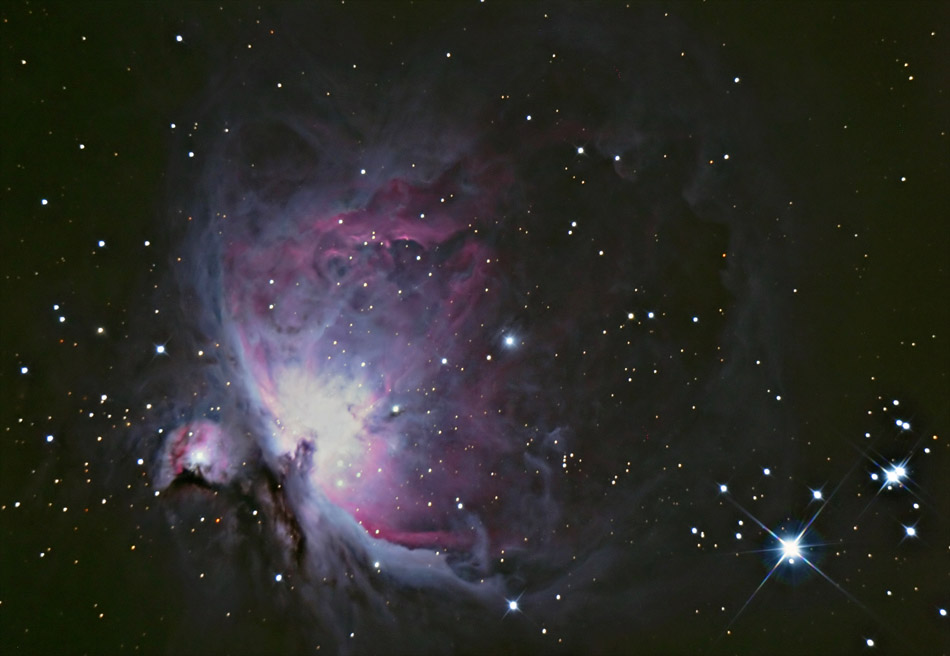
Photo of the Orion Nebula (also known as Messier 42, or NGC 1976). Photo taken in Gaisberg, Salzburg (Austria).
Explore Public Surveys and 3D Dust Maps
- Use all-sky H I maps (e.g., HI4PI) and dust maps (e.g., Planck) to visualize Galactic structures like loops, shells, and filaments.
- Leverage 3D dust maps constructed from Gaia and optical surveys to estimate extinction along sightlines to targets of interest.
In Python, the dustmaps package provides programmatic access to several 3D dust maps. Example snippet to query reddening E(B−V) along a line of sight:
from dustmaps.config import config
from dustmaps.bayestar import BayestarWebQuery
from astropy.coordinates import SkyCoord
import astropy.units as u

# Set a directory to cache downloads
config['data_dir'] = '/path/to/dustmaps'

# Create a sky coordinate (Galactic coordinates can also be used)
coord = SkyCoord(ra=83.6331*u.deg, dec=22.0145*u.deg, frame='icrs')

# Query Bayestar map at a set of distances
bayestar = BayestarWebQuery(version='2019')
distances = [0.5, 1.0, 2.0]  # in kpc
for d in distances:
    ebv = bayestar(coord, d)
    print(f"Distance: {d} kpc, E(B-V): {ebv:.3f}")
This simple script highlights how extinction accumulates with distance, connecting directly to concepts from dust and extinction.
Backyard Radio Astronomy at 21 cm
Some amateurs build small 21-cm receivers with software-defined radios and home-built antennas to detect the Milky Way’s H I emission. While angular resolution is modest, it’s possible to measure the H I line, track Galactic rotation signatures in velocity profiles, and map bright regions in the plane. Safety note: ensure appropriate radio regulations in your region and avoid transmitting; passive reception is typically fine.
Citizen Science
- Projects like the Milky Way Project have invited volunteers to identify bubbles and structures in infrared images, features often tied to feedback and PDRs.
- Optical photometry campaigns can measure reddening toward clusters, an indirect window into extinction patterns.
Comparing Multiwavelength Views
Use astronomical visualization tools to overlay radio, infrared, optical, and X-ray data. Comparing the morphology across bands reveals how different ISM phases line up, connect, or avoid one another, reinforcing the multiphase picture developed in Physical Conditions.
Frequently Asked Questions
Is space empty?
No. Even the most diffuse regions within galaxies contain gas, dust, magnetic fields, and cosmic rays. In the Milky Way’s disk, typical densities are about one atom per cubic centimeter—trillions of times less dense than Earth’s atmosphere, but enough to influence starlight, form new stars, and power emission across the spectrum.
How does the ISM affect what we see of distant stars?
Dust grains absorb and scatter blue light more efficiently than red light, causing stars to appear dimmer and redder than they intrinsically are. Gas along the line of sight imprints absorption lines that can reveal velocity and composition. Correcting for extinction and accounting for gas absorption are essential for accurate distances, luminosities, and stellar properties.
Final Thoughts on Exploring the Interstellar Medium
The interstellar medium is the connective tissue of galaxies. Its gases and dust seed star birth, its turbulence and magnetic fields sculpt cosmic structures, and its chemistry sets the stage for planets and potentially for life’s building blocks. By uniting radio, infrared, optical, ultraviolet, X-ray, and gamma-ray observations with theory and simulation, astronomers have assembled a coherent, albeit incomplete, portrait of a multiphase ecosystem governed by energy exchange and feedback.
As instruments sharpen and surveys expand, we are poised to resolve long-standing puzzles: how clouds assemble and disperse, how cosmic rays and magnetic fields regulate star formation, and how the ISM evolves across cosmic time. For curious readers and aspiring observers, today’s open data and tools offer hands-on ways to join the exploration—from mapping extinction to detecting the H I line from your backyard.
If you found this deep dive into the ISM valuable, consider subscribing to our newsletter to stay updated on forthcoming articles. We’ll continue exploring the physics that connect small-scale processes in the ISM to the grand narratives of galaxy formation and evolution.