
Table of Contents
- What Beginners Need to Know Before Buying a Telescope
- Refractors vs Reflectors vs Catadioptrics: Optical Designs Explained
- Aperture, Focal Length, f/ratio, and Magnification
- Mount Types Compared: Alt-Azimuth, Equatorial, and Dobsonian
- What You Can See: Planets, Moon, Star Clusters, Nebulae, and Galaxies
- Essential Accessories and Upgrades for First-Time Observers
- Budget Tiers and Smart Shopping: Getting the Best Value
- Setup, Collimation, Cooling, and Basic Maintenance
- Avoiding Common Pitfalls and Misleading Marketing Claims
- Learning the Sky: Apps, Star Hopping, and Observing Techniques
- Frequently Asked Questions
- Final Thoughts on Choosing the Right First Telescope
What Beginners Need to Know Before Buying a Telescope
Choosing a first telescope is exciting, but the options can feel overwhelming. If you’ve been browsing product pages and reading specs like “aperture,” “focal length,” and “EQ mount,” you’re already encountering a new vocabulary that actually points to simple ideas. In this practical guide, we’ll demystify telescopes so you can choose the right tool for your sky, your goals, and your budget.
Before you dive into models, take a moment to clarify your observing goals. Do you want sharp views of the Moon and planets from a light-polluted city? Are you drawn to wide-field sweeps of star fields and bright nebulae from dark sites? Or do you want something that can grow with you into astrophotography later? Each answer nudges you toward a different optical design and mount type.

Attribution: James Stewart; Public domain via Wikimedia Commons.
As a beginner, you’ll generally have the best learning experience with a telescope that:
- Sets up quickly and encourages frequent use.
- Has sufficient aperture for your targets and typical sky conditions.
- Sits on a stable, intuitive mount that doesn’t fight you.
- Includes eyepieces and accessories that provide useful magnifications and fields of view.
Two helpful rules of thumb guide many first-time buyers:
- Aperture matters: The diameter of the main lens or mirror largely determines how faint an object you can see. More aperture gathers more light and improves resolution, but also increases size, weight, and cooldown time.
- Mount matters even more: A great telescope on a shaky mount delivers a frustrating experience. A modest scope on a stable mount often shows more, because you can actually focus and track the target comfortably.
Throughout this guide we’ll connect each decision (optical design, aperture, focal ratio, and mount) to outcomes at the eyepiece. If you want a quick primer on what the numbers mean, jump to Aperture, Focal Length, f/ratio, and Magnification. Curious about the pros and cons of refractors versus reflectors? See Refractors vs Reflectors vs Catadioptrics. Wondering where the budget sweet spots are? Head to Budget Tiers and Smart Shopping.
Refractors vs Reflectors vs Catadioptrics: Optical Designs Explained

Attribution: OpenStax/Rice University (CC BY 4.0) via Wikimedia Commons.
Most beginner telescopes fall into three families of optical design. Each can be excellent when well-made and properly supported by a suitable mount. Understanding how they differ will help you match the instrument to your goals and observing environment.
Refractors (Lens-Based)
Refractors use lenses to bend and focus light. They’re popular for beginners because they’re intuitive: point and look. They hold alignment well and typically require little to no maintenance beyond basic care.

Key characteristics of refractors:
- Pros: Quick to deploy, generally sharp and high-contrast views; low maintenance; great for the Moon, planets, double stars, and wide-field scanning (especially with shorter focal length models).
- Cons: Aperture costs rise quickly; long tubes can be unwieldy; simpler doublet designs may show chromatic aberration (false color fringes) on bright targets at high magnification, especially at fast focal ratios.
Common beginner sizes range from 70 mm to 102 mm. An 80 mm refractor on a stable alt-az mount offers a wonderful quick-look setup. For planets and the Moon, a longer focal length refractor (higher f/ratio) can provide cleaner color correction in affordable designs.
Reflectors (Mirror-Based)
Reflectors use mirrors and deliver the most aperture per dollar. Dobsonian reflectors—Newtonian optics on a simple alt-az base—are especially beginner-friendly because they combine large light-gathering power with a stable, intuitive mount.
Key characteristics of reflectors:
- Pros: Excellent value for aperture; bright, detailed views of deep-sky objects; Dobsonian mounts are stable and easy to use; no color fringing.
- Cons: Require occasional collimation (optical alignment); need time to reach thermal equilibrium; bulkier than refractors of the same aperture.
A 150–200 mm (6–8 inch) Dobsonian is a classic first telescope for visual observers. Under decent skies, it reveals star clusters, nebulae, many galaxies, and delivers strong planetary performance. If portability is a concern, compact 130 mm tabletop reflectors are a compelling alternative when paired with a sturdy surface.
Catadioptrics (Mirror-Lens Hybrids)
Catadioptric designs such as Maksutov-Cassegrains (Mak) and Schmidt-Cassegrains (SCT) fold the optical path, packing long focal length into compact tubes. They are popular for their versatility and transportability.

Attribution: CC BY-SA 4.0 via Wikimedia Commons.
Key characteristics of catadioptrics:
- Pros: Compact; excellent for high magnification on the Moon and planets (especially Maks); closed tubes reduce dust; good all-rounders when paired with a suitable mount.
- Cons: Longer cool-down time than small refractors; narrower maximum field of view for a given aperture; often cost more than similar-aperture reflectors.
Small Maksutov-Cassegrains (90–127 mm) excel for grab-and-go lunar and planetary observing. SCTs in the 150–200 mm range offer a versatile platform for a wide variety of targets, especially if you later add tracking or GoTo features on an equatorial or computerized alt-az mount.
Quick tip: If you want the brightest deep-sky views for the price, consider a Dobsonian. If you want a maintenance-light experience and crisp lunar/planetary views, a refractor is hard to beat. If you want compact versatility and later upgrades like tracking, a small Mak or SCT is appealing.
Aperture, Focal Length, f/ratio, and Magnification
Specs like “130 mm f/5” or “80 mm f/7.5” pack a lot of information about how a telescope behaves. Here’s how to decode them and apply them to your decision.
Aperture
Aperture is the diameter of the main lens or mirror, usually given in millimeters (mm) or inches. It sets two crucial limits: how much light the telescope gathers and its theoretical resolving power.
- Light gathering increases as the square of the aperture. For example, a 200 mm scope gathers about 2.8× as much light as a 120 mm scope (because 200² / 120² ≈ 2.78).
- Resolution improves with larger aperture, allowing you to separate closer double stars and see finer planetary details—assuming the atmosphere (“seeing”) cooperates.
Focal Length and f/ratio
Focal length is the distance over which the telescope brings light to focus. Divide the focal length by the aperture to get the focal ratio (f/ratio). The f/ratio describes how “fast” or “slow” the optical system is.
- Fast (low f/ratio), e.g., f/4 to f/6: Wider fields of view with a given eyepiece; better for sweeping star fields and large nebulae; more demanding on eyepiece quality in reflectors; reflectors may show coma toward the edge at very fast ratios unless corrected.
- Slow (high f/ratio), e.g., f/8 to f/15: Narrower fields, higher magnification with the same eyepiece; often easier on eyepieces; refractors at higher f/ratios tend to have reduced chromatic aberration.
Magnification, Exit Pupil, and Field of View
Magnification depends on both the telescope and eyepiece. Three simple formulas explain much of what you’ll experience at the eyepiece.
  Magnification (M) = Telescope focal length / Eyepiece focal length

  Exit pupil (mm)   = Eyepiece focal length / Telescope f/ratio

  True FOV (°)     ≈ Eyepiece apparent FOV (°) / Magnification
Interpreting these:
- Magnification: A 650 mm telescope with a 10 mm eyepiece gives 65×. To double magnification, halve the eyepiece focal length (e.g., 5 mm gives 130×).
- Exit pupil: This is the diameter of the beam leaving the eyepiece. For comfortable bright views, a 2–3 mm exit pupil is great for many deep-sky objects; 0.5–1 mm is typical for high-power planetary viewing; 4–6 mm is common for low-power wide-field scanning.
- True field of view: A 68° eyepiece at 65× yields roughly 1.0° true field (68/65 ≈ 1.05°), about two full Moons side by side.
Every telescope has a practical magnification range. A common rule of thumb for highest useful magnification is around 25–50× per inch of aperture under excellent atmospheric stability. For example, a 6-inch scope tops out around 150–300× on nights of steady seeing, but many nights will favor lower power for sharper views.
Balancing Specs With Real-World Use
Tables and formulas are helpful, but the right choice always balances optical potential with practical realities like weight, storage space, cooldown time, and local seeing conditions. If your observing time is limited, a setup you can carry outside in one or two trips may show you more over a year than a larger but cumbersome rig that rarely leaves the closet. See the advice on mounts in Mount Types and portability guidance in Budget Tiers and Smart Shopping.
Mount Types Compared: Alt-Azimuth, Equatorial, and Dobsonian
The mount is the unsung hero of a satisfying observing session. Stability and ease of motion directly affect how fast you acquire targets and how long you can comfortably study them. Here are the most common mount types for beginners.
Alt-Azimuth (Alt-Az)
Alt-az mounts move up/down (altitude) and left/right (azimuth). They’re intuitive and quick to learn. Many small refractors and Mak/SCTs come on alt-az tripods, and tabletop reflectors also use alt-az motions.
- Pros: Simple; fast setup; intuitive pointing; usually lighter weight.
- Cons: Without tracking, you must nudge the scope to follow targets; cheaper versions can be less stable at higher magnifications.
Equatorial (EQ)
Equatorial mounts align one axis with Earth’s rotational axis, allowing you to track objects with movement along a single axis after polar alignment. They’re useful for high-power planetary work and essential for traditional long-exposure astrophotography.
- Pros: Smooth tracking along Right Ascension after alignment; good for extended high-power observing; motorized versions can track automatically.
- Cons: Heavier and more complex; polar alignment adds setup time; not always necessary for casual visual observing.
Dobsonian
Dobsonian mounts are a special case of alt-az with a low center of gravity and smooth bearing surfaces, optimized for Newtonian reflectors. The result is remarkable stability and ease of use for visual observing.
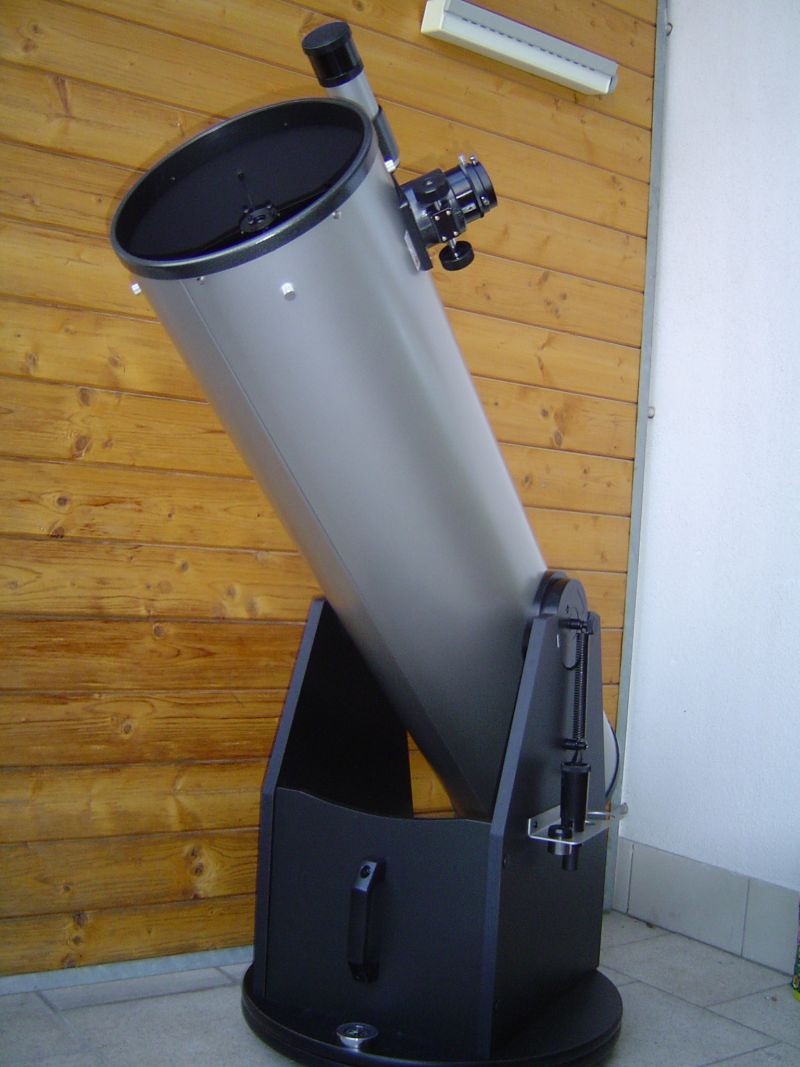
Attribution: Copyrighted free use via Wikimedia Commons.
- Pros: Excellent stability for the price; simple motions; pairs with large apertures for bright views.
- Cons: Bulkier bases; manual tracking; tabletop versions require a sturdy platform.
If you’re primarily a visual observer and want maximum aperture per dollar with minimal fuss, a Dobsonian is hard to beat. If you’re leaning toward future astrophotography, consider whether an equatorial mount is on your roadmap and choose your optical tube accordingly. For casual, portable lunar and planetary work, a small alt-az setup is often perfect.
What You Can See: Planets, Moon, Star Clusters, Nebulae, and Galaxies
Expectations shape satisfaction. The sky is generous, but what you’ll see depends on aperture, seeing conditions, light pollution, and your observing skill. Below is a realistic overview of what common beginner telescopes can reveal.
The Moon
Even the smallest telescope will deliver breathtaking lunar vistas. Craters, rilles, and mountain ranges pop into relief near the terminator (the day-night boundary). A neutral density or variable polarizing filter can make bright phases more comfortable (see Essential Accessories).
Planets
- Jupiter: Cloud bands, the Great Red Spot (when visible), and transits of the Galilean moons show clearly in 80–100 mm refractors and larger scopes. Higher aperture improves detail and stability at higher magnification.
- Saturn: Rings are visible even in small scopes; with sufficient aperture and steady seeing, you’ll see the Cassini Division and several moons.
- Mars: At favorable oppositions, dark albedo features and the polar cap can be visible in moderate apertures; otherwise it can be a small, bright disk.
- Venus: Phases are easy to see; surface detail is not visible in typical visual observing.
- Mercury: Phases are possible but challenging due to low altitude and glare.
- Outer planets: Uranus and Neptune appear as small, bluish disks; Neptune’s moon Triton can be seen in larger amateur apertures from dark sites.
Double Stars and Star Clusters
Double stars are satisfying tests of seeing and optics. Open clusters (like the Pleiades and the Double Cluster) are stunning in small to medium apertures, especially with wide fields. Globular clusters begin to resolve into stars in 150–200 mm scopes under dark skies.
Nebulae and Galaxies
Bright nebulae such as Orion’s M42 are rewarding even in modest light pollution, but the contrast improves dramatically under dark skies. Narrowband filters like UHC and O-III can enhance nebular detail and contrast. Galaxies are more sensitive to sky darkness—aperture helps, but dark-sky access helps even more. Under suburban skies, expect brighter galaxy cores; under dark skies, spiral arms and faint companions become feasible in moderate apertures.
Reality check: Telescopes deliver primarily grayscale views at the eyepiece because the human eye’s color sensitivity is limited in low light. Subtle color exists (e.g., in bright planetary nebulae or star colors), but photographs show more vivid hues because of long exposures and image processing.
Essential Accessories and Upgrades for First-Time Observers
Good accessories amplify your telescope’s strengths. Start with the essentials and add gradually as your observing interests sharpen.
Eyepieces and Barlows
Most telescopes ship with one or two eyepieces. A basic set that covers low, medium, and high magnifications will handle most targets. For example:
- Low power (~25–35×): Wide-field scanning, large nebulae, framing open clusters.
- Medium power (~60–120×): General-purpose lunar and planetary views; many deep-sky objects.
- High power (~150–250×, conditions allowing): Lunar detail, planetary features, double stars.
A 2× Barlow lens effectively doubles your eyepiece collection. If your scope has a shorter focal length, a Barlow can help reach higher powers without resorting to very short focal length eyepieces that may have tighter eye relief. To understand how eyepiece choices interact with your scope, revisit the formulas in Aperture, Focal Length, f/ratio, and Magnification.
Finders and Alignment Aids
A red-dot or reflex finder is fast and intuitive for initial pointing. Optical finderscopes (e.g., 6×30 or 8×50) provide magnified views and are helpful for star hopping in moderate light pollution. Many observers use both: a red-dot to get in the neighborhood, then the optical finder to refine the aim.
Filters
- Moon filters: Neutral density or variable polarizing filters reduce glare and increase comfort at bright lunar phases.
- Nebula filters: UHC and O-III filters selectively pass key emission lines, increasing contrast on emission and planetary nebulae; they do not help galaxies.
- Solar filters: For safe solar observing, use only front-mounted, full-aperture white-light filters made for telescopes. Never use eyepiece-mounted “sun filters,” and never point an unfiltered telescope at the Sun.
Comfort and Stability
- Observing chair: A steady, adjustable-height chair significantly improves comfort and perceived sharpness by keeping you still at the eyepiece.
- Dew control: In humid climates, dew shields, heaters, or simple anti-dew practices (like keeping caps on and storing gear in a dry place) prevent fogging.
- Carrying solutions: Padded cases, hand trucks for Dobsonians, or backpack straps for small refractors make “one trip out the door” more realistic.
Budget Tiers and Smart Shopping: Getting the Best Value
Price and value don’t scale linearly in astronomy gear. Spending a bit more on the mount can transform your experience. Conversely, chasing the highest theoretical magnification rarely helps. Here’s how to think about common budget tiers and avoid regret.
Under $200 (Entry Basics)
At this level, consider compact options that prioritize ease of use and optical quality over raw aperture. Tabletop reflectors in the 100–130 mm range can be excellent if paired with a sturdy surface. Small 70–80 mm refractors can be enjoyable for the Moon, planets, and bright clusters—provided the mount is stable.

Attribution: CC BY-SA 4.0 via Wikimedia Commons.
Avoid heavy, long-tube scopes on flimsy tripods. Stability is everything. When in doubt, choose the smaller, better-mounted option.
$200–$400 (Solid Starters)
Many beginners find their sweet spot here. A 130 mm f/5 tabletop or tripod-mounted Newtonian, or an 80–102 mm refractor on a stable alt-az mount, delivers capable views without overwhelming size. Expect to add a couple of eyepieces over time.
$400–$800 (Aperture and Stability)
Dobsonians in the 150–200 mm range often live here and represent tremendous value for visual observing. You can also find compact Maksutov-Cassegrains (90–127 mm) on solid mounts in this bracket. Choosing between them comes down to your targets and portability needs: the Dobsonian for deep-sky brightness and general versatility; the Mak for compact lunar and planetary performance.
$800–$1500 (Versatile, Upgradable Rigs)
At this level you’ll see 200 mm Dobsonians with upgraded bearings and accessories, 127–150 mm Maks/SCTs on tracking mounts, and 102–120 mm refractors on sturdier alt-az or beginner equatorial mounts. If you plan to dabble in astrophotography later, consider the mount’s upgrade path and payload capacity carefully.
Used Gear and Community
Buying used can stretch your budget, especially for eyepieces and mounts. Local astronomy clubs often host public nights where you can try different setups. Observing before buying is one of the best ways to align expectations with reality.
  1) Mount: Is it stable at high power?

  2) Aperture: Does it match your sky and targets?

  3) Portability: One or two trips out the door?

  4) Accessories: Usable eyepieces, finder, dew solutions

  5) Setup time: Will you use it on weeknights?

  6) Maintenance: Collimation needs, cooldown, care
For guidance on maintenance and alignment, see Setup, Collimation, Cooling, and Basic Maintenance. For help setting expectations by target, revisit What You Can See.
Setup, Collimation, Cooling, and Basic Maintenance
Telescopes are relatively simple devices, but a little care goes a long way. Proper setup improves performance and increases the fun factor significantly.
Collimation (Alignment)
Reflectors and some catadioptrics require periodic optical alignment. Here are the essentials:
- Newtonian reflectors: Collimation ensures the primary and secondary mirrors are aligned with the focuser. Tools range from simple collimation caps to laser or Cheshire eyepieces. It sounds intimidating but becomes routine with practice.
- Maksutov/SCT: Collimation is less frequent but should be checked if star images appear asymmetrical or soft at high power. Follow the manufacturer’s procedure precisely and make small adjustments.
- Refractors: Typically do not require user collimation; if star images are persistently off, consult the vendor or a service technician.
Thermal Equilibrium (Cooldown)
Optics perform best when they reach ambient temperature. Reflectors and larger catadioptrics usually need more time than small refractors. As a rough guide:
- Small refractors (60–100 mm): Often ready in minutes.
- Medium reflectors and catadioptrics (130–200 mm): 20–60 minutes depending on temperature difference.
- Larger apertures: Longer cooldown, potentially aided by fans or ventilated designs.
Let your telescope acclimate while you set up eyepieces, charts, and a chair. Start with lower-power targets and shift to higher-power planetary views as the optics settle.
Focusing and Star Testing
Achieving precise focus is half the battle. Use a bright star and refine focus until the Airy disk and diffraction rings (in steady seeing) look concentric. A simple star test at high magnification can also reveal collimation or thermal issues. If stars look like comets at the edge of the field in a fast Newtonian, that’s likely coma; it’s normal and can be mitigated with a coma corrector if desired.
Cleaning and Storage
- Less is more: Clean optics only when truly necessary. Dust typically has minimal visual impact.
- Safe cleaning: Use a blower to remove loose dust; for smudges, employ lens-safe solutions and lint-free wipes with gentle pressure. Avoid touching mirror surfaces unless you’re following a proven procedure.
- Storage: Keep equipment dry and capped. Desiccant packs in cases help in humid climates.
Avoiding Common Pitfalls and Misleading Marketing Claims
The market for entry-level telescopes mixes gems with gadgets. Here are frequent traps and how to sidestep them.
Beware of “Maximum Magnification” Hype
Any telescope can claim huge magnifications by using very short eyepieces or stacking Barlows, but the result is dim, blurry views. Always ground your expectations in aperture and atmospheric seeing. For practical high-power work, 25–50× per inch of aperture is a reasonable ceiling, often lower under typical conditions.
Underbuilt Mounts
A common beginner frustration is a wobbly tripod. Look for sturdier legs, metal construction, and mounts rated for your telescope’s weight with headroom to spare. A steady mount helps at every magnification.
Under-equipped Kits
Some packages include too few or low-quality accessories. Budget for at least one additional eyepiece to fill gaps and a comfortable finder solution. Review the essentials in Essential Accessories and Upgrades.
Ignoring Light Pollution
Urban and suburban skies don’t doom observing, but they shape your plan. Planetary and lunar observing are rewarding from cities. For galaxies and faint nebulae, prioritize trips to darker sites or use filters to improve contrast on emission nebulae. See What You Can See for target-specific expectations.
Learning the Sky: Apps, Star Hopping, and Observing Techniques
The telescope is a tool; skill turns it into an instrument. A few habits accelerate your progress and enjoyment.
Star Charts and Apps
Printed atlases and mobile planetarium apps help you plan sessions and learn constellations. Use red-light mode at night to preserve night vision. If your mount lacks tracking, choose targets that culminate (reach their highest point) during your session to enjoy steadier seeing.
Star Hopping
Star hopping means navigating from bright, easily recognized stars to fainter targets using patterns shown on a chart. It’s a core skill for alt-az and Dobsonian users. Start with bright Messier objects and short hops. Your finderscope and low-power eyepiece will be your main tools.
Observing Techniques
- Dark adaptation: Give your eyes 20–30 minutes in darkness to reach optimal sensitivity.
- Averted vision: Look slightly to the side of a faint object to activate more sensitive rod cells.
- Patience: Planetary detail swims in and out as the atmosphere steadies. Wait for moments of good seeing at moderate power.
- Record keeping: Keep a log of targets, magnifications, and conditions. It sharpens your skills and informs future gear choices.
Planning Sessions
Use the Moon phase, planet positions, and seasonal deep-sky highlights to guide your agenda. For example, winter evenings favor Orion and bright clusters; spring highlights galaxies in Leo and Virgo; summer showcases the Milky Way’s nebulae and clusters; autumn offers Andromeda and the Pleiades rising.
Frequently Asked Questions
How much aperture do I need for galaxies?
Galaxies benefit from dark skies more than anything. Under suburban conditions, even 150–200 mm scopes often show primarily the brighter cores. Under dark skies, the same apertures begin to reveal spiral structure and fainter companions. If you can only observe from light-polluted areas, consider a scope that excels at planetary and lunar views and plan occasional trips to darker sites for galaxies.
Can I use my first telescope for astrophotography?
It depends on your goals. For lunar and planetary imaging, many beginners use smartphones or simple cameras at the eyepiece with good results. For deep-sky astrophotography, the mount becomes crucial: tracking accuracy and load capacity dominate. If deep-sky imaging is a near-term goal, you’ll want to research equatorial mounts and consider a short, fast refractor as a starting point. If visual observing is your priority, choose a stable, simple setup now and learn the sky; you can always add imaging gear later.
Final Thoughts on Choosing the Right First Telescope
Good telescopes don’t need to be complicated. The best beginner setup is the one you look through often because it fits your life, sky, and interests. If you crave bright deep-sky views, a 6–8 inch Dobsonian on a stable base is a perennial winner. If you want crisp, low-maintenance lunar and planetary sessions, a small refractor or Mak on a solid alt-az mount shines. If you plan to explore tracking and later imaging, consider a compact catadioptric or refractor with an upgrade path to an equatorial mount.
Keep your expectations grounded in aperture and sky conditions, invest in stability, and develop observing skills that multiply what your optics can show. Most of all, choose a scope you’re excited to use at a moment’s notice. Clear skies favor the prepared observer.
If you found this guide helpful, explore our other deep-dive articles on observing techniques and equipment, and subscribe to our newsletter to receive future guides, seasonal target lists, and practical tips in your inbox.