
Table of Contents
- What Is an 8-Inch Dobsonian Telescope?
- Why an 8-Inch Dobsonian Hits the Visual Sweet Spot
- Optical Basics and Performance Benchmarks
- Mount Mechanics: Alt-Az Simplicity Done Right
- Eyepieces, Filters, and Essential Accessories
- Setup, Collimation, and Maintenance Best Practices
- What You Can See: City, Suburbs, and Dark-Sky Targets
- Push-To, Digital Setting Circles, and Smart Upgrades
- Field Use, Ergonomics, Transport, and Storage
- Buying Guide: Solid-Tube vs. Truss and What to Look For
- Frequently Asked Questions
- Final Thoughts on Choosing the Right 8-Inch Dobsonian
What Is an 8-Inch Dobsonian Telescope?
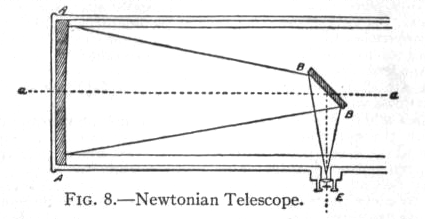
An 8-inch Dobsonian is a Newtonian reflector with a primary mirror approximately 203 mm in diameter, mounted on a simple altitude-azimuth (alt-az) base. The design was popularized to make large-aperture visual observing affordable, intuitive, and portable. Typical commercial 8-inch Dobsonians operate around f/6, yielding a focal length near 1200 mm. This combination is well loved because it balances light-gathering power, resolution, and ease of use without needing complex electronics.

Artist: Bin im Garten
The Dobsonian approach is grounded in minimalism: a smooth-turning base, a low-maintenance optical tube, and a straightforward optical path using a parabolic primary mirror and a small secondary mirror. The result is a telescope that excels at deep-sky visual astronomy while remaining more than capable for lunar and planetary observing. While it is not the ideal platform for long-exposure deep-sky imaging, it is unmatched in its price-to-aperture ratio for purely visual enjoyment.
If you are upgrading from a small refractor or a 4–6 inch reflector, moving to an 8-inch Dobsonian feels transformative. Galaxies cease to be faint smudges and begin to reveal shape; globular clusters resolve into granular star clouds; and nebulae acquire texture, especially when paired with the right filters discussed in Eyepieces, Filters, and Essential Accessories.
Why an 8-Inch Dobsonian Hits the Visual Sweet Spot
In amateur astronomy, “aperture is king,” but it has to be balanced against cost, weight, cool-down time, and complexity. An 8-inch Dobsonian strikes that balance elegantly.
- Light Gathering: An 8-inch mirror collects over four times the light of a 4-inch scope. This added light opens up thousands of deep-sky objects that are challenging or inaccessible in smaller instruments, especially from dark skies.
- Resolution: With approximately 203 mm of aperture, theoretical resolution is around half an arcsecond under perfect conditions. In practice, local atmospheric seeing often sets the limit, but the scope has the headroom to capitalize on good nights, revealing planetary detail and tight double stars.
- Portability: Most 8-inch solid-tube Dobsonians can be carried in two pieces. The base and tube fit in small cars, through doorways, and up staircases without drama, unlike many larger reflectors.
- Value: Compared to compound catadioptrics or premium refractors of similar light-gathering ability, 8-inch Dobsonians are remarkably cost-effective. You get aperture where it counts most—at the primary mirror.
- Forgiving f/ratio: Around f/6, collimation remains manageable, edge-of-field aberrations are modest, and a wide range of eyepieces perform well. This is covered further in Optical Basics and Performance Benchmarks.
For many observers, the 8-inch Dobsonian becomes the “forever telescope”—large enough to impress for a lifetime, yet compact enough to see frequent use. It’s an excellent choice for clubs, families, and anyone wanting a powerful general-purpose visual instrument.
Optical Basics and Performance Benchmarks
Before you choose accessories or plan observing projects, it helps to understand what the optics can deliver. Several practical metrics define how an 8-inch Dobsonian performs:
Artist: Anonymous
Resolution and Seeing
The Dawes limit provides a rough resolution estimate in arcseconds: 116 divided by the aperture in millimeters. For a 203 mm mirror, this is about 0.57 arcseconds. Real-world performance is usually constrained by atmospheric turbulence (often 1–3 arcseconds). On nights of steady seeing, the scope can split close double stars and reveal fine planetary details such as Saturn’s Cassini Division, subtle banding on Jupiter, and lunar rilles.
Light Gathering and Limiting Magnitude
An 8-inch mirror gathers enough light for substantial deep-sky work. Under dark, transparent skies, experienced observers routinely reach stellar magnitudes around 14 visually, depending on conditions and observer technique. Extended objects (like galaxies and nebulae) depend even more on surface brightness, sky darkness, and contrast management, which is why filters and dark adaptation (see Eyepieces, Filters, and Essential Accessories) matter.
Common f/ratios and Field Characteristics
Most 8-inch Dobsonians are near f/6. That focal ratio produces a wide, well-corrected field with many eyepiece designs. Coma—a natural off-axis aberration in parabolic mirrors—exists but is generally mild at f/6, often acceptable without a coma corrector for casual viewing. At lower f/ratios (e.g., f/5), coma increases and wide-field eyepiece performance depends more on design quality. For observers who love expansive star fields, the f/6 sweet spot keeps cost and complexity in check while still enabling immersive views.
Central Obstruction and Contrast
Reflectors use a secondary mirror to direct light to the focuser. The obstruction slightly reduces contrast compared to unobstructed refractors, but the larger aperture more than compensates for most deep-sky targets. Proper collimation and thermal equilibrium (see Setup, Collimation, and Maintenance Best Practices) are critical for maximizing contrast on planets and the Moon.
Magnification, Exit Pupil, and True Field
Understanding magnification and exit pupil helps you choose eyepieces intelligently:
// Typical 8-inch f/6 Dobsonian
focal_length_telescope = 1200 // in mm
magnification = focal_length_telescope / eyepiece_focal_length_mm
exit_pupil_mm = eyepiece_focal_length_mm / f_ratio // f_ratio ~ 6
true_field_deg ≈ apparent_field_deg / magnification
For reference:
- Low power (30–40 mm eyepiece) yields a large exit pupil (5–7 mm) and a wide true field, ideal for star-hopping and large nebulae.
- Medium power (14–20 mm) offers a balanced view for open clusters and smaller nebulae.
- High power (8–10 mm) reveals planetary detail and resolves globular clusters; add a Barlow for very tight doubles or lunar studies on steady nights.
Mount Mechanics: Alt-Az Simplicity Done Right
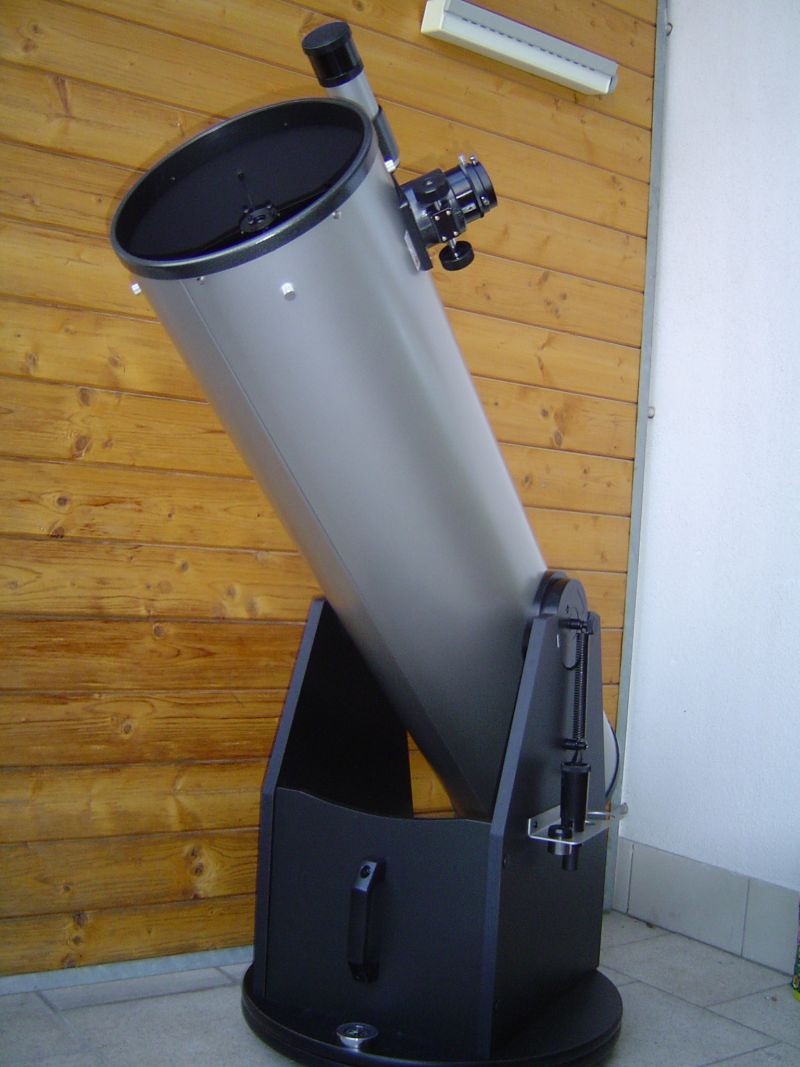
The Dobsonian mount is a masterclass in practical design. It uses large-radius bearings and carefully chosen friction materials to enable smooth, controlled motion. The result is point-and-view simplicity: you push the tube where you want it to go, and it stays there without backlash or complex counterweights.
Credit: first uploaded on the English-speaking Wikipedia under the same filename
Altitude and Azimuth Bearings
Altitude (up-down) motion typically rides on semicircular side bearings or trunnions. Azimuth (left-right) motion runs on a turntable bearing. The combination allows a natural, intuitive sky-navigation experience, especially when paired with a right-angle finderscope or reflex sight. Fine balance and modest stiction prevent overshoot at high magnification.
Balance and Tensioning
Many 8-inch Dobsonians incorporate adjustable tension controls to accommodate different eyepiece weights. Switching from a light Plössl to a heavy 2-inch wide-field eyepiece can shift balance dramatically. If your mount lacks tension control, simple counterweights or magnetic weights keep motions smooth.
Ground Board and Feet
A rigid ground board with well-spaced feet reduces wobble. On soft lawns, feet can settle; a portable observing pad or pavers provide a stable surface. Ensuring level setup helps with add-ons like digital setting circles discussed in Push-To, Digital Setting Circles, and Smart Upgrades.
Eyepieces, Filters, and Essential Accessories
The right accessories transform how your 8-inch Dobsonian performs. Start with a sensible eyepiece spread, then add tools that boost contrast and usability.
Building a Useful Eyepiece Set
- Low Power, Wide Field (30–40 mm): Ideal for sweeping the Milky Way, framing large open clusters, and locating faint fuzzies before moving to higher power. A 30–32 mm eyepiece is an excellent starting point for f/6.
- Medium Power (14–20 mm): A workhorse range for star clusters, bright galaxies, and nebulae with filters. Apparent fields of 60–70 degrees are comfortable and immersive without excessive weight or cost.
- High Power (8–10 mm): Planetary detail and globular cluster resolution live here. On steady nights, you might use 150–200x or more; on average nights, 120–160x is common.
- Barlow Lens (2x): Doubles your eyepiece collection’s effective focal lengths and maintains comfortable eye relief with longer eyepieces at higher magnification.
Whether you choose 1.25-inch or 2-inch eyepieces depends on your focuser and priorities. Many 8-inch Dobsonians ship with a 2-inch focuser and a 1.25-inch adapter, enabling both wide-field views and compact higher-power eyepieces.
Filters That Matter
- Neutral Density or Variable Polarizer: Tames lunar brightness, enhancing detail and comfort.
- UHC (Ultra High Contrast): Boosts emission nebula contrast by transmitting key emission lines while suppressing broad skyglow.
- O III (Oxygen-III): Often dramatic on planetary nebulae and some bright supernova remnants. In an 8-inch, it can make targets pop under suburban skies.
- Broadband Skyglow Filters: Effects vary and are weaker than UHC/O III, but they can offer modest improvement on some targets in light-polluted areas.
Finders and Aiming Aids
A reflex sight (e.g., a zero-power finder) paired with a right-angle, correct-image (RACI) finderscope makes star-hopping efficient. The reflex sight gets you in the neighborhood; the RACI finder refines the hop using a star chart app or atlas. This tandem helps you exploit the wide, low-power eyepiece views discussed earlier in Optical Basics and Performance Benchmarks.
Collimation Tools
- Collimation Cap or Cheshire: Simple, reliable tools to align mirrors.
- Laser Collimator: Convenient for quick checks, especially in the field; verify accuracy against a Cheshire for best results.
Thermal Management
A small rear fan helps the mirror reach ambient temperature faster, improving image steadiness. Thermal equilibrium often matters as much as optics for crisp planetary views. See practical steps in Setup, Collimation, and Maintenance Best Practices.
Setup, Collimation, and Maintenance Best Practices
Well-aligned optics and sensible setup habits unlock the performance you paid for. Fortunately, 8-inch Dobsonians are straightforward to prepare and maintain.
Site Selection and Setup
- Choose stable ground: Firm surfaces reduce vibration. If on grass, consider a pad or pavers for the base.
- Level the base: Useful if you add digital aids later; it also feels more natural when pushing the scope in azimuth.
- Thermal acclimation: Set the scope out 30–60 minutes before high-resolution observing so the mirror cools and tube currents settle.
- Dew control: A simple dew shield and, if needed, a small heater on the finderscope eyepiece keep your session productive.

Artist: Morn
Basic Collimation Workflow
Collimation centers the optical components along a common axis. A typical f/6 8-inch Dobsonian is forgiving, but alignment still matters for sharp images.
- Secondary positioning: Through the empty focuser or with a sight tube, ensure the secondary mirror appears circular and centered under the focuser. Adjust the secondary’s fore–aft position and rotation as needed.
- Secondary tilt: Use a sight tube or laser to aim the secondary so the focuser axis points at the primary center mark.
- Primary tilt: Using a Cheshire or the return beam of a calibrated laser, adjust the primary mirror tilting screws to center the primary’s reflected image and the alignment donut.
- Star test: On a moderately bright star at high power, check for concentric diffraction rings inside and outside focus when seeing allows. Make small tweaks if necessary.
Tip: Collimate at the telescope’s typical observing altitude. Slight mechanical shifts can change alignment between zenith and horizon.
Cleaning and Care
- Primary mirror: Only clean when truly needed (e.g., noticeable haze). Dust rarely harms views. When cleaning, use distilled water, gentle rinses, and soft drag techniques—no scrubbing.
- Secondary mirror: Same caution as the primary. Avoid touching the surface; handle by the edges.
- Focuser and bearings: Keep clean and free of grit. Follow manufacturer guidance for any lubrication; many modern bearings rely on dry friction materials rather than grease.
Routine tweaks keep your 8-inch performing like new. If you notice slipping or stiffness in the altitude motion, revisit balance and tension as discussed in Mount Mechanics: Alt-Az Simplicity Done Right.
What You Can See: City, Suburbs, and Dark-Sky Targets
An 8-inch Dobsonian is exceptionally versatile. While light pollution dims low-contrast objects, careful target selection and the right filters still deliver rewarding sessions from almost anywhere.
Urban Observing (Heavy Light Pollution)
- The Moon: Rugged crater rims, rilles, and mountain shadows reward high magnification. A neutral density or variable polarizer improves comfort.
- Planets: Jupiter’s belts and festoons, Saturn’s rings and Cassini Division, Mars’s polar cap (in season), and Venus’s phases are all well within reach. Use moderate to high power when seeing permits, as outlined in Optical Basics and Performance Benchmarks.
- Double Stars: Splitting classic pairs is fun and educational; the 8-inch has ample resolving power on steady nights.
- Bright Planetary Nebulae: With an O III filter, planetary nebulae stand out even in bright skies.
Suburban Observing (Moderate Light Pollution)
- Open Clusters and Globulars: From suburban sites, many Messier clusters are spectacular. An 8-inch resolves the outskirts of globular clusters and begins to show core granularity with higher power.
- Bright Nebulae: UHC and O III filters transform views of emission nebulae. Contrast improves, revealing structure and dark lanes.
- Showcase Galaxies: Under transparent skies, bright galaxies show cores and hints of spiral form. Patience and averted vision help.
Dark-Sky Observing (Rural or Dedicated Sites)
- Galaxies: The 8-inch begins to reveal shapes, dust lanes, and subtle asymmetries in brighter targets. Groups and clusters of galaxies become fields to explore.
- Nebulae and Supernova Remnants: With a UHC or O III filter, structural detail emerges in classic nebulae. Planetary nebulae transform from star-like dots to discs with halos and texture.
- Globular Clusters: At high power and steady seeing, many globulars explode into resolved star swarms.
Use a low-power eyepiece for locating, then step up magnification to improve contrast and reveal detail. This workflow aligns with the eyepiece strategy in Eyepieces, Filters, and Essential Accessories.
Push-To, Digital Setting Circles, and Smart Upgrades
While the classic Dobsonian is fully manual, modern add-ons make navigation and tracking easier without abandoning simplicity.
Push-To Aids
Digital setting circles (DSCs) pair encoders on the altitude and azimuth axes with a hand unit or app. After a quick two-star alignment, you get real-time arrows guiding you where to push. Combined with a wide-field low-power eyepiece, this reduces time lost hunting while preserving the tactile Dobsonian feel.
Telrad and Finder Patterns
Reflex finders with concentric rings are a star-hopper’s friend. The rings correspond to known angular scales, making offsets and hops predictable with a chart. This approach complements RACI finders and smooth motions described in Mount Mechanics.
Coma Correctors and Focusers
At f/6, a coma corrector is optional. Some observers value tighter stars at the edge, especially with ultrawide eyepieces. Upgrading to a dual-speed Crayford focuser improves fine focus control, particularly at high magnification or when using heavy eyepieces.
Equatorial Platforms (Advanced)
Equatorial platforms add tracking by slowly rotating the entire base around a polar-aligned axis. This keeps objects centered for extended study or for short-exposure planetary imaging, extending the capabilities discussed in Frequently Asked Questions.
Field Use, Ergonomics, Transport, and Storage

Artist: Bin im Garten
Enjoying your telescope more often comes down to comfort and logistics. A few practical touches make a big difference.
Comfort and Observing Flow
- Adjustable chair: Sitting steadies your view and encourages patient, high-resolution observing.
- Red-light headlamp: Preserves night vision and keeps hands free.
- Checklists: A simple list avoids missing critical items—collimation tools, filters, battery for the fan, and warm clothing.
Dew and Environmental Factors
- Dew resistance: The primary mirror often sits deep in the tube, which helps. Finders and eyepieces dew more easily; caps and heaters are useful.
- Wind: A Dobsonian’s broad tube can catch gusts. Shield your setup behind a vehicle or windbreak when possible.
Transport and Storage
- Carrying: Move in two pieces—base and tube. Some observers add handles or soft straps to the tube for better grip.
- Vehicle fit: Most 8-inch solid-tube OTAs fit across the back seat or in small hatchbacks. Use blankets or foam to prevent rolling.
- Storage: Indoor, dry storage minimizes thermal swings and avoids humidity-related issues. If you store in a garage, allow extra time for cool-down before observing.
Buying Guide: Solid-Tube vs. Truss and What to Look For
When choosing an 8-inch Dobsonian, the big decisions include tube style, optical quality, and component features. Here’s what to evaluate:
Solid-Tube vs. Truss

Artist: JamesStewart669
- Solid-Tube (most common): Simple, fast to set up, and dust resistant. The tube length near 1.2 meters is manageable for most cars and storage spaces.
- Truss or Collapsible Designs: More compact for transport and storage; marginally lighter. They benefit from a light shroud to block stray light and dew. Setup takes a bit longer and collimation may need more frequent checks.
Primary Mirror and Coatings
- Glass type: Common plate glass or borosilicate works well at 8 inches. What matters most is the figure accuracy and smoothness.
- Coatings: Enhanced aluminum with protective overcoats is standard and durable.
Secondary Mirror and Obstruction
Secondary sizes on 8-inch f/6 scopes typically provide good illumination across the field without excessive obstruction. A modest central obstruction maintains contrast while enabling convenient focus travel for a range of eyepieces.
Focuser, Finder, and Base
- Focuser: A 2-inch dual-speed Crayford offers smooth control and supports heavy eyepieces. Many models include a 1.25-inch adapter.
- Finder options: Some packages include a straight-through finder; many observers prefer a RACI finder and a separate reflex sight as noted in Eyepieces, Filters, and Essential Accessories.
- Base materials: Sturdy, moisture-resistant panels with quality bearings translate into smoother motion and longevity.
Warranty and Support
Reputable vendors provide clear return policies and support for collimation and mechanical adjustments. Verify that replacement parts (springs, knobs, finders) are readily available.
New vs. Used
- Used market advantages: Significant savings are possible. Inspect mirrors for coating condition, check the smoothness of motions, and test focuser travel.
- Potential upgrades: Buying used may free budget for better eyepieces, a UHC filter, or a dual-speed focuser upgrade—enhancements that can matter more than marginal optical differences.
Frequently Asked Questions
Can an 8-inch Dobsonian do astrophotography?
Long-exposure deep-sky astrophotography generally requires equatorial tracking and precise guiding, which a standard Dobsonian mount does not provide. However, you can capture impressive lunar and planetary images by recording short video clips at high magnification and stacking the best frames. For extended tracking on visual sessions or for modest planetary imaging convenience, an equatorial platform (see Push-To, Digital Setting Circles, and Smart Upgrades) adds tracking capability under the Dobsonian base.
How heavy and portable is an 8-inch Dobsonian?
Most 8-inch Dobsonians break down into two manageable parts: the tube and the base. Each piece typically fits through standard doorways and into small cars. Using simple add-ons like tube handles or a lightweight hand truck can make transport even easier. For compact storage, consider a truss or collapsible design as discussed in the Buying Guide.
Final Thoughts on Choosing the Right 8-Inch Dobsonian
An 8-inch Dobsonian earns its reputation by delivering remarkable views with minimal fuss. It is powerful enough to tackle galaxies and resolve globular clusters, yet simple enough to set up on a whim for a quick look at the Moon or planets. With solid collimation and basic maintenance, smart eyepiece and filter choices, and perhaps a few navigation and focusing upgrades, the scope becomes an enduring companion that grows with your skills.
If you are weighing the jump to 8 inches, consider where and how you observe most often, how you plan to transport and store the instrument, and which accessories will make your sessions smoother from day one. Take your time, read user experiences, and when possible, try one at a club night.
Ready to learn more? Explore additional equipment guides, observing lists, and practical how‑tos. If you found this guide helpful, subscribe to our newsletter to get future articles on observing techniques, gear optimization, and seasonal targets delivered to your inbox.