
Table of Contents
- What Is the Orion Constellation and Why It Captivates Winter Skies?
- How to Find Orion: Star-Hopping and Seasonal Visibility
- Betelgeuse, Rigel, and Orion’s Bright Star Family
- Deep-Sky Wonders in Orion: M42, Running Man, and Barnard’s Loop
- Science of Orion’s Stars: Distances, Types, and Evolution
- Cultural History: Orion in Myth, Navigation, and Calendars
- Choosing Gear to Observe Orion: Binoculars to Telescopes
- Astrophotography Tips for Capturing the Orion Nebula
- Advanced Projects: Variable Stars, Spectra, and Photometry
- Frequently Asked Questions
- Final Thoughts on Exploring the Orion Constellation
What Is the Orion Constellation and Why It Captivates Winter Skies?
Orion is one of the most recognizable constellations in Earth’s night sky, famed for its three-star “belt” and its vivid pair of bright stars, Betelgeuse and Rigel. It straddles the celestial equator, meaning observers in both the Northern and Southern Hemispheres can see it prominently during their respective winter evenings. Astronomically, Orion hosts a rich catalog of deep-sky objects—especially star-forming regions—while culturally it is woven into stories from ancient Greece to Indigenous sky traditions worldwide.

Artist: Rogelio Bernal Andreo
Beyond its iconic shape, Orion is a living laboratory for stellar evolution. Within its boundaries, you can observe a spectrum of star types—from newborn protostars shrouded in gas and dust to aging red supergiants nearing the ends of their lives. Many of these objects belong to a larger structure called the Orion Molecular Cloud Complex, a vast region of gas and dust where new stars are actively forming. The complex includes the Orion Nebula (M42), one of the brightest and closest stellar nurseries visible to the naked eye under dark skies.
Orion’s layout also makes it an excellent anchor for navigating the winter sky. Its belt, a nearly straight line of three stars, acts like a celestial arrow that points toward other bright targets and constellations. For instance, follow the belt down and westward to reach the bright star Sirius in Canis Major, or trace it up and eastward to Aldebaran in Taurus. These intuitive “star hops” transform Orion into a gateway for wider sky exploration, connecting it to surrounding constellations and asterisms described below in How to Find Orion.
Whether you’re a new observer with a pair of binoculars or a seasoned amateur astronomer equipped with a telescope and camera, Orion offers a satisfying mix of beauty, science, and accessibility. Its research value continues to grow, with astronomers studying star formation, dust processes, and variable star behavior in this region. In the sections that follow, we’ll cover how to locate Orion, its brightest stars, remarkable nebulae, the science behind what you see, and practical tips for both visual observing and astrophotography.
How to Find Orion: Star-Hopping and Seasonal Visibility
Orion is visible around the world, but the best time to see it in the Northern Hemisphere is during the late autumn through early spring evenings, with peak prominence in the months of December and January. In the Southern Hemisphere, Orion dominates the summer sky during those same months. Because Orion lies along the celestial equator, its stars rise and set for most of the globe, offering equatorial symmetry that few famous constellations share.
Look for three medium-bright stars arranged in a straight line—these are the belt stars: Alnitak, Alnilam, and Mintaka. Once you’ve found the belt, it’s straightforward to pick out the rest of the constellation’s shape:
- Above the belt (to the north) is the reddish star Betelgeuse, marking Orion’s shoulder.
- Below the belt (to the south) is the blue-white star Rigel, marking Orion’s knee or foot.
- To the east and west of the belt are the stars Saiph and Bellatrix, completing the broad hourglass outline.
Under dark skies, you can also spot a line of stars hanging below the belt known as Orion’s Sword. The fuzzy patch in the Sword is the Orion Nebula (M42), a stellar nursery visible even to the naked eye when conditions are excellent.
Star-hopping from Orion opens up other prominent targets:
- Follow the belt down and to the right (westward) to find Sirius, the brightest star in the night sky, in Canis Major.
- Trace the belt up and left (eastward) to reach Aldebaran in Taurus, near the Hyades star cluster; continue onward to find the Pleiades (M45), a compact open cluster.
- Draw an imaginary line from Rigel through Betelgeuse to intersect Castor and Pollux in Gemini; this helps anchor the broader winter sky pattern known in the north as the Winter Hexagon.
For those who track the sky more formally, Orion’s right ascension (RA) and declination (Dec) span roughly RA 4h to 6h and Dec +23° to −10°, placing it across the equatorial region. If you like precision, here are approximate coordinates for a few highlights (keep in mind these are rounded and intended for orientation):
Betelgeuse (Alpha Ori): RA ≈ 05h 55m, Dec ≈ +07°

Rigel (Beta Ori):     RA ≈ 05h 15m, Dec ≈ −08°

Bellatrix (Gamma Ori):RA ≈ 05h 25m, Dec ≈ +06°

Alnitak (Zeta Ori):   RA ≈ 05h 41m, Dec ≈ −01°

Alnilam (Epsilon Ori):RA ≈ 05h 36m, Dec ≈ −01°

Mintaka (Delta Ori):  RA ≈ 05h 32m, Dec ≈  00°

Orion Nebula (M42):   RA ≈ 05h 35m, Dec ≈ −05°
These waypoints make excellent targets for binocular sweeps. If you’re starting out, consider reading the gear recommendations below to get the most from your observing sessions and to prepare for a closer look at the deep-sky objects in Orion.
Betelgeuse, Rigel, and Orion’s Bright Star Family
Orion’s standout stars are among the most studied in the night sky. They provide contrasting examples of stellar properties—most famously the cool, swollen red supergiant Betelgeuse and the hot, luminous blue supergiant Rigel.
Betelgeuse (Alpha Orionis): A Nearby Red Supergiant
Betelgeuse is a red supergiant star nearing the end of its life. It is notable for its enormous size—if placed at the center of our solar system, it would extend beyond the orbit of the inner planets—and for being relatively close to Earth on a galactic scale. Its distance estimates vary due to its complex atmosphere and brightness variations, but it lies on the order of hundreds of light-years away. Betelgeuse is a semiregular variable star, meaning its brightness fluctuates over time due to pulsations and surface activity. In late 2019 and early 2020, Betelgeuse underwent a widely publicized dimming event; subsequent research indicated a combination of surface changes and dust formation along our line of sight as the likely cause. Though Betelgeuse will end as a supernova one day, current evidence does not indicate an imminent explosion.
Rigel (Beta Orionis): A Brilliant Blue Supergiant
Rigel contrasts sharply with Betelgeuse: it is a hot, blue-white supergiant that radiates enormous energy. Rigel is a multiple-star system, though its companions are much fainter and challenging to see visually without significant magnification and steady air. Rigel’s intense luminosity and mass place it on a fast evolutionary track compared to stars like the Sun. It is another essential aiming point for navigation within Orion and an impressive sight through light-polluted skies.
The Belt Stars: Alnitak, Alnilam, and Mintaka
The three nearly collinear belt stars are striking because of their alignment and similar brightness. All three are hot, massive stars associated with the broader Orion OB1 association of young, luminous stars in this region. The belt is not merely an aesthetic line—it marks the location of active star formation and intricate nebular structures, including the famous Flame Nebula near Alnitak and the dark Horsehead Nebula silhouetted against a glowing background (see Deep-Sky Wonders).
Bellatrix and Saiph: Completing the Hourglass
Bellatrix (Gamma Orionis) and Saiph (Kappa Orionis) help to define Orion’s characteristic hourglass shape. Bellatrix is a blue giant, while Saiph is a hot, luminous star that, like Rigel, is in a more advanced stage of stellar evolution than the Sun. Observing these two stars provides a sense of Orion’s scale and symmetry, as they sit roughly opposite one another across the belt.
If you are building a personal star index, consider taking brief notes on each star’s color impression—some observers perceive Betelgeuse as distinctly reddish-orange and Rigel as icy blue-white. These color contrasts remain visible even in moderate light pollution, making Orion a reliable testbed for color sensitivity and atmospheric seeing conditions.
Deep-Sky Wonders in Orion: M42, Running Man, and Barnard’s Loop
Orion’s deep-sky objects are diverse and dramatic, ranging from the easily visible Orion Nebula to fainter features that reward patient observing and careful imaging. Under dark skies, many can be explored with binoculars or small telescopes.
Orion Nebula (M42) and the Trapezium
M42 is a sprawling emission nebula and a star-forming region roughly centered in Orion’s Sword. It’s one of the brightest nebulae in the sky, visible to the naked eye as a hazy patch and revealing structure through binoculars. In small telescopes, you can observe the Trapezium, a tight cluster of young, massive stars that illuminates and sculpts the surrounding gas and dust. The interplay between brilliant newborn stars and the nebular material they ionize and disperse is a vivid, real-time glimpse of stellar birth environments. Under steady skies, larger apertures can reveal additional Trapezium components beyond the well-known A-D stars.

Artist: NASA, ESA, M. Robberto (STScI/ESA) and the HST Orion Treasury Project Team
Running Man Nebula (NGC 1977)
Located just north of M42, the Running Man is a reflection nebula complex illuminated by nearby young stars. Its bluish hue arises as starlight scatters off dust grains, and the shapes within the nebula can appear as a running figure in long-exposure images. Visually, it’s more subtle than M42, but under good conditions you may catch a soft glow in small telescopes, with more structure in medium to large apertures. Pairing views of M42 and NGC 1977 is a nice exercise in comparing emission-dominated and reflection-dominated nebulae.
Flame Nebula (NGC 2024) and the Horsehead Nebula (Barnard 33)
Near the bright belt star Alnitak lies the Flame Nebula, an emission nebula appearing as a bright, tree-like glow with dark lanes. To its south is the Horsehead Nebula, a famous dark nebula silhouetted against a bright emission background (IC 434). The Horsehead is notoriously challenging visually; it often requires a combination of dark skies, larger aperture, and a hydrogen-beta (Hβ) filter. Imagers commonly pursue the Horsehead with narrowband filters to capture the delicate contrast between the dark dust and the glowing hydrogen gas.
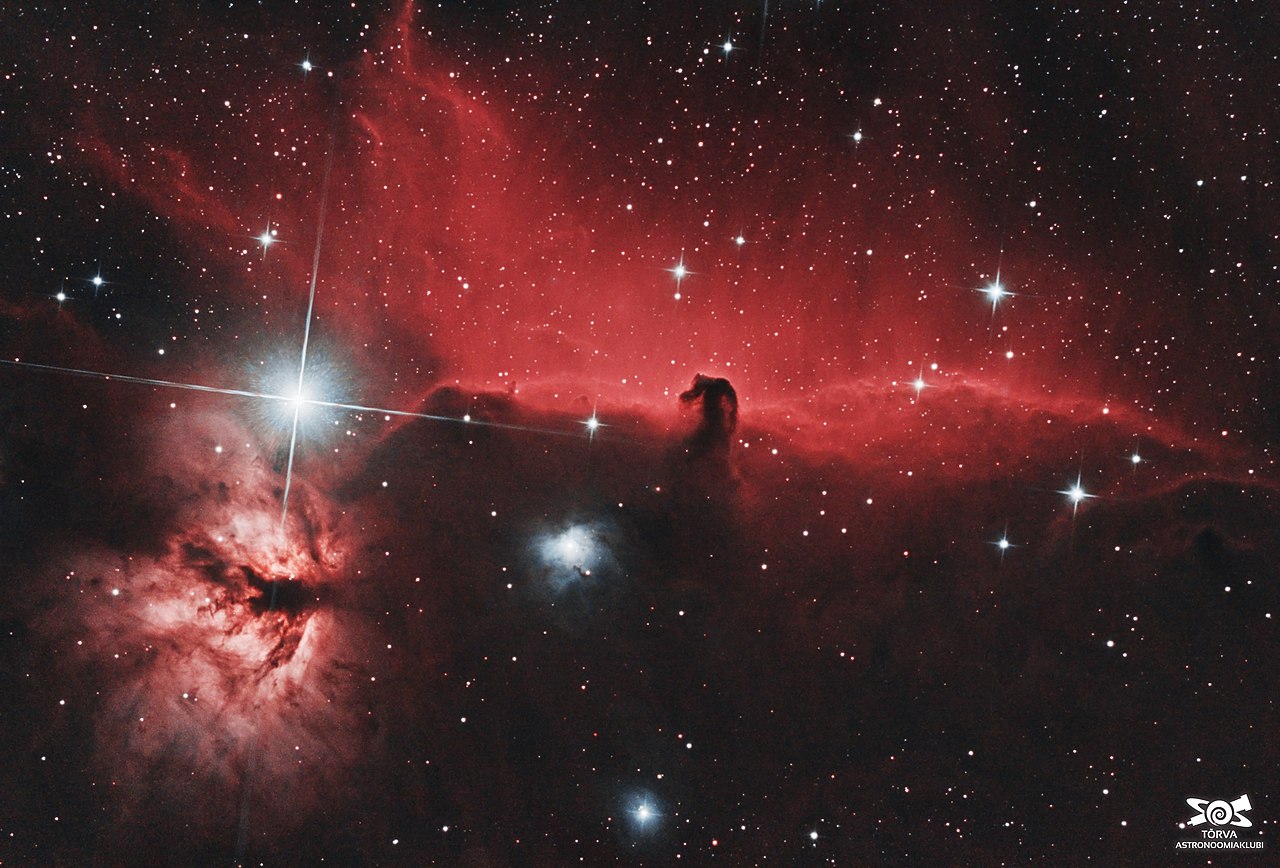
Artist: Taavi Niittee
Barnard’s Loop and the Orion-Eridanus Superbubble
Barnard’s Loop is a vast arc of emission that sweeps around much of Orion’s complex. It likely traces the aftermath of ancient stellar activity—winds and supernovae from massive stars that sculpted the interstellar medium. Under very dark skies, ultrawide-field imaging can capture the Loop along with the Orion Nebula, the Horsehead region, and the broader Orion-Eridanus superbubble, a gigantic cavity in the interstellar medium filled with hot, ionized gas. Although Barnard’s Loop is challenging to see visually without optical aids, it’s a favorite subject for wide-field astrophotography, discussed further in Astrophotography Tips.

Artist: SimgDe
Open Clusters and Lesser-Known Nebulae
Beyond the headlines, Orion holds smaller open clusters and emission patches that repay careful scanning:
- NGC 1981: A sparse open cluster just north of M42, good for binoculars.
- De Mairan’s Nebula (M43): A bright knot adjacent to M42, separated by a dust lane; noticeable even in small telescopes.
- Sh2-261 (Lower’s Nebula): A faint emission nebula accessible mainly to imagers and very dark-sky visual observers with filters.
For an efficient tour, start at the belt and sweep south to the Sword for M42/M43/NGC 1977. Then circle east to Alnitak for NGC 2024 and the Horsehead, and finally frame the region with a wide-field instrument to record Barnard’s Loop. These routes underline how Orion’s objects interconnect as a single, dynamic star-forming complex.
Science of Orion’s Stars: Distances, Types, and Evolution
Studying Orion gives a tour through multiple stages of stellar life cycles. Its stars and nebulae exemplify how massive stars form, shine, interact with their surroundings, and ultimately end their lives.
From Molecular Clouds to Protostars
Within the Orion Molecular Cloud Complex, dense clumps of gas and dust collapse under gravity to form protostars. Angular momentum causes collapsing material to flatten into disks, where accretion drives growth and jets clear cavities. Radiation pressure, stellar winds, and outflows from massive young stars carve intricate shapes into their birth clouds. The Trapezium’s intense ultraviolet radiation ionizes the nearby gas, producing the glowing emission of M42. Embedded sources visible in infrared and radio wavelengths provide a more complete census of nascent stars than optical views alone.

Artist: (c) NASA, ESA, CSA / Science leads and image processing: M. McCaughrean, S. Pearson
Massive Stars and Their Short Lives
Many of Orion’s prominent stars are massive and hot—classified as O or B type—with luminosities tens of thousands of times that of the Sun. These stars burn through their nuclear fuel quickly, often living only millions of years compared to the Sun’s multibillion-year lifetime. Their intense ultraviolet light and stellar winds heat and shape the surrounding interstellar medium, creating emission nebulae and clearing bubbles. As these stars evolve, some will end as supernovae, seeding the region with heavy elements and cosmic dust that future generations of stars and planets will incorporate.
Betelgeuse’s Variability and Red Supergiant Physics
Betelgeuse is a valuable case study for late-stage stellar evolution. Its variability arises from pulsations and surface activity in its extended, convective atmosphere. Observations across the electromagnetic spectrum—from optical photometry to infrared interferometry—help characterize its size, temperature variations, and mass loss. Dust formation episodes can temporarily obscure the star, as happened during the notable dimming in 2019–2020. While Betelgeuse is expected to explode as a core-collapse supernova at some point on cosmic timescales, available data suggest there is no imminent danger to Earth, and the timeline for such events is typically estimated in tens of thousands to perhaps hundreds of thousands of years or more.
Rigel’s Luminosity and Multiplicity
Rigel’s blue-white brilliance comes from its high surface temperature and large radius. Its multiplicity reveals the commonality of multiple-star systems among massive stars. Spectroscopy and high-resolution imaging techniques are used to resolve and study faint companions, offering insight into massive star formation and the dynamics of young stellar systems. Rigel’s spectral lines also serve as a teaching tool for understanding stellar atmospheres and temperature diagnostics, a theme you can explore with the projects described in Advanced Projects.
Distances and Uncertainties
Determining distances to bright, evolved stars like Betelgeuse is challenging. Parallax measurements from space observatories are invaluable, but the star’s brightness, extended atmosphere, and surface irregularities can introduce uncertainties. For clusters, associations, and nebulae, astronomers often piece together distances using multiple methods, including parallax, spectroscopy, and models of stellar populations. The Orion Nebula itself sits a few hundred to about a thousand light-years away depending on which part of the complex you reference; commonly cited estimates place M42 at several hundred light-years distance within that range. The key takeaway is that Orion resides close enough to serve as a cornerstone region for studying nearby star formation.
Cultural History: Orion in Myth, Navigation, and Calendars
Orion’s bold shape has inspired stories for millennia. In Greek mythology, Orion was a mighty hunter, often depicted pursuing the Pleiades or battling Taurus the Bull. But the constellation’s cultural reach extends far beyond the Mediterranean: Indigenous cultures around the world have identified Orion with figures ranging from hunters to ancestral beings and seasonal markers.
Sailors and travelers historically used Orion as a navigational guide. The belt provides an easy directional pointer, and its seasonal appearance and setting times helped structure calendars. In many traditions, the rising of Orion heralded changes in weather patterns, planting or harvesting seasons, or significant cultural events.
In modern astronomy education, Orion functions as a teaching scaffold. Students learn to identify bright stars, link asterisms, trace the ecliptic’s neighborhood, and understand celestial coordinates using Orion as a reference. Observing Orion’s nebulae and color contrasts in its stars also fosters curiosity about astrophysical processes—how stars form, evolve, and influence their environments—drawing a line from sky lore to contemporary science described in Science of Orion’s Stars.
Choosing Gear to Observe Orion: Binoculars to Telescopes
Orion is rich enough to reward every level of equipment. You can appreciate its architecture with the naked eye, but binoculars and small telescopes reveal layers of additional structure and color. Here’s how to match expectations with gear:
Naked-Eye Observing
- Identify the belt and hourglass shape; note star colors of Betelgeuse (reddish) and Rigel (blue-white).
- Under dark skies, look for the fuzzy glow of M42 in the Sword.
- Use the belt to star-hop to Sirius and Aldebaran, practicing sky navigation.
Binoculars (7×50, 8×42, 10×50 class)
- Resolve the Sword region; M42 and M43 appear as a soft, glowing patch with a brighter core.
- Trace star fields around the belt; look for NGC 1981 north of M42.
- Experiment with handheld versus tripod mounting; stability dramatically improves detail on nebulae.
Small Telescopes (60–130 mm refractors, 4–6 inch reflectors)
- Use low power (20–50x) and wide fields to frame M42, M43, and NGC 1977 together.
- Increase magnification (80–150x) to split Trapezium components; dark skies help reveal E and F stars.
- Try nebula filters (UHC or OIII) to enhance contrast in emission regions; an Hβ filter may aid the Horsehead under excellent conditions.
Medium to Large Telescopes (8–14 inch and up)
- Resolve fine structure in M42’s nebulosity and dark lanes.
- Attempt the Horsehead with an Hβ filter; patience and averted vision are essential.
- Explore faint emission patches and reflection nebulae around Alnitak and Alnilam.
Whichever instrument you choose, give your eyes time to dark adapt, shield them from stray light, and use averted vision on faint details. For planning, consult star charts or planetarium apps to prepare custom observing lists targeting objects outlined in Deep-Sky Wonders.
Astrophotography Tips for Capturing the Orion Nebula

Artist: Astrofalls
Orion is a premier astrophotography target, offering everything from wide-field mosaics to high-resolution studies of the Trapezium. Because objects like M42 are bright, beginners can achieve pleasing results even with modest gear. Yet Orion’s extreme dynamic range—from the Trapezium’s bright core to the faint outer nebulosity—also challenges experienced imagers to refine technique.
Wide-Field Nightscape and Constellation Shots
- Use a fast, wide lens (e.g., 14–35 mm at f/2–f/2.8) on a tripod.
- Take multiple exposures (e.g., 10–20 seconds at high ISO) and stack them to improve signal-to-noise.
- Under dark skies, aim for longer tracked exposures; a star tracker enables 30–120 second subs at lower ISO to reduce noise.
- Frame Orion with surrounding features (e.g., Sirius and the Winter Hexagon) to tell a larger sky story.
Telephoto and Short Refractor Imaging
- A 135–200 mm lens or a short apochromatic refractor (e.g., 250–500 mm focal length) can capture the Belt, Flame, and Horsehead near Alnitak plus M42 in a single frame.
- Use dual-band or narrowband filters under light pollution; hydrogen-alpha (Hα) excels at highlighting emission nebulae.
- Consider mosaic planning if you want to include Barnard’s Loop and the Orion-Eridanus superbubble.
High-Resolution Nebula Core and Trapezium
- For M42’s core, take short exposures (e.g., 1–10 seconds) to avoid saturating the Trapezium, and blend with longer subs for the faint wings of the nebula.
- Guided mounts, careful polar alignment, and dithering between exposures help control noise and star shapes.
- Combine broadband RGB with narrowband Hα/OIII data to boost contrast while preserving natural color balance.
Processing Considerations
- Calibrate with dark, flat, and bias frames to correct sensor artifacts and field vignetting.
- Use masked stretches or localized contrast enhancement to maintain core detail without blowing out highlights.
- Star reduction and color calibration can improve aesthetics; be conservative to retain a physically plausible result.
If you’re just starting, keep your workflow simple: a tracked DSLR or mirrorless camera with a 50–135 mm lens can already capture M42, M43, and the Running Man. As you gain experience, explore narrowband imaging to reveal structures mentioned in Deep-Sky Wonders that are otherwise hidden under city lights.
Advanced Projects: Variable Stars, Spectra, and Photometry
Orion offers meaningful projects for observers eager to contribute to science or deepen their technical skills. Many of these activities connect amateur capability with professional research domains, creating opportunities for citizen science.
Monitoring Betelgeuse’s Brightness
Because Betelgeuse is a semiregular variable, you can estimate its brightness over time using nearby comparison stars. Organizations focused on variable star observations provide standardized methods and sequences for recording visual magnitudes. Repeated measurements add to long-term light curves that help astronomers interpret stellar pulsations, mass loss, and circumstellar dust behavior. Simple visual estimates, if consistent and well-documented, can be valuable—especially when coordinated with larger campaigns during notable events such as unusual dimming episodes.
Photometry of Orion’s Nebula
While extended nebulae are trickier than point sources, calibrated imaging can still track changes in localized features, especially in reflection nebulae where illumination may vary with the output of nearby stars. Amateur photometry of compact emission knots or embedded variables within or adjacent to M42 provides challenging but rewarding targets. Careful attention to calibration and air mass corrections is essential.
Introductory Spectroscopy
Low-resolution spectroscopes for amateur telescopes can record emission lines from nebulae and absorption patterns from bright stars like Rigel. For nebular spectra, prominent hydrogen lines (such as Hα) appear strong, while [O III] and [S II] lines may be detectable depending on your setup. Stellar spectra reveal temperature information and, in some cases, signatures of stellar winds or circumstellar material. These observations connect directly to the physical processes covered in Science of Orion’s Stars.
Mapping the Orion Molecular Cloud in the Infrared (Conceptually)
Although infrared observations typically require specialized equipment and are better suited to professional facilities or citizen-access observatories, understanding the infrared view of Orion deepens your appreciation of what you see in optical light. Infrared penetrates dust, exposing embedded protostars and warm dust emission. Public data archives and sky surveys offer infrared maps you can compare against your optical images, providing a multiwavelength perspective on star formation.
Planning and Documentation
Advanced observers benefit from meticulous planning and logging:
- Use planetarium software to plot object paths, visibility windows, and air mass.
- Maintain observation logs with date, time, site conditions, instrument details, filters, and results.
- When imaging, preserve raw data and calibration frames, and note processing steps for reproducibility.
Sharing results with local astronomy clubs or online forums can lead to collaborative projects. As Orion is a prominent target for many observers, your data may complement others’ by filling geographic or time-of-night coverage gaps.
Frequently Asked Questions
Is Betelgeuse about to explode as a supernova?
There is no evidence that Betelgeuse will explode imminently. While it is a red supergiant in a late evolutionary stage and will eventually end as a core-collapse supernova, timelines for such events are uncertain and typically long on human scales—often discussed in terms of tens of thousands of years or more. The well-known dimming episode of 2019–2020 was attributed to surface activity and dust along our line of sight, not an immediate prelude to collapse. You can monitor Betelgeuse’s changing brightness as part of a variable star observing program, as outlined in Advanced Projects.
When is the best time and place to view the Orion Nebula?
The Orion Nebula is best viewed on clear, moonless nights during Orion’s high season: late autumn to early spring in the Northern Hemisphere, and summer months in the Southern Hemisphere. Aim to observe when Orion is highest in the sky (near local culmination) to minimize atmospheric distortion. Dark-sky locations away from city lights yield the best views. Even in suburban areas, binoculars or a small telescope can reveal the nebula’s core glow, and an ultra-high-contrast (UHC) filter can enhance contrast. For imaging tips, see Astrophotography.
Final Thoughts on Exploring the Orion Constellation
Orion is a bridge between beauty and science. Its familiar pattern makes it an anchor for newcomers learning the sky, while its stellar nurseries, variable stars, and massive supergiants provide a natural syllabus for deeper study. From the naked-eye glow of the Orion Nebula to the subtle challenges of the Horsehead, from the warm hue of Betelgeuse to the icy spark of Rigel, the constellation invites observers of all levels to return night after night.
If you’re getting started, begin with simple goals: find the belt, hop to M42, and compare star colors. As your confidence grows, add a binocular sweep of the Sword, then experiment with a small telescope and a nebula filter. Imagers can progress from wide-field nightscapes to high-dynamic-range composites of M42 and eventually mosaics that capture Barnard’s Loop. For the scientifically inclined, consider monitoring Betelgeuse or dabbling in spectroscopy to connect your observations with the physics presented in Science of Orion’s Stars.
Ultimately, Orion demonstrates how a single region of the sky can encapsulate key themes in astronomy: star birth, stellar evolution, and the interplay between matter and radiation. Keep exploring, share your observations, and stay tuned for more guides on constellations, star-hopping techniques, and deep-sky targets. If you found this article helpful, subscribe to our newsletter to receive future observing guides, science explainers, and seasonal sky highlights delivered to your inbox.