
Table of Contents
- What Is the Orion Constellation?
- How to Find Orion from Any Sky Location
- Bright Stars of Orion: Betelgeuse, Rigel, and the Belt
- Deep-Sky Wonders in Orion: Nebulae, Clusters, and Loops
- Using Orion to Navigate the Winter Sky
- Observing Orion with Binoculars and Small Telescopes
- Photographing Orion: Settings, Techniques, and Workflows
- The Science Inside Orion’s Molecular Clouds
- Cultural Stories: Orion in World Mythologies
- Frequently Asked Questions
- Final Thoughts on Exploring the Orion Constellation
What Is the Orion Constellation?
Orion is one of the most recognizable constellations in the night sky, visible from most of the world and celebrated across cultures. Framed by the bright red supergiant Betelgeuse at one shoulder and the luminous blue supergiant Rigel at the opposite foot, Orion is anchored by a striking, nearly straight row of three stars known as Orion’s Belt. Hanging from the belt is the “sword,” where the famous Orion Nebula glows as the nearest massive star-forming region easily seen by amateur observers.

By Rogelio Bernal Andreo
From a sky-mapping perspective, Orion is a large constellation spanning roughly 594 square degrees, which makes it among the more expansive of the 88 modern constellations (commonly listed around the 26th largest). It straddles the celestial equator, centered approximately near right ascension 5 hours and declination +5 degrees. This equatorial placement makes Orion an excellent seasonal marker and a convenient “gateway” to traversing the winter sky in both hemispheres. For a practical compass to the stars that surround Orion, see Using Orion to Navigate the Winter Sky.
Orion is bordered by several well-known constellations: Taurus to the northwest (home of Aldebaran and the Pleiades), Gemini to the northeast, Monoceros to the east, Lepus just below, and Eridanus flowing southwest. Astronomically, the region is rich in star formation and massive young stars, notably the Orion OB1 association and the Orion A and Orion B molecular clouds, subjects we explore in The Science Inside Orion’s Molecular Clouds.
For beginners, Orion is a friendly starting point: its bright pattern is easy to spot even in suburban skies, and it hosts a spectrum of targets from naked-eye landmarks to binocular showpieces and telescope challenges. If you are new to finding constellations, the step-by-step guidance in How to Find Orion from Any Sky Location will walk you through the process.
How to Find Orion from Any Sky Location
Because Orion spans the celestial equator, it is visible from most inhabited places on Earth throughout the year at certain times of night. In the Northern Hemisphere, Orion dominates the evening sky from late autumn through winter into early spring; in the Southern Hemisphere, it stands high on summer nights.
General seasonal guidance:
- Northern Hemisphere: Best evening views are from about November to February. Orion rises in the east in the early evening during late fall, culminates high in the south around midnight in winter, and sets in the west toward dawn.
- Southern Hemisphere: Best evening views are from about December to March. Orion appears high in the northern sky on summer evenings, with the belt tilted differently than in the north.
- Extreme latitudes: At far northern latitudes, Orion rides low over the southern horizon and may be invisible during midnight sun season. Far southern latitudes see Orion higher but also must contend with seasonal daylight duration.
Practical star-hopping: The three evenly spaced, bright stars of Orion’s Belt are the giveaway. Look for a trio forming a short, straight line. Once you identify the belt, you can confirm Orion by spotting the reddish hue of Betelgeuse above and to one side of the belt and the bluish-white blaze of Rigel below and to the opposite side. The softly glowing patch below the belt marks the sword region with the Orion Nebula.

By Till Credner
To avoid confusion with similar asterisms:
- Magnitudes: Mintaka, Alnilam, and Alnitak are all prominent, typically magnitude ~2 or brighter. Few other trios match this even spacing and brightness.
- Color cues: Betelgeuse looks distinctly orange-red by comparison to the blue-white hues of Rigel, Bellatrix, and Saiph.
- Context: Nearby bright stars include Aldebaran to one side and Sirius in the general direction that the belt stars “point.” See Using Orion to Navigate the Winter Sky for more alignment tips.
Approximate sky coordinates you can enter into a planetarium app to center Orion in the field:
  Constellation region center: RA 05h 30m, Dec +05°

  Belt midpoint near Alnilam: RA 05h 36m, Dec −01° 12′ (approx.)

  Orion Nebula (M42): RA 05h 35m, Dec −05° 23′ (approx.)
Small differences between catalog values and what you see in apps are normal. The numbers above are meant as signposts, not exact edges. Once you have Orion centered, jump to Deep-Sky Wonders in Orion for the best telescopic and binocular targets.
Bright Stars of Orion: Betelgeuse, Rigel, and the Belt
Orion’s stars are not just bright; many are astrophysically important. The constellation showcases a stellar cast of supergiants, giants, and massive young stars that illuminate and sculpt the nearby interstellar medium. Below are the highlights you will want to recognize in the eyepiece and by name.
Betelgeuse (Alpha Orionis)
Betelgeuse, the reddish star marking Orion’s shoulder, is a red supergiant nearing the end of its life. It is a semiregular variable star whose brightness naturally waxes and wanes. In 2019–2020, Betelgeuse underwent a much-discussed “Great Dimming,” which careful observations and imaging have linked to a dust ejection partially obscuring the star from our vantage point. Estimates of its distance are on the order of a few hundred light-years, commonly cited in the ~550–650 light-year range depending on method and dataset. Betelgeuse’s enormous size, cool surface temperature compared with blue stars, and variable brightness make it a favorite target even for naked-eye monitoring projects.
Rigel (Beta Orionis)
Rigel marks Orion’s foot and is a blue supergiant, among the most luminous stars within a thousand light-years of the Sun. It lies roughly on the order of several hundred to nearly a thousand light-years away (often cited around ~860 light-years). In small telescopes and steady seeing, you can detect a faint companion star close by, making Rigel a rewarding double-star challenge. Rigel’s intense radiation illuminates surrounding dust and gas, contributing to reflection nebulae in the region.
Bellatrix (Gamma Orionis) and Saiph (Kappa Orionis)
Bellatrix sits opposite Betelgeuse across Orion’s Belt and is a bright blue giant star, often listed around a few hundred light-years away (~250 light-years). Saiph, another blue supergiant, forms the other knee of Orion and lies substantially farther—on the order of hundreds to several hundred light-years (~650–720 light-years in many sources). Together, these four corner stars—Betelgeuse, Bellatrix, Rigel, and Saiph—frame Orion’s hourglass shape.
Orion’s Belt: Mintaka, Alnilam, and Alnitak
The Belt’s three stars are massive, luminous, and young by stellar standards:
- Alnitak (Zeta Orionis): A multiple system that includes a hot O-type star; distance roughly on the order of ~1,200 light-years.
- Alnilam (Epsilon Orionis): A brilliant blue supergiant and the most distant of the three, commonly cited around ~2,000 light-years.
- Mintaka (Delta Orionis): A multiple system near the celestial equator, typically placed around ~1,200 light-years away.
The Belt stars are central to the Orion OB1 association of young, massive stars. Their ultraviolet output shapes nearby nebulae and brightens familiar targets like the Flame Nebula. For more on how stellar radiation sculpts interstellar clouds, see The Science Inside Orion’s Molecular Clouds.
Meissa (Lambda Orionis)
Marking Orion’s head, Meissa is associated with a wide ring-like structure of gas and dust called the Lambda Orionis ring. Meissa lies roughly around a thousand or more light-years away and is part of a complex of star formation and feedback signatures. The ring itself is best revealed in deep imaging and H-alpha surveys.
Deep-Sky Wonders in Orion: Nebulae, Clusters, and Loops
Orion is a treasure trove for deep-sky observers. From easily visible wonders to faint, photographic-only structures, the constellation offers a seasonal showcase of star formation and interstellar drama.
The Orion Nebula (M42) and De Mairan’s Nebula (M43)
The Orion Nebula is the most famous deep-sky object in Orion and one of the brightest emission nebulae in the night sky. It lies around ~1,300–1,400 light-years away (often cited near ~1,340 light-years) and is a massive, nearby star-forming region. In binoculars or a small telescope, M42 presents as a luminous, fan-shaped cloud with a bright core. Within the core, a tight grouping of young, hot stars called the Trapezium energizes surrounding gas, making the nebula glow. Adjacent to M42 and separated by a dark lane is M43, sometimes referred to as De Mairan’s Nebula. Even under suburban skies, M42 and M43 are showpieces.
Observational tip: Start with low magnification to capture the entire nebular fan. Then increase power to resolve the Trapezium and internal structure. A narrowband or UHC filter can enhance contrast, especially under light pollution, by suppressing city-glow and highlighting emission lines.
NGC 1977: The Running Man
Just north of M42/M43 is the reflection nebula complex NGC 1977, often called the “Running Man.” It is more subtle than M42 and benefits from darker skies and moderate magnification. Blue-white reflection nebulosity surrounds embedded young stars, creating the distinctive silhouette seen in long-exposure images.
The Horsehead (Barnard 33) and Flame (NGC 2024) Nebulae
Near the eastern belt star Alnitak, the Orion complex hosts two famous targets for imagers:
- Horsehead Nebula (Barnard 33): A dark, horse-head-shaped dust cloud silhouetted against the bright emission nebula IC 434. The outline is notoriously difficult visually and typically requires very dark skies, a large telescope, and often an H-beta filter. It is much more accessible with long-exposure photography.
- Flame Nebula (NGC 2024): A bright emission nebula adjacent to Alnitak, with branching dark lanes that suggest “flames.” This object shows structure in moderate telescopes under good conditions and is a striking target for imaging.
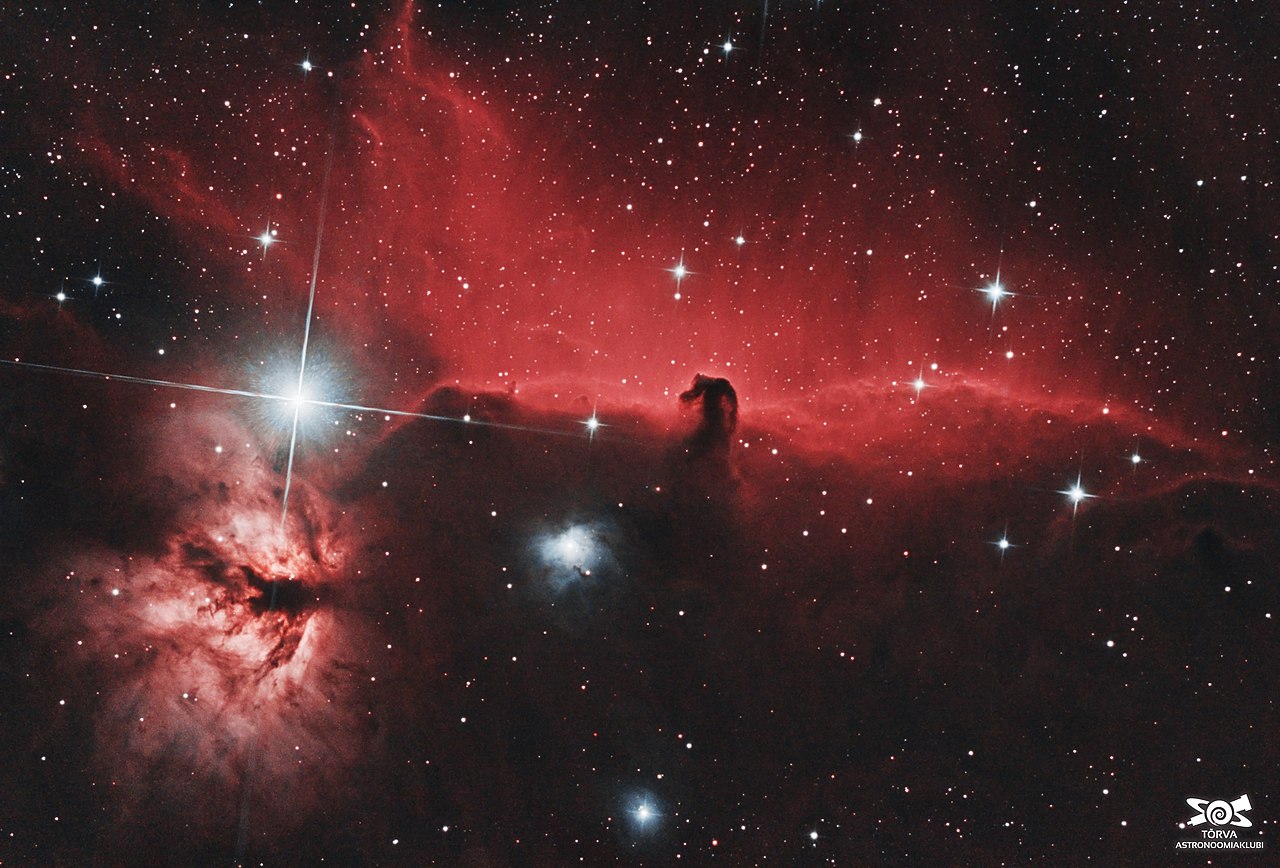
By Taavi Niittee
NGC 2023 and IC 434
The reflection nebula NGC 2023 lies near the Horsehead star field and is an accessible target in medium to large telescopes. IC 434 itself is a large, faint emission strip; the Horsehead is a silhouette against this glowing curtain. These areas are enriched by ultraviolet radiation from hot stars in the Belt region, a theme elaborated in The Science Inside Orion’s Molecular Clouds.
Barnard’s Loop and the Lambda Orionis Ring
Barnard’s Loop is a vast arc of emission that sweeps across much of Orion. It is typically invisible to the eye but appears prominently in deep, widefield H-alpha images. Another large-scale structure, the Lambda Orionis ring around Meissa, frames the constellation’s head with a faint, circular glow. Together, these structures tell a story of stellar feedback—winds and radiation carving cavities and illuminating the interstellar medium.
The Witch Head Nebula (IC 2118)
While technically in the neighboring constellation Eridanus, the Witch Head Nebula lies near Rigel and is often included in Orion-region imaging. It is a dusty reflection nebula that shines with the blue light scattered from Rigel. The Witch Head is a photographic target rather than a visual one from typical skies.
Using Orion to Navigate the Winter Sky
Orion is a celestial signpost. Once you identify the Belt, you can “jump” to many bright stars and patterns that dominate the winter sky. Amateur observers use these alignments for star-hopping and to build familiarity with broader sky geography.
- Orion’s Belt to Sirius: Follow the line made by the Belt stars down and across the sky to the brightest star, Sirius, in Canis Major. In the Northern Hemisphere, this is toward the southeast to south; in the Southern Hemisphere, it appears angled differently but still points reliably to Sirius.

Orion Constellation
By Davydushta - Belt to Aldebaran and the Pleiades: Extend the line of the Belt in the opposite direction to find the red giant Aldebaran in Taurus, then continue onward to the Pleiades (M45).
- Winter Triangle: Connect Betelgeuse, Procyon (in Canis Minor), and Sirius to outline a large triangle that helps you navigate nearby constellations.
- Winter Hexagon: A bigger asterism connecting Capella (Auriga), Aldebaran (Taurus), Rigel (Orion), Sirius (Canis Major), Procyon (Canis Minor), and Pollux (Gemini). Orion sits on one side of this enormous ring.
If you observe in October, keep an eye out for the Orionids meteor shower, which peaks in the latter half of the month. While meteor radiants do not indicate where meteors originate physically, the Orionids appear to streak away from a point near Orion. These meteors are associated with debris from Halley’s Comet. For best results, watch after midnight from a dark location with a wide view of the sky.
As you move from naked-eye navigation to telescopic observing, the suggestions in Observing Orion with Binoculars and Small Telescopes will help you prioritize targets under your local conditions.
Observing Orion with Binoculars and Small Telescopes
Orion rewards observers at every scale. Whether you use handheld binoculars, a small refractor, or a medium Dobsonian, the constellation offers a rich set of goals.
Best binocular targets
- M42/M43: In 7×50 or 10×50 binoculars, the Orion Nebula looks like a bright wing or fan. The core is readily visible even in moderate light pollution.
- Orion’s Belt and Sword: The star fields around the Belt and Sword are densely sprinkled and make for pleasing binocular sweeps.
- NGC 1981: A small, bright open cluster just above the Orion Nebula; a nice binocular bonus.
- Betelgeuse and Rigel color contrast: In the same field with binocular panning, the color contrast between these stars becomes obvious—an instructive lesson in stellar temperatures.
Small telescope highlights (60–130 mm aperture)
- M42 and the Trapezium: Even at 60–80 mm aperture, a steady night will occasionally reveal three or four stars in the Trapezium. Larger small scopes can begin to show the fainter E and F components under excellent seeing.
- Flame Nebula (NGC 2024): Visible from dark sites; try a narrowband filter for added contrast. The Horsehead is typically beyond the reach of small scopes visually, but it is a fair target for imaging.
- Double stars: Split Rigel and explore other doubles in the surrounding region. Mintaka is also a pleasing double under good seeing.
Medium scopes and filters
With 150–250 mm aperture, you can push deeper into Orion’s nebular structures. A UHC or O III filter helps emphasize emission features. For the Horsehead, an H-beta filter and a dark, transparent sky are often essential, but success still requires patience and practice. Many observers choose to photograph it instead.
Practical observing tips
- Dark adaptation: Give your eyes 20–30 minutes to adjust. Shield yourself from direct light sources, including phone screens.
- Averted vision: Look slightly away from faint targets to activate more sensitive parts of your retina.
- Magnetic eyepiece choices: Start with low power to frame nebulae; then incrementally increase magnification to inspect internal detail.
- Filters: Narrowband/UHC filters improve contrast for emission nebulae like M42; broadband light-pollution filters offer modest benefits for reflection nebulae.
- Transparency vs. seeing: For nebulae, transparency (clarity) matters more than sub-arcsecond seeing. Pick nights with low haze and minimal moisture.
If you plan to photograph Orion, the techniques in Photographing Orion: Settings, Techniques, and Workflows will help you capture both the nebula-rich Sword and the expansive Belt region.
Photographing Orion: Settings, Techniques, and Workflows
From wide-field landscapes to high-resolution nebula portraits, Orion is one of the best astrophotography subjects for all experience levels. The constellation’s mix of bright emission and reflection clouds alongside dark nebulae invites both simple and complex imaging strategies.
Wide-field constellation shots (no tracker)
Use a DSLR or mirrorless camera on a tripod with a fast, wide lens. Frame Orion’s Belt and Sword with nearby bright stars for context. In suburban skies, Orion remains photogenic, especially when you incorporate landscape elements.
- Lens: 20–35 mm (full-frame equivalent)
- Aperture: f/1.8–f/2.8
- Shutter: 5–15 s (use the “500 rule” or NPF rule to estimate max exposure without trails)
- ISO: 800–3200 depending on sky brightness and camera
- Technique: Shoot 20–100 frames for stacking; include dark frames to reduce noise
Tracked wide-field mosaics
A star tracker enables longer exposures at lower ISO, revealing faint structures such as Barnard’s Loop and the Lambda Orionis ring. Consider a multi-panel mosaic to encompass Orion, Taurus, and the Pleiades.
- Lens: 35–85 mm for a tight constellation frame; 85–135 mm to emphasize Belt & Sword
- Aperture: f/2–f/3.5 (stop down a little for sharpness)
- Shutter: 60–180 s (on a well-aligned tracker)
- ISO: 400–1600
- Frames: 40–200 lights per panel; capture flats and bias
Nebula close-ups: M42, Running Man, Flame, and Horsehead
Telephoto lenses (200–400 mm) or small refractors (60–100 mm) excel for Orion’s nebulae. A key challenge is the dynamic range of M42: the bright core saturates quickly while outer dust requires longer integration.

By Astrofalls
- Optics: 60–100 mm apochromatic refractor or 200–400 mm telephoto
- Mount: Equatorial mount or tracking star adventurer-class tracker
- Guiding: Optional for short focal lengths; recommended beyond ~300–400 mm
- Filters: Dual/tri-band narrowband filters help under light pollution; broadband L-pro style filters can tame gradients while preserving colors
To preserve both core and outer nebulosity, blend exposures:
- Short exposures (e.g., 10–30 s) to capture the Trapezium region unsaturated
- Medium exposures (e.g., 60–120 s) for midtones
- Long exposures (e.g., 180–300 s) for faint outer dust
Register and stack each set, then combine with an HDR technique in your processing software. If you use narrowband filters, plan for longer total integration to overcome filter throughput limits.
City-sky strategies
- Use narrowband: Dual/tri-band filters on color cameras or mono narrowband (H-alpha, O III) cut through light pollution.
- Target emission regions: M42, Flame, and IC 434 respond well to H-alpha; reflection targets like the Witch Head are harder under urban skies.
- Dither: Between exposures to reduce fixed pattern noise and improve background smoothness with drizzle or sigma-clipping.
- Calibrate: Flats, darks, and bias frames are crucial; they remove vignetting and sensor artifacts.
Processing workflow basics
- Pre-processing: Calibrate with flats/darks/bias, register, and stack.
- Gradient removal: Use background extraction to correct light pollution and moonlight gradients.
- Color calibration: Calibrate white balance using star colors or photometric calibration. Orion often benefits from preserving subtle reflection nebula blues while maintaining realistic H II reds.
- Noise reduction: Apply mild, multi-scale noise reduction before aggressive stretching.
- Stretching: Increase contrast with masked stretches; protect star cores to prevent bloat.
- Star control: Consider star-reduction techniques to emphasize nebulosity without losing star color.
- HDR blend (for M42): Integrate short and long exposures to retain Trapezium detail.
If you are curious about what makes these nebulae glow and how massive young stars shape their environments, the primer in The Science Inside Orion’s Molecular Clouds explores the physics behind the beauty.
The Science Inside Orion’s Molecular Clouds
Beyond its visual appeal, Orion is a nearby laboratory for studying how stars form and how they sculpt their surroundings. Much of Orion’s glowing scenery comes from two major giant molecular clouds known as Orion A and Orion B, along with related structures like Barnard’s Loop and the Lambda Orionis ring.
Orion A and Orion B
Orion A stretches southward from the Belt through the Sword, encompassing the Orion Nebula (M42), the dense region L1641, and a chain of young clusters. Orion B lies to the north and east, containing areas near the Flame Nebula (NGC 2024) and the reflection nebula complex around the Belt. These clouds are cold reservoirs of molecular hydrogen mixed with dust, and they are threaded by filaments where gravity and turbulence channel material into star-forming cores.
OB associations and feedback
The Orion OB1 association includes several subgroups of massive, hot, luminous O- and B-type stars. The intense ultraviolet radiation and stellar winds from these stars ionize nearby hydrogen (producing H II regions) and drive shocks that compress or erode surrounding gas. This process, often called feedback, can both trigger and inhibit subsequent star formation, depending on local conditions.
Proplyds and stellar nurseries
High-resolution observations of the Orion Nebula, including images from major observatories, reveal protoplanetary disks (proplyds) around young stars. These disks are sculpted by the harsh radiation environment and offer direct insight into the early stages of planetary system formation. The Trapezium cluster’s radiation creates ionization fronts, bow shocks, and other dynamic structures that observers can trace in high-detail imagery.

By NASA, ESA, M. Robberto (Space Telescope Science Institute/ESA) and the Hubble Space Telescope Orion Treasury Project Team
Photodissociation regions (PDRs)
At the interface between ionized and molecular gas, photodissociation regions arise where far-ultraviolet light breaks apart molecules and heats dust. These transitions, prominent near the edges of H II regions like M42 and the Flame Nebula, are rich in emission lines and provide clues about chemical evolution and energy balance in star-forming environments.
Kinematics and large-scale structures
On larger scales, Orion is full of shells, arcs, and loops—evidence of past episodes of stellar activity. Barnard’s Loop and the Lambda Orionis ring are believed to be remnants and signatures of feedback processes operating over millions of years. These structures exhibit complex kinematics: expanding shells, cavities carved by winds, and coherent motion of young stellar groups. Modern surveys combining optical, infrared, radio, and astrometric data deepen our view of these processes.
Distances and uncertainties
Because Orion contains overlapping structures at different depths, published distances can vary depending on the specific region measured and the techniques used. For example, stars in the Belt are generally more distant than the Orion Nebula. When you encounter numbers like “~1,340 light-years for M42” or “~2,000 light-years for Alnilam,” understand that these reflect current best estimates and that improved measurements can refine them. The take-away is that Orion is both nearby enough to resolve in fine detail and large enough to reveal diverse stages of star formation in a single constellation.
Cultural Stories: Orion in World Mythologies
Orion’s vivid outline has inspired stories across continents and epochs. The most familiar Western tale casts Orion as a mighty hunter from Greek mythology. The star Betelgeuse forms one shoulder, Bellatrix the other, Rigel and Saiph the knees or feet, and the Belt stars mark his waist. Nearby constellations—Canis Major and Canis Minor—are interpreted as his hunting dogs, with Taurus as the bull he pursues.
In ancient Mesopotamia, a figure identified with Orion appears as SIPA.ZI.AN.NA, translated as the “True Shepherd of Anu.” In Egyptian sky lore, Orion was associated with Osiris. Popular discussions sometimes point to patterns between the Belt stars and the layout of pyramids on the Giza plateau; interpretations vary, and mainstream archaeology and archaeoastronomy evaluate such ideas with caution and debate. Regardless of specific claims, Orion’s prominence near the celestial equator made it a natural seasonal marker for many early civilizations.
In European folk traditions, the Belt has been called the “Three Kings,” the “Three Marys,” or “Jacob’s Staff.” In parts of Scandinavia, Orion’s Belt and Sword have been linked to a distaff (a traditional tool for spinning), sometimes named for Frigg or Freyja. Various Indigenous cultures across the world have their own interpretations, often tied to seasonal cycles important for agriculture, hunting, or navigation.
These stories highlight a larger truth: easily recognized asterisms like Orion act as shared sky-lore, connecting practical observation with cultural meaning. If you are introducing newcomers to stargazing, beginning with Orion’s Belt and Sword can be a gentle way to blend science, story, and orientation to the night sky.
Frequently Asked Questions
Is Betelgeuse about to explode as a supernova?
Betelgeuse is a red supergiant that will eventually end its life in a supernova, but “eventually” spans long astronomical timescales—on the order of many tens of thousands to hundreds of thousands of years or more. The notable dimming episode in 2019–2020 drew interest because it was unusually deep compared with typical variability; subsequent observations point to dust ejected from the star temporarily obscuring it from our line of sight. While Betelgeuse is an advanced star evolving toward its end, there is no observational evidence that an explosion is imminent on human timescales.
Can I see the Orion Nebula from a city?
Yes, in many cases. The Orion Nebula (M42) is bright enough to be visible even under moderate light pollution, especially when Orion is high in the sky and the air is clear. Through binoculars, expect a glowing patch rather than vivid detail. A small telescope will reveal the fan shape and the Trapezium. Nebula filters can help from suburban locations, though their benefits are limited in very bright urban skies. For the richest view, travel to a darker site and observe when the Moon is not bright.
Final Thoughts on Exploring the Orion Constellation
Orion is more than a seasonal marker—it is a fully stocked classroom for learning the night sky. With its instantly recognizable Belt and contrasting stars Betelgeuse and Rigel, it anchors the Winter Triangle and Hexagon and points the way to Taurus, the Pleiades, and Sirius. For observers, Orion offers a ladder of targets: wide-field sweeps for binoculars, detailed nebula structure for small telescopes, and challenging dark nebulae and expansive loops for imagers. For students of astrophysics, the constellation provides a living laboratory where star formation, feedback, and interstellar chemistry are written across the sky in emission and reflection.
As you plan your next night under the stars, refer back to How to Find Orion from Any Sky Location to locate the constellation quickly, explore the Deep-Sky Wonders in Orion with your optics of choice, and try the techniques in Photographing Orion to record what you see. Whether you are just starting out or deepening your practice, Orion will reward repeated attention across the season.
If you enjoyed this guide, consider subscribing to our newsletter to get future sky tours, observing checklists, and astrophotography walkthroughs delivered to your inbox. Clear skies—and enjoy your journey through the Hunter’s magnificent realm.