Table of Contents
- What Does Numerical Aperture Mean in Light Microscopy?
- How Numerical Aperture Sets Resolution: Diffraction, PSF, and Criteria
- Beyond Magnification: Useful Magnification and Empty Zoom
- Wavelength, Refractive Index, and Immersion Media Effects
- Depth of Field, Depth of Focus, and Working Distance Trade-offs
- Illumination and Condenser NA: Getting the Most from Your Objective
- Sampling on Cameras: Pixel Size, Nyquist, and Digital Imaging
- Practical Trade-offs and Objective Selection by Application
- Frequently Asked Questions
- Final Thoughts on Choosing the Right Numerical Aperture
What Does Numerical Aperture Mean in Light Microscopy?
Numerical aperture (NA) is the central parameter that sets the resolving power, light-gathering ability, and optical sectioning strength of a microscope objective. If you want to understand why two objectives that both say “40×” can behave so differently, NA is the reason.
Formally, numerical aperture is defined as:
NA = n · sin(θ), where n is the refractive index of the medium between specimen and objective front lens (for example, air ≈ 1.00, water ≈ 1.33, immersion oil ≈ 1.515), and θ is the half-angle of the largest cone of light that the objective can accept from the specimen.
Because sin(θ) ≤ 1, the maximum achievable NA in air is limited to approximately 1.00 (in practice, high-end dry objectives reach around 0.95). Immersion media with higher refractive index allow NAs greater than 1.0, which is one reason oil-immersion objectives can resolve finer detail than dry objectives of similar magnification.
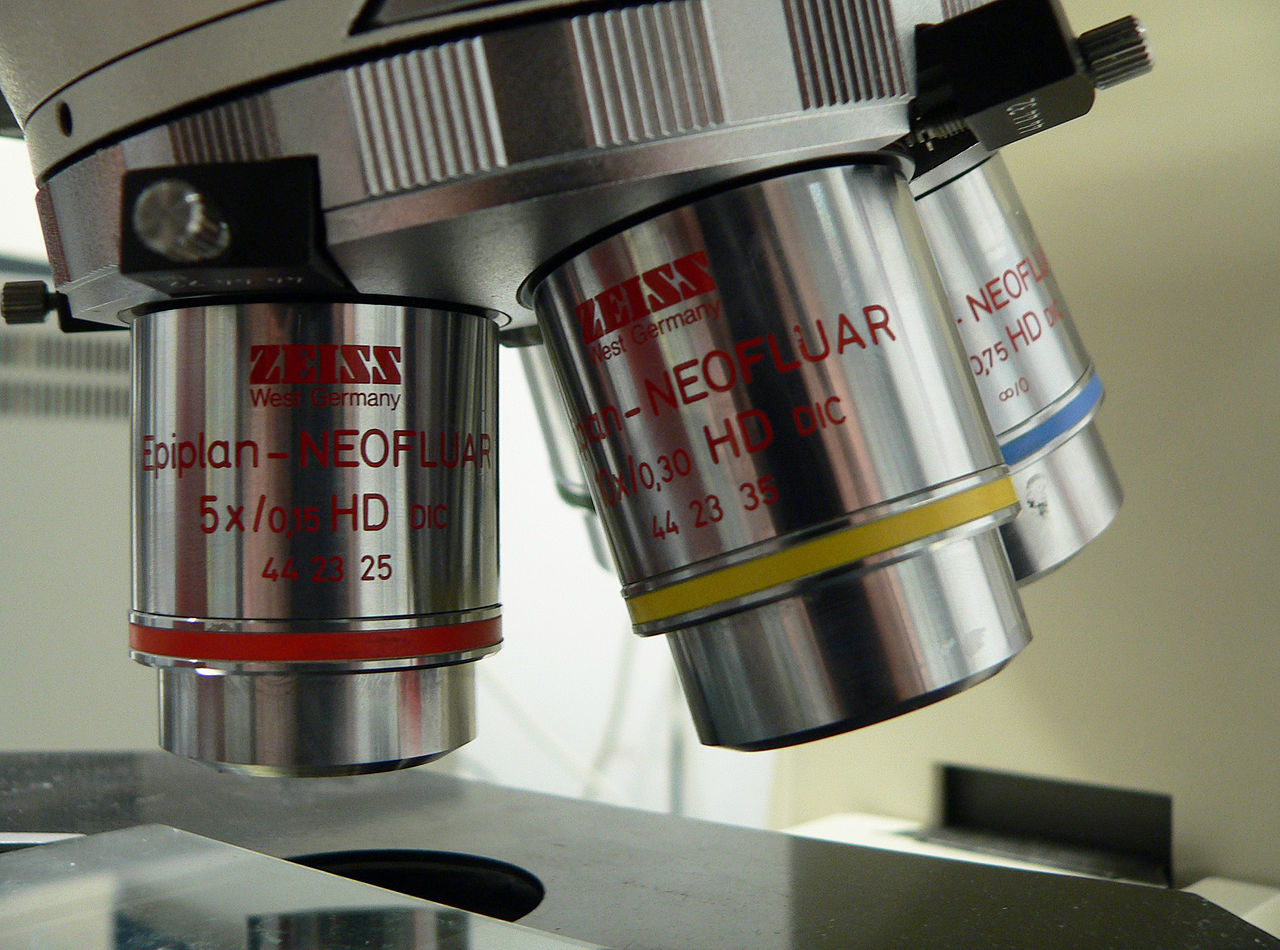
NA appears on every objective barrel because it is the objective’s most significant performance indicator. While magnification tells you “how big” the image appears, NA tells you “how much detail” the optics can faithfully transfer. The two are related but not interchangeable, a theme we will return to in Beyond Magnification.
Artist: Ice Boy Tell
Why NA is more than a single number
Although NA is a single scalar listed on the objective, it connects multiple image qualities:
- Resolution: Higher NA supports transfer of higher spatial frequencies, enabling separation of finer details. See How Numerical Aperture Sets Resolution.
- Brightness and signal collection: Higher NA collects light over a larger solid angle, increasing signal for fluorescence emission and improving brightness in transmitted modalities, all else equal.
- Depth of field: As NA increases, depth of field typically decreases, making focus more selective. We analyze this trade-off in Depth of Field, Depth of Focus, and Working Distance.
- Working distance: For a given magnification class, higher NA often correlates with shorter working distance. This has practical implications when imaging thick samples or using coverslip-dependent objectives, also covered in that section.
- Illumination matching: In brightfield or DIC, the condenser NA should be set comparably to the objective NA to fully exploit the objective’s resolving power. We discuss this in Illumination and Condenser NA.
NA vs. f-number in microscopy
In photography, many people are comfortable with f-number (f/#), which is inversely related to the numerical aperture (in image space) for lenses focused at infinity. Microscopes are designed and specified in object space; the direct analog is NA. A larger NA acts like a smaller f-number: it gathers more light, yields higher resolution, and offers a shallower depth of field.
Understanding NA in object space is more relevant than image-space f/# for microscope objectives because primary performance metrics—resolution in the specimen plane and optical sectioning—are determined by object-space NA. For a deeper dive into resolution definitions and what counts as “separable detail,” head to the next section.
How Numerical Aperture Sets Resolution: Diffraction, PSF, and Criteria

Artist: Anaqreon
Even a perfect lens blurs a point of light into a finite-sized pattern due to diffraction. This pattern is the point spread function (PSF), whose central bright region is often described by an Airy disk in a circular, unaberrated aperture. The size of the PSF establishes the smallest detail that can be resolved: two points must be sufficiently separated so their PSFs are distinguishable.
Diffraction-limited resolution in the specimen plane
For incoherent imaging (typical of brightfield with Köhler illumination or fluorescence), a common resolution benchmark is the Rayleigh criterion. In object space, the approximate center-to-center separation required to just resolve two point emitters is:
r ≈ 0.61 · λ / NA
This image uses a nonlinear color scale (specifically, the fourth root) in order to better show the minima and maxima.
Artist: Spencer Bliven
Here λ is the wavelength of light relevant to image formation. For fluorescence, one uses the detected emission wavelength; for transmitted light, a representative wavelength of illumination is used. Shorter wavelengths and higher NA both reduce r, improving resolution.
For periodic structures (e.g., line gratings), the Abbe limit is often quoted:
d ≈ λ / (2 · NA)
These two expressions differ by a numerical factor because they refer to different criteria and object types: Rayleigh is a point-separation criterion, while Abbe characterizes frequency transfer for periodic detail. Both demonstrate the same key dependence: resolution improves with higher NA and shorter wavelength.
The role of the condenser in transmitted light
In transmitted brightfield, the condenser’s numerical aperture plays a crucial role in delivering the spatial frequencies the objective can capture. Practically, to achieve the full resolution potential of an objective, the condenser aperture should be set to a value comparable to the objective NA. If the condenser NA is set too low, high spatial frequencies are under-illuminated, reducing contrast for fine detail even if the objective NA is high. This relationship is revisited in Illumination and Condenser NA.
Point spread function and optical transfer
The PSF describes how a point of light is imaged. Its Fourier transform, the optical transfer function (OTF), expresses how different spatial frequencies are transferred in amplitude and phase; the magnitude of the OTF is the modulation transfer function (MTF). Higher NA optics extend the support of the OTF to higher spatial frequencies, permitting finer details to pass with measurable contrast. Conversely, lower NA truncates high-frequency content, softening edges and textures.
Aberrations, misalignment, and coverslip mismatch can broaden the PSF beyond the diffraction-limited size. While a microscope objective is often corrected to be near diffraction-limited on-axis under specified conditions (e.g., a 0.17 mm coverslip for certain objective types), real-world deviations can erode resolution. This is one reason many high-NA objectives specify a required coverslip thickness, and some include a correction collar to compensate for small variations.
Axial resolution and sectioning
Resolution is three-dimensional. In widefield microscopy, the optical section thickness—the axial distance over which features remain in focus—is broader than the lateral resolution by a factor that depends on NA and refractive index. While exact constants vary with the criterion used, a reliable rule is that axial resolution improves approximately with λ / NA2, meaning that increasing NA is especially powerful for sectioning in the axial direction. This is one reason high-NA oil or water objectives are favored for optical sectioning in fluorescence microscopy when physical constraints allow.
Confocal and other sectioning modalities can further narrow the effective axial PSF by rejecting out-of-focus light; however, even in those systems, objective NA remains the foundation of the theoretical best case. For a purely optical discussion focused on objective NA, see the trade-offs in Depth of Field and Working Distance.
Beyond Magnification: Useful Magnification and Empty Zoom
A pervasive misconception in microscopy is that magnification alone defines image quality. In reality, resolution is set by NA and wavelength, not magnification. It is entirely possible to make a soft, unresolved image look bigger without revealing additional detail—a phenomenon known as “empty magnification.”
www.micro-shop.zeiss.com/
Artist: ZEISS Microscopy
Why magnification is not resolution
Consider two 40× objectives: one with NA 0.65 and another with NA 0.85. Although both enlarge the image equally, the NA 0.85 objective resolves finer detail because it captures and transfers higher spatial frequencies. Conversely, swapping a 40× NA 0.85 for a 60× NA 0.65 does not necessarily improve resolvable detail, even though the image is larger; the 60× might display the same information simply spread over more pixels.
To translate resolution into sampling guidance, see Sampling on Cameras, where we connect NA and wavelength to recommended pixel sizes.
Useful magnification: a rule of thumb
For visual observation, a widely cited guideline is that useful magnification lies roughly in the range of 500× to 1000× per unit NA. For example, a 0.65 NA objective provides useful visual magnification on the order of 325× to 650×. Magnifying beyond this does not uncover new detail; it simply enlarges the diffraction pattern and noise.
When imaging to a camera, the analogous concept is ensuring that the sampling in the camera plane is appropriate for the optical resolution. Oversampling increases file size and may slow acquisition but does not create new information; undersampling risks aliasing and loss of detail. Details on how to choose camera pixel size and total magnification are in Sampling on Cameras.
Field of view and magnification trade-offs
Higher magnification typically reduces field of view for a given tube lens and camera sensor size, which can limit context. Thus, choosing magnification is as much about framing and sampling as it is about showing detail. If the objective NA already limits resolution, increasing magnification without changing NA will not improve the smallest visible features, but it may help display those features at a more comfortable scale on a monitor if the camera was undersampling. The right choice balances resolution, sampling, and the desired field of view.
Wavelength, Refractive Index, and Immersion Media Effects
The physics of diffraction tells us that shorter wavelengths improve resolution. However, in a real microscope, both wavelength and refractive index of the immersion medium enter the NA definition and impact contrast, brightness, and aberration correction.
Choosing wavelengths
In transmitted-light imaging, white light contains a range of wavelengths. Objectives and condensers are designed and corrected over a spectral band (e.g., 400–700 nm). Chromatic aberration—wavelength-dependent focus—can broaden the effective PSF if optics or filters are not well matched. In fluorescence, excitation and emission bands are separated; image-forming light is typically the emission band. Using shorter emission wavelengths improves nominal resolution (smaller λ), but signal levels, sample autofluorescence, and photostability must also be considered. While we avoid procedural advice, conceptually it is beneficial to be aware that optimizing for resolution by simply choosing a shorter wavelength is subject to practical trade-offs like signal-to-noise ratio.
Immersion media and NA
A key lever for increasing NA is to increase the refractive index n in NA = n · sin(θ). Common immersion options include:
- Air (n ≈ 1.00): Convenient; practical NA ceiling around 0.95 for high-performance dry objectives.
- Water (n ≈ 1.33): Useful for aqueous samples, live-cell imaging, and reducing spherical aberration when the specimen is water-rich. Water immersion objectives often provide NA up to ~1.2.
- Glycerol (n ≈ 1.47): Intermediate option; can reduce refractive index mismatch for certain samples and mounting media.
- Immersion oil (n ≈ 1.515): Standard for many high-NA objectives; allows NA ~1.40 and above in practice.
Choice of immersion medium impacts not only NA but also aberrations due to refractive index mismatch between sample, coverslip, mounting medium, and objective design. Using an immersion medium for which the objective is corrected supports the sharpest PSF and highest contrast. See how this interacts with working distance and depth of field.
Coverslip thickness and correction collars
Many high-NA objectives specify a coverslip thickness, commonly 0.17 mm (No. 1.5). Departures from this thickness can introduce spherical aberration that enlarges the PSF, especially at high NA. Some objectives include a correction collar to compensate for small coverslip or sample thickness variations. Used appropriately, correction collars can restore a near-diffraction-limited PSF under the intended conditions, preserving the resolution that the stated NA promises.
When the sample is thick or index-mismatched, focusing deeper into the specimen can accumulate aberration, reducing effective resolution even if the nominal NA is high. Water immersion can mitigate this for aqueous samples by decreasing index mismatch and reducing spherical aberration at depth. This interplay of immersion and specimen refractive index is a core consideration when interpreting the resolution limits in practice.
Depth of Field, Depth of Focus, and Working Distance Trade-offs
Depth of field (DOF) and depth of focus are often conflated but describe different spaces. DOF refers to the axial range in object space over which features appear acceptably sharp. Depth of focus refers to a corresponding tolerance in the image space around the intermediate image plane or sensor.
How DOF scales with NA
As NA increases, the DOF in object space decreases. While various criteria yield different coefficients, the scaling trend is consistent: DOF is approximately proportional to λ / NA2 plus a term influenced by the system’s permissible blur and magnification. The practical upshot is that for a doubling of NA (holding wavelength constant), the depth of field decreases by roughly a factor of four. This steeper dependence compared to lateral resolution makes high-NA imaging more sensitive to small focus offsets but simultaneously enhances optical sectioning.
In fluorescence, the thin DOF at high NA helps reject out-of-plane signal by virtue of the PSF’s axial confinement. In transmitted light, a smaller DOF means surface texture might appear sharper while out-of-plane structures blur. Whether this is beneficial depends on the specimen and imaging goals.
Depth of focus in the image plane
In the image plane, depth of focus defines the tolerance for sensor position relative to the image formed by the objective. It grows with the f-number in image space and depends on permissible blur. High-NA objectives (small f-number analogs) offer a tighter depth of focus, which means camera mounting and tube lens alignment must be precise to maintain peak sharpness across the field. While modern systems are designed to meet these tolerances, awareness is useful when diagnosing subtle softness that cannot be explained by resolution limits alone.
Working distance and NA
Working distance is the gap between the objective’s front lens and the specimen at the plane of focus. For a given magnification class, higher NA typically reduces working distance because a large acceptance cone demands a front element close to the specimen. Nevertheless, specialized “long working distance” objectives exist that trade some NA for clearance to accommodate thicker samples or micromanipulation tools. The engineering takeaway is that NA, working distance, and objective design constraints are coupled; map your specimen geometry and handling requirements against achievable NA before committing to an objective choice. We revisit this in Practical Trade-offs and Objective Selection.
Contrast and background considerations
Increasing NA collects more signal but can also collect more background if the sample or preparation introduces stray light. In fluorescence, for instance, higher NA gathers more emitted photons, improving signal-to-noise under many conditions. In transmitted modalities, higher condenser NA can sometimes reduce apparent contrast on low-absorption features because the broader range of angles lowers relief shading. These are not contradictions—they are reminders that NA interacts with the specimen’s scattering and absorption characteristics. Balancing NA with illumination and contrast method is part of well-optimized imaging, discussed in Illumination and Condenser NA.
Illumination and Condenser NA: Getting the Most from Your Objective
Objectives do not work in isolation; they are part of an imaging chain that includes a condenser and an illumination system. In transmitted-light microscopy, the condenser’s role is to control the angular distribution of light reaching the specimen, which in turn sets the spectrum of spatial frequencies available for the objective to capture.
Condenser NA and brightfield resolution
Under incoherent illumination typical of Köhler-configured brightfield, setting the condenser aperture to a value comparable to the objective NA helps supply the high-angle rays necessary to realize the objective’s full resolution. If the condenser NA is set too low, high spatial frequencies will be underfilled, reducing fine-detail contrast even though the objective is physically capable of transferring those frequencies.

Images donated as part of a GLAM collaboration with Carl Zeiss Microscopy – please contact Andy Mabbett for details.
Artist: ZEISS Microscopy from Germany
Conversely, opening the condenser aperture excessively may add glare and reduce contrast in some specimens, particularly those with low inherent absorption. A practical approach is to treat the condenser aperture as a control that balances resolution and contrast. Aligning this with the objective’s NA is a good starting point, with fine adjustments made to optimize visibility of specimen features. This conceptual balance complements the discussion on resolution limits and depth of field.
Contrast methods and effective NA
Different contrast techniques leverage NA in distinct ways:
- Darkfield: The condenser excludes low-angle rays so that only scattered light from the specimen enters the objective. Objectives used for darkfield must have an NA lower than the darkfield condenser’s inner NA to block direct illumination, while still being high enough to collect scattered light efficiently.
- Phase contrast: Relies on phase annuli in the condenser and a matching phase plate in the objective. The system’s effective NA for phase contrast depends on the objective and phase ring design; while high NA is still beneficial, correct matching is essential.
- Differential interference contrast (DIC): Uses shear interferometry; objectives and condensers suitable for DIC are polarized and Nomarski prism-equipped. High NA increases gradient sensitivity and axial sectioning, but optimal performance requires the full DIC optical path to be in specification.
The throughline is that condenser settings and contrast optics must be compatible with the objective to realize the benefits of higher NA. This perspective reinforces that NA is necessary but not sufficient; the imaging system’s configuration must support it.
Epi-illumination and collection efficiency
In reflected-light and fluorescence epi-illumination, the same objective both delivers excitation and collects emission (in fluorescence) or reflected/scattered light. In these modalities, higher NA increases the fraction of emitted or reflected photons captured, raising signal levels. For fluorescence detection, the collected fraction of isotropic emission grows as the acceptance solid angle grows with NA. Practically, higher NA yields brighter, more detailed fluorescence images at a given exposure, subject to the trade-offs in depth of field and immersion medium.
Sampling on Cameras: Pixel Size, Nyquist, and Digital Imaging
Modern microscopy frequently records images to digital sensors. The optics determine the continuous image; the camera samples that image on a discrete pixel grid. To preserve optical resolution, sampling must satisfy the Nyquist criterion: the pixel pitch in the specimen plane should be small enough to represent the highest spatial frequencies passed by the optics.
From NA and wavelength to recommended pixel size
A pragmatic way to choose sampling is to start from a resolution criterion, such as Rayleigh’s r ≈ 0.61 · λ / NA, and then ensure at least two samples across that distance. That is, target a specimen-plane pixel size p satisfying:
p ≤ r / 2 ≈ (0.61 · λ) / (2 · NA)
Many practitioners prefer to sample somewhat finer—around 2.3–3 pixels across the smallest resolvable feature—to provide headroom for interpolation and deconvolution. Translating this into a rule of thumb yields:
- Conservative Nyquist:
p ≤ 0.5 · r - Comfortable sampling:
p ≈ 0.33–0.43 · r
Remember that p here is the pixel size at the specimen. The camera’s physical pixel size is divided by the total magnification between specimen and sensor. For infinity-corrected systems, total magnification is objective magnification times the ratio of the tube lens focal length to the design tube lens focal length if those differ.
Practical calculation workflow
Suppose your camera has 6.5 µm pixels and your objective is 60×, with a standard tube lens yielding 60× at the sensor. Then the specimen-plane pixel size is 6.5 µm / 60 ≈ 108 nm. If using 525 nm emission light and NA 1.4, Rayleigh’s r ≈ 0.61 · 525 nm / 1.4 ≈ 229 nm. Nyquist suggests p ≤ r / 2 ≈ 115 nm. The 108 nm sampling is slightly finer than Nyquist, which is appropriate. If the same camera were used with a 40× NA 0.65 objective, the specimen-plane pixel size would be 6.5 µm / 40 ≈ 162.5 nm. For 525 nm and NA 0.65, r ≈ 0.61 · 525 / 0.65 ≈ 492 nm, so Nyquist would require p ≤ 246 nm, and 162.5 nm sampling is comfortably fine.
This example illustrates how magnification should be chosen with resolution and sensor pixel size in mind. Oversampling is acceptable within reason, but excessive oversampling slows readout and increases data size without improving captured information.
Aliasing and the hazards of undersampling
If the camera undersamples relative to optical resolution, fine structures can appear as false patterns (aliasing) or vanish entirely because high spatial frequencies fold back into lower frequencies in the sampled image. When evaluating detail visibility, always consider whether the sampling grid, not the optics, is the limiting factor. Proper sampling ensures that the optical performance conferred by higher NA is represented in the recorded data.
Digital zoom vs optical information
Digital zoom (interpolation) enlarges pixel values but does not add new information. While upscaling can aid presentation, it cannot restore missed spatial frequencies once aliasing has occurred. Therefore, if your imaging goal requires the finest possible detail that your objective’s NA can transfer, set your optics and sensor to meet Nyquist at the wavelengths of interest rather than relying on post-acquisition scaling.
Practical Trade-offs and Objective Selection by Application
Objective selection often begins with magnification but should pivot quickly to NA and specimen constraints. Below we map common goals to NA-related considerations, highlighting how choices interact with immersion media, working distance, and illumination.
General transmitted-light observation
- Moderate NA (e.g., 0.40–0.65 dry) often balances resolution with DOF and ease of use in air. For brightfield of stained thin sections, matching the condenser NA to the objective helps resolve fine histological features while preserving contrast.
- High NA dry (≈0.80–0.95) can deliver excellent resolution with air but may have short working distances and tighter DOF; expect more sensitivity to coverslip and specimen flatness.
- Condenser alignment is essential to make the most of the objective’s NA in transmitted light; underfilling the condenser aperture can mask the theoretical resolution benefit of higher NA, as discussed in Illumination and Condenser NA.
Fluorescence imaging
- High NA is typically valuable to collect more emission photons and improve both lateral and axial resolution. Oil objectives with NA ≈ 1.3–1.4 are common for thin specimens mounted under coverslips of the specified thickness.
- Water immersion may be preferred for live or aqueous samples, especially when focusing deeper into the specimen. The closer refractive index match can reduce spherical aberration with depth.
- Sampling should be set according to Nyquist recommendations for the emission wavelength and NA. When switching emission bands, reassess whether sampling remains adequate.
Thick or three-dimensional specimens
- Working distance becomes critical. Long-working-distance objectives trade NA for clearance. If axial sectioning is important, weigh whether the reduced NA can still meet the resolution requirement.
- Refractive index matching across specimen, mounting medium, and immersion can mitigate spherical aberration. Water or glycerol immersion objectives might outperform oil immersion at depth in aqueous samples despite lower nominal NA because they maintain a tighter PSF in practice.
Quantitative measurements and imaging fidelity
- Plan-corrected objectives help maintain focus and magnification consistency across the field, essential when measurements rely on field-wide uniformity.
- Chromatic corrections matter if multi-wavelength alignment is needed. Achromat, semi-apochromat, and apochromat designs differ in how many wavelengths are brought to a common focus and magnification. This affects the effective PSF when using polychromatic light.
- NA remains primary for resolution, but aberration corrections ensure the resolution implied by NA is realizable across the field, not just on-axis.
Low-light and sensitive samples
- High NA improves photon collection efficiency in fluorescence, reducing required exposure for a given signal-to-noise, subject to sample constraints.
- Moderate NA may be preferable in transmitted modalities to balance contrast and DOF when the specimen is fragile and cannot tolerate high illumination or extensive focus adjustments.
Compatibility and system-level thinking
- Tube lens and sensor: Confirm that total magnification and camera pixel size satisfy Nyquist for the NA and wavelengths in use.
- Condenser availability: Ensure that the condenser can reach the NA needed by the objective in transmitted modalities; otherwise, the system will be under-illuminated in angle space.
- Coverslip conditions: If the specimen geometry or container prevents the specified coverslip and immersion arrangement, prefer objectives designed for that condition (e.g., no-cover objectives or dipping objectives) rather than forcing a mismatch that increases aberrations.
Frequently Asked Questions
Does a higher NA always produce a brighter image?
Higher NA increases the solid angle over which light is collected, which often raises signal levels, especially in epi-fluorescence. In transmitted light, brightness at the image depends on both the objective and condenser NAs as well as illumination intensity and specimen transmission. Thus, while higher NA is associated with improved photon collection, actual image brightness is a system-level outcome that also involves illumination settings and specimen properties. Importantly, higher NA can reduce depth of field and make the system more sensitive to focus, which may affect perceived brightness and contrast.
Can I achieve the same resolution at 40× as at 60× if the NA is the same?
If the objectives have the same NA and are used at the same wavelength under comparable imaging conditions, their diffraction-limited resolution is similar. The 60× objective will present that detail at a larger scale, which can be helpful for visual observation or to meet Nyquist sampling on a camera with larger pixels. However, the smallest resolvable feature size in the specimen plane is fundamentally set by NA and wavelength, not by magnification. Differences in aberration correction, field flatness, and working distance between specific objective models may lead to practical differences, but the NA establishes the theoretical limit.
Final Thoughts on Choosing the Right Numerical Aperture
Numerical aperture is the keystone of light microscopy performance. It connects resolution, contrast transfer, photon collection, depth of field, and working distance. Magnification scales an image but does not set the detail it can carry—NA and wavelength do. Translating these principles into practice means aligning three pillars:
Artist: Rama
- Optics: Choose an objective whose NA and immersion medium match the specimen’s geometry and refractive index landscape. Verify coverslip and correction requirements to keep the PSF tight.
- Illumination: In transmitted light, set the condenser NA to support the objective’s resolving power while balancing contrast. In epi modalities, exploit high NA to collect more photons efficiently.
- Sampling: Pair camera pixel size and total magnification to meet or slightly exceed Nyquist for the relevant wavelength and NA, avoiding both aliasing and excessive oversampling.
When these elements are harmonized, the images you acquire will faithfully represent the finest detail your system can resolve. As you evaluate objectives, remember that NA is the headline number to anchor your decision, with magnification, immersion, and working distance providing the necessary context. Continue exploring topics like Köhler illumination, contrast methods, and camera optimization to build a complete, robust imaging workflow. For more deep dives like this one, subscribe to our newsletter and be the first to read new microscopy fundamentals and best-practice guides.