Table of Contents
- What Is Numerical Aperture in Light Microscopy?
- How Numerical Aperture Controls Resolution, Contrast, and Brightness
- Condenser Numerical Aperture and Illumination Geometry
- Immersion Media, Refractive Index, and High-NA Objectives
- Working Distance, Depth of Field, and Axial Resolution
- Resolution Limits: Abbe, Rayleigh, Sparrow, and Frequency Cutoffs
- Sampling, Pixel Size, and Avoiding Empty Magnification
- Common Misconceptions About Numerical Aperture
- Choosing Objectives by Numerical Aperture: Trade-offs and Context
- Frequently Asked Questions
- Final Thoughts on Choosing the Right Numerical Aperture
What Is Numerical Aperture in Light Microscopy?
Numerical aperture (NA) is the most consequential single number on a microscope objective when it comes to image detail and light collection. It is defined by the expression NA = n sin(theta), where n is the refractive index of the medium between the specimen and the objective’s front lens (for example, air, water, or immersion oil), and θ is the half-angle of the widest cone of light accepted by the lens from the specimen. A larger NA means the lens accepts light over a wider range of angles, which directly influences resolution, contrast, and brightness.
On most objectives you will see markings such as “20×/0.50” or “60×/1.40 Oil.” The number after the slash is the objective’s NA. The medium (e.g., Oil, Water, Gly, Sil) indicates the required immersion medium needed to achieve that NA. Because sin(theta) ≤ 1, NA cannot exceed the refractive index of the immersion medium. Typical upper bounds are roughly:

- Air:
n ≈ 1.00, practical NA ≤ ~0.95 - Water:
n ≈ 1.33, high-NA water objectives up to ~1.20 - Silicone oil:
n ≈ 1.40, objectives often around 1.30–1.40 - Standard immersion oil:
n ≈ 1.515, objectives near 1.40–1.49
While magnification determines how large a specimen appears, NA largely determines how much fine detail the lens can actually resolve and how efficiently it collects photons. This distinction between magnification and resolution is foundational. A 100× objective with NA 0.80 will not resolve as much detail as a 60× objective with NA 1.40, even though the former magnifies more—the higher-NA lens can form a sharper, more information-rich image.
NA is meaningful on both sides of the microscope’s optical train: there is the NA of the objective lens (for detection) and the NA of the condenser (for illumination) in transmitted-light modalities. As we will see in Condenser Numerical Aperture and Illumination Geometry, condenser NA is critical to fully exploiting objective NA in brightfield, darkfield, and phase contrast.
In short: NA sets the cone of acceptance. Larger cones capture higher spatial frequencies, which are the image details we perceive as fine structure.

How Numerical Aperture Controls Resolution, Contrast, and Brightness
The principal reason NA matters is its direct link to spatial resolution—the ability to distinguish two closely spaced features as separate. In widefield microscopy, the lateral (xy) resolution limit is frequently approximated by the Rayleigh criterion:
d_{xy} ≈ 0.61 ; lambda / NA
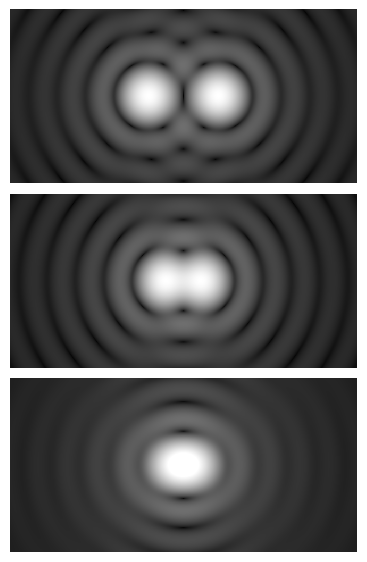
Here lambda is the relevant wavelength of light. For fluorescence imaging, one typically uses the emission wavelength for lambda, while for transmitted-light brightfield the effective wavelength is within the passband of the illumination and detection. Shorter wavelengths and larger NA both reduce d_{xy}, improving resolution (smaller d means finer details are resolved).
NA also affects brightness and contrast. For detection of weak signals such as fluorescence, collection efficiency depends on the solid angle of light the objective captures. For small angles, this collection scales roughly with NA^2. Practically, a higher-NA objective gathers more emitted photons from a given point, improving signal-to-noise ratio (SNR) for the same exposure. However, for transmitted-light imaging of extended uniform scenes, image irradiance also depends on illumination geometry and the relationship between NA and magnification. We discuss the illumination side in Condenser Numerical Aperture and Illumination Geometry.
Beyond resolution and brightness, NA influences contrast. Wider angular acceptance reduces blur from diffraction, but also captures more scattered light. In transparent specimens, increasing condenser NA (up to a match with the objective NA) can improve resolution but may reduce intrinsic phase-based contrast in brightfield. Conversely, stopping down the condenser aperture (reducing its effective NA) increases contrast by limiting stray rays but sacrifices resolution. This trade-off is part of the art of microscopy.
Objective NA and Lateral Detail
Intuitively, a larger theta (and thus larger NA) means the imaging system uses higher-angle rays. These higher-angle rays carry information about steeper spatial frequency components of the specimen. The point spread function (PSF) becomes narrower as NA increases, concentrating energy and yielding finer detail. In the frequency domain, the optical transfer function (OTF) of an incoherent system extends to a cutoff proportional to 2 NA / lambda (see Resolution Limits: Abbe, Rayleigh, Sparrow, and Frequency Cutoffs). This is the frequency-space framing of the same property captured by the Rayleigh formula.
NA and Brightness in Fluorescence
Fluorescence imaging benefits from high NA because emission is generally dipole-like and isotropic within the objective’s acceptance angles. Collection efficiency increases with the solid angle captured, which for moderate NA scales approximately with NA^2 (more precisely, proportional to 1 - costheta). Thus, moving from NA 0.75 to NA 1.4 can yield a substantial gain in detected signal, enabling shorter exposure times or lower excitation intensity.
NA and Contrast in Transmitted Light
In brightfield with Köhler illumination, contrast arises from absorption, scattering, and phase gradients in the specimen. The condenser NA shapes the angular distribution of illumination. Aligning condenser NA with the objective NA (or setting it moderately below, often around two-thirds, depending on specimen and preference) can balance resolution and contrast. This relationship also underpins techniques like darkfield (requiring a high-NA hollow cone from the condenser that exceeds the objective’s acceptance for direct light) and phase contrast (requiring condenser annuli matched to phase rings in the objective).
It is therefore incomplete to speak only about objective NA. To fully utilize the resolution promised by a high-NA objective in transmitted light, you must consider condenser NA and illumination geometry.
Condenser Numerical Aperture and Illumination Geometry
The condenser focuses illumination onto the specimen and controls the angles at which rays strike the sample plane. Like an objective, the condenser has an NA, and the effective illumination NA is determined by the condenser’s design and its aperture diaphragm opening. In transmitted-light modalities, two NAs matter:
- Objective NA (detection): sets resolution and collection of light forming the image.
- Condenser NA (illumination): sets the range of incident ray angles and strongly impacts resolution and contrast in brightfield, phase contrast, DIC, and darkfield.
Under Köhler illumination, the condenser aperture diaphragm is conjugate to the objective’s back focal plane, so changing the diaphragm opening changes the angular spread of illumination. A few practical principles (not modality-specific procedures) are widely applicable:
- Matching NA for detail: In brightfield, setting condenser NA to approach the objective NA allows the system to capture higher spatial frequencies, improving resolution. However, this may reduce phase-gradient contrast in transparent specimens.
- Stopping down for contrast: Reducing condenser NA boosts contrast and depth of field but sacrifices the highest spatial frequencies. This can help with low-relief specimens or when glare is problematic.
- Darkfield requirement: For classical transmitted darkfield, the condenser must deliver a hollow cone with NA higher than the objective’s NA for direct rays, so only scattered light enters the objective.
- Phase contrast coupling: The condenser annulus and the objective’s phase ring must be matched to function correctly. Although the objective NA still limits resolution, misalignment or mismatched annuli degrade contrast dramatically.
Because condenser NA is a partner to objective NA, discussions of resolution in transmitted light should consider both. In fact, the Abbe theory for periodic structures in coherent or partially coherent illumination highlights that detectable spatial frequencies depend on the sum of the illumination and detection NAs. We expand on this in Resolution Limits: Abbe, Rayleigh, Sparrow, and Frequency Cutoffs.
An important practical implication: a high-NA objective used with a low-NA condenser may not deliver its potential resolution in brightfield. Conversely, a modest-NA objective paired with a well-adjusted condenser can still produce crisp, high-contrast images within its inherent resolution limit.
Immersion Media, Refractive Index, and High-NA Objectives
High-NA objectives generally require an immersion medium between the coverslip and the objective’s front lens. The medium’s refractive index, n, influences the attainable NA via NA = n sintheta. The refractive index also determines how much refraction and optical path mismatch occurs at interfaces in the optical path, which affects aberrations and image quality.

Common Immersion Media
- Air: No immersion medium;
n ≈ 1.00. Convenient and clean, but NA is limited to about 0.95 at the practical high end for air objectives. - Water:
n ≈ 1.33. Water-immersion objectives are valuable for aqueous specimens, live imaging, or thick samples where refractive index matching with the specimen environment reduces spherical aberration. - Glycerol:
n ≈ 1.47(typical). Useful when imaging in high-refractive-index mounting media or deeper into tissues with intermediate refractive indices. - Silicone oil:
n ≈ 1.40. Offers reduced sensitivity to temperature changes and improved index matching for some live samples, with high NA achievable. - Standard immersion oil:
n ≈ 1.515. Delivers the highest NAs in conventional widefield and confocal microscopy, especially with thin, coverslip-mounted specimens.
Index Matching and Spherical Aberration
Image quality at high NA is highly sensitive to refractive index mismatches. Mismatches cause spherical aberration, which broadens the point spread function and reduces contrast at high spatial frequencies. Notably:
- Cover glass thickness: Most high-NA objectives are designed for a standard cover glass thickness of approximately 0.17 mm (#1.5 class). Variations introduce aberrations unless corrected.
- Correction collars: Some objectives include a correction collar to adjust for cover glass thickness or temperature-induced index changes. Using it properly helps maintain the objective’s specified NA performance.
- Immersion medium selection: Matching the immersion medium to the sample environment minimizes refractive index jumps. Water-immersion lenses, for instance, can outperform oil objectives for aqueous live samples because they reduce spherical aberration at depth, even if the oil objective’s nominal NA is higher.
Immersion media also influence fluorescence imaging by affecting background autofluorescence and potential chemical interactions with the sample. While those aspects are application-specific, the optical rule remains: maximize index matching to reduce aberrations and preserve the high-frequency information that a large NA can, in principle, capture.
Why NA Cannot Exceed the Medium’s Index
Because sintheta has a maximum value of 1, and NA = n sintheta, the NA is bounded above by n. This simple relation explains why air objectives top out below NA 1.0, whereas oil objectives can reach around 1.40 or higher. Higher refractive index allows the cone of accepted rays to include larger angles from the specimen without total internal reflection losses at the interface.
In practice, pushing toward the maximum theoretical NA increases sensitivity to alignment, cleanliness, and sample preparation. Even tiny air bubbles in immersion oil can materially degrade performance by interrupting the refractive index continuity.
Working Distance, Depth of Field, and Axial Resolution
NA does not act in isolation. As NA increases, other optical characteristics typically change. Two closely related properties are working distance and depth of field, and a third is axial resolution.
Working Distance
Working distance is the axial distance between the objective’s front lens and the specimen when in focus. As NA increases, the front lens group tends to be larger and closer to the specimen, so working distance generally decreases. High-NA oil objectives often have working distances of a few hundred micrometers or less, whereas lower-NA long working distance objectives maintain millimeter-scale clearance.
The practical implications are straightforward:
- High NA is ideal for resolving fine details in thin, coverslip-mounted specimens.
- For thick or uneven samples, a longer working distance may be necessary to avoid collisions and to accommodate sample holders or microfluidics devices.
- In reflected-light (episcopic) imaging of rough surfaces, longer working distance objectives make navigation safer and more convenient.
Depth of Field (DOF)
Depth of field describes the axial range within which features appear acceptably sharp. It has two main contributors: diffraction-limited blur and geometrical blur determined by the system’s acceptance angle and detection criterion. A common approximation for the diffraction-limited component in widefield imaging is that DOF scales inversely with NA^2, for example:
DOF_{diffraction} propto frac{lambda ; n}{NA^2}

This relationship captures the essential trade-off: as NA increases, the system is more sensitive to defocus, and the axial range of sharp focus narrows rapidly. The exact constants depend on the definition of “acceptably sharp” and the coherence of illumination, but the inverse-square trend with NA is robust.
In practice, two users can arrive at different acceptable DOFs because the criterion often reflects context—display resolution, print size, and noise tolerance. Still, if you double NA (holding wavelength and medium constant), expect an approximate fourfold reduction in diffraction-limited DOF.
Axial Resolution
Axial (z) resolution is the minimum separation along the optical axis at which two planes can be distinguished. In widefield microscopy, a commonly used approximation for the axial resolution is:
d_z approx frac{2 ; n ; lambda}{NA^2}
Though again, the precise constant depends on the imaging modality and the criterion (Rayleigh-like vs. other definitions). The inverse-square dependence on NA conveys the main principle: improving axial resolution requires disproportionately higher NA. This is why high-NA objectives, even at moderate magnification, outperform low-NA high-magnification objectives for optical sectioning and fine axial detail.
For completeness, confocal microscopy and structured illumination alter axial resolution due to their contrast mechanisms and spatial filtering. However, the underlying role of NA remains central: higher NA narrows the PSF and extends the frequency support to higher spatial frequencies in all three dimensions.
To see how these relationships tie back to illumination and detection, revisit Condenser Numerical Aperture and Illumination Geometry and Resolution Limits: Abbe, Rayleigh, Sparrow, and Frequency Cutoffs.
Resolution Limits: Abbe, Rayleigh, Sparrow, and Frequency Cutoffs
Resolution can be framed by several closely related criteria and by frequency-domain cutoffs. Understanding how they connect helps clarify apparent discrepancies between different “resolution formulae.”
Abbe and Rayleigh in Lateral Resolution
- Abbe criterion: For incoherent imaging of periodic structures, Abbe’s analysis yields a minimum resolvable period approximately
p_{min} ≈ lambda / (2,NA)when the detection limits the resolution. This is often restated as a separation distance similar in scale to Rayleigh’s. - Rayleigh criterion: For two point sources, the classic Rayleigh criterion gives
d_{xy} ≈ 0.61 lambda / NAfor the minimum distance at which the first minimum of one Airy disk coincides with the central maximum of the other.
These two forms are numerically close and are frequently used interchangeably for order-of-magnitude estimates. The key is consistent assumptions about the illumination and detection. In fluorescence (incoherent emission), d_{xy} ≈ 0.61 lambda/NA is standard. For coherent or partially coherent transmitted light, resolution can depend on both condenser and objective NAs. A useful conceptual guideline for periodic structures is that resolvable spatial frequencies scale roughly with the sum of illumination and detection half-apertures—intuitively, wider cones in both illumination and detection allow the system to capture more diffracted orders from the specimen.
Sparrow Criterion
The Sparrow criterion, which considers the point at which the dip between two point images disappears (inflection point), yields a slightly smaller separation than Rayleigh. It is sometimes used in system testing and modeling, but for practical microscopy Rayleigh or Abbe approximations are more common. The important point is that different criteria alter the constants but not the core NA and wavelength dependencies.
Frequency-Domain View
In frequency space, the optical transfer function (OTF) describes how spatial frequencies are transmitted. For incoherent imaging (applicable to fluorescence and many brightfield conditions), the OTF has a cutoff spatial frequency of approximately:
f_{cutoff, incoherent} ≈ 2,NA / lambda
For coherent imaging (relevant to certain transmitted-light cases where the illumination is spatially coherent), the cutoff is lower:
f_{cutoff, coherent} ≈ NA / lambda
These cutoffs articulate the same relationships visible in the real-space resolution expressions: higher NA and shorter wavelength move the cutoff to higher frequencies, allowing finer detail to pass.
Whether you prefer real-space Rayleigh/Abbe distances or frequency cutoffs, the message is identical: resolution scales inversely with NA and wavelength.
For an applied perspective that connects these limits to detectors and image sampling, continue to Sampling, Pixel Size, and Avoiding Empty Magnification.
Sampling, Pixel Size, and Avoiding Empty Magnification
Even a perfect high-NA objective cannot deliver detailed images if the detector undersamples the optical information. Digital sampling must meet the Nyquist criterion to capture the highest spatial frequencies transmitted by the optics without aliasing. This section connects NA, wavelength, magnification, and pixel size.
From Camera Pixel to Specimen Pixel
In microscopy, the effective pixel size at the specimen plane is the camera pixel size divided by the total magnification between specimen and sensor:
p_{specimen} = frac{p_{camera}}{M_{total}}
Here, p_{camera} is the physical pixel pitch of the sensor, and M_{total} includes objective magnification and any additional magnification from tube lenses or intermediate optics. To faithfully represent the smallest optical features, p_{specimen} must be sufficiently small relative to the optical resolution limit.
Nyquist Sampling Relative to Optical Resolution
Let’s denote the lateral resolution limit (Rayleigh) as d_{xy} ≈ 0.61 lambda / NA. To avoid aliasing and preserve fine detail, a common practical recommendation is to sample the point spread function with roughly 2.3 pixels across the resolvable feature scale. A simple rule of thumb is:
p_{specimen} lesssim frac{d_{xy}}{2.3} = frac{0.61,lambda}{2.3,NA} approx 0.27,frac{lambda}{NA}
Equivalently, the required total magnification to achieve Nyquist-limited sampling becomes:
M_{total} gtrsim frac{p_{camera}}{p_{specimen}} approx frac{p_{camera}}{0.27, (lambda/NA)} = 3.7,frac{p_{camera},NA}{lambda}
This shows explicitly how higher NA and shorter wavelengths demand higher total magnification (or smaller camera pixels) to avoid undersampling. Conversely, using much more magnification than needed does not increase true detail—it simply spreads the same information over more pixels, a phenomenon known as empty magnification.
Balancing Read Noise and Sampling
If you exceed the necessary magnification, you pay a price in signal-to-noise ratio because the same photon flux is distributed over more pixels. On the other hand, undersampling sacrifices resolvable detail and can introduce aliasing artifacts. The sweet spot balances optical NA, wavelength, and detector pixel size. While the exact factor (2–3× sampling across the smallest resolvable feature) can vary with application, the dependence on NA and lambda is universal.
Whether you prioritize speed, sensitivity, or ultimate detail, the idea remains the same: choose magnification and pixel size so that p_{specimen} is on the order of one-quarter to one-third of the diffraction-limited lateral resolution. For more on fundamental limits that define this target, see Resolution Limits: Abbe, Rayleigh, Sparrow, and Frequency Cutoffs.
Common Misconceptions About Numerical Aperture
NA sits at the center of many rules-of-thumb in microscopy, and it is easy to internalize approximations as absolutes. Here are frequent misconceptions—and the facts that correct them:
- “More magnification always means more detail.”
False. High magnification without sufficient NA is empty magnification. Resolution is largely governed byNAandlambda, not magnification per se. See Sampling, Pixel Size, and Avoiding Empty Magnification. - “NA only affects brightness.”
Incomplete. NA indeed influences photon collection, especially in fluorescence, but it also sets the resolution limit and affects contrast and DOF. - “Oil-immersion is always best.”
Not necessarily. Oil can achieve very high NA for thin, coverslip-mounted specimens, but water or silicone immersion may yield better performance in thick, aqueous samples by reducing spherical aberration. See Immersion Media, Refractive Index, and High-NA Objectives. - “Condenser settings are secondary.”
Incorrect. In transmitted light, condenser NA controls illumination angles and is essential for reaching the objective’s resolution potential. See Condenser Numerical Aperture and Illumination Geometry. - “Closing the condenser aperture always improves images.”
It increases contrast and DOF but reduces resolution. Whether that is an “improvement” depends on your specimen and goals. It is a trade-off, not a free lunch. - “NA is equivalent to f-number.”
They are related but not identical. In photography, f-numberf/# = f/Ddescribes the cone angle via the entrance pupil for imaging extended scenes at infinity. In microscopy, NA directly incorporates the refractive index and the sine of the half-angle at the object plane, which better reflects resolution, especially in high-NA regimes. - “A single NA number tells the whole performance story.”
NA is foundational, but aberrations, field flatness, chromatic correction, and sample preparation all influence the realized image quality.
Choosing Objectives by Numerical Aperture: Trade-offs and Context
NA is a central criterion when selecting objectives, but the “best” NA depends on your sample, modality, and practical constraints. The aim here is educational: to help you reason about the trade-offs inherent to NA.
Trade-offs Tied to Higher NA
- Resolution vs. working distance: Higher NA improves lateral and axial resolution but shortens working distance, increasing the risk of contacting the specimen.
- Photon collection vs. index sensitivity: Higher NA improves light collection, which is advantageous for weak signals, yet it increases sensitivity to index mismatches and alignment.
- Field of view vs. edge performance: High-NA optics often have stricter constraints on aberrations across the field. Performance typically degrades sooner toward the edges compared with lower-NA, lower-magnification optics.
- Depth of field: Higher NA yields thinner axial DOF. This enables optical sectioning in thin samples but complicates imaging of thick, uneven specimens.
Specimen and Modality Considerations
- Thin, coverslip-mounted specimens (e.g., fixed sections): High-NA oil objectives excel here, offering maximal resolution and brightness when the coverslip thickness is well controlled.
- Aqueous live specimens and thicker tissues: Water or silicone-immersion objectives can outperform oil at depth due to better index matching, reducing spherical aberration and maintaining resolution deeper into the sample. See Immersion Media, Refractive Index, and High-NA Objectives.
- Reflected-light imaging of materials: High NA improves surface detail, but working distance and clearance around probes or fixtures may dictate a compromise NA.
- Transmitted-light brightfield of low-contrast samples: Slightly reducing condenser NA (relative to objective NA) may improve visibility, though you trade away the finest detail. See Condenser Numerical Aperture and Illumination Geometry.
- Fluorescence: High NA substantially increases collected signal, beneficial for dim fluorophores or rapid imaging. Shorter emission wavelengths also help resolution but must be weighed against photobleaching and sample considerations.

Objective Labels and Compatibility
Objective barrels contain a wealth of information beyond NA: magnification, immersion medium, cover glass thickness, and sometimes a correction collar range. While NA is the primary optical performance factor, achieving specified performance depends on meeting the objective’s design conditions—especially for high-NA objectives. Cleanliness, immersion medium integrity, and proper coverslip thickness are necessary to realize the promised resolution.
To avoid disappointed expectations, align NA choice with realistic sample preparation and handling. If you cannot consistently maintain clean, bubble-free oil and #1.5 coverslips, using the highest-NA oil lens may not yield better images than a slightly lower-NA water-immersion objective tuned to the sample’s refractive index.
Frequently Asked Questions
Is higher NA always better for microscopy?
Higher NA improves lateral and axial resolution and increases photon collection, especially for fluorescence. However, it also shortens working distance, reduces depth of field, increases sensitivity to refractive index mismatches, and demands more careful alignment and sample preparation. In transmitted brightfield, maximizing objective NA without attention to condenser NA and illumination may not yield a visible improvement. Choose higher NA when you can realize its benefits given your sample, modality, and handling constraints.
What NA do I need for brightfield versus fluorescence?
For brightfield of moderate-contrast, thin specimens, NA around 0.65–0.85 (air) often suffices to resolve cellular-scale detail, especially when the condenser NA is well adjusted. For fine subcellular detail or microstructure near the diffraction limit, higher NA (≥1.0 with immersion) becomes advantageous. In fluorescence, increased collection efficiency makes high NA particularly valuable; NA 1.2–1.4 objectives are preferred for dim samples or when fast imaging is required. Ultimately, the meaningful criterion is the resolution and signal you require, which scale with NA and lambda.
Final Thoughts on Choosing the Right Numerical Aperture
Numerical aperture is the “information valve” of optical microscopy. It sets the bandwidth of spatial frequencies you can collect and strongly influences how many photons you detect. The fundamental relationships are straightforward but profound:
- Lateral resolution improves roughly as
1/NA, axial resolution and depth of field scale roughly as1/NA^2. - Shorter wavelengths further improve resolution and shift the optical cutoff to higher spatial frequencies.
- In transmitted light, condenser NA and illumination geometry are essential partners to objective NA.
- Digital sampling must match the optical resolution to avoid either aliasing or empty magnification.
- Immersion media and refractive index matching are critical to realize the benefits of high-NA optics.
Seen this way, NA is not just a number on the barrel—it is a design decision that connects physics, specimen preparation, and imaging goals. Approach it thoughtfully: pick NA to match your sample and modality, adjust illumination to support the objective’s capabilities, and set sampling to capture what the optics can deliver.
If you found this deep dive helpful, consider exploring more articles in our microscopy fundamentals series and subscribe to our newsletter to stay updated on future installments that unpack other core concepts with the same careful, practical lens.