Table of Contents
- What Do Microscopists Mean by Numerical Aperture and Resolution?
- Diffraction, Airy Patterns, and How NA Sets Lateral Resolution
- Axial Resolution, Depth of Field, and Optical Sectioning Limits
- Illumination, Condenser NA, and Coherence
- Immersion Media, Refractive Index, and Cover Glass Effects
- Magnification, Empty Magnification, and Field of View
- Contrast vs Resolution: Apertures, Phase Contrast, and DIC
- Digital Imaging, Pixel Sampling, and the Nyquist Criterion
- Practical Scenarios: Selecting Objectives and Condensers
- Frequently Asked Questions
- Final Thoughts on Choosing the Right NA–Resolution Trade-offs
What Do Microscopists Mean by Numerical Aperture and Resolution?
In optical microscopy, three words dominate discussions of image quality: numerical aperture (NA), resolution, and contrast. These terms are related, but not interchangeable. Understanding how they interact is the foundation for choosing objectives, adjusting illumination, and interpreting what you see at the eyepieces or on a camera sensor.

Artist: PaulT (Gunther Tschuch)
Numerical aperture quantifies the light-gathering and resolving power of an objective or condenser. It is defined as NA = n · sin(θ), where n is the refractive index of the medium between the specimen and the objective front lens (air ≈ 1.0, water ≈ 1.33, standard immersion oil ≈ 1.515), and θ is the half-angle of the widest cone of light that can enter (or leave, for a condenser) the optical system. Higher NA means the system accepts steeper rays and more spatial frequency content from the specimen.
Resolution is the smallest separation at which two features can be distinguished as distinct. In a lens-based imaging system, resolution is fundamentally limited by diffraction. For brightfield, widefield microscopy with incoherent illumination, a commonly used estimate for lateral (x–y) resolution at the specimen is the Rayleigh criterion: r ≈ 0.61 · λ / NA, where λ is the wavelength of light in the specimen medium. Another widely cited estimate is the Abbe limit: d ≈ λ / (2 · NA). Both describe the same underlying physics with slightly different criteria; real performance depends on illumination, contrast, aberrations, and detection.
Contrast is the difference in intensity (or other signal) between a feature and its background. High resolution is not useful if the contrast is too low to discern details. Apertures, illumination coherence, and contrast-enhancing modalities change how much contrast you see—often at the expense of the highest spatial frequencies. We will return to this trade-off in Contrast vs Resolution.
To pull these ideas together, remember three guiding principles:
- NA controls the highest spatial frequencies that can be transferred. More NA generally improves resolution and light throughput.
- Magnification alone does not increase resolution; it only spreads detail. Beyond a point, extra magnification adds no new information (see Empty Magnification).
- Illumination geometry and coherence influence which spatial frequencies are present at the specimen and how efficiently they are transferred (see Illumination and Condenser NA).
Diffraction, Airy Patterns, and How NA Sets Lateral Resolution
Light passing through a finite aperture does not converge to an infinitesimal point. Instead, it forms a diffraction pattern with a bright central spot and surrounding rings—an Airy pattern. When two point sources are close together, their Airy patterns overlap. The system’s ability to distinguish them as separate peaks defines its lateral resolution limit.
Two commonly cited measures are:
- Rayleigh criterion: Two Airy disks are just resolved when the first minimum of one coincides with the maximum of the other. The approximate lateral resolution is
r ≈ 0.61 · λ / NA. - Abbe criterion: Based on spatial frequency cut-off for periodic structures, the smallest resolvable period is
d ≈ λ / (2 · NA). This is particularly helpful when reasoning about gratings or repeating fine textures.
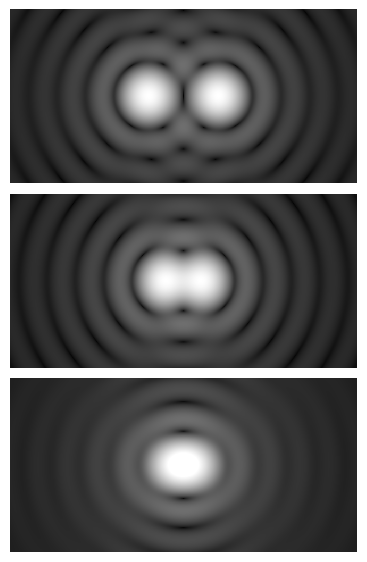
This image uses a nonlinear color scale (specifically, the fourth root) in order to better show the minima and maxima.
Artist: Spencer Bliven
These expressions assume incoherent or partially coherent illumination typical of Köhler brightfield. For different contrast mechanisms (e.g., coherent illumination in certain darkfield geometries), the precise constants differ, but the dominant dependence on λ and NA remains. Shorter wavelengths and higher NA improve resolution.
Three practical implications flow directly from the Airy model:
- Wavelength choice matters: Blue light (shorter
λ) yields finer resolution than red light. Many objectives are corrected across the visible spectrum, but if you have spectral choice, shorter wavelengths reveal finer detail—balanced against specimen absorption and contrast considerations. - Objective NA dominates lateral resolution: For a given wavelength and imaging geometry, raising NA is the most direct way to tighten the Airy disk and separate closely spaced features.
- Optical aberrations broaden the effective PSF: Imperfect correction, misalignment, and refractive index mismatch all enlarge and distort the point spread function (PSF), reducing the realized resolution below the diffraction-limited prediction. We address mitigation in Immersion and Cover Glass Effects.
In everyday use, the theoretical resolution limit is a target. Reaching it requires appropriate illumination, matching condenser NA, stable focus, and low aberration. If your image looks soft, check these factors before concluding you need a higher-NA lens.
Axial Resolution, Depth of Field, and Optical Sectioning Limits
While lateral resolution describes separation in the specimen plane, axial resolution concerns separation along the optical axis (z direction). In widefield imaging with incoherent illumination, the axial point spread function elongates compared to the lateral PSF, so axial resolution is intrinsically poorer than lateral resolution.
A commonly used approximation for axial resolution in widefield brightfield is of the form Δz ∝ λ · n / NA², where n is the refractive index of the immersion medium. Precise constants vary with definition (e.g., full-width at half-maximum vs. Rayleigh-like criteria), but the key dependencies are robust: shorter wavelengths, higher NA, and higher refractive index all improve axial resolution.
Depth of field (DOF) describes the axial range over which the image remains acceptably sharp. In microscopy, DOF arises from both diffraction and imaging geometry. A widely used qualitative expression includes a diffraction term proportional to λ · n / NA² and a term related to the permissible blur projected onto the detector. Importantly, as NA increases, DOF shrinks quickly, which is why high-NA objectives demand careful focusing and vibration control.
These relationships explain familiar observations:
- High-NA oil objectives produce thin optical sections but require precise focus and very flat, well-corrected fields.
- Low-NA objectives offer generous DOF and are easier to use for thick specimens, but their lateral resolution is limited by the larger Airy disk (see Diffraction and Airy Patterns).
- Stopping down the condenser aperture increases DOF and contrast but reduces effective NA and lateral resolution (see Contrast vs Resolution).
Tip: If your sample is thick, consider focusing strategies that respect DOF constraints—e.g., select an NA appropriate to the feature scale you need to see and the axial range you must keep in focus. Excessive NA can make navigation difficult without adding useful information.
Illumination, Condenser NA, and Coherence
Illumination is the other half of resolution. The objective cannot collect spatial frequencies that are not present in the illuminated specimen. The condenser lens forms the illumination cone and, together with the field and aperture diaphragms in Köhler illumination, sets the illumination geometry and coherence.
Matching condenser NA to objective NA
In transmitted brightfield, the condenser aperture diaphragm controls the illumination cone’s NA at the specimen. For optimal transfer of high spatial frequencies while preserving useful contrast, a common practice is to set the condenser aperture to a fraction of the objective’s NA. Many microscopists start near roughly two-thirds to four-fifths of the objective NA and adjust based on the specimen’s contrast and the presence of glare or flare. Opening the condenser aperture increases effective illumination NA, enabling finer details but reducing contrast; closing it increases contrast and DOF at the expense of resolution.
If your condenser has a numerical NA scale, this setting can be read directly. Otherwise, you can estimate the aperture opening by observing the back focal plane (BFP) of the objective: adjust the condenser aperture until the illuminated disk in the BFP fills an appropriate fraction of the pupil. This approach ties adjustments directly to diffraction-limited transfer.
Köhler illumination and partial coherence

Ask your ZEISS account manager for a lab poster! You’ll find more knowledge brochures and materials on our website www.zeiss.com/microscopy
Images donated as part of a GLAM collaboration with Carl Zeiss Microscopy – please contact Andy Mabbett for details.
Artist: ZEISS Microscopy from Germany
Köhler illumination decouples image of the light source from the specimen plane by conjugate imaging of field and aperture planes. Properly set, it produces uniform field brightness, controls glare, and offers a tunable degree of spatial coherence via the aperture diaphragm. Partial coherence typical of Köhler brightfield supports the Rayleigh and Abbe resolution expressions discussed in Diffraction and Airy Patterns.
In practice, well-adjusted Köhler illumination will:
- Deliver even field illumination across the field of view.
- Provide a controllable illumination NA through the condenser aperture that can be matched to the objective’s needs.
- Reduce stray light and flare, improving microcontrast.
Oblique, darkfield, and structured illumination
Alternative illumination geometries can emphasize different spatial frequencies:
- Oblique illumination can enhance edge contrast and make fine features more apparent by shifting illumination angles, though it may introduce directional artifacts.
- Darkfield uses high-angle illumination so that only light scattered by the specimen enters the objective. It favors high spatial frequencies and edges but requires careful condenser–objective NA relationships (the condenser’s illumination NA must exceed the collection NA of the objective). Resolution remains diffraction-limited by the objective NA, though visibility of fine features often improves due to increased contrast.
- Structured or patterned illumination (in widefield contexts) can shift some high spatial frequencies into the passband of the optical system. In basic forms, it’s a contrast aid; in advanced implementations it becomes a separate modality beyond the scope of this fundamentals article.
Whichever illumination you choose, remember that resolution, contrast, and brightness form a triangle: pushing one corner usually pulls on the others. Use the condenser aperture and geometry as deliberate controls, not afterthoughts.
Immersion Media, Refractive Index, and Cover Glass Effects
Objectives reach higher NA by using immersion media with refractive indices above air, which increases n in NA = n · sin(θ) and allows larger acceptance angles without total internal reflection at the front lens. The most common immersion types are air, water, and oil, each with important implications:

Artist: Thebiologyprimer
- Air objectives (n ≈ 1.0): Convenient, no medium required. NA typically up to ~0.95 in high-end designs, though many standard air objectives are lower. Air objectives are more tolerant to minor cover glass deviations but still benefit from correct thickness.
- Water immersion objectives (n ≈ 1.33): Better index match for aqueous specimens, reducing spherical aberration in thick media. Useful for live or hydrated samples; they can offer high NA with improved axial performance compared to air, especially when imaging into water-based media.
- Oil immersion objectives (n ≈ 1.515 for standard immersion oil): Highest NA among common options. They rely on oil to bridge the gap between cover glass and front lens, minimizing refraction and maximizing transmitted high-angle rays.
Cover glass thickness and spherical aberration
Most high-NA objectives designed for coverslipped specimens specify a cover glass thickness—often 0.17 mm (designated “No. 1.5” in many systems). Deviations from the intended thickness introduce spherical aberration: high-angle rays focus at different planes compared to low-angle rays, broadening the PSF and softening detail. This effect grows with NA and with refractive index mismatch between immersion medium, cover glass, and specimen medium.
Correction collars on some objectives allow the user to compensate for small deviations in cover glass thickness or temperature-induced index changes. Proper collar adjustment can significantly improve contrast and sharpness, especially at high NA. When a collar is present, small, deliberate adjustments while observing fine detail can minimize blur and halos.
Refractive index mismatch into thick specimens
Imaging deeper into specimens whose refractive index differs from that of the immersion medium and cover glass leads to progressive spherical aberration and loss of contrast. Although this is more often discussed in fluorescence and confocal contexts, the underlying optics apply broadly. If you need to look significantly into aqueous samples, water immersion can retain better point spread function symmetry than oil immersion.
Takeaway: when maximum resolution matters, match the immersion type to your specimen environment, use the correct cover glass, and—if available—tune the correction collar to minimize aberration. These steps ensure the objective delivers the NA you paid for.
Magnification, Empty Magnification, and Field of View
Magnification determines how large features appear, but not how much detail is present. After the optical system has transferred the finest resolvable features (set primarily by NA), additional magnification cannot create new information. This is the classic concept of empty magnification.
Magnification and resolution are distinct
Consider two objectives: 40×/0.65 and 100×/0.50. The 40× objective has lower magnification but higher NA; it resolves finer detail than the 100×/0.50, despite the latter’s higher power. Choosing by magnification alone can lead to worse images if NA is lower.
To make the most of available resolution, you need enough magnification to visually or digitally sample the Airy-sized features properly. For human viewing, many use a total magnification roughly 500–1000× the NA as a rule of thumb for sufficient visual sampling. For cameras, the appropriate scaling depends on pixel size and Nyquist sampling (see Digital Imaging and Nyquist).
Field of view and field number
The field of view (FOV) through eyepieces is influenced by the eyepiece’s field number (FN), objective magnification, and any intermediate optics. At the specimen plane, the diameter of the observable area is approximately FOV ≈ FN / M_obj for simple arrangements, where M_obj is objective magnification. Increasing magnification shrinks the field of view, making navigation and context more challenging. If you need to survey large areas, a lower-power objective is often more efficient, even if ultimate resolution is reduced.
Practical note: For documentation or quantitative work, ensure the camera’s field of view and sampling are matched to your specimen size and the spatial frequencies you care about. If your pixels are too large at the specimen, you will undersample; if too small, you lose sensitivity without gaining new information.
Contrast vs Resolution: Apertures, Phase Contrast, and DIC
Resolution isn’t everything. Without adequate contrast, fine details can remain invisible even if the optics could, in principle, resolve them. Illumination apertures, phase contrast, and differential interference contrast (DIC) are powerful tools for balancing contrast and resolution.
Condenser aperture diaphragm
As discussed in Illumination and Condenser NA, closing the condenser aperture diaphragm reduces the illumination NA. This increases image contrast and DOF but reduces the highest spatial frequencies transferred. Opening the aperture does the opposite. Many practitioners adjust the aperture to the minimum opening that reveals the needed detail without excessive glare, then fine-tune for the specimen.
Phase contrast
Phase contrast converts phase shifts (caused by variations in optical path length) into intensity differences. It requires a matched objective with a phase ring and a condenser annulus. Resolution remains fundamentally limited by the objective NA and wavelength, but because phase contrast emphasizes edges and low-amplitude features, it can make small structures clearly visible that are nearly invisible in brightfield at the same NA. Improper ring alignment or mismatched components will reduce contrast and can introduce halos around features.
Differential interference contrast (DIC)
DIC uses sheared, polarized beams to convert gradients in optical path length into intensity variations, producing a pseudo-relief effect with excellent microcontrast and optical sectioning-like behavior. Like phase contrast, DIC does not change the diffraction-limited resolution set by NA and wavelength. Instead, it increases visibility of subtle gradients and reduces out-of-focus background. DIC performance depends on correct prism settings, polarizer/analyzer alignment, and specimen properties.
Darkfield
In darkfield, only light scattered by the specimen is collected, producing bright features on a dark background. High-angle illumination delivers strong edge contrast and can reveal small particles. The condenser’s effective illumination NA must exceed the objective’s collection NA to block direct rays. Resolution is still governed by the objective NA, but contrast improvements often help reveal high-frequency detail that was masked in brightfield.
Bottom line: use contrast methods to improve visibility of features within the limits set by NA. If you need intrinsically finer detail than the NA allows, you must change the optics (e.g., higher-NA objective, shorter wavelength, better immersion match) rather than only altering contrast.
Digital Imaging, Pixel Sampling, and the Nyquist Criterion
When capturing images with a camera, the detector’s pixel size and the system magnification together determine the sampling interval at the specimen. To faithfully represent the finest resolvable detail, the sampling must meet the Nyquist criterion: the sampling frequency should be at least twice the highest spatial frequency present in the image. Translated to spatial sampling, the pixel spacing at the specimen should be no larger than half the smallest resolvable period.
Specimen-plane pixel size
The specimen-plane pixel size is approximately p_specimen = p_camera / M_total, where p_camera is the camera’s physical pixel size and M_total is the system magnification from specimen to camera (including the objective and any intermediate optics such as tube lenses or projection adapters). To satisfy Nyquist for lateral resolution limited by Rayleigh’s criterion r ≈ 0.61 · λ / NA, a simple guideline is:
p_specimen ≤ r / 2 ≈ 0.305 · λ / NA
Rearranging to find the required magnification for a given camera pixel size and optical resolution:
M_total ≥ p_camera / (r / 2)
Because r depends on wavelength and NA, there is no single ideal magnification for all situations. Instead, determine your optical resolution for the wavelength of interest and adjust magnification or choose a camera voxel size accordingly.
Consequences of under- and oversampling
- Undersampling (pixels too large at the specimen): high spatial frequencies alias into lower frequencies, creating Moiré patterns or apparent false textures. Fine details may disappear or be misrepresented.
- Oversampling (pixels much smaller than necessary): preserves all available detail but spreads the signal over more pixels, reducing per-pixel signal-to-noise ratio for a given exposure. File sizes increase without additional information content.
In practice, modest oversampling is often acceptable or even helpful for post-processing and precise localization, but large oversampling brings diminishing returns. Align sampling choices with your signal levels, exposure constraints, and the optical resolution you expect from your objective and illumination. If you change NA or wavelength, revisit your sampling plan.
Practical Scenarios: Selecting Objectives and Condensers
Bringing these fundamentals into everyday decisions helps avoid common pitfalls. The following scenarios illustrate how to balance NA, resolution, contrast, DOF, and sampling without relying on brand- or model-specific details.
Surveying large specimens with moderate detail needs
If your goal is to scan wide areas and identify regions of interest—say, locating structures tens of micrometers across—a low-magnification, moderate-NA objective is efficient. For example, a 10× objective with NA around 0.25 offers a wide field and generous DOF. Set the condenser aperture so that the illumination NA is somewhat below the objective NA to maintain contrast and navigability. You can then move to a higher-NA objective for close inspection when needed (see Magnification and Field of View).
Resolving fine subcellular-like detail in transmitted light

Artist: Ed Uthman from Houston, TX, USA
When features approach the diffraction limit for visible light, NA is paramount. An objective in the 40×–60× range with NA around 0.65–0.95 (air) or higher (water/oil) can deliver the lateral resolution necessary to separate structures near a half-micrometer scale at green wavelengths, subject to specimen contrast. Use high-quality Köhler illumination and match the condenser aperture closely to the objective NA to transfer the highest spatial frequencies (see Illumination and Condenser NA). If the specimen is in aqueous medium and you must image somewhat into the volume, a water immersion objective may reduce spherical aberration compared to oil immersion (see Immersion Media).
Balancing DOF and detail on thick specimens
For thick specimens where axial stacking is not practical, consider stepping down NA slightly to gain DOF. Closing the condenser aperture will also increase DOF and contrast but reduces resolution. Aim for the lowest NA that still resolves the features of interest, and use contrast techniques like oblique illumination or phase contrast to enhance visibility without excessively sacrificing resolution (see Contrast vs Resolution).
Darkfield for small particles and edges
To highlight small, scattering features against a dark background, darkfield can be effective. Ensure the condenser provides an illumination cone that exceeds the objective’s NA so that direct light is excluded. Remember that the finest resolvable detail is still constrained by the objective NA and wavelength; darkfield primarily boosts contrast for features that scatter light strongly (see Illumination Geometry).
Digital documentation with a fixed-pixel camera
Suppose your camera has a known pixel size. Determine the expected optical resolution based on your objective NA and wavelength of interest (e.g., green light for general brightfield). Compute the specimen-plane pixel size (p_specimen = p_camera / M_total) for your current magnification. If p_specimen is larger than roughly half the optical resolution estimate, increase the magnification (with an appropriate objective or intermediate optics) until Nyquist is satisfied. If p_specimen is much smaller than necessary, consider whether the reduced per-pixel signal-to-noise ratio hampers your documentation or whether the added headroom is beneficial for your workflow (see Nyquist Criterion).
Fine-tuning with a correction collar
When using a collar-corrected objective on coverslipped specimens, adjust the collar while observing a high-contrast, fine-detail region. Seek the setting that maximizes sharpness and minimizes halos. Small misadjustments can disproportionately reduce high-frequency transfer, especially at higher NA (see Cover Glass Effects).
Frequently Asked Questions
Does using oil immersion always improve resolution?
Oil immersion can improve resolution by enabling higher NA, which tightens the Airy disk as described by diffraction theory. However, improvement is not automatic. To benefit, you need an oil-immersion objective designed for your cover glass and imaging geometry, correct application of the oil (without bubbles), and good alignment. For aqueous specimens or imaging into water-rich media, water immersion can sometimes deliver better effective resolution at depth by reducing spherical aberration, even if its nominal NA is lower (see Immersion Media).
Why does stopping down the condenser make my images look sharper?
Closing the condenser aperture increases contrast and depth of field, which often creates a subjective impression of sharpness. It also reduces glare and suppresses high-angle stray light. But this comes with a trade-off: the system’s effective illumination NA decreases, and high spatial frequencies are attenuated. Very fine details that were previously resolved may become less distinct. For best results, adjust the aperture to the smallest opening that preserves the detail you need (see Aperture and Contrast).
Final Thoughts on Choosing the Right NA–Resolution Trade-offs
Numerical aperture sets the ceiling on the spatial detail an objective and condenser can transfer. Diffraction determines the smallest distinguishable structures at a given wavelength. Illumination geometry, condenser settings, and contrast modalities shape how much of that theoretical capacity you realize in practice. Magnification then scales that information for your eyes or camera—but it cannot create what optics have not delivered.
When choosing settings or equipment, think in layers:
- Start with NA: Pick an objective whose NA matches the finest features you need to resolve and the specimen medium you’re imaging in.
- Match illumination: Use Köhler illumination and adjust the condenser aperture to balance contrast and resolution for your specimen.
- Control aberrations: Use the correct cover glass, appropriate immersion medium, and—if present—tune the correction collar.
- Sample correctly: For cameras, ensure pixel sampling meets Nyquist for your optical resolution; avoid both aliasing and excessive oversampling.
- Refine contrast: Select phase contrast, DIC, oblique, or darkfield to make essential features stand out without exceeding the resolution limits set by NA and wavelength.
By treating numerical aperture as the core specification and everything else as a means of honoring it, you will make more confident choices, avoid empty magnification, and produce images that are both informative and aesthetically clean.

Artist: Anaqreon
If you found this deep dive useful, explore related fundamentals on illumination geometry, condenser alignment, and sampling theory in microscopy. For ongoing insights and practical tips, consider subscribing to our newsletter so you never miss future articles in this series.