Table of Contents
- What Is Numerical Aperture in Optical Microscopy?
- How NA Governs Resolution: Abbe, Rayleigh, and Optical Transfer
- NA, Brightness, and Signal-to-Noise: Light Budget Basics
- Depth of Field and Depth of Focus: The NA Trade-off
- Objective NA vs Condenser NA: Matching Illumination and Collection
- Immersion Media and Refractive Index: How NA Exceeds 1.0
- Digital Sampling, Pixel Size, and Magnification with NA
- Choosing Numerical Aperture for Different Specimens and Techniques
- Common Misconceptions About Numerical Aperture
- Frequently Asked Questions
- Final Thoughts on Choosing the Right Numerical Aperture
What Is Numerical Aperture in Optical Microscopy?
Numerical aperture (NA) is one of the most important specifications on any microscope objective or condenser. It encodes how much angular range of light the optical system can accept or deliver, and it directly controls resolution, brightness, and depth of field. In simple terms, higher NA means the system can capture or illuminate with wider cones of light, enabling finer detail at the expense of shallower focus and generally tighter alignment tolerances.
Formally, numerical aperture is defined as:
NA = n \\times \\sin(\\theta)

Artist: PaulT (Gunther Tschuch)
where n is the refractive index of the medium between the specimen and the lens (commonly air, water, or immersion oil), and θ is the half-angle of the maximum cone of light that can enter (for objectives) or be delivered (for condensers). The NA printed on an objective refers to its collection acceptance; the NA printed on a condenser refers to its illumination delivery.
Why NA matters:
- Resolution: The smallest resolvable feature size shrinks as NA increases. See How NA Governs Resolution.
- Brightness and signal: For fluorescence and other emission-limited imaging, collected photons scale approximately with NA squared. See NA, Brightness, and Signal-to-Noise.
- Depth of field (DOF): Higher NA yields shallower DOF and tighter focus tolerance. See Depth of Field and Depth of Focus.
- Illumination: In transmitted light, condenser NA shapes contrast and resolution by controlling the illumination cone. See Objective NA vs Condenser NA.
Although magnification is the first number many users notice, NA is the property that determines the optical performance of a microscope. Two objectives at the same magnification can deliver vastly different resolving power and brightness if their NAs differ.
How NA Governs Resolution: Abbe, Rayleigh, and Optical Transfer
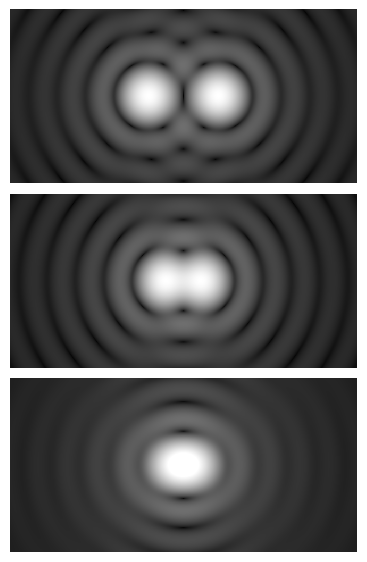
Optical resolution describes the ability of a microscope to separate fine details in the specimen into distinct image features. Resolution is diffraction-limited by the wave nature of light and strongly controlled by NA and wavelength.
Key formulas and their contexts
Two widely used criteria quantify lateral resolution under different assumptions:
- Rayleigh criterion (incoherent imaging): A useful estimate for the minimum resolvable center-to-center distance of two point-like features is
d \\approx 0.61 \\times \\frac{\\lambda}{NA_{obj}}, where λ is the relevant imaging wavelength and NAobj is the objective NA. This is commonly used for brightfield and widefield fluorescence. - Abbe criterion (periodic structures): For resolving line spacings in gratings, a frequently cited estimate is
d \\approx \\frac{\\lambda}{2\\,NA}. In transmitted light with coherent illumination, resolution requires that diffracted orders enter the objective pupil. Practically, matching the condenser NA to the objective NA supports this condition. For incoherent illumination, objective NA dominates the image resolution when the condenser NA is not limiting.
Artist: Spencer Bliven
These simple formulas capture widely observed limits but do not replace the full Fourier optics description. They are, however, excellent guides for planning, selecting objectives, and verifying that expectations are physically reasonable.
Optical transfer and cutoff frequency
The optical transfer function (OTF) describes how spatial frequencies of the specimen are transmitted to the image. For incoherent imaging, the cutoff spatial frequency in object space is approximately:
f_c \\approx \\frac{2\\,NA_{obj}}{\\lambda} (cycles per unit length)

Artist: GONDRAN Alexandre
Frequencies beyond this limit are not passed by the optical system. This relationship also guides sampling requirements for digital imaging, discussed in Digital Sampling, Pixel Size, and Magnification.
Axial resolution and sectioning
While lateral resolution is often emphasized, the axial (z) resolution is also NA-dependent. In widefield imaging, the axial extent of the point spread function (PSF) is significantly larger than its lateral extent, but it narrows as NA increases. Confocal and other optical sectioning techniques further improve axial discrimination by rejecting out-of-focus light, but the fundamental dependence on NA remains.
Wavelength matters
Resolution improves as the wavelength decreases. For example, imaging the same specimen with shorter-wavelength light yields smaller d in d \\propto \\lambda / NA. For fluorescence, the relevant wavelength is usually the emission peak of the fluorophore; for transmitted brightfield, it is the passband of the illumination (often green light for best balance of sensitivity and resolution).
Practical implication
When choosing between objectives at the same magnification, the one with the higher NA will generally provide finer lateral detail, as expressed by the Rayleigh or Abbe estimates. However, as explained in Depth of Field and Depth of Focus, higher NA tends to reduce the depth of field, which may not be desirable for thick specimens.
NA, Brightness, and Signal-to-Noise: Light Budget Basics
Brightness and signal-to-noise ratio (SNR) are central performance metrics in microscopy, especially for low-light modalities such as fluorescence. NA influences light collection and illumination efficiency in predictable ways.
Collection efficiency scales with NA squared
For isotropic emitters (e.g., fluorescence in a homogeneous medium), the fraction of emitted photons captured by an objective increases roughly with NA^2. Intuitively, higher NA subtends a larger solid angle at the sample, intercepting more emitted light. This effect is a major reason high-NA objectives are preferred for dim samples.
Two caveats improve accuracy in real systems:
- Refractive index: Light is emitted into a medium of refractive index n. The objective’s effective collection depends on NA relative to that medium. See Immersion Media and Refractive Index.
- Losses and aberrations: Transmission losses, coatings, and aberration corrections affect the actual throughput. The NA-based scaling remains a good first-order guide to trends.
Illumination irradiance and condenser NA
In transmitted-light configurations with Köhler illumination, the irradiance at the specimen generally increases as the condenser NA increases. A larger illumination NA delivers a wider cone of rays, raising irradiance while also altering image contrast and resolution behavior. Balancing condenser NA is part of optimizing image quality, as explained in Objective NA vs Condenser NA.
Signal-to-noise considerations
Higher photon rates improve SNR in the shot-noise-limited regime, where noise increases with the square root of detected photons. By capturing more photons with higher NA, you can achieve the same SNR at shorter exposure times, reducing motion blur or photobleaching risk in fluorescence. However, the increased cone angle also makes the system more sensitive to alignment and aberration sources, a practical factor to weigh in Choosing Numerical Aperture.
Brightness vs. field uniformity
At higher NA, the optical system’s acceptance and delivery angles grow, which can expose field nonuniformities in illumination or collection. Maintaining uniform Köhler illumination and using well-corrected objectives and tube lenses helps preserve even brightness across the field of view.
Depth of Field and Depth of Focus: The NA Trade-off
Higher NA improves resolution and brightness but narrows the depth of field. Understanding the difference between depth of field (object space) and depth of focus (image space) helps clarify why focus becomes more demanding at high NA.
Definitions
- Depth of field (DOF): The axial range in object space over which features appear acceptably sharp in the image.
- Depth of focus: The axial tolerance in image space over which the image remains acceptably sharp; this matters for camera placement and focusing mechanisms.
Approximate scaling with NA
Ignoring camera sampling constraints, the diffraction-limited DOF in object space scales approximately as \\propto \\frac{\\lambda}{NA^2}. This means that doubling NA reduces the DOF by roughly a factor of four, all else equal. The image-space depth of focus also scales as \\propto \\frac{\\lambda}{NA^2}.
In practical digital imaging, a commonly used approximation for DOF includes a term for the permissible blur at the detector:
DOF \\approx k_1 \\frac{\\lambda\\,n}{NA^2} + k_2 \\frac{n\\,e}{M\\,NA}

Artist: Guiding light at English Wikipedia
Here, n is refractive index, e is the pixel size, M is the objective magnification (total lateral magnification to the detector may be used depending on the optical path), and k1, k2 are constants on the order of unity that depend on the precise criterion for acceptable blur. While the constants vary with definition, the key scaling is robust: DOF shrinks with increasing NA and grows with wavelength.
Practical compromise
For thin, high-contrast specimens, maximizing NA is usually advantageous for resolution. For thicker or more three-dimensional samples, a slightly lower NA often yields images that are easier to interpret because more of the specimen remains in focus. This trade-off, along with specimen refractive index and cover glass considerations detailed in Immersion Media and Refractive Index, informs the objective choice in Choosing Numerical Aperture.
Objective NA vs Condenser NA: Matching Illumination and Collection
In transmitted light microscopy, the objective and condenser form a pair. The objective collects light; the condenser delivers it. Their NAs need to be thoughtfully managed for optimal resolution and contrast.
Matching principles
- Non-limiting condenser NA: If the condenser NA is equal to or larger than the objective NA, the illumination cone can support the objective’s resolution potential in incoherent brightfield. In coherent conditions, access to diffracted orders relies on sufficient illumination angle, so a well-matched or slightly higher condenser NA helps resolve fine periodic detail.
- Contrast control: Reducing condenser NA narrows the illumination cone, often increasing contrast at the expense of the highest spatial frequencies. This is useful for low-contrast transparent samples where visibility of larger-scale features matters more than ultimate resolution.
- Aperture diaphragms: Both the objective and condenser typically have associated aperture stops. Adjusting the condenser aperture (often via the condenser iris) is a primary control for balancing resolution and contrast under Köhler illumination.
When the condenser NA is the bottleneck
If the condenser NA is significantly smaller than the objective NA, the effective system resolution in transmitted brightfield can be limited by the condenser. In that case, even a high-NA objective may not perform to its theoretical potential because the illumination does not provide the necessary angular range. Ensuring proper alignment and matching is therefore part of realizing the performance promised in How NA Governs Resolution.
Epi-illumination exception
In epi-illumination (reflected light or fluorescence excitation through the objective), there is no separate condenser; the objective serves both to deliver and collect light. Here, the objective NA alone governs both the excitation cone (subject to source and beam conditioning) and the collection cone. The NA-brightness relationship described in NA, Brightness, and Signal-to-Noise is especially direct in these modalities.
Immersion Media and Refractive Index: How NA Exceeds 1.0
Because NA equals n \\sin(\\theta), using a medium with refractive index greater than 1.0 between the specimen and the objective enables NA values above 1.0. Common immersion media include air (n ≈ 1.0, no immersion), water (n ≈ 1.33), and standard immersion oil (n ≈ 1.515 near visible wavelengths). By increasing n, the objective can accept larger ray angles for the same mechanical cone, boosting both resolution and photon collection.

Artist: Thebiologyprimer
Air, water, and oil objectives
- Air (dry) objectives: NA typically up to about 0.95. They are convenient, require no immersion medium, and offer longer working distances. They are more susceptible to refractive index mismatches for aqueous specimens because the sample is not index-matched to air.
- Water-immersion objectives: NA commonly near 1.0–>1.0. They reduce spherical aberration when imaging into aqueous samples or through water columns, making them valuable for live or thick biological preparations in water-based media. Working distances are often longer than oil-immersion counterparts of similar NA.
- Oil-immersion objectives: NA commonly in the 1.3–1.4 range. They achieve very high lateral resolution and light collection when imaging through a standard cover glass with immersion oil that matches the glass refractive index. Proper use requires a well-matched cover glass thickness and the correct oil.
Effective NA and refractive index mismatch
Even with a high-NA oil objective, imaging into a medium very different from the immersion index (for example, deep into water with an oil objective) can introduce spherical aberration and reduce effective resolution and contrast. The printed NA is a design property; the realized performance depends on matching refractive indices and managing cover glass thickness. Objectives labeled with a specific cover glass thickness (e.g., 0.17 mm) are corrected for that value; deviations can degrade performance at high NA.
Working distance and NA
Higher NA objectives often have shorter working distances because achieving a large cone angle in object space requires the front lens to be physically close to the specimen. Long-working-distance designs exist, but at very high NA, physical constraints limit how much working distance can be preserved. This trade-off is part of the selection considerations in Choosing Numerical Aperture.
Digital Sampling, Pixel Size, and Magnification with NA
Digital cameras and displays add a second layer to the resolution story: sampling. To faithfully capture the optical detail that a high-NA objective can deliver, the camera must sample the image at a sufficient rate, and the optical system must provide appropriate magnification onto the sensor.
Nyquist sampling for incoherent imaging
For widefield incoherent imaging, the optical cutoff spatial frequency is approximately f_c \\approx 2\\,NA/\\lambda. The Nyquist criterion requires sampling at least twice this frequency. Translating into a pixel size in object space, a widely used guideline is:
p_{object} \\le \\frac{\\lambda}{4\\,NA}
Linking camera pixels to specimen scale
If the camera pixel size is psensor and the total magnification from object to sensor is M, then the sampling at the specimen plane is:
p_{object} = \\frac{p_{sensor}}{M}
Thus, to meet the Nyquist guideline, you can either increase magnification or use a camera with smaller pixels. Oversampling (smaller p_{object} than required) is not harmful to resolution but can increase read noise relative to signal per pixel. Undersampling wastes the resolving potential set by NA and causes aliasing artifacts.
Contrast transfer and practical bandwidth
While Nyquist is the sampling threshold, contrast at the highest spatial frequencies is typically low even in well-corrected systems. Many practitioners target a slightly finer sampling to robustly capture detail near the diffraction limit, while balancing SNR and file size. The specific choice depends on the imaging modality and the expected spatial frequencies of interest in the specimen.
Magnification myths
Increasing magnification without increasing NA does not improve optical resolution. It only spreads the same detail over more pixels or a larger field in the eyepiece. The term empty magnification refers to this regime. To genuinely gain detail, you must increase NA or decrease wavelength, as discussed in How NA Governs Resolution.
Choosing Numerical Aperture for Different Specimens and Techniques

Artist: QuodScripsiScripsi
Selecting NA is a balancing act across resolution, brightness, depth of field, working distance, and compatibility with specimen media. The best choice depends on your imaging goals and constraints.
Thin, high-contrast specimens (e.g., prepared sections)
- Goal: Maximize lateral resolution.
- NA guidance: Favor higher NA objectives, matched with appropriate condenser NA in transmitted light. Shorter wavelengths (within the specimen’s tolerance and your filter set) can further improve resolution.
- Notes: Ensure cover glass thickness and immersion medium match the objective specification to realize the NA’s potential.
Thick or three-dimensional specimens
- Goal: Balance resolution with sufficient depth of field or optical sectioning.
- NA guidance: Moderately high NA can be advantageous, especially if combined with sectioning techniques. For purely widefield images of volumetric samples, a slightly lower NA may yield more interpretable images by increasing DOF, as covered in Depth of Field and Depth of Focus.
- Notes: Consider water-immersion objectives if imaging into aqueous media to reduce spherical aberration; see Immersion Media and Refractive Index.
Low-light fluorescence
- Goal: Maximize photon collection and SNR at reasonable exposure times.
- NA guidance: Favor the highest NA practical for the sample and setup. Collection efficiency benefits roughly as
\\propto NA^2, improving SNR in shot-noise-limited conditions, as described in NA, Brightness, and Signal-to-Noise. - Notes: Confirm sampling at the camera meets Nyquist for the chosen NA; see Digital Sampling, Pixel Size, and Magnification.
Live aqueous specimens and index mismatches
- Goal: Preserve resolution and contrast while minimizing aberrations due to index mismatch.
- NA guidance: Water-immersion objectives are often beneficial when imaging into water-based environments. They balance relatively high NA with reduced spherical aberration compared to mismatched oil systems, as discussed in Immersion Media and Refractive Index.
- Notes: If using cover glasses, verify thickness compatibility for high NA.
General brightfield education and routine observation
- Goal: Reliable contrast and ease of use across varied samples.
- NA guidance: Mid-range NA dry objectives (e.g., around 0.40–0.75) offer a practical trade-off between resolution, DOF, and working distance. Adjust condenser NA to tune contrast; see Objective NA vs Condenser NA.
- Notes: High NA demands more careful alignment. For general teaching microscopes, a stepwise progression of NA across objectives helps illustrate the trade-offs live at the bench.
Macro- to micro- transitions
At low magnifications, objectives often have lower NA and longer working distance. As magnification rises, NA typically increases, but the exact pairing varies by objective family. When planning a multi-scale study, confirm that your sampling and NA choices at each magnification yield compatible resolution and contrast, revisiting the guidance in Digital Sampling and Resolution.
Common Misconceptions About Numerical Aperture
Because NA connects several important imaging properties, misunderstandings are common. Clarifying these points helps avoid wasted effort and ensures expectations match physical reality.
“Higher magnification always resolves more”
Reality: Without sufficient NA, increasing magnification simply enlarges the same diffraction-limited detail. True gains in resolved information require higher NA or shorter wavelength, as established in How NA Governs Resolution.
“Condenser NA doesn’t matter in brightfield”
Reality: Condenser NA significantly affects contrast and can limit resolution in transmitted light if it is much smaller than the objective NA. Proper matching, discussed in Objective NA vs Condenser NA, is integral to performance.
“NA is the same as f-number”
Reality: In photography, the f-number relates focal length to pupil diameter and governs exposure. In microscopy, NA is the sine of the collection angle times refractive index. While both affect light throughput, they are not interchangeable, especially because NA explicitly includes refractive index and angular acceptance in object space.
“An oil objective always outperforms a water objective”
Reality: Oil-immersion objectives commonly have higher NA, but if you are imaging into water or deep into tissue-like media, index mismatch with oil can introduce aberrations that negate some advantages. A water-immersion objective may deliver better realized resolution and contrast for those conditions, as explained in Immersion Media and Refractive Index.
“Depth of field is independent of wavelength”
Reality: DOF depends on wavelength and NA. Longer wavelengths and smaller NA increase DOF; shorter wavelengths and larger NA decrease it. This mirrors the resolution relationship summarized in Depth of Field and Depth of Focus.
Frequently Asked Questions
How close can two points be and still be resolved with high NA?
Using the Rayleigh criterion for incoherent imaging, an estimate for the center-to-center separation is d \\approx 0.61 \\times \\lambda / NA_{obj}. For example, at a representative visible wavelength, increasing NA reduces d proportionally. Keep in mind that realized resolution also depends on aberration control, alignment, sampling at the camera (see Digital Sampling), and specimen contrast.
Is a high-NA dry objective as bright as a high-NA oil objective for fluorescence?
Collection efficiency scales roughly with NA^2 for isotropic emission in a given medium, but the refractive index and interface conditions matter. Oil-immersion objectives can achieve higher NA because they operate in a higher-index immersion medium, which widens the acceptable cone angle. If the specimen is separated from the immersion medium by a cover glass designed for oil objectives, the oil objective typically collects more fluorescence photons than a lower-NA dry objective. However, if imaging directly into a water-based environment with an oil objective, index mismatch can introduce aberrations that reduce effective collection and contrast. Matching the immersion medium to the sample environment often yields the best realized performance, as discussed in Immersion Media and Refractive Index.
Final Thoughts on Choosing the Right Numerical Aperture
Numerical aperture is the central lever that sets the balance between resolution, brightness, and depth of field in optical microscopy. The core relationships are straightforward: higher NA improves lateral resolution and photon collection but reduces depth of field and often working distance. These trade-offs are navigated by aligning objective NA with your specimen’s optical environment, choosing appropriate immersion media, matching condenser NA in transmitted light, and ensuring camera sampling meets the Nyquist criterion for your chosen wavelength and NA.
If you remember only a few takeaways, let them be these:
- Resolution improves as
d \\propto \\lambda / NA; higher NA and shorter wavelengths resolve finer detail. - Fluorescence photon collection grows roughly with
NA^2, boosting SNR for dim samples. - Depth of field shrinks approximately as
\\propto \\lambda / NA^2, so plan NA according to specimen thickness. - Condenser NA matters in transmitted light; match it thoughtfully to the objective NA.
- Verify that digital sampling (
p_{object} \\le \\lambda / (4\\,NA)for incoherent imaging) captures the optical detail you’ve paid for.
Equipped with these principles, you can make confident, physics-grounded decisions about objectives, illumination, and camera settings—decisions that directly translate into clearer, more informative images. If you found this deep dive into numerical aperture useful, explore related topics on illumination strategies and objective corrections, and subscribe to our newsletter to get future installments on microscope fundamentals delivered to your inbox.